CHAPTER II
TYPES OF RESEARCH
TYPES OF RESEARCH
A. ACCORDING TO OBJECTIVES:
1. PURE VS. APPLIED RESEARCH
2. EXPLORATORY VS. EXPLANATORY
3. QUANTITATIVE VS. QUALITATIVE
B. ACCORDING TO METHODS:
1. HISTORICAL METHOD
2. DESCRIPTIVE METHOD
3. EXPERIMENTAL RESEARCH
A. HISTORICAL METHOD
- Critical investigation of events, development and experiences of the past,
the careful weighing of evidence of the validity of sources of information of
the past and the interpretation of the weighted evidence.
- It describes and interprets “What Was?”
MOTIVATIONS:
1. Doubts of some reported events
2. Unanswered questions
3. Existing data may not be satisfactory.
4. Gaps of historical account.
BASIC RULES IN HISTORICAL RESEARCH:
1. Always use the primary source and secondary source as supplement.
2. Subject the source of Historical
PROBLEMS IN HISTORICAL RESEARCH:
1. Historical research does not provide a holistic view
of the past.
2. Difficulty in ascertaining the veracity of materials
and the data they contain.
3. Absence of technical terminology which either
blocks or causes confusion in the communication or
information. Words may mean differently to different
people, culture, situation, institution, organization or
time.
B. DESCRIPTIVE METHOD
- “FACT-FINDING RESEARCH” which describes and interprets
“WHAT IS?”
- It reveals condition on relationship and can be presented
either quantitative or qualitative way depending on the nature
of materials.
Purpose: To describe systematically the facts and characteristics
of a given population or area of interest, factually and accurately
Characteristics:
A. Used in the literal sense of describing situations or events, it is
the accumulation of a database that is solely descriptive but may
also aim for more powerful purposes like:
-seek or explain relationship
-test hypothesis
-make predictions
-get at meanings and implications
B. Many researchers often broaden the term descriptive
research to include all form of research except historical and
experimental; in this broader context, the term “survey
studies” is often used. Specifically, survey studies have the
following purposes:
- to collect detailed factual information that describes
existing phenomena
- to identify problems or justify current conditions and
practices
- to make comparisons and evaluations
- to determine what others are doing with similar problems
or situations and benefit from their experience in making
future and decisions.
Types:
1. Developmental Research – purpose: is to investigate
patterns and sequences of growth and or changes as a
function of time.
Examples:
-Longitudinal growth studies directly measure the nature
and rate of changes in a sample of the same children or
individuals at different stages of development.
-Cross sectional growth studies indirectly measure the
nature and rate of the same changes by drawing samples
of different children from representative age levels.
-Trend studies are designed to establish patterns of
change in the past in order to predict future patterns or
condition.
2. Correlational Research – purpose: is to investigate the
extent to which variations in one or more factors based on
correlation coefficient.
- Attempts to determine whether what degree a
relationship exist between two or more quantifiable
variable.
- Degree of association between the independent and
dependent variables.
- To make predictions.
Examples:
- A study investigating the relationship between grade point
average as the criterion variable and predictor variables such as
intelligences, interest, parenting style, maternal presence, father
absence, etc.
- A factor analytic study of several personality tests
- A study to predict success in graduate school based on
undergraduate variables such as academic performance,
personality, motivation, etc.
3. Case Study - complete analysis and report of status of
individual or institution.
- purpose: to study intensively the background,
current status and environmental interactions of a given
social unit: an individual, group, institution or
community.
Examples:
- Piaget’s studies of cognitive growth in children
- A study of recovering alcoholics in a rehabilitation center.
- An in depth study of adjustment patterns of students with learning
disabilities who are enrolled in an inclusion program of a university.
- A study of managerial style of the administrators and managers of an
educational institution.
4. Action Research – purpose: to develop new skills or
approaches and to solve problems with direct
application to the class room or workplace.
Examples:
- To develop an in service training program to help
train peer counselors to work more effectively with
children with family problems.
- To develop an enrichment program for scholars
honor students
- To test a fresh approach in the teaching of a
particular discipline like the constructive approach
of collaborative learning and use of personal
reflections.
5. Ethnographic Techniques
- Observation
- Participant Observation – act of taking part in the
events one is observing, describing and analyzing
- Conversation, interviewing and interview schedules
- The genealogical technique – discovering and
recording connections of kinship, descent and
marriage using diagrams and symbols.
- Life Histories Technique – birth to death portrait of
existence in a culture.
Other recognized descriptive research types:
1. Research Survey - Organized in attempt to analyze. Interpret
and report the present status of the institution, group or area. It
deals with cross-section of the present.
2. Normative Research Survey – use of standardized instruments
to describe typical condition or set of behavior.
3. Documentary Research – “Arm-Chair Research”
4. Participatory Research – applied in the field of sociology.
Characterize by everyone participating in the process.
5. Ex Post Facto Research - “From after the fact” Studying the
variable in retrospect.
- It measures the systematic,
experimental inquiry in which the scientist does not have the
direct control of independent variable, because their manifestation
has already occurred or because they are inherently non-
manipulable.
-“Cause and Effect Research”
WEAKNESS OF EX POST FACTO RESEARCH
1. Inability to manipulate the independent variable purposely.
2. Researcher’s lack of power to assign subjects randomly to group level
variable under study.
STEPS IN CONDUCTING SURVEY STUDIES (Descriptive research)
1. Define the objectives in clear specific terms. What facts and characteristics
are to be uncovered?
2. Design the approach:
- How will the data be collected
- How will the subjects be selected to insure they represent the
population to be described?
- What instruments or observation techniques are available or will
need to be developed
- Will the data collection methods need to be field tested and will
data gatherers need to be trained?
3. Collect the data
4. Report the results
C. EXPERIMENTAL RESEARCH
-Most accurate research.
-The description of “What Will Be?” or what will
occur, under carefully controlled conditions.
-Termed as method of difference – in process of
condition, one is manipulated and one is controlled.
-Leads itself to easier manipulation because of
quantitative entities.
-Observations are done under controlled conditions.
-Gathering the valid facts is rigorous
-Can be conducted in the laboratory, in class room
or field.
-Laboratory experiments are intensive and exciting
-Most often experiments are limited to a small
number of cases or subjects.
-There is more through analysis of variable factors.
TYPES OF EXPERIMENTAL RESEARCH
A. TRUE EXPERIMENT
-experiment that leads to an unambiguous outcome
regarding what caused an event.
-Three Characteristics:
1. Some type of intervention or treatment is
implemented.
2. The experimenter has a high degree of control
over the arrangement of experimental conditions,
assignment of participants, systematic
manipulation of independent variables and choice of
dependent variables.
3. There is an appropriate comparison in order to
evaluate the effectiveness of a treatment.
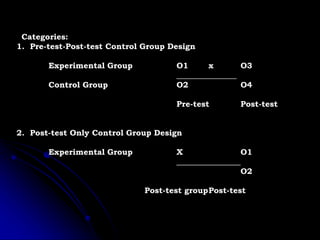
Categories:
1. Pre-test-Post-test Control Group Design
Experimental Group O1 x O3
_______________
Control Group O2 O4
Pre-test Post-test
2. Post-test Only Control Group Design
Experimental Group X O1
________________
O2
Post-test groupPost-test
B. QUASI-EXPERIMENTAL GROUP
- semi or partial experiment because it lacks one or more of the
properties of a true, pure or full experiment. The missing
property is either randomization, control group or validity of
component.
- Randomization is the process of getting a sample such that
every individual that comprises the population will be given an
equal chance to be included as sample.
- No control group is used as basis for comparison.
- Validity of the cause and effect inferences may be challenged
since only human judgment rather than objective criteria is
utilized in reaching a decision.
- Weakened if there are extraneous variables that may influence
or affect the dependent variable due to the absence of a control
group.
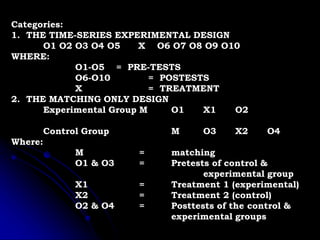
Categories:
1. THE TIME-SERIES EXPERIMENTAL DESIGN
O1 O2 O3 O4 O5 X O6 O7 O8 O9 O10
WHERE:
O1-O5 = PRE-TESTS
O6-O10 = POSTESTS
X = TREATMENT
2. THE MATCHING ONLY DESIGN
Experimental Group M O1 X1 O2
Control Group M O3 X2 O4
Where:
M = matching
O1 & O3 = Pretests of control &
experimental group
X1 = Treatment 1 (experimental)
X2 = Treatment 2 (control)
O2 & O4 = Posttests of the control &
experimental groups
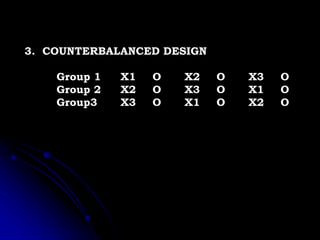
3. COUNTERBALANCED DESIGN
Group 1 X1 O X2 O X3 O
Group 2 X2 O X3 O X1 O
Group3 X3 O X1 O X2 O
Variables – Characteristics or property whereby the members of the
group set differ from one another.
A. Independent Variables – “X variable or Response
Variable”
- Characteristics or condition that is introduced, removed
or manipulated to cause a change in the dependent variable that is to
be observed or measured.
- Predictor of Input
B. Dependent Variable – “Y variable or Response Variable”
- Characteristics or condition that is observed and
measured to find out how the independent variable affects it.
- (Outcome or attitude variable)
C. Z Variable – “Moderator Variable”
- Secondary independent variable that is included and
measured in the study to determine whether it affects, modify or
alter the relation between the independent and dependent variable.
Note: 1. Independent variable is
manipulated
2. All other variables except the
independent variable are held
constant.
3. Effect of manipulation of the
independent variable to dependent
variable is observed or measured.
2 Groupings:
1. Experimental – receives the treatment
2. Control – as ease, for comparison.

Ch 2 types of research

  • 1.
    CHAPTER II TYPES OFRESEARCH TYPES OF RESEARCH A. ACCORDING TO OBJECTIVES: 1. PURE VS. APPLIED RESEARCH 2. EXPLORATORY VS. EXPLANATORY 3. QUANTITATIVE VS. QUALITATIVE B. ACCORDING TO METHODS: 1. HISTORICAL METHOD 2. DESCRIPTIVE METHOD 3. EXPERIMENTAL RESEARCH
  • 2.
    A. HISTORICAL METHOD -Critical investigation of events, development and experiences of the past, the careful weighing of evidence of the validity of sources of information of the past and the interpretation of the weighted evidence. - It describes and interprets “What Was?” MOTIVATIONS: 1. Doubts of some reported events 2. Unanswered questions 3. Existing data may not be satisfactory. 4. Gaps of historical account. BASIC RULES IN HISTORICAL RESEARCH: 1. Always use the primary source and secondary source as supplement. 2. Subject the source of Historical
  • 3.
    PROBLEMS IN HISTORICALRESEARCH: 1. Historical research does not provide a holistic view of the past. 2. Difficulty in ascertaining the veracity of materials and the data they contain. 3. Absence of technical terminology which either blocks or causes confusion in the communication or information. Words may mean differently to different people, culture, situation, institution, organization or time.
  • 4.
    B. DESCRIPTIVE METHOD -“FACT-FINDING RESEARCH” which describes and interprets “WHAT IS?” - It reveals condition on relationship and can be presented either quantitative or qualitative way depending on the nature of materials. Purpose: To describe systematically the facts and characteristics of a given population or area of interest, factually and accurately Characteristics: A. Used in the literal sense of describing situations or events, it is the accumulation of a database that is solely descriptive but may also aim for more powerful purposes like: -seek or explain relationship -test hypothesis -make predictions -get at meanings and implications
  • 5.
    B. Many researchersoften broaden the term descriptive research to include all form of research except historical and experimental; in this broader context, the term “survey studies” is often used. Specifically, survey studies have the following purposes: - to collect detailed factual information that describes existing phenomena - to identify problems or justify current conditions and practices - to make comparisons and evaluations - to determine what others are doing with similar problems or situations and benefit from their experience in making future and decisions.
  • 6.
    Types: 1. Developmental Research– purpose: is to investigate patterns and sequences of growth and or changes as a function of time. Examples: -Longitudinal growth studies directly measure the nature and rate of changes in a sample of the same children or individuals at different stages of development. -Cross sectional growth studies indirectly measure the nature and rate of the same changes by drawing samples of different children from representative age levels. -Trend studies are designed to establish patterns of change in the past in order to predict future patterns or condition.
  • 7.
    2. Correlational Research– purpose: is to investigate the extent to which variations in one or more factors based on correlation coefficient. - Attempts to determine whether what degree a relationship exist between two or more quantifiable variable. - Degree of association between the independent and dependent variables. - To make predictions. Examples: - A study investigating the relationship between grade point average as the criterion variable and predictor variables such as intelligences, interest, parenting style, maternal presence, father absence, etc. - A factor analytic study of several personality tests - A study to predict success in graduate school based on undergraduate variables such as academic performance, personality, motivation, etc.
  • 8.
    3. Case Study- complete analysis and report of status of individual or institution. - purpose: to study intensively the background, current status and environmental interactions of a given social unit: an individual, group, institution or community. Examples: - Piaget’s studies of cognitive growth in children - A study of recovering alcoholics in a rehabilitation center. - An in depth study of adjustment patterns of students with learning disabilities who are enrolled in an inclusion program of a university. - A study of managerial style of the administrators and managers of an educational institution.
  • 9.
    4. Action Research– purpose: to develop new skills or approaches and to solve problems with direct application to the class room or workplace. Examples: - To develop an in service training program to help train peer counselors to work more effectively with children with family problems. - To develop an enrichment program for scholars honor students - To test a fresh approach in the teaching of a particular discipline like the constructive approach of collaborative learning and use of personal reflections.
  • 10.
    5. Ethnographic Techniques -Observation - Participant Observation – act of taking part in the events one is observing, describing and analyzing - Conversation, interviewing and interview schedules - The genealogical technique – discovering and recording connections of kinship, descent and marriage using diagrams and symbols. - Life Histories Technique – birth to death portrait of existence in a culture.
  • 11.
    Other recognized descriptiveresearch types: 1. Research Survey - Organized in attempt to analyze. Interpret and report the present status of the institution, group or area. It deals with cross-section of the present. 2. Normative Research Survey – use of standardized instruments to describe typical condition or set of behavior. 3. Documentary Research – “Arm-Chair Research” 4. Participatory Research – applied in the field of sociology. Characterize by everyone participating in the process. 5. Ex Post Facto Research - “From after the fact” Studying the variable in retrospect. - It measures the systematic, experimental inquiry in which the scientist does not have the direct control of independent variable, because their manifestation has already occurred or because they are inherently non- manipulable. -“Cause and Effect Research”
  • 12.
    WEAKNESS OF EXPOST FACTO RESEARCH 1. Inability to manipulate the independent variable purposely. 2. Researcher’s lack of power to assign subjects randomly to group level variable under study. STEPS IN CONDUCTING SURVEY STUDIES (Descriptive research) 1. Define the objectives in clear specific terms. What facts and characteristics are to be uncovered? 2. Design the approach: - How will the data be collected - How will the subjects be selected to insure they represent the population to be described? - What instruments or observation techniques are available or will need to be developed - Will the data collection methods need to be field tested and will data gatherers need to be trained? 3. Collect the data 4. Report the results
  • 13.
    C. EXPERIMENTAL RESEARCH -Mostaccurate research. -The description of “What Will Be?” or what will occur, under carefully controlled conditions. -Termed as method of difference – in process of condition, one is manipulated and one is controlled. -Leads itself to easier manipulation because of quantitative entities. -Observations are done under controlled conditions. -Gathering the valid facts is rigorous -Can be conducted in the laboratory, in class room or field. -Laboratory experiments are intensive and exciting -Most often experiments are limited to a small number of cases or subjects. -There is more through analysis of variable factors.
  • 14.
    TYPES OF EXPERIMENTALRESEARCH A. TRUE EXPERIMENT -experiment that leads to an unambiguous outcome regarding what caused an event. -Three Characteristics: 1. Some type of intervention or treatment is implemented. 2. The experimenter has a high degree of control over the arrangement of experimental conditions, assignment of participants, systematic manipulation of independent variables and choice of dependent variables. 3. There is an appropriate comparison in order to evaluate the effectiveness of a treatment.
  • 15.
    Categories: 1. Pre-test-Post-test ControlGroup Design Experimental Group O1 x O3 _______________ Control Group O2 O4 Pre-test Post-test 2. Post-test Only Control Group Design Experimental Group X O1 ________________ O2 Post-test groupPost-test
  • 16.
    B. QUASI-EXPERIMENTAL GROUP -semi or partial experiment because it lacks one or more of the properties of a true, pure or full experiment. The missing property is either randomization, control group or validity of component. - Randomization is the process of getting a sample such that every individual that comprises the population will be given an equal chance to be included as sample. - No control group is used as basis for comparison. - Validity of the cause and effect inferences may be challenged since only human judgment rather than objective criteria is utilized in reaching a decision. - Weakened if there are extraneous variables that may influence or affect the dependent variable due to the absence of a control group.
  • 17.
    Categories: 1. THE TIME-SERIESEXPERIMENTAL DESIGN O1 O2 O3 O4 O5 X O6 O7 O8 O9 O10 WHERE: O1-O5 = PRE-TESTS O6-O10 = POSTESTS X = TREATMENT 2. THE MATCHING ONLY DESIGN Experimental Group M O1 X1 O2 Control Group M O3 X2 O4 Where: M = matching O1 & O3 = Pretests of control & experimental group X1 = Treatment 1 (experimental) X2 = Treatment 2 (control) O2 & O4 = Posttests of the control & experimental groups
  • 18.
    3. COUNTERBALANCED DESIGN Group1 X1 O X2 O X3 O Group 2 X2 O X3 O X1 O Group3 X3 O X1 O X2 O
  • 19.
    Variables – Characteristicsor property whereby the members of the group set differ from one another. A. Independent Variables – “X variable or Response Variable” - Characteristics or condition that is introduced, removed or manipulated to cause a change in the dependent variable that is to be observed or measured. - Predictor of Input B. Dependent Variable – “Y variable or Response Variable” - Characteristics or condition that is observed and measured to find out how the independent variable affects it. - (Outcome or attitude variable) C. Z Variable – “Moderator Variable” - Secondary independent variable that is included and measured in the study to determine whether it affects, modify or alter the relation between the independent and dependent variable.
  • 20.
    Note: 1. Independentvariable is manipulated 2. All other variables except the independent variable are held constant. 3. Effect of manipulation of the independent variable to dependent variable is observed or measured. 2 Groupings: 1. Experimental – receives the treatment 2. Control – as ease, for comparison.