









Research Approaches and Design
Presented by:Shivangi Sharma
 Introduction
• A Research design is the framework or guide used for the
planning, implementation and analysis of a study. It is a
systematic plan of what is to be done, how it will be done and
how the data will be analyzed.
 DEFINITION
• “Research design is the master plan specifying the methods and
procedures for collecting and analyzing the needed information
in a research study”.
• “Research design is a plan of how, when and where data are to
be collected and analyzed”.
cont...
• “Research design is the researcher’s overall plan for answering
the research questions or testing the research hypothesis”.
 ELEMENTS OF RESEARCH DESIGN
• Research design is also known as a blueprint thatresearchers
select to carry out their research study,sometimes research
design is used interchangeably withthe term methodology.
Research design includes majorelements like.
1. The Approach
2. The Population, Sample and Sampling Technique
3. The Time, Place and Sources of Data collection:
4. Tools and methods of data collection
5. Methods of data analysis
 The Approach
• It involves the description of the plan toinvestigate the
phenomenon under study in astructured, structured,
unstructured unstructured or a combination of two methods.
Therefore the approach helps to decide about the presence or
absence as well as manipulation and control over variables.
 The Population, Sample and SamplingTechnique:
• It also provides the researcher with directions about population,
sample and samplingtechnique which will be used for research
study.
 The Time, Place and Sources of Data collection:
• The Time, Place and Sources of the requisite data are the other
important constituents essential to ensure effective planning to
conduct research study.
Tools and methods of data collection:
• This element of research design involves the description of
different tools and methods of data collection.
 Methods of data analysis:
• A research design must also include the description of the
methods of data analysis either quantitative or qualitative
techniques that helps the researcher to collect the relevant data,
which later can be analyze as per research design plan.
 Factors Affecting Selection of Research Design
• Nature of Research Problem:
Researcher decides whether it should be investigated through an
experimental, Non Experimental or Quasiexperimental approach.
• Purpose of study:
Study may be conducted for the purpose of the prediction,
description, exploration or correlation of research variable.
• Researcher Knowledge and Experience:
Selection of research design is largely influenced by researcher
knowledge and experience, because they avoid using those
designs wherein they lack confidence, confidence, relevant
relevant knowledge knowledge or experience.
• Researcher Interest and Motivation:
Motivated researcher always analyze most aspectsof research
design before selecting one or a combination of designs.
• Researcher’s Ethics and Principles:
Incorporation of ethics and principles in researchdesign is essential.
This includes moral obligationssuch as respect for participants and
their rights.
• Subjects/ Participants:
The number and availability availability of study subjects may
influence the selection of research design if only few subjects are
involved, an in-depth qualitative research design may be choose, but
in case of large samples the researcher may opt for
quantitativeresearch design.
• Resources:
None of the researcher can be conduct withoutresources
such as money, equipments, facilitiesand support from
colleagues.
• Time:
Time is also a major deciding factor for theselection of
research design.
• Possible Control of Extraneous Variables:
An efficient design can maximize results decrease errors
and control pre existing and impaired conditions that may
affect the outcome of the study.
• Users of the Study Finding Finding:
A research design also involves various methods data
collection and analysis. Therefore while choosing a
research design researcher must ensurethat research
design is as appropriate for the users of the study
findings.
• TYPES OF RESEARCH DESIGN.
• Research designs are classified into two broad categories
and several subtypes:
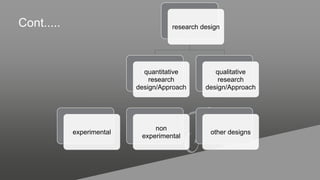
Cont..... research design
quantitative
research
design/Approach
experimental
non
experimental
other designs
qualitative
research
design/Approach
Cont......
Experimental Research
Design
true
experimental
quasi
experimental
pre experimental
Non-Experimental
Research Design
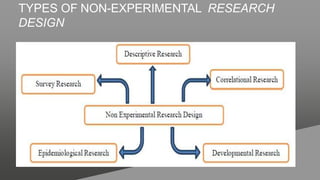
descriptive
design
coorelational design
developmental design
epidimiologocal
design
survey research
design
other designs
methodological
Meta Analysis
Secondary Data
Outcome Research
Evaluation Studies
operational
Research
 EXPERIMENTAL RESEARCH DESIGN
• They are concerned with examination ofthe effect of
independent variable on the dependent variable, where the
independent variable is manipulated through treatment or
interventions and the effect of these interventions is observed
on dependent variable.
• True Experimental Design
They are those where researchers have complete control over the
extraneous variables and can predict confidently that the observed
effect on the dependable variable is only due to the manipulation of
the independent variable.
Essential Characteristics
A True Experimental research design mustessentially consists of
following threecharacteristics
• Manipulation,
• Control and
• Randomization.
 Manipulation:
• It refers to conscious control of theindependent variable by the
researcher throughtreatment or interventions to observe its
effecton dependent variable.
Control:
• It refers to the use of control group andcontrolling the effects of
extraneous variables on the dependent variable in which
researcher is interested.
 Randomization:
• It means that every subject has an equal chance of being
assigned to experimental or control group this is also
known as random assignments of subjects which involves
involves the placement of study subjects on the random
basis. Through random assignments of subjects under
experimental or control group, chances of systemic bias is
eliminated.
 Types of True Experimental Design
• Post test only design
• Pretest-Posttest only design
• Solomon 4 Group design
• Factorial design
• Randomized Block design
• Cross over design
• Latin Square Design
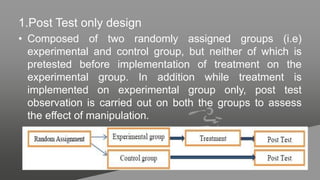
1.Post Test only design
• Composed of two randomly assigned groups (i.e)
experimental and control group, but neither of which is
pretested before implementation of treatment on the
experimental group. In addition while treatment is
implemented on experimental group only, post test
observation is carried out on both the groups to assess
the effect of manipulation.
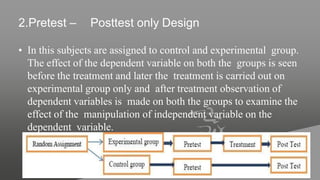
2.Pretest – Posttest only Design
• In this subjects are assigned to control and experimental group.
The effect of the dependent variable on both the groups is seen
before the treatment and later the treatment is carried out on
experimental group only and after treatment observation of
dependent variables is made on both the groups to examine the
effect of the manipulation of independent variable on the
dependent variable.
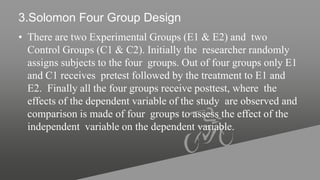
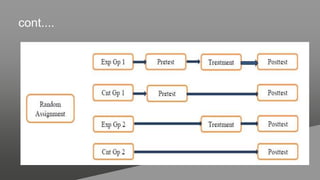
3.Solomon Four Group Design
• There are two Experimental Groups (E1 & E2) and two
Control Groups (C1 & C2). Initially the researcher randomly
assigns subjects to the four groups. Out of four groups only E1
and C1 receives pretest followed by the treatment to E1 and
E2. Finally all the four groups receive posttest, where the
effects of the dependent variable of the study are observed and
comparison is made of four groups to assess the effect of the
independent variable on the dependent variable.
cont....
4.Factorial Design
• In this researcher manipulates two or more independent
variables simultaneously to observe the effects on the
dependent variables. This design is useful when there are more
than two independent variables.
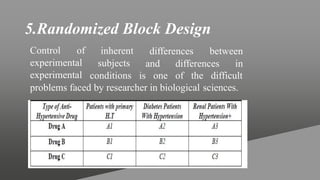
5.Randomized Block Design
differences between
and differences in
Control of
experimental
experimental
inherent
subjects
conditions is one of the difficult
problems faced by researcher in biological sciences.
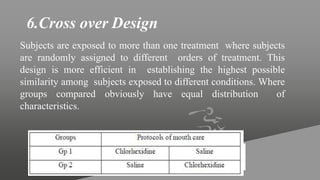
6.Cross over Design
Subjects are exposed to more than one treatment where subjects
are randomly assigned to different orders of treatment. This
design is more efficient in establishing the highest possible
similarity among subjects exposed to different conditions. Where
groups compared obviously have equal distribution of
characteristics.
Advantages
• To establish casual relationship between independent and dependent
variables
• The controlled environment in which the study is conducted can yield a
greater degree of purity in observation.
Conditions not found in natural settings can be created in an
experimental setting where the independent variable is manipulated
by investigator.
•
• In this approach, we can often create conditions in a short period of time
that may take years naturally.
When experiment is conducted in laboratory, the pressure and problems
of real life situations are removed and the researcher can pursue the studies
in a more leisurely careful and concentrated way.
 Disadvantages
• The results of experimental designs cannot be replicated in studies
conducted on human beings due to ethical problems.
• Many of the human variables neither have valid measurable criteria nor
instruments to measure them.
• If experimental studies conducted in natural settings like hospitals or
community, it is not possible to impose control over extraneous variables.
• It is difficult to get cooperation from the study participants because it
may involve medical or surgical treatment or intervention which may make the
prospective subjects reluctant to participate in research study.
 Quasi Experimental Research Design
It involves the manipulation of independent variable to
observe the effect on dependent variable, but it lacks at
least one of the two characteristics of the true
experimental design randomization or control.
 Characteristics
• Manipulation of the independentvariablesto observe the
effects on the dependent variables.
• Lack at least one of the two other essential characteristics
of the true experimental design
• Quasi-independent variable are used instead of true
independent variables.
TYPES OF QUASI EXPERIMENTALDESIGN
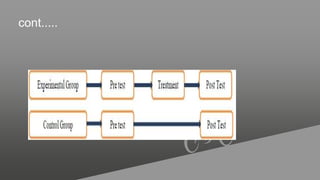
• 1.Non Randomized Control Group Design
• In this design experimental and control group are selected
without randomization and dependent variables are observed
in both groups before intervention, later the experiment group
alone receives treatment and after that posttest observation of
dependent variables is carried out for both the groups to assess
the effect of treatment on experiment group.
cont.....
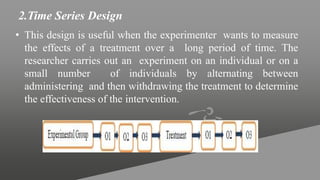
2.Time Series Design
• This design is useful when the experimenter wants to measure
the effects of a treatment over a long period of time. The
researcher carries out an experiment on an individual or on a
small number of individuals by alternating between
administering and then withdrawing the treatment to determine
the effectiveness of the intervention.
 Pre Experimental Research Design
• This research design considered very weak because the
researcher has very little control over the variables.
TYPES OF PRE EXPERIMENTAL RESEARCH
DESIGN
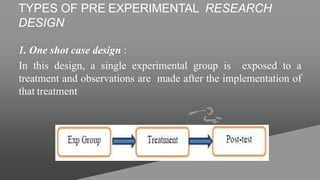
1. One shot case design :
In this design, a single experimental group is exposed to a
treatment and observations are made after the implementation of
that treatment
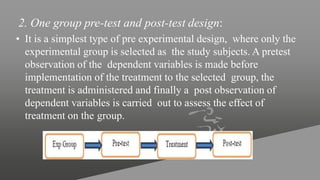
2. One group pre-test and post-test design:
• It is a simplest type of pre experimental design, where only the
experimental group is selected as the study subjects. A pretest
observation of the dependent variables is made before
implementation of the treatment to the selected group, the
treatment is administered and finally a post observation of
dependent variables is carried out to assess the effect of
treatment on the group.
 Advantages :
• Very simple and convenient to conduct these studies in natural
setting especially in nursing.
• Most suitable design for the beginners in the field of
experimental research.
 Disadvantages :
• It has very little control over the research.
• Considered a very weak experimental design to establish
casual relationship between independent and dependent
variables, because it controls no threat to internal validity.
 NON EXPERIMENTAL RESEARCH DESIGN
• It is one of the broad categories of research designs in which
the researcher observes the phenomena as they occur naturally
and no external variables are introduced.
• In this non experimental research, Researcher collects data
without making changes or introducing treatments. Data
obtained are analyzed and the results may lead to the formation
of hypothesis that can be tested experimentally.
Needs.....
• Independent variable cannot be manipulated
• The studies where it is not practically possible to conduct
experiment
• Descriptive studythat do not require any
experimental approaches.
TYPES OF NON-EXPERIMENTAL RESEARCH
DESIGN
 Descriptive Research Design
• The purpose of descriptive design is to describe and document
aspects of a situation as it naturally occurs and sometimes to
serve as a starting point for hypotheses generation or theory
development.
 Main features
• They are used to observe, document and describe a
phenomenon occurring in its natural setting without any
manipulation or control.
• They provide an impression of a situation
as it occurs in natural settings.
• They do not involve the manipulation of variables and
they are studied as they exist in the real world.
• They may be used to develop theories, identify
problem with current practices,justify current practices or
determine other practices in similar situatuins.
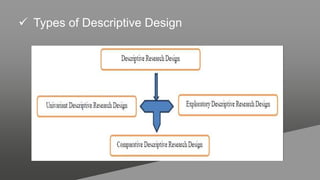
 Types of Descriptive Design
1.Univariant Descriptive Design
• They are undertaken to describe the frequency of occurrence of
a phenomenon. This design does not necessarily focus on the
study of a single variable. They are may be one or more
variables involved in the study.
Ex: A researcher is interested in assessing the experiences of
patients suffering from Rheumatoid arthritis. In this study
researcher may describe the frequency of different symptoms
experienced by the patient and the type of they received during
the course of disease.
2.Exploratory Research Design
• It is used to identify, explore and describe the
existing phenomenon and its related factors. It is not only a
simple description or the frequency of occurrence of a
phenomenon but is in depth exploration and a study of its
related factors to improve further understanding about a less
understood behavior.
• Ex: an exploratory study to assess the multi-factorial
dimensions of falls and home safety measures for elderly
people living in selected communities.
3.Comparative Design
• It involves comparing and contrasting two or more samples of
study subjects on one or more variables, often at a single point
of time.
• This design is used to compare two distinct groups on the basis
of selected attributes such as knowledge level, perceptions and
attitudes.
4.Correlational Research
• This is Non-Experimental Research design, where researcher
examines the relationship between two or more variables in a
natural setting without manipulation or control.
• In this researchers study the relationship of two or more
variables without any intervention.
 Main Features:
• The researcher examines the strength of relationship between
variables by determining how change is correlated with
changes in the other variables.
• Generally they have independent and dependent variables, but
the effect of independent variable is observed on dependent
variable without manipulating the independent variable
cont......
• Magnitude and direction of relationship of independent and
dependent variable is measured by using the correlation
coefficient statistical measure, where results range between -1
to +1
• -ve results shows negative correlation
• +ve results shows positive correlation
• Zero results shows no correlation
• Theoretically a positive relationship means increase in one
variable leads to increase of the other variable. While
negativerelationship means increase in one variable leads to
decrease of the other variable or vice versa.
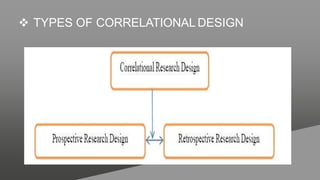
 TYPES OF CORRELATIONAL DESIGN
1. Prospective Research Design:
• A design in which the researcher relates the present to the future
is a prospective research design. In this researcher observes
phenomena from cause to effect.
2. Retrospective Research Design:
• In this researcher studies current phenomenon by seeking
information from past. In other words researcher has a backward
approach, in other words the researcher has a backward
approach where he or she move from effect to identify cause.
Developmental Research Design
• They are generally used as adjuvant research designs with
other research designs such as cross sectional, descriptive,
longitudinal, correlational research design.
• This design examines the phenomenon with reference to time.
TYPES OF DEVELOPMENTAL RESEARCH DESIGN
1. Cross sectional Design:
• Is one in which researcher collects data at a particular point of
time.
2. Longitudinal Design:
• It is used to collect data over an extended period of time. Its
value is in its ability to demonstrate change over a period of
time.
• These are generally classified into three types they are trend
studies, panel studies and follow up studies.
cont....
Trend Studies
• They permit researchers to examine pattern and the rate of
changes and to make prediction about future direction based on
previously identified patterns and rates of changes.
Panel Studies
• In this, some people are involved and over a period of time they
become more informative on the phenomenon that the subjects
in trend studies because the researcher cannot only examine the
pattern of change and also reasons for change.
cont....
Follow up Studies
• These are undertaken to determine the subsequent states of
subjects with a specified condition or those who have received
a specific intervention.
 Epidemiological Research Design
• It is a study to investigate the distribution and causes of the
disease in population.
• Epidemiological studies are generally conducted to investigate
causes of different diseases in either prospective researches or
retrospective researches.
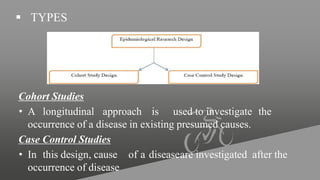
 TYPES
Cohort Studies
• A longitudinal approach is used to investigate the
occurrence of a disease in existing presumed causes.
Case Control Studies
• In this design, cause of a diseaseare investigated after the
occurrence of disease
 SURVEY RESEARCH DESIGN
• A survey is a research design which is used to collect
information from different subjects within a given population
having same characteristics of interest.
 Main features:
• It is the process of gathering current required data from the
subjects so that new information can be obtained.
• In survey research information is collected from a mix of
subjects who represent the total population in the
characteristics being studied
• It relies heavily upon the validity of verbal reports.
• Personal interview are regarded as the most useful method of
collecting survey data, because of the quality of information
that can be obtained.
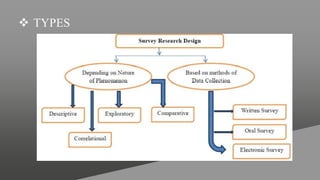
 TYPES
1. Depending on the nature of phenomenon under
study
Descriptive:
• Undertaken to describe the frequency of occurrence of a
phenomenon rather than to study relationship
Exploratory:
• It is a survey of a phenomenon and its related factors about
which much is not known
Comparative:
• Comparing and contrasting the existence of a certain
phenomenon in two or more groups is done by comparative
study
cont....
Correlational:
• It is a study of relationship between two or more variables
in a natural settings without manipulation or control.
2. Based on methods of data collection:
Written survey
• In this data are collected with a help of written,
structured tools such as questionnaire
Oral Survey
• In this data iscollected by using face to face or telephonic
conversation or oral interview with respondents.
Electronic survey
• When data is collected by using electronic means such as
email messages, web forms, SMS etc.
 Advantages
• They tend to be closest to real life situation.
• They are most useful to enhance our understanding about the
existing real world setting around us.
• Numerous human characteristics are not subject to experimental
manipulation. Therefore the effects of these characteristics on
other phenomena cannot be studied experimentally.
• There are many situations in which it is simply not practical to
conduct a true experiment like shortage of funds, lack of
administrative approval, insufficient time etc.
 Disadvantages
• The results obtained and the relationship between the
dependent and independent variables can never be absolutely
clear and error free.
• They are conducted for comparative purpose using non
randomly selected groups.
 Other Research Designs
• There are some of the research designs, which cannot be
categorized under either experimental or non-experimental
research designs.
1. METHODOLOGICAL STUDY
Methodological studies are conducted to develop,validate, test
and evaluate the research instruments and methods. The basic
steps of methodological study are
• Defining behavior or construct to measure
• Formulating the items for tool
• Developing instruments for users and respondents
• Testing the reliability and validity of research tool.
2. META-ANALYSIS
• Quantitatively combining and integrating the finding of the
multiple research studies on a particular topic is known as meta-
analysis.
• Meta analysis is considered as the statistical analysis of a large
amount of analyzed results from individual studies for the
purpose of integrating the finding.
• Meta analysis studies starts with selecting studies with similar
variables and population samples, followed by identifying &
coding study characteristics and finally statistically Analyzing
and reporting the assessed findings of the meta analysis study.
Steps in conducting meta analysis:
• Define Hypothesis
• Locate the studies
• Input data
• Calculate effect sizes
• Analyse variables
3. SECONDARY DATAANALYSIS
• It is a research design in which the data collected by one
researcher is re analyzed by another researcher, usually to test
new hypothesis.
• Sometimes researchers collect lots of data in a study, out of
which some of the data is left unused or unanalyzed that is
taken up later and utilized by another researcher.
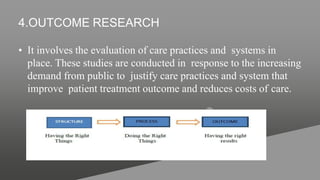
4.OUTCOME RESEARCH
• It involves the evaluation of care practices and systems in
place. These studies are conducted in response to the increasing
demand from public to justify care practices and system that
improve patient treatment outcome and reduces costs of care.
5.EVALUATION STUDIES
• They are an applied form of research design, which involves
the judgement about how well a specific programme, practice
or policy is working.
• They may alsobe used to determine the
6.OPERATIONAL RESEARCH
• It involves study of complex human organizations and services
to develop new knowledge about institutions, programme, use
of facilities and personnel in order to improve working
efficiency of an organization.
• It is the application of scientific method of investigation to
the study of complex human organization and services.
research design ppt.pptx

research design ppt.pptx

  • 1.
    Research Approaches andDesign Presented by:Shivangi Sharma
  • 2.
     Introduction • AResearch design is the framework or guide used for the planning, implementation and analysis of a study. It is a systematic plan of what is to be done, how it will be done and how the data will be analyzed.
  • 3.
     DEFINITION • “Researchdesign is the master plan specifying the methods and procedures for collecting and analyzing the needed information in a research study”. • “Research design is a plan of how, when and where data are to be collected and analyzed”.
  • 4.
    cont... • “Research designis the researcher’s overall plan for answering the research questions or testing the research hypothesis”.
  • 5.
     ELEMENTS OFRESEARCH DESIGN • Research design is also known as a blueprint thatresearchers select to carry out their research study,sometimes research design is used interchangeably withthe term methodology. Research design includes majorelements like. 1. The Approach 2. The Population, Sample and Sampling Technique 3. The Time, Place and Sources of Data collection: 4. Tools and methods of data collection 5. Methods of data analysis
  • 6.
     The Approach •It involves the description of the plan toinvestigate the phenomenon under study in astructured, structured, unstructured unstructured or a combination of two methods. Therefore the approach helps to decide about the presence or absence as well as manipulation and control over variables.
  • 7.
     The Population,Sample and SamplingTechnique: • It also provides the researcher with directions about population, sample and samplingtechnique which will be used for research study.
  • 8.
     The Time,Place and Sources of Data collection: • The Time, Place and Sources of the requisite data are the other important constituents essential to ensure effective planning to conduct research study. Tools and methods of data collection: • This element of research design involves the description of different tools and methods of data collection.
  • 9.
     Methods ofdata analysis: • A research design must also include the description of the methods of data analysis either quantitative or qualitative techniques that helps the researcher to collect the relevant data, which later can be analyze as per research design plan.
  • 10.
     Factors AffectingSelection of Research Design • Nature of Research Problem: Researcher decides whether it should be investigated through an experimental, Non Experimental or Quasiexperimental approach. • Purpose of study: Study may be conducted for the purpose of the prediction, description, exploration or correlation of research variable.
  • 11.
    • Researcher Knowledgeand Experience: Selection of research design is largely influenced by researcher knowledge and experience, because they avoid using those designs wherein they lack confidence, confidence, relevant relevant knowledge knowledge or experience. • Researcher Interest and Motivation: Motivated researcher always analyze most aspectsof research design before selecting one or a combination of designs.
  • 12.
    • Researcher’s Ethicsand Principles: Incorporation of ethics and principles in researchdesign is essential. This includes moral obligationssuch as respect for participants and their rights. • Subjects/ Participants: The number and availability availability of study subjects may influence the selection of research design if only few subjects are involved, an in-depth qualitative research design may be choose, but in case of large samples the researcher may opt for quantitativeresearch design.
  • 13.
    • Resources: None ofthe researcher can be conduct withoutresources such as money, equipments, facilitiesand support from colleagues. • Time: Time is also a major deciding factor for theselection of research design.
  • 14.
    • Possible Controlof Extraneous Variables: An efficient design can maximize results decrease errors and control pre existing and impaired conditions that may affect the outcome of the study. • Users of the Study Finding Finding: A research design also involves various methods data collection and analysis. Therefore while choosing a research design researcher must ensurethat research design is as appropriate for the users of the study findings.
  • 15.
    • TYPES OFRESEARCH DESIGN. • Research designs are classified into two broad categories and several subtypes:
  • 16.
  • 17.
    Cont...... Experimental Research Design true experimental quasi experimental pre experimental Non-Experimental ResearchDesign descriptive design coorelational design developmental design epidimiologocal design survey research design other designs methodological Meta Analysis Secondary Data Outcome Research Evaluation Studies operational Research
  • 18.
     EXPERIMENTAL RESEARCHDESIGN • They are concerned with examination ofthe effect of independent variable on the dependent variable, where the independent variable is manipulated through treatment or interventions and the effect of these interventions is observed on dependent variable.
  • 19.
    • True ExperimentalDesign They are those where researchers have complete control over the extraneous variables and can predict confidently that the observed effect on the dependable variable is only due to the manipulation of the independent variable. Essential Characteristics A True Experimental research design mustessentially consists of following threecharacteristics • Manipulation, • Control and • Randomization.
  • 20.
     Manipulation: • Itrefers to conscious control of theindependent variable by the researcher throughtreatment or interventions to observe its effecton dependent variable. Control: • It refers to the use of control group andcontrolling the effects of extraneous variables on the dependent variable in which researcher is interested.
  • 21.
     Randomization: • Itmeans that every subject has an equal chance of being assigned to experimental or control group this is also known as random assignments of subjects which involves involves the placement of study subjects on the random basis. Through random assignments of subjects under experimental or control group, chances of systemic bias is eliminated.
  • 22.
     Types ofTrue Experimental Design • Post test only design • Pretest-Posttest only design • Solomon 4 Group design • Factorial design • Randomized Block design • Cross over design • Latin Square Design
  • 23.
    1.Post Test onlydesign • Composed of two randomly assigned groups (i.e) experimental and control group, but neither of which is pretested before implementation of treatment on the experimental group. In addition while treatment is implemented on experimental group only, post test observation is carried out on both the groups to assess the effect of manipulation.
  • 24.
    2.Pretest – Posttestonly Design • In this subjects are assigned to control and experimental group. The effect of the dependent variable on both the groups is seen before the treatment and later the treatment is carried out on experimental group only and after treatment observation of dependent variables is made on both the groups to examine the effect of the manipulation of independent variable on the dependent variable.
  • 25.
    3.Solomon Four GroupDesign • There are two Experimental Groups (E1 & E2) and two Control Groups (C1 & C2). Initially the researcher randomly assigns subjects to the four groups. Out of four groups only E1 and C1 receives pretest followed by the treatment to E1 and E2. Finally all the four groups receive posttest, where the effects of the dependent variable of the study are observed and comparison is made of four groups to assess the effect of the independent variable on the dependent variable.
  • 26.
  • 27.
    4.Factorial Design • Inthis researcher manipulates two or more independent variables simultaneously to observe the effects on the dependent variables. This design is useful when there are more than two independent variables.
  • 28.
    5.Randomized Block Design differencesbetween and differences in Control of experimental experimental inherent subjects conditions is one of the difficult problems faced by researcher in biological sciences.
  • 29.
    6.Cross over Design Subjectsare exposed to more than one treatment where subjects are randomly assigned to different orders of treatment. This design is more efficient in establishing the highest possible similarity among subjects exposed to different conditions. Where groups compared obviously have equal distribution of characteristics.
  • 30.
    Advantages • To establishcasual relationship between independent and dependent variables • The controlled environment in which the study is conducted can yield a greater degree of purity in observation. Conditions not found in natural settings can be created in an experimental setting where the independent variable is manipulated by investigator. • • In this approach, we can often create conditions in a short period of time that may take years naturally. When experiment is conducted in laboratory, the pressure and problems of real life situations are removed and the researcher can pursue the studies in a more leisurely careful and concentrated way.
  • 31.
     Disadvantages • Theresults of experimental designs cannot be replicated in studies conducted on human beings due to ethical problems. • Many of the human variables neither have valid measurable criteria nor instruments to measure them. • If experimental studies conducted in natural settings like hospitals or community, it is not possible to impose control over extraneous variables. • It is difficult to get cooperation from the study participants because it may involve medical or surgical treatment or intervention which may make the prospective subjects reluctant to participate in research study.
  • 32.
     Quasi ExperimentalResearch Design It involves the manipulation of independent variable to observe the effect on dependent variable, but it lacks at least one of the two characteristics of the true experimental design randomization or control.
  • 33.
     Characteristics • Manipulationof the independentvariablesto observe the effects on the dependent variables. • Lack at least one of the two other essential characteristics of the true experimental design • Quasi-independent variable are used instead of true independent variables.
  • 34.
    TYPES OF QUASIEXPERIMENTALDESIGN • 1.Non Randomized Control Group Design • In this design experimental and control group are selected without randomization and dependent variables are observed in both groups before intervention, later the experiment group alone receives treatment and after that posttest observation of dependent variables is carried out for both the groups to assess the effect of treatment on experiment group.
  • 35.
  • 36.
    2.Time Series Design •This design is useful when the experimenter wants to measure the effects of a treatment over a long period of time. The researcher carries out an experiment on an individual or on a small number of individuals by alternating between administering and then withdrawing the treatment to determine the effectiveness of the intervention.
  • 37.
     Pre ExperimentalResearch Design • This research design considered very weak because the researcher has very little control over the variables.
  • 38.
    TYPES OF PREEXPERIMENTAL RESEARCH DESIGN 1. One shot case design : In this design, a single experimental group is exposed to a treatment and observations are made after the implementation of that treatment
  • 39.
    2. One grouppre-test and post-test design: • It is a simplest type of pre experimental design, where only the experimental group is selected as the study subjects. A pretest observation of the dependent variables is made before implementation of the treatment to the selected group, the treatment is administered and finally a post observation of dependent variables is carried out to assess the effect of treatment on the group.
  • 40.
     Advantages : •Very simple and convenient to conduct these studies in natural setting especially in nursing. • Most suitable design for the beginners in the field of experimental research.  Disadvantages : • It has very little control over the research. • Considered a very weak experimental design to establish casual relationship between independent and dependent variables, because it controls no threat to internal validity.
  • 41.
     NON EXPERIMENTALRESEARCH DESIGN • It is one of the broad categories of research designs in which the researcher observes the phenomena as they occur naturally and no external variables are introduced. • In this non experimental research, Researcher collects data without making changes or introducing treatments. Data obtained are analyzed and the results may lead to the formation of hypothesis that can be tested experimentally.
  • 42.
    Needs..... • Independent variablecannot be manipulated • The studies where it is not practically possible to conduct experiment • Descriptive studythat do not require any experimental approaches.
  • 43.
  • 44.
     Descriptive ResearchDesign • The purpose of descriptive design is to describe and document aspects of a situation as it naturally occurs and sometimes to serve as a starting point for hypotheses generation or theory development.
  • 45.
     Main features •They are used to observe, document and describe a phenomenon occurring in its natural setting without any manipulation or control. • They provide an impression of a situation as it occurs in natural settings. • They do not involve the manipulation of variables and they are studied as they exist in the real world. • They may be used to develop theories, identify problem with current practices,justify current practices or determine other practices in similar situatuins.
  • 46.
     Types ofDescriptive Design
  • 47.
    1.Univariant Descriptive Design •They are undertaken to describe the frequency of occurrence of a phenomenon. This design does not necessarily focus on the study of a single variable. They are may be one or more variables involved in the study. Ex: A researcher is interested in assessing the experiences of patients suffering from Rheumatoid arthritis. In this study researcher may describe the frequency of different symptoms experienced by the patient and the type of they received during the course of disease.
  • 48.
    2.Exploratory Research Design •It is used to identify, explore and describe the existing phenomenon and its related factors. It is not only a simple description or the frequency of occurrence of a phenomenon but is in depth exploration and a study of its related factors to improve further understanding about a less understood behavior. • Ex: an exploratory study to assess the multi-factorial dimensions of falls and home safety measures for elderly people living in selected communities.
  • 49.
    3.Comparative Design • Itinvolves comparing and contrasting two or more samples of study subjects on one or more variables, often at a single point of time. • This design is used to compare two distinct groups on the basis of selected attributes such as knowledge level, perceptions and attitudes.
  • 50.
    4.Correlational Research • Thisis Non-Experimental Research design, where researcher examines the relationship between two or more variables in a natural setting without manipulation or control. • In this researchers study the relationship of two or more variables without any intervention.
  • 51.
     Main Features: •The researcher examines the strength of relationship between variables by determining how change is correlated with changes in the other variables. • Generally they have independent and dependent variables, but the effect of independent variable is observed on dependent variable without manipulating the independent variable
  • 52.
    cont...... • Magnitude anddirection of relationship of independent and dependent variable is measured by using the correlation coefficient statistical measure, where results range between -1 to +1 • -ve results shows negative correlation • +ve results shows positive correlation • Zero results shows no correlation • Theoretically a positive relationship means increase in one variable leads to increase of the other variable. While negativerelationship means increase in one variable leads to decrease of the other variable or vice versa.
  • 53.
     TYPES OFCORRELATIONAL DESIGN
  • 54.
    1. Prospective ResearchDesign: • A design in which the researcher relates the present to the future is a prospective research design. In this researcher observes phenomena from cause to effect. 2. Retrospective Research Design: • In this researcher studies current phenomenon by seeking information from past. In other words researcher has a backward approach, in other words the researcher has a backward approach where he or she move from effect to identify cause.
  • 55.
    Developmental Research Design •They are generally used as adjuvant research designs with other research designs such as cross sectional, descriptive, longitudinal, correlational research design. • This design examines the phenomenon with reference to time.
  • 56.
    TYPES OF DEVELOPMENTALRESEARCH DESIGN
  • 57.
    1. Cross sectionalDesign: • Is one in which researcher collects data at a particular point of time. 2. Longitudinal Design: • It is used to collect data over an extended period of time. Its value is in its ability to demonstrate change over a period of time. • These are generally classified into three types they are trend studies, panel studies and follow up studies.
  • 58.
    cont.... Trend Studies • Theypermit researchers to examine pattern and the rate of changes and to make prediction about future direction based on previously identified patterns and rates of changes. Panel Studies • In this, some people are involved and over a period of time they become more informative on the phenomenon that the subjects in trend studies because the researcher cannot only examine the pattern of change and also reasons for change.
  • 59.
    cont.... Follow up Studies •These are undertaken to determine the subsequent states of subjects with a specified condition or those who have received a specific intervention.
  • 60.
     Epidemiological ResearchDesign • It is a study to investigate the distribution and causes of the disease in population. • Epidemiological studies are generally conducted to investigate causes of different diseases in either prospective researches or retrospective researches.
  • 61.
     TYPES Cohort Studies •A longitudinal approach is used to investigate the occurrence of a disease in existing presumed causes. Case Control Studies • In this design, cause of a diseaseare investigated after the occurrence of disease
  • 62.
     SURVEY RESEARCHDESIGN • A survey is a research design which is used to collect information from different subjects within a given population having same characteristics of interest.
  • 63.
     Main features: •It is the process of gathering current required data from the subjects so that new information can be obtained. • In survey research information is collected from a mix of subjects who represent the total population in the characteristics being studied • It relies heavily upon the validity of verbal reports. • Personal interview are regarded as the most useful method of collecting survey data, because of the quality of information that can be obtained.
  • 64.
  • 65.
    1. Depending onthe nature of phenomenon under study Descriptive: • Undertaken to describe the frequency of occurrence of a phenomenon rather than to study relationship Exploratory: • It is a survey of a phenomenon and its related factors about which much is not known Comparative: • Comparing and contrasting the existence of a certain phenomenon in two or more groups is done by comparative study
  • 66.
    cont.... Correlational: • It isa study of relationship between two or more variables in a natural settings without manipulation or control.
  • 67.
    2. Based onmethods of data collection: Written survey • In this data are collected with a help of written, structured tools such as questionnaire Oral Survey • In this data iscollected by using face to face or telephonic conversation or oral interview with respondents. Electronic survey • When data is collected by using electronic means such as email messages, web forms, SMS etc.
  • 68.
     Advantages • Theytend to be closest to real life situation. • They are most useful to enhance our understanding about the existing real world setting around us. • Numerous human characteristics are not subject to experimental manipulation. Therefore the effects of these characteristics on other phenomena cannot be studied experimentally. • There are many situations in which it is simply not practical to conduct a true experiment like shortage of funds, lack of administrative approval, insufficient time etc.
  • 69.
     Disadvantages • Theresults obtained and the relationship between the dependent and independent variables can never be absolutely clear and error free. • They are conducted for comparative purpose using non randomly selected groups.
  • 70.
     Other ResearchDesigns • There are some of the research designs, which cannot be categorized under either experimental or non-experimental research designs.
  • 71.
    1. METHODOLOGICAL STUDY Methodologicalstudies are conducted to develop,validate, test and evaluate the research instruments and methods. The basic steps of methodological study are • Defining behavior or construct to measure • Formulating the items for tool • Developing instruments for users and respondents • Testing the reliability and validity of research tool.
  • 72.
    2. META-ANALYSIS • Quantitativelycombining and integrating the finding of the multiple research studies on a particular topic is known as meta- analysis. • Meta analysis is considered as the statistical analysis of a large amount of analyzed results from individual studies for the purpose of integrating the finding. • Meta analysis studies starts with selecting studies with similar variables and population samples, followed by identifying & coding study characteristics and finally statistically Analyzing and reporting the assessed findings of the meta analysis study.
  • 73.
    Steps in conductingmeta analysis: • Define Hypothesis • Locate the studies • Input data • Calculate effect sizes • Analyse variables
  • 74.
    3. SECONDARY DATAANALYSIS •It is a research design in which the data collected by one researcher is re analyzed by another researcher, usually to test new hypothesis. • Sometimes researchers collect lots of data in a study, out of which some of the data is left unused or unanalyzed that is taken up later and utilized by another researcher.
  • 75.
    4.OUTCOME RESEARCH • Itinvolves the evaluation of care practices and systems in place. These studies are conducted in response to the increasing demand from public to justify care practices and system that improve patient treatment outcome and reduces costs of care.
  • 76.
    5.EVALUATION STUDIES • Theyare an applied form of research design, which involves the judgement about how well a specific programme, practice or policy is working. • They may alsobe used to determine the
  • 77.
    6.OPERATIONAL RESEARCH • Itinvolves study of complex human organizations and services to develop new knowledge about institutions, programme, use of facilities and personnel in order to improve working efficiency of an organization. • It is the application of scientific method of investigation to the study of complex human organization and services.