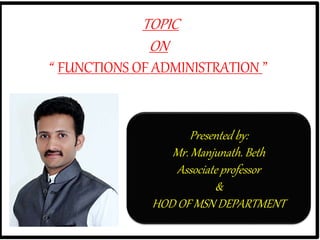
TOPIC
ON
“ FUNCTIONS OF ADMINISTRATION ”
Presented by:
Mr. Manjunath. Beth
Associate professor
&
HOD OF MSN DEPARTMENT
FUNCTIONS
OF ADMINISTRATION
Presented By: Mr. Manjunath. M. Beth (Lecturer) Dept: Med-Sur-Nsg
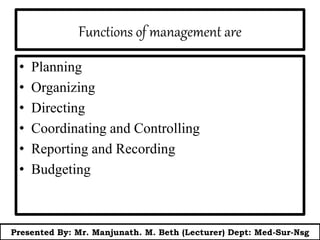
Functions of management are
• Planning
• Organizing
• Directing
• Coordinating and Controlling
• Reporting and Recording
• Budgeting
Presented By: Mr. Manjunath. M. Beth (Lecturer) Dept: Med-Sur-Nsg
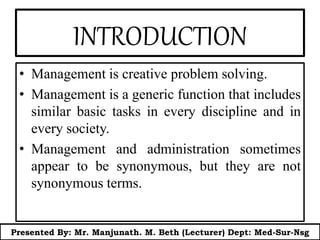
INTRODUCTION
• Management is creative problem solving.
• Management is a generic function that includes
similar basic tasks in every discipline and in
every society.
• Management and administration sometimes
appear to be synonymous, but they are not
synonymous terms.
Presented By: Mr. Manjunath. M. Beth (Lecturer) Dept: Med-Sur-Nsg
DEFINITION
• Management may be defined as the art of
securing maximum results with a minimum of
effort so as to secure maximum prosperity and
happiness for both employer and employee and
give the public the best possible service (John
Mee, 1963)
Presented By: Mr. Manjunath. M. Beth (Lecturer) Dept: Med-Sur-Nsg
PLANNING
• Planning means to decide in advance what is to
be done.
• It charts a course of actions for the future.
• It is an intellectual process and it aims to achieve
a coordinated and consistent set of operations
aimed at desired objectives.
Presented By: Mr. Manjunath. M. Beth (Lecturer) Dept: Med-Sur-Nsg
Essentials of good planning
• Yields reasonable organizational objectives and
develops alternative approaches to meet these
objectives.
• Helps to eliminate or reduce the future uncertainty and
chance.
• Helps to gain economical operations.
• Lays the foundation for organizing.
• Facilitates co-ordination.
• Helps to facilitate control.
• Dictates those activities to which employers are
directed.
Presented By: Mr. Manjunath. M. Beth (Lecturer) Dept: Med-Sur-Nsg
Organizing
• Once the objectives have been established through
planning, management concern must turn to
developing an organization that is capable of
carrying them out.
• The management function of organizing can be
defined as ,”relating people and things to each other
in such a way that they are all combined and
interrelated into a unit capable of being directed
toward the organizational objectives.”
Presented By: Mr. Manjunath. M. Beth (Lecturer) Dept: Med-Sur-Nsg
• Work activities required for the organizational
performance are separated through
– Horizontal differentiation (i.e.. Dividing the
organization into operational units for more effective
and efficient performance.)
– Vertical differentiation (i.e.. Establishes the hierarchy
and the number of levels in the organization
Presented By: Mr. Manjunath. M. Beth (Lecturer) Dept: Med-Sur-Nsg
The formal organization depends on two
basic principles:
a) Responsibility: responsibility n an organization is
divided among available personnel by grouping the
functions that are similar in objectives and content.
This should be done in a manner that avoids overlaps
and gaps as much as possible. Responsibility may be
continuing or it may be terminated by the
accomplishment of a single action.
b) Authority: when responsibility is given to a person,
he must also be given the authority to make
commitments, use resources and take the actions
necessary to carry out his responsibilities.
Presented By: Mr. Manjunath. M. Beth (Lecturer) Dept: Med-Sur-Nsg
STAFFING
Staffing is the
Selection,
Training,
Motivating and
Retaining of a personnel in the organization.
Before selection we have to make analysis of the
particular job, which is required in the
organization., then comes the selection of the
personnel. It involves manpower planning to have
the right person in the right place and avoid
“square peg in the round hole”.
Presented By: Mr. Manjunath. M. Beth (Lecturer) Dept: Med-Sur-Nsg
Manpower planning involves the following steps
1. Scrutiny of present personnel strength.
2. Anticipation of manpower needs.
3. Investigation of turnover of personnel.
4.Planning job requirements and job
descriptions.
Presented By: Mr. Manjunath. M. Beth (Lecturer) Dept: Med-Sur-Nsg
Directing
• Directing means the issuance of orders,
assignments and instructions that permit the
subordinate to understand what is expected of
him and the guidance and overseeing of the
subordinate so that he can contribute effectively
and efficiently to the attainment of
organizational objectives.
Presented By: Mr. Manjunath. M. Beth (Lecturer) Dept: Med-Sur-Nsg
• Directing includes the following activities
• Giving orders
• Making supervision
• Leading
• Motivating
• Communicating
Presented By: Mr. Manjunath. M. Beth (Lecturer) Dept: Med-Sur-Nsg
Giving orders:
• The central task in directing is giving orders.
• The order is the technical means through which a
subordinate understands what is to be done.
• To facilitate this there are certain characteristics
of good orders which manager should be aware
of: The order should be clear, concise and
consistent to give sufficient information to ensure
understanding.
Presented By: Mr. Manjunath. M. Beth (Lecturer) Dept: Med-Sur-Nsg
• Order should be based on obvious demands of a
particular situation, it seems logical to the
subordinates and not just an arbitrary whim of the
manager.
• The tone of the order is very important. The manner
in which the manager delivers the order has a great
deal to do with its acceptance by the subordinate.
• Whenever possible, the reason for the order should
be given. A subordinate will accept an order more
readily if he understands the need for it.
• In some instances the manager uses delegation of
authority instead of issuance of orders for avoiding
too many specific orders.
Presented By: Mr. Manjunath. M. Beth (Lecturer) Dept: Med-Sur-Nsg
Supervision
• Supervision is the activity of the management
that is concerned with the training and discipline
of the work force. It includes follow up to assure
the prompt and proper execution of orders.
• Supervision is the art of overseeing, watching
and directing with authority, the work and
behaviour of other.
Presented By: Mr. Manjunath. M. Beth (Lecturer) Dept: Med-Sur-Nsg
Leading
• Leadership is the ability to inspire and influence
others to contribute to the attainment of the
objectives. Successful leadership is the result of
interaction between the leader and his subordinates
in a particular organizational situation.
• There are number of styles of leadership that have
been identified such as autocratic, democratic
participative leadership.
Presented By: Mr. Manjunath. M. Beth (Lecturer) Dept: Med-Sur-Nsg
• The continuum of leadership styles, ranges from
the completely authoritarian situation with no
subordinate participation to a maximum degree of
democratic leadership, enabling the subordinate
to participate in all phases of the decision making
process.
Presented By: Mr. Manjunath. M. Beth (Lecturer) Dept: Med-Sur-Nsg
Motivating
• Motivation refers to the way in which the
needs (urges, aspirations, desires) control,
direct or explain the behaviour of human
beings.
• The manager must motivate, or cause, the
employee to follow directives.
Presented By: Mr. Manjunath. M. Beth (Lecturer) Dept: Med-Sur-Nsg
Communicating
• Communication is the passing of information
and understanding from a sender to receiver.
• Communication is vital to the directing
function of the management, one way to
visualise this importance is to view the
manager on one side of a barrier and the work
group on the other. Communication is the
means the manager has of reaching through the
barrier to attain work group activity.
Presented By: Mr. Manjunath. M. Beth (Lecturer) Dept: Med-Sur-Nsg
Coordinating
• It is the act of synchronising people and activities
so that they function smoothly in the attainment
of organization objectives.
• Coordination is more important in the health
services organization, because functionally they
are departmentalized.
• Different kinds of organization require different
amount of coordination.
Presented By: Mr. Manjunath. M. Beth (Lecturer) Dept: Med-Sur-Nsg
Basic approaches to coordination
• Corrective co ordinations are those coordinative
activities that rectify the present error or correct a
dysfunction in the organization.
• Preventive coordination comprises those
coordinative activities that are aimed at preventing
the occurrence of anticipated problems of
coordination, or at least minimizing the impact of
these problems.
Presented By: Mr. Manjunath. M. Beth (Lecturer) Dept: Med-Sur-Nsg
• Regulatory coordination comprises those
coordinative activities that are aimed at the
maintenance of existing structural and functional
arrangements in the organizations.
• Promotive coordination has those coordinative
activities that are aimed at attempting to improve
the articulation of the parts of the organization, or
to improve the existing organizational
arrangements without regard for specific
problems.
Presented By: Mr. Manjunath. M. Beth (Lecturer) Dept: Med-Sur-Nsg
Controlling
• Controlling can be defined as the regulation of
activities in accordance with the requirements
of plans.
• Steps of control:
– The control function, whether it is applied to cash,
medical care, employee morale or anything else,
involves four steps.
Presented By: Mr. Manjunath. M. Beth (Lecturer) Dept: Med-Sur-Nsg
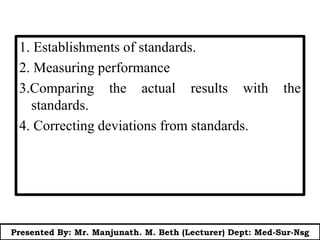
1. Establishments of standards.
2. Measuring performance
3.Comparing the actual results with the
standards.
4. Correcting deviations from standards.
Presented By: Mr. Manjunath. M. Beth (Lecturer) Dept: Med-Sur-Nsg
Reporting and recording
• Reports are oral or written exchanges
of information shared between caregivers or
workers in a number of ways.
• A report summarizes the services of the
person, personnel and of the agency.
• Reports are written usually daily, weekly,
monthly or yearly.
Presented By: Mr. Manjunath. M. Beth (Lecturer) Dept: Med-Sur-Nsg
Purposes of reporting
• To show the kind and amount of services
rendered over a specified period.
• To illustrate progress in reaching goals.
• As an aid in studying health conditions.
• As an aid in planning.
• To interpret services to the public and to the other
interested agencies.
• Records and reports must be functional, accurate,
complete, current organized and confidential.
Presented By: Mr. Manjunath. M. Beth (Lecturer) Dept: Med-Sur-Nsg
Budgeting
• Budgeting, though primarily recognized as a
device for controlling, becomes a major part of
the planning process in any organization.
• It is expressed in financial terms and based on
expected income and expenditure. Budget is
the heart of administrative management.
• It served as a powerful tool of coordination
and negatively an effective device of
eliminating duplicating and wastage.
Presented By: Mr. Manjunath. M. Beth (Lecturer) Dept: Med-Sur-Nsg
Features of budget
• Should be flexible.
• Should be synthesis of past, present and future.
• Should be product of joint venture & cooperation
of executives/ department heads at different levels
of management.
• It should be in the form of statistical standard laid
down in specific numerical terms.
• It should have support of top management
throughout the period of its planning and
supplementation.
Presented By: Mr. Manjunath. M. Beth (Lecturer) Dept: Med-Sur-Nsg
Conclusion
• Managers address complex issues by planning,
budgeting, and setting target goals.
• They meet their goals by organizing, staffing,
controlling and problem solving.
• The nurse manager can assist the staff to think
strategically about what it is doing and what it
should be doing for its clients , for example, in
today’s world of cost containment, examining what
clients pay for the care they receive from the health
care professionals.
Presented By: Mr. Manjunath. M. Beth (Lecturer) Dept: Med-Sur-Nsg
Functions of nursing administration

Functions of nursing administration

  • 2.
    TOPIC ON “ FUNCTIONS OFADMINISTRATION ” Presented by: Mr. Manjunath. Beth Associate professor & HOD OF MSN DEPARTMENT
  • 3.
    FUNCTIONS OF ADMINISTRATION Presented By:Mr. Manjunath. M. Beth (Lecturer) Dept: Med-Sur-Nsg
  • 4.
    Functions of managementare • Planning • Organizing • Directing • Coordinating and Controlling • Reporting and Recording • Budgeting Presented By: Mr. Manjunath. M. Beth (Lecturer) Dept: Med-Sur-Nsg
  • 5.
    INTRODUCTION • Management iscreative problem solving. • Management is a generic function that includes similar basic tasks in every discipline and in every society. • Management and administration sometimes appear to be synonymous, but they are not synonymous terms. Presented By: Mr. Manjunath. M. Beth (Lecturer) Dept: Med-Sur-Nsg
  • 6.
    DEFINITION • Management maybe defined as the art of securing maximum results with a minimum of effort so as to secure maximum prosperity and happiness for both employer and employee and give the public the best possible service (John Mee, 1963) Presented By: Mr. Manjunath. M. Beth (Lecturer) Dept: Med-Sur-Nsg
  • 7.
    PLANNING • Planning meansto decide in advance what is to be done. • It charts a course of actions for the future. • It is an intellectual process and it aims to achieve a coordinated and consistent set of operations aimed at desired objectives. Presented By: Mr. Manjunath. M. Beth (Lecturer) Dept: Med-Sur-Nsg
  • 8.
    Essentials of goodplanning • Yields reasonable organizational objectives and develops alternative approaches to meet these objectives. • Helps to eliminate or reduce the future uncertainty and chance. • Helps to gain economical operations. • Lays the foundation for organizing. • Facilitates co-ordination. • Helps to facilitate control. • Dictates those activities to which employers are directed. Presented By: Mr. Manjunath. M. Beth (Lecturer) Dept: Med-Sur-Nsg
  • 9.
    Organizing • Once theobjectives have been established through planning, management concern must turn to developing an organization that is capable of carrying them out. • The management function of organizing can be defined as ,”relating people and things to each other in such a way that they are all combined and interrelated into a unit capable of being directed toward the organizational objectives.” Presented By: Mr. Manjunath. M. Beth (Lecturer) Dept: Med-Sur-Nsg
  • 10.
    • Work activitiesrequired for the organizational performance are separated through – Horizontal differentiation (i.e.. Dividing the organization into operational units for more effective and efficient performance.) – Vertical differentiation (i.e.. Establishes the hierarchy and the number of levels in the organization Presented By: Mr. Manjunath. M. Beth (Lecturer) Dept: Med-Sur-Nsg
  • 11.
    The formal organizationdepends on two basic principles: a) Responsibility: responsibility n an organization is divided among available personnel by grouping the functions that are similar in objectives and content. This should be done in a manner that avoids overlaps and gaps as much as possible. Responsibility may be continuing or it may be terminated by the accomplishment of a single action. b) Authority: when responsibility is given to a person, he must also be given the authority to make commitments, use resources and take the actions necessary to carry out his responsibilities. Presented By: Mr. Manjunath. M. Beth (Lecturer) Dept: Med-Sur-Nsg
  • 12.
    STAFFING Staffing is the Selection, Training, Motivatingand Retaining of a personnel in the organization. Before selection we have to make analysis of the particular job, which is required in the organization., then comes the selection of the personnel. It involves manpower planning to have the right person in the right place and avoid “square peg in the round hole”. Presented By: Mr. Manjunath. M. Beth (Lecturer) Dept: Med-Sur-Nsg
  • 13.
    Manpower planning involvesthe following steps 1. Scrutiny of present personnel strength. 2. Anticipation of manpower needs. 3. Investigation of turnover of personnel. 4.Planning job requirements and job descriptions. Presented By: Mr. Manjunath. M. Beth (Lecturer) Dept: Med-Sur-Nsg
  • 14.
    Directing • Directing meansthe issuance of orders, assignments and instructions that permit the subordinate to understand what is expected of him and the guidance and overseeing of the subordinate so that he can contribute effectively and efficiently to the attainment of organizational objectives. Presented By: Mr. Manjunath. M. Beth (Lecturer) Dept: Med-Sur-Nsg
  • 15.
    • Directing includesthe following activities • Giving orders • Making supervision • Leading • Motivating • Communicating Presented By: Mr. Manjunath. M. Beth (Lecturer) Dept: Med-Sur-Nsg
  • 16.
    Giving orders: • Thecentral task in directing is giving orders. • The order is the technical means through which a subordinate understands what is to be done. • To facilitate this there are certain characteristics of good orders which manager should be aware of: The order should be clear, concise and consistent to give sufficient information to ensure understanding. Presented By: Mr. Manjunath. M. Beth (Lecturer) Dept: Med-Sur-Nsg
  • 17.
    • Order shouldbe based on obvious demands of a particular situation, it seems logical to the subordinates and not just an arbitrary whim of the manager. • The tone of the order is very important. The manner in which the manager delivers the order has a great deal to do with its acceptance by the subordinate. • Whenever possible, the reason for the order should be given. A subordinate will accept an order more readily if he understands the need for it. • In some instances the manager uses delegation of authority instead of issuance of orders for avoiding too many specific orders. Presented By: Mr. Manjunath. M. Beth (Lecturer) Dept: Med-Sur-Nsg
  • 18.
    Supervision • Supervision isthe activity of the management that is concerned with the training and discipline of the work force. It includes follow up to assure the prompt and proper execution of orders. • Supervision is the art of overseeing, watching and directing with authority, the work and behaviour of other. Presented By: Mr. Manjunath. M. Beth (Lecturer) Dept: Med-Sur-Nsg
  • 19.
    Leading • Leadership isthe ability to inspire and influence others to contribute to the attainment of the objectives. Successful leadership is the result of interaction between the leader and his subordinates in a particular organizational situation. • There are number of styles of leadership that have been identified such as autocratic, democratic participative leadership. Presented By: Mr. Manjunath. M. Beth (Lecturer) Dept: Med-Sur-Nsg
  • 20.
    • The continuumof leadership styles, ranges from the completely authoritarian situation with no subordinate participation to a maximum degree of democratic leadership, enabling the subordinate to participate in all phases of the decision making process. Presented By: Mr. Manjunath. M. Beth (Lecturer) Dept: Med-Sur-Nsg
  • 21.
    Motivating • Motivation refersto the way in which the needs (urges, aspirations, desires) control, direct or explain the behaviour of human beings. • The manager must motivate, or cause, the employee to follow directives. Presented By: Mr. Manjunath. M. Beth (Lecturer) Dept: Med-Sur-Nsg
  • 22.
    Communicating • Communication isthe passing of information and understanding from a sender to receiver. • Communication is vital to the directing function of the management, one way to visualise this importance is to view the manager on one side of a barrier and the work group on the other. Communication is the means the manager has of reaching through the barrier to attain work group activity. Presented By: Mr. Manjunath. M. Beth (Lecturer) Dept: Med-Sur-Nsg
  • 23.
    Coordinating • It isthe act of synchronising people and activities so that they function smoothly in the attainment of organization objectives. • Coordination is more important in the health services organization, because functionally they are departmentalized. • Different kinds of organization require different amount of coordination. Presented By: Mr. Manjunath. M. Beth (Lecturer) Dept: Med-Sur-Nsg
  • 24.
    Basic approaches tocoordination • Corrective co ordinations are those coordinative activities that rectify the present error or correct a dysfunction in the organization. • Preventive coordination comprises those coordinative activities that are aimed at preventing the occurrence of anticipated problems of coordination, or at least minimizing the impact of these problems. Presented By: Mr. Manjunath. M. Beth (Lecturer) Dept: Med-Sur-Nsg
  • 25.
    • Regulatory coordinationcomprises those coordinative activities that are aimed at the maintenance of existing structural and functional arrangements in the organizations. • Promotive coordination has those coordinative activities that are aimed at attempting to improve the articulation of the parts of the organization, or to improve the existing organizational arrangements without regard for specific problems. Presented By: Mr. Manjunath. M. Beth (Lecturer) Dept: Med-Sur-Nsg
  • 26.
    Controlling • Controlling canbe defined as the regulation of activities in accordance with the requirements of plans. • Steps of control: – The control function, whether it is applied to cash, medical care, employee morale or anything else, involves four steps. Presented By: Mr. Manjunath. M. Beth (Lecturer) Dept: Med-Sur-Nsg
  • 27.
    1. Establishments ofstandards. 2. Measuring performance 3.Comparing the actual results with the standards. 4. Correcting deviations from standards. Presented By: Mr. Manjunath. M. Beth (Lecturer) Dept: Med-Sur-Nsg
  • 28.
    Reporting and recording •Reports are oral or written exchanges of information shared between caregivers or workers in a number of ways. • A report summarizes the services of the person, personnel and of the agency. • Reports are written usually daily, weekly, monthly or yearly. Presented By: Mr. Manjunath. M. Beth (Lecturer) Dept: Med-Sur-Nsg
  • 29.
    Purposes of reporting •To show the kind and amount of services rendered over a specified period. • To illustrate progress in reaching goals. • As an aid in studying health conditions. • As an aid in planning. • To interpret services to the public and to the other interested agencies. • Records and reports must be functional, accurate, complete, current organized and confidential. Presented By: Mr. Manjunath. M. Beth (Lecturer) Dept: Med-Sur-Nsg
  • 30.
    Budgeting • Budgeting, thoughprimarily recognized as a device for controlling, becomes a major part of the planning process in any organization. • It is expressed in financial terms and based on expected income and expenditure. Budget is the heart of administrative management. • It served as a powerful tool of coordination and negatively an effective device of eliminating duplicating and wastage. Presented By: Mr. Manjunath. M. Beth (Lecturer) Dept: Med-Sur-Nsg
  • 31.
    Features of budget •Should be flexible. • Should be synthesis of past, present and future. • Should be product of joint venture & cooperation of executives/ department heads at different levels of management. • It should be in the form of statistical standard laid down in specific numerical terms. • It should have support of top management throughout the period of its planning and supplementation. Presented By: Mr. Manjunath. M. Beth (Lecturer) Dept: Med-Sur-Nsg
  • 32.
    Conclusion • Managers addresscomplex issues by planning, budgeting, and setting target goals. • They meet their goals by organizing, staffing, controlling and problem solving. • The nurse manager can assist the staff to think strategically about what it is doing and what it should be doing for its clients , for example, in today’s world of cost containment, examining what clients pay for the care they receive from the health care professionals. Presented By: Mr. Manjunath. M. Beth (Lecturer) Dept: Med-Sur-Nsg