IMPORTANCE OF NURSING THEORIES
To Practice loving kindness
Instill faith & hope
Nurture individual spiritual beliefs and practices
Develop helping-trusting relationships
Promote and accept the expression of positive &
negative feelings.
Use creative scientific problems solving methods for
decision making.
Perform teaching & learning that address individual
needs and learning styles.
Creating a healing environment for the physical and
spiritual self which respects human dignity.
Assist with physical, emotional & spiritual human
needs
Allow room for miracles to take place
Introduction
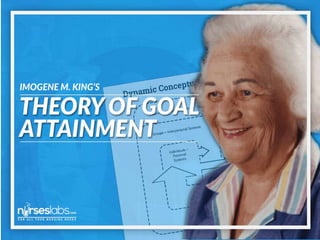
• Theorist : Imogene King - born in 1923.
• Bachelor in science of nursing from St. Louis
University in 1948
• Master of science in nursing from St. Louis University
in 1957
• Doctorate from Teacher’s college, Columbia University.
• Theory describes a dynamic, interpersonal relationship
in which a person grows and develops to attain certain
life goals.
• Factors which affects the attainment of goal are: Roles,
stress, space & time.
• The Theory describes a dynamic, interpersonal
relationship in which a patient grows and develops
to attain certain life goals.
• The theory explains that factors which can affect the
attainment of goals are roles, stress, space, and time.
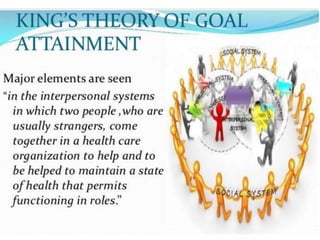
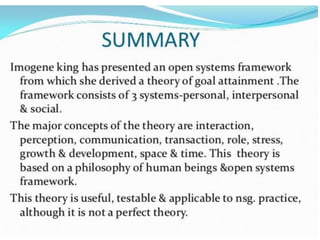
The model has three interacting systems:
1. Personal
2. Interpersonal, and
3. social.
• Each of these systems has its own set of concepts.
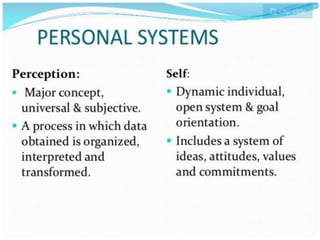
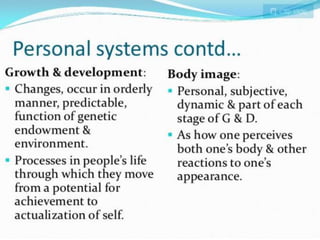
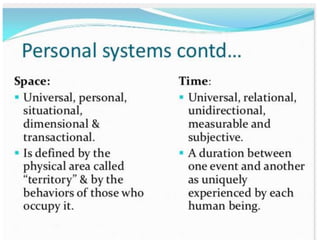
1. Personal system : The concepts for the personal system
are perception, self, growth and development, body
image, space, and time.
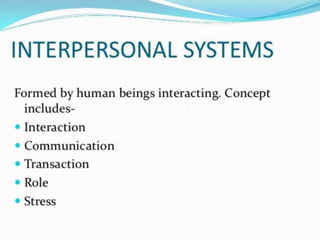
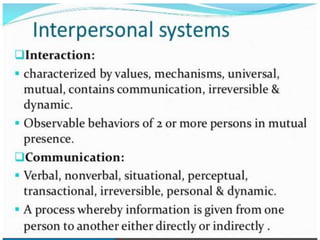
2. Interpersonal system : The concepts for the
interpersonal system are interaction, communication,
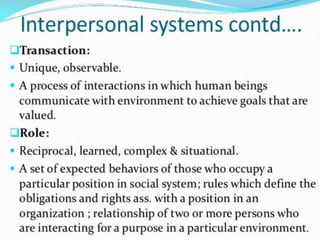
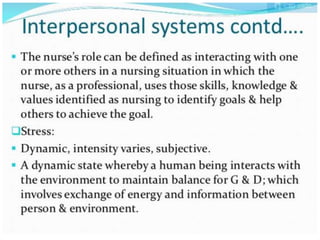
transaction, role, and stress.
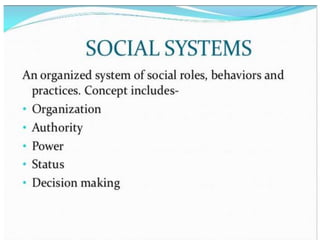
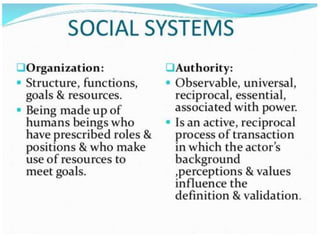
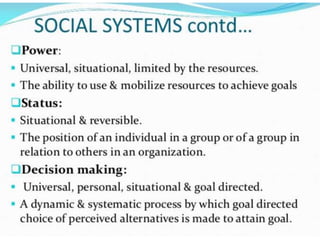
3. Social system : The concepts for the social system are
organization, authority, power, status, and decision-
making.
CONCEPTUAL
FRAMEWORK
The following propositions are made in the Theory of
Goal Attainment:
1. If perceptual interaction accuracy is present in nurse-
patient interactions, transaction will occur.
2. If the Nurse and patient make transaction, the goal or
goals will be achieved.
3. If the goal or goals are achieved, satisfaction will
occur.
4. If transactions are made in nurse-patient interactions,
growth and development will be enhanced.
5. If role expectations and role performance as
perceived by the nurse and patient are appropriate,
transaction will occur.
6. If role conflict is experienced by either the nurse or
the patient (or both), stress in the nurse-patient
interaction will occur.
7. If a nurse with special knowledge communicates
appropriate information to the patient, mutual goal-
setting and goal achievement will occur.
Basic assumptions
1. Nursing focus is the care of human being
2. Nursing goal is the health care of individuals & groups
3. Human beings: are open systems interacting constantly
with their environment.
4. Basic assumption of goal attainment theory is that
nurse and client communicate information, set goal
mutually and then act to attain those goals, is also the
basic assumption of nursing process.
5. “Each human being perceives the world as a total
person in making transactions with individuals and
things in environment”
6. “Transaction represents a life situation in which
perceiver & thing perceived are encountered and in
which person enters the situation as an active
participant and each is changed in the process of
these experiences”
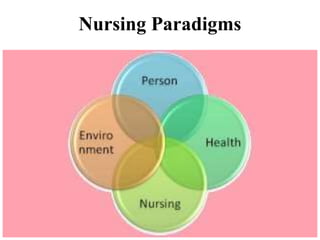
Nursing Paradigms
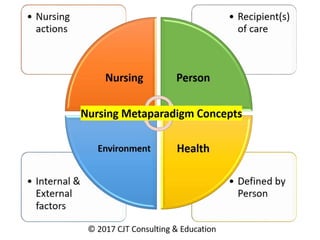
The Four Nursing Metaparadigm Concepts
• The four phenomena of central interest that define
nursing practice (or the key foci of patient care) are
identified as nursing, person, health, and environment.
These four phenomena or concepts make up the overall
metaparadigm of nursing.
• Note that the phenomena of Person, Health, and
Environment all relate to the recipient(s) of nursing care
or nursing actions. The phenomenon of Nursing is only
focused on the nurse.
• PHENOMENON OF NURSING:
This nursing metaparadigm concept is related to the
art and science of nursing.
It consists of nursing actions or nursing
interventions.
Think of this concept as what nurses DO. This
concept includes the nurse applying professional
knowledge, procedural and technical skills, and
indirect and direct (hands-on) patient care.
PHENOMENON OF PERSON:
Nurses provide nursing care to Persons.
The Person is the one receiving the nursing care.
But importantly, Person is defined according to the
recipient of nursing care (the patient or client) and
may include the patient’s family and friends and the
community.
The nurse needs to consider how the patient defines
family when planning care.
• PHENOMENON OF HEALTH: the concept of
health is relative to the person and is defined
according to the patient’s perspective. What one
person considers healthy, may be considered
unhealthy to another person. What one person
considers an acceptable quality of life, may be
considered an unacceptable quality of life to
another person.
• It refers to the patient’s level of wellness (i.e., the
health/wellness-illness continuum) in all its many
aspects: physical, psychological, mental,
intellectual, emotional, and spiritual. The ability to
access healthcare and resources to support health
and wellness is included.
• PHENOMENON OF ENVIRONMENT: While we
typically think of the environment as something
external to us – a setting or place – a person’s
environment is also internal.
• The environment consists of internal, external, and
social factors that impact a patient’s health (including
genetics, immune function, culture, interpersonal
relationships, economics, mental state, geographic
location, education level, politics, ecology, social status,
job or career level, etc.)
Nursing Paradigms according IMOGEN KINGS
• 1. Human being /person
• Human being or person refers to social being who
are rational and sentient.
• Person has ability to :
– perceive
– think
– feel
– choose
– set goals
– select means to achieve goals and
– to make decision
Human being has three fundamental needs:
1. The need for the health information that is
unable at the time when it is needed and can be
used
2. The need for care that seek to prevent illness,
and
3. The need for care when human beings are
unable to help themselves.
2. Health
• Health involves dynamic life experiences of a human
being, which implies continuous adjustment to stressors
in the internal and external environment through
optimum use of one’s resources to achieve maximum
potential for daily living.
3. Environment
• Environment is the background for human interactions.
• It involves:
– Internal environment: transforms energy to enable person to
adjust to continuous external environmental changes.
– External environment: involves formal and informal
organizations. Nurse is a part of the patient’s environment.
4. Nursing
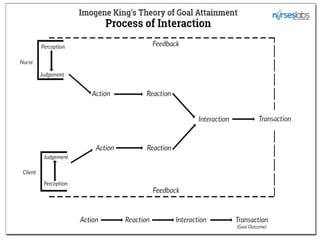
• Definition: “A process of action, reaction and
interaction by which nurse and client share
information about their perception in nursing
situation.” and “ a process of human interactions
between nurse and client whereby each perceives
the other and the situation, and through
communication, they set goals, explore means, and
agree on means to achieve goals.”
• Action: is defined as a sequence of behaviors
involving mental and physical action.
• Reaction: which is considered as included in the
sequence of behaviors described in action.
• In addition, king discussed:
–(a) goal
–(b) domain and
–(c) functions of professional nurse
• Goal of nurse: “To help individuals to maintain
their health so they can function in their roles.”
• Domain of nurse: “includes promoting,
maintaining, and restoring health, and caring for the
sick, injured and dying.
• Function of professional nurse: “To interpret
information in nursing process to plan, implement
and evaluate nursing care..
THEORY OF GOAL ATTAINMENT AND NURSING
PROCESS
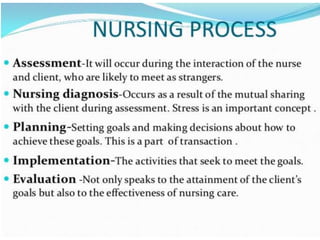
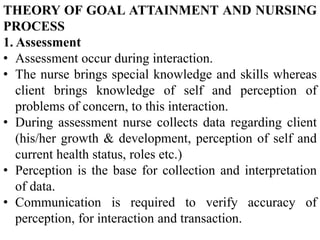
1. Assessment
• Assessment occur during interaction.
• The nurse brings special knowledge and skills whereas
client brings knowledge of self and perception of
problems of concern, to this interaction.
• During assessment nurse collects data regarding client
(his/her growth & development, perception of self and
current health status, roles etc.)
• Perception is the base for collection and interpretation
of data.
• Communication is required to verify accuracy of
perception, for interaction and transaction.
2. Nursing diagnosis
• The data collected by assessment are used to make
nursing diagnosis in nursing process.
• In process of attaining goal the nurse identifies the
problems, concerns and disturbances about which
person seek help.
3. Planning
• After diagnosis, planning for interventions to solve
those problems is done.
• In goal attainment planning is represented by setting
goals and making decisions about and being agreed
on the means to achieve goals.
• This part of transaction and client’s participation is
encouraged in making decision on the means to
achieve the goals.
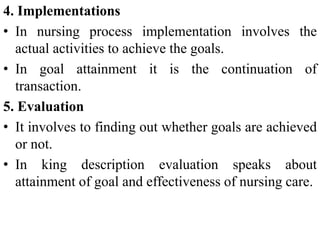
4. Implementations
• In nursing process implementation involves the
actual activities to achieve the goals.
• In goal attainment it is the continuation of
transaction.
5. Evaluation
• It involves to finding out whether goals are achieved
or not.
• In king description evaluation speaks about
attainment of goal and effectiveness of nursing care.
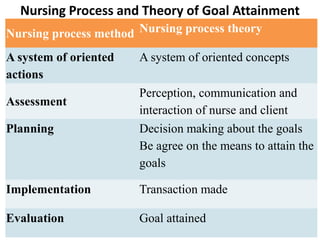
Nursing Process and Theory of Goal Attainment
Nursing process method Nursing process theory
A system of oriented
actions
A system of oriented concepts
Assessment
Perception, communication and
interaction of nurse and client
Planning Decision making about the goals
Be agree on the means to attain the
goals
Implementation Transaction made
Evaluation Goal attained
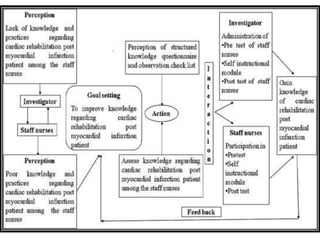
APPLICATION OF
THEORY in nursing
process
• http://currentnursing.com/nursing_theory/go
al_attainment_theory.html

Imogen kings (manju)

  • 2.
    IMPORTANCE OF NURSINGTHEORIES To Practice loving kindness Instill faith & hope Nurture individual spiritual beliefs and practices Develop helping-trusting relationships Promote and accept the expression of positive & negative feelings.
  • 3.
    Use creative scientificproblems solving methods for decision making. Perform teaching & learning that address individual needs and learning styles. Creating a healing environment for the physical and spiritual self which respects human dignity. Assist with physical, emotional & spiritual human needs Allow room for miracles to take place
  • 6.
    Introduction • Theorist :Imogene King - born in 1923. • Bachelor in science of nursing from St. Louis University in 1948 • Master of science in nursing from St. Louis University in 1957 • Doctorate from Teacher’s college, Columbia University. • Theory describes a dynamic, interpersonal relationship in which a person grows and develops to attain certain life goals. • Factors which affects the attainment of goal are: Roles, stress, space & time.
  • 7.
    • The Theorydescribes a dynamic, interpersonal relationship in which a patient grows and develops to attain certain life goals. • The theory explains that factors which can affect the attainment of goals are roles, stress, space, and time. The model has three interacting systems: 1. Personal 2. Interpersonal, and 3. social.
  • 8.
    • Each ofthese systems has its own set of concepts. 1. Personal system : The concepts for the personal system are perception, self, growth and development, body image, space, and time. 2. Interpersonal system : The concepts for the interpersonal system are interaction, communication, transaction, role, and stress. 3. Social system : The concepts for the social system are organization, authority, power, status, and decision- making.
  • 20.
  • 23.
    The following propositionsare made in the Theory of Goal Attainment: 1. If perceptual interaction accuracy is present in nurse- patient interactions, transaction will occur. 2. If the Nurse and patient make transaction, the goal or goals will be achieved. 3. If the goal or goals are achieved, satisfaction will occur. 4. If transactions are made in nurse-patient interactions, growth and development will be enhanced.
  • 24.
    5. If roleexpectations and role performance as perceived by the nurse and patient are appropriate, transaction will occur. 6. If role conflict is experienced by either the nurse or the patient (or both), stress in the nurse-patient interaction will occur. 7. If a nurse with special knowledge communicates appropriate information to the patient, mutual goal- setting and goal achievement will occur.
  • 26.
    Basic assumptions 1. Nursingfocus is the care of human being 2. Nursing goal is the health care of individuals & groups 3. Human beings: are open systems interacting constantly with their environment. 4. Basic assumption of goal attainment theory is that nurse and client communicate information, set goal mutually and then act to attain those goals, is also the basic assumption of nursing process.
  • 27.
    5. “Each humanbeing perceives the world as a total person in making transactions with individuals and things in environment” 6. “Transaction represents a life situation in which perceiver & thing perceived are encountered and in which person enters the situation as an active participant and each is changed in the process of these experiences”
  • 30.
  • 32.
    The Four NursingMetaparadigm Concepts • The four phenomena of central interest that define nursing practice (or the key foci of patient care) are identified as nursing, person, health, and environment. These four phenomena or concepts make up the overall metaparadigm of nursing. • Note that the phenomena of Person, Health, and Environment all relate to the recipient(s) of nursing care or nursing actions. The phenomenon of Nursing is only focused on the nurse.
  • 33.
    • PHENOMENON OFNURSING: This nursing metaparadigm concept is related to the art and science of nursing. It consists of nursing actions or nursing interventions. Think of this concept as what nurses DO. This concept includes the nurse applying professional knowledge, procedural and technical skills, and indirect and direct (hands-on) patient care.
  • 34.
    PHENOMENON OF PERSON: Nursesprovide nursing care to Persons. The Person is the one receiving the nursing care. But importantly, Person is defined according to the recipient of nursing care (the patient or client) and may include the patient’s family and friends and the community. The nurse needs to consider how the patient defines family when planning care.
  • 35.
    • PHENOMENON OFHEALTH: the concept of health is relative to the person and is defined according to the patient’s perspective. What one person considers healthy, may be considered unhealthy to another person. What one person considers an acceptable quality of life, may be considered an unacceptable quality of life to another person.
  • 36.
    • It refersto the patient’s level of wellness (i.e., the health/wellness-illness continuum) in all its many aspects: physical, psychological, mental, intellectual, emotional, and spiritual. The ability to access healthcare and resources to support health and wellness is included.
  • 37.
    • PHENOMENON OFENVIRONMENT: While we typically think of the environment as something external to us – a setting or place – a person’s environment is also internal. • The environment consists of internal, external, and social factors that impact a patient’s health (including genetics, immune function, culture, interpersonal relationships, economics, mental state, geographic location, education level, politics, ecology, social status, job or career level, etc.)
  • 38.
    Nursing Paradigms accordingIMOGEN KINGS • 1. Human being /person • Human being or person refers to social being who are rational and sentient. • Person has ability to : – perceive – think – feel – choose – set goals – select means to achieve goals and – to make decision
  • 39.
    Human being hasthree fundamental needs: 1. The need for the health information that is unable at the time when it is needed and can be used 2. The need for care that seek to prevent illness, and 3. The need for care when human beings are unable to help themselves.
  • 40.
    2. Health • Healthinvolves dynamic life experiences of a human being, which implies continuous adjustment to stressors in the internal and external environment through optimum use of one’s resources to achieve maximum potential for daily living. 3. Environment • Environment is the background for human interactions. • It involves: – Internal environment: transforms energy to enable person to adjust to continuous external environmental changes. – External environment: involves formal and informal organizations. Nurse is a part of the patient’s environment.
  • 41.
    4. Nursing • Definition:“A process of action, reaction and interaction by which nurse and client share information about their perception in nursing situation.” and “ a process of human interactions between nurse and client whereby each perceives the other and the situation, and through communication, they set goals, explore means, and agree on means to achieve goals.” • Action: is defined as a sequence of behaviors involving mental and physical action.
  • 42.
    • Reaction: whichis considered as included in the sequence of behaviors described in action. • In addition, king discussed: –(a) goal –(b) domain and –(c) functions of professional nurse • Goal of nurse: “To help individuals to maintain their health so they can function in their roles.”
  • 43.
    • Domain ofnurse: “includes promoting, maintaining, and restoring health, and caring for the sick, injured and dying. • Function of professional nurse: “To interpret information in nursing process to plan, implement and evaluate nursing care..
  • 45.
    THEORY OF GOALATTAINMENT AND NURSING PROCESS 1. Assessment • Assessment occur during interaction. • The nurse brings special knowledge and skills whereas client brings knowledge of self and perception of problems of concern, to this interaction. • During assessment nurse collects data regarding client (his/her growth & development, perception of self and current health status, roles etc.) • Perception is the base for collection and interpretation of data. • Communication is required to verify accuracy of perception, for interaction and transaction.
  • 46.
    2. Nursing diagnosis •The data collected by assessment are used to make nursing diagnosis in nursing process. • In process of attaining goal the nurse identifies the problems, concerns and disturbances about which person seek help.

  • 47.
    3. Planning • Afterdiagnosis, planning for interventions to solve those problems is done. • In goal attainment planning is represented by setting goals and making decisions about and being agreed on the means to achieve goals. • This part of transaction and client’s participation is encouraged in making decision on the means to achieve the goals.
  • 48.
    4. Implementations • Innursing process implementation involves the actual activities to achieve the goals. • In goal attainment it is the continuation of transaction. 5. Evaluation • It involves to finding out whether goals are achieved or not. • In king description evaluation speaks about attainment of goal and effectiveness of nursing care.
  • 49.
    Nursing Process andTheory of Goal Attainment Nursing process method Nursing process theory A system of oriented actions A system of oriented concepts Assessment Perception, communication and interaction of nurse and client Planning Decision making about the goals Be agree on the means to attain the goals Implementation Transaction made Evaluation Goal attained
  • 53.
    APPLICATION OF THEORY innursing process
  • 54.