Presented By-CHETAN VISHWANATH PAWAR
M.Pharmacy Sem –I
Guided By- Dr. Mrs. R F Chavan
Department of Pharmaceutics
PDEA’s S.G.R.S. College of Pharmacy Saswad
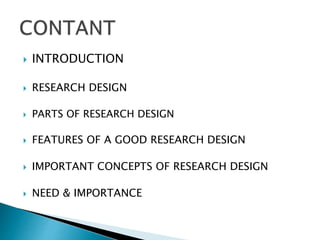
 INTRODUCTION
 RESEARCH DESIGN
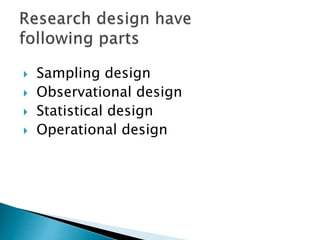
 PARTS OF RESEARCH DESIGN
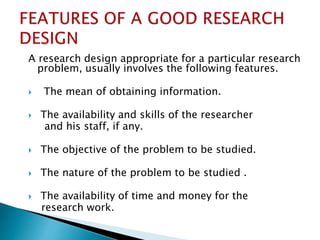
 FEATURES OF A GOOD RESEARCH DESIGN
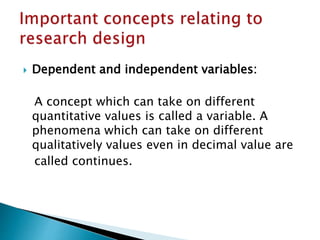
 IMPORTANT CONCEPTS OF RESEARCH DESIGN
 NEED & IMPORTANCE
Meaning of Research –
It Is A Careful Investigation Or Inquiry
Specially Through Search For New Facts In
Any Branch Of Knowledge Is Called As
“Research”.
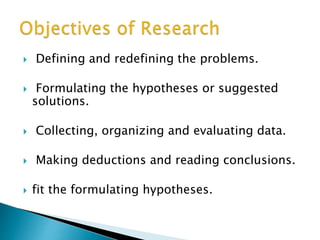
 Defining and redefining the problems.
 Formulating the hypotheses or suggested
solutions.
 Collecting, organizing and evaluating data.
 Making deductions and reading conclusions.
 fit the formulating hypotheses.
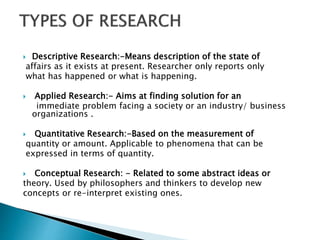
 Descriptive Research:-Means description of the state of
affairs as it exists at present. Researcher only reports only
what has happened or what is happening.
 Applied Research:- Aims at finding solution for an
immediate problem facing a society or an industry/ business
organizations .
 Quantitative Research:-Based on the measurement of
quantity or amount. Applicable to phenomena that can be
expressed in terms of quantity.
 Conceptual Research: - Related to some abstract ideas or
theory. Used by philosophers and thinkers to develop new
concepts or re-interpret existing ones.
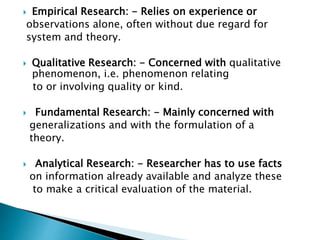
 Empirical Research: - Relies on experience or
observations alone, often without due regard for
system and theory.
 Qualitative Research: - Concerned with qualitative
phenomenon, i.e. phenomenon relating
to or involving quality or kind.
 Fundamental Research: - Mainly concerned with
generalizations and with the formulation of a
theory.
 Analytical Research: - Researcher has to use facts
on information already available and analyze these
to make a critical evaluation of the material.
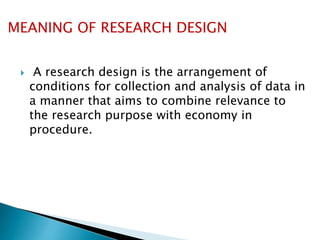
 A research design is the arrangement of
conditions for collection and analysis of data in
a manner that aims to combine relevance to
the research purpose with economy in
procedure.
MEANING OF RESEARCH DESIGN
 Sampling design
 Observational design
 Statistical design
 Operational design
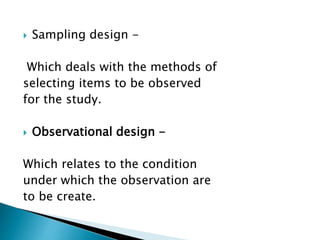
 Sampling design -
Which deals with the methods of
selecting items to be observed
for the study.
 Observational design -
Which relates to the condition
under which the observation are
to be create.
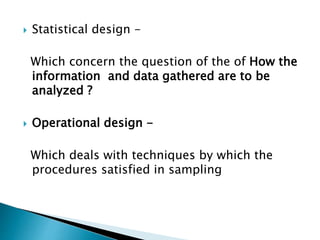
 Statistical design -
Which concern the question of the of How the
information and data gathered are to be
analyzed ?
 Operational design -
Which deals with techniques by which the
procedures satisfied in sampling
A research design appropriate for a particular research
problem, usually involves the following features.
 The mean of obtaining information.
 The availability and skills of the researcher
and his staff, if any.
 The objective of the problem to be studied.
 The nature of the problem to be studied .
 The availability of time and money for the
research work.
 Dependent and independent variables:
A concept which can take on different
quantitative values is called a variable. A
phenomena which can take on different
qualitatively values even in decimal value are
called continues.
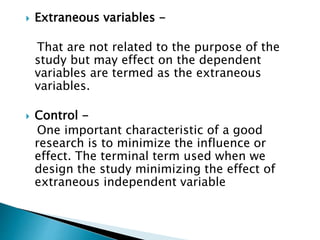
 Extraneous variables -
That are not related to the purpose of the
study but may effect on the dependent
variables are termed as the extraneous
variables.
 Control -
One important characteristic of a good
research is to minimize the influence or
effect. The terminal term used when we
design the study minimizing the effect of
extraneous independent variable
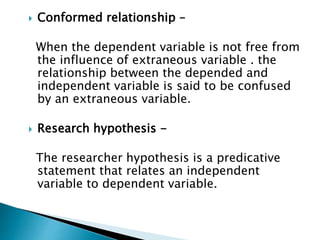
 Conformed relationship –
When the dependent variable is not free from
the influence of extraneous variable . the
relationship between the depended and
independent variable is said to be confused
by an extraneous variable.
 Research hypothesis -
The researcher hypothesis is a predicative
statement that relates an independent
variable to dependent variable.
 Experimental and non experimental hypothesis
testing -
When the purpose of research is to test a
research hypothesis, it us termed as hypothesis
testing research . It can be experimental or non
experimental.
 Experimental and control groups -
When a group is exposed to usual conditions, it is
termed as a control group.
But when the group is exposed to be some
special condition, it is termed as Experimental
group .
 Treatments –
The different conditions under which Experiment
and control groups are put up usually referred to
as treatment.
 Experiment -
The process of examining the truth of a statistical
hypothesis, relating to some research problem, is
known as an Experiment.
E.g.:-
we can conduct an Experiment to examine the
usefulness of a certainnewly developed drug.
NEED & IMPORTANCE -
 Smooth sailing of research operations.
 Stands for advance planning of the methods.
 Great bearing on reliability of the results.
 Helps to give directions.
 Helps in decision making.
 Research design prevent blind searching.
 Helps researchers to anticipate potential
problems
 in collecting data etc.
 RESEARCH METHODOLOGY Methods and
Techniques , 3rd edition, by C R Kothari and
Gaurav Garg pg no – 1 to 51.
 Robson, C. (1993). Real-world research: A
resource for social scientists and practitioner
researchers. Malden: Blackwell Publishing
Research Design