INTRODUCTION
The nursing profession is continuously
evolving and dynamic. Ever since Florence
Nightingale started writing her notes on nursing,
more theories and models about the nursing
profession flourished during the last decade; one
of these is Myra Levine’s Conservational Theory
which was completed on 1973.
Levine's Four Conservation
Principles
Myra Levine's Conservation Theory
• "Ethical behavior is not the display of one's
moral rectitude in times of crisis, it is the day-
to-day expression of one's commitment to other
persons and the ways in which human beings
relate to one another in their daily
interactions." - Levine, Myra (1972) .
Major Concepts of Conservational model
• Goal of the model is to promote adaptation and
maintain wholeness using the principles of
conservation
• Model guides the nurse to focus on the influences
and responses at the organismic level
• Nurse accomplishes the goal of model through the
conservation of energy, structure and personal and
social integrity.
Adaptation
• Every individual has a unique range of adaptive
responses
• The responses will vary by heredity, age, gender or
challenges of illness experiences
• While the responses are same, the timing and
manifestation of organismic responses will be unique
for each individual pulse rate.
• An ongoing process of change in which patient
maintains his integrity within the realities of
environment
• Achieved through the "frugal, economic, contained and
controlled use of environmental resources by individual
in his or her best interest“.
Wholeness
• Exist when the interaction or constant
adaptations to the environment permits the
assurance of integrity
• Promoted by use of conservation principle
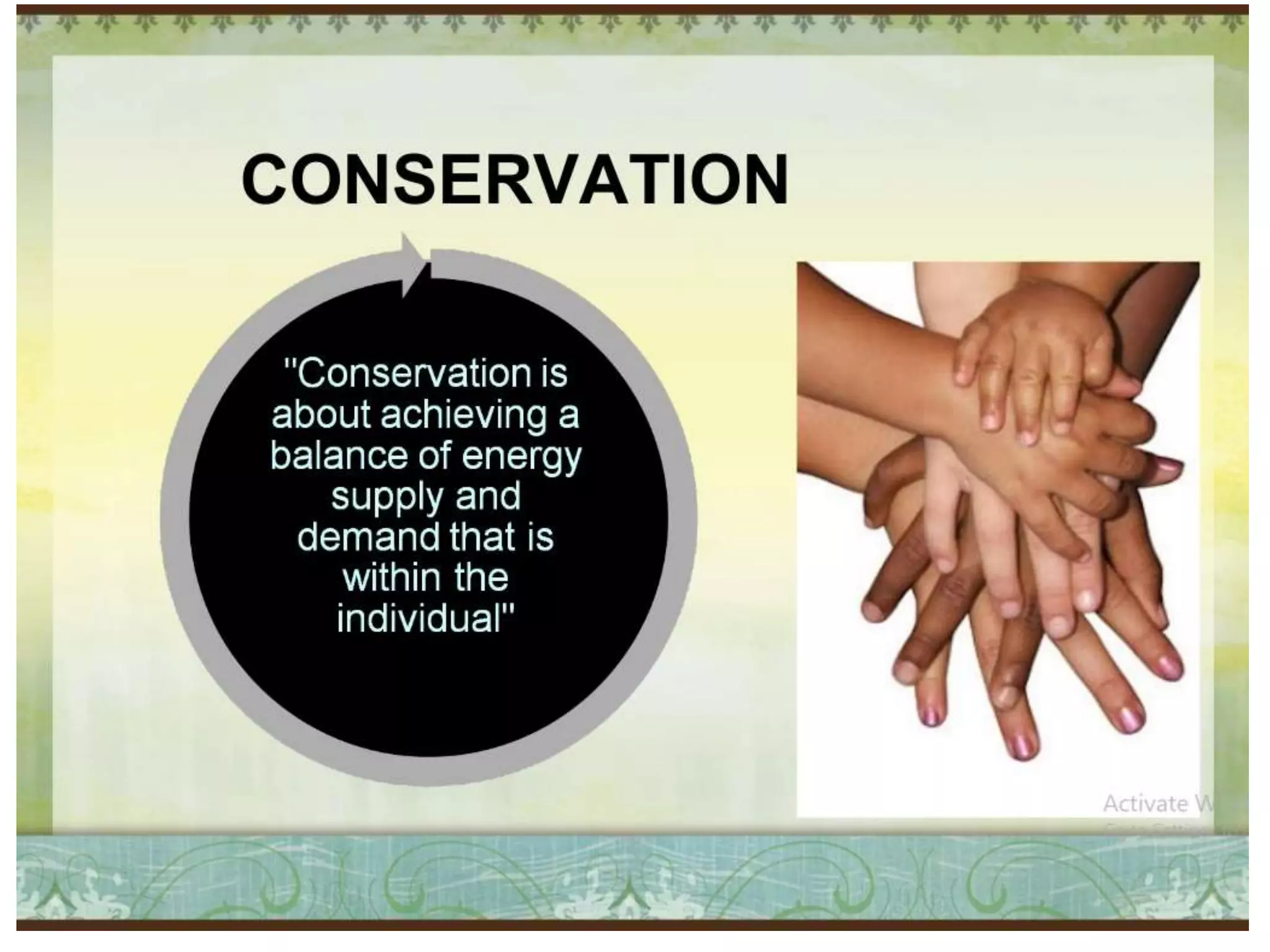
Conservation
• The product of adaptation
• "Keeping together "of the life systems or the
wholeness of the individual
• Achieving a balance of energy supply and
demand that is with in the unique biological
realities of the individual.
Nursing’s paradigm
Person
• A holistic being who constantly strives to
preserve wholeness and integrity.
• A unique individual in unity and integrity,
feeling, believing, thinking and whole system
of system.
Environment
Competes the wholeness of person
• Internal
–Homeostasis
–Homeorrhesis
• External
–Preconceptual
–Operational
–Conceptual
Internal Environment
• Homeostasis
– A state of energy sparing that also provide the
necessary baselines for a multitude of
synchronized physiological and psychological
factors
– A state of conservation
• Homeorrhesis
–A stabilized flow rather than a static state
–Emphasis the fluidity of change within a space-
time continuum
–Describe the pattern of adaptation, which permit
the individual’s body to sustain its well being with
the vast changes which encroach upon it from the
environment.
External Environment
• Preconceptual
– Aspect of the world that individual are able to intercept
• Operational
– Elements that may physically affects individuals but not
perceived by hem: radiation, micro-organism and
pollution
• Conceptual
– Part of person's environment including cultural patterns
characterized by spiritual existence, ideas, values, beliefs
and tradition
Person and environment
• Adaptation
• Organismic response
• Conservation
Adaptation
Characteristics
• Historicity: Adaptations are grounded in history and
await the challenges to which they respond
• Specificity: Individual responses and their adaptive
pattern varies on the base of specific genetic
structure
• Redundancy: Safe and fail options available to the
individual to ensure continued adaptation.
Organismic response
• A change in behavior of an individual during an
attempt to adapt to the environment
• Help individual to protect and maintain their
integrity
• They co-exist
• They are four types:
• 1. Flight or fight: An instantaneous response to
real or imagined threat, most primitive response
• 2. Inflammatory: response intended to provide
for structural integrity and the promotion of
healing
• 3. Stress: Response developed over time and
influenced by each stressful experience
encountered by person
• 4. Perceptual: Involves gathering information
from the environment and converting it in to a
meaning experience.
Nine models of guided assessment
• Vital’s signs
• Body movement and positioning
• Ministration of personal hygiene needs
• Pressure gradient system in nursing interventions
• Nursing determination in provision of nutritional
needs
• Pressure gradient system in nursing
• Local application of heat and cold
• Administration of medicine
• Establishing an aseptic environment
Assumption
1. The nurse creates an environment in which healing
could occur
2. A human being is more than the sum of the part
3. Human being respond in a predictable way
4. Human being are unique in their responses
5. Human being know and appraise objects ,condition
and situation
6. Human being sense, reflects, reason and understand
7. human being action are self determined even when
emotional
8. Human being are capable of prolonging reflection
through such strategists raising questions.
Characteristics of theory
1. The concept of illness adaptation, using
interventions, and the evaluation of nursing
interventions are interrelated.
2. Concepts are sequential and logical and can
be used to explain the consequences of
nursing action.
3. Levine’s theory is easy to use and elements
are easily comprehensible.
4. Levine’s idea can be tested and hypothesis
can be derived from them.
5. The principle of conservation are specific
enough to be testable
6. Levine’s idea have not yet been widely
researched.
7. Levine's theory has been applied in surgical
settings.
8. Levine’s ideas are consistent with other
theories, laws and principles particularly
those from the humanities and sciences.
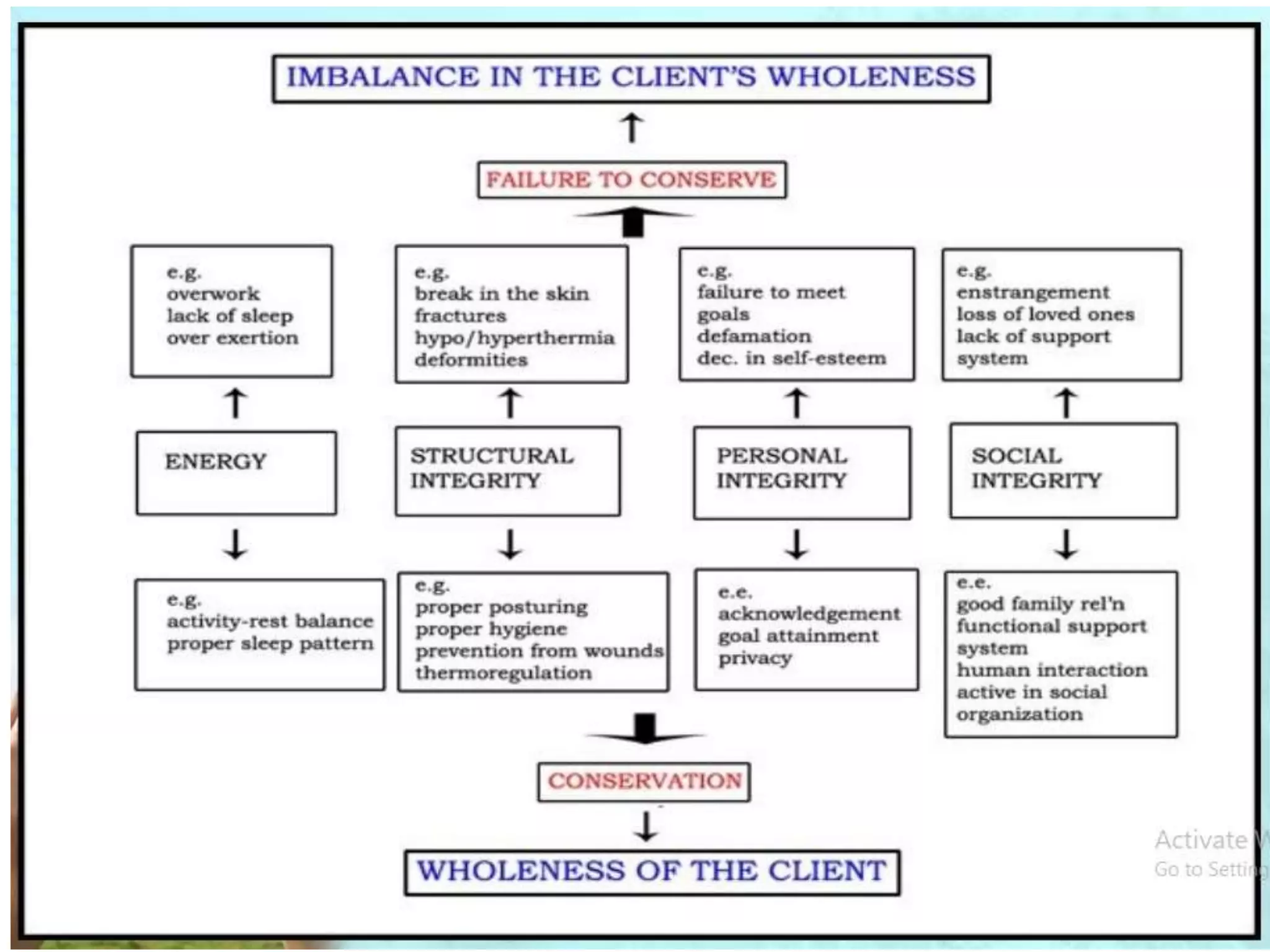
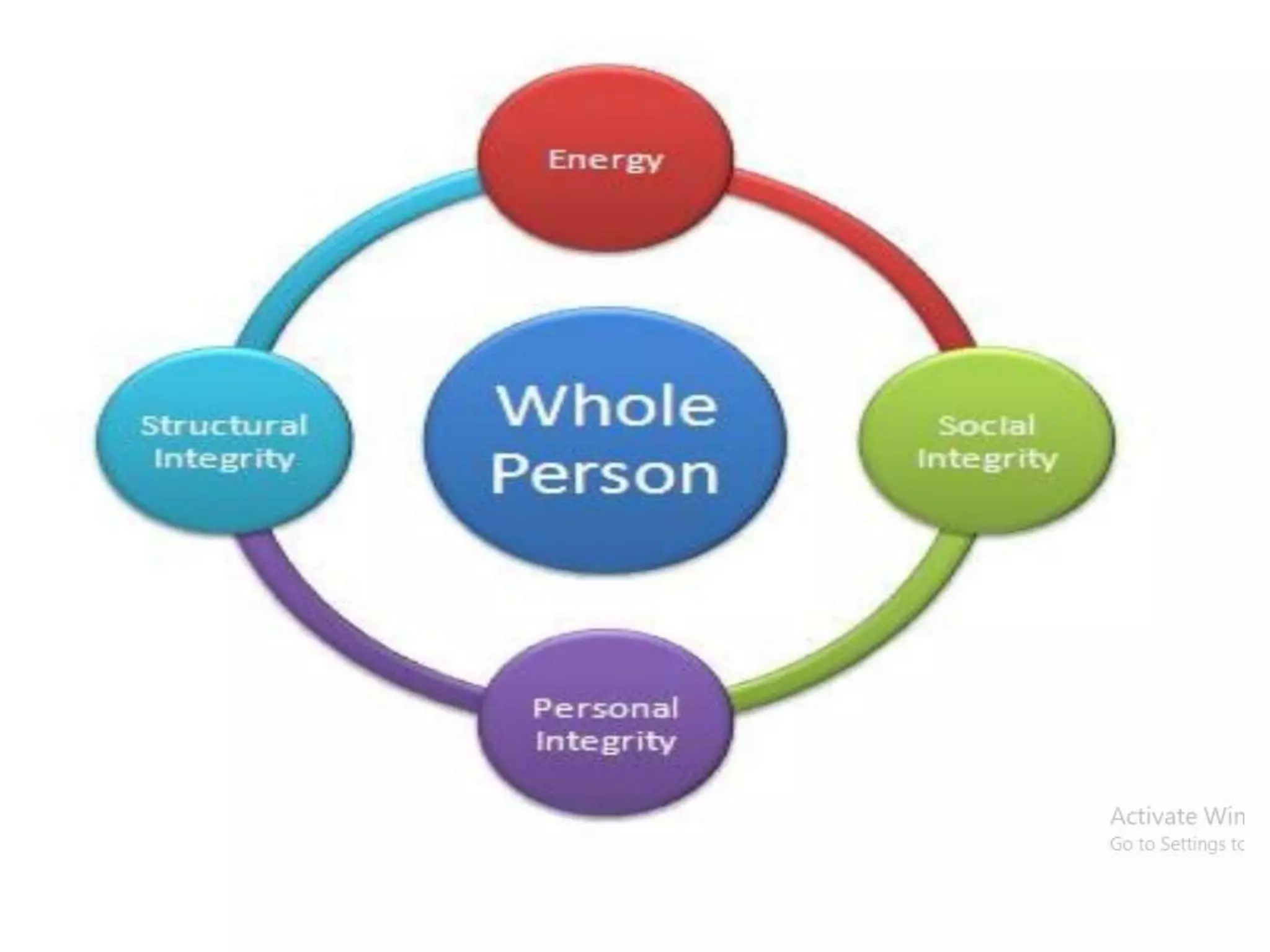
Conservational Principle
1. Conservation of energy
2. Conservation of structural integrity
3. Conservation of personal integrity
4. Conservation of social integrity
1. Conservation of energy
• Refers to balancing energy input and output to
avoid excessive fatigue
• includes adequate rest, nutrition and exercise
Example:
• Availability of adequate rest
• Maintenance of adequate nutrition
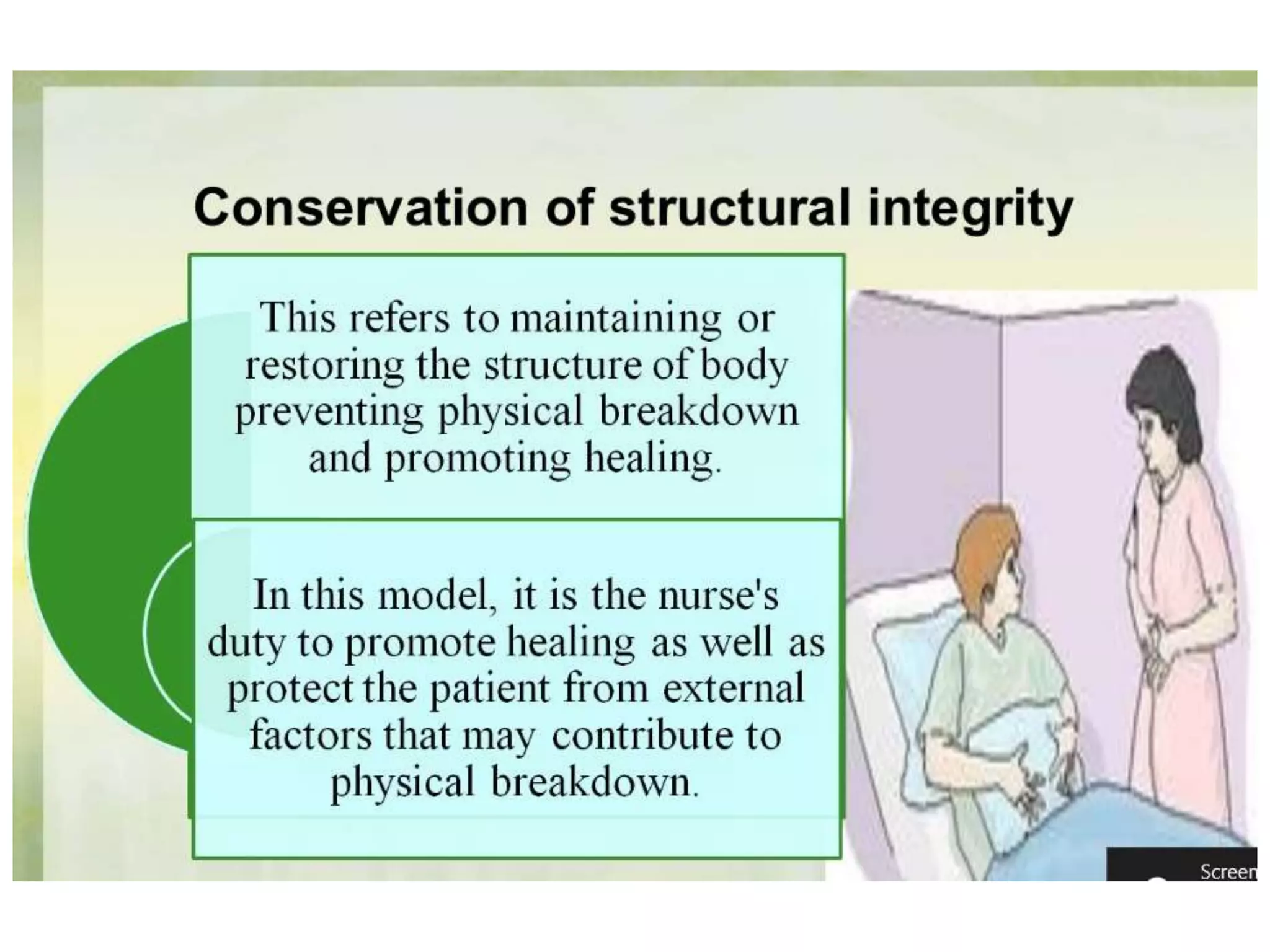
2. Conservation of structural integrity
• Refers to maintaining or restoring the structure
of body preventing physical breakdown And
promoting healing
Example:
• Assist patient in ROM exercise
• Maintenance of patient’s personal hygiene.
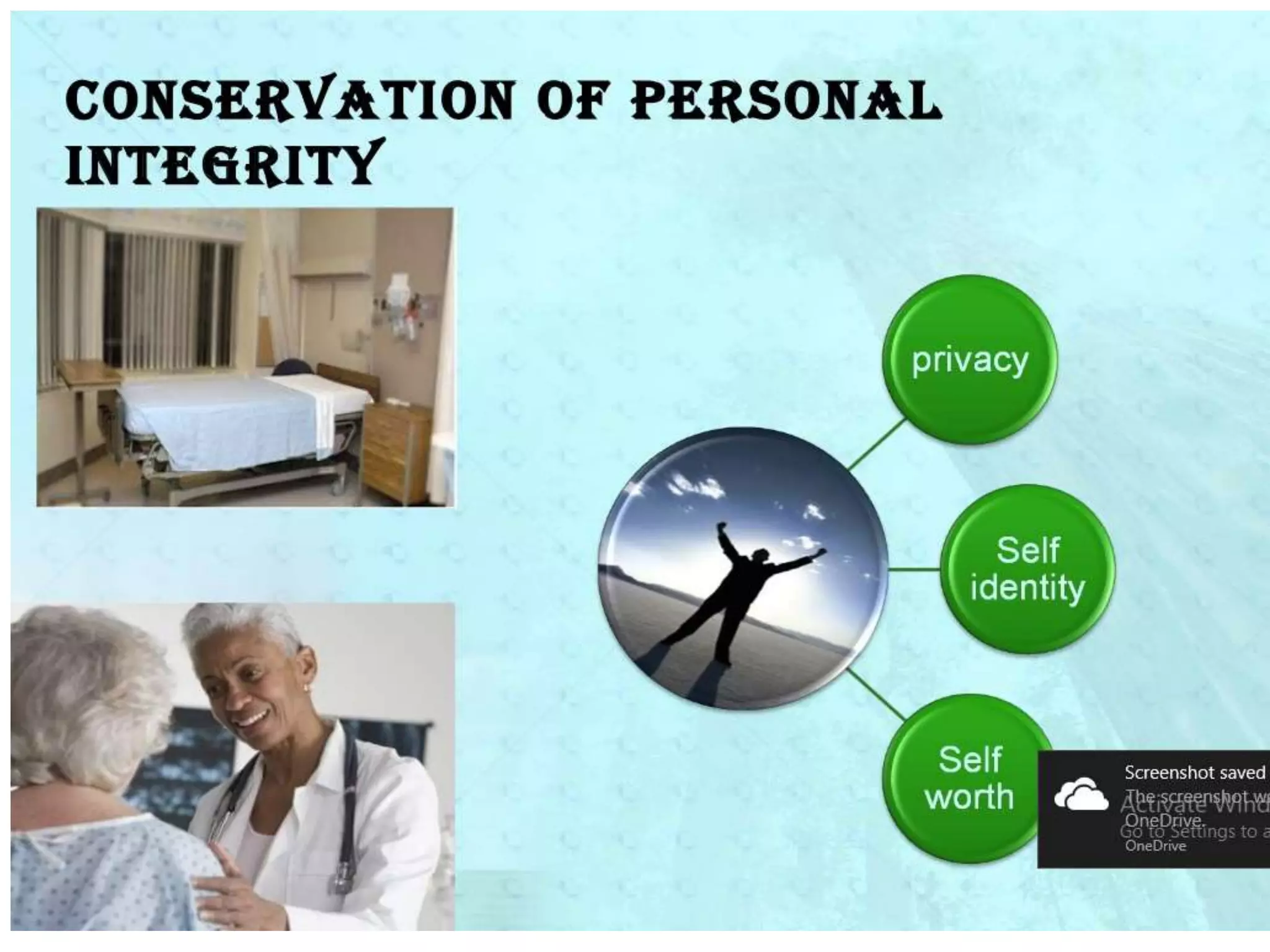
3. Conservation of personal integrity
• Recognizes the individual as one who strives
for recognition, respect, self awareness,
selfhood and self determination
Example:
• Recognize and protect patient’s space needs.
4. Conservation of social integrity
• An individual is recognized as some one who
resides with in a family, a community ,a religious
group, an ethnic group, a political system and a
nation
Example:
• Position patient in bed to foster social interaction
with other patients
• Avoid sensory deprivation
• Promote patient’s use of news paper, magazines,
radio. TV
• Provide support and assistance to family.
Health
• Health is a wholeness and successful adaptation
• It is not merely healing of an afflicted part ,it is
return to daily activities, selfhood and the ability
of the individual to pursue once more his or her
own interest without constraints
• Disease: It is unregulated and undisciplined
change and must be stopped or death will ensue
Nursing
"Nursing is a profession as well as an academic
discipline, always practiced and studied in concert
with all of the disciplines that together from the
health sciences“
• The human interaction relying on communication,
rooted in the organic dependency of the individual
human being in his relationships with other human
beings
• Nursing involves engaging in "human interactions“.
Goal of Nursing
• To promote wholeness, realizing that every
individual requires a unique and separate cluster
of activities
• The individual integrity is his abiding concern
and it is the nurse’s responsibility to assist him to
defend and to seek its realization
Nursing Process
1. Assessment
2. Trophicognosis
3. Hypothesis
4. Interventions
5. Evaluation
Conservational models
• Conservational model provides the
basis for development of two theories
–Theory of redundancy
–Theory of therapeutic intention
Theory of redundancy
• Untested, speculative theory that redefined
aging and everything else that has to do with
human life
• Aging is diminished availability of redundant
system necessary for effective maintenance of
physical and social well being
Theory of therapeutic intention
• Goal: To seek a way of organizing nursing
interventions out of the biological realities which
the nurse has to confront
• Therapeutic regimens should support the
following goals:
• Facilitate healing through natural response to
disease
• Provide support for a failing auto regulatory
portion of the integrated system
• Restore individual integrity and well being.
Limitation
• Nurse has the responsibility for determining the
patient ability to participate in the care, and if the
perception of nurse and patient about the patient
ability to participate in care don’t match, this
mismatch will be an area of conflict.
• The major limitation is the focus on individual in
an illness state and on the dependency of patient.
Research Highlights
• A theory of health promotion for preterm infants
based on conservational model of nursing.
Nursing science quarterly,2004 Jul,17 (3):The
article describes a new middle range theory of
health promotion for preterm infants based on
Levine’s conservational model that can be used
to guide neonatal nursing practice.
APPLICATIONS
Nursing research
Principles of conservation have been used for
data collection in various researches
• Conservational model was used by Hanson et
al.in their study of incidence and prevalence of
pressure ulcers in hospice patient
• Newport (n.d.) used principle of conservation
of energy and social integrity for comparing
the body temperature of infant’s who had been
placed on mother’s chest immediately after
birth with those who were placed in warmer.
Nursing education
Conservational model was used as guidelines for
curriculum development
• It was used to develop nursing undergraduate
program at Allentown college of St. Francis de
Sales, Pennsylvania
• Used in nursing education program sponsored by
Kapat Holim in Israel
Nursing administration
• Taylor (n.d.) described an assessment guide for
data collection of neurological patients which
forms basis for development of comprehensive
nursing care plan and thus evaluate nursing care
• McCall (n.d.) developed an assessment tool for
data collection on the basis of four conservational
principles to identify nursing care needs of
epileptic patients
• Family assessment tool was designed by Lynn-
Mchale and Smith (n.d.) for families of patient in
critical care setting.
Nursing practice
• Conservational model has been used for nursing
practice in different settings
• Bayley (n.d.) discussed the care of a severely
burned teenagers on the basis of four
conservational principles and discussed patient’s
perceptual, operational and conceptual
environment
• Pond (n.d.) used conservation model for guiding
the nursing care of homeless at a clinic, shelters or
streets.
Nursing Process
• Assessment
Collection of provocative facts through
observation and interview of challenges to the
internal and external environment using four
conservation principles
• Nurses observes patient for organismic responses
to illness, reads medical reports. talks to patient
and family
• Assesses factors which challenges the individual.
Trophicognosis
• Nursing diagnosis-gives provocative facts
meaning
• A nursing care judgment arrived at through the
use of the scientific process
• Judgment is made about patient’s needs for
assistance.
Hypothesis
Planning
• Nurse proposes hypothesis about the problems
and the solutions which becomes the plan of
care
• Goal is to maintain wholeness and promoting
adaptation.
Interventions
• Testing the hypothesis
• Interventions are designed based on the
conservation principles
• Mutually acceptable
• Goal is to maintain wholeness and promoting
adaptation.
Evaluation
Observation of organismic response to
interventions
• It is assesses whether hypothesis is supported
or not supported
• If not supported, plan is revised, new
hypothesis is proposed.
Summary
• To summarize, Levine expressed the view that within
the nurse-patient relationship a patient’s state of health
is dependent on the nurse-supported process of
adaptation.
• This guides nurses to focus on the influences and
responses of a client to promote wholeness through the
Conservation Principles.
• The goal of this model is to accomplish this through the
conservation of energy, structural, personal and social
integrity.
• The goal of nursing is to recognize, assist, promote, and
support adaptive processes that benefit the patient.
APPLICATION OF
THEORY in nursing
process
• http://nursingtheories.blogspot.in/2009/07/m
yra-levines-conservation-theory.html
• http://currentnursing.com/nursing_theory/Le
vin_four_conservation_principles.html

Levine's four conservation principles

  • 2.
    INTRODUCTION The nursing professionis continuously evolving and dynamic. Ever since Florence Nightingale started writing her notes on nursing, more theories and models about the nursing profession flourished during the last decade; one of these is Myra Levine’s Conservational Theory which was completed on 1973.
  • 3.
  • 5.
    Myra Levine's ConservationTheory • "Ethical behavior is not the display of one's moral rectitude in times of crisis, it is the day- to-day expression of one's commitment to other persons and the ways in which human beings relate to one another in their daily interactions." - Levine, Myra (1972) .
  • 9.
    Major Concepts ofConservational model • Goal of the model is to promote adaptation and maintain wholeness using the principles of conservation • Model guides the nurse to focus on the influences and responses at the organismic level • Nurse accomplishes the goal of model through the conservation of energy, structure and personal and social integrity.
  • 11.
    Adaptation • Every individualhas a unique range of adaptive responses • The responses will vary by heredity, age, gender or challenges of illness experiences • While the responses are same, the timing and manifestation of organismic responses will be unique for each individual pulse rate. • An ongoing process of change in which patient maintains his integrity within the realities of environment • Achieved through the "frugal, economic, contained and controlled use of environmental resources by individual in his or her best interest“.
  • 13.
    Wholeness • Exist whenthe interaction or constant adaptations to the environment permits the assurance of integrity • Promoted by use of conservation principle
  • 15.
    Conservation • The productof adaptation • "Keeping together "of the life systems or the wholeness of the individual • Achieving a balance of energy supply and demand that is with in the unique biological realities of the individual.
  • 16.
    Nursing’s paradigm Person • Aholistic being who constantly strives to preserve wholeness and integrity. • A unique individual in unity and integrity, feeling, believing, thinking and whole system of system.
  • 17.
    Environment Competes the wholenessof person • Internal –Homeostasis –Homeorrhesis • External –Preconceptual –Operational –Conceptual
  • 18.
    Internal Environment • Homeostasis –A state of energy sparing that also provide the necessary baselines for a multitude of synchronized physiological and psychological factors – A state of conservation
  • 19.
    • Homeorrhesis –A stabilizedflow rather than a static state –Emphasis the fluidity of change within a space- time continuum –Describe the pattern of adaptation, which permit the individual’s body to sustain its well being with the vast changes which encroach upon it from the environment.
  • 20.
    External Environment • Preconceptual –Aspect of the world that individual are able to intercept • Operational – Elements that may physically affects individuals but not perceived by hem: radiation, micro-organism and pollution • Conceptual – Part of person's environment including cultural patterns characterized by spiritual existence, ideas, values, beliefs and tradition
  • 21.
    Person and environment •Adaptation • Organismic response • Conservation
  • 23.
    Adaptation Characteristics • Historicity: Adaptationsare grounded in history and await the challenges to which they respond • Specificity: Individual responses and their adaptive pattern varies on the base of specific genetic structure • Redundancy: Safe and fail options available to the individual to ensure continued adaptation.
  • 24.
    Organismic response • Achange in behavior of an individual during an attempt to adapt to the environment • Help individual to protect and maintain their integrity • They co-exist • They are four types:
  • 25.
    • 1. Flightor fight: An instantaneous response to real or imagined threat, most primitive response • 2. Inflammatory: response intended to provide for structural integrity and the promotion of healing • 3. Stress: Response developed over time and influenced by each stressful experience encountered by person • 4. Perceptual: Involves gathering information from the environment and converting it in to a meaning experience.
  • 26.
    Nine models ofguided assessment • Vital’s signs • Body movement and positioning • Ministration of personal hygiene needs • Pressure gradient system in nursing interventions • Nursing determination in provision of nutritional needs • Pressure gradient system in nursing • Local application of heat and cold • Administration of medicine • Establishing an aseptic environment
  • 27.
    Assumption 1. The nursecreates an environment in which healing could occur 2. A human being is more than the sum of the part 3. Human being respond in a predictable way 4. Human being are unique in their responses 5. Human being know and appraise objects ,condition and situation 6. Human being sense, reflects, reason and understand 7. human being action are self determined even when emotional 8. Human being are capable of prolonging reflection through such strategists raising questions.
  • 28.
    Characteristics of theory 1.The concept of illness adaptation, using interventions, and the evaluation of nursing interventions are interrelated. 2. Concepts are sequential and logical and can be used to explain the consequences of nursing action. 3. Levine’s theory is easy to use and elements are easily comprehensible.
  • 29.
    4. Levine’s ideacan be tested and hypothesis can be derived from them. 5. The principle of conservation are specific enough to be testable 6. Levine’s idea have not yet been widely researched. 7. Levine's theory has been applied in surgical settings. 8. Levine’s ideas are consistent with other theories, laws and principles particularly those from the humanities and sciences.
  • 30.
    Conservational Principle 1. Conservationof energy 2. Conservation of structural integrity 3. Conservation of personal integrity 4. Conservation of social integrity
  • 35.
    1. Conservation ofenergy • Refers to balancing energy input and output to avoid excessive fatigue • includes adequate rest, nutrition and exercise Example: • Availability of adequate rest • Maintenance of adequate nutrition
  • 36.
    2. Conservation ofstructural integrity • Refers to maintaining or restoring the structure of body preventing physical breakdown And promoting healing Example: • Assist patient in ROM exercise • Maintenance of patient’s personal hygiene.
  • 42.
    3. Conservation ofpersonal integrity • Recognizes the individual as one who strives for recognition, respect, self awareness, selfhood and self determination Example: • Recognize and protect patient’s space needs.
  • 46.
    4. Conservation ofsocial integrity • An individual is recognized as some one who resides with in a family, a community ,a religious group, an ethnic group, a political system and a nation Example: • Position patient in bed to foster social interaction with other patients • Avoid sensory deprivation • Promote patient’s use of news paper, magazines, radio. TV • Provide support and assistance to family.
  • 50.
    Health • Health isa wholeness and successful adaptation • It is not merely healing of an afflicted part ,it is return to daily activities, selfhood and the ability of the individual to pursue once more his or her own interest without constraints • Disease: It is unregulated and undisciplined change and must be stopped or death will ensue
  • 51.
    Nursing "Nursing is aprofession as well as an academic discipline, always practiced and studied in concert with all of the disciplines that together from the health sciences“ • The human interaction relying on communication, rooted in the organic dependency of the individual human being in his relationships with other human beings • Nursing involves engaging in "human interactions“.
  • 52.
    Goal of Nursing •To promote wholeness, realizing that every individual requires a unique and separate cluster of activities • The individual integrity is his abiding concern and it is the nurse’s responsibility to assist him to defend and to seek its realization
  • 53.
    Nursing Process 1. Assessment 2.Trophicognosis 3. Hypothesis 4. Interventions 5. Evaluation
  • 54.
    Conservational models • Conservationalmodel provides the basis for development of two theories –Theory of redundancy –Theory of therapeutic intention
  • 55.
    Theory of redundancy •Untested, speculative theory that redefined aging and everything else that has to do with human life • Aging is diminished availability of redundant system necessary for effective maintenance of physical and social well being
  • 56.
    Theory of therapeuticintention • Goal: To seek a way of organizing nursing interventions out of the biological realities which the nurse has to confront • Therapeutic regimens should support the following goals: • Facilitate healing through natural response to disease • Provide support for a failing auto regulatory portion of the integrated system • Restore individual integrity and well being.
  • 57.
    Limitation • Nurse hasthe responsibility for determining the patient ability to participate in the care, and if the perception of nurse and patient about the patient ability to participate in care don’t match, this mismatch will be an area of conflict. • The major limitation is the focus on individual in an illness state and on the dependency of patient.
  • 58.
    Research Highlights • Atheory of health promotion for preterm infants based on conservational model of nursing. Nursing science quarterly,2004 Jul,17 (3):The article describes a new middle range theory of health promotion for preterm infants based on Levine’s conservational model that can be used to guide neonatal nursing practice.
  • 59.
    APPLICATIONS Nursing research Principles ofconservation have been used for data collection in various researches • Conservational model was used by Hanson et al.in their study of incidence and prevalence of pressure ulcers in hospice patient • Newport (n.d.) used principle of conservation of energy and social integrity for comparing the body temperature of infant’s who had been placed on mother’s chest immediately after birth with those who were placed in warmer.
  • 60.
    Nursing education Conservational modelwas used as guidelines for curriculum development • It was used to develop nursing undergraduate program at Allentown college of St. Francis de Sales, Pennsylvania • Used in nursing education program sponsored by Kapat Holim in Israel
  • 61.
    Nursing administration • Taylor(n.d.) described an assessment guide for data collection of neurological patients which forms basis for development of comprehensive nursing care plan and thus evaluate nursing care • McCall (n.d.) developed an assessment tool for data collection on the basis of four conservational principles to identify nursing care needs of epileptic patients • Family assessment tool was designed by Lynn- Mchale and Smith (n.d.) for families of patient in critical care setting.
  • 62.
    Nursing practice • Conservationalmodel has been used for nursing practice in different settings • Bayley (n.d.) discussed the care of a severely burned teenagers on the basis of four conservational principles and discussed patient’s perceptual, operational and conceptual environment • Pond (n.d.) used conservation model for guiding the nursing care of homeless at a clinic, shelters or streets.
  • 63.
    Nursing Process • Assessment Collectionof provocative facts through observation and interview of challenges to the internal and external environment using four conservation principles • Nurses observes patient for organismic responses to illness, reads medical reports. talks to patient and family • Assesses factors which challenges the individual.
  • 64.
    Trophicognosis • Nursing diagnosis-givesprovocative facts meaning • A nursing care judgment arrived at through the use of the scientific process • Judgment is made about patient’s needs for assistance.
  • 65.
    Hypothesis Planning • Nurse proposeshypothesis about the problems and the solutions which becomes the plan of care • Goal is to maintain wholeness and promoting adaptation.
  • 66.
    Interventions • Testing thehypothesis • Interventions are designed based on the conservation principles • Mutually acceptable • Goal is to maintain wholeness and promoting adaptation.
  • 67.
    Evaluation Observation of organismicresponse to interventions • It is assesses whether hypothesis is supported or not supported • If not supported, plan is revised, new hypothesis is proposed.
  • 69.
    Summary • To summarize,Levine expressed the view that within the nurse-patient relationship a patient’s state of health is dependent on the nurse-supported process of adaptation. • This guides nurses to focus on the influences and responses of a client to promote wholeness through the Conservation Principles. • The goal of this model is to accomplish this through the conservation of energy, structural, personal and social integrity. • The goal of nursing is to recognize, assist, promote, and support adaptive processes that benefit the patient.
  • 70.
    APPLICATION OF THEORY innursing process
  • 71.