‘
TOPIC
ON
COORDINATIONAS AMANAGEMENT FUNCTION
Presented by:
Mr. Manjunath. Beth
Associate professor
&
HOD OF MSN DEPARTMENT
COORDINATION AS A MANAGEMENT
FUNCTION
Presented By: Mr. Manjunath. M. Beth (Lecturer) Dept: Med-Sur-Nsg
INTRODUCTION
Presented By: Mr. Manjunath. M. Beth (Lecturer) Dept: Med-Sur-Nsg
Introduction
• Coordination is considered as an essential element
of administration.
• Coordination is the integration, synchronisation or
orderly pattern of group efforts in the institution
towards the accomplishment of common
objectives.
• The concept of co-ordination is much broader than
that of co-operation.
Presented By: Mr. Manjunath. M. Beth (Lecturer) Dept: Med-Sur-Nsg
DEFINITION
• "Co-ordination is the orderly synchronization of
efforts to provide the proper amount, timing, and
directing execution resulting in harmonious and and
unified actions to a stated objective"
• "Co-ordination is the integration of several parts into
an orderly whole to achieve the purpose of
undertaking"
• "Co-ordination is the integrating process in an orderly
pattern of group efforts in an organization toward the
accomplishment of a common objective"
Presented By: Mr. Manjunath. M. Beth (Lecturer) Dept: Med-Sur-Nsg
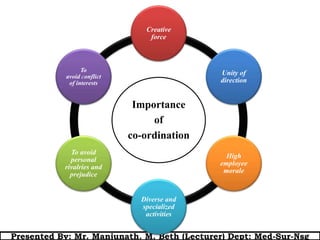
Importance
of
co-ordination
Creative
force
Unity of
direction
High
employee
morale
Diverse and
specialized
activities
To avoid
personal
rivalries and
prejudice
To
avoid conflict
of interests
Importance of co-ordination
1. Creative force
• Group efforts when coordinated create a result greater than
the sum total of the individual and isolated.
2. Unity of direction
• co-ordination ensures unity if direction by way of securing
spontaneous collaboration on the part of different
departments.
3. High employee morale
• co-ordination enhances the general level of employee
morale and provides satisfaction
Presented By: Mr. Manjunath. M. Beth (Lecturer) Dept: Med-Sur-Nsg
4. Diverse and specialized activities
• Total activities of an organisation are divided into several
units and subunits on the basis of either product
specialisation.
5. To avoid personal rivalries and prejudice
• human organisation give rise in course of time to the
development of personality politics among members.
6. To avoid conflict of interests
• Subordination of individual interest to general interest
often happen in organizations. There is need for
coordination to avoid conflicts or overlapping in the work
of employees or units or as organisation.
Presented By: Mr. Manjunath. M. Beth (Lecturer) Dept: Med-Sur-Nsg
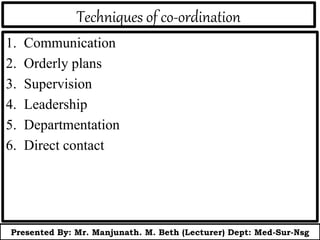
Techniques of co-ordination
1. Communication
2. Orderly plans
3. Supervision
4. Leadership
5. Departmentation
6. Direct contact
Presented By: Mr. Manjunath. M. Beth (Lecturer) Dept: Med-Sur-Nsg
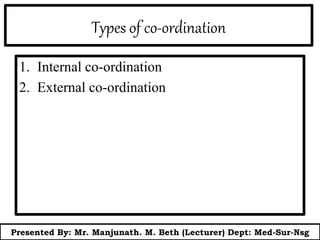
Types of co-ordination
1. Internal co-ordination
2. External co-ordination
Presented By: Mr. Manjunath. M. Beth (Lecturer) Dept: Med-Sur-Nsg
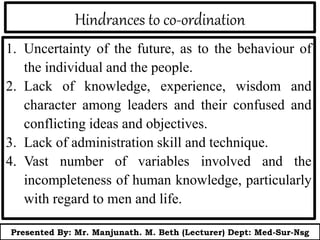
Hindrances to co-ordination
1. Uncertainty of the future, as to the behaviour of
the individual and the people.
2. Lack of knowledge, experience, wisdom and
character among leaders and their confused and
conflicting ideas and objectives.
3. Lack of administration skill and technique.
4. Vast number of variables involved and the
incompleteness of human knowledge, particularly
with regard to men and life.
Presented By: Mr. Manjunath. M. Beth (Lecturer) Dept: Med-Sur-Nsg
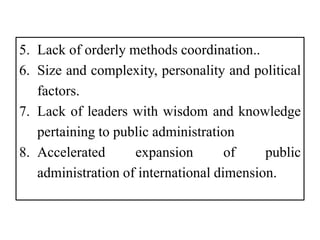
5. Lack of orderly methods coordination..
6. Size and complexity, personality and political
factors.
7. Lack of leaders with wisdom and knowledge
pertaining to public administration
8. Accelerated expansion of public
administration of international dimension.
Coordination Applied to Nursing Management
1. Health care system consists of different categories
of health personnel which requires intense
coordination to function it effectively.
2. Nursing service is often the largest group of health
personnel with wide range of functions and skills.
3. Effective coordination of nursing services and
patient care will lead to patient satisfaction, better
quality of service and patient outcomes.
Presented By: Mr. Manjunath. M. Beth (Lecturer) Dept: Med-Sur-Nsg
Coordination as a management function

Coordination as a management function

  • 2.
    ‘ TOPIC ON COORDINATIONAS AMANAGEMENT FUNCTION Presentedby: Mr. Manjunath. Beth Associate professor & HOD OF MSN DEPARTMENT
  • 3.
    COORDINATION AS AMANAGEMENT FUNCTION Presented By: Mr. Manjunath. M. Beth (Lecturer) Dept: Med-Sur-Nsg
  • 4.
    INTRODUCTION Presented By: Mr.Manjunath. M. Beth (Lecturer) Dept: Med-Sur-Nsg
  • 5.
    Introduction • Coordination isconsidered as an essential element of administration. • Coordination is the integration, synchronisation or orderly pattern of group efforts in the institution towards the accomplishment of common objectives. • The concept of co-ordination is much broader than that of co-operation. Presented By: Mr. Manjunath. M. Beth (Lecturer) Dept: Med-Sur-Nsg
  • 6.
    DEFINITION • "Co-ordination isthe orderly synchronization of efforts to provide the proper amount, timing, and directing execution resulting in harmonious and and unified actions to a stated objective" • "Co-ordination is the integration of several parts into an orderly whole to achieve the purpose of undertaking" • "Co-ordination is the integrating process in an orderly pattern of group efforts in an organization toward the accomplishment of a common objective" Presented By: Mr. Manjunath. M. Beth (Lecturer) Dept: Med-Sur-Nsg
  • 7.
    Presented By: Mr.Manjunath. M. Beth (Lecturer) Dept: Med-Sur-Nsg Importance of co-ordination Creative force Unity of direction High employee morale Diverse and specialized activities To avoid personal rivalries and prejudice To avoid conflict of interests
  • 8.
    Importance of co-ordination 1.Creative force • Group efforts when coordinated create a result greater than the sum total of the individual and isolated. 2. Unity of direction • co-ordination ensures unity if direction by way of securing spontaneous collaboration on the part of different departments. 3. High employee morale • co-ordination enhances the general level of employee morale and provides satisfaction Presented By: Mr. Manjunath. M. Beth (Lecturer) Dept: Med-Sur-Nsg
  • 9.
    4. Diverse andspecialized activities • Total activities of an organisation are divided into several units and subunits on the basis of either product specialisation. 5. To avoid personal rivalries and prejudice • human organisation give rise in course of time to the development of personality politics among members. 6. To avoid conflict of interests • Subordination of individual interest to general interest often happen in organizations. There is need for coordination to avoid conflicts or overlapping in the work of employees or units or as organisation. Presented By: Mr. Manjunath. M. Beth (Lecturer) Dept: Med-Sur-Nsg
  • 10.
    Techniques of co-ordination 1.Communication 2. Orderly plans 3. Supervision 4. Leadership 5. Departmentation 6. Direct contact Presented By: Mr. Manjunath. M. Beth (Lecturer) Dept: Med-Sur-Nsg
  • 11.
    Types of co-ordination 1.Internal co-ordination 2. External co-ordination Presented By: Mr. Manjunath. M. Beth (Lecturer) Dept: Med-Sur-Nsg
  • 12.
    Hindrances to co-ordination 1.Uncertainty of the future, as to the behaviour of the individual and the people. 2. Lack of knowledge, experience, wisdom and character among leaders and their confused and conflicting ideas and objectives. 3. Lack of administration skill and technique. 4. Vast number of variables involved and the incompleteness of human knowledge, particularly with regard to men and life. Presented By: Mr. Manjunath. M. Beth (Lecturer) Dept: Med-Sur-Nsg
  • 13.
    5. Lack oforderly methods coordination.. 6. Size and complexity, personality and political factors. 7. Lack of leaders with wisdom and knowledge pertaining to public administration 8. Accelerated expansion of public administration of international dimension.
  • 14.
    Coordination Applied toNursing Management 1. Health care system consists of different categories of health personnel which requires intense coordination to function it effectively. 2. Nursing service is often the largest group of health personnel with wide range of functions and skills. 3. Effective coordination of nursing services and patient care will lead to patient satisfaction, better quality of service and patient outcomes. Presented By: Mr. Manjunath. M. Beth (Lecturer) Dept: Med-Sur-Nsg