GROUNDED THEORY
DR.MAHESWARI JAIKUMAR
• Is an inductive technique
developed for health related
topics by GLOSER & STRAUSS
(1967).
• GROUNDED THEORY means that
the theory developed from the
research is “grounded” or has it’s
roots in the data from which it
was derived.
CHARACTERISTICS
• The main focus is on developing
social experiences that characterize
a particular event or a
phenomenon.
• The theory suggests that there
should be a continuous interplay
between data collection & data
analysis
• The grounded theory allows the
researcher to develop a
theoretical account of the
general features of a topic
• ……….. while simultaneously
grounding the account in the
empirical observation or data.
• Grounded theory begins with
a research situation.
• Within that situation the task
of a researcher is to
understand what is happening
there. (core variable) & how
players manage their role.
• After each hour of data
collection, the investigator notes
down the key issues. This is
known as NOTE TAKING.
• Constant comparison is made.
• From this comparison theory
emerges.
• Researchers compare the initial data
to the theory & the results of
comparison are written in the
margin of the notes, taken as codes.
• The researcher’s identify categories
& their properties from these codes.
• There may be links between
categories or a core category may
emerge.
• The researcher writes further
notes about this theory, which is
called MEMOING.
• The researcher groups memo
line by line & sequences them in
an order that will make the
theory clearer.
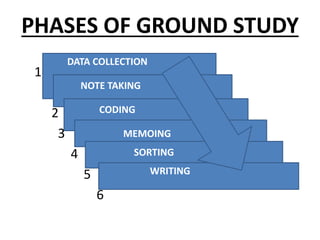
PHASES OF GROUND STUDY
1
2
3
4
5
6
DATA COLLECTION
NOTE TAKING
CODING
MEMOING
SORTING
WRITING
METHODOLOGY
• The steps of grounded theory
occurs simultaneously.
• Constant comparison is an
important methodological
technique.
SOURCES OF DATA COLLECTION
• The researcher uses his/her – all
senses.
• A lot of information can be learned
by simple observation.
• Sources of data collection varies
with the focus of enquiry, purpose
of investigation & guidelines of
research approach being used.
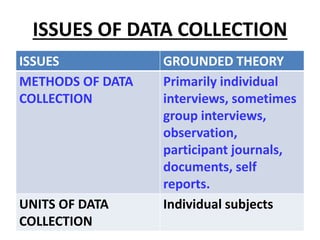
ISSUES OF DATA COLLECTION
ISSUES GROUNDED THEORY
METHODS OF DATA
COLLECTION
Primarily individual
interviews, sometimes
group interviews,
observation,
participant journals,
documents, self
reports.
UNITS OF DATA
COLLECTION
Individual subjects
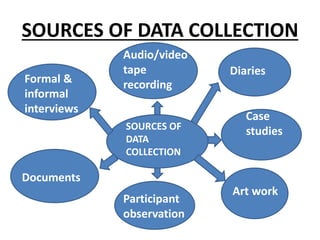
SOURCES OF DATA COLLECTION
SOURCES OF
DATA
COLLECTION
Audio/video
tape
recording
Diaries
Case
studies
Art work
Participant
observation
Formal &
informal
interviews
Documents
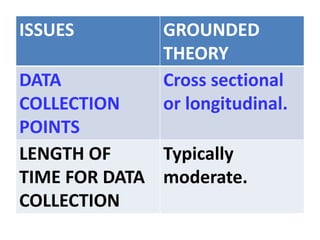
ISSUES GROUNDED
THEORY
DATA
COLLECTION
POINTS
Cross sectional
or longitudinal.
LENGTH OF
TIME FOR DATA
COLLECTION
Typically
moderate.
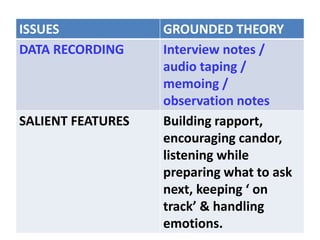
ISSUES GROUNDED THEORY
DATA RECORDING Interview notes /
audio taping /
memoing /
observation notes
SALIENT FEATURES Building rapport,
encouraging candor,
listening while
preparing what to ask
next, keeping ‘ on
track’ & handling
emotions.
DATA ANALYSIS
• Usually the sample size is 25 -50 &
data are collected by in depth
interviews, data collection notes,
typed interview transcripts or video
taped / audio taped conversations
that contain multiple pieces of data
to be stored & analyzed.
• The process is initiated by
coding & categorizing the
data.
• There are several types of
coding : OPEN, AXIAL &
SELECTIVE CODING.
OPEN CODING
• Open coding is concerned with
identifying, naming, categorizing &
describing phenomenon found in
the text.
• Each line or a paragraph is read in
search of the answer to the
repeated questions.
AXIAL CODING
• Is a process of relating
(categories & properties) to each
other via inductive & deductive
thinking.
• The ground theorist emphasize
causal relationship & fit things
into a basic frame of generic
relationship
SELECTION CODING
• Is the process of choosing one
category to be the core category &
relating all other categories to that
category.
• The essential idea is to find the
driver that implies the story
forward.
TYPES OF GROUND THEORY
1. SUBSTANTIVE THEORY.
2.FORMAL THEORY.
SUBSTANTIVE THEORY
1.Is grounded in data on a specific
substantive area. (such as post
partum depression).
2.Substantive theory serves as a
spring board foe developing a
higher abstract level of
theory.(custom tailored clothing)
FORMAL THEORY
• Is opposite of substantive theory.
(Ready to wear clothing)
EXAMPLE
• A grounded theory to look into
how parents coped with difficult
times when caring for a
chronically ill child
THANK YOU

GROUNDED THEORY

  • 1.
  • 2.
    • Is aninductive technique developed for health related topics by GLOSER & STRAUSS (1967). • GROUNDED THEORY means that the theory developed from the research is “grounded” or has it’s roots in the data from which it was derived.
  • 3.
    CHARACTERISTICS • The mainfocus is on developing social experiences that characterize a particular event or a phenomenon. • The theory suggests that there should be a continuous interplay between data collection & data analysis
  • 4.
    • The groundedtheory allows the researcher to develop a theoretical account of the general features of a topic • ……….. while simultaneously grounding the account in the empirical observation or data.
  • 5.
    • Grounded theorybegins with a research situation. • Within that situation the task of a researcher is to understand what is happening there. (core variable) & how players manage their role.
  • 6.
    • After eachhour of data collection, the investigator notes down the key issues. This is known as NOTE TAKING. • Constant comparison is made. • From this comparison theory emerges.
  • 7.
    • Researchers comparethe initial data to the theory & the results of comparison are written in the margin of the notes, taken as codes. • The researcher’s identify categories & their properties from these codes. • There may be links between categories or a core category may emerge.
  • 8.
    • The researcherwrites further notes about this theory, which is called MEMOING. • The researcher groups memo line by line & sequences them in an order that will make the theory clearer.
  • 9.
    PHASES OF GROUNDSTUDY 1 2 3 4 5 6 DATA COLLECTION NOTE TAKING CODING MEMOING SORTING WRITING
  • 10.
    METHODOLOGY • The stepsof grounded theory occurs simultaneously. • Constant comparison is an important methodological technique.
  • 11.
    SOURCES OF DATACOLLECTION • The researcher uses his/her – all senses. • A lot of information can be learned by simple observation. • Sources of data collection varies with the focus of enquiry, purpose of investigation & guidelines of research approach being used.
  • 12.
    ISSUES OF DATACOLLECTION ISSUES GROUNDED THEORY METHODS OF DATA COLLECTION Primarily individual interviews, sometimes group interviews, observation, participant journals, documents, self reports. UNITS OF DATA COLLECTION Individual subjects
  • 13.
    SOURCES OF DATACOLLECTION SOURCES OF DATA COLLECTION Audio/video tape recording Diaries Case studies Art work Participant observation Formal & informal interviews Documents
  • 14.
    ISSUES GROUNDED THEORY DATA COLLECTION POINTS Cross sectional orlongitudinal. LENGTH OF TIME FOR DATA COLLECTION Typically moderate.
  • 15.
    ISSUES GROUNDED THEORY DATARECORDING Interview notes / audio taping / memoing / observation notes SALIENT FEATURES Building rapport, encouraging candor, listening while preparing what to ask next, keeping ‘ on track’ & handling emotions.
  • 16.
    DATA ANALYSIS • Usuallythe sample size is 25 -50 & data are collected by in depth interviews, data collection notes, typed interview transcripts or video taped / audio taped conversations that contain multiple pieces of data to be stored & analyzed.
  • 17.
    • The processis initiated by coding & categorizing the data. • There are several types of coding : OPEN, AXIAL & SELECTIVE CODING.
  • 18.
    OPEN CODING • Opencoding is concerned with identifying, naming, categorizing & describing phenomenon found in the text. • Each line or a paragraph is read in search of the answer to the repeated questions.
  • 19.
    AXIAL CODING • Isa process of relating (categories & properties) to each other via inductive & deductive thinking. • The ground theorist emphasize causal relationship & fit things into a basic frame of generic relationship
  • 20.
    SELECTION CODING • Isthe process of choosing one category to be the core category & relating all other categories to that category. • The essential idea is to find the driver that implies the story forward.
  • 21.
    TYPES OF GROUNDTHEORY 1. SUBSTANTIVE THEORY. 2.FORMAL THEORY.
  • 22.
    SUBSTANTIVE THEORY 1.Is groundedin data on a specific substantive area. (such as post partum depression). 2.Substantive theory serves as a spring board foe developing a higher abstract level of theory.(custom tailored clothing)
  • 23.
    FORMAL THEORY • Isopposite of substantive theory. (Ready to wear clothing)
  • 24.
    EXAMPLE • A groundedtheory to look into how parents coped with difficult times when caring for a chronically ill child
  • 25.