1Riiddhi Parmar
1 Introduction
LOREM IPSUM DOLOR SIT AMET CONSECTETUER
2 Types
LOREM IPSUM DOLOR SIT AMET CONSECTETUER
2Riiddhi Parmar
4 Definition
01 02
03
04
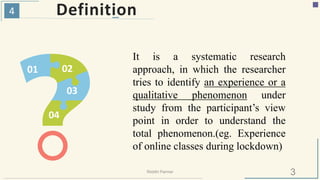
It is a systematic research
approach, in which the researcher
tries to identify an experience or a
qualitative phenomenon under
study from the participant’s view
point in order to understand the
total phenomenon.(eg. Experience
of online classes during lockdown)
3Riiddhi Parmar
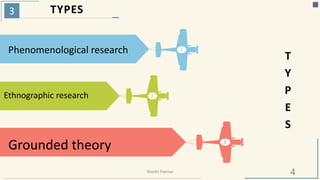
3 TYPES
1Phenomenological research
2Ethnographic research
3
Grounded theory
T
Y
P
E
S
4Riiddhi Parmar
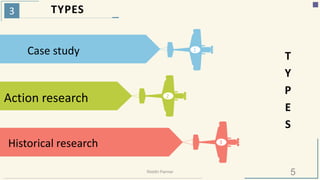
3 TYPES
1Case study
2
Action research
3Historical research
T
Y
P
E
S
5Riiddhi Parmar
Phenomenological
research
6Riiddhi Parmar
Phenomenological
Introduction
• It is a qualitative research study, which examines
& describes a phenomenon or experience through
the descriptions provided by people involved in it
(lived experience).
• Here the subjects are asked to describe their
experiences as they perceive them.
• Its aim is to know the live experiences of people
and generates the theories or model of phenomena
being studied.
• Eg: feeling of mother whose child is having final
stage of blood cancer.
01
7Riiddhi Parmar
• Bracketing: it is putting aside the ideas of the
researcher related to the phenomenon so that he
can view the experience from the subject’s point
of view.
• Data collected in this type of study may be oral or
written.
• Analysis of data requires special training by the
researcher.
• Result of such study is narrated as a series of
events from the research question
01
8Riiddhi Parmar
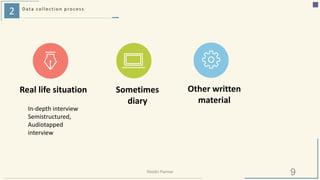
2 Data collection process
Real life situation
In-depth interview
Semistructured,
Audiotapped
interview
Sometimes
diary
Other written
material
9Riiddhi Parmar
4 EXAMPLE
EXAMPLE
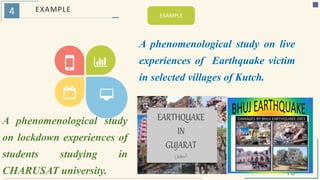
A phenomenological study on live
experiences of Earthquake victim
in selected villages of Kutch.
10Riiddhi Parmar
A phenomenological study
on lockdown experiences of
students studying in
CHARUSAT university.
Ethnography
research
11Riiddhi Parmar
Ethnography
• Harvard Business Review defines ethnography as a
“branch of anthropology that involves trying to
understand how people live their lives.”
• Ethno = people
• https://study.sagepub.com/sites/default/files/Eriksso
n%20and%20Kovalainen.pdf
• https://www.folklore.ee/folklore/vol61/youth_cultur
e.pdf
02
12Riiddhi Parmar
Ethnography
• It is the systematic process of observing, detailing,
describing, documenting & analyzing the life ways or
particular patterns of different cultures in order to
understand the culture.
• The primary purpose of ethnographic studies is to give
an in-depth description of the culture of a group being
studied from the groups point of view.
• Here, mostly the researcher lives with the group being
studied & becomes a part of their culture.
• This is method of conducting inquiry of a life process
by studying individuals, are facts or documents in their
natural setting
02
13Riiddhi Parmar
Ethnography
• Data is collected by observations, interviews, life
histories, researcher’s interpretations, etc.
• Ethnographer’s collect information from the most
knowledgeable person of the group who are called as
key informants.
• Ethnographer’s follow bracketting here also.
• Data collection & analysis is done simultaneously
02
14Riiddhi Parmar
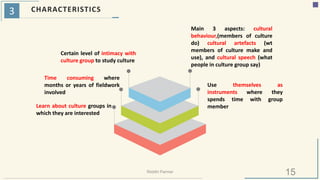
3 CHARACTERISTICS
Use themselves as
instruments where they
spends time with group
member
Certain level of intimacy with
culture group to study culture
Time consuming where
months or years of fieldwork
involved
Learn about culture groups in
which they are interested
Main 3 aspects: cultural
behaviour,(members of culture
do) cultural artefacts (wt
members of culture make and
use), and cultural speech (what
people in culture group say)
15Riiddhi Parmar
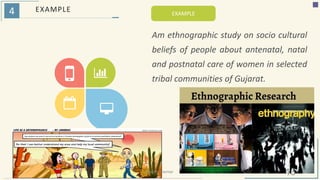
4 EXAMPLE EXAMPLE
Am ethnographic study on socio cultural
beliefs of people about antenatal, natal
and postnatal care of women in selected
tribal communities of Gujarat.
16Riiddhi Parmar
Grounded Theory
17Riiddhi Parmar
Grounded theory
• It is a systematic methodology involving construction
of theories through methodical gathering and analysis
of data.
• The theory is grounded in actual data means analysis
and development of theories happens after you have
collected data.
• In Grounded theory both collecting data & analyzing
data happen simultaneously; this is called as “constant
comparision”. Thus the theoretical formulations remains
grounded in the data.
• Here data is collected by interview or observations
• Eg: research conducted on literature review.
03
18Riiddhi Parmar
1 DATA COLLECTION
1
3
2
Group interview
Individual interview
Observation
Participants journal, documents, self
report
DATA COLLECTION
19Riiddhi Parmar
Historic research
21Riiddhi Parmar
Historical research
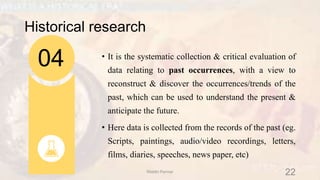
• It is the systematic collection & critical evaluation of
data relating to past occurrences, with a view to
reconstruct & discover the occurrences/trends of the
past, which can be used to understand the present &
anticipate the future.
• Here data is collected from the records of the past (eg.
Scripts, paintings, audio/video recordings, letters,
films, diaries, speeches, news paper, etc)
04
22Riiddhi Parmar
Historical research
• The data collected is checked for its
reliability & validity.
• The historians then analyze the collected
data & then give generalizations of the
research findings.
04
23Riiddhi Parmar
3 Characteristics
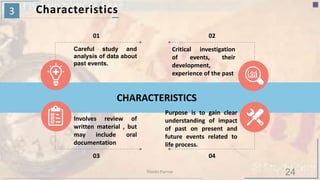
CHARACTERISTICS
01
Careful study and
analysis of data about
past events.
02
Critical investigation
of events, their
development,
experience of the past
03
Involves review of
written material , but
may include oral
documentation
04
Purpose is to gain clear
understanding of impact
of past on present and
future events related to
life process.
24Riiddhi Parmar
1 DATA COLLECTION
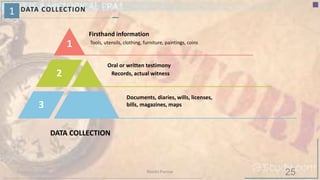
1
3
2
Tools, utensils, clothing, furniture, paintings, coins
Firsthand information
Oral or written testimony
Documents, diaries, wills, licenses,
bills, magazines, maps
DATA COLLECTION
Records, actual witness
25Riiddhi Parmar
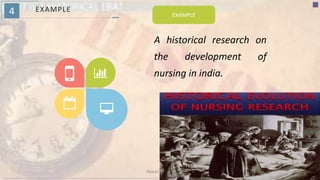
4 EXAMPLE
EXAMPLE
A historical research on
the development of
nursing in india.
26Riiddhi Parmar
Case study
27Riiddhi Parmar
Case study
• Is an in-depth examination of people, places or
institutions.
• Acc. To Robson.
• Case study is the development of detailed,
intensive knowledge about a single “case”
or a small number of related cases.
05
28Riiddhi Parmar
4 EXAMPLE
EXAMPLE
A case study on availbility
and utilization of
emergency services in
civil hospitl.
29Riiddhi Parmar
Action research
LOREM IPSUM DOLOR SIT AMET CONSECTETUER
30Riiddhi Parmar
Action research
• It is a form of applied research that tries to
empower people through a process that
constructs and uses knowledge.
• It tries to find practical solution to problems
existing in the framework of an organization.

• It increase the understanding of how change in
one’s action or practice can mutually benefits
nurses within an organization
• Changes are planned, which can be locally
implemented in particular organizaional set up.
06
31Riiddhi Parmar
Action research
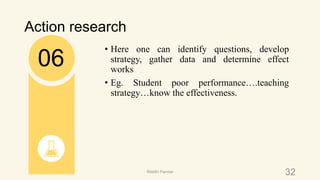
• Here one can identify questions, develop
strategy, gather data and determine effect
works
• Eg. Student poor performance….teaching
strategy…know the effectiveness.
06
32Riiddhi Parmar
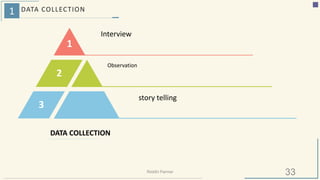
1 DATA COLLECTION
1
3
2
Interview
Observation
story telling
DATA COLLECTION
33Riiddhi Parmar
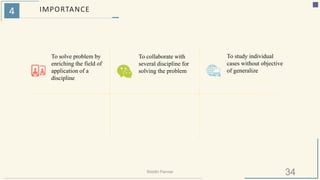
4 IMPORTANCE
To solve problem by
enriching the field of
application of a
discipline
To collaborate with
several discipline for
solving the problem
To study individual
cases without objective
of generalize
34Riiddhi Parmar
4 EXAMPLE
EXAMPLE
An action research on the practability of western
nursing practice protocols in public and private
Indian health care organizations.
Action Research Healthcare: Focus on
Patients, Improve Quality, Drive Down Costs
https://pubmed.ncbi.nlm.nih.gov/27770047/?from_t
erm=action+research&from_pos=3
35Riiddhi Parmar
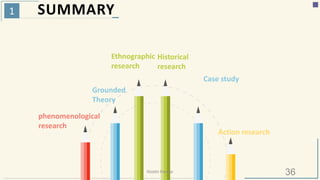
1 SUMMARY
Ethnographic
research
Action research
phenomenological
research
Case study
Historical
research
Grounded
Theory
36Riiddhi Parmar
37Riiddhi Parmar

Qualitative research design

  • 1.
  • 2.
    1 Introduction LOREM IPSUMDOLOR SIT AMET CONSECTETUER 2 Types LOREM IPSUM DOLOR SIT AMET CONSECTETUER 2Riiddhi Parmar
  • 3.
    4 Definition 01 02 03 04 Itis a systematic research approach, in which the researcher tries to identify an experience or a qualitative phenomenon under study from the participant’s view point in order to understand the total phenomenon.(eg. Experience of online classes during lockdown) 3Riiddhi Parmar
  • 4.
    3 TYPES 1Phenomenological research 2Ethnographicresearch 3 Grounded theory T Y P E S 4Riiddhi Parmar
  • 5.
    3 TYPES 1Case study 2 Actionresearch 3Historical research T Y P E S 5Riiddhi Parmar
  • 6.
  • 7.
    Phenomenological Introduction • It isa qualitative research study, which examines & describes a phenomenon or experience through the descriptions provided by people involved in it (lived experience). • Here the subjects are asked to describe their experiences as they perceive them. • Its aim is to know the live experiences of people and generates the theories or model of phenomena being studied. • Eg: feeling of mother whose child is having final stage of blood cancer. 01 7Riiddhi Parmar
  • 8.
    • Bracketing: itis putting aside the ideas of the researcher related to the phenomenon so that he can view the experience from the subject’s point of view. • Data collected in this type of study may be oral or written. • Analysis of data requires special training by the researcher. • Result of such study is narrated as a series of events from the research question 01 8Riiddhi Parmar
  • 9.
    2 Data collectionprocess Real life situation In-depth interview Semistructured, Audiotapped interview Sometimes diary Other written material 9Riiddhi Parmar
  • 10.
    4 EXAMPLE EXAMPLE A phenomenologicalstudy on live experiences of Earthquake victim in selected villages of Kutch. 10Riiddhi Parmar A phenomenological study on lockdown experiences of students studying in CHARUSAT university.
  • 11.
  • 12.
    Ethnography • Harvard BusinessReview defines ethnography as a “branch of anthropology that involves trying to understand how people live their lives.” • Ethno = people • https://study.sagepub.com/sites/default/files/Eriksso n%20and%20Kovalainen.pdf • https://www.folklore.ee/folklore/vol61/youth_cultur e.pdf 02 12Riiddhi Parmar
  • 13.
    Ethnography • It isthe systematic process of observing, detailing, describing, documenting & analyzing the life ways or particular patterns of different cultures in order to understand the culture. • The primary purpose of ethnographic studies is to give an in-depth description of the culture of a group being studied from the groups point of view. • Here, mostly the researcher lives with the group being studied & becomes a part of their culture. • This is method of conducting inquiry of a life process by studying individuals, are facts or documents in their natural setting 02 13Riiddhi Parmar
  • 14.
    Ethnography • Data iscollected by observations, interviews, life histories, researcher’s interpretations, etc. • Ethnographer’s collect information from the most knowledgeable person of the group who are called as key informants. • Ethnographer’s follow bracketting here also. • Data collection & analysis is done simultaneously 02 14Riiddhi Parmar
  • 15.
    3 CHARACTERISTICS Use themselvesas instruments where they spends time with group member Certain level of intimacy with culture group to study culture Time consuming where months or years of fieldwork involved Learn about culture groups in which they are interested Main 3 aspects: cultural behaviour,(members of culture do) cultural artefacts (wt members of culture make and use), and cultural speech (what people in culture group say) 15Riiddhi Parmar
  • 16.
    4 EXAMPLE EXAMPLE Amethnographic study on socio cultural beliefs of people about antenatal, natal and postnatal care of women in selected tribal communities of Gujarat. 16Riiddhi Parmar
  • 17.
  • 18.
    Grounded theory • Itis a systematic methodology involving construction of theories through methodical gathering and analysis of data. • The theory is grounded in actual data means analysis and development of theories happens after you have collected data. • In Grounded theory both collecting data & analyzing data happen simultaneously; this is called as “constant comparision”. Thus the theoretical formulations remains grounded in the data. • Here data is collected by interview or observations • Eg: research conducted on literature review. 03 18Riiddhi Parmar
  • 19.
    1 DATA COLLECTION 1 3 2 Groupinterview Individual interview Observation Participants journal, documents, self report DATA COLLECTION 19Riiddhi Parmar
  • 20.
  • 21.
    Historical research • Itis the systematic collection & critical evaluation of data relating to past occurrences, with a view to reconstruct & discover the occurrences/trends of the past, which can be used to understand the present & anticipate the future. • Here data is collected from the records of the past (eg. Scripts, paintings, audio/video recordings, letters, films, diaries, speeches, news paper, etc) 04 22Riiddhi Parmar
  • 22.
    Historical research • Thedata collected is checked for its reliability & validity. • The historians then analyze the collected data & then give generalizations of the research findings. 04 23Riiddhi Parmar
  • 23.
    3 Characteristics CHARACTERISTICS 01 Careful studyand analysis of data about past events. 02 Critical investigation of events, their development, experience of the past 03 Involves review of written material , but may include oral documentation 04 Purpose is to gain clear understanding of impact of past on present and future events related to life process. 24Riiddhi Parmar
  • 24.
    1 DATA COLLECTION 1 3 2 Tools,utensils, clothing, furniture, paintings, coins Firsthand information Oral or written testimony Documents, diaries, wills, licenses, bills, magazines, maps DATA COLLECTION Records, actual witness 25Riiddhi Parmar
  • 25.
    4 EXAMPLE EXAMPLE A historicalresearch on the development of nursing in india. 26Riiddhi Parmar
  • 26.
  • 27.
    Case study • Isan in-depth examination of people, places or institutions. • Acc. To Robson. • Case study is the development of detailed, intensive knowledge about a single “case” or a small number of related cases. 05 28Riiddhi Parmar
  • 28.
    4 EXAMPLE EXAMPLE A casestudy on availbility and utilization of emergency services in civil hospitl. 29Riiddhi Parmar
  • 29.
    Action research LOREM IPSUMDOLOR SIT AMET CONSECTETUER 30Riiddhi Parmar
  • 30.
    Action research • Itis a form of applied research that tries to empower people through a process that constructs and uses knowledge. • It tries to find practical solution to problems existing in the framework of an organization. • It increase the understanding of how change in one’s action or practice can mutually benefits nurses within an organization • Changes are planned, which can be locally implemented in particular organizaional set up. 06 31Riiddhi Parmar
  • 31.
    Action research • Hereone can identify questions, develop strategy, gather data and determine effect works • Eg. Student poor performance….teaching strategy…know the effectiveness. 06 32Riiddhi Parmar
  • 32.
    1 DATA COLLECTION 1 3 2 Interview Observation storytelling DATA COLLECTION 33Riiddhi Parmar
  • 33.
    4 IMPORTANCE To solveproblem by enriching the field of application of a discipline To collaborate with several discipline for solving the problem To study individual cases without objective of generalize 34Riiddhi Parmar
  • 34.
    4 EXAMPLE EXAMPLE An actionresearch on the practability of western nursing practice protocols in public and private Indian health care organizations. Action Research Healthcare: Focus on Patients, Improve Quality, Drive Down Costs https://pubmed.ncbi.nlm.nih.gov/27770047/?from_t erm=action+research&from_pos=3 35Riiddhi Parmar
  • 35.
    1 SUMMARY Ethnographic research Action research phenomenological research Casestudy Historical research Grounded Theory 36Riiddhi Parmar
  • 36.