Research Design
Introduction
• Research design is a plan or framework for completing a research
work.
• “Research design is a master plan specifying data methods and
procedures for collecting and analyzing the needed information.”-
William Zikmund.
Features of Research Design
• Reliability- if research gives same result when same tools are used in
the same sample then such research is considered as reliable
research.
• Objectivity- research method should be accurate and objective.
• Validity- integrity of the conclusions drawn from the specific research.
Data is tested again and again, where prediction of future made
remains correct.
• Replicability- research design should be imitable.
• Generalizability- the findings from the sample data should be
generalizable to the population.
Elements of Research Design
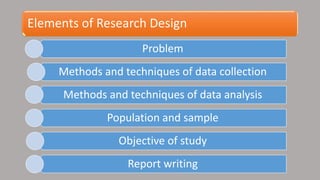
Problem
Methods and techniques of data collection
Methods and techniques of data analysis
Population and sample
Objective of study
Report writing
Types of Research Design
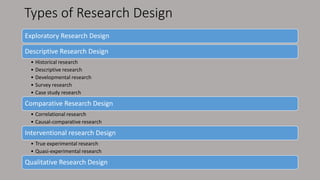
Exploratory Research Design
Descriptive Research Design
• Historical research
• Descriptive research
• Developmental research
• Survey research
• Case study research
Comparative Research Design
• Correlational research
• Causal-comparative research
Interventional research Design
• True experimental research
• Quasi-experimental research
Qualitative Research Design
1. Exploratory Research Design
A study undertaken in areas where very little prior
knowledge or information is available on the subject under
investigation.
Its main aim is to gain new ideas or insights.
It serves three purposes:
• Diagnosing the situation
• Screening alternatives
2. Descriptive Research Design
• It describes the variables as they exist.
A. Historical Research:
• Study of past events chronologically.
• Historical research is the systematic and objective location,
evaluation, and synthesis of evidence in order to establish facts and
draw conclusions about past events.
• Its main purpose is to show relevance of past events to the present.
B. Descriptive Research:
• Extension of exploratory research.
• It is more formal and rigid.
• Does not seem to explain relationship, test hypothesis an make
predictions.
• For predicting future trends.
A. Longitudinal Study: data are collected from the respondents at two or more
points in time from the same group of individuals.
a. Trend Study
• When the data are collected at intervals over a period of time, it is called trend
study.
• This type of research samples different groups of people at different points in
time from the same population.
b. Cohort Study
• ‘Cohort’ is a group of people who share a common characteristic or
experience within a defined period.
• There are many types of cohorts studied, birth cohort, student cohort,
disease cohort, employment cohort. A sample of selected cohort group is
studied at different point of time.
C. Developmental Research
c. Panel Study
• A panel is the group of individuals that have agreed to
provide information to a researcher over a period of time.
• Measure the same sample of respondents at different
points in time. Unlike trend studies, panel studies can
reveal both net change and gross change in the
dependent variable.
B. Cross-sectional Study
• Data are collected only once.
• It involves observation of some items of the population
all at the same time.
• Involves comparison of people at different age ranges.
D. Survey Research
• systematic gathering of information from respondents for the purpose of
understanding and/or predicting some aspect of the behavior of the population
of interest.
A. Exploratory Survey Research: carried in the early phases of research and helps for the in-
depth survey research further.
B. Confirmatory (Theory Testing/Explanatory) Survey Research: carried to test a hypothesis.
C. Descriptive Survey Research: describes the distribution of phenomenon in a population.
E. Case Study Research
• An empirical enquiry that investigates contemporary phenomenon within its real-
life context.
• Focus on in-depth, longitudinal examination of a single case.
Types
A.Snapshot Case Studies
B.Longitudinal Case Studies
C.Pre-post Case Studies
D.Cross-case Studies
Limitations
A.More expensive because of exploratory nature
B.Can not generalize the findings of one case on whole
population
C.Influence of subjectivity
A. Correlational Research:
• Ascertains the extent to which two variables are related.
• Not concerned with if one variables influence other one. Identifies if two
variables co-vary, identifies the direction and magnitude of the relationship.
A. Positive Correlation
B. Negative correlation
C. No correlation
B. Causal-Comparative Research
• Also called Ex-post facto (after the fact) research.
• Analyzes the performance of any organization before and after any event.
• Requires two groups for making comparison.
• Researcher searches the likeliness and differences among his subjects to
obtain clues about what might cause or contribute to the occurrence of a
particular phenomenon.
• It is of three types: exploration of effects, exploration of causes,
exploration of consequences.
3. Comparative Research Design
4. Interventional Research Design
• The researcher intervenes and manipulates situation
to measure the effects of the manipulation.
• Usually two groups are compared.
• Aims to discover the causal relationship.
• It is of three types
• Pre-experimental design
• Quasi-experimental design
• True experimental design
• Pre-Experimental Design: It is an experimental design which
lacks a control group for study.
• True-Experimental Design:
• Involves control group and experimental group.
• Of two types: Laboratory experiment and Field Experiment.
• It has four characteristics:
• Experimental or treatment group: a group which is manipulated.
• Manipulation: the researcher does something to one group
(experimental group).
• Control Group: a group which is placed to make comparison.
• Randomization: Randomly assigns subjects to control and
experimental groups.
• Double Blind: Neither the subject nor the experimenter knows the
subject is in the treatment or in the normal condition.
• Quasi-Experimental Design:
• Still involves manipulation of an independent variable that serves
as an intervention.
• The subjects in two groups are not randomly assigned. They are
intuitively assigned.

Research design

  • 1.
  • 2.
    Introduction • Research designis a plan or framework for completing a research work. • “Research design is a master plan specifying data methods and procedures for collecting and analyzing the needed information.”- William Zikmund.
  • 3.
    Features of ResearchDesign • Reliability- if research gives same result when same tools are used in the same sample then such research is considered as reliable research. • Objectivity- research method should be accurate and objective. • Validity- integrity of the conclusions drawn from the specific research. Data is tested again and again, where prediction of future made remains correct. • Replicability- research design should be imitable. • Generalizability- the findings from the sample data should be generalizable to the population.
  • 4.
    Elements of ResearchDesign Problem Methods and techniques of data collection Methods and techniques of data analysis Population and sample Objective of study Report writing
  • 5.
    Types of ResearchDesign Exploratory Research Design Descriptive Research Design • Historical research • Descriptive research • Developmental research • Survey research • Case study research Comparative Research Design • Correlational research • Causal-comparative research Interventional research Design • True experimental research • Quasi-experimental research Qualitative Research Design
  • 6.
    1. Exploratory ResearchDesign A study undertaken in areas where very little prior knowledge or information is available on the subject under investigation. Its main aim is to gain new ideas or insights. It serves three purposes: • Diagnosing the situation • Screening alternatives
  • 7.
    2. Descriptive ResearchDesign • It describes the variables as they exist. A. Historical Research: • Study of past events chronologically. • Historical research is the systematic and objective location, evaluation, and synthesis of evidence in order to establish facts and draw conclusions about past events. • Its main purpose is to show relevance of past events to the present. B. Descriptive Research: • Extension of exploratory research. • It is more formal and rigid. • Does not seem to explain relationship, test hypothesis an make predictions.
  • 8.
    • For predictingfuture trends. A. Longitudinal Study: data are collected from the respondents at two or more points in time from the same group of individuals. a. Trend Study • When the data are collected at intervals over a period of time, it is called trend study. • This type of research samples different groups of people at different points in time from the same population. b. Cohort Study • ‘Cohort’ is a group of people who share a common characteristic or experience within a defined period. • There are many types of cohorts studied, birth cohort, student cohort, disease cohort, employment cohort. A sample of selected cohort group is studied at different point of time. C. Developmental Research
  • 9.
    c. Panel Study •A panel is the group of individuals that have agreed to provide information to a researcher over a period of time. • Measure the same sample of respondents at different points in time. Unlike trend studies, panel studies can reveal both net change and gross change in the dependent variable. B. Cross-sectional Study • Data are collected only once. • It involves observation of some items of the population all at the same time. • Involves comparison of people at different age ranges.
  • 10.
    D. Survey Research •systematic gathering of information from respondents for the purpose of understanding and/or predicting some aspect of the behavior of the population of interest. A. Exploratory Survey Research: carried in the early phases of research and helps for the in- depth survey research further. B. Confirmatory (Theory Testing/Explanatory) Survey Research: carried to test a hypothesis. C. Descriptive Survey Research: describes the distribution of phenomenon in a population. E. Case Study Research • An empirical enquiry that investigates contemporary phenomenon within its real- life context. • Focus on in-depth, longitudinal examination of a single case. Types A.Snapshot Case Studies B.Longitudinal Case Studies C.Pre-post Case Studies D.Cross-case Studies
  • 11.
    Limitations A.More expensive becauseof exploratory nature B.Can not generalize the findings of one case on whole population C.Influence of subjectivity
  • 12.
    A. Correlational Research: •Ascertains the extent to which two variables are related. • Not concerned with if one variables influence other one. Identifies if two variables co-vary, identifies the direction and magnitude of the relationship. A. Positive Correlation B. Negative correlation C. No correlation B. Causal-Comparative Research • Also called Ex-post facto (after the fact) research. • Analyzes the performance of any organization before and after any event. • Requires two groups for making comparison. • Researcher searches the likeliness and differences among his subjects to obtain clues about what might cause or contribute to the occurrence of a particular phenomenon. • It is of three types: exploration of effects, exploration of causes, exploration of consequences. 3. Comparative Research Design
  • 13.
    4. Interventional ResearchDesign • The researcher intervenes and manipulates situation to measure the effects of the manipulation. • Usually two groups are compared. • Aims to discover the causal relationship. • It is of three types • Pre-experimental design • Quasi-experimental design • True experimental design
  • 14.
    • Pre-Experimental Design:It is an experimental design which lacks a control group for study. • True-Experimental Design: • Involves control group and experimental group. • Of two types: Laboratory experiment and Field Experiment. • It has four characteristics: • Experimental or treatment group: a group which is manipulated. • Manipulation: the researcher does something to one group (experimental group). • Control Group: a group which is placed to make comparison. • Randomization: Randomly assigns subjects to control and experimental groups. • Double Blind: Neither the subject nor the experimenter knows the subject is in the treatment or in the normal condition.
  • 15.
    • Quasi-Experimental Design: •Still involves manipulation of an independent variable that serves as an intervention. • The subjects in two groups are not randomly assigned. They are intuitively assigned.