 Introduction
 Formation of compound with congurent
melting point
 Formation of compound with incogurent
melting point
 Gibbs Phase Rule
 The Phase rule gives the relation between
the degree of freedom (F),the number of
components (C) and the number of phase
(P) present at equilibrium in a given system.
F= C-P+2
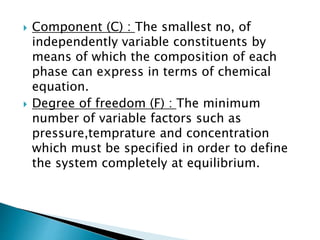
 Phase (P) : Any homogenous and physically
distinct part of a system which is a bounded
by a surface & is mechanically separable
from each other parts of a system.
 Component (C) : The smallest no, of
independently variable constituents by
means of which the composition of each
phase can express in terms of chemical
equation.
 Degree of freedom (F) : The minimum
number of variable factors such as
pressure,temprature and concentration
which must be specified in order to define
the system completely at equilibrium.
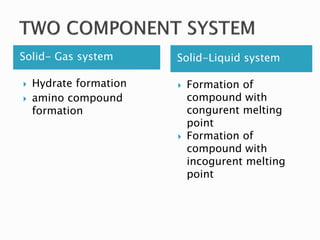
Solid- Gas system Solid-Liquid system
 Hydrate formation
 amino compound
formation
 Formation of
compound with
congurent melting
point
 Formation of
compound with
incogurent melting
point
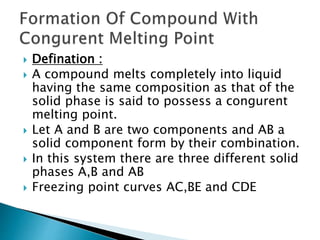
 Defination :
 A compound melts completely into liquid
having the same composition as that of the
solid phase is said to possess a congurent
melting point.
 Let A and B are two components and AB a
solid component form by their combination.
 In this system there are three different solid
phases A,B and AB
 Freezing point curves AC,BE and CDE
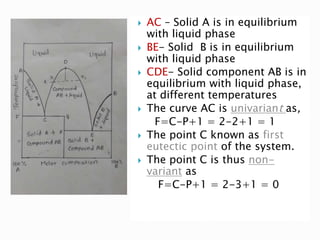
 AC – Solid A is in equilibrium
with liquid phase
 BE- Solid B is in equilibrium
with liquid phase
 CDE- Solid component AB is in
equilibrium with liquid phase,
at different temperatures
 The curve AC is univariant as,
F=C-P+1 = 2-2+1 = 1
 The point C known as first
eutectic point of the system.
 The point C is thus non-
variant as
F=C-P+1 = 2-3+1 = 0
 Curve BE is univariant as, F=C-P+1=2-2+1=1
 The point E is known as the second eutectic point
of the system.
 The liquid consists of the curve AC,CDE & BE
whereas solidus consists of the curve FCG & HEJ,AF
& BJ.
 The maximum point D of the curve is the congurent
melting point accordingly to the phase rule, D is
non-variant.
 At certain temperature, the compound AB can have
two solubilities at same temperature i.e. X and X’
 The congurent melting point can be above,below or
in between the melting point of both the
components. The position of congurent melting
point gives the composition of the compound
formed.
 Curve BE represents depression in freezing point
of the compound AB on addition of B.
 Curve AC represents depression in freezing
point of the compound AB on addition of A.
 The congurent melting point can be
above,below or in between the melting point of
both the components. The position of congurent
melting point gives the composition of the
compound formed.
 Example :
 Zinc- magnessium system
 Aluminium-magnessium system
 Mercury – Thallium system
 Phenol- aniline system
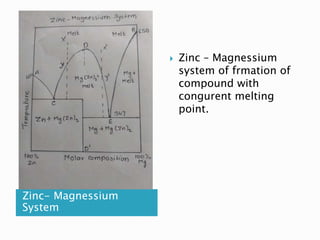
Zinc- Magnessium
System
 Zinc – Magnessium
system of frmation of
compound with
congurent melting
point.
 In many system,the compound formed by
the combination formed of two
components,instead of melting
congurently,decompose when heated giving
a new solid phase and a solution of solid
with a composition different from that of
the solid phase.Such compound said to
have an incongurent melting point.
 Equation :
 S1 S2 + solution
Original solid New solid
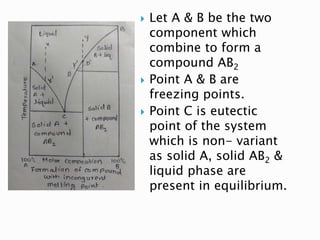
 Let A & B be the two
component which
combine to form a
compound AB2
 Point A & B are
freezing points.
 Point C is eutectic
point of the system
which is non- variant
as solid A, solid AB2 &
liquid phase are
present in equilibrium.
 Curve AC : freezing point of A which indicates
lowering the freezing point of A when B is
added. It is fusion curve of A. it is univariant.
 Curve CD : fusion curve of compound AB2
system is univariant along CD
 Curve BD : fusion curve of B
system is univariant along BD
 If we cool a composition X, A is the first
solid to separate out at point X’
 On cooling composition Y, B is first solid to
separate out at point Y’
 At point D, transition reaction occurs
Solid AB + Solution Solid AB2
 The compound AB2 now stable. Curve CD
would have proceeded upto E.
 If the curve CD is prolonged further, we get
point D which would normally be the
congurent M.P. of the compound this point
is called a submerged maximum.
 Examples :
 Picric acid-benzene system
 Gold-antimony system
 Sodium sulphate- water system
 REFERENCES :
 Principles of Physical Chemistry – Puri.
Sharma.
 D.N. Bajpai, advanced physical
chemistry,s.chand 1st edition,1992
 Physical chemistry by Glasston page
no.175,176
 K.L. Kapoor,Elemental of physical
chemistry,page no.150,151.
Thank you…!

TWO COMPONENT SYSTEM

  • 2.
     Introduction  Formationof compound with congurent melting point  Formation of compound with incogurent melting point
  • 3.
     Gibbs PhaseRule  The Phase rule gives the relation between the degree of freedom (F),the number of components (C) and the number of phase (P) present at equilibrium in a given system. F= C-P+2  Phase (P) : Any homogenous and physically distinct part of a system which is a bounded by a surface & is mechanically separable from each other parts of a system.
  • 4.
     Component (C): The smallest no, of independently variable constituents by means of which the composition of each phase can express in terms of chemical equation.  Degree of freedom (F) : The minimum number of variable factors such as pressure,temprature and concentration which must be specified in order to define the system completely at equilibrium.
  • 5.
    Solid- Gas systemSolid-Liquid system  Hydrate formation  amino compound formation  Formation of compound with congurent melting point  Formation of compound with incogurent melting point
  • 6.
     Defination : A compound melts completely into liquid having the same composition as that of the solid phase is said to possess a congurent melting point.  Let A and B are two components and AB a solid component form by their combination.  In this system there are three different solid phases A,B and AB  Freezing point curves AC,BE and CDE
  • 7.
     AC –Solid A is in equilibrium with liquid phase  BE- Solid B is in equilibrium with liquid phase  CDE- Solid component AB is in equilibrium with liquid phase, at different temperatures  The curve AC is univariant as, F=C-P+1 = 2-2+1 = 1  The point C known as first eutectic point of the system.  The point C is thus non- variant as F=C-P+1 = 2-3+1 = 0
  • 8.
     Curve BEis univariant as, F=C-P+1=2-2+1=1  The point E is known as the second eutectic point of the system.  The liquid consists of the curve AC,CDE & BE whereas solidus consists of the curve FCG & HEJ,AF & BJ.  The maximum point D of the curve is the congurent melting point accordingly to the phase rule, D is non-variant.  At certain temperature, the compound AB can have two solubilities at same temperature i.e. X and X’  The congurent melting point can be above,below or in between the melting point of both the components. The position of congurent melting point gives the composition of the compound formed.
  • 9.
     Curve BErepresents depression in freezing point of the compound AB on addition of B.  Curve AC represents depression in freezing point of the compound AB on addition of A.  The congurent melting point can be above,below or in between the melting point of both the components. The position of congurent melting point gives the composition of the compound formed.  Example :  Zinc- magnessium system  Aluminium-magnessium system  Mercury – Thallium system  Phenol- aniline system
  • 10.
    Zinc- Magnessium System  Zinc– Magnessium system of frmation of compound with congurent melting point.
  • 11.
     In manysystem,the compound formed by the combination formed of two components,instead of melting congurently,decompose when heated giving a new solid phase and a solution of solid with a composition different from that of the solid phase.Such compound said to have an incongurent melting point.  Equation :  S1 S2 + solution Original solid New solid
  • 12.
     Let A& B be the two component which combine to form a compound AB2  Point A & B are freezing points.  Point C is eutectic point of the system which is non- variant as solid A, solid AB2 & liquid phase are present in equilibrium.
  • 13.
     Curve AC: freezing point of A which indicates lowering the freezing point of A when B is added. It is fusion curve of A. it is univariant.  Curve CD : fusion curve of compound AB2 system is univariant along CD  Curve BD : fusion curve of B system is univariant along BD
  • 14.
     If wecool a composition X, A is the first solid to separate out at point X’  On cooling composition Y, B is first solid to separate out at point Y’  At point D, transition reaction occurs Solid AB + Solution Solid AB2  The compound AB2 now stable. Curve CD would have proceeded upto E.  If the curve CD is prolonged further, we get point D which would normally be the congurent M.P. of the compound this point is called a submerged maximum.
  • 15.
     Examples : Picric acid-benzene system  Gold-antimony system  Sodium sulphate- water system
  • 16.
     REFERENCES : Principles of Physical Chemistry – Puri. Sharma.  D.N. Bajpai, advanced physical chemistry,s.chand 1st edition,1992  Physical chemistry by Glasston page no.175,176  K.L. Kapoor,Elemental of physical chemistry,page no.150,151.
  • 17.