To calculate the e.m.f of a Galvanic Cell
(Cell potential) at Non-standard
Conditions: Nernst Equation for a Cell
Reaction at Non-standard Conditions
Nernst Equation
Standard Conditions
C = 1 M
T = 250C (298 K)
Gases = 1 atm
E0
(anode)
E0
(cathode)
E0
cell = [E0
(cathode)] – [E0
(anode)]
The values of E0 can be directly obtained from the
electrochemical series
Non-standard
Conditions
C = other than 1 M
T = other than 250C
(298 K)
Gases = other than 1
atm
E (anode)
E (cathode)
E0
cell ???
Nernst Equation (contd…)
Nernst Equation
Nernst Equation correlates E to the T and C of the
electrode system
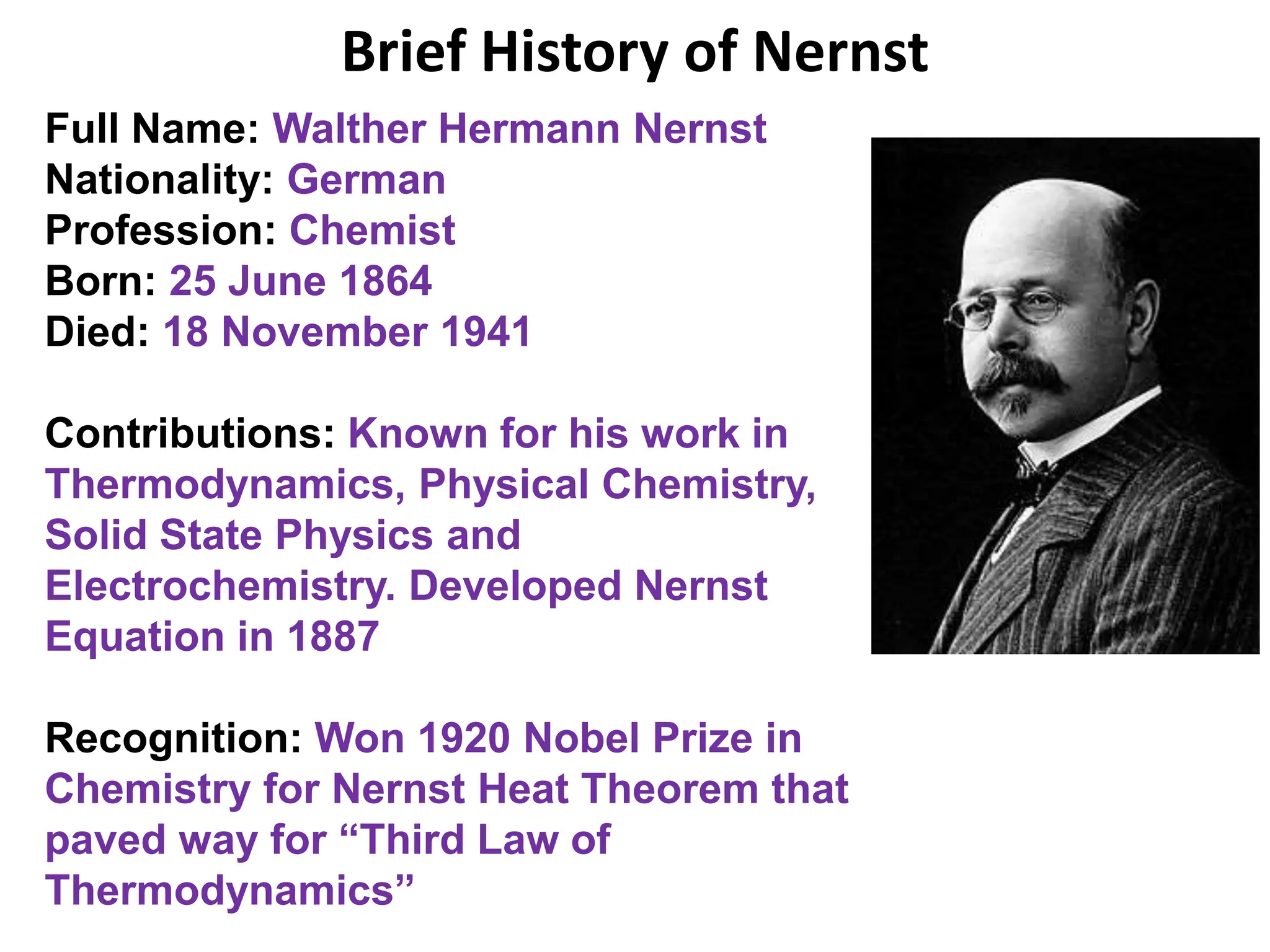
Brief History of Nernst
Full Name: Walther Hermann Nernst
Nationality: German
Profession: Chemist
Born: 25 June 1864
Died: 18 November 1941
Contributions: Known for his work in
Thermodynamics, Physical Chemistry,
Solid State Physics and
Electrochemistry. Developed Nernst
Equation in 1887
Recognition: Won 1920 Nobel Prize in
Chemistry for Nernst Heat Theorem that
paved way for “Third Law of
Thermodynamics”
• Nernst equation gives relation between
i. EM
n+/M and E0
M
n+/M
ii. Eredox and E0
redox
iii. Ecell and E0
cell
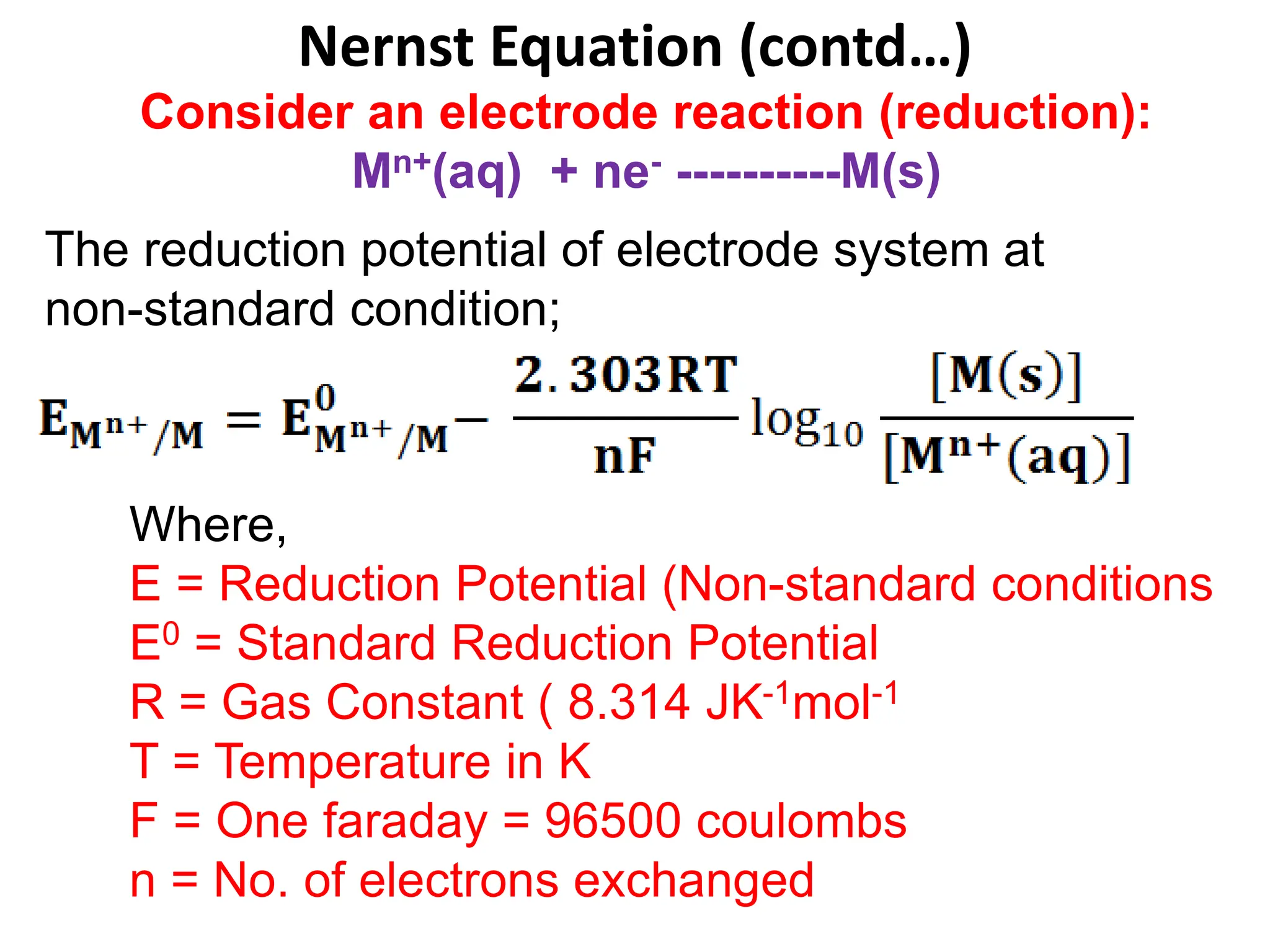
Nernst Equation (contd…)
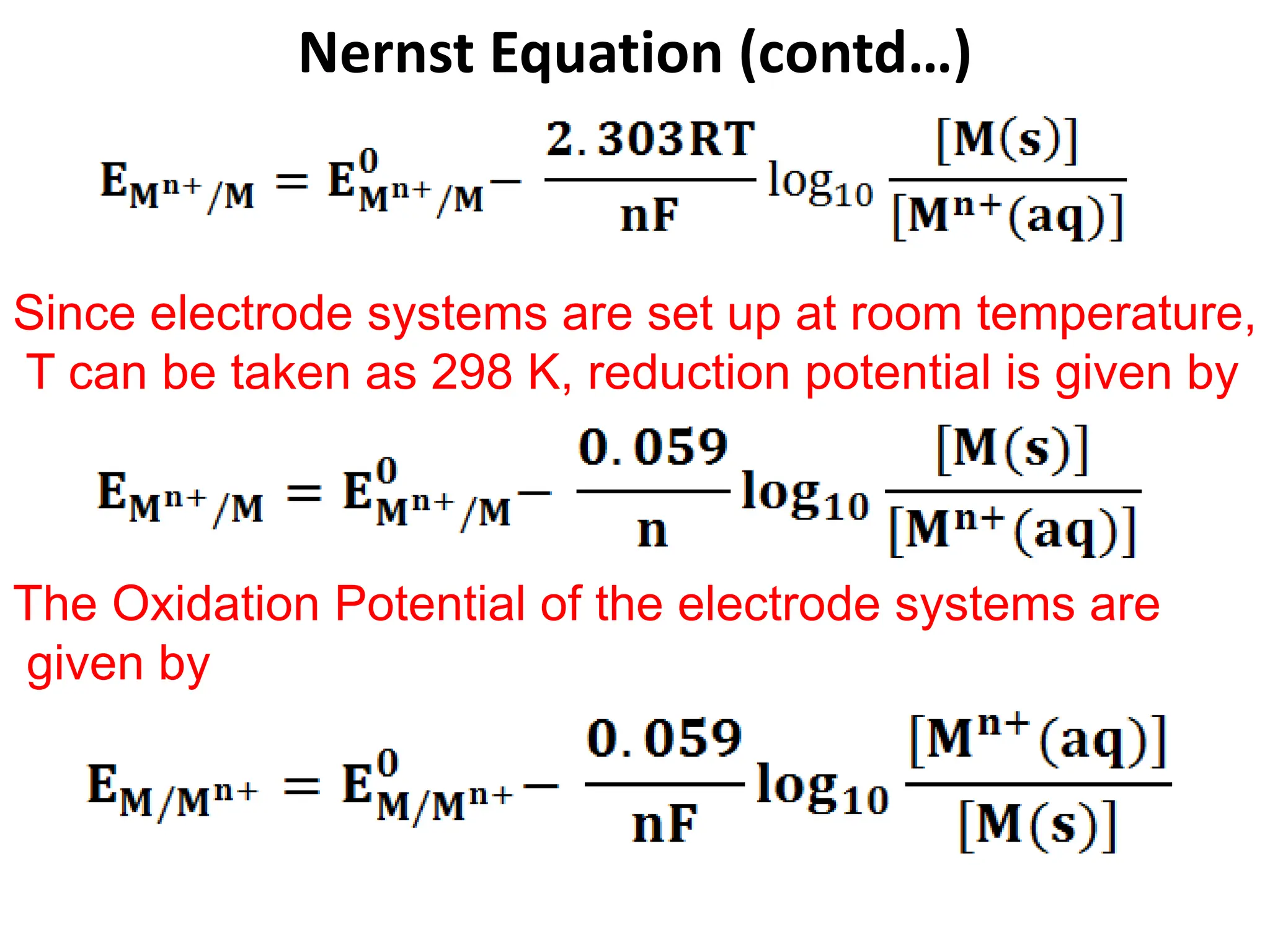
Consider an electrode reaction (reduction):
Mn+(aq) + ne- ----------M(s)
The reduction potential of electrode system at
non-standard condition;
Where,
E = Reduction Potential (Non-standard conditions
E0 = Standard Reduction Potential
R = Gas Constant ( 8.314 JK-1mol-1
T = Temperature in K
F = One faraday = 96500 coulombs
n = No. of electrons exchanged
Nernst Equation (contd…)
Since electrode systems are set up at room temperature,
T can be taken as 298 K, reduction potential is given by
The Oxidation Potential of the electrode systems are
given by
Nernst Equation (contd…)
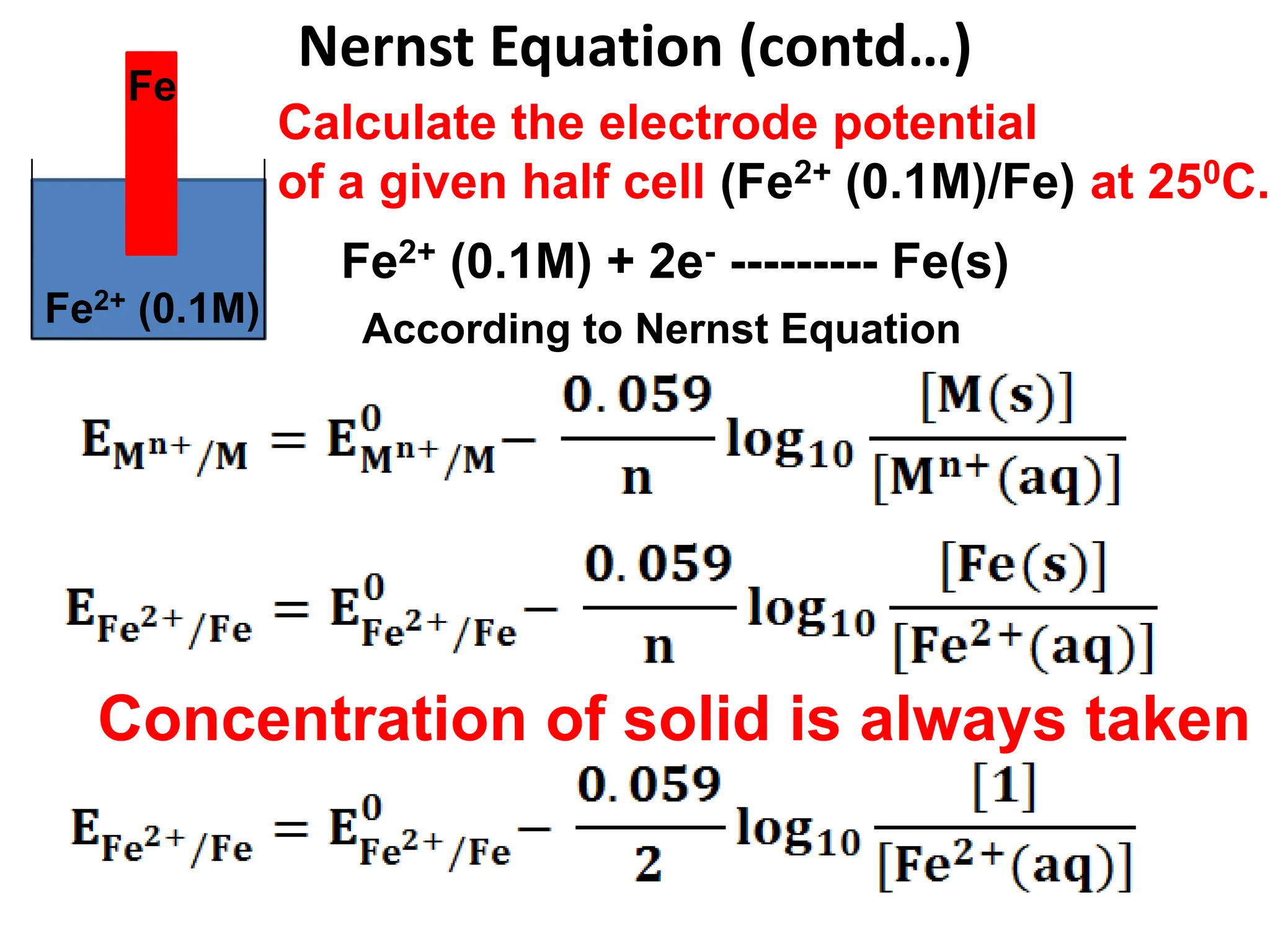
Calculate the electrode potential
of a given half cell (Fe2+ (0.1M)/Fe) at 250C.
Fe
Fe2+ (0.1M) According to Nernst Equation
Concentration of solid is always taken a
Fe2+ (0.1M) + 2e- --------- Fe(s)
Nernst Equation (contd…)
Given;
E0
Fe
2+
/Fe = -0.44 V (Electrochemical series)
n = 2 and, [Fe2+] = 0.1 M
= -0.44 – (0.0295) = -0.4695 V
Activity: Calculate the electrode potential of
Mg2+/Mg at 250C when the concentration of Mg2+
ions is 0.1M and [Mg 2+]= -2.38
Answer: -2.39V
Nernst Equation (contd…)
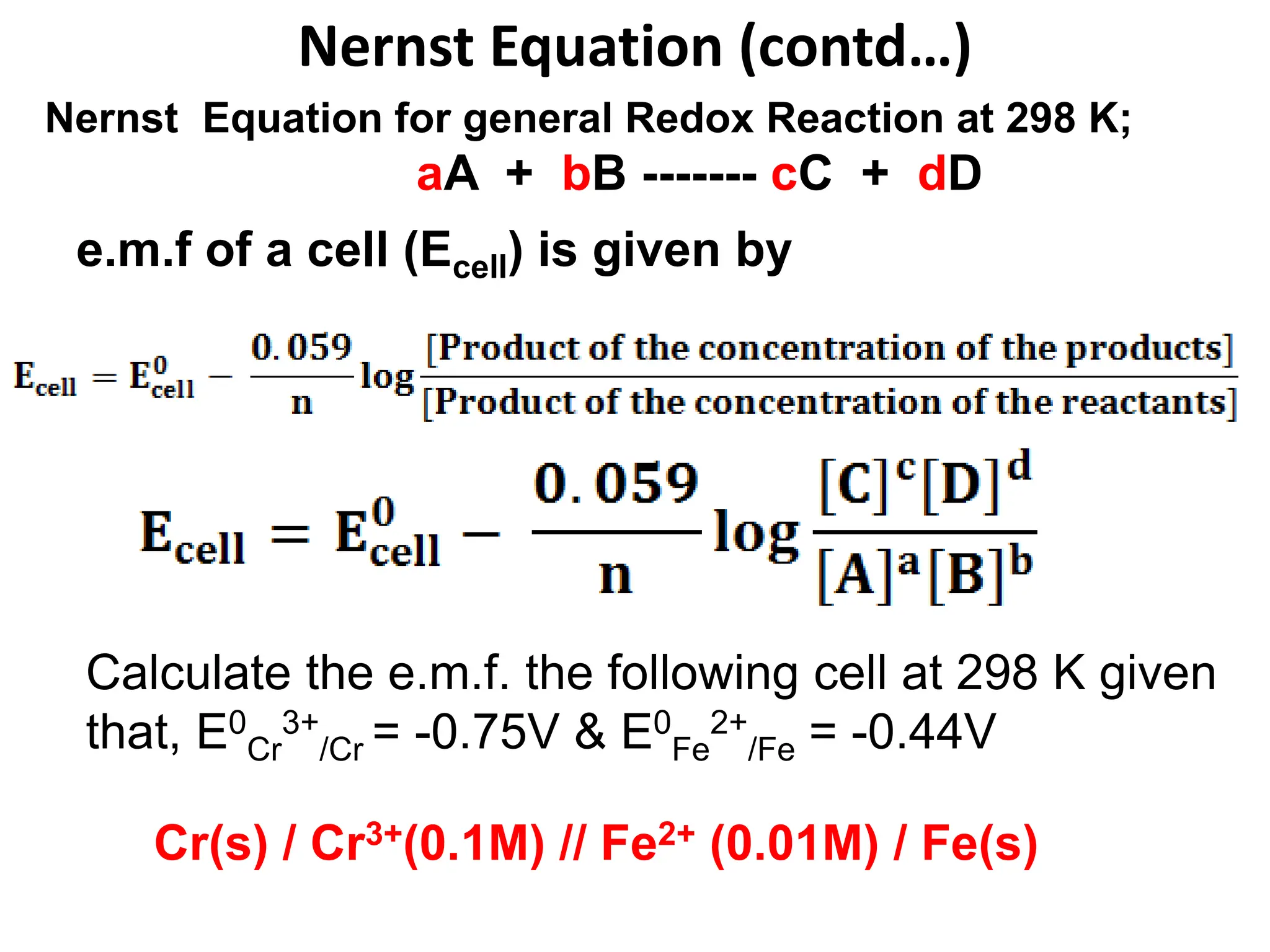
Nernst Equation for general Redox Reaction at 298 K;
aA + bB ------- cC + dD
e.m.f of a cell (Ecell) is given by
Calculate the e.m.f. the following cell at 298 K given
that, E0
Cr
3+
/Cr = -0.75V & E0
Fe
2+
/Fe = -0.44V
Cr(s) / Cr3+(0.1M) // Fe2+ (0.01M) / Fe(s)
Nernst Equation (contd…)
Given;
E0
Cr
3+
/Cr = -0.75V (RP) & E0
Fe
2+
/Fe = -0.44V (RP)
[Cr3+] = 0.1M & [Fe2+] = 0.01M
Cell Rep: Cr(s) / Cr3+(0.1M) // Fe2+ (0.01M) / Fe(s)
Cell Reactions
[Cr(s) ----------- Cr3+(0.1M) + 3e- ]
[Fe2+ (0.01M) + 2e- -------- Fe(s) ]
Anode (OHCR)
Cathode (RHCR)
X 2
X 3
2Cr(s) + 3Fe2+(0.01M) -------- 2Cr3+(0.1M) + 3Fe(s) NCR)
n = ??? n = 6
E0
cell = [E0
(cathode)] – [E0
(anode)] = [-0.44] – [-0.75] = 0.31 V
Nernst Equation (contd…)
Activity
1) Calculate the cell potential at 298 K for the cell;
Zn(s) / Zn2+ (0.1M) // Sn2+ (0.001M) / Sn (s)
2) Calculate the potential of the following cell at
298 K:
Sn4+(1.50M) + Zn(s) --- Sn2+(0.50 M) + Zn2+ (2.0M)
Answer:
1) 0.561V
2) 0.895
Nernst Equation (contd…)
Equilibrium Constant (Kc) of Redox Reaction
• Zn(s) + Cu2+(aq) ↔ Zn2+(aq) + Cu(s)
At “Equilibrium”, Ecell = 0
--------Eq (I)
----------------------Eq (II)
• Calculate the Kc for the cell reaction;
• Zn(s) + Cu2+(aq) ↔ Zn2+(aq) + Cu(s);
• E0
Zn
2+
/Zn = -0.76V & E0
Cu
2+
/Cu = +0.34 V
• Half cell Reactions
• n = 2
• Kc = antilog 37.29
• = 1.95 x 1037
Equilibrium Constant (Kc) of Redox Reaction
E0cell = +0.34V - -0.76V = +1.10V
Practice Problems
a) Calculate the Kc for the following reaction;
3Sn4+ + 2Cr -------- 3Sn2+ + 2Cr3+
(E0
Sn4+/Sn2+ = +0.15 V & E0
Cr3+/Cr = -0.71V)
Answer:
E0
Cell = 0.15+0.71 = 0.86V, n = 6
Kc = antilog [6 x 0.86]/[0.059] = [5.16]/[0.059] =
1 x 1090
Equilibrium Constant (Kc) of Redox Reaction
Relation between “Standard Free Energy
Change” (∆G0) and “Standard Cell Potential”
(E0
cell)
• Free Energy Change (∆G) measures the amount
of useful work that can be obtained.
• Electrical work is obtained by operating
electrochemical cell
• ∆G = Welectrical = -nFEcell
• ∆G0 = -nFE0
cell
• For spontaneous cell reaction ∆G must be
negative & Ecell must be positive
• For the cell; Mg(s)/Mg+2(aq)//Ag+(aq)/Ag(s)
calculate Kc at 250C and the Maximum Work that
can be obtained by the operating cell.
• (E0
Mg
2+/Mg = -2.38 V & E0
Ag+/Ag = +0.80V)
• Write cell reaction & find “n”
• Calculate E0
cell
• E0
cell = 3.18 V
• W(max) = ∆G0 = -nFE0
cell
• -(2 x 96500 x 3.18) = -611810 J
= antilog 107.8 = 6.26 x 10107
• Practice Problems
• For the reduction of silver ions with
copper metal the standard cell potential
was found to be +0.46V at 250C. Calculate
the work done in operating the cell.
• Ans: -89.0 kJ
• The value of standard free energy change in
the Daniel cell is -212.3 kJ at 298K. Calculate
the equilibrium constant for the reaction.
• Ans: 1.6 x 1037
Practice Problems
• T.B Q nos: 40 (pp:3.73),
• MCQ Q No: 36, 91

Nernst Equation 3.ppt

  • 1.
    To calculate thee.m.f of a Galvanic Cell (Cell potential) at Non-standard Conditions: Nernst Equation for a Cell Reaction at Non-standard Conditions
  • 2.
    Nernst Equation Standard Conditions C= 1 M T = 250C (298 K) Gases = 1 atm E0 (anode) E0 (cathode) E0 cell = [E0 (cathode)] – [E0 (anode)] The values of E0 can be directly obtained from the electrochemical series
  • 3.
    Non-standard Conditions C = otherthan 1 M T = other than 250C (298 K) Gases = other than 1 atm E (anode) E (cathode) E0 cell ??? Nernst Equation (contd…) Nernst Equation Nernst Equation correlates E to the T and C of the electrode system
  • 4.
    Brief History ofNernst Full Name: Walther Hermann Nernst Nationality: German Profession: Chemist Born: 25 June 1864 Died: 18 November 1941 Contributions: Known for his work in Thermodynamics, Physical Chemistry, Solid State Physics and Electrochemistry. Developed Nernst Equation in 1887 Recognition: Won 1920 Nobel Prize in Chemistry for Nernst Heat Theorem that paved way for “Third Law of Thermodynamics”
  • 5.
    • Nernst equationgives relation between i. EM n+/M and E0 M n+/M ii. Eredox and E0 redox iii. Ecell and E0 cell
  • 6.
    Nernst Equation (contd…) Consideran electrode reaction (reduction): Mn+(aq) + ne- ----------M(s) The reduction potential of electrode system at non-standard condition; Where, E = Reduction Potential (Non-standard conditions E0 = Standard Reduction Potential R = Gas Constant ( 8.314 JK-1mol-1 T = Temperature in K F = One faraday = 96500 coulombs n = No. of electrons exchanged
  • 7.
    Nernst Equation (contd…) Sinceelectrode systems are set up at room temperature, T can be taken as 298 K, reduction potential is given by The Oxidation Potential of the electrode systems are given by
  • 8.
    Nernst Equation (contd…) Calculatethe electrode potential of a given half cell (Fe2+ (0.1M)/Fe) at 250C. Fe Fe2+ (0.1M) According to Nernst Equation Concentration of solid is always taken a Fe2+ (0.1M) + 2e- --------- Fe(s)
  • 9.
    Nernst Equation (contd…) Given; E0 Fe 2+ /Fe= -0.44 V (Electrochemical series) n = 2 and, [Fe2+] = 0.1 M = -0.44 – (0.0295) = -0.4695 V Activity: Calculate the electrode potential of Mg2+/Mg at 250C when the concentration of Mg2+ ions is 0.1M and [Mg 2+]= -2.38 Answer: -2.39V
  • 10.
    Nernst Equation (contd…) NernstEquation for general Redox Reaction at 298 K; aA + bB ------- cC + dD e.m.f of a cell (Ecell) is given by Calculate the e.m.f. the following cell at 298 K given that, E0 Cr 3+ /Cr = -0.75V & E0 Fe 2+ /Fe = -0.44V Cr(s) / Cr3+(0.1M) // Fe2+ (0.01M) / Fe(s)
  • 11.
    Nernst Equation (contd…) Given; E0 Cr 3+ /Cr= -0.75V (RP) & E0 Fe 2+ /Fe = -0.44V (RP) [Cr3+] = 0.1M & [Fe2+] = 0.01M Cell Rep: Cr(s) / Cr3+(0.1M) // Fe2+ (0.01M) / Fe(s) Cell Reactions [Cr(s) ----------- Cr3+(0.1M) + 3e- ] [Fe2+ (0.01M) + 2e- -------- Fe(s) ] Anode (OHCR) Cathode (RHCR) X 2 X 3 2Cr(s) + 3Fe2+(0.01M) -------- 2Cr3+(0.1M) + 3Fe(s) NCR) n = ??? n = 6 E0 cell = [E0 (cathode)] – [E0 (anode)] = [-0.44] – [-0.75] = 0.31 V
  • 12.
  • 13.
    Activity 1) Calculate thecell potential at 298 K for the cell; Zn(s) / Zn2+ (0.1M) // Sn2+ (0.001M) / Sn (s) 2) Calculate the potential of the following cell at 298 K: Sn4+(1.50M) + Zn(s) --- Sn2+(0.50 M) + Zn2+ (2.0M) Answer: 1) 0.561V 2) 0.895 Nernst Equation (contd…)
  • 14.
    Equilibrium Constant (Kc)of Redox Reaction • Zn(s) + Cu2+(aq) ↔ Zn2+(aq) + Cu(s) At “Equilibrium”, Ecell = 0 --------Eq (I) ----------------------Eq (II)
  • 15.
    • Calculate theKc for the cell reaction; • Zn(s) + Cu2+(aq) ↔ Zn2+(aq) + Cu(s); • E0 Zn 2+ /Zn = -0.76V & E0 Cu 2+ /Cu = +0.34 V • Half cell Reactions • n = 2 • Kc = antilog 37.29 • = 1.95 x 1037 Equilibrium Constant (Kc) of Redox Reaction E0cell = +0.34V - -0.76V = +1.10V
  • 16.
    Practice Problems a) Calculatethe Kc for the following reaction; 3Sn4+ + 2Cr -------- 3Sn2+ + 2Cr3+ (E0 Sn4+/Sn2+ = +0.15 V & E0 Cr3+/Cr = -0.71V) Answer: E0 Cell = 0.15+0.71 = 0.86V, n = 6 Kc = antilog [6 x 0.86]/[0.059] = [5.16]/[0.059] = 1 x 1090 Equilibrium Constant (Kc) of Redox Reaction
  • 17.
    Relation between “StandardFree Energy Change” (∆G0) and “Standard Cell Potential” (E0 cell) • Free Energy Change (∆G) measures the amount of useful work that can be obtained. • Electrical work is obtained by operating electrochemical cell • ∆G = Welectrical = -nFEcell • ∆G0 = -nFE0 cell • For spontaneous cell reaction ∆G must be negative & Ecell must be positive
  • 18.
    • For thecell; Mg(s)/Mg+2(aq)//Ag+(aq)/Ag(s) calculate Kc at 250C and the Maximum Work that can be obtained by the operating cell. • (E0 Mg 2+/Mg = -2.38 V & E0 Ag+/Ag = +0.80V) • Write cell reaction & find “n” • Calculate E0 cell • E0 cell = 3.18 V • W(max) = ∆G0 = -nFE0 cell • -(2 x 96500 x 3.18) = -611810 J = antilog 107.8 = 6.26 x 10107
  • 19.
    • Practice Problems •For the reduction of silver ions with copper metal the standard cell potential was found to be +0.46V at 250C. Calculate the work done in operating the cell. • Ans: -89.0 kJ • The value of standard free energy change in the Daniel cell is -212.3 kJ at 298K. Calculate the equilibrium constant for the reaction. • Ans: 1.6 x 1037
  • 20.
    Practice Problems • T.BQ nos: 40 (pp:3.73), • MCQ Q No: 36, 91