Difference between Diamagnetic, Paramagnetic and
Ferromagnetic materials
Diamagnetic Paramagnetic Ferromagnetic
Diamagnetic substances
are feebly repelled by
the applied magnetic
field.
Paramagnetic sub-
stances are feebly
attracted by the applied
magnetic field.
Ferromagnetic sub-
stances are strongly
attracted by the applied
magnetic field.
Ex. Antimony, Bis-
muth, Copper, Gold, Sil-
ver, Mercury, Quartz, Al-
cohol, Water, Air, Argon,
Hydrogen etc.
Ex. Aluminum,
Chromium, Alkali met-
als, Alkaline earth
metals, Platinum, Oxy-
gen, CuSO4, MnSO4 etc.
Ex. Iron, Cobalt, Nickel,
Steel, Gadolinium etc.
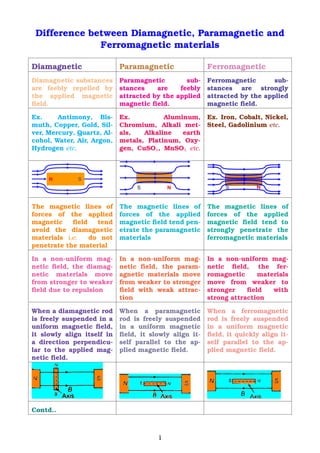
The magnetic lines of
forces of the applied
magnetic field tend
avoid the diamagnetic
materials i.e. do not
penetrate the material
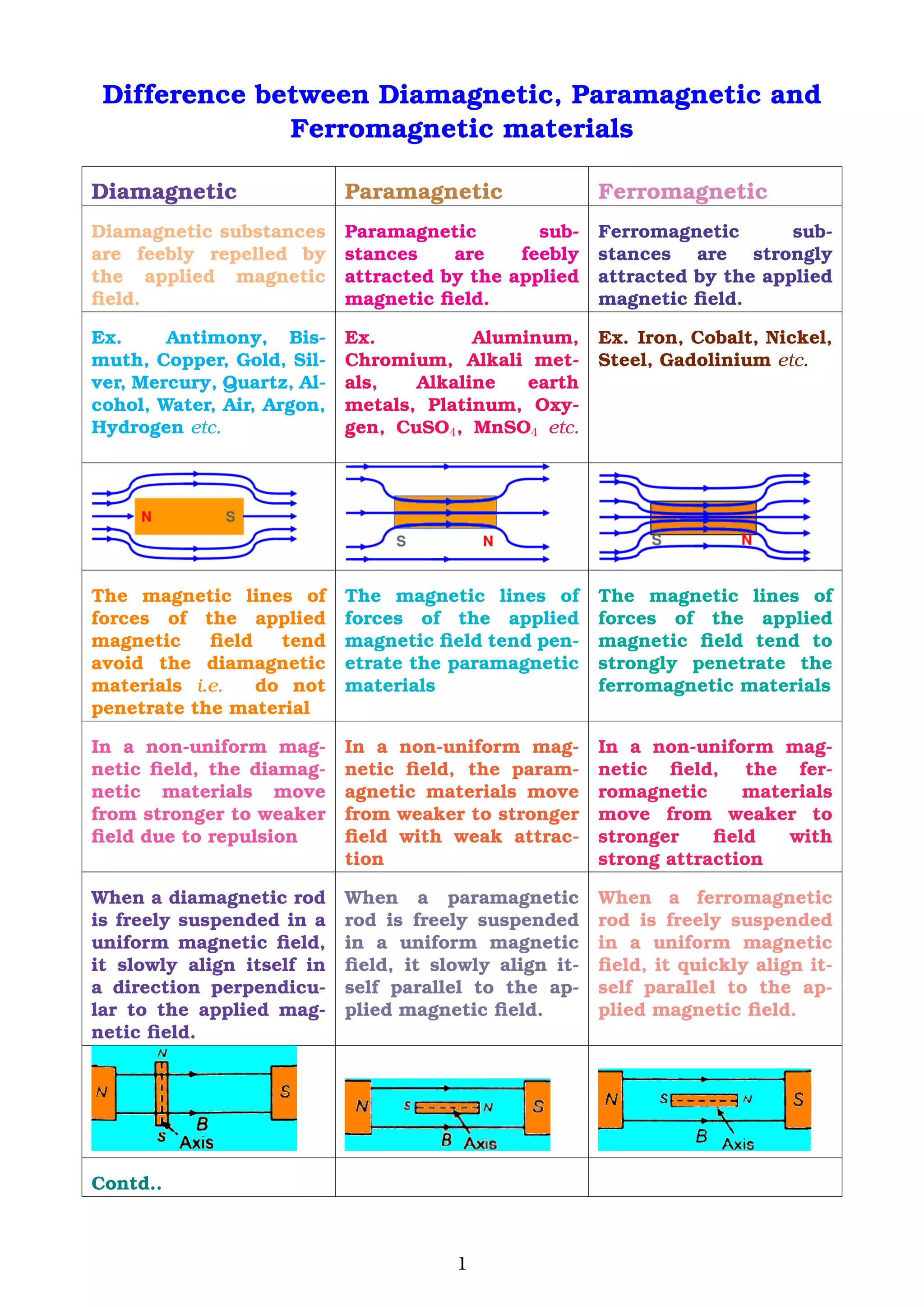
The magnetic lines of
forces of the applied
magnetic field tend pen-
etrate the paramagnetic
materials
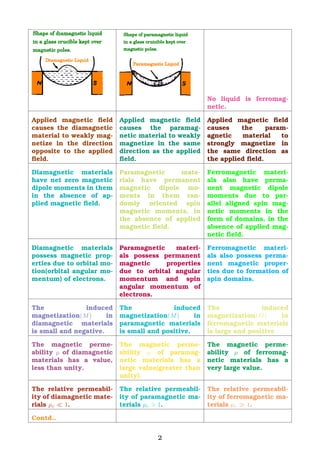
The magnetic lines of
forces of the applied
magnetic field tend to
strongly penetrate the
ferromagnetic materials
In a non-uniform mag-
netic field, the diamag-
netic materials move
from stronger to weaker
field due to repulsion
In a non-uniform mag-
netic field, the param-
agnetic materials move
from weaker to stronger
field with weak attrac-
tion
In a non-uniform mag-
netic field, the fer-
romagnetic materials
move from weaker to
stronger field with
strong attraction
When a diamagnetic rod
is freely suspended in a
uniform magnetic field,
it slowly align itself in
a direction perpendicu-
lar to the applied mag-
netic field.
When a paramagnetic
rod is freely suspended
in a uniform magnetic
field, it slowly align it-
self parallel to the ap-
plied magnetic field.
When a ferromagnetic
rod is freely suspended
in a uniform magnetic
field, it quickly align it-
self parallel to the ap-
plied magnetic field.
Contd..
1
No liquid is ferromag-
netic.
Applied magnetic field
causes the diamagnetic
material to weakly mag-
netize in the direction
opposite to the applied
field.
Applied magnetic field
causes the paramag-
netic material to weakly
magnetize in the same
direction as the applied
field.
Applied magnetic field
causes the param-
agnetic material to
strongly magnetize in
the same direction as
the applied field.
Diamagnetic materials
have net zero magnetic
dipole moments in them
in the absence of ap-
plied magnetic field.
Paramagnetic mate-
rials have permanent
magnetic dipole mo-
ments in them ran-
domly oriented spin
magnetic moments, in
the absence of applied
magnetic field.
Ferromagnetic materi-
als also have perma-
nent magnetic dipole
moments due to par-
allel aligned spin mag-
netic moments in the
form of domains, in the
absence of applied mag-
netic field.
Diamagnetic materials
possess magnetic prop-
erties due to orbital mo-
tion(orbital angular mo-
mentum) of electrons.
Paramagnetic materi-
als possess permanent
magnetic properties
due to orbital angular
momentum and spin
angular momentum of
electrons.
Ferromagnetic materi-
als also possess perma-
nent magnetic proper-
ties due to formation of
spin domains.
The induced
magnetization(M) in
diamagnetic materials
is small and negative.
The induced
magnetization(M) in
paramagnetic materials
is small and positive.
The induced
magnetization(M) in
ferromagnetic materials
is large and positive
The magnetic perme-
ability µ of diamagnetic
materials has a value,
less than unity.
The magnetic perme-
ability µ of paramag-
netic materials has a
large value(greater than
unity).
The magnetic perme-
ability µ of ferromag-
netic materials has a
very large value.
The relative permeabil-
ity of diamagnetic mate-
rials µr 1.
The relative permeabil-
ity of paramagnetic ma-
terials µr > 1.
The relative permeabil-
ity of ferromagnetic ma-
terials µr 1.
Contd..
2
The susceptibility χ =
M
H
(magnetization pro-
duced per unit applied
magnetic field inten-
sity) has negative value.
Susceptibility χ has low
positive value.
Susceptibility χ has
high positive value.
These materials do not
obey Curie law χ ∝ 1
T
,
the properties are inde-
pendent of temperature
These materials obey
Curie law χ ∝ 1
T
, their
properties change with
rise in temperature.
They obey Curie-Weiss
law χ ∝ 1
T−Tc
, they con-
vert to paramagnetic
at a temperature called
Curie temperature.
For diamagnetic materi-
als the M vs H curve and
the behavior of suscep-
tibility with respect to
temperature is as shown
below
For paramagnetic mate-
rials the M vs H curve
and the behavior of sus-
ceptibility with respect
to temperature is as
shown below
For ferromagnetic mate-
rials the M vs H give
rise to hysteresis curve
over a complete cy-
cle. The susceptibility
shows a transition from
ferromagnetic to para-
magnetic phase at the
critical temperature as
shown below.
References
[1] Images:Materials in the presence of magnetic fields.
[2] https://doi.org/10.3390/inorganics8010006.
[3] Images:Susceptibility1.
[4] Images:Susceptibility2.
[5] https://en.wikipedia.org/wiki/Magnetism.
[6] www.google.com.
3

Contrast between Diamagnetic, Paramagnetic and Ferromagnetic Materials

  • 1.
    Difference between Diamagnetic,Paramagnetic and Ferromagnetic materials Diamagnetic Paramagnetic Ferromagnetic Diamagnetic substances are feebly repelled by the applied magnetic field. Paramagnetic sub- stances are feebly attracted by the applied magnetic field. Ferromagnetic sub- stances are strongly attracted by the applied magnetic field. Ex. Antimony, Bis- muth, Copper, Gold, Sil- ver, Mercury, Quartz, Al- cohol, Water, Air, Argon, Hydrogen etc. Ex. Aluminum, Chromium, Alkali met- als, Alkaline earth metals, Platinum, Oxy- gen, CuSO4, MnSO4 etc. Ex. Iron, Cobalt, Nickel, Steel, Gadolinium etc. The magnetic lines of forces of the applied magnetic field tend avoid the diamagnetic materials i.e. do not penetrate the material The magnetic lines of forces of the applied magnetic field tend pen- etrate the paramagnetic materials The magnetic lines of forces of the applied magnetic field tend to strongly penetrate the ferromagnetic materials In a non-uniform mag- netic field, the diamag- netic materials move from stronger to weaker field due to repulsion In a non-uniform mag- netic field, the param- agnetic materials move from weaker to stronger field with weak attrac- tion In a non-uniform mag- netic field, the fer- romagnetic materials move from weaker to stronger field with strong attraction When a diamagnetic rod is freely suspended in a uniform magnetic field, it slowly align itself in a direction perpendicu- lar to the applied mag- netic field. When a paramagnetic rod is freely suspended in a uniform magnetic field, it slowly align it- self parallel to the ap- plied magnetic field. When a ferromagnetic rod is freely suspended in a uniform magnetic field, it quickly align it- self parallel to the ap- plied magnetic field. Contd.. 1
  • 2.
    No liquid isferromag- netic. Applied magnetic field causes the diamagnetic material to weakly mag- netize in the direction opposite to the applied field. Applied magnetic field causes the paramag- netic material to weakly magnetize in the same direction as the applied field. Applied magnetic field causes the param- agnetic material to strongly magnetize in the same direction as the applied field. Diamagnetic materials have net zero magnetic dipole moments in them in the absence of ap- plied magnetic field. Paramagnetic mate- rials have permanent magnetic dipole mo- ments in them ran- domly oriented spin magnetic moments, in the absence of applied magnetic field. Ferromagnetic materi- als also have perma- nent magnetic dipole moments due to par- allel aligned spin mag- netic moments in the form of domains, in the absence of applied mag- netic field. Diamagnetic materials possess magnetic prop- erties due to orbital mo- tion(orbital angular mo- mentum) of electrons. Paramagnetic materi- als possess permanent magnetic properties due to orbital angular momentum and spin angular momentum of electrons. Ferromagnetic materi- als also possess perma- nent magnetic proper- ties due to formation of spin domains. The induced magnetization(M) in diamagnetic materials is small and negative. The induced magnetization(M) in paramagnetic materials is small and positive. The induced magnetization(M) in ferromagnetic materials is large and positive The magnetic perme- ability µ of diamagnetic materials has a value, less than unity. The magnetic perme- ability µ of paramag- netic materials has a large value(greater than unity). The magnetic perme- ability µ of ferromag- netic materials has a very large value. The relative permeabil- ity of diamagnetic mate- rials µr 1. The relative permeabil- ity of paramagnetic ma- terials µr > 1. The relative permeabil- ity of ferromagnetic ma- terials µr 1. Contd.. 2
  • 3.
    The susceptibility χ= M H (magnetization pro- duced per unit applied magnetic field inten- sity) has negative value. Susceptibility χ has low positive value. Susceptibility χ has high positive value. These materials do not obey Curie law χ ∝ 1 T , the properties are inde- pendent of temperature These materials obey Curie law χ ∝ 1 T , their properties change with rise in temperature. They obey Curie-Weiss law χ ∝ 1 T−Tc , they con- vert to paramagnetic at a temperature called Curie temperature. For diamagnetic materi- als the M vs H curve and the behavior of suscep- tibility with respect to temperature is as shown below For paramagnetic mate- rials the M vs H curve and the behavior of sus- ceptibility with respect to temperature is as shown below For ferromagnetic mate- rials the M vs H give rise to hysteresis curve over a complete cy- cle. The susceptibility shows a transition from ferromagnetic to para- magnetic phase at the critical temperature as shown below. References [1] Images:Materials in the presence of magnetic fields. [2] https://doi.org/10.3390/inorganics8010006. [3] Images:Susceptibility1. [4] Images:Susceptibility2. [5] https://en.wikipedia.org/wiki/Magnetism. [6] www.google.com. 3