PRESENTED BY
AKHTAR MEHMOOD
ROLL # 11041706-010
DEPARTMENT OF BOTANY
M.PHIL BOTANY FINAL SEMESTER
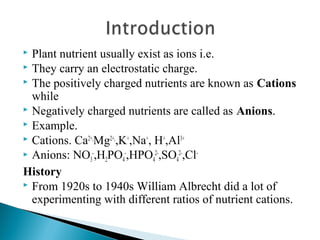
Plant nutrient usually exist as ions i.e.
 They carry an electrostatic charge.
 The positively charged nutrients are known as Cations
while
 Negatively charged nutrients are called as Anions.
 Example.
 Cations. Ca2+,Mg2+,,K+,Na+, H+,Al3+
 Anions: NO -,H PO -,HPO 2-,SO 2-,Cl3
2
4
4
4
History
 From 1920s to 1940s William Albrecht did a lot of
experimenting with different ratios of nutrient cations.





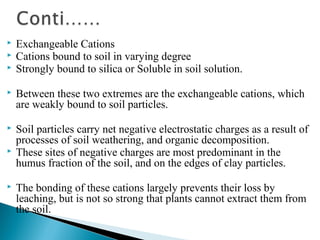
Exchangeable Cations
Cations bound to soil in varying degree
Strongly bound to silica or Soluble in soil solution.



Between these two extremes are the exchangeable cations, which
are weakly bound to soil particles.



Soil particles carry net negative electrostatic charges as a result of
processes of soil weathering, and organic decomposition.
These sites of negative charges are most predominant in the
humus fraction of the soil, and on the edges of clay particles.





The bonding of these cations largely prevents their loss by
leaching, but is not so strong that plants cannot extract them from
the soil.


The Cation exchange capacity of a soil is a
measurement of its ability to bind or hold exchangeable
cations. In other words, it is a measure of the number of
negatively-charged binding sites in the soil.
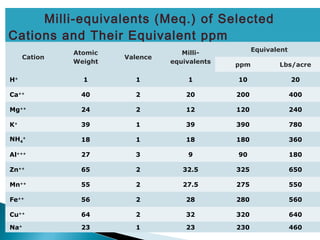
Milli-equivalents (Meq.) of Selected
Cations and Their Equivalent ppm
Equivalent

Valence

Milliequivalents

ppm

Lbs/acre

1

1

1

10

20

Ca++

40

2

20

200

400

Mg++

24

2

12

120

240

K+

39

1

39

390

780

NH4+

18

1

18

180

360

Al+++

27

3

9

90

180

Zn++

65

2

32.5

325

650

Mn++

55

2

27.5

275

550

Fe++

56

2

28

280

560

Cu++

64

2

32

320

640

Na+

23

1

23

230

460

Cation
H+

Atomic
Weight
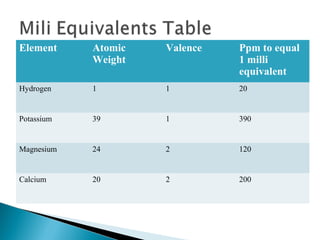
Element

Atomic
Weight

Valence

Ppm to equal
1 milli
equivalent

Hydrogen

1

1

20

Potassium

39

1

390

Magnesium

24

2

120

Calcium

20

2

200
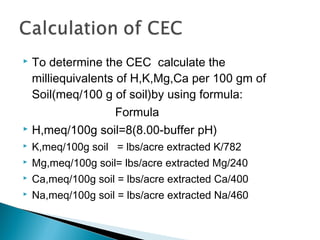
To determine the CEC calculate the
milliequivalents of H,K,Mg,Ca per 100 gm of
Soil(meq/100 g of soil)by using formula:
Formula
 H,meq/100g soil=8(8.00-buffer pH)




K,meq/100g soil = lbs/acre extracted K/782



Mg,meq/100g soil= lbs/acre extracted Mg/240



Ca,meq/100g soil = lbs/acre extracted Ca/400



Na,meq/100g soil = lbs/acre extracted Na/460
Lab
#

Sampe
l#

Soil
code

Soil
pH

Buffe
r pH

P

K

Mg

Ca

Na

113

3

4

5.1

7.70

168

221

28

400

12


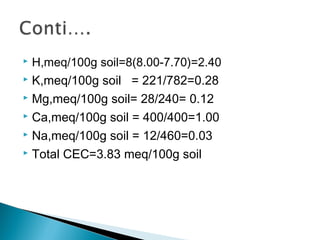
H,meq/100g soil=8(8.00-7.70)=2.40

K,meq/100g soil = 221/782=0.28
 Mg,meq/100g soil= 28/240= 0.12
 Ca,meq/100g soil = 400/400=1.00
 Na,meq/100g soil = 12/460=0.03
 Total CEC=3.83 meq/100g soil

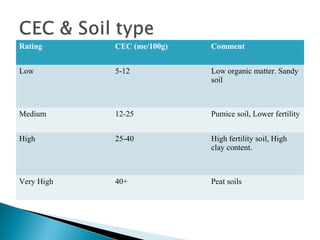
Rating

CEC (me/100g)

Comment

Low

5-12

Low organic matter. Sandy
soil

Medium

12-25

Pumice soil, Lower fertility

High

25-40

High fertility soil, High
clay content.

Very High

40+

Peat soils
It refers to Elements that are basic or Alkaline in their
reaction.e.g K,Mg, Ca & small amount of Na & Al.
 Hydrogen is an element with a positive charge and acts
like a cation however soils with significant saturation
of hydrogen are acidic, or have a lower pH.
 The measure is expressed as milligram equivalents per
100 grams of soil or shortened to “me”.

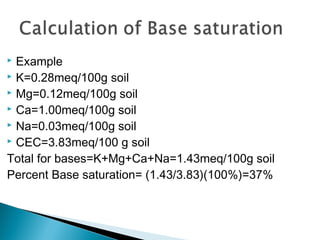
Example
 K=0.28meq/100g soil
 Mg=0.12meq/100g soil
 Ca=1.00meq/100g soil
 Na=0.03meq/100g soil
 CEC=3.83meq/100 g soil
Total for bases=K+Mg+Ca+Na=1.43meq/100g soil
Percent Base saturation= (1.43/3.83)(100%)=37%

Exchangeable Cations can be divided into two groups.
 Bases
 Acids
 Every CEC binding site must have a cation bound to it,
to maintain electeroneutrality.
 The soil pH Will be effected by whichever cations
predominate on these exchange sites.
 More base cations more alkaline soil
 More acid Cations more acidic soil

It is the fraction of the negative binding sites occupied
by bases.
 For example
 A base saturation level of 75% means that three out of
four sites are occupied by basic cations (remaining
25% by acidic cations).
 Total base saturation is determined by following
formula
 Total base saturation= Ca+Mg+K+Na

CEC

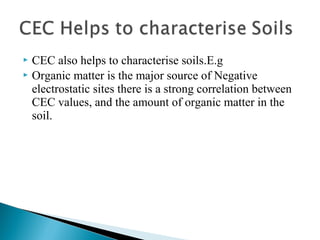
CEC also helps to characterise soils.E.g
 Organic matter is the major source of Negative
electrostatic sites there is a strong correlation between
CEC values, and the amount of organic matter in the
soil.

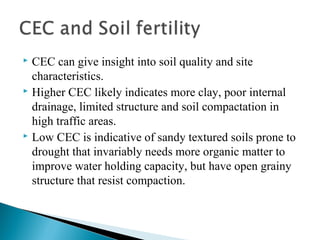
CEC can give insight into soil quality and site
characteristics.
 Higher CEC likely indicates more clay, poor internal
drainage, limited structure and soil compactation in
high traffic areas.
 Low CEC is indicative of sandy textured soils prone to
drought that invariably needs more organic matter to
improve water holding capacity, but have open grainy
structure that resist compaction.

What we have learned


Clay and organic matter have negative charges that can
hold and release positively charged nutrients.(The
cations are adsorbed onto the surface of the clay of the
clay or humus).That static charge keeps the nutrients
from being washed away, and holds them so they are
available to plant roots and soil microorganisms.
THANKS

Cation exchange capicity and base saturation

  • 1.
    PRESENTED BY AKHTAR MEHMOOD ROLL# 11041706-010 DEPARTMENT OF BOTANY M.PHIL BOTANY FINAL SEMESTER
  • 2.
    Plant nutrient usuallyexist as ions i.e.  They carry an electrostatic charge.  The positively charged nutrients are known as Cations while  Negatively charged nutrients are called as Anions.  Example.  Cations. Ca2+,Mg2+,,K+,Na+, H+,Al3+  Anions: NO -,H PO -,HPO 2-,SO 2-,Cl3 2 4 4 4 History  From 1920s to 1940s William Albrecht did a lot of experimenting with different ratios of nutrient cations. 
  • 3.
       Exchangeable Cations Cations boundto soil in varying degree Strongly bound to silica or Soluble in soil solution.  Between these two extremes are the exchangeable cations, which are weakly bound to soil particles.  Soil particles carry net negative electrostatic charges as a result of processes of soil weathering, and organic decomposition. These sites of negative charges are most predominant in the humus fraction of the soil, and on the edges of clay particles.   The bonding of these cations largely prevents their loss by leaching, but is not so strong that plants cannot extract them from the soil.
  • 4.
     The Cation exchangecapacity of a soil is a measurement of its ability to bind or hold exchangeable cations. In other words, it is a measure of the number of negatively-charged binding sites in the soil.
  • 5.
    Milli-equivalents (Meq.) ofSelected Cations and Their Equivalent ppm Equivalent Valence Milliequivalents ppm Lbs/acre 1 1 1 10 20 Ca++ 40 2 20 200 400 Mg++ 24 2 12 120 240 K+ 39 1 39 390 780 NH4+ 18 1 18 180 360 Al+++ 27 3 9 90 180 Zn++ 65 2 32.5 325 650 Mn++ 55 2 27.5 275 550 Fe++ 56 2 28 280 560 Cu++ 64 2 32 320 640 Na+ 23 1 23 230 460 Cation H+ Atomic Weight
  • 6.
    Element Atomic Weight Valence Ppm to equal 1milli equivalent Hydrogen 1 1 20 Potassium 39 1 390 Magnesium 24 2 120 Calcium 20 2 200
  • 7.
    To determine theCEC calculate the milliequivalents of H,K,Mg,Ca per 100 gm of Soil(meq/100 g of soil)by using formula: Formula  H,meq/100g soil=8(8.00-buffer pH)   K,meq/100g soil = lbs/acre extracted K/782  Mg,meq/100g soil= lbs/acre extracted Mg/240  Ca,meq/100g soil = lbs/acre extracted Ca/400  Na,meq/100g soil = lbs/acre extracted Na/460
  • 8.
  • 9.
     H,meq/100g soil=8(8.00-7.70)=2.40 K,meq/100g soil= 221/782=0.28  Mg,meq/100g soil= 28/240= 0.12  Ca,meq/100g soil = 400/400=1.00  Na,meq/100g soil = 12/460=0.03  Total CEC=3.83 meq/100g soil 
  • 10.
    Rating CEC (me/100g) Comment Low 5-12 Low organicmatter. Sandy soil Medium 12-25 Pumice soil, Lower fertility High 25-40 High fertility soil, High clay content. Very High 40+ Peat soils
  • 11.
    It refers toElements that are basic or Alkaline in their reaction.e.g K,Mg, Ca & small amount of Na & Al.  Hydrogen is an element with a positive charge and acts like a cation however soils with significant saturation of hydrogen are acidic, or have a lower pH.  The measure is expressed as milligram equivalents per 100 grams of soil or shortened to “me”. 
  • 12.
    Example  K=0.28meq/100g soil Mg=0.12meq/100g soil  Ca=1.00meq/100g soil  Na=0.03meq/100g soil  CEC=3.83meq/100 g soil Total for bases=K+Mg+Ca+Na=1.43meq/100g soil Percent Base saturation= (1.43/3.83)(100%)=37% 
  • 13.
    Exchangeable Cations canbe divided into two groups.  Bases  Acids  Every CEC binding site must have a cation bound to it, to maintain electeroneutrality.  The soil pH Will be effected by whichever cations predominate on these exchange sites.  More base cations more alkaline soil  More acid Cations more acidic soil 
  • 14.
    It is thefraction of the negative binding sites occupied by bases.  For example  A base saturation level of 75% means that three out of four sites are occupied by basic cations (remaining 25% by acidic cations).  Total base saturation is determined by following formula  Total base saturation= Ca+Mg+K+Na  CEC 
  • 15.
    CEC also helpsto characterise soils.E.g  Organic matter is the major source of Negative electrostatic sites there is a strong correlation between CEC values, and the amount of organic matter in the soil. 
  • 16.
    CEC can giveinsight into soil quality and site characteristics.  Higher CEC likely indicates more clay, poor internal drainage, limited structure and soil compactation in high traffic areas.  Low CEC is indicative of sandy textured soils prone to drought that invariably needs more organic matter to improve water holding capacity, but have open grainy structure that resist compaction. 
  • 17.
    What we havelearned  Clay and organic matter have negative charges that can hold and release positively charged nutrients.(The cations are adsorbed onto the surface of the clay of the clay or humus).That static charge keeps the nutrients from being washed away, and holds them so they are available to plant roots and soil microorganisms.
  • 18.