
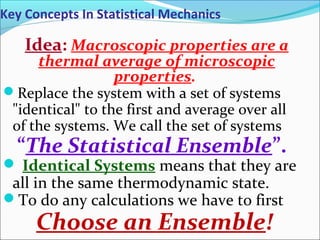
Key Concepts In Statistical Mechanics
Idea: Macroscopic properties are a
thermal average of microscopic
properties.
Replace the system with a set of systems
"identical" to the first and average over all
of the systems. We call the set of systems
“The Statistical Ensemble”.
 Identical Systems means that they are
all in the same thermodynamic state.
To do any calculations we have to first
Choose an Ensemble!
The Most Common Statistical Ensembles:
1. The Micro-Canonical Ensemble:
Isolated Systems: Constant Energy E.
Nothing happens! ⇒ Not Interesting!
4
The Most Common Statistical Ensembles:
1. The Micro-Canonical Ensemble:
Isolated Systems: Constant Energy E.
Nothing happens! ⇒ Not Interesting!
2. The Canonical Ensemble:
Systems with a fixed number N of
molecules
In equilibrium with a Heat Reservoir (Heat Bath).
5
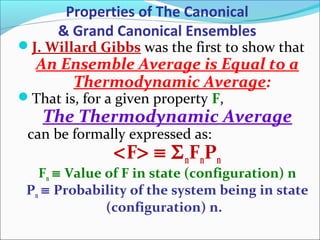
J. Willard Gibbs was the first to show that
An Ensemble Average is Equal to a
Thermodynamic Average:
That is, for a given property F,
The Thermodynamic Average
can be formally expressed as:
<F> ≡ ΣnFnPn
Fn ≡ Value of F in state (configuration) n
Pn ≡ Probability of the system being in state
(configuration) n.
Properties of The Canonical
& Grand Canonical Ensembles
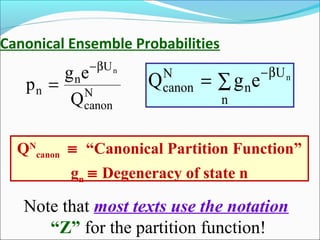
Canonical Ensemble Probabilities
p
g e
Q
n
n
U
canon
N
n
=
−β
QN
canon ≡ “Canonical Partition Function”
gn ≡ Degeneracy of state n
Q g ecanon
N
n
n
Un
= ∑
−β
Note that most texts use the notation
“Z” for the partition function!
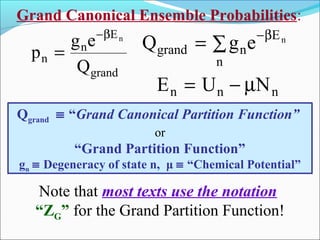
Grand Canonical Ensemble Probabilities:
p
g e
Q
n
n
E
grand
n
=
−β
E U Nn n n= − µ
Q g egrand n
n
En
= ∑
−β
Qgrand ≡ “Grand Canonical Partition Function”
or
“Grand Partition Function”
gn ≡ Degeneracy of state n, μ ≡ “Chemical Potential”
Note that most texts use the notation
“ZG” for the Grand Partition Function!
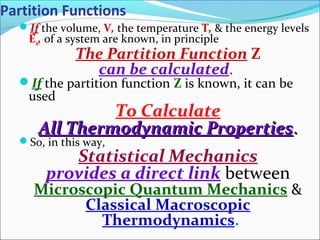
Partition Functions
If the volume, V, the temperature T, & the energy levels
En, of a system are known, in principle
The Partition Function Z
can be calculated.
If the partition function Z is known, it can be
used
To Calculate
All Thermodynamic PropertiesAll Thermodynamic Properties..
So, in this way,
Statistical Mechanics
provides a direct link between
Microscopic Quantum Mechanics &
Classical Macroscopic
Thermodynamics.
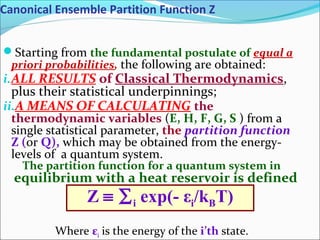
Canonical Ensemble Partition Function Z
Starting from the fundamental postulate of equal a
priori probabilities, the following are obtained:
i.ALL RESULTS of Classical Thermodynamics,
plus their statistical underpinnings;
ii.A MEANS OF CALCULATING the
thermodynamic variables (E, H, F, G, S ) from a
single statistical parameter, the partition function
Z (or Q), which may be obtained from the energy-
levels of a quantum system.
The partition function for a quantum system in
equilibrium with a heat reservoir is defined
as
W
Where εi is the energy of the i’th state.
Z ≡ ∑i exp(- εi/kBT)
11
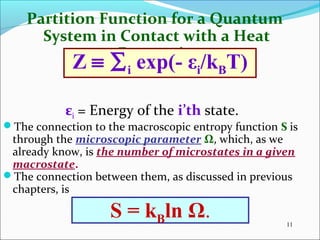
Partition Function for a Quantum
System in Contact with a Heat
Reservoir:
,
F
εi = Energy of the i’th state.
The connection to the macroscopic entropy function S is
through the microscopic parameter Ω, which, as we
already know, is the number of microstates in a given
macrostate.
The connection between them, as discussed in previous
chapters, is
Z ≡ ∑i exp(- εi/kBT)
S = kBln Ω.
Relationship of Z to Macroscopic Parameters
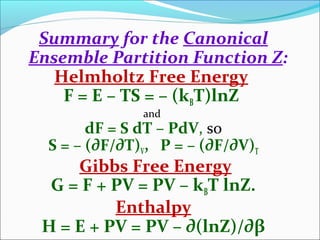
Summary for the Canonical
Ensemble Partition Function Z:
(Derivations are in the book!)
Internal Energy: Ē ≡ E = - ∂(lnZ)/∂β
<ΔE)2
> = [∂2
(lnZ)/∂β2
]
β = 1/(kBT), kB = Boltzmann’s constantt.
Entropy: S = kBβĒ + kBlnZ
An important, frequently used result!
Summary for the Canonical
Ensemble Partition Function Z:
Helmholtz Free Energy
F = E – TS = – (kBT)lnZ
and
dF = S dT – PdV, so
S = – (∂F/∂T)V, P = – (∂F/∂V)T
Gibbs Free Energy
G = F + PV = PV – kBT lnZ.
Enthalpy
H = E + PV = PV – ∂(lnZ)/∂β
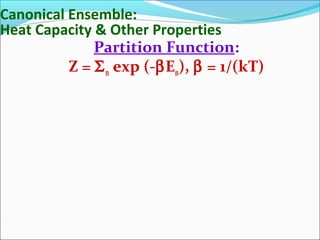
Canonical Ensemble:
Heat Capacity & Other Properties
Partition Function:
Z = Σn exp (-βEn), β = 1/(kT)
Canonical Ensemble:
Heat Capacity & Other Properties
Partition Function:
Z = Σn exp (-βEn), β = 1/(kT)
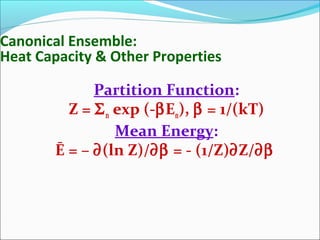
Mean Energy:
Ē = – ∂(ln Z)/∂β = - (1/Z)∂Z/∂β
Canonical Ensemble:
Heat Capacity & Other Properties
Partition Function:
Z = Σn exp (-βEn), β = 1/(kT)
Mean Energy:
Ē = – ∂(ln Z)/∂β = - (1/Z)∂Z/∂β
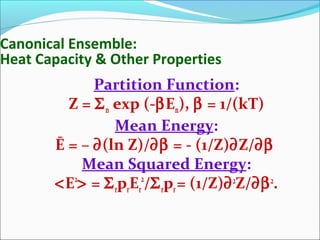
Mean Squared Energy:
<E2
> = ΣrprEr
2
/Σrpr= (1/Z)∂2
Z/∂β2
.
Canonical Ensemble:
Heat Capacity & Other Properties
Partition Function:
Z = Σn exp (-βEn), β = 1/(kT)
Mean Energy:
Ē = – ∂(ln Z)/∂β = - (1/Z)∂Z/∂β
Mean Squared Energy:
<E2
> = ΣrprEr
2
/Σrpr= (1/Z)∂2
Z/∂β2
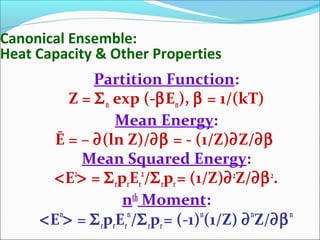
.
nth
Moment:
<En
> = ΣrprEr
n
/Σrpr= (-1)n
(1/Z) ∂n
Z/∂βn
Canonical Ensemble:
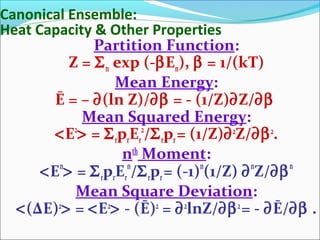
Heat Capacity & Other Properties
Partition Function:
Z = Σn exp (-βEn), β = 1/(kT)
Mean Energy:
Ē = – ∂(ln Z)/∂β = - (1/Z)∂Z/∂β
Mean Squared Energy:
<E2
> = ΣrprEr
2
/Σrpr= (1/Z)∂2
Z/∂β2
.
nth
Moment:
<En
> = ΣrprEr
n
/Σrpr= (-1)n
(1/Z) ∂n
Z/∂βn
Mean Square Deviation:
<(ΔE)2
> = <E2
> - (Ē)2
= ∂2
lnZ/∂β2
= - ∂Ē/∂β .
Canonical Ensemble:
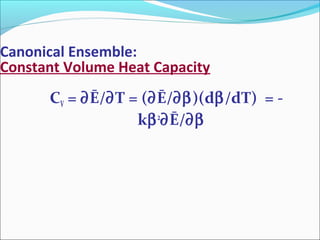
Constant Volume Heat Capacity
CV = ∂Ē/∂T = (∂Ē/∂β)(dβ/dT) = -
kβ2
∂Ē/∂β
Canonical Ensemble:
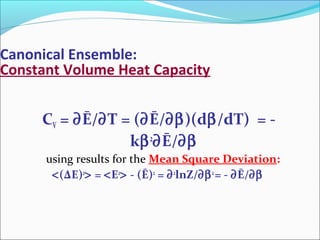
Constant Volume Heat Capacity
CV = ∂Ē/∂T = (∂Ē/∂β)(dβ/dT) = -
kβ2
∂Ē/∂β
using results for the Mean Square Deviation:
<(ΔE)2
> = <E2
> - (Ē)2
= ∂2
lnZ/∂β2
= - ∂Ē/∂β
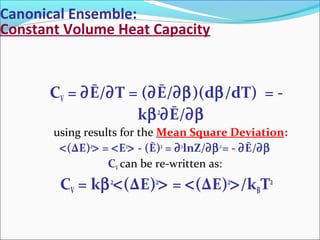
Canonical Ensemble:
Constant Volume Heat Capacity
CV = ∂Ē/∂T = (∂Ē/∂β)(dβ/dT) = -
kβ2
∂Ē/∂β
using results for the Mean Square Deviation:
<(ΔE)2
> = <E2
> - (Ē)2
= ∂2
lnZ/∂β2
= - ∂Ē/∂β
CV can be re-written as:
CV = kβ2
<(ΔE)2
> = <(ΔE)2
>/kBT2
STATISTICAL MECHNICE

STATISTICAL MECHNICE

  • 3.
    Key Concepts InStatistical Mechanics Idea: Macroscopic properties are a thermal average of microscopic properties. Replace the system with a set of systems "identical" to the first and average over all of the systems. We call the set of systems “The Statistical Ensemble”.  Identical Systems means that they are all in the same thermodynamic state. To do any calculations we have to first Choose an Ensemble!
  • 4.
    The Most CommonStatistical Ensembles: 1. The Micro-Canonical Ensemble: Isolated Systems: Constant Energy E. Nothing happens! ⇒ Not Interesting! 4
  • 5.
    The Most CommonStatistical Ensembles: 1. The Micro-Canonical Ensemble: Isolated Systems: Constant Energy E. Nothing happens! ⇒ Not Interesting! 2. The Canonical Ensemble: Systems with a fixed number N of molecules In equilibrium with a Heat Reservoir (Heat Bath). 5
  • 6.
    J. Willard Gibbswas the first to show that An Ensemble Average is Equal to a Thermodynamic Average: That is, for a given property F, The Thermodynamic Average can be formally expressed as: <F> ≡ ΣnFnPn Fn ≡ Value of F in state (configuration) n Pn ≡ Probability of the system being in state (configuration) n. Properties of The Canonical & Grand Canonical Ensembles
  • 7.
    Canonical Ensemble Probabilities p ge Q n n U canon N n = −β QN canon ≡ “Canonical Partition Function” gn ≡ Degeneracy of state n Q g ecanon N n n Un = ∑ −β Note that most texts use the notation “Z” for the partition function!
  • 8.
    Grand Canonical EnsembleProbabilities: p g e Q n n E grand n = −β E U Nn n n= − µ Q g egrand n n En = ∑ −β Qgrand ≡ “Grand Canonical Partition Function” or “Grand Partition Function” gn ≡ Degeneracy of state n, μ ≡ “Chemical Potential” Note that most texts use the notation “ZG” for the Grand Partition Function!
  • 9.
    Partition Functions If thevolume, V, the temperature T, & the energy levels En, of a system are known, in principle The Partition Function Z can be calculated. If the partition function Z is known, it can be used To Calculate All Thermodynamic PropertiesAll Thermodynamic Properties.. So, in this way, Statistical Mechanics provides a direct link between Microscopic Quantum Mechanics & Classical Macroscopic Thermodynamics.
  • 10.
    Canonical Ensemble PartitionFunction Z Starting from the fundamental postulate of equal a priori probabilities, the following are obtained: i.ALL RESULTS of Classical Thermodynamics, plus their statistical underpinnings; ii.A MEANS OF CALCULATING the thermodynamic variables (E, H, F, G, S ) from a single statistical parameter, the partition function Z (or Q), which may be obtained from the energy- levels of a quantum system. The partition function for a quantum system in equilibrium with a heat reservoir is defined as W Where εi is the energy of the i’th state. Z ≡ ∑i exp(- εi/kBT)
  • 11.
    11 Partition Function fora Quantum System in Contact with a Heat Reservoir: , F εi = Energy of the i’th state. The connection to the macroscopic entropy function S is through the microscopic parameter Ω, which, as we already know, is the number of microstates in a given macrostate. The connection between them, as discussed in previous chapters, is Z ≡ ∑i exp(- εi/kBT) S = kBln Ω.
  • 12.
    Relationship of Zto Macroscopic Parameters Summary for the Canonical Ensemble Partition Function Z: (Derivations are in the book!) Internal Energy: Ē ≡ E = - ∂(lnZ)/∂β <ΔE)2 > = [∂2 (lnZ)/∂β2 ] β = 1/(kBT), kB = Boltzmann’s constantt. Entropy: S = kBβĒ + kBlnZ An important, frequently used result!
  • 13.
    Summary for theCanonical Ensemble Partition Function Z: Helmholtz Free Energy F = E – TS = – (kBT)lnZ and dF = S dT – PdV, so S = – (∂F/∂T)V, P = – (∂F/∂V)T Gibbs Free Energy G = F + PV = PV – kBT lnZ. Enthalpy H = E + PV = PV – ∂(lnZ)/∂β
  • 14.
    Canonical Ensemble: Heat Capacity& Other Properties Partition Function: Z = Σn exp (-βEn), β = 1/(kT)
  • 15.
    Canonical Ensemble: Heat Capacity& Other Properties Partition Function: Z = Σn exp (-βEn), β = 1/(kT) Mean Energy: Ē = – ∂(ln Z)/∂β = - (1/Z)∂Z/∂β
  • 16.
    Canonical Ensemble: Heat Capacity& Other Properties Partition Function: Z = Σn exp (-βEn), β = 1/(kT) Mean Energy: Ē = – ∂(ln Z)/∂β = - (1/Z)∂Z/∂β Mean Squared Energy: <E2 > = ΣrprEr 2 /Σrpr= (1/Z)∂2 Z/∂β2 .
  • 17.
    Canonical Ensemble: Heat Capacity& Other Properties Partition Function: Z = Σn exp (-βEn), β = 1/(kT) Mean Energy: Ē = – ∂(ln Z)/∂β = - (1/Z)∂Z/∂β Mean Squared Energy: <E2 > = ΣrprEr 2 /Σrpr= (1/Z)∂2 Z/∂β2 . nth Moment: <En > = ΣrprEr n /Σrpr= (-1)n (1/Z) ∂n Z/∂βn
  • 18.
    Canonical Ensemble: Heat Capacity& Other Properties Partition Function: Z = Σn exp (-βEn), β = 1/(kT) Mean Energy: Ē = – ∂(ln Z)/∂β = - (1/Z)∂Z/∂β Mean Squared Energy: <E2 > = ΣrprEr 2 /Σrpr= (1/Z)∂2 Z/∂β2 . nth Moment: <En > = ΣrprEr n /Σrpr= (-1)n (1/Z) ∂n Z/∂βn Mean Square Deviation: <(ΔE)2 > = <E2 > - (Ē)2 = ∂2 lnZ/∂β2 = - ∂Ē/∂β .
  • 19.
    Canonical Ensemble: Constant VolumeHeat Capacity CV = ∂Ē/∂T = (∂Ē/∂β)(dβ/dT) = - kβ2 ∂Ē/∂β
  • 20.
    Canonical Ensemble: Constant VolumeHeat Capacity CV = ∂Ē/∂T = (∂Ē/∂β)(dβ/dT) = - kβ2 ∂Ē/∂β using results for the Mean Square Deviation: <(ΔE)2 > = <E2 > - (Ē)2 = ∂2 lnZ/∂β2 = - ∂Ē/∂β
  • 21.
    Canonical Ensemble: Constant VolumeHeat Capacity CV = ∂Ē/∂T = (∂Ē/∂β)(dβ/dT) = - kβ2 ∂Ē/∂β using results for the Mean Square Deviation: <(ΔE)2 > = <E2 > - (Ē)2 = ∂2 lnZ/∂β2 = - ∂Ē/∂β CV can be re-written as: CV = kβ2 <(ΔE)2 > = <(ΔE)2 >/kBT2