FUNDAMENTAL RESERVOIR FLUID PROPERTIES 
Ekeh Modesty Kelechukwu 
Dept. of Chemical & Petroleum Engineering 
UCSI University 
56000 Cheras , Kuala Lumpur 
ekehmodesty@ucsi.edu.my
Syllabus 
Fundamental of Reservoir Fluid Behaviours 
 Sampling and analysis of reservoir fluids 
 Basic classification of hydrocarbons 
 Hydrocarbon phase behaviours (single, double, multi-components) 
 Classification of reservoir fluids 
 Gas properties 
 Liquid properties 
 Formation water properties
Typical Reservoir 
Gas 
Oil 
water
Hydrocarbon 
Reservoir 
Fluids: oil, gas and water 
Typical Flow 
Reservoir fluid must flow to the surface for 
marketable oil and gas
Hydrocarbon Reserves 
Np = A*h*f * Sw -Swi ( )* 1 
Boi 
- 1 
Bo 
æ  
è  
ç  ö  
÷  
ø  
1 
G= A*h*f * ( 1- S)* ( B1 - - 
B1 
) 
p wi B gi B 
gi g 
g
Oil or Gas or Mixture of Both 
Pressure 
Temperature 
oil 
gas 
Oil + Gas 
Bubble point
Fluid flow in reservoir 
qw = kwA 
m 
Dp 
DL 
qo = koA 
m 
Dp 
DL 
qg = 
kgA 
m 
Dp 
DL 
Saturated with oil, gas and water
Recovery optimization 
separator 
Oil reservoir
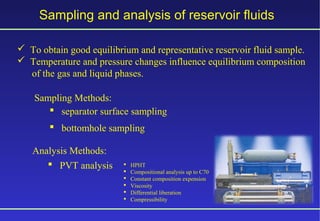
Sampling and analysis of reservoir fluids 
 To obtain good equilibrium and representative reservoir fluid sample. 
 Temperature and pressure changes influence equilibrium composition 
of the gas and liquid phases. 
Sampling Methods: 
 separator surface sampling 
 bottomhole sampling 
Analysis Methods: 
 PVT analysis 
 HPHT 
 Compositional analysis up to C70 
 Constant composition expension 
 Viscosity 
 Differential liberation 
 Compressibility
General properties of hydrocarbon fluids 
 Formation volume factor, Bg, Bo, Bw: volres/volsc 
 Density, specific gravity 
 Isothermal Compressibility 
 Viscosity 
 Solution Gas-Oil Ratio 
 Ideal gas law: pV = nRT 
 Real gas law: pV = znRT
Typical composition of Petroleum Gases 
Natural Gas 
Hydrocarbons 
Methane 70-98% 
Ethane 1-10% 
Propane trace - 5% 
Butane trace - 2% 
Pentane trace - 1% 
Hexane trace - 0.5% 
Heptane+ trace - 0.5% 
Non-hydrocarbons 
Nitrogen trace - 15% 
Carbon dioxide trace - 5% 
Hydrogen Sulfide trace - 3% 
Helium up to 5%, 
normally traces 
or none
Typical composition of Petroleum Gases 
Gas from Oil Well 
Hydrocarbons 
Methane 45-92% 
Ethane 4-21% 
Propane 1 - 15% 
Butane 0.5 - 7% 
Pentane v. little - 3% 
Hexane v. little - 2% 
Heptane+ v. little - 1.5% 
Non-hydrocarbons 
Nitrogen v. little – up to 10% 
Carbon dioxide v. little - 4% 
Hydrogen Sulfide v. little - 6% 
Helium none
Typical Crude Oil Fractions 
Crude oil fractions Boiling Chemical 
Point, oF Composition Usages 
Gas hydrocarbon C1 – C2 Fuel gas 
up to 100 C3 – C6 Bottled fuel gas, solvent 
Gasoline 100 – 500 C5 – C10 Motor fuel, solvent 
Kerosene 350 – 480 C11 – C13 Jet fuel, cracking stock 
Light Gas Oil 450 – 480 C13 – C17 Diesel fuel, furnace fuel 
Heavy Gas Oil 580 – 750 C18 – C25 Lubricating oil, bunker fuel 
Lubricant and Wax 750 – 950 C26 – C38 Lubricating oil, paraffin wax, petroleum jelly 
Residual Oil 950+ C38+ Tar, roof compound, asphalt, coke
Typical composition analysis of crude oils 
Carbon 84 - 87% 
Hydrogen 11 - 14% 
Sulfur 0.06 – 2% 
Nitrogen 0.1 – 2% 
Oxygen 0.1 – 2%
Basic classification of hydrocarbons 
Hydrocarbon Homolog Series 
Hydrocarbons 
Alkenes 
-unsaturated H 
-olefin: 1 double bond 
-diolefin: 2 double bonds 
Alkanes (paraffin) 
-saturated H 
Aliphatic 
Alkynes (acetylene) 
-unsaturated H 
-triple bonds 
Aromatics 
(Benzene) 
Cyclic aliphatic 
Naphthalene
Compounds in Crude Oil (South Ponca Field, Oklahoma)
Alkanes, CnH2n+2 
No. of Carbon Name 
1 Methane 
2 Ethane 
3 Propane 
4 Butane 
5 Pentane 
6 Hexane 
7 Heptane 
8 Octane 
9 Nonane 
10 Decane 
20 Eicosane 
30 Triacontane 
 Covalent bond: sharing electrons 
 Isomerism - same molecular formula but 
different structure, different physical and 
chemical properties 
 Prefix isomers – n-, iso-, neo-, etc. 
Heptane C5 H12 
 n-heptane 
 iso-heptane 
 neo-heptane
Alkanes, CnH2n+2 
Physical properties: 
Alkane Formula Boiling point [°C] Melting point [°C] Density [g·cm3] 
(at 20°C) 
Methane CH4 -162 -183 gas 
Ethane C2H6 -89 -172 gas 
Propane C3H8 -42 -188 gas 
Butane C4H10 0 -138 gas 
Pentane C5H12 36 -130 0.626(liquid) 
Hexane C6H14 69 -95 0.659(liquid) 
Heptane C7H16 98 -91 0.684(liquid) 
Octane C8H18 126 -57 0.703(liquid) 
Nonane C9H20 151 -54 0.718(liquid) 
Decane C10H22 174 -30 0.730(liquid) 
Undecane C11H24 196 -26 0.740(liquid) 
Dodecane C12H26 216 -10 0.749(liquid) 
Icosane C20H42 343 37 solid 
Triacontane C30H62 450 66 solid 
Tetracontane C40H82 525 82 solid 
Pentacontane C50H102 575 91 solid
Nomenclature of Alkanes 
Based on IUPAC (International Union of Pure and Applied Chemistry) rules: 
Alkyl groups (missing one hydrocarbon atom): methyl group, ethyl group, prophyl group 
These rules are as follows: 
 The largest continuous chain of carbon atoms is taken as the 
framework on which the various alkyl groups are considered to be 
substituted. Thus the following hydrocarbon is a pentane. 
 The parent hydrocarbon is then numbered starting from the 
end of the chain and the substituent groups are assigned numbers 
corresponding to their positions on the chain. The direction of 
numbering is chosen to give the lowest sum for 
the numbers of the side chain substituents. Thus, the 
hydrocarbon is 2,3-dimethylpentane. .
Nomenclature of Alkanes 
 Where there are two identical substituents in one position 
as in the compound below numbers are supplied for each. 
 Branched-chain substituent groups are given appropriate 
names by a simple extension of the system used for branched 
chain hydrocarbons. The longest chain of the substituent is 
numbered starting with the carbon attached directly to the 
parent hydrocarbon chain. Parentheses are used to separate 
the numbering of the substituent and the main hydrocarbon 
chain. 
 When there are two or more different substituents present, 
the common method is to list the substituents in alphabetical 
order, although the substituents are sometimes listed in order 
of increasing complexity.

Fundamental Reservoir Fluid Behaviour

  • 1.
    FUNDAMENTAL RESERVOIR FLUIDPROPERTIES Ekeh Modesty Kelechukwu Dept. of Chemical & Petroleum Engineering UCSI University 56000 Cheras , Kuala Lumpur ekehmodesty@ucsi.edu.my
  • 2.
    Syllabus Fundamental ofReservoir Fluid Behaviours  Sampling and analysis of reservoir fluids  Basic classification of hydrocarbons  Hydrocarbon phase behaviours (single, double, multi-components)  Classification of reservoir fluids  Gas properties  Liquid properties  Formation water properties
  • 3.
  • 4.
    Hydrocarbon Reservoir Fluids:oil, gas and water Typical Flow Reservoir fluid must flow to the surface for marketable oil and gas
  • 5.
    Hydrocarbon Reserves Np= A*h*f * Sw -Swi ( )* 1 Boi - 1 Bo æ è ç ö ÷ ø 1 G= A*h*f * ( 1- S)* ( B1 - - B1 ) p wi B gi B gi g g
  • 6.
    Oil or Gasor Mixture of Both Pressure Temperature oil gas Oil + Gas Bubble point
  • 7.
    Fluid flow inreservoir qw = kwA m Dp DL qo = koA m Dp DL qg = kgA m Dp DL Saturated with oil, gas and water
  • 8.
  • 9.
    Sampling and analysisof reservoir fluids  To obtain good equilibrium and representative reservoir fluid sample.  Temperature and pressure changes influence equilibrium composition of the gas and liquid phases. Sampling Methods:  separator surface sampling  bottomhole sampling Analysis Methods:  PVT analysis  HPHT  Compositional analysis up to C70  Constant composition expension  Viscosity  Differential liberation  Compressibility
  • 10.
    General properties ofhydrocarbon fluids  Formation volume factor, Bg, Bo, Bw: volres/volsc  Density, specific gravity  Isothermal Compressibility  Viscosity  Solution Gas-Oil Ratio  Ideal gas law: pV = nRT  Real gas law: pV = znRT
  • 11.
    Typical composition ofPetroleum Gases Natural Gas Hydrocarbons Methane 70-98% Ethane 1-10% Propane trace - 5% Butane trace - 2% Pentane trace - 1% Hexane trace - 0.5% Heptane+ trace - 0.5% Non-hydrocarbons Nitrogen trace - 15% Carbon dioxide trace - 5% Hydrogen Sulfide trace - 3% Helium up to 5%, normally traces or none
  • 12.
    Typical composition ofPetroleum Gases Gas from Oil Well Hydrocarbons Methane 45-92% Ethane 4-21% Propane 1 - 15% Butane 0.5 - 7% Pentane v. little - 3% Hexane v. little - 2% Heptane+ v. little - 1.5% Non-hydrocarbons Nitrogen v. little – up to 10% Carbon dioxide v. little - 4% Hydrogen Sulfide v. little - 6% Helium none
  • 13.
    Typical Crude OilFractions Crude oil fractions Boiling Chemical Point, oF Composition Usages Gas hydrocarbon C1 – C2 Fuel gas up to 100 C3 – C6 Bottled fuel gas, solvent Gasoline 100 – 500 C5 – C10 Motor fuel, solvent Kerosene 350 – 480 C11 – C13 Jet fuel, cracking stock Light Gas Oil 450 – 480 C13 – C17 Diesel fuel, furnace fuel Heavy Gas Oil 580 – 750 C18 – C25 Lubricating oil, bunker fuel Lubricant and Wax 750 – 950 C26 – C38 Lubricating oil, paraffin wax, petroleum jelly Residual Oil 950+ C38+ Tar, roof compound, asphalt, coke
  • 14.
    Typical composition analysisof crude oils Carbon 84 - 87% Hydrogen 11 - 14% Sulfur 0.06 – 2% Nitrogen 0.1 – 2% Oxygen 0.1 – 2%
  • 15.
    Basic classification ofhydrocarbons Hydrocarbon Homolog Series Hydrocarbons Alkenes -unsaturated H -olefin: 1 double bond -diolefin: 2 double bonds Alkanes (paraffin) -saturated H Aliphatic Alkynes (acetylene) -unsaturated H -triple bonds Aromatics (Benzene) Cyclic aliphatic Naphthalene
  • 16.
    Compounds in CrudeOil (South Ponca Field, Oklahoma)
  • 17.
    Alkanes, CnH2n+2 No.of Carbon Name 1 Methane 2 Ethane 3 Propane 4 Butane 5 Pentane 6 Hexane 7 Heptane 8 Octane 9 Nonane 10 Decane 20 Eicosane 30 Triacontane  Covalent bond: sharing electrons  Isomerism - same molecular formula but different structure, different physical and chemical properties  Prefix isomers – n-, iso-, neo-, etc. Heptane C5 H12  n-heptane  iso-heptane  neo-heptane
  • 18.
    Alkanes, CnH2n+2 Physicalproperties: Alkane Formula Boiling point [°C] Melting point [°C] Density [g·cm3] (at 20°C) Methane CH4 -162 -183 gas Ethane C2H6 -89 -172 gas Propane C3H8 -42 -188 gas Butane C4H10 0 -138 gas Pentane C5H12 36 -130 0.626(liquid) Hexane C6H14 69 -95 0.659(liquid) Heptane C7H16 98 -91 0.684(liquid) Octane C8H18 126 -57 0.703(liquid) Nonane C9H20 151 -54 0.718(liquid) Decane C10H22 174 -30 0.730(liquid) Undecane C11H24 196 -26 0.740(liquid) Dodecane C12H26 216 -10 0.749(liquid) Icosane C20H42 343 37 solid Triacontane C30H62 450 66 solid Tetracontane C40H82 525 82 solid Pentacontane C50H102 575 91 solid
  • 19.
    Nomenclature of Alkanes Based on IUPAC (International Union of Pure and Applied Chemistry) rules: Alkyl groups (missing one hydrocarbon atom): methyl group, ethyl group, prophyl group These rules are as follows:  The largest continuous chain of carbon atoms is taken as the framework on which the various alkyl groups are considered to be substituted. Thus the following hydrocarbon is a pentane.  The parent hydrocarbon is then numbered starting from the end of the chain and the substituent groups are assigned numbers corresponding to their positions on the chain. The direction of numbering is chosen to give the lowest sum for the numbers of the side chain substituents. Thus, the hydrocarbon is 2,3-dimethylpentane. .
  • 20.
    Nomenclature of Alkanes  Where there are two identical substituents in one position as in the compound below numbers are supplied for each.  Branched-chain substituent groups are given appropriate names by a simple extension of the system used for branched chain hydrocarbons. The longest chain of the substituent is numbered starting with the carbon attached directly to the parent hydrocarbon chain. Parentheses are used to separate the numbering of the substituent and the main hydrocarbon chain.  When there are two or more different substituents present, the common method is to list the substituents in alphabetical order, although the substituents are sometimes listed in order of increasing complexity.