Process Control
and
Instrumentation
Dr. Debasis Sarkar
Department of Chemical Engineering
Indian Institute of Technology Kharagpur
Transducers
Transducers
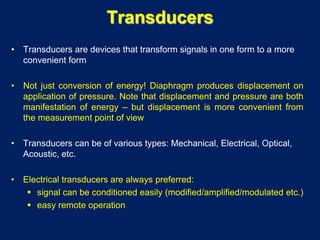
• Transducers are devices that transform signals in one form to a more
convenient form
• Not just conversion of energy! Diaphragm produces displacement on
application of pressure. Note that displacement and pressure are both
manifestation of energy – but displacement is more convenient from
the measurement point of view
• Transducers can be of various types: Mechanical, Electrical, Optical,
Acoustic, etc.
• Electrical transducers are always preferred:
 signal can be conditioned easily (modified/amplified/modulated etc.)
 easy remote operation
Transducers
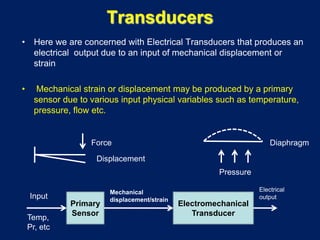
• Here we are concerned with Electrical Transducers that produces an
electrical output due to an input of mechanical displacement or
strain
• Mechanical strain or displacement may be produced by a primary
sensor due to various input physical variables such as temperature,
pressure, flow etc.
Primary
Sensor
Electromechanical
Transducer
Mechanical
displacement/strain
Electrical
outputInput
Temp,
Pr, etc
Force
Displacement
Pressure
Diaphragm
Transducers
We will briefly discuss:
 Pneumatic Transducer:
– Flapper/Nozzle system
 Electromechanical Transducers:
– Linear Variable Differential Transducer (LVDT)
• Inductance type transducer: magnetic characteristics of an electrical
circuit changes due to motion of an object
– Resistance Strain Gauge
• If a conductor is stretched/strained, its resistance will change
– Capacitive Type Transducer
• There is a change in capacitance between two plates due to motion
– Piezo-electric Transducer
• An electrical charge is produced when a crystalline material
(quartz/barium titanate) is distorted
Flapper/Nozzle System
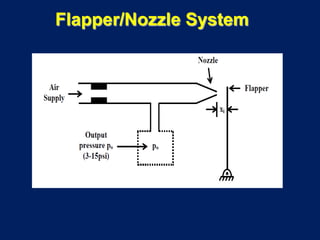
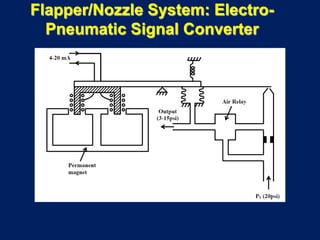
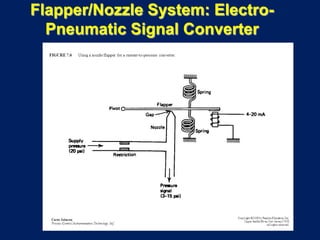
• Flapper/Nozzle system is a pneumatic transducer
• Pneumatic control system operates with air. The signal is transmitted in
the form of variable air pressure in the range of 3 – 15 psi.
• Early days, we had only pneumatic control systems
• With advent of modern electronics, many pneumatic control systems
have now been replace by electronic control systems
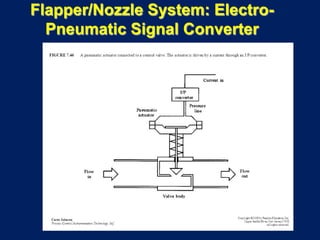
• However, even these days many industrial actuators are still pneumatic
in nature
• Advantage: Safe/Low cost/can generate more torque to its own weight
compared to electrical actuators
• Disadvantage: Slow response
Flapper/Nozzle System
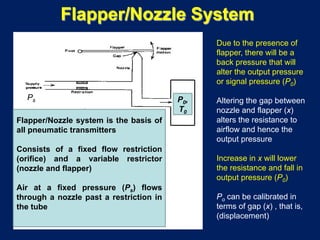
Due to the presence of
flapper, there will be a
back pressure that will
alter the output pressure
or signal pressure (P0)
Altering the gap between
nozzle and flapper (x)
alters the resistance to
airflow and hence the
output pressure
Increase in x will lower
the resistance and fall in
output pressure (P0)
Po can be calibrated in
terms of gap (x) , that is,
(displacement)
Ps P0,
T0
Flapper/Nozzle system is the basis of
all pneumatic transmitters
Consists of a fixed flow restriction
(orifice) and a variable restrictor
(nozzle and flapper)
Air at a fixed pressure (Ps) flows
through a nozzle past a restriction in
the tube
Flapper/Nozzle System
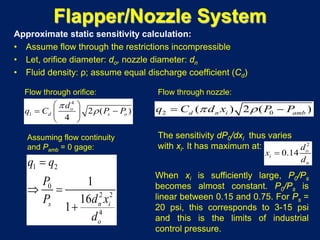
Approximate static sensitivity calculation:
• Assume flow through the restrictions incompressible
• Let, orifice diameter: do, nozzle diameter: dn
• Fluid density: ρ; assume equal discharge coefficient (Cd)
4
1 2 ( )
4
o
d s o
d
q C P P
π
ρ
 
− 
 
2 0( ) 2 ( )d n i ambq C d x P Pπ ρ= −
1 2
0
2 2
4
1
16
1 n is
o
q q
P
d xP
d
=
⇒ =
+
The sensitivity dP0/dxi thus varies
with xi. It has maximum at: 2
0.14 o
i
n
d
x
d
=
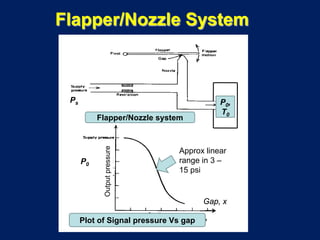
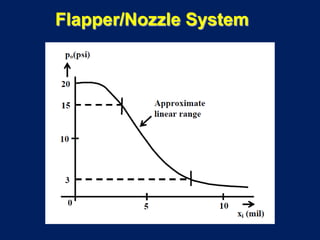
When xi is sufficiently large, P0/Ps
becomes almost constant. P0/Ps is
linear between 0.15 and 0.75. For Ps =
20 psi, this corresponds to 3-15 psi
and this is the limits of industrial
control pressure.
Flow through orifice: Flow through nozzle:
Assuming flow continuity
and Pamb = 0 gage:
Flapper/Nozzle System
Flapper/Nozzle system
Plot of Signal pressure Vs gap
Ps
P0
P0,
T0
Approx linear
range in 3 –
15 psi
Gap, x
Outputpressure
Flapper/Nozzle System
Flapper/Nozzle System: Electro-
Pneumatic Signal Converter
Flapper/Nozzle System: Electro-
Pneumatic Signal Converter
Flapper/Nozzle System: Electro-
Pneumatic Signal Converter
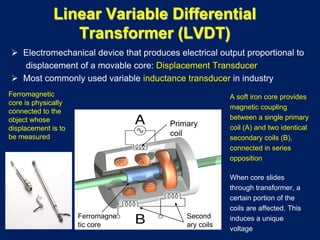
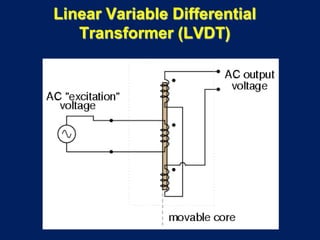
 Electromechanical device that produces electrical output proportional to
displacement of a movable core: Displacement Transducer
 Most commonly used variable inductance transducer in industry
A soft iron core provides
magnetic coupling
between a single primary
coil (A) and two identical
secondary coils (B),
connected in series
opposition
When core slides
through transformer, a
certain portion of the
coils are affected. This
induces a unique
voltage
Linear Variable Differential
Transformer (LVDT)
Primary
coil
Second
ary coils
Ferromagne
tic core
Ferromagnetic
core is physically
connected to the
object whose
displacement is to
be measured
Linear Variable Differential
Transformer (LVDT)
Transducers: LVDT
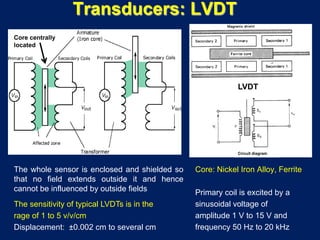
Core: Nickel Iron Alloy, Ferrite
Primary coil is excited by a
sinusoidal voltage of
amplitude 1 V to 15 V and
frequency 50 Hz to 20 kHz
The sensitivity of typical LVDTs is in the
rage of 1 to 5 v/v/cm
Displacement: ±0.002 cm to several cm
The whole sensor is enclosed and shielded so
that no field extends outside it and hence
cannot be influenced by outside fields
LVDT
Circuit diagram
Core centrally
located
Transducers: LVDT
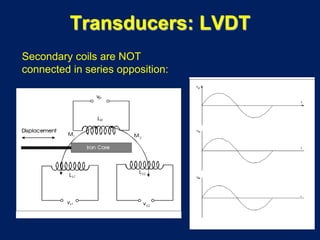
Secondary coils are NOT
connected in series opposition:
Transducers: LVDT
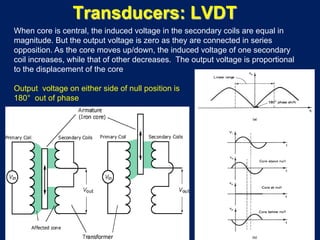
When core is central, the induced voltage in the secondary coils are equal in
magnitude. But the output voltage is zero as they are connected in series
opposition. As the core moves up/down, the induced voltage of one secondary
coil increases, while that of other decreases. The output voltage is proportional
to the displacement of the core
Output voltage on either side of null position is
180° out of phase
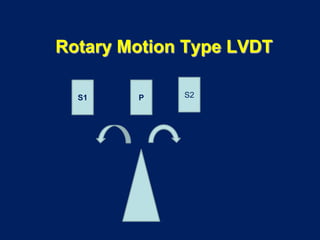
Rotary Motion Type LVDT
S1 P S2
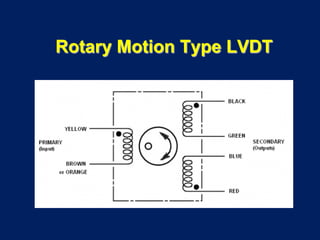
Rotary Motion Type LVDT
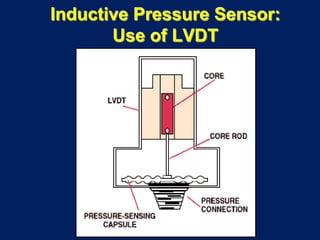
Inductive Pressure Sensor:
Use of LVDT
Advantages of LVDT
• LVDT is a very sensitive transducer
• Over a range of motion, the output is linear
• Essentially frictionless measurement
• Very long mechanical life
• Very high resolution
• Null repeatability
Strain Gauge
• When we apply force to a solid at rest, it will be mechanically
deformed to a certain extent. If the force is tensile, the length of the
solid will increase. If the force is compressive, the length of the solid
will decrease.
• The longitudinal or axial strain is defined as: ε = ΔL/L
• Longitudinal stress: σ = F/A (force F applied on area A)
• Stress-strain relationship within elastic limit: Hooke’s Law: E = σ/ε
E = Young’s modulus [if σ is in kg/m2, so will be E]
• When a body of length is elongated, its transverse (perpendicular)
dimension will contract. Lateral strain: εt = ΔD/D
• Poisson’s ratio: ν = Lateral strain/Longitudinal strain = εt/εa
Poisson’s ratio lie between 0 and 0.5. And mostly, it is 0.3
Strain Gauge
• Strain measurement is essentially measurement of very small, about
1 micrometer, displacement
• Methods:
– Mechanical: Use levers and gears to measure ΔL after
magnification [early days: extensometer uses many levers to
magnify strain so that it becomes readable]
– Electrical: Change in resistance or inductance or capacitance
– Optical: Use interference, diffraction, and scattering of light
waves
• Most commonly used method: Electrical: change in resistance:
Resistive Strain Gauges
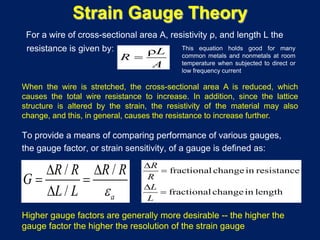
Strain Gauge Theory
For a wire of cross-sectional area A, resistivity ρ, and length L the
resistance is given by: L
R
A
ρ
=
fractional changein resistance
fractional changein length
R
R
L
L
∆
=
∆
=
/ /
/ a
R R R R
G
L L ε
∆ ∆
= =
∆
To provide a means of comparing performance of various gauges,
the gauge factor, or strain sensitivity, of a gauge is defined as:
Higher gauge factors are generally more desirable -- the higher the
gauge factor the higher the resolution of the strain gauge
This equation holds good for many
common metals and nonmetals at room
temperature when subjected to direct or
low frequency current
When the wire is stretched, the cross-sectional area A is reduced, which
causes the total wire resistance to increase. In addition, since the lattice
structure is altered by the strain, the resistivity of the material may also
change, and this, in general, causes the resistance to increase further.
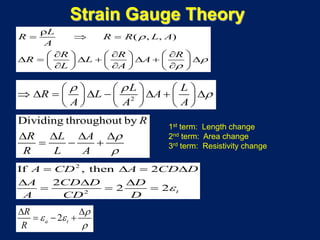
Strain Gauge Theory
( , , )
L
R R R L A
A
R R R
R L A
L A
ρ
ρ
ρ
ρ
= ⇒ =
 ∂ ∂ ∂   
∆ = ∆ + ∆ + ∆     
∂ ∂ ∂     
2
L L
R L A
A A A
ρ ρ
ρ
     
⇒ ∆= ∆ − ∆ + ∆     
     
Dividing throughout by R
R L A
R L A
ρ
ρ
∆ ∆ ∆ ∆
= − +
1st term: Length change
2nd term: Area change
3rd term: Resistivity change
2
2
If , then 2
2
2 2 t
A CD A CD D
A CD D D
A CD D
ε
= ∆= ∆
∆ ∆ ∆
= = =
2a t
R
R
ρ
ε ε
ρ
∆ ∆
= − +
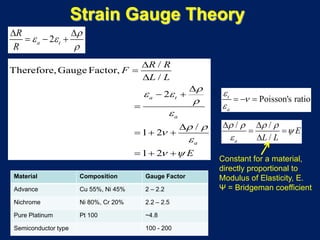
Strain Gauge Theory
2a t
R
R
ρ
ε ε
ρ
∆ ∆
= − +
/
Therefore,Gauge Factor,
/
2
/
1 2
1 2
a t
a
a
R R
F
L L
E
ρ
ε ε
ρ
ε
ρ ρ
ν
ε
ν ψ
∆
=
∆
∆
− +
=
∆
=+ +
=+ +
Poisson's ratiot
a
ε
ν
ε
=− =
/ /
/a
E
L L
ρ ρ ρ ρ
ψ
ε
∆ ∆
= =
∆
Constant for a material,
directly proportional to
Modulus of Elasticity, E.
Ψ = Bridgeman coefficient
Material Composition Gauge Factor
Advance Cu 55%, Ni 45% 2 – 2.2
Nichrome Ni 80%, Cr 20% 2.2 – 2.5
Pure Platinum Pt 100 ~4.8
Semiconductor type 100 - 200
Strain Gauge
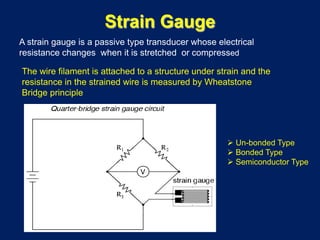
A strain gauge is a passive type transducer whose electrical
resistance changes when it is stretched or compressed
The wire filament is attached to a structure under strain and the
resistance in the strained wire is measured by Wheatstone
Bridge principle
 Un-bonded Type
 Bonded Type
 Semiconductor Type
Strain Gauge Operation
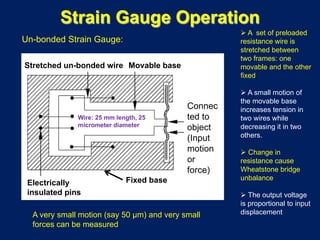
Un-bonded Strain Gauge:
Movable base
Fixed base
Wire: 25 mm length, 25
micrometer diameter
Electrically
insulated pins
Stretched un-bonded wire
Connec
ted to
object
(Input
motion
or
force)
 A set of preloaded
resistance wire is
stretched between
two frames: one
movable and the other
fixed
 A small motion of
the movable base
increases tension in
two wires while
decreasing it in two
others.
 Change in
resistance cause
Wheatstone bridge
unbalance
 The output voltage
is proportional to input
displacementA very small motion (say 50 µm) and very small
forces can be measured
Strain Gauge Operation
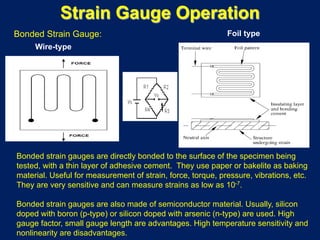
Bonded Strain Gauge:
Wire-type
Foil type
Bonded strain gauges are directly bonded to the surface of the specimen being
tested, with a thin layer of adhesive cement. They use paper or bakelite as baking
material. Useful for measurement of strain, force, torque, pressure, vibrations, etc.
They are very sensitive and can measure strains as low as 10-7.
Bonded strain gauges are also made of semiconductor material. Usually, silicon
doped with boron (p-type) or silicon doped with arsenic (n-type) are used. High
gauge factor, small gauge length are advantages. High temperature sensitivity and
nonlinearity are disadvantages.
Strain Gauge Operation
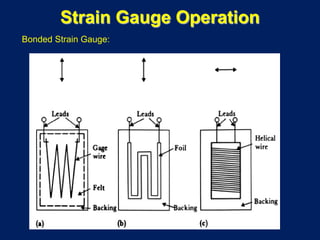
Bonded Strain Gauge:
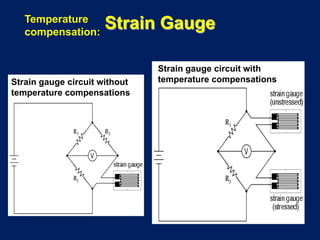
Strain Gauge
Strain gauge circuit with
temperature compensations
Temperature
compensation:
Strain gauge circuit without
temperature compensations
Application of Strain gauge
• Strain gages are used to measure displacement, force,
load, pressure, torque or weight
• Strain gages may be bonded to cantilever springs to
measure the force of bending
• Strain-gage elements also are used in the design of
pressure transmitters using a bellows type or diaphragm
type pressure sensor
• Semiconductor type strain gauge – high gauge factor
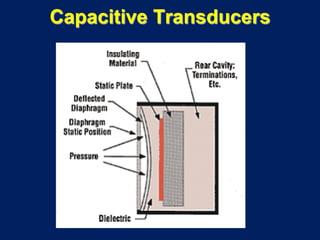
Capacitive Transducers
d
Area=A
0
A
C
d
ε ε=
C: capacitance, pF
ε0: dielectric constant (relative permittivity) of
free space (vacuum) = 8.85 pF/m
ε: dielectric constant of insulating material
A: area of plates, m2
d: distance between plates, m
Two parallel metal plates separated by a
dielectric or insulating material:
d A A
Plate displacedd changes Dielectric material moves
(a) (b) (c)
There are 3 ways to change the capacity:
(1) variation of distance between the plates (d) [Fig. a]
(2) variation of the shared area of the plates (A ) [Fig. b]
(3) variation of dielectric constant (ε) [Fig. c]
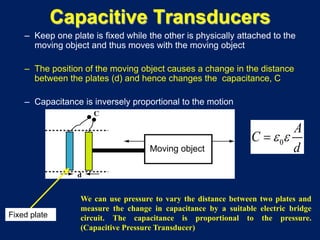
– Keep one plate is fixed while the other is physically attached to the
moving object and thus moves with the moving object
– The position of the moving object causes a change in the distance
between the plates (d) and hence changes the capacitance, C
– Capacitance is inversely proportional to the motion
Capacitive Transducers
Moving object
Fixed plate
0
A
C
d
ε ε=
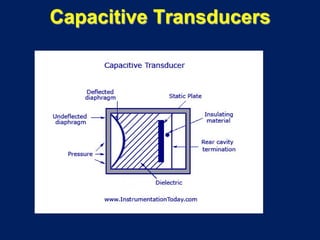
We can use pressure to vary the distance between two plates and
measure the change in capacitance by a suitable electric bridge
circuit. The capacitance is proportional to the pressure.
(Capacitive Pressure Transducer)
Capacitive Transducers
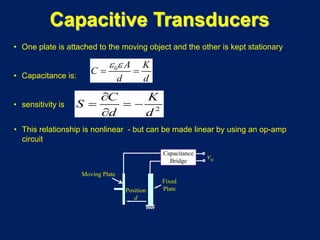
• One plate is attached to the moving object and the other is kept stationary
• Capacitance is:
• sensitivity is
• This relationship is nonlinear - but can be made linear by using an op-amp
circuit
2
C K
S
d d
∂
= = −
∂
Capacitive Transducers
0 A K
C
d d
ε ε
= =
Moving Plate
Position
d
vo
Fixed
Plate
Capacitance
Bridge
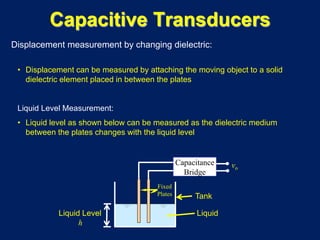
Displacement measurement by changing dielectric:
• Displacement can be measured by attaching the moving object to a solid
dielectric element placed in between the plates
Liquid Level Measurement:
• Liquid level as shown below can be measured as the dielectric medium
between the plates changes with the liquid level
vo
Fixed
Plates
Liquid Level
h
Liquid
Capacitance
Bridge
Tank
Capacitive Transducers
DC Output
vo
Capacitance
Bridge
Rotating
Plate
A
Fixed Plate
Rotation
θ
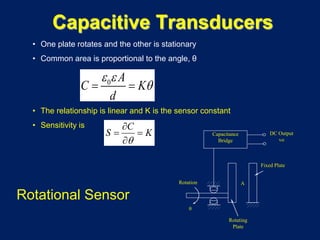
• One plate rotates and the other is stationary
• Common area is proportional to the angle, θ
0 A
C K
d
ε ε
θ= =
• The relationship is linear and K is the sensor constant
• Sensitivity is
K
C
S =
∂
∂
=
θ
Capacitive Transducers
Rotational Sensor
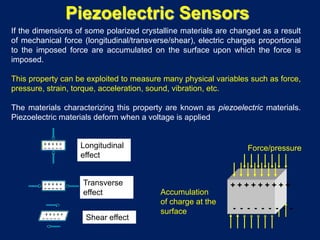
+ + + + + + + + +
- - - - - - - - -
Force/pressure
Accumulation
of charge at the
surface
If the dimensions of some polarized crystalline materials are changed as a result
of mechanical force (longitudinal/transverse/shear), electric charges proportional
to the imposed force are accumulated on the surface upon which the force is
imposed.
This property can be exploited to measure many physical variables such as force,
pressure, strain, torque, acceleration, sound, vibration, etc.
The materials characterizing this property are known as piezoelectric materials.
Piezoelectric materials deform when a voltage is applied
Piezoelectric Sensors
Longitudinal
effect
Transverse
effect
Shear effect
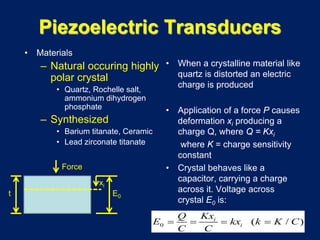
Piezoelectric Transducers
• Materials
– Natural occuring highly
polar crystal
• Quartz, Rochelle salt,
ammonium dihydrogen
phosphate
– Synthesized
• Barium titanate, Ceramic
• Lead zirconate titanate
• When a crystalline material like
quartz is distorted an electric
charge is produced
• Application of a force P causes
deformation xi producing a
charge Q, where Q = Kxi
where K = charge sensitivity
constant
• Crystal behaves like a
capacitor, carrying a charge
across it. Voltage across
crystal E0 is:
0 ( / )i
i
KxQ
E kx k K C
C C
= = = =
Force
xi
E0t
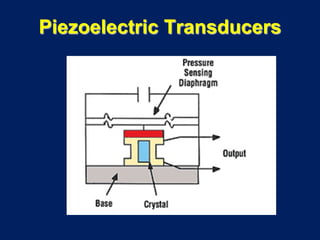
Piezoelectric Transducers
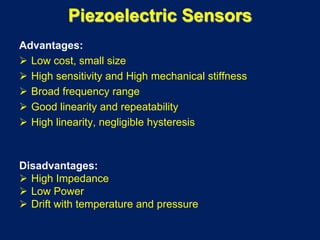
Piezoelectric Sensors
Advantages:
 Low cost, small size
 High sensitivity and High mechanical stiffness
 Broad frequency range
 Good linearity and repeatability
 High linearity, negligible hysteresis
Disadvantages:
 High Impedance
 Low Power
 Drift with temperature and pressure
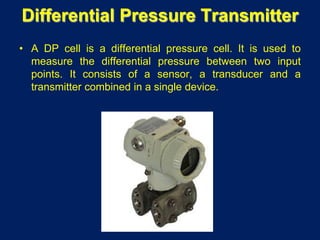
Differential Pressure Transmitter
• A DP cell is a differential pressure cell. It is used to
measure the differential pressure between two input
points. It consists of a sensor, a transducer and a
transmitter combined in a single device.
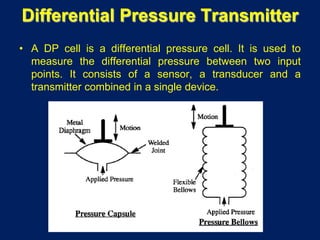
Differential Pressure Transmitter
• A DP cell is a differential pressure cell. It is used to
measure the differential pressure between two input
points. It consists of a sensor, a transducer and a
transmitter combined in a single device.
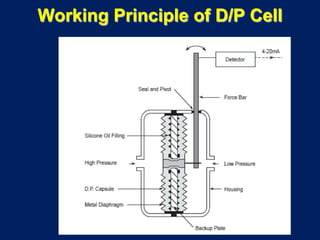
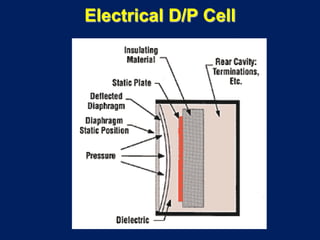
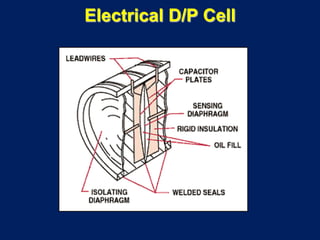
Working Principle of a D/P Cell
In DP cell a diaphragm is present which remains in normal
condition when the forces on both sides of diaphragm are
equal. The unequal forces (pressure difference) create
deformation in the diaphragm. By the extent of deformation,
the differential pressure is calculated.
There are two main types of DP Cells:
 Pneumatic DP Cell
 Electrical/Electronic DP Cell
Working Principle of D/P Cell
Pneumatic Transmitter: Basic Idea
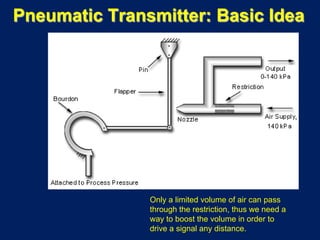
Only a limited volume of air can pass
through the restriction, thus we need a
way to boost the volume in order to
drive a signal any distance.
Pneumatic Transmitter: Relay
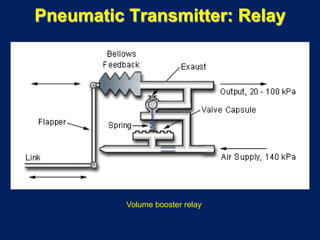
Volume booster relay
Pneumatic D/P Cell
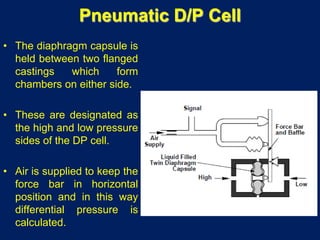
• The diaphragm capsule is
held between two flanged
castings which form
chambers on either side.
• These are designated as
the high and low pressure
sides of the DP cell.
• Air is supplied to keep the
force bar in horizontal
position and in this way
differential pressure is
calculated.
Pneumatic D/P Cell
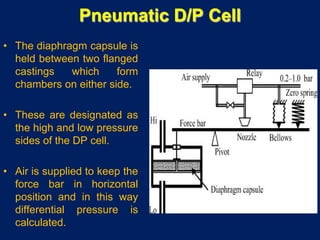
• The diaphragm capsule is
held between two flanged
castings which form
chambers on either side.
• These are designated as
the high and low pressure
sides of the DP cell.
• Air is supplied to keep the
force bar in horizontal
position and in this way
differential pressure is
calculated.
Electrical D/P Cell
Electrical D/P Cell
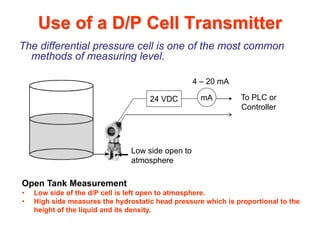
Use of a D/P Cell Transmitter
The differential pressure cell is one of the most common
methods of measuring level.
Open Tank Measurement
• Low side of the d/P cell is left open to atmosphere.
• High side measures the hydrostatic head pressure which is proportional to the
height of the liquid and its density.
Low side open to
atmosphere
24 VDC mA
4 – 20 mA
To PLC or
Controller
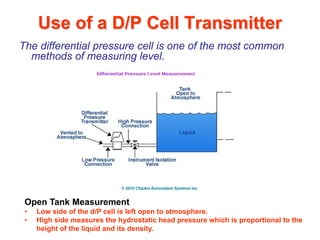
Use of a D/P Cell Transmitter
The differential pressure cell is one of the most common
methods of measuring level.
Open Tank Measurement
• Low side of the d/P cell is left open to atmosphere.
• High side measures the hydrostatic head pressure which is proportional to the
height of the liquid and its density.
Use of a D/P Cell Transmitter
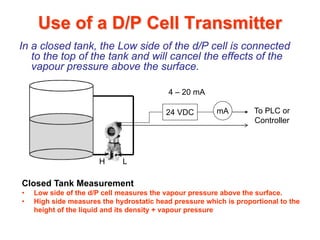
In a closed tank, the Low side of the d/P cell is connected
to the top of the tank and will cancel the effects of the
vapour pressure above the surface.
Closed Tank Measurement
• Low side of the d/P cell measures the vapour pressure above the surface.
• High side measures the hydrostatic head pressure which is proportional to the
height of the liquid and its density + vapour pressure
24 VDC mA
4 – 20 mA
To PLC or
Controller
H L
Use of a D/P Cell Transmitter
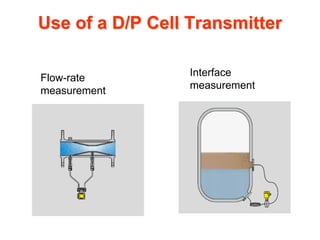
Flow-rate
measurement
Interface
measurement
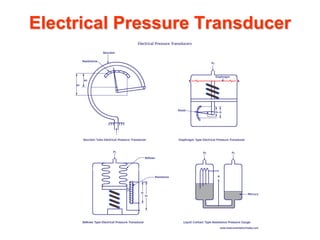
Electrical Pressure Transducer

Transducer

  • 1.
    Process Control and Instrumentation Dr. DebasisSarkar Department of Chemical Engineering Indian Institute of Technology Kharagpur
  • 2.
  • 3.
    Transducers • Transducers aredevices that transform signals in one form to a more convenient form • Not just conversion of energy! Diaphragm produces displacement on application of pressure. Note that displacement and pressure are both manifestation of energy – but displacement is more convenient from the measurement point of view • Transducers can be of various types: Mechanical, Electrical, Optical, Acoustic, etc. • Electrical transducers are always preferred:  signal can be conditioned easily (modified/amplified/modulated etc.)  easy remote operation
  • 4.
    Transducers • Here weare concerned with Electrical Transducers that produces an electrical output due to an input of mechanical displacement or strain • Mechanical strain or displacement may be produced by a primary sensor due to various input physical variables such as temperature, pressure, flow etc. Primary Sensor Electromechanical Transducer Mechanical displacement/strain Electrical outputInput Temp, Pr, etc Force Displacement Pressure Diaphragm
  • 5.
    Transducers We will brieflydiscuss:  Pneumatic Transducer: – Flapper/Nozzle system  Electromechanical Transducers: – Linear Variable Differential Transducer (LVDT) • Inductance type transducer: magnetic characteristics of an electrical circuit changes due to motion of an object – Resistance Strain Gauge • If a conductor is stretched/strained, its resistance will change – Capacitive Type Transducer • There is a change in capacitance between two plates due to motion – Piezo-electric Transducer • An electrical charge is produced when a crystalline material (quartz/barium titanate) is distorted
  • 6.
    Flapper/Nozzle System • Flapper/Nozzlesystem is a pneumatic transducer • Pneumatic control system operates with air. The signal is transmitted in the form of variable air pressure in the range of 3 – 15 psi. • Early days, we had only pneumatic control systems • With advent of modern electronics, many pneumatic control systems have now been replace by electronic control systems • However, even these days many industrial actuators are still pneumatic in nature • Advantage: Safe/Low cost/can generate more torque to its own weight compared to electrical actuators • Disadvantage: Slow response
  • 7.
    Flapper/Nozzle System Due tothe presence of flapper, there will be a back pressure that will alter the output pressure or signal pressure (P0) Altering the gap between nozzle and flapper (x) alters the resistance to airflow and hence the output pressure Increase in x will lower the resistance and fall in output pressure (P0) Po can be calibrated in terms of gap (x) , that is, (displacement) Ps P0, T0 Flapper/Nozzle system is the basis of all pneumatic transmitters Consists of a fixed flow restriction (orifice) and a variable restrictor (nozzle and flapper) Air at a fixed pressure (Ps) flows through a nozzle past a restriction in the tube
  • 8.
  • 9.
    Flapper/Nozzle System Approximate staticsensitivity calculation: • Assume flow through the restrictions incompressible • Let, orifice diameter: do, nozzle diameter: dn • Fluid density: ρ; assume equal discharge coefficient (Cd) 4 1 2 ( ) 4 o d s o d q C P P π ρ   −    2 0( ) 2 ( )d n i ambq C d x P Pπ ρ= − 1 2 0 2 2 4 1 16 1 n is o q q P d xP d = ⇒ = + The sensitivity dP0/dxi thus varies with xi. It has maximum at: 2 0.14 o i n d x d = When xi is sufficiently large, P0/Ps becomes almost constant. P0/Ps is linear between 0.15 and 0.75. For Ps = 20 psi, this corresponds to 3-15 psi and this is the limits of industrial control pressure. Flow through orifice: Flow through nozzle: Assuming flow continuity and Pamb = 0 gage:
  • 10.
    Flapper/Nozzle System Flapper/Nozzle system Plotof Signal pressure Vs gap Ps P0 P0, T0 Approx linear range in 3 – 15 psi Gap, x Outputpressure
  • 11.
  • 12.
  • 13.
  • 14.
  • 15.
     Electromechanical devicethat produces electrical output proportional to displacement of a movable core: Displacement Transducer  Most commonly used variable inductance transducer in industry A soft iron core provides magnetic coupling between a single primary coil (A) and two identical secondary coils (B), connected in series opposition When core slides through transformer, a certain portion of the coils are affected. This induces a unique voltage Linear Variable Differential Transformer (LVDT) Primary coil Second ary coils Ferromagne tic core Ferromagnetic core is physically connected to the object whose displacement is to be measured
  • 16.
  • 17.
    Transducers: LVDT Core: NickelIron Alloy, Ferrite Primary coil is excited by a sinusoidal voltage of amplitude 1 V to 15 V and frequency 50 Hz to 20 kHz The sensitivity of typical LVDTs is in the rage of 1 to 5 v/v/cm Displacement: ±0.002 cm to several cm The whole sensor is enclosed and shielded so that no field extends outside it and hence cannot be influenced by outside fields LVDT Circuit diagram Core centrally located
  • 18.
    Transducers: LVDT Secondary coilsare NOT connected in series opposition:
  • 19.
    Transducers: LVDT When coreis central, the induced voltage in the secondary coils are equal in magnitude. But the output voltage is zero as they are connected in series opposition. As the core moves up/down, the induced voltage of one secondary coil increases, while that of other decreases. The output voltage is proportional to the displacement of the core Output voltage on either side of null position is 180° out of phase
  • 20.
    Rotary Motion TypeLVDT S1 P S2
  • 21.
  • 22.
  • 23.
    Advantages of LVDT •LVDT is a very sensitive transducer • Over a range of motion, the output is linear • Essentially frictionless measurement • Very long mechanical life • Very high resolution • Null repeatability
  • 24.
    Strain Gauge • Whenwe apply force to a solid at rest, it will be mechanically deformed to a certain extent. If the force is tensile, the length of the solid will increase. If the force is compressive, the length of the solid will decrease. • The longitudinal or axial strain is defined as: ε = ΔL/L • Longitudinal stress: σ = F/A (force F applied on area A) • Stress-strain relationship within elastic limit: Hooke’s Law: E = σ/ε E = Young’s modulus [if σ is in kg/m2, so will be E] • When a body of length is elongated, its transverse (perpendicular) dimension will contract. Lateral strain: εt = ΔD/D • Poisson’s ratio: ν = Lateral strain/Longitudinal strain = εt/εa Poisson’s ratio lie between 0 and 0.5. And mostly, it is 0.3
  • 25.
    Strain Gauge • Strainmeasurement is essentially measurement of very small, about 1 micrometer, displacement • Methods: – Mechanical: Use levers and gears to measure ΔL after magnification [early days: extensometer uses many levers to magnify strain so that it becomes readable] – Electrical: Change in resistance or inductance or capacitance – Optical: Use interference, diffraction, and scattering of light waves • Most commonly used method: Electrical: change in resistance: Resistive Strain Gauges
  • 26.
    Strain Gauge Theory Fora wire of cross-sectional area A, resistivity ρ, and length L the resistance is given by: L R A ρ = fractional changein resistance fractional changein length R R L L ∆ = ∆ = / / / a R R R R G L L ε ∆ ∆ = = ∆ To provide a means of comparing performance of various gauges, the gauge factor, or strain sensitivity, of a gauge is defined as: Higher gauge factors are generally more desirable -- the higher the gauge factor the higher the resolution of the strain gauge This equation holds good for many common metals and nonmetals at room temperature when subjected to direct or low frequency current When the wire is stretched, the cross-sectional area A is reduced, which causes the total wire resistance to increase. In addition, since the lattice structure is altered by the strain, the resistivity of the material may also change, and this, in general, causes the resistance to increase further.
  • 27.
    Strain Gauge Theory (, , ) L R R R L A A R R R R L A L A ρ ρ ρ ρ = ⇒ =  ∂ ∂ ∂    ∆ = ∆ + ∆ + ∆      ∂ ∂ ∂      2 L L R L A A A A ρ ρ ρ       ⇒ ∆= ∆ − ∆ + ∆            Dividing throughout by R R L A R L A ρ ρ ∆ ∆ ∆ ∆ = − + 1st term: Length change 2nd term: Area change 3rd term: Resistivity change 2 2 If , then 2 2 2 2 t A CD A CD D A CD D D A CD D ε = ∆= ∆ ∆ ∆ ∆ = = = 2a t R R ρ ε ε ρ ∆ ∆ = − +
  • 28.
    Strain Gauge Theory 2at R R ρ ε ε ρ ∆ ∆ = − + / Therefore,Gauge Factor, / 2 / 1 2 1 2 a t a a R R F L L E ρ ε ε ρ ε ρ ρ ν ε ν ψ ∆ = ∆ ∆ − + = ∆ =+ + =+ + Poisson's ratiot a ε ν ε =− = / / /a E L L ρ ρ ρ ρ ψ ε ∆ ∆ = = ∆ Constant for a material, directly proportional to Modulus of Elasticity, E. Ψ = Bridgeman coefficient Material Composition Gauge Factor Advance Cu 55%, Ni 45% 2 – 2.2 Nichrome Ni 80%, Cr 20% 2.2 – 2.5 Pure Platinum Pt 100 ~4.8 Semiconductor type 100 - 200
  • 29.
    Strain Gauge A straingauge is a passive type transducer whose electrical resistance changes when it is stretched or compressed The wire filament is attached to a structure under strain and the resistance in the strained wire is measured by Wheatstone Bridge principle  Un-bonded Type  Bonded Type  Semiconductor Type
  • 30.
    Strain Gauge Operation Un-bondedStrain Gauge: Movable base Fixed base Wire: 25 mm length, 25 micrometer diameter Electrically insulated pins Stretched un-bonded wire Connec ted to object (Input motion or force)  A set of preloaded resistance wire is stretched between two frames: one movable and the other fixed  A small motion of the movable base increases tension in two wires while decreasing it in two others.  Change in resistance cause Wheatstone bridge unbalance  The output voltage is proportional to input displacementA very small motion (say 50 µm) and very small forces can be measured
  • 31.
    Strain Gauge Operation BondedStrain Gauge: Wire-type Foil type Bonded strain gauges are directly bonded to the surface of the specimen being tested, with a thin layer of adhesive cement. They use paper or bakelite as baking material. Useful for measurement of strain, force, torque, pressure, vibrations, etc. They are very sensitive and can measure strains as low as 10-7. Bonded strain gauges are also made of semiconductor material. Usually, silicon doped with boron (p-type) or silicon doped with arsenic (n-type) are used. High gauge factor, small gauge length are advantages. High temperature sensitivity and nonlinearity are disadvantages.
  • 32.
  • 33.
    Strain Gauge Strain gaugecircuit with temperature compensations Temperature compensation: Strain gauge circuit without temperature compensations
  • 34.
    Application of Straingauge • Strain gages are used to measure displacement, force, load, pressure, torque or weight • Strain gages may be bonded to cantilever springs to measure the force of bending • Strain-gage elements also are used in the design of pressure transmitters using a bellows type or diaphragm type pressure sensor • Semiconductor type strain gauge – high gauge factor
  • 35.
    Capacitive Transducers d Area=A 0 A C d ε ε= C:capacitance, pF ε0: dielectric constant (relative permittivity) of free space (vacuum) = 8.85 pF/m ε: dielectric constant of insulating material A: area of plates, m2 d: distance between plates, m Two parallel metal plates separated by a dielectric or insulating material: d A A Plate displacedd changes Dielectric material moves (a) (b) (c) There are 3 ways to change the capacity: (1) variation of distance between the plates (d) [Fig. a] (2) variation of the shared area of the plates (A ) [Fig. b] (3) variation of dielectric constant (ε) [Fig. c]
  • 36.
    – Keep oneplate is fixed while the other is physically attached to the moving object and thus moves with the moving object – The position of the moving object causes a change in the distance between the plates (d) and hence changes the capacitance, C – Capacitance is inversely proportional to the motion Capacitive Transducers Moving object Fixed plate 0 A C d ε ε= We can use pressure to vary the distance between two plates and measure the change in capacitance by a suitable electric bridge circuit. The capacitance is proportional to the pressure. (Capacitive Pressure Transducer)
  • 37.
  • 38.
  • 39.
    • One plateis attached to the moving object and the other is kept stationary • Capacitance is: • sensitivity is • This relationship is nonlinear - but can be made linear by using an op-amp circuit 2 C K S d d ∂ = = − ∂ Capacitive Transducers 0 A K C d d ε ε = = Moving Plate Position d vo Fixed Plate Capacitance Bridge
  • 40.
    Displacement measurement bychanging dielectric: • Displacement can be measured by attaching the moving object to a solid dielectric element placed in between the plates Liquid Level Measurement: • Liquid level as shown below can be measured as the dielectric medium between the plates changes with the liquid level vo Fixed Plates Liquid Level h Liquid Capacitance Bridge Tank Capacitive Transducers
  • 41.
    DC Output vo Capacitance Bridge Rotating Plate A Fixed Plate Rotation θ •One plate rotates and the other is stationary • Common area is proportional to the angle, θ 0 A C K d ε ε θ= = • The relationship is linear and K is the sensor constant • Sensitivity is K C S = ∂ ∂ = θ Capacitive Transducers Rotational Sensor
  • 42.
    + + ++ + + + + + - - - - - - - - - Force/pressure Accumulation of charge at the surface If the dimensions of some polarized crystalline materials are changed as a result of mechanical force (longitudinal/transverse/shear), electric charges proportional to the imposed force are accumulated on the surface upon which the force is imposed. This property can be exploited to measure many physical variables such as force, pressure, strain, torque, acceleration, sound, vibration, etc. The materials characterizing this property are known as piezoelectric materials. Piezoelectric materials deform when a voltage is applied Piezoelectric Sensors Longitudinal effect Transverse effect Shear effect
  • 43.
    Piezoelectric Transducers • Materials –Natural occuring highly polar crystal • Quartz, Rochelle salt, ammonium dihydrogen phosphate – Synthesized • Barium titanate, Ceramic • Lead zirconate titanate • When a crystalline material like quartz is distorted an electric charge is produced • Application of a force P causes deformation xi producing a charge Q, where Q = Kxi where K = charge sensitivity constant • Crystal behaves like a capacitor, carrying a charge across it. Voltage across crystal E0 is: 0 ( / )i i KxQ E kx k K C C C = = = = Force xi E0t
  • 44.
  • 45.
    Piezoelectric Sensors Advantages:  Lowcost, small size  High sensitivity and High mechanical stiffness  Broad frequency range  Good linearity and repeatability  High linearity, negligible hysteresis Disadvantages:  High Impedance  Low Power  Drift with temperature and pressure
  • 46.
    Differential Pressure Transmitter •A DP cell is a differential pressure cell. It is used to measure the differential pressure between two input points. It consists of a sensor, a transducer and a transmitter combined in a single device.
  • 47.
    Differential Pressure Transmitter •A DP cell is a differential pressure cell. It is used to measure the differential pressure between two input points. It consists of a sensor, a transducer and a transmitter combined in a single device.
  • 48.
    Working Principle ofa D/P Cell In DP cell a diaphragm is present which remains in normal condition when the forces on both sides of diaphragm are equal. The unequal forces (pressure difference) create deformation in the diaphragm. By the extent of deformation, the differential pressure is calculated. There are two main types of DP Cells:  Pneumatic DP Cell  Electrical/Electronic DP Cell
  • 49.
  • 50.
    Pneumatic Transmitter: BasicIdea Only a limited volume of air can pass through the restriction, thus we need a way to boost the volume in order to drive a signal any distance.
  • 51.
  • 52.
    Pneumatic D/P Cell •The diaphragm capsule is held between two flanged castings which form chambers on either side. • These are designated as the high and low pressure sides of the DP cell. • Air is supplied to keep the force bar in horizontal position and in this way differential pressure is calculated.
  • 53.
    Pneumatic D/P Cell •The diaphragm capsule is held between two flanged castings which form chambers on either side. • These are designated as the high and low pressure sides of the DP cell. • Air is supplied to keep the force bar in horizontal position and in this way differential pressure is calculated.
  • 54.
  • 55.
  • 56.
    Use of aD/P Cell Transmitter The differential pressure cell is one of the most common methods of measuring level. Open Tank Measurement • Low side of the d/P cell is left open to atmosphere. • High side measures the hydrostatic head pressure which is proportional to the height of the liquid and its density. Low side open to atmosphere 24 VDC mA 4 – 20 mA To PLC or Controller
  • 57.
    Use of aD/P Cell Transmitter The differential pressure cell is one of the most common methods of measuring level. Open Tank Measurement • Low side of the d/P cell is left open to atmosphere. • High side measures the hydrostatic head pressure which is proportional to the height of the liquid and its density.
  • 58.
    Use of aD/P Cell Transmitter In a closed tank, the Low side of the d/P cell is connected to the top of the tank and will cancel the effects of the vapour pressure above the surface. Closed Tank Measurement • Low side of the d/P cell measures the vapour pressure above the surface. • High side measures the hydrostatic head pressure which is proportional to the height of the liquid and its density + vapour pressure 24 VDC mA 4 – 20 mA To PLC or Controller H L
  • 59.
    Use of aD/P Cell Transmitter Flow-rate measurement Interface measurement
  • 60.