Resistance Temperature
Detector
Made by- Bhavesh Mishra
STUDENT AT JSSATEN
DEPARTMENT OF IC
What is an RTD?
• RTD stands for Resistance Temperature Detector.
• The change in temperature is detected by the
change in resistance of the wire.
• There are two types of RTD:
1. Having positive thermal coefficients of resistivity
(resistance increases with the increase in
temperature respectively).
2. Having negative thermal coefficients of
resistivity (resistance decreases with the
increase in temperature respectively).
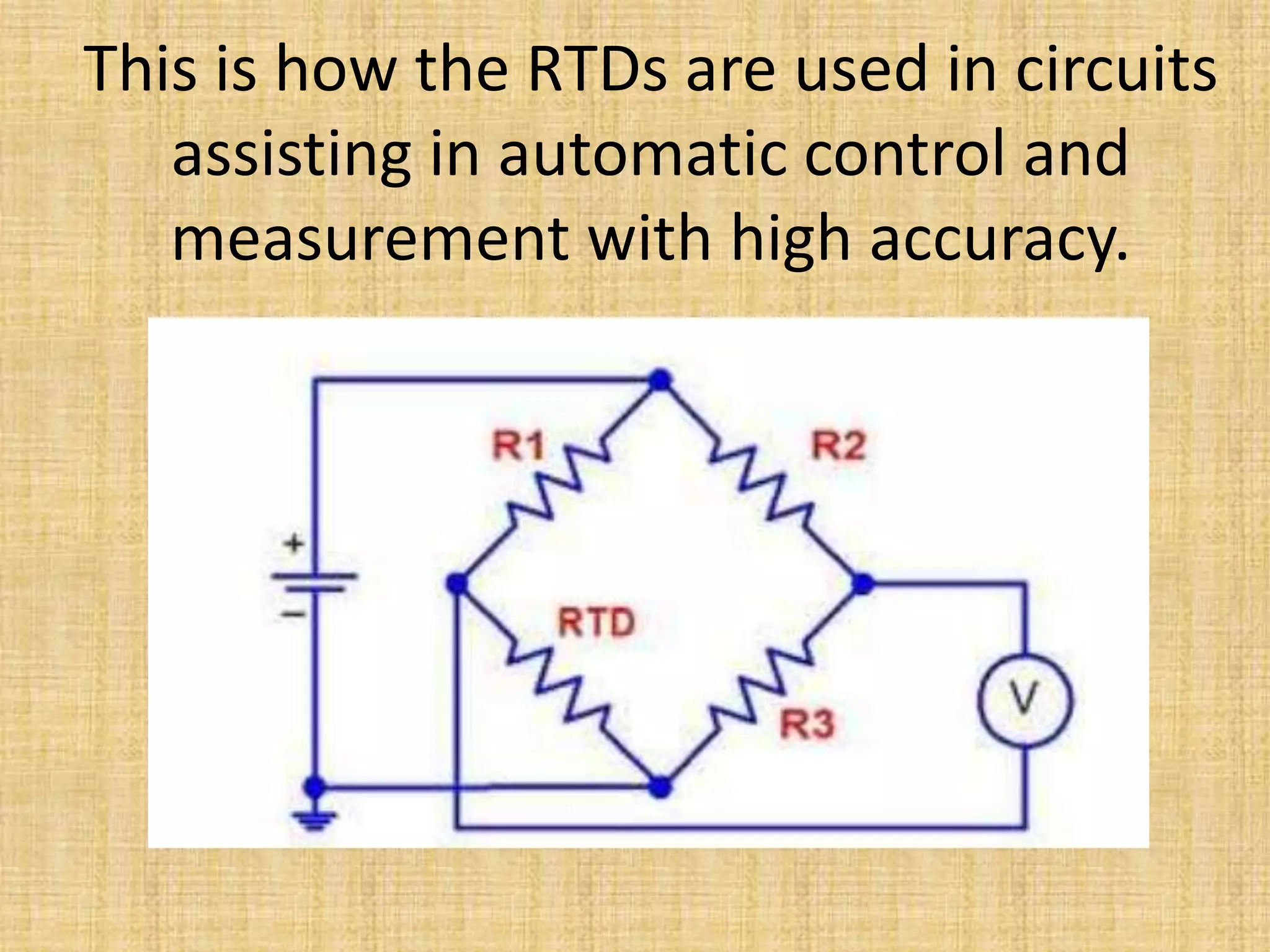
• RTDs are used for temperature
measurements by using them in bridge
circuits.
• The change in temperature causes
considerable resistance change which gives a
voltage drop in accordance with the thermal
coefficient of resistance of the wire.
• This voltage is further amplified and the
temperature is read thus.
This is how the RTDs are used in circuits
assisting in automatic control and
measurement with high accuracy.
TYPICAL DESIGN
RTD PROBE
Common Resistance Materials for
RTDs:
• Platinum (most popular and accurate)
• Nickel
• Copper
• Balco (rare)
• Tungsten (rare)
Advantages
• Due to no fluid present absolute temperature
is recorded.
• It is highly sensitive and gives accurate results.
• It has a good range of temperature
measurement. It can thus measure from very
low to very high temperature.
• Due to electrical output (resistance change) it
can be used with PLCs and complete
automation can be achieved.
Applications of RTD
• It is widely used in furnaces for automatic
temperature measurement.
• Due to its compactness, it replaces conventional
thermometers as well as thermocouples thus
eliminating the use of lots of wires.
• Used in medical and chemical laboratories to
detect very low temperatures (like dry ice and
liquid nitrogen).
• Due to electrical output it is used wherever
feedback system is required and corrective action
is thus taken in an automated system.
Questions And Answers
• Why use an RTD instead of a thermocouple or thermistor sensor?
• Each type of temperature sensor has a particular set of conditions
for which it is best suited. RTDs offer several advantages:
• A wide temperature range (approximately -200 to 850°C)
• Good accuracy (better than thermocouples)
• Good interchangeability
• Long-term stability
With a temperature range up to 850°C, RTDs can be used in all but
the highest-temperature industrial processes. When made using
metals such as platinum, they are very stable and are not affected
by corrosion or oxidation. Other materials such as nickel, copper,
and nickel-iron alloy have also been used for RTDs. However, these
materials are not commonly used since they have lower
temperature capabilities and are not as stable or repeatable as
platinum.
Why is platinum more commonly
used?
• The RTD wire is a pure material, typically
platinum. The material has an accurate
resistance/temperature relationship which is
used to provide an indication of temperature.
As RTD elements are fragile(Easily breakable),
they are often housed in protective probes.
Thank YOU

RTD

  • 1.
    Resistance Temperature Detector Made by-Bhavesh Mishra STUDENT AT JSSATEN DEPARTMENT OF IC
  • 2.
    What is anRTD? • RTD stands for Resistance Temperature Detector. • The change in temperature is detected by the change in resistance of the wire. • There are two types of RTD: 1. Having positive thermal coefficients of resistivity (resistance increases with the increase in temperature respectively). 2. Having negative thermal coefficients of resistivity (resistance decreases with the increase in temperature respectively).
  • 3.
    • RTDs areused for temperature measurements by using them in bridge circuits. • The change in temperature causes considerable resistance change which gives a voltage drop in accordance with the thermal coefficient of resistance of the wire. • This voltage is further amplified and the temperature is read thus.
  • 4.
    This is howthe RTDs are used in circuits assisting in automatic control and measurement with high accuracy.
  • 5.
  • 6.
  • 7.
    Common Resistance Materialsfor RTDs: • Platinum (most popular and accurate) • Nickel • Copper • Balco (rare) • Tungsten (rare)
  • 8.
    Advantages • Due tono fluid present absolute temperature is recorded. • It is highly sensitive and gives accurate results. • It has a good range of temperature measurement. It can thus measure from very low to very high temperature. • Due to electrical output (resistance change) it can be used with PLCs and complete automation can be achieved.
  • 9.
    Applications of RTD •It is widely used in furnaces for automatic temperature measurement. • Due to its compactness, it replaces conventional thermometers as well as thermocouples thus eliminating the use of lots of wires. • Used in medical and chemical laboratories to detect very low temperatures (like dry ice and liquid nitrogen). • Due to electrical output it is used wherever feedback system is required and corrective action is thus taken in an automated system.
  • 10.
    Questions And Answers •Why use an RTD instead of a thermocouple or thermistor sensor? • Each type of temperature sensor has a particular set of conditions for which it is best suited. RTDs offer several advantages: • A wide temperature range (approximately -200 to 850°C) • Good accuracy (better than thermocouples) • Good interchangeability • Long-term stability With a temperature range up to 850°C, RTDs can be used in all but the highest-temperature industrial processes. When made using metals such as platinum, they are very stable and are not affected by corrosion or oxidation. Other materials such as nickel, copper, and nickel-iron alloy have also been used for RTDs. However, these materials are not commonly used since they have lower temperature capabilities and are not as stable or repeatable as platinum.
  • 11.
    Why is platinummore commonly used? • The RTD wire is a pure material, typically platinum. The material has an accurate resistance/temperature relationship which is used to provide an indication of temperature. As RTD elements are fragile(Easily breakable), they are often housed in protective probes.
  • 12.