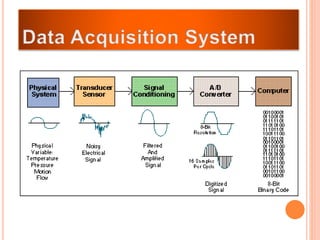
Data acquisition system, in effect, requires integration of:
 Sensor/transducer for measurement of physical variables
 Signal-Conditioner/transmission circuitry, that enables
conversion of signal outputs from transducers to a readable
form for Data Acquisition/interface modules.
 The Data Acquisition Hardware comprising Multiplexer,
Amplifier, A/D Converter, Buffer Memory, etc. to digitise
the analog signals for CPU.
 Computer/CPU to process the digital data for data
processing, display, outputs (control), storage,
transmission, etc.
What is transducer?
The device which converts the
physical form of signal into
electrical form.
Types of Transducer:-
 Displacement
 Force & Pressure
 Temperature
 Light Sensors
 Others
 Strain Measurement
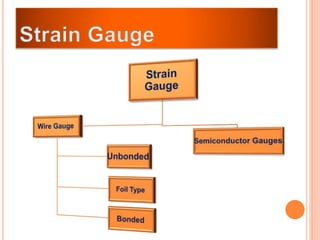
Strain Gauge
Piezoelectric Transducer
 Pressure Measurement
 Gravitational Pressure Transducer
Manometers
 Elastic Pressure Transducer
Diaphragm
Capsule
Bellows
Bourdon Tubes
Definition:-
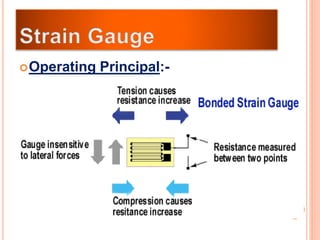
Strain Gauge is a passive, Resistive
transducer which converts the
mechanical elongation and compression
into a resistance change.
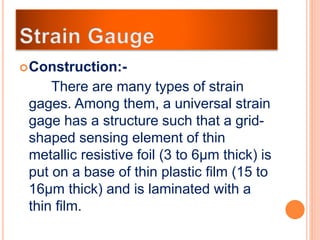
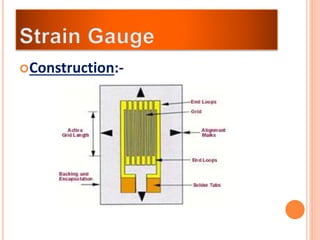
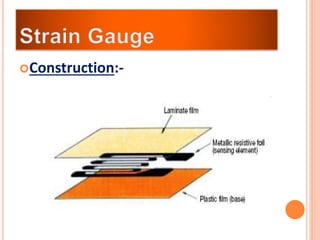
Construction:-
There are many types of strain
gages. Among them, a universal strain
gage has a structure such that a grid-
shaped sensing element of thin
metallic resistive foil (3 to 6μm thick) is
put on a base of thin plastic film (15 to
16μm thick) and is laminated with a
thin film.
Construction:-
Construction:-
Operating Principal:-
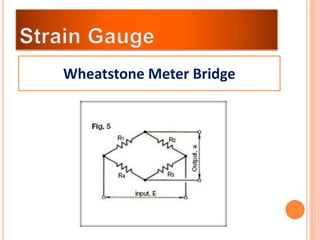
Wheatstone Meter Bridge
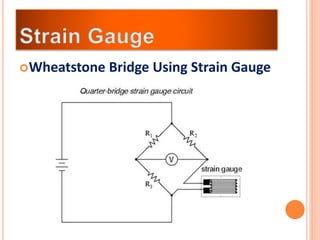
Wheatstone Bridge Using Strain Gauge
Construction:-
Operating Principal:-
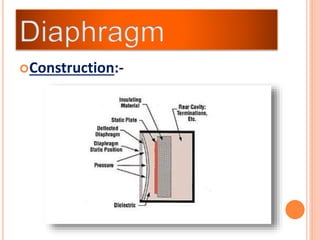
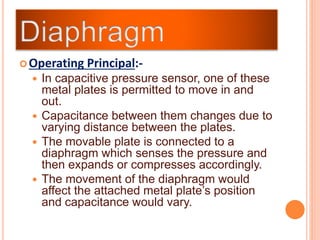
 In capacitive pressure sensor, one of these
metal plates is permitted to move in and
out.
 Capacitance between them changes due to
varying distance between the plates.
 The movable plate is connected to a
diaphragm which senses the pressure and
then expands or compresses accordingly.
 The movement of the diaphragm would
affect the attached metal plate’s position
and capacitance would vary.
Construction:-
Operating Principal:-
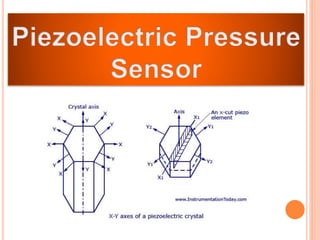
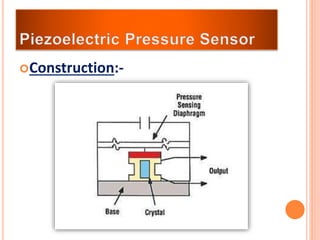
 Piezoelectric crystals develop a potential
difference (i.e. voltage is induced across the
surfaces) whenever they are subjected to any
mechanical pressure.
 Attached to the crystal is a horizontal shaft to
which a diaphragm is connected.
 Whenever the diaphragm senses pressure, it
pushes the shaft down which pressurizes the
crystal and voltage is produced.

Transducers

  • 4.
    Data acquisition system,in effect, requires integration of:  Sensor/transducer for measurement of physical variables  Signal-Conditioner/transmission circuitry, that enables conversion of signal outputs from transducers to a readable form for Data Acquisition/interface modules.  The Data Acquisition Hardware comprising Multiplexer, Amplifier, A/D Converter, Buffer Memory, etc. to digitise the analog signals for CPU.  Computer/CPU to process the digital data for data processing, display, outputs (control), storage, transmission, etc.
  • 5.
    What is transducer? Thedevice which converts the physical form of signal into electrical form.
  • 6.
    Types of Transducer:- Displacement  Force & Pressure  Temperature  Light Sensors  Others
  • 7.
     Strain Measurement StrainGauge Piezoelectric Transducer  Pressure Measurement  Gravitational Pressure Transducer Manometers  Elastic Pressure Transducer Diaphragm Capsule Bellows Bourdon Tubes
  • 10.
    Definition:- Strain Gauge isa passive, Resistive transducer which converts the mechanical elongation and compression into a resistance change.
  • 12.
    Construction:- There are manytypes of strain gages. Among them, a universal strain gage has a structure such that a grid- shaped sensing element of thin metallic resistive foil (3 to 6μm thick) is put on a base of thin plastic film (15 to 16μm thick) and is laminated with a thin film.
  • 13.
  • 14.
  • 15.
  • 16.
  • 17.
  • 19.
  • 20.
    Operating Principal:-  Incapacitive pressure sensor, one of these metal plates is permitted to move in and out.  Capacitance between them changes due to varying distance between the plates.  The movable plate is connected to a diaphragm which senses the pressure and then expands or compresses accordingly.  The movement of the diaphragm would affect the attached metal plate’s position and capacitance would vary.
  • 22.
  • 23.
    Operating Principal:-  Piezoelectriccrystals develop a potential difference (i.e. voltage is induced across the surfaces) whenever they are subjected to any mechanical pressure.  Attached to the crystal is a horizontal shaft to which a diaphragm is connected.  Whenever the diaphragm senses pressure, it pushes the shaft down which pressurizes the crystal and voltage is produced.