Parallel sorting Algorithms
By- Garima Shakya
Sorting in Parallel
● Why?
it is a frequent operation in many applications.
● Goal?
sorting a sequence of values in increasing order using n processors
● Potential speedup?
best sequential algorithm has complexity= O(n log n)
● the best we can aim with a parallel algorithm, using n processors is:
optimal complexity of a parallel sorting algorithm: O(n log n)/n = O(log n)
Parallel Sorting
Algorithms
● Parallel Bubble Sort
● Parallel Merge Sort
● Bitonic Sort
● Shear sort
Parallel Sorting
Algorithms
● Parallel Bubble Sort
● Parallel Merge Sort
● Bitonic Sort
● Shear sort
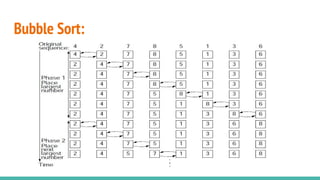
Bubble Sort
● One of the straight-forward sorting methods.
– Cycles through the list.
– Compares consecutive elements and swaps them if necessary.
– Stops when no more out of order pair.
● Slow & inefficient.
● Average performance is O(n^2 ).
Bubble Sort:
Parallel Bubble Sort:
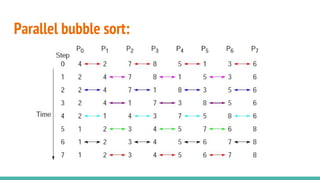
● Also known as Odd-Even Bubble sort.
● operates in two alternate phases:
Phase-even:
even processes exchange values with right neighbors.
Phase-odd:
odd processes exchange values with right neighbors.
Parallel bubble sort:
Parallel Bubble Sort:
Algorithm:
1. For k = 0 to n-1
2. If k is even then
3. for i = 0 to (n/2) do in parallel
4. If A[2i] > A[2i+1] then
5. Exchange A[2i] ↔ A[2i+1]
6. Else
7. for i = 0 to (n/2)-1 do in parallel
8. If A[2i+1] > A[2i+2] then
9. Exchange A[2i+1] ↔ A[2i+2]
10. Next k
Parallel bubble sort : Analysis
● Steps 1-10 is a one big loop that is represented n times.
● Therefore, the parallel time complexity is O(n).
● The algorithm, odd-numbered steps need (n/2) - 1 processors and even-numbered
steps require (n/2) processors.
● Therefore, this needs O(n) processors.
Parallel Sorting
Algorithms
● Parallel Bubble Sort
● Parallel Merge Sort
● Bitonic Sort
● Shear sort
Mergesort:
● Example of a divide-and-conquer algorithm.
● Sorting method to sort a vector; first subdivides it in two parts,
● applies again the same method to each part and when they are both sorted (2 sorted
vectors/lists) with m and n elements,
● They are merged to produce a sorted vector that contains m + n elements of the initial
vector.
● The average complexity is O(n log n).
● T (n) = b n=1
=2T(n/2)+b(n) n>1
● Solve the recurrence relation, T(n) = O(nlogn)
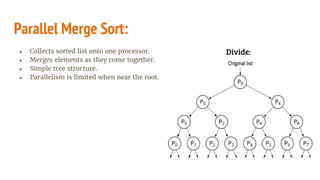
Parallel Merge Sort:
● Collects sorted list onto one processor.
● Merges elements as they come together.
● Simple tree structure.
● Parallelism is limited when near the root.
Divide:
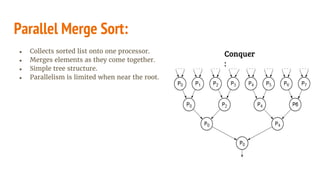
Parallel Merge Sort:
● Collects sorted list onto one processor.
● Merges elements as they come together.
● Simple tree structure.
● Parallelism is limited when near the root.
Conquer
:
Parallel Merge sort: Using a strategy to assign work to
processors organized in a tree.
Merge sort - Time complexity
● Sequential Merge sort, O(nlogn)
● In Parallel,We have n processors
● logn time is required to divide sequence
● logn is for merging it.
● logn+logn= 2 logn
● O(logn)
Parallel Sorting
Algorithms
● Parallel Bubble Sort
● Parallel Merge Sort
● Bitonic Sort
● Shear sort
Bitonic Sort :
● A Bitonic List is defined as a list with
no more than one LOCAL MAXIMUM and no
more than one LOCAL MINIMUM.
● (Endpoints must be considered - wraparound )
A sequence is bitonic if it contains two
sequences, one increasing and one decreasing,
i.e.
● a1
< a2
< . . . < ai−1
< ai
> ai+1
> ai+2
> . . . > an
for
some i such that (0 ≤ i ≤ n)
● a sequence is bitonic if the property described
is attained by a circular rotation to the right of
its elements.
Bitonic sort:
How many parallel steps does it take to sort ?
--> logN
How would you sort a bitonic list WHEN N is NOT A POWER OF 2 ?
-->Use as many processes as N' where N' is a power of 2 and the
smallest number larger than N. Assign a special value such as
"infinity" to all the extra processes (some kind of a padding).
Bitonic Sort:
How to divide a bitonic sequence into two
bitonic subsequences ??
● The compare-and-exchange
operation moves smaller values to
the left and greater values to the
right.
● Given a bitonic sequence, if we apply
recursively these operations we get a
sorted sequence.
Bitonic Sort:
How to divide a bitonic sequence into two
bitonic subsequences ??
● The compare-and-exchange
operation moves smaller values to
the left and greater values to the
right.
● Given a bitonic sequence, if we apply
recursively these operations we get a
sorted sequence.
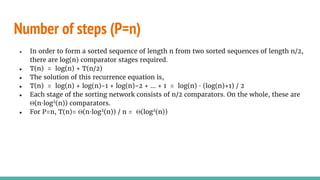
Number of steps (P=n)
● In order to form a sorted sequence of length n from two sorted sequences of length n/2,
there are log(n) comparator stages required.
● T(n) = log(n) + T(n/2)
● The solution of this recurrence equation is,
● T(n) = log(n) + log(n)-1 + log(n)-2 + ... + 1 = log(n) · (log(n)+1) / 2
● Each stage of the sorting network consists of n/2 comparators. On the whole, these are
Θ(n·log2
(n)) comparators.
● For P=n, T(n)= Θ(n·log2
(n)) / n = Θ(log2
(n))
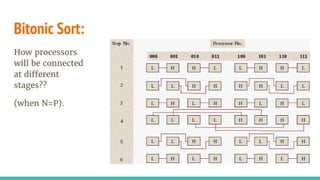
Bitonic Sort:
How processors
will be connected
at different
stages??
(when N=P).
Parallel Sorting
Algorithms
● Parallel Bubble Sort
● Parallel Merge Sort
● Bitonic Sort
● Shear sort
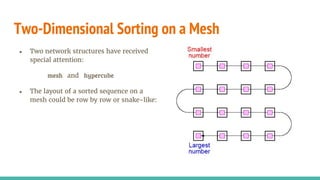
Two-Dimensional Sorting on a Mesh
● Two network structures have received
special attention:
mesh and hypercube
● The layout of a sorted sequence on a
mesh could be row by row or snake-like:
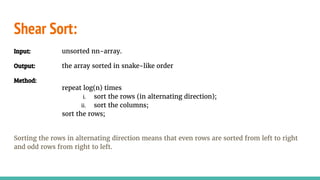
Shear Sort:
Input: unsorted nn-array.
Output: the array sorted in snake-like order
Method:
repeat log(n) times
i. sort the rows (in alternating direction);
ii. sort the columns;
sort the rows;
Sorting the rows in alternating direction means that even rows are sorted from left to right
and odd rows from right to left.
Shear sort:
Alternate row and column sorting until list is fully sorted.
Alternate row directions to get snake-like sorting:
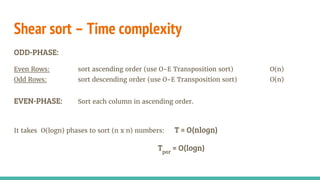
Shear sort – Time complexity
ODD-PHASE:
Even Rows: sort ascending order (use O-E Transposition sort) O(n)
Odd Rows: sort descending order (use O-E Transposition sort) O(n)
EVEN-PHASE: Sort each column in ascending order.
It takes O(logn) phases to sort (n x n) numbers: T = O(nlogn)
Tpar
= O(logn)
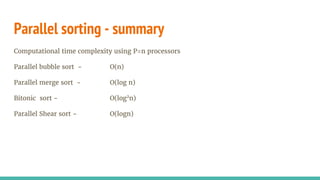
Parallel sorting - summary
Computational time complexity using P=n processors
Parallel bubble sort - O(n)
Parallel merge sort - O(log n)
Bitonic sort - O(log2
n)
Parallel Shear sort - O(logn)
References:
● “Parallel Programming Techniques & Applications Using Networked Workstations &
Parallel Computers, 2nd ed.” B.Wilkinson)
● http://web.mst.edu/~ercal/387/Suppl/class.9.txt
● http://www.gel.usherbrooke.ca/mailhot/gei431/labos/labo2/oets_ss2.html
● http://www.iti.fh-flensburg.de/lang/algorithmen/sortieren/twodim/shear/shearsorten.
htm
● https://en.wikipedia.org/wiki/Bitonic_sorter
Thank You!

Parallel sorting Algorithms

  • 1.
  • 2.
    Sorting in Parallel ●Why? it is a frequent operation in many applications. ● Goal? sorting a sequence of values in increasing order using n processors ● Potential speedup? best sequential algorithm has complexity= O(n log n) ● the best we can aim with a parallel algorithm, using n processors is: optimal complexity of a parallel sorting algorithm: O(n log n)/n = O(log n)
  • 3.
    Parallel Sorting Algorithms ● ParallelBubble Sort ● Parallel Merge Sort ● Bitonic Sort ● Shear sort
  • 4.
    Parallel Sorting Algorithms ● ParallelBubble Sort ● Parallel Merge Sort ● Bitonic Sort ● Shear sort
  • 5.
    Bubble Sort ● Oneof the straight-forward sorting methods. – Cycles through the list. – Compares consecutive elements and swaps them if necessary. – Stops when no more out of order pair. ● Slow & inefficient. ● Average performance is O(n^2 ).
  • 6.
  • 7.
    Parallel Bubble Sort: ●Also known as Odd-Even Bubble sort. ● operates in two alternate phases: Phase-even: even processes exchange values with right neighbors. Phase-odd: odd processes exchange values with right neighbors.
  • 8.
  • 9.
    Parallel Bubble Sort: Algorithm: 1.For k = 0 to n-1 2. If k is even then 3. for i = 0 to (n/2) do in parallel 4. If A[2i] > A[2i+1] then 5. Exchange A[2i] ↔ A[2i+1] 6. Else 7. for i = 0 to (n/2)-1 do in parallel 8. If A[2i+1] > A[2i+2] then 9. Exchange A[2i+1] ↔ A[2i+2] 10. Next k
  • 10.
    Parallel bubble sort: Analysis ● Steps 1-10 is a one big loop that is represented n times. ● Therefore, the parallel time complexity is O(n). ● The algorithm, odd-numbered steps need (n/2) - 1 processors and even-numbered steps require (n/2) processors. ● Therefore, this needs O(n) processors.
  • 11.
    Parallel Sorting Algorithms ● ParallelBubble Sort ● Parallel Merge Sort ● Bitonic Sort ● Shear sort
  • 12.
    Mergesort: ● Example ofa divide-and-conquer algorithm. ● Sorting method to sort a vector; first subdivides it in two parts, ● applies again the same method to each part and when they are both sorted (2 sorted vectors/lists) with m and n elements, ● They are merged to produce a sorted vector that contains m + n elements of the initial vector. ● The average complexity is O(n log n). ● T (n) = b n=1 =2T(n/2)+b(n) n>1 ● Solve the recurrence relation, T(n) = O(nlogn)
  • 13.
    Parallel Merge Sort: ●Collects sorted list onto one processor. ● Merges elements as they come together. ● Simple tree structure. ● Parallelism is limited when near the root. Divide:
  • 14.
    Parallel Merge Sort: ●Collects sorted list onto one processor. ● Merges elements as they come together. ● Simple tree structure. ● Parallelism is limited when near the root. Conquer :
  • 15.
    Parallel Merge sort:Using a strategy to assign work to processors organized in a tree.
  • 16.
    Merge sort -Time complexity ● Sequential Merge sort, O(nlogn) ● In Parallel,We have n processors ● logn time is required to divide sequence ● logn is for merging it. ● logn+logn= 2 logn ● O(logn)
  • 17.
    Parallel Sorting Algorithms ● ParallelBubble Sort ● Parallel Merge Sort ● Bitonic Sort ● Shear sort
  • 18.
    Bitonic Sort : ●A Bitonic List is defined as a list with no more than one LOCAL MAXIMUM and no more than one LOCAL MINIMUM. ● (Endpoints must be considered - wraparound ) A sequence is bitonic if it contains two sequences, one increasing and one decreasing, i.e. ● a1 < a2 < . . . < ai−1 < ai > ai+1 > ai+2 > . . . > an for some i such that (0 ≤ i ≤ n) ● a sequence is bitonic if the property described is attained by a circular rotation to the right of its elements.
  • 19.
    Bitonic sort: How manyparallel steps does it take to sort ? --> logN How would you sort a bitonic list WHEN N is NOT A POWER OF 2 ? -->Use as many processes as N' where N' is a power of 2 and the smallest number larger than N. Assign a special value such as "infinity" to all the extra processes (some kind of a padding).
  • 20.
    Bitonic Sort: How todivide a bitonic sequence into two bitonic subsequences ?? ● The compare-and-exchange operation moves smaller values to the left and greater values to the right. ● Given a bitonic sequence, if we apply recursively these operations we get a sorted sequence.
  • 21.
    Bitonic Sort: How todivide a bitonic sequence into two bitonic subsequences ?? ● The compare-and-exchange operation moves smaller values to the left and greater values to the right. ● Given a bitonic sequence, if we apply recursively these operations we get a sorted sequence.
  • 22.
    Number of steps(P=n) ● In order to form a sorted sequence of length n from two sorted sequences of length n/2, there are log(n) comparator stages required. ● T(n) = log(n) + T(n/2) ● The solution of this recurrence equation is, ● T(n) = log(n) + log(n)-1 + log(n)-2 + ... + 1 = log(n) · (log(n)+1) / 2 ● Each stage of the sorting network consists of n/2 comparators. On the whole, these are Θ(n·log2 (n)) comparators. ● For P=n, T(n)= Θ(n·log2 (n)) / n = Θ(log2 (n))
  • 23.
    Bitonic Sort: How processors willbe connected at different stages?? (when N=P).
  • 24.
    Parallel Sorting Algorithms ● ParallelBubble Sort ● Parallel Merge Sort ● Bitonic Sort ● Shear sort
  • 25.
    Two-Dimensional Sorting ona Mesh ● Two network structures have received special attention: mesh and hypercube ● The layout of a sorted sequence on a mesh could be row by row or snake-like:
  • 26.
    Shear Sort: Input: unsortednn-array. Output: the array sorted in snake-like order Method: repeat log(n) times i. sort the rows (in alternating direction); ii. sort the columns; sort the rows; Sorting the rows in alternating direction means that even rows are sorted from left to right and odd rows from right to left.
  • 27.
    Shear sort: Alternate rowand column sorting until list is fully sorted. Alternate row directions to get snake-like sorting:
  • 28.
    Shear sort –Time complexity ODD-PHASE: Even Rows: sort ascending order (use O-E Transposition sort) O(n) Odd Rows: sort descending order (use O-E Transposition sort) O(n) EVEN-PHASE: Sort each column in ascending order. It takes O(logn) phases to sort (n x n) numbers: T = O(nlogn) Tpar = O(logn)
  • 29.
    Parallel sorting -summary Computational time complexity using P=n processors Parallel bubble sort - O(n) Parallel merge sort - O(log n) Bitonic sort - O(log2 n) Parallel Shear sort - O(logn)
  • 30.
    References: ● “Parallel ProgrammingTechniques & Applications Using Networked Workstations & Parallel Computers, 2nd ed.” B.Wilkinson) ● http://web.mst.edu/~ercal/387/Suppl/class.9.txt ● http://www.gel.usherbrooke.ca/mailhot/gei431/labos/labo2/oets_ss2.html ● http://www.iti.fh-flensburg.de/lang/algorithmen/sortieren/twodim/shear/shearsorten. htm ● https://en.wikipedia.org/wiki/Bitonic_sorter
  • 31.