1
Marketing mix and product
management.
At the end of this module the learning actuates are.
1. What is a product?
2. Various levels of product.
3. How products are classified?
4. Differentiation
5. Product and brand relationships
6. Packaging
2
What is a Product?
A product is anything that can be offered to a
market to satisfy a want or need, including
physical goods, services, experiences, events,
persons, places, properties, organizations,
information, and ideas.
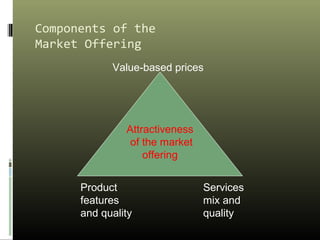
Components of the
Market Offering
Attractiveness
of the market
offering
Value-based prices
Product
features
and quality
Services
mix and
quality
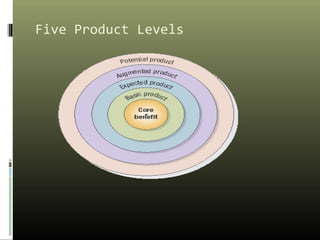
Five Product Levels
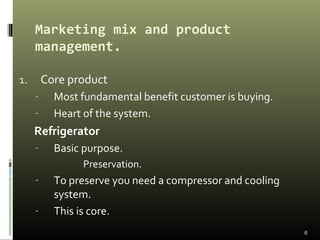
Marketing mix and product
management.
1. Core product
- Most fundamental benefit customer is buying.
- Heart of the system.
Refrigerator
- Basic purpose.
Preservation.
- To preserve you need a compressor and cooling
system.
- This is core.
6
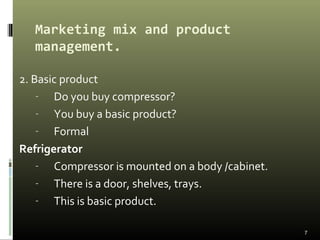
Marketing mix and product
management.
2. Basic product
- Do you buy compressor?
- You buy a basic product?
- Formal
Refrigerator
- Compressor is mounted on a body /cabinet.
- There is a door, shelves, trays.
- This is basic product.
7
Marketing mix and product
management.
EXPECTED PRODUCT
- A set of attributes and conditions customers expect. This
depends on the chosen target audience.
- This is expected from a marketer.
Refrigerator
- Freezer.
- Bulb.
- Thermostat.
- Quiet not noisy.
- Different types of shelves.
- Antirust system.
This is expected product.
8
Marketing mix and product
management.
AUGMENTED PRODUCT
- Prepare a product that exceeds customer
expectation. Is the reason to buy.
- Add further attributes
- Each attribute adds cost
- Will customer pay enough to cover the extra
cost?
Refrigerators
- Easy financing scheme
- Four year warranty on compressor
- Free rice – cooker with every refrigerator
purchased.
9
Marketing mix and product
management.
POTENTIAL PRODUCT
- Companies search for new ways to satisfy
customers and distinguish their offer.
Refrigerator
- Water dispenser – on the door
 Prevent frequent opening of doors.
 Faster cooling.
PRODUCT 11
Marketing mix and product
management.
WHAT DO WE OBSERVE?
- Most competition at augmentation level.
- Constant innovation.
- Understand how customers use their
product.
- New features add to the cost.
- Marketers have to find out that whether
customers are willing to pay extra cost.
Marketing mix and product
management.
REFRIGERATORS.
1. Whirlpool
• Quick lce making
1. Samsung
• Super x – flow
Uniform cooling.
3. LG
• Nutritional value maintained.
3. ALLWYN
• Efficient compressor.
3. KELVINATOR
• Coolest.
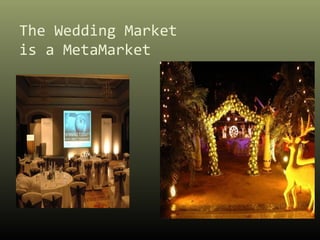
The Wedding Market
is a MetaMarket
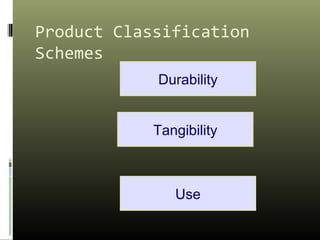
Product Classification
Schemes
Durability
Use
Tangibility
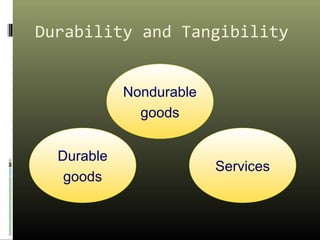
Durability and Tangibility
Nondurable
goods
Services
Durable
goods
Marketing mix and product
management.
A. Durability & Tangibility
1. Non-durable goods
- Consumed in one or few uses
- Consumed quickly
- Frequent purchase
- Need to make them available in many locations
- Heavy promotion
- Induce trial
Example
Coke, Modern bread, Lux Soap, Mother Diary Milk
Marketing mix and product
management.
2. Durable goods
- Used many times
- More personal selling/service
- Seller’s assurance about product longevity
Example
- Refrigerators
- Mixer
- Car
 Higher priced than non-durable
 Consumer involvement is high as they are high
priced
Marketing mix and product
management.
3. Services
- Intangible
- Inseparable
- Variable
- Perishable
Example
- Beauty parlour
- Education Services
- A Surgery
- Listening to concert
- Airlines
Marketing mix and product
management.
Therefore
 Products which are predominantly tangible
are called goods
 Products, which are predominantly
intangible, are called services.
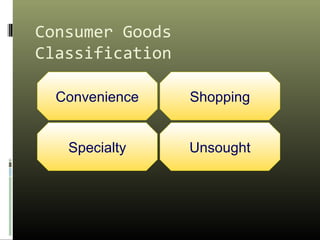
Consumer Goods
Classification
Convenience
Unsought
Shopping
Specialty
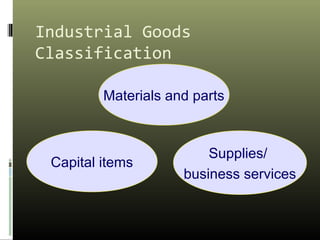
Industrial Goods
Classification
Materials and parts
Supplies/
business services
Capital items
Marketing mix and product
management.
B. Consumer – Goods classification
Based on shopping habits
1. Convenience goods
Goods purchased
- Frequently
- Immediately
- Minimum effort
Example
- Newspapers
- Bread
- Milk
Distributed at shops very near to households
Marketing mix and product
management.
2. Shopping goods
- Goods that the customer in the process of
selection and purchase
- Characteristically compares on such basis as
suitability, quality, price and style
Examples
- Furniture
- Clothing
- Appliances
Marketing mix and product
management.
3. Speciality goods
- Unique characteristics
- Unique brand values
- Buyers willing to make extra efforts
Example
- House
- Jewellery
Very few outlets, exclusive
- Cars
Marketing mix and product
management.
4. Unsought goods
- Goods the consumer does not know about or
does not normally think of buying
- Consumers made aware through
promotional efforts of the firm.
Examples
- Life insurance
- Security equipments
- Fire extinguisher
Marketing mix and product
management.
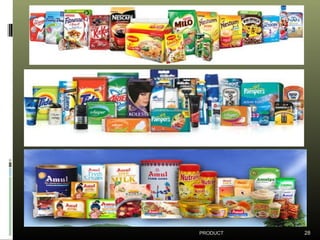
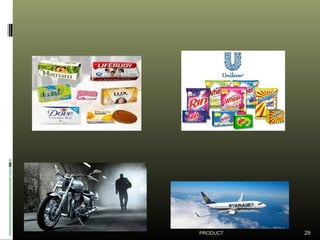
PRODUCT MIX
- Set of all products and items that a particular seller offers
for sale
Example:
BPL
• Consumer products
- TVs, Washing Machine
• Cellular Services
- Mobile operations in Mumbai
• Telecom
- Instruments
PRODUCT 28
PRODUCT 29
Marketing mix and product
management.
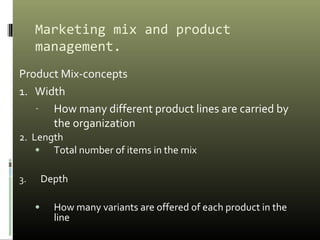
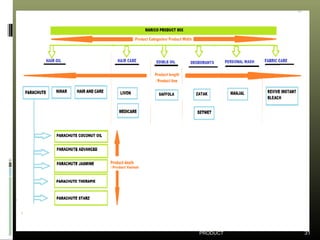
Product Mix-concepts
1. Width
- How many different product lines are carried by
the organization
2. Length
• Total number of items in the mix
3. Depth
• How many variants are offered of each product in the
line
PRODUCT 31
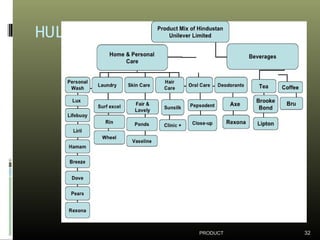
HUL
PRODUCT 32
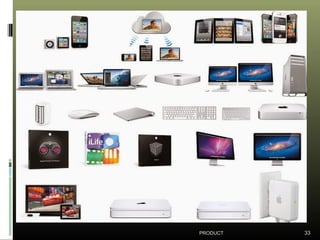
PRODUCT 33
PRODUCT 34
Marketing mix and product
management.
4. Consistency
How closely related the various product lines are in
end use, production requirements, distribution
channels or some other way.
Proctor and Gamble
- Very consistent
- Why
- Products are available through the same
distribution channels
Marketing mix and product
management.
GE
• Very inconsistent
• Are Refrigerators, Aircraft engines and Electricity
equipment available from same places
• No ?
• Refrigerators
- Shops
• Aircraft Engine’s
- Direct
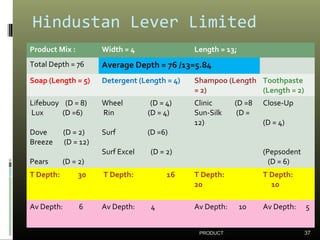
Hindustan Lever Limited
Product Mix : Width = 4 Length = 13;
Total Depth = 76 Average Depth = 76 /13=5.84
Soap (Length = 5) Detergent (Length = 4) Shampoo (Length
= 2)
Toothpaste
(Length = 2)
Lifebuoy (D = 8)
Lux (D =6)
Dove (D = 2)
Breeze (D = 12)
Pears (D = 2)
Wheel (D = 4)
Rin (D = 4)
Surf (D =6)
Surf Excel (D = 2)
Clinic (D =8
Sun-Silk (D =
12)
Close-Up
(D = 4)
(Pepsodent
(D = 6)
T Depth: 30 T Depth: 16 T Depth:
20
T Depth:
10
Av Depth: 6 Av Depth: 4 Av Depth: 10 Av Depth: 5
PRODUCT 37
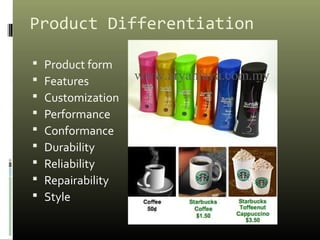
Product Differentiation
 Product form
 Features
 Customization
 Performance
 Conformance
 Durability
 Reliability
 Repairability
 Style
Service Differentiation
 Ordering ease
 Delivery
 Installation
 Customer training
 Customer consulting
 Maintenance and
repair
 Returns
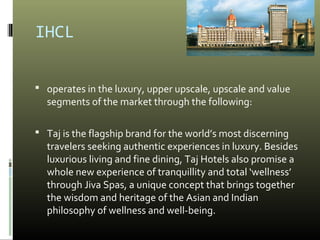
IHCL
 operates in the luxury, upper upscale, upscale and value
segments of the market through the following:
 Taj is the flagship brand for the world’s most discerning
travelers seeking authentic experiences in luxury. Besides
luxurious living and fine dining, Taj Hotels also promise a
whole new experience of tranquillity and total ‘wellness’
through Jiva Spas, a unique concept that brings together
the wisdom and heritage of the Asian and Indian
philosophy of wellness and well-being.
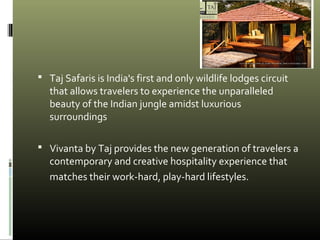
 Taj Safaris is India's first and only wildlife lodges circuit
that allows travelers to experience the unparalleled
beauty of the Indian jungle amidst luxurious
surroundings
 Vivanta by Taj provides the new generation of travelers a
contemporary and creative hospitality experience that
matches their work-hard, play-hard lifestyles.
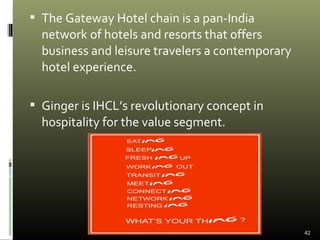
 The Gateway Hotel chain is a pan-India
network of hotels and resorts that offers
business and leisure travelers a contemporary
hotel experience.
 Ginger is IHCL’s revolutionary concept in
hospitality for the value segment.
42
 Taj Trade and Transport operates the chain of
Taj Salon and Taj Khazana lifestyle boutiques
across selected properties of the Taj group.
Taj operated salons are currently operating at
12 locations in the group.
PRODUCT 43
Maintenance and Repair
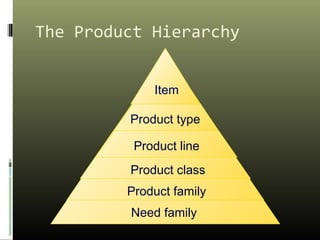
The Product Hierarchy
Need family
Product family
Product class
Product line
Product type
Item
46
7-Levels of Product
Hierarchy
 Product need—to satisfy a need e.g. feet protection
 Product class—a family of products having similar
function e.g. all shoes
 Product line—a group of products with closely related
functions e.g. sports shoes
 Product type—products within a line having similar form
e.g. basket-ball shoes
 Brand—a name representing a product or line e.g. Nike
 Item (Stock Keeping Unit)—a unit item e.g. one pair of
Nike basket-ball shoe
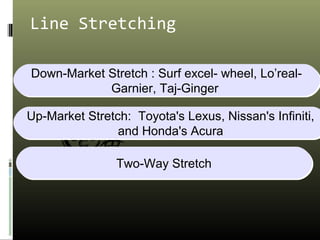
Line Stretching
Down-Market Stretch : Surf excel- wheel, Lo’real-
Garnier, Taj-Ginger
Down-Market Stretch : Surf excel- wheel, Lo’real-
Garnier, Taj-Ginger
Up-Market Stretch: Toyota's Lexus, Nissan's Infiniti,
and Honda's Acura
Up-Market Stretch: Toyota's Lexus, Nissan's Infiniti,
and Honda's Acura
Two-Way StretchTwo-Way Stretch
Line Filling & Pruning
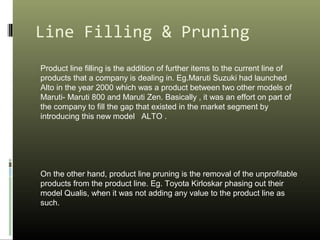
Product line filling is the addition of further items to the current line of
products that a company is dealing in. Eg.Maruti Suzuki had launched
Alto in the year 2000 which was a product between two other models of
Maruti- Maruti 800 and Maruti Zen. Basically , it was an effort on part of
the company to fill the gap that existed in the market segment by
introducing this new model ALTO .
On the other hand, product line pruning is the removal of the unprofitable
products from the product line. Eg. Toyota Kirloskar phasing out their
model Qualis, when it was not adding any value to the product line as
such.
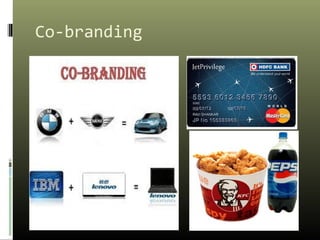
Co-branding
Ingredient Branding
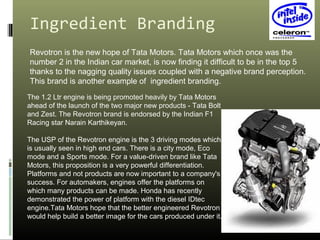
Revotron is the new hope of Tata Motors. Tata Motors which once was the
number 2 in the Indian car market, is now finding it difficult to be in the top 5
thanks to the nagging quality issues coupled with a negative brand perception.
This brand is another example of ingredient branding.
The 1.2 Ltr engine is being promoted heavily by Tata Motors
ahead of the launch of the two major new products - Tata Bolt
and Zest. The Revotron brand is endorsed by the Indian F1
Racing star Narain Karthikeyan.
The USP of the Revotron engine is the 3 driving modes which
is usually seen in high end cars. There is a city mode, Eco
mode and a Sports mode. For a value-driven brand like Tata
Motors, this proposition is a very powerful differentiation.
Platforms and not products are now important to a company's
success. For automakers, engines offer the platforms on
which many products can be made. Honda has recently
demonstrated the power of platform with the diesel IDtec
engine.Tata Motors hope that the better engineered Revotron
would help build a better image for the cars produced under it.
What is the Fifth P?
Packaging, sometimes called the fifth P,
is all the activities of designing and
producing the container for a product.
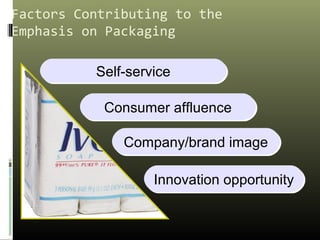
Factors Contributing to the
Emphasis on Packaging
Self-serviceSelf-service
Consumer affluenceConsumer affluence
Company/brand imageCompany/brand image
Innovation opportunityInnovation opportunity
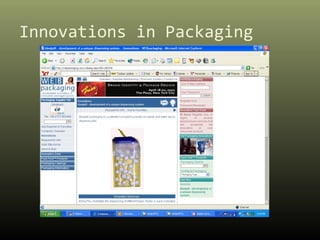
Innovations in Packaging
Packaging Objectives
 Identify the brand
 Convey descriptive and persuasive
information
 Facilitate product transportation and
protection
 Assist at-home storage
 Aid product consumption
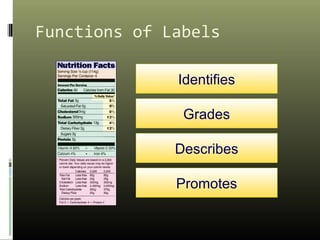
Functions of Labels
Identifies
Grades
Describes
Promotes
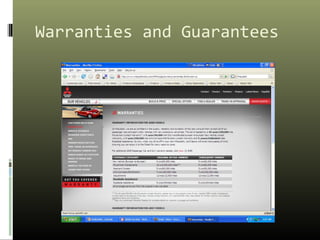
Warranties and Guarantees

Marketing Management-Product Management

  • 1.
  • 2.
    Marketing mix andproduct management. At the end of this module the learning actuates are. 1. What is a product? 2. Various levels of product. 3. How products are classified? 4. Differentiation 5. Product and brand relationships 6. Packaging 2
  • 3.
    What is aProduct? A product is anything that can be offered to a market to satisfy a want or need, including physical goods, services, experiences, events, persons, places, properties, organizations, information, and ideas.
  • 4.
    Components of the MarketOffering Attractiveness of the market offering Value-based prices Product features and quality Services mix and quality
  • 5.
  • 6.
    Marketing mix andproduct management. 1. Core product - Most fundamental benefit customer is buying. - Heart of the system. Refrigerator - Basic purpose. Preservation. - To preserve you need a compressor and cooling system. - This is core. 6
  • 7.
    Marketing mix andproduct management. 2. Basic product - Do you buy compressor? - You buy a basic product? - Formal Refrigerator - Compressor is mounted on a body /cabinet. - There is a door, shelves, trays. - This is basic product. 7
  • 8.
    Marketing mix andproduct management. EXPECTED PRODUCT - A set of attributes and conditions customers expect. This depends on the chosen target audience. - This is expected from a marketer. Refrigerator - Freezer. - Bulb. - Thermostat. - Quiet not noisy. - Different types of shelves. - Antirust system. This is expected product. 8
  • 9.
    Marketing mix andproduct management. AUGMENTED PRODUCT - Prepare a product that exceeds customer expectation. Is the reason to buy. - Add further attributes - Each attribute adds cost - Will customer pay enough to cover the extra cost? Refrigerators - Easy financing scheme - Four year warranty on compressor - Free rice – cooker with every refrigerator purchased. 9
  • 10.
    Marketing mix andproduct management. POTENTIAL PRODUCT - Companies search for new ways to satisfy customers and distinguish their offer. Refrigerator - Water dispenser – on the door  Prevent frequent opening of doors.  Faster cooling.
  • 11.
  • 12.
    Marketing mix andproduct management. WHAT DO WE OBSERVE? - Most competition at augmentation level. - Constant innovation. - Understand how customers use their product. - New features add to the cost. - Marketers have to find out that whether customers are willing to pay extra cost.
  • 13.
    Marketing mix andproduct management. REFRIGERATORS. 1. Whirlpool • Quick lce making 1. Samsung • Super x – flow Uniform cooling. 3. LG • Nutritional value maintained. 3. ALLWYN • Efficient compressor. 3. KELVINATOR • Coolest.
  • 14.
  • 15.
  • 16.
  • 17.
    Marketing mix andproduct management. A. Durability & Tangibility 1. Non-durable goods - Consumed in one or few uses - Consumed quickly - Frequent purchase - Need to make them available in many locations - Heavy promotion - Induce trial Example Coke, Modern bread, Lux Soap, Mother Diary Milk
  • 18.
    Marketing mix andproduct management. 2. Durable goods - Used many times - More personal selling/service - Seller’s assurance about product longevity Example - Refrigerators - Mixer - Car  Higher priced than non-durable  Consumer involvement is high as they are high priced
  • 19.
    Marketing mix andproduct management. 3. Services - Intangible - Inseparable - Variable - Perishable Example - Beauty parlour - Education Services - A Surgery - Listening to concert - Airlines
  • 20.
    Marketing mix andproduct management. Therefore  Products which are predominantly tangible are called goods  Products, which are predominantly intangible, are called services.
  • 21.
  • 22.
    Industrial Goods Classification Materials andparts Supplies/ business services Capital items
  • 23.
    Marketing mix andproduct management. B. Consumer – Goods classification Based on shopping habits 1. Convenience goods Goods purchased - Frequently - Immediately - Minimum effort Example - Newspapers - Bread - Milk Distributed at shops very near to households
  • 24.
    Marketing mix andproduct management. 2. Shopping goods - Goods that the customer in the process of selection and purchase - Characteristically compares on such basis as suitability, quality, price and style Examples - Furniture - Clothing - Appliances
  • 25.
    Marketing mix andproduct management. 3. Speciality goods - Unique characteristics - Unique brand values - Buyers willing to make extra efforts Example - House - Jewellery Very few outlets, exclusive - Cars
  • 26.
    Marketing mix andproduct management. 4. Unsought goods - Goods the consumer does not know about or does not normally think of buying - Consumers made aware through promotional efforts of the firm. Examples - Life insurance - Security equipments - Fire extinguisher
  • 27.
    Marketing mix andproduct management. PRODUCT MIX - Set of all products and items that a particular seller offers for sale Example: BPL • Consumer products - TVs, Washing Machine • Cellular Services - Mobile operations in Mumbai • Telecom - Instruments
  • 28.
  • 29.
  • 30.
    Marketing mix andproduct management. Product Mix-concepts 1. Width - How many different product lines are carried by the organization 2. Length • Total number of items in the mix 3. Depth • How many variants are offered of each product in the line
  • 31.
  • 32.
  • 33.
  • 34.
  • 35.
    Marketing mix andproduct management. 4. Consistency How closely related the various product lines are in end use, production requirements, distribution channels or some other way. Proctor and Gamble - Very consistent - Why - Products are available through the same distribution channels
  • 36.
    Marketing mix andproduct management. GE • Very inconsistent • Are Refrigerators, Aircraft engines and Electricity equipment available from same places • No ? • Refrigerators - Shops • Aircraft Engine’s - Direct
  • 37.
    Hindustan Lever Limited ProductMix : Width = 4 Length = 13; Total Depth = 76 Average Depth = 76 /13=5.84 Soap (Length = 5) Detergent (Length = 4) Shampoo (Length = 2) Toothpaste (Length = 2) Lifebuoy (D = 8) Lux (D =6) Dove (D = 2) Breeze (D = 12) Pears (D = 2) Wheel (D = 4) Rin (D = 4) Surf (D =6) Surf Excel (D = 2) Clinic (D =8 Sun-Silk (D = 12) Close-Up (D = 4) (Pepsodent (D = 6) T Depth: 30 T Depth: 16 T Depth: 20 T Depth: 10 Av Depth: 6 Av Depth: 4 Av Depth: 10 Av Depth: 5 PRODUCT 37
  • 38.
    Product Differentiation  Productform  Features  Customization  Performance  Conformance  Durability  Reliability  Repairability  Style
  • 39.
    Service Differentiation  Orderingease  Delivery  Installation  Customer training  Customer consulting  Maintenance and repair  Returns
  • 40.
    IHCL  operates inthe luxury, upper upscale, upscale and value segments of the market through the following:  Taj is the flagship brand for the world’s most discerning travelers seeking authentic experiences in luxury. Besides luxurious living and fine dining, Taj Hotels also promise a whole new experience of tranquillity and total ‘wellness’ through Jiva Spas, a unique concept that brings together the wisdom and heritage of the Asian and Indian philosophy of wellness and well-being.
  • 41.
     Taj Safarisis India's first and only wildlife lodges circuit that allows travelers to experience the unparalleled beauty of the Indian jungle amidst luxurious surroundings  Vivanta by Taj provides the new generation of travelers a contemporary and creative hospitality experience that matches their work-hard, play-hard lifestyles.
  • 42.
     The GatewayHotel chain is a pan-India network of hotels and resorts that offers business and leisure travelers a contemporary hotel experience.  Ginger is IHCL’s revolutionary concept in hospitality for the value segment. 42
  • 43.
     Taj Tradeand Transport operates the chain of Taj Salon and Taj Khazana lifestyle boutiques across selected properties of the Taj group. Taj operated salons are currently operating at 12 locations in the group. PRODUCT 43
  • 44.
  • 45.
    The Product Hierarchy Needfamily Product family Product class Product line Product type Item
  • 46.
    46 7-Levels of Product Hierarchy Product need—to satisfy a need e.g. feet protection  Product class—a family of products having similar function e.g. all shoes  Product line—a group of products with closely related functions e.g. sports shoes  Product type—products within a line having similar form e.g. basket-ball shoes  Brand—a name representing a product or line e.g. Nike  Item (Stock Keeping Unit)—a unit item e.g. one pair of Nike basket-ball shoe
  • 47.
    Line Stretching Down-Market Stretch: Surf excel- wheel, Lo’real- Garnier, Taj-Ginger Down-Market Stretch : Surf excel- wheel, Lo’real- Garnier, Taj-Ginger Up-Market Stretch: Toyota's Lexus, Nissan's Infiniti, and Honda's Acura Up-Market Stretch: Toyota's Lexus, Nissan's Infiniti, and Honda's Acura Two-Way StretchTwo-Way Stretch
  • 48.
    Line Filling &Pruning Product line filling is the addition of further items to the current line of products that a company is dealing in. Eg.Maruti Suzuki had launched Alto in the year 2000 which was a product between two other models of Maruti- Maruti 800 and Maruti Zen. Basically , it was an effort on part of the company to fill the gap that existed in the market segment by introducing this new model ALTO . On the other hand, product line pruning is the removal of the unprofitable products from the product line. Eg. Toyota Kirloskar phasing out their model Qualis, when it was not adding any value to the product line as such.
  • 49.
  • 50.
    Ingredient Branding Revotron isthe new hope of Tata Motors. Tata Motors which once was the number 2 in the Indian car market, is now finding it difficult to be in the top 5 thanks to the nagging quality issues coupled with a negative brand perception. This brand is another example of ingredient branding. The 1.2 Ltr engine is being promoted heavily by Tata Motors ahead of the launch of the two major new products - Tata Bolt and Zest. The Revotron brand is endorsed by the Indian F1 Racing star Narain Karthikeyan. The USP of the Revotron engine is the 3 driving modes which is usually seen in high end cars. There is a city mode, Eco mode and a Sports mode. For a value-driven brand like Tata Motors, this proposition is a very powerful differentiation. Platforms and not products are now important to a company's success. For automakers, engines offer the platforms on which many products can be made. Honda has recently demonstrated the power of platform with the diesel IDtec engine.Tata Motors hope that the better engineered Revotron would help build a better image for the cars produced under it.
  • 51.
    What is theFifth P? Packaging, sometimes called the fifth P, is all the activities of designing and producing the container for a product.
  • 52.
    Factors Contributing tothe Emphasis on Packaging Self-serviceSelf-service Consumer affluenceConsumer affluence Company/brand imageCompany/brand image Innovation opportunityInnovation opportunity
  • 53.
  • 54.
    Packaging Objectives  Identifythe brand  Convey descriptive and persuasive information  Facilitate product transportation and protection  Assist at-home storage  Aid product consumption
  • 55.
  • 56.

Editor's Notes

  • #48 Video icon links to Marriott video on Marriott’s downward stretch.