Presenter: 
Ibrar Khalid 
2011-Ch-55 
Department of Chemical Engineering 
UET Lahore
Contents
IInnttrroodduuccttiioonn 
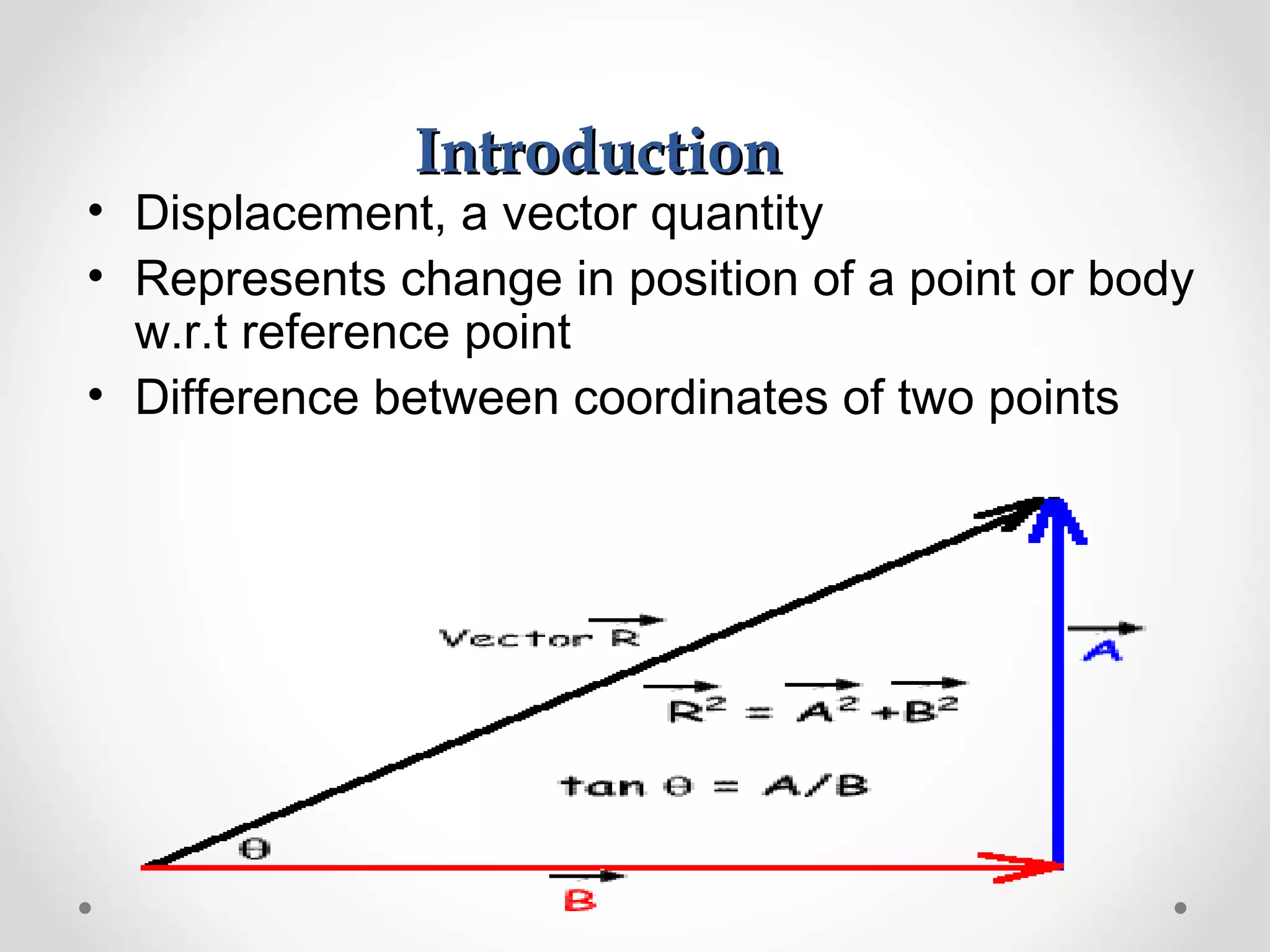
• Displacement, a vector quantity 
• Represents change in position of a point or body 
w.r.t reference point 
• Difference between coordinates of two points
NEEDS OF MEASUREMENT 
• Used for the measurement of many 
derived quantities such as force , stress , 
pressure, velocity and acceleration etc. 
• Force, pressure, velocity etc. in terms of 
displacement
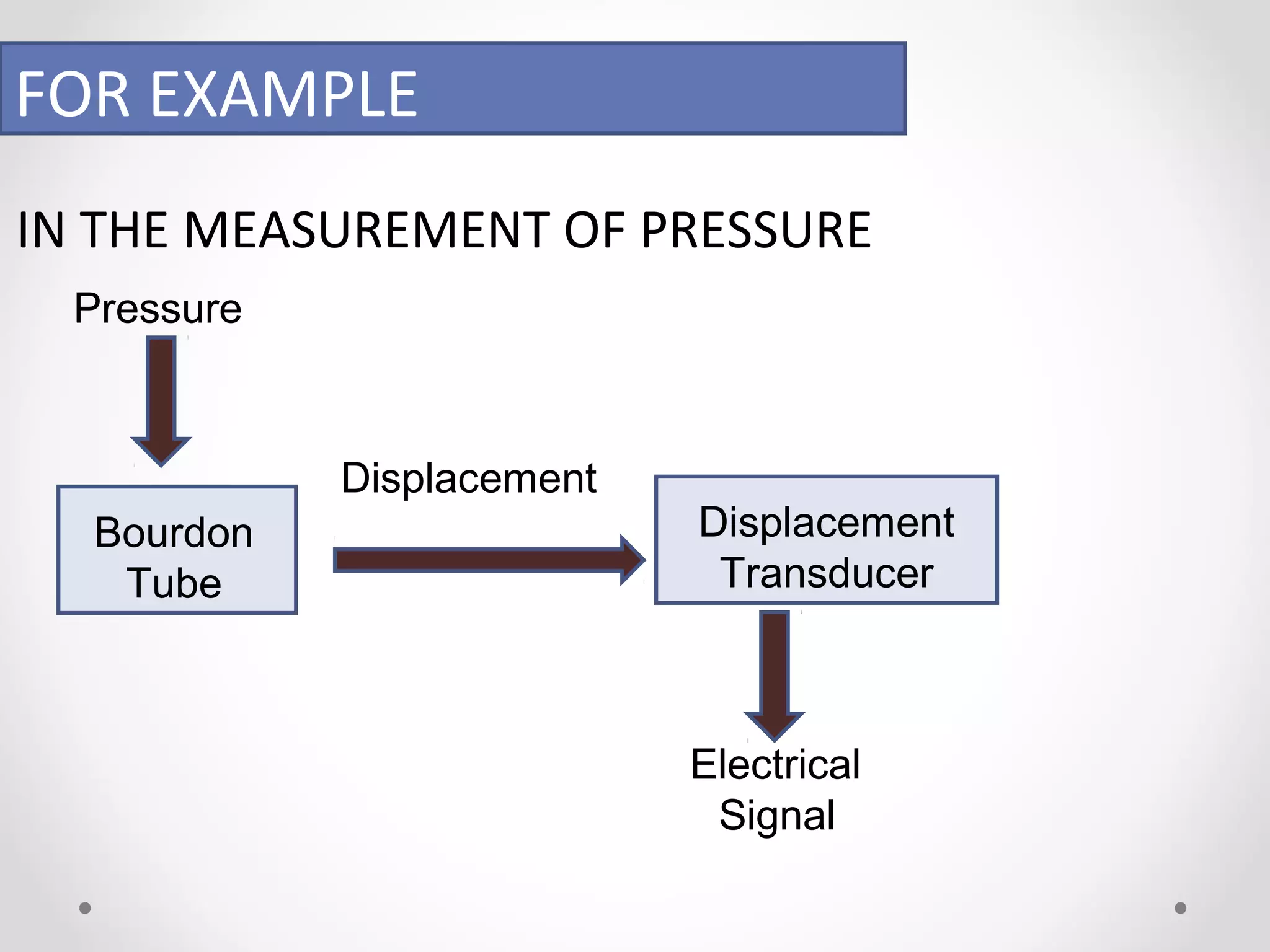
FOR EXAMPLE 
IN THE MEASUREMENT OF PRESSURE 
Pressure 
Bourdon 
Tube 
Displacement 
Displacement 
Transducer 
Electrical 
Signal
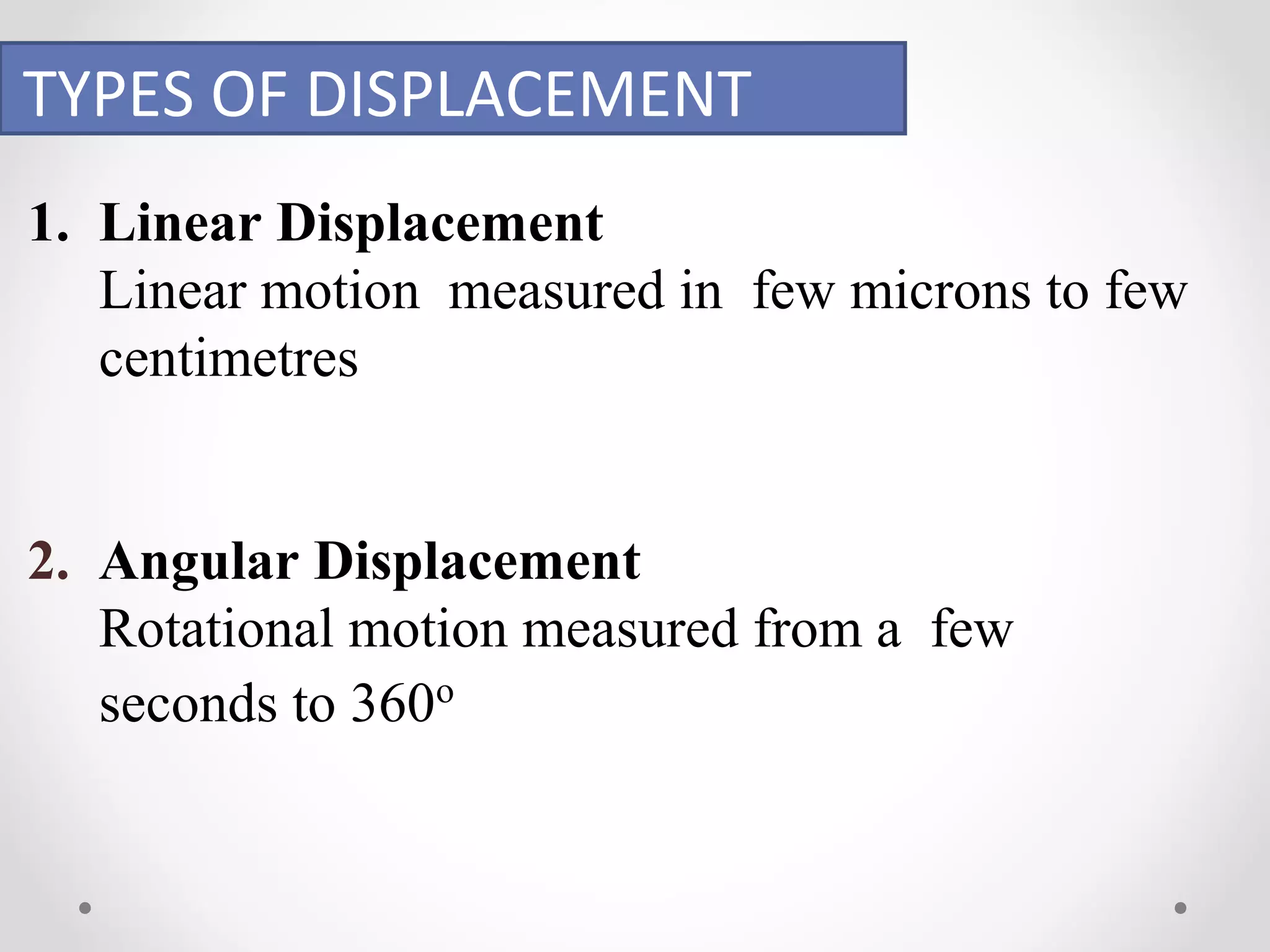
TYPES OF DISPLACEMENT 
1. Linear Displacement 
Linear motion measured in few microns to few 
centimetres 
2. Angular Displacement 
Rotational motion measured from a few 
seconds to 360o
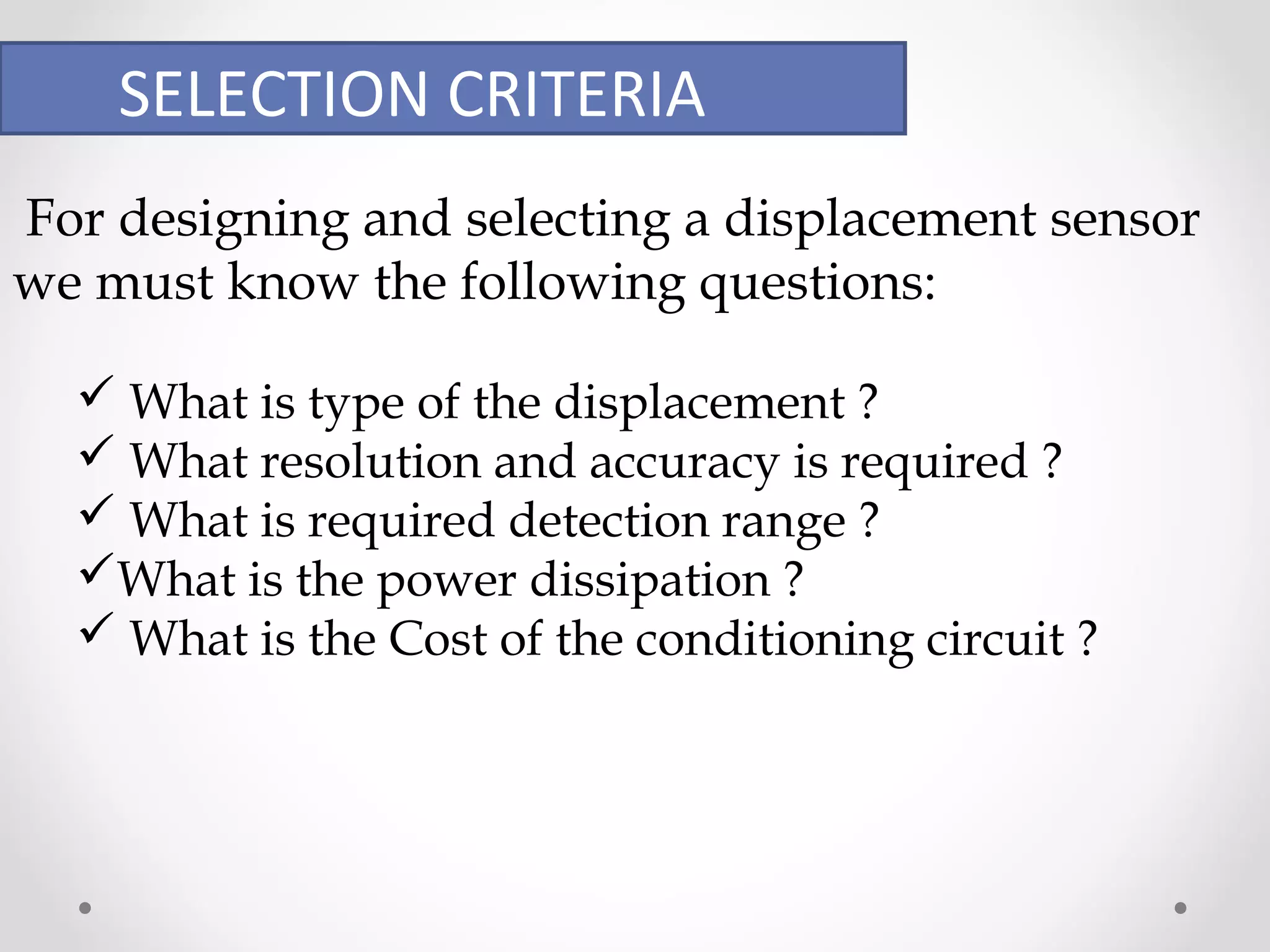
SELECTION CRITERIA 
For designing and selecting a displacement sensor 
we must know the following questions: 
 What is type of the displacement ? 
 What resolution and accuracy is required ? 
 What is required detection range ? 
What is the power dissipation ? 
 What is the Cost of the conditioning circuit ?
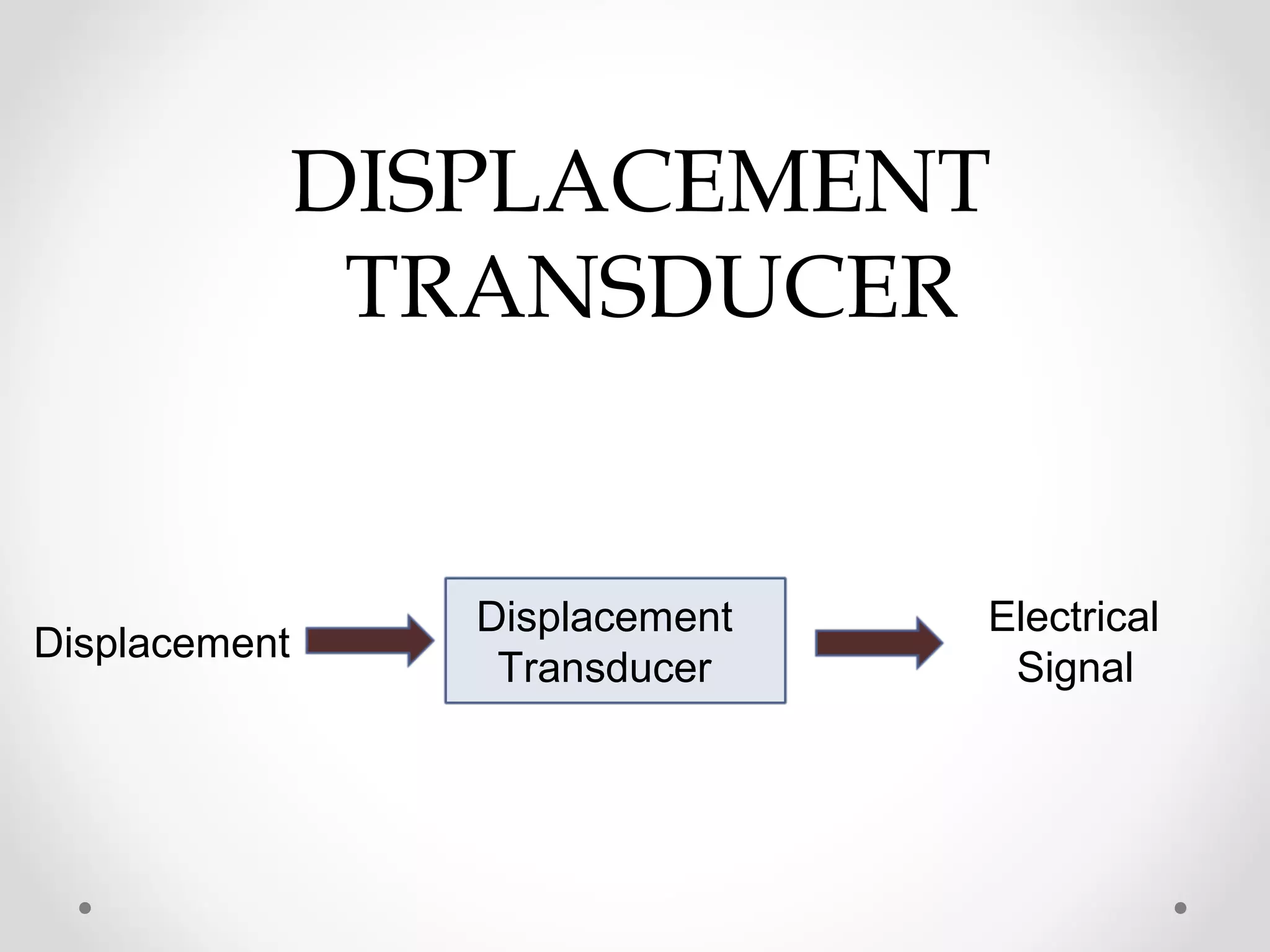
DISPLACEMENT 
TRANSDUCER 
Displacement Electrical 
Signal 
Displacement 
Transducer
DDiissppllaacceemmeenntt TTrraannssdduucceerr 
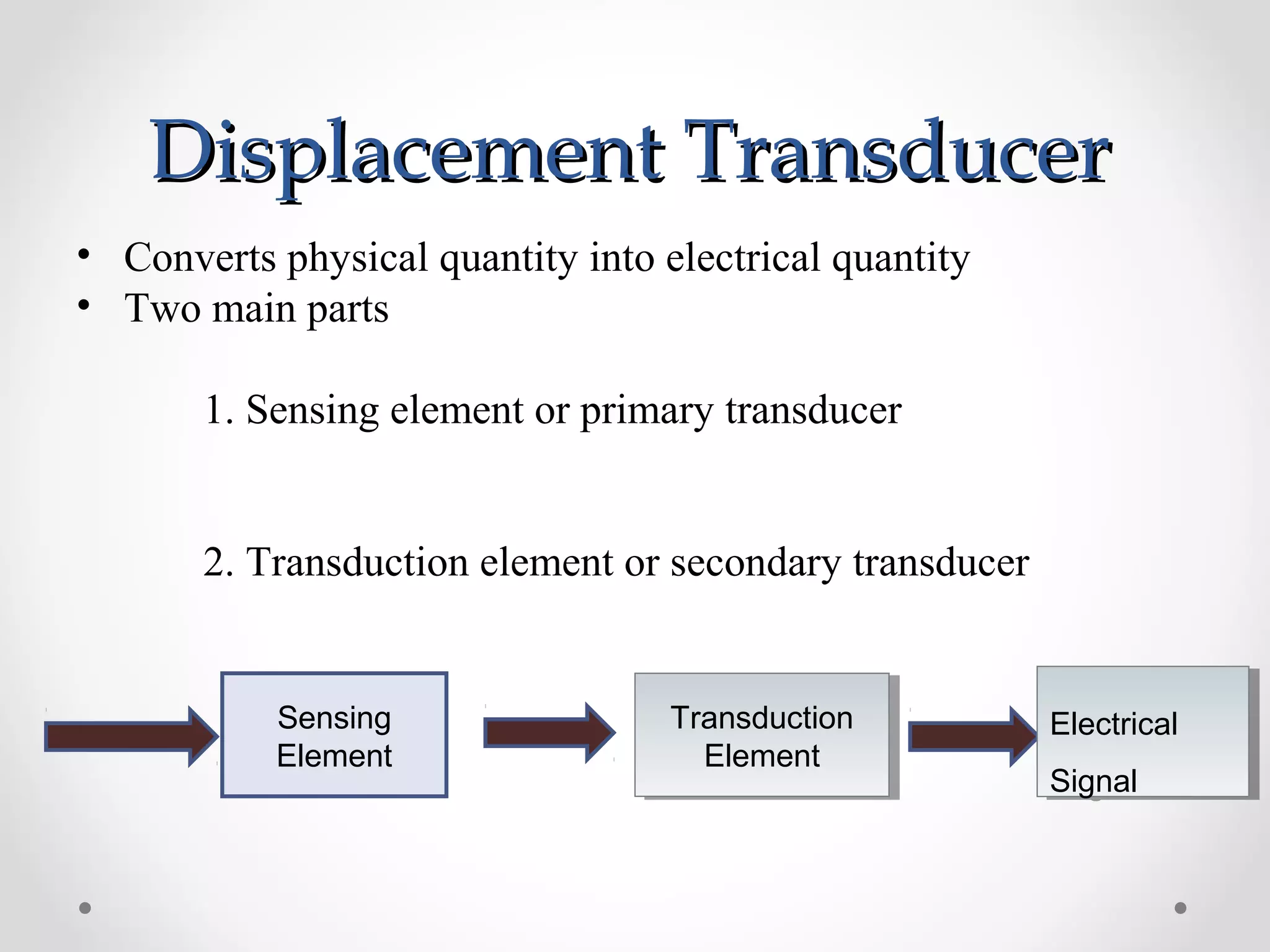
• Converts physical quantity into electrical quantity 
• Two main parts 
1. Sensing element or primary transducer 
2. Transduction element or secondary transducer 
Sensing 
Element 
Electrical 
Signal 
Electrical 
Signal 
Transduction 
Element 
Transduction 
Element
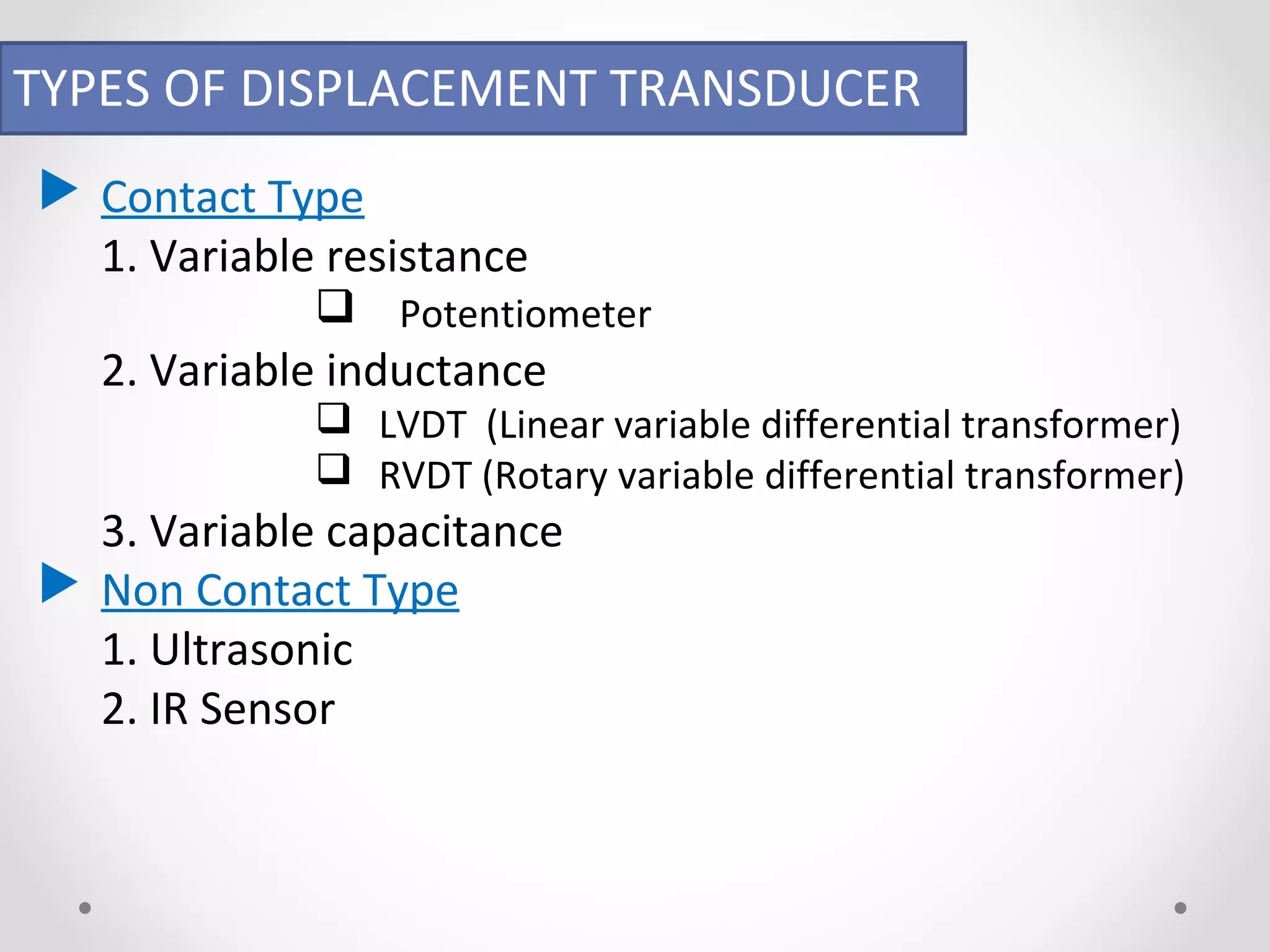
TYPES OF DISPLACEMENT TRANSDUCER 
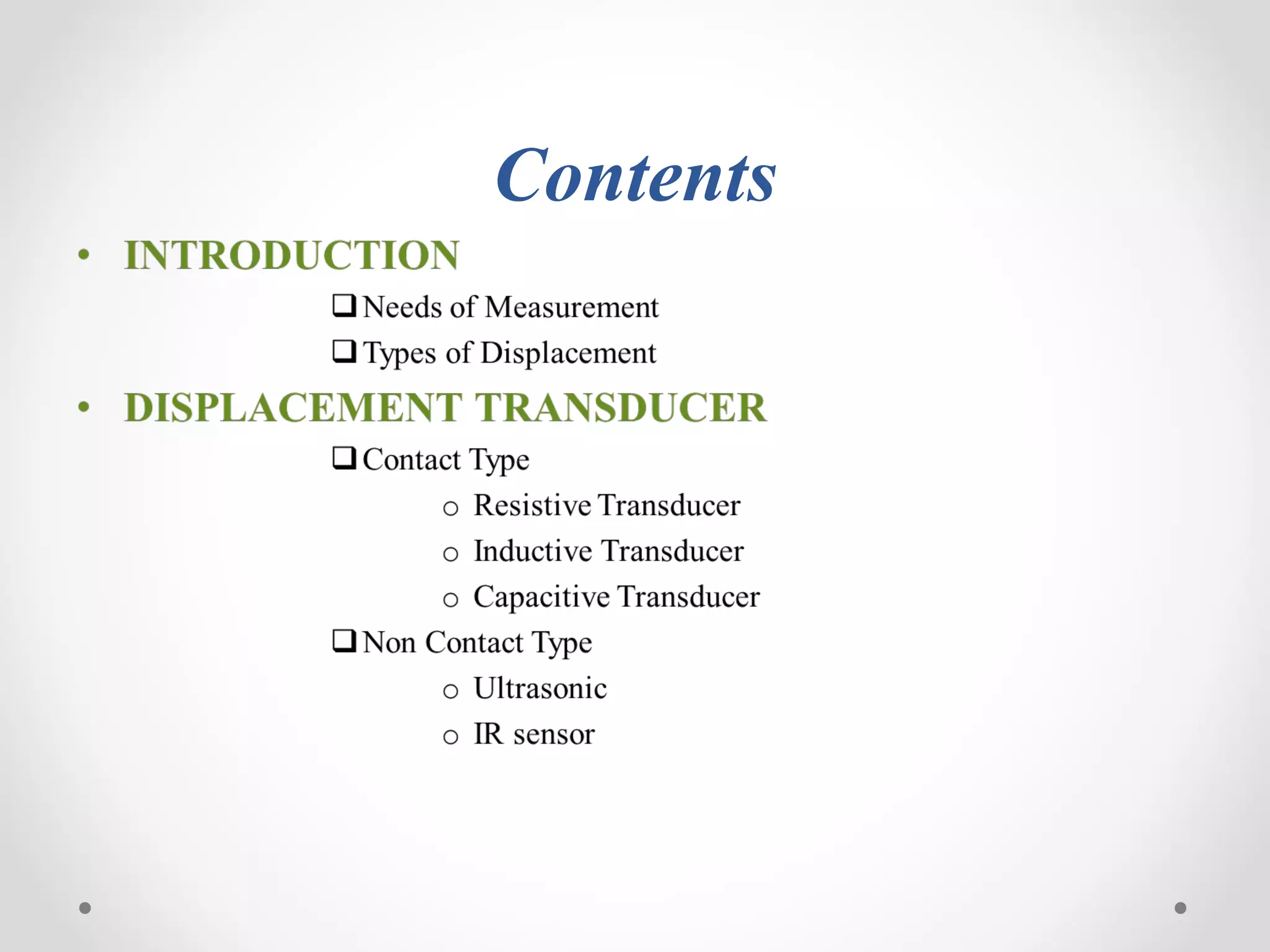
 Contact Type 
1. Variable resistance 
 Potentiometer 
2. Variable inductance 
 LVDT (Linear variable differential transformer) 
 RVDT (Rotary variable differential transformer) 
3. Variable capacitance 
 Non Contact Type 
1. Ultrasonic 
2. IR Sensor
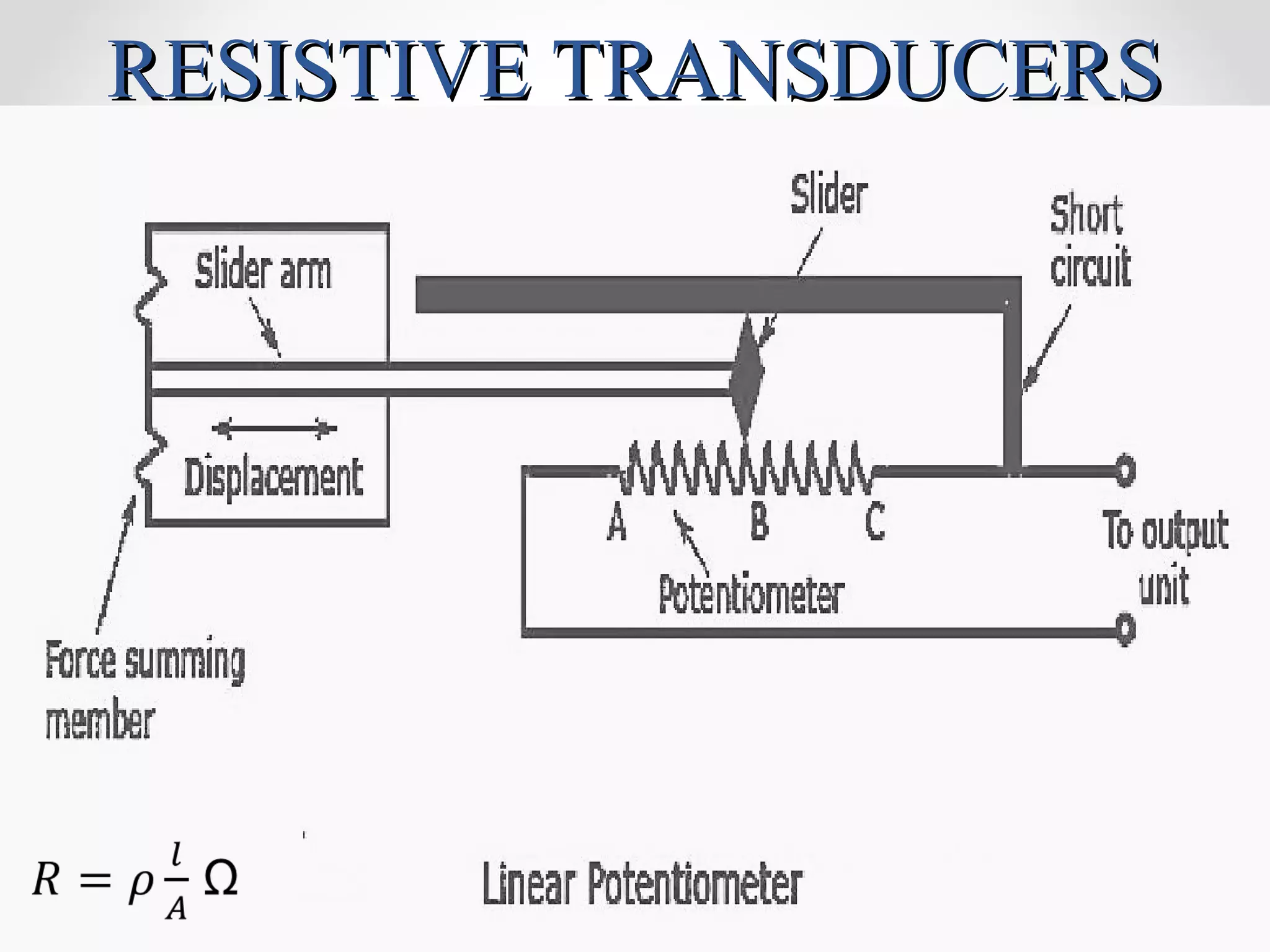
RREESSIISSTTIIVVEE TTRRAANNSSDDUUCCEERRSS
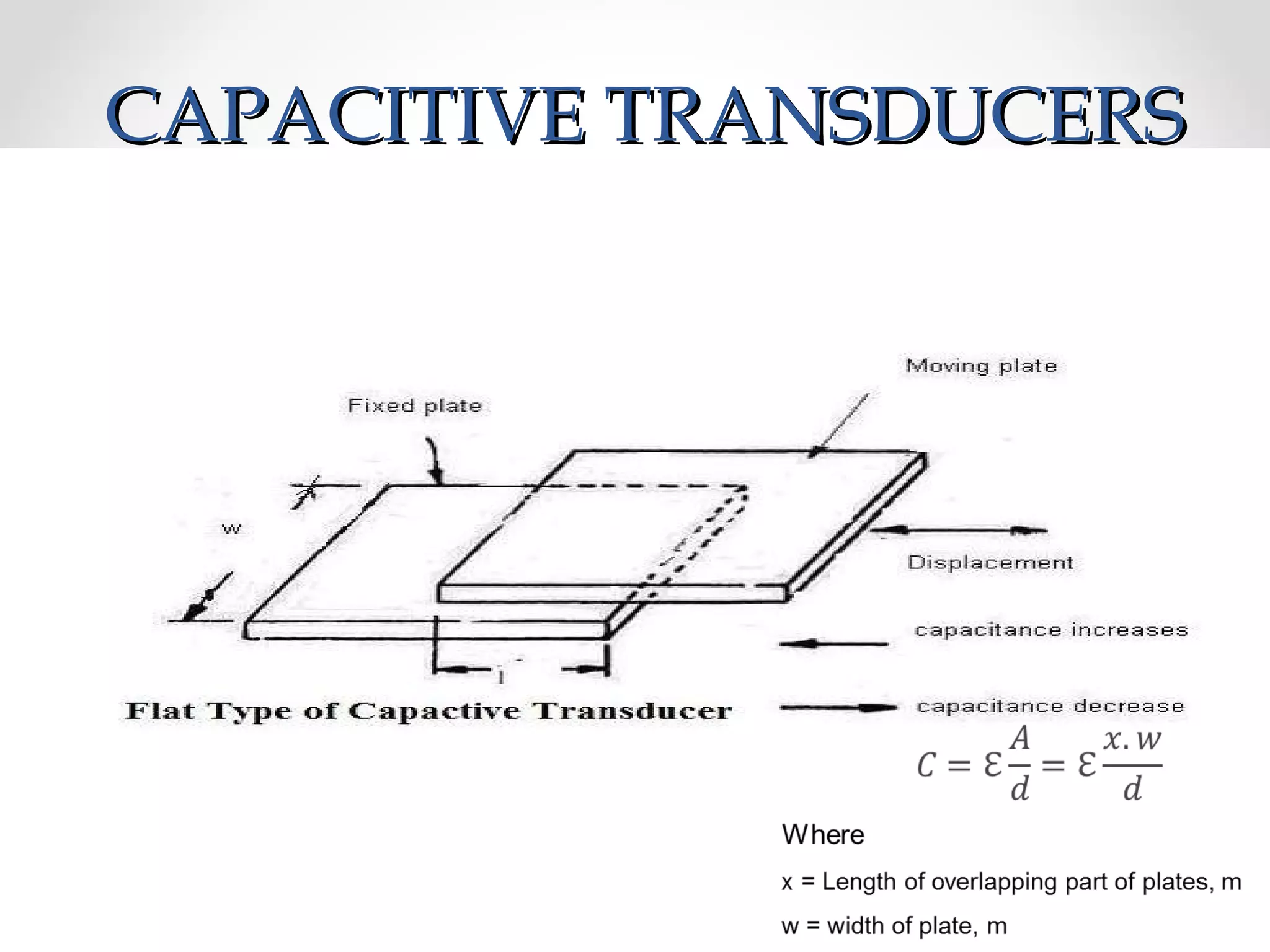
CCAAPPAACCIITTIIVVEE TTRRAANNSSDDUUCCEERRSS
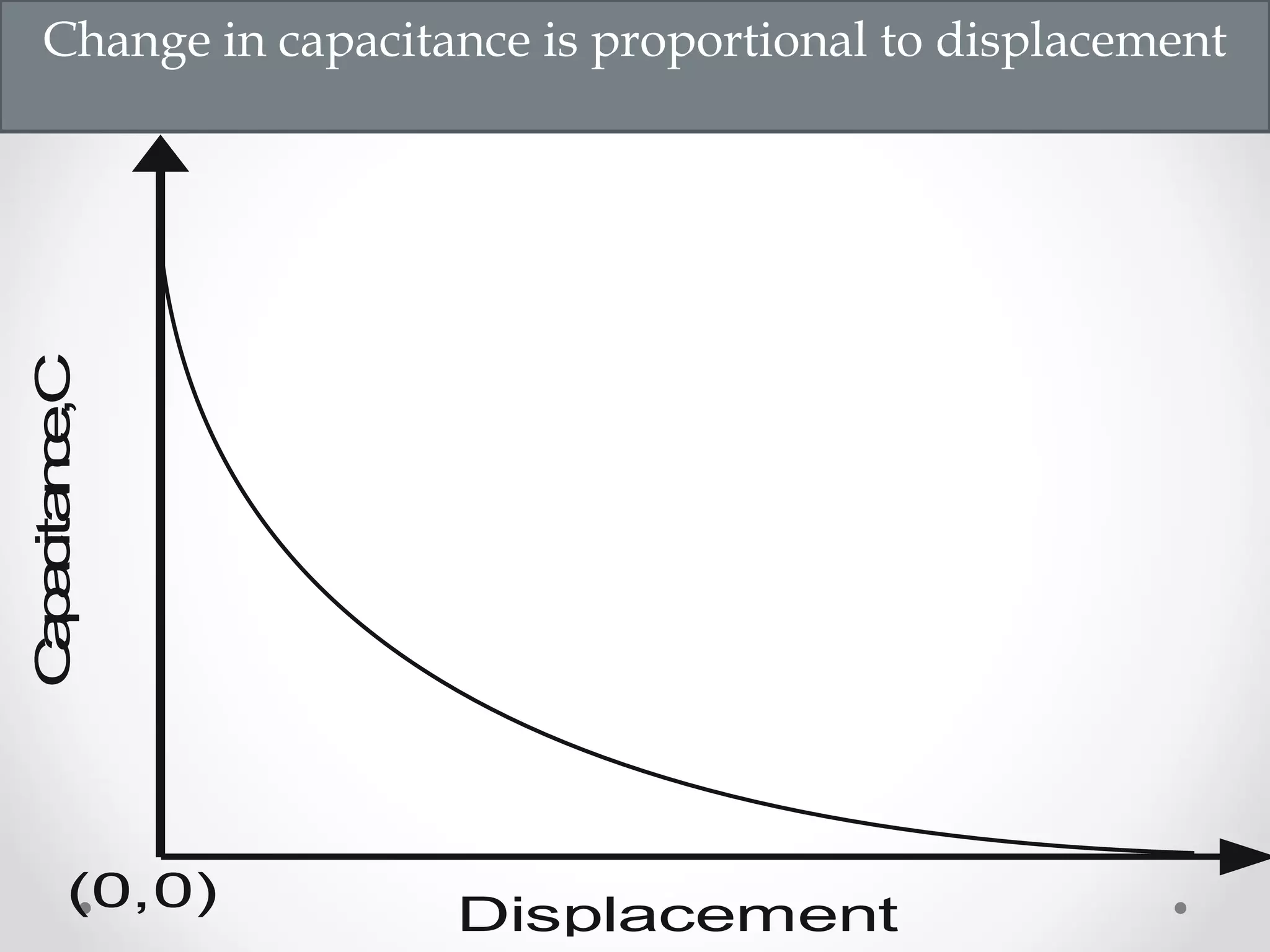
Change in capacitance is proportional to displacement 
(0,0) Displacement Capacitance,C
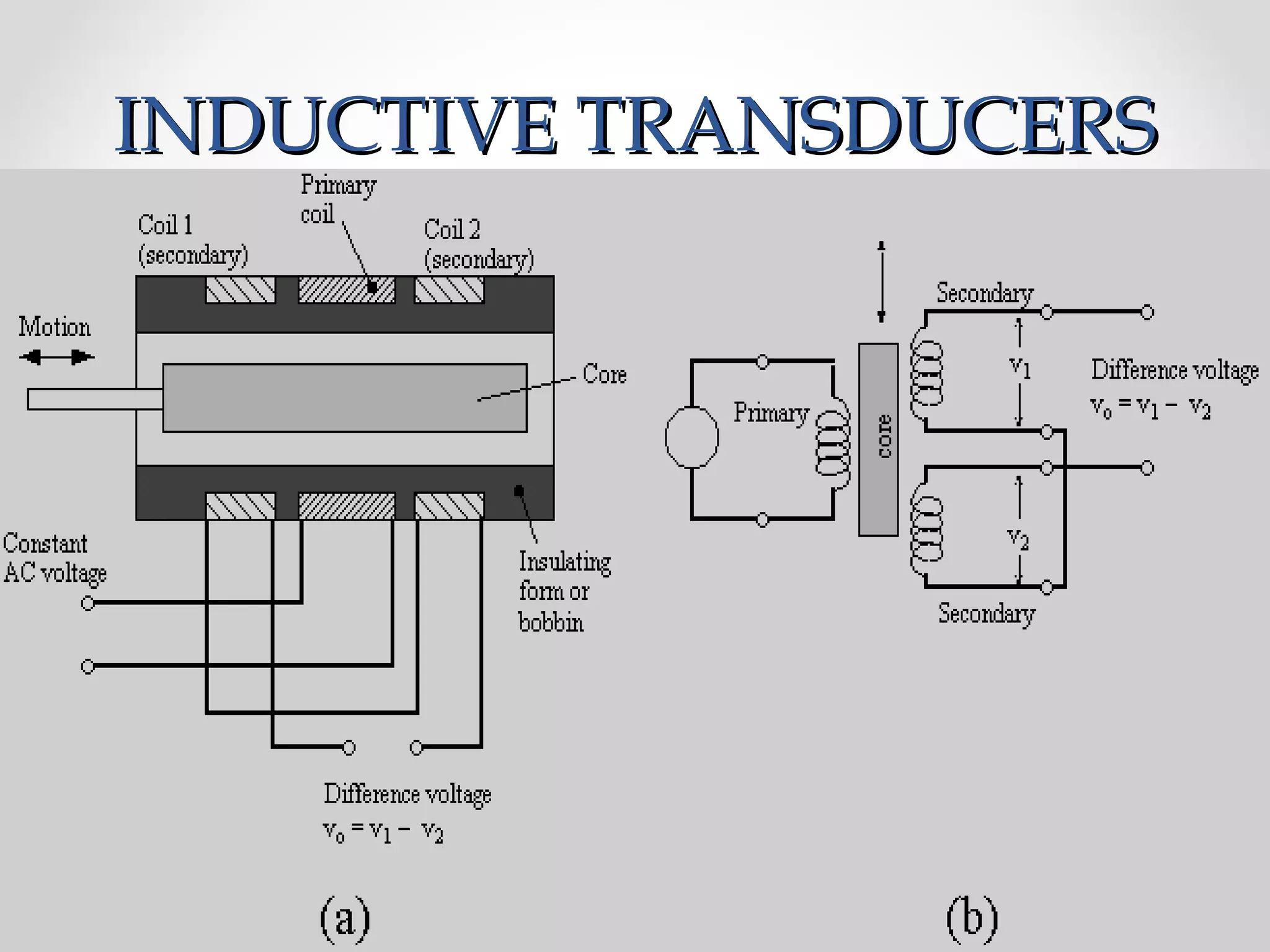
IINNDDUUCCTTIIVVEE TTRRAANNSSDDUUCCEERRSS
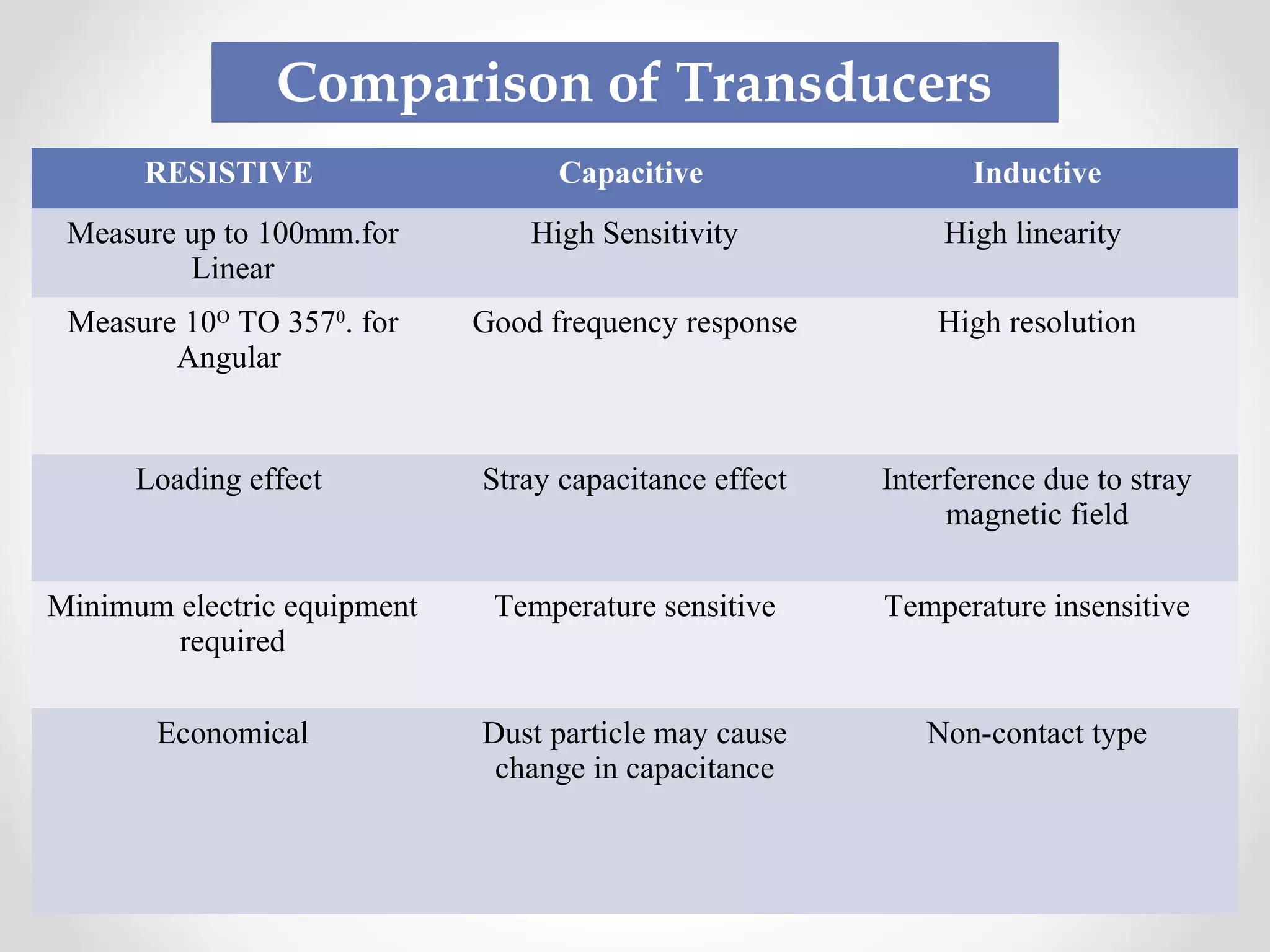
Comparison of Transducers 
RESISTIVE Capacitive Inductive 
Measure up to 100mm.for 
Linear 
High Sensitivity High linearity 
Measure 10O TO 3570. for 
Angular 
Good frequency response High resolution 
Loading effect 
Stray capacitance effect Interference due to stray 
magnetic field 
Minimum electric equipment 
required 
Temperature sensitive Temperature insensitive 
Economical Dust particle may cause 
change in capacitance 
Non-contact type
It is not the end, 
It is not even the beginning of end, 
But it is end of beginning….. 
Displacement measurement

Displacement measurement

  • 2.
    Presenter: Ibrar Khalid 2011-Ch-55 Department of Chemical Engineering UET Lahore
  • 3.
  • 4.
    IInnttrroodduuccttiioonn • Displacement,a vector quantity • Represents change in position of a point or body w.r.t reference point • Difference between coordinates of two points
  • 5.
    NEEDS OF MEASUREMENT • Used for the measurement of many derived quantities such as force , stress , pressure, velocity and acceleration etc. • Force, pressure, velocity etc. in terms of displacement
  • 6.
    FOR EXAMPLE INTHE MEASUREMENT OF PRESSURE Pressure Bourdon Tube Displacement Displacement Transducer Electrical Signal
  • 7.
    TYPES OF DISPLACEMENT 1. Linear Displacement Linear motion measured in few microns to few centimetres 2. Angular Displacement Rotational motion measured from a few seconds to 360o
  • 8.
    SELECTION CRITERIA Fordesigning and selecting a displacement sensor we must know the following questions:  What is type of the displacement ?  What resolution and accuracy is required ?  What is required detection range ? What is the power dissipation ?  What is the Cost of the conditioning circuit ?
  • 9.
    DISPLACEMENT TRANSDUCER DisplacementElectrical Signal Displacement Transducer
  • 10.
    DDiissppllaacceemmeenntt TTrraannssdduucceerr •Converts physical quantity into electrical quantity • Two main parts 1. Sensing element or primary transducer 2. Transduction element or secondary transducer Sensing Element Electrical Signal Electrical Signal Transduction Element Transduction Element
  • 11.
    TYPES OF DISPLACEMENTTRANSDUCER  Contact Type 1. Variable resistance  Potentiometer 2. Variable inductance  LVDT (Linear variable differential transformer)  RVDT (Rotary variable differential transformer) 3. Variable capacitance  Non Contact Type 1. Ultrasonic 2. IR Sensor
  • 12.
  • 13.
  • 14.
    Change in capacitanceis proportional to displacement (0,0) Displacement Capacitance,C
  • 15.
  • 16.
    Comparison of Transducers RESISTIVE Capacitive Inductive Measure up to 100mm.for Linear High Sensitivity High linearity Measure 10O TO 3570. for Angular Good frequency response High resolution Loading effect Stray capacitance effect Interference due to stray magnetic field Minimum electric equipment required Temperature sensitive Temperature insensitive Economical Dust particle may cause change in capacitance Non-contact type
  • 17.
    It is notthe end, It is not even the beginning of end, But it is end of beginning….. 

Editor's Notes

  • #2 Asslam o alaikum.. A very good morning to all of you.. I think most of you know me, but I’ll introduce myself anyway.. It’s nice to see so many young people today…
  • #5 an object's displacement equals the difference between a starting and stopping position, and is independent of the path that the objects travels
  • #6 Being a fundamental quantity,
  • #7 The Bourdon pressure gauge uses the principle that a flattened tube tends to straighten or regain its circular form in cross-section when pressurized
  • #9 Resolution is the ability to 'resolve' differences; that is, to draw a distinction between two things. High resolution means being able to resolve small differences. The accuracy of a system refers to how much the sytem, whether in measurement or control, deviates from the truth. To be meaningful, accuracy must really refer to 'worst case accuracy‘ The accuracy of a system can never exceed its resolution!
  • #11 Sensing element The part of the transducer which respond to a physical phenomenon or change in the physical phenomenon Transduction element It transform the output of the sensing element to an electrical output.
  • #12 Rotary Variable Differential Transformer (RVDT) is an electromechanical transducer that provides a variable alternating current (AC) output voltage that is linearly proportional to the angular displacement of its input shaft. When energized with a fixed AC source, the output signal is linear within a specified range over the angular displacement. the linear variable differential transformer (LVDT) (also called just a differential transformer,[1] linear variable displacement transformer,[2] or linear variable displacement transducer [3]) is a type of electrical transformer used for measuring linear displacement (position)
  • #13 A resistive transducer that works on the principle of voltage division. A passive transducer can measure both translational as well as rotational motions. Where R= Resistance, Ω ρ= Resistivity of material , Ω-m l=length, m A= Area, m 2
  • #14 Useful for measurement of linear displacement from 1mm to 10mm(resolution) with an accuracy of 0.005% Cylindrical Capacitor is used for Measurement of Angular Displacement The capacitance is maximum when the two plates completely overlap each other i.e., when θ=pi (360)
  • #15 Sensitivity is constant, and the relationship between capacitance and displacement is linear
  • #16 When an external force is applied and if the steel iron core moves in the right hand side direction then the emf induced in the secondary coil 2 is greater when compared to the emf voltage induced in the secondary coil 1.
  • #17 When a high-power appliance switches on, it dramatically reduces the load impedance. If the load impedance is not very much higher than the power supply impedance, the voltages will drop. In a domestic environment, switching on a heating appliance may cause incandescent lights to dim noticeably.
  • #18 If no one else has any questions I will leave it there.