Multi-Robot SystemsCSCI 7000-006Monday, August 31, 2009NikolausCorrell
So farIntroduction to robotics and multi-robot systemsSimilar algorithms and properties for robot teams, robot swarms and smart materials
TodayReactive algorithmsEnvironmental templatesCollaboration in reactive swarms
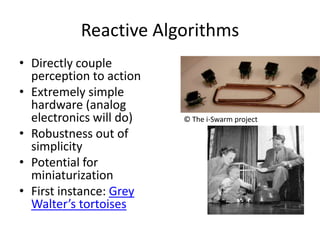
Reactive AlgorithmsDirectly couple perception to actionExtremely simple hardware (analog electronics will do)Robustness out of simplicityPotential for miniaturizationFirst instance: Grey Walter’s tortoises© The i-Swarm project
Concept: Braitenberg VehiclesCouple perception to actionSensor input coupled to actuator outputInspired by brain architecture left/right hemisphereNeural networkCourse question: how do the vehicles behave with respect to a light source?Light SensorMotors
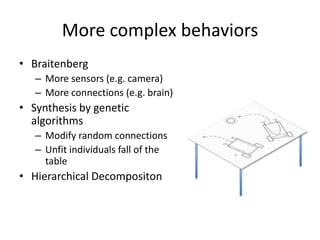
More complex behaviorsBraitenbergMore sensors (e.g. camera)More connections (e.g. brain)Synthesis by genetic algorithmsModify random connectionsUnfit individuals fall of the tableHierarchical Decompositon
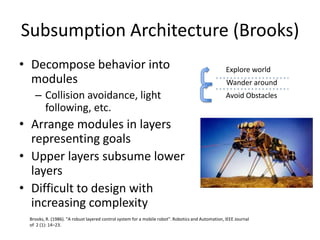
Subsumption Architecture (Brooks)Decompose behavior into modulesCollision avoidance, light following, etc.Arrange modules in layers representing goalsUpper layers subsume lower layersDifficult to design with increasing complexityExplore worldWander aroundAvoid ObstaclesBrooks, R. (1986). "A robust layered control system for a mobile robot". Robotics and Automation, IEEE Journal of  2 (1): 14–23.
Alternative view: Artificial Potential FieldsAka virtual physics, motor schemesGoals are represented by virtual forces (attraction/repulsion) Forces are calculated from sensor inputAddition yields vector field that the robots followObvious problem: local minima and cycles© Craig Reynolds
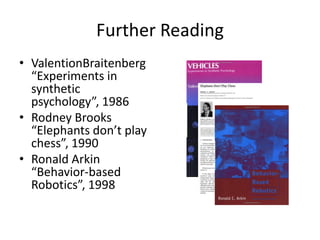
Further ReadingValentionBraitenberg“Experiments in synthetic psychology”, 1986Rodney Brooks“Elephants don’t play chess”, 1990Ronald Arkin“Behavior-based Robotics”, 1998
Example: Jet Turbine InspectionGoal: surround every blade in a turbine with a robotic sensorRobots need to be small, only local communicationAlice(ASL, EPFL), sugar cube, 368bytes of RAM
Robotic PlatformAlice miniature robot [Caprari2005]PIC microcontroller (368 bytes RAM, 8Kb FLASH)Length of 22mmMaximal speed of 4cm/s, stepper motors4 IR modules serve as very crude proximity sensors (3cm) and local communication devices Energetic autonomy 5h-10h
Baseline: Randomized Coverage without LocalizationSearchInspectTranslateAvoid ObstacleWall | RobotObstacle clearSearchInspectTranslatealong bladeptBlade1-ptTt expired
Robot CapabilitiesSensing: infrared distance sensorsComputation: FSM, wall followingActuation: differential wheelsCommunication: none
Analysis (Intuition)Collaboration: implicitCompleteness: probabilistic, asymptoticProbability to leave blade at round or sharp tip affects robot distribution
Experimental Results20, 25, 30 robots
Spatial distribution for pt=0Leaving the blades at a tip generates drift in the environment“Enviromental Template”Probability to inspect some of the blades higher
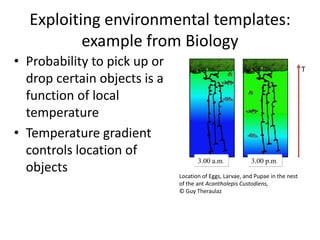
Exploiting environmental templates: example from BiologyProbability to pick up or drop certain objects is a function of local temperatureTemperature gradient controls location of objectsT3.00 a.m.3.00 p.m.Location of Eggs, Larvae, and Pupae in the nest of the ant Acantholepis Custodiens,© Guy Theraulaz
Randomized Coverage with CollaborationTranslateInspectInspectAvoid ObstacleWall | RobotObstacle clearSearchInspectMobileMarkerptBlade1-pt | MarkerTt expired
Robot CapabilitiesSensing: infrared distance sensorsComputation: FSM, wall followingActuation: differential wheelsCommunication: single bit (blade busy or not)
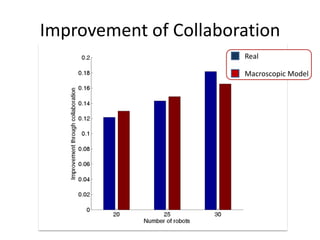
Improvement of CollaborationRealMacroscopic Model
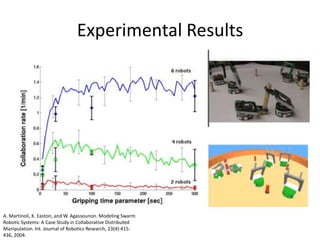
Example 2: Stick-PullingGoal: pull sticks out of the groundTwo robots need to collaborateA. Martinoli, K. Easton, and W. Agassounon. Modeling Swarm Robotic Systems: A Case Study in Collaborative Distributed Manipulation. Int. Journal of Robotics Research, 23(4):415-436, 2004.
Robotic Platform16 MHz Motorola CPUIncremental wheel encoders6 frontal infra-red sensorsPosition feedback in arm (communication!)
Robot CapabilitiesSensing: infrared distance sensors, detect stickComputation: FSM, wall followingActuation: differential wheelsCommunication: explicit, physical via stickCourse question: what happens if time-out is too high?
Analysis (Intuition)Time-out during wait key for performanceLess robots than sticksTime-out too low: collaboration unlikelyTime-out too high: robot depletionMore robots than sticksThe longer the time-out, the betterOptimal value for gripping time when less robots than sticks?
Experimental ResultsA. Martinoli, K. Easton, and W. Agassounon. Modeling Swarm Robotic Systems: A Case Study in Collaborative Distributed Manipulation. Int. Journal of Robotics Research, 23(4):415-436, 2004.
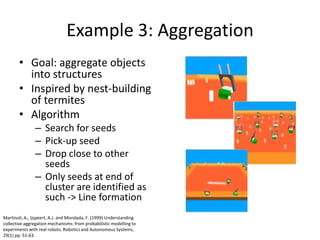
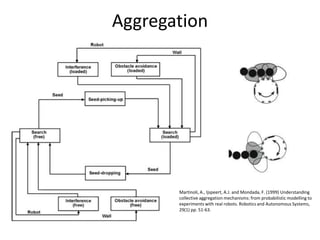
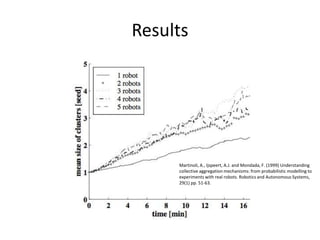
Example 3: AggregationGoal: aggregate objects into structuresInspired by nest-building of termitesAlgorithmSearch for seedsPick-up seedDrop close to other seedsOnly seeds at end of cluster are identified as such -> Line formationMartinoli, A., Ijspeert, A.J. and Mondada, F. (1999) Understanding collective aggregation mechanisms: from probabilistic modelling to experiments with real robots. Robotics and Autonomous Systems, 29(1) pp. 51-63.
AggregationMartinoli, A., Ijspeert, A.J. and Mondada, F. (1999) Understanding collective aggregation mechanisms: from probabilistic modelling to experiments with real robots. Robotics and Autonomous Systems, 29(1) pp. 51-63.
ResultsMartinoli, A., Ijspeert, A.J. and Mondada, F. (1999) Understanding collective aggregation mechanisms: from probabilistic modelling to experiments with real robots. Robotics and Autonomous Systems, 29(1) pp. 51-63.
SummaryReactive control: tight coupling between perception and actuationBehavior is function of controller and environmentCollaboration in reactive swarmsImplicitExplicit: via the environment and local communication
Next SessionsWednesday: More on reactive algorithmsthreshold-based algorithmsmessage propagationFriday: First lab

August 31, Reactive Algorithms I

  • 1.
  • 2.
    So farIntroduction torobotics and multi-robot systemsSimilar algorithms and properties for robot teams, robot swarms and smart materials
  • 3.
  • 4.
    Reactive AlgorithmsDirectly coupleperception to actionExtremely simple hardware (analog electronics will do)Robustness out of simplicityPotential for miniaturizationFirst instance: Grey Walter’s tortoises© The i-Swarm project
  • 5.
    Concept: Braitenberg VehiclesCoupleperception to actionSensor input coupled to actuator outputInspired by brain architecture left/right hemisphereNeural networkCourse question: how do the vehicles behave with respect to a light source?Light SensorMotors
  • 6.
    More complex behaviorsBraitenbergMoresensors (e.g. camera)More connections (e.g. brain)Synthesis by genetic algorithmsModify random connectionsUnfit individuals fall of the tableHierarchical Decompositon
  • 7.
    Subsumption Architecture (Brooks)Decomposebehavior into modulesCollision avoidance, light following, etc.Arrange modules in layers representing goalsUpper layers subsume lower layersDifficult to design with increasing complexityExplore worldWander aroundAvoid ObstaclesBrooks, R. (1986). "A robust layered control system for a mobile robot". Robotics and Automation, IEEE Journal of 2 (1): 14–23.
  • 8.
    Alternative view: ArtificialPotential FieldsAka virtual physics, motor schemesGoals are represented by virtual forces (attraction/repulsion) Forces are calculated from sensor inputAddition yields vector field that the robots followObvious problem: local minima and cycles© Craig Reynolds
  • 9.
    Further ReadingValentionBraitenberg“Experiments insynthetic psychology”, 1986Rodney Brooks“Elephants don’t play chess”, 1990Ronald Arkin“Behavior-based Robotics”, 1998
  • 10.
    Example: Jet TurbineInspectionGoal: surround every blade in a turbine with a robotic sensorRobots need to be small, only local communicationAlice(ASL, EPFL), sugar cube, 368bytes of RAM
  • 11.
    Robotic PlatformAlice miniaturerobot [Caprari2005]PIC microcontroller (368 bytes RAM, 8Kb FLASH)Length of 22mmMaximal speed of 4cm/s, stepper motors4 IR modules serve as very crude proximity sensors (3cm) and local communication devices Energetic autonomy 5h-10h
  • 12.
    Baseline: Randomized Coveragewithout LocalizationSearchInspectTranslateAvoid ObstacleWall | RobotObstacle clearSearchInspectTranslatealong bladeptBlade1-ptTt expired
  • 13.
    Robot CapabilitiesSensing: infrareddistance sensorsComputation: FSM, wall followingActuation: differential wheelsCommunication: none
  • 14.
    Analysis (Intuition)Collaboration: implicitCompleteness:probabilistic, asymptoticProbability to leave blade at round or sharp tip affects robot distribution
  • 15.
  • 16.
    Spatial distribution forpt=0Leaving the blades at a tip generates drift in the environment“Enviromental Template”Probability to inspect some of the blades higher
  • 17.
    Exploiting environmental templates:example from BiologyProbability to pick up or drop certain objects is a function of local temperatureTemperature gradient controls location of objectsT3.00 a.m.3.00 p.m.Location of Eggs, Larvae, and Pupae in the nest of the ant Acantholepis Custodiens,© Guy Theraulaz
  • 18.
    Randomized Coverage withCollaborationTranslateInspectInspectAvoid ObstacleWall | RobotObstacle clearSearchInspectMobileMarkerptBlade1-pt | MarkerTt expired
  • 19.
    Robot CapabilitiesSensing: infrareddistance sensorsComputation: FSM, wall followingActuation: differential wheelsCommunication: single bit (blade busy or not)
  • 21.
  • 22.
    Example 2: Stick-PullingGoal:pull sticks out of the groundTwo robots need to collaborateA. Martinoli, K. Easton, and W. Agassounon. Modeling Swarm Robotic Systems: A Case Study in Collaborative Distributed Manipulation. Int. Journal of Robotics Research, 23(4):415-436, 2004.
  • 23.
    Robotic Platform16 MHzMotorola CPUIncremental wheel encoders6 frontal infra-red sensorsPosition feedback in arm (communication!)
  • 24.
    Robot CapabilitiesSensing: infrareddistance sensors, detect stickComputation: FSM, wall followingActuation: differential wheelsCommunication: explicit, physical via stickCourse question: what happens if time-out is too high?
  • 25.
    Analysis (Intuition)Time-out duringwait key for performanceLess robots than sticksTime-out too low: collaboration unlikelyTime-out too high: robot depletionMore robots than sticksThe longer the time-out, the betterOptimal value for gripping time when less robots than sticks?
  • 26.
    Experimental ResultsA. Martinoli,K. Easton, and W. Agassounon. Modeling Swarm Robotic Systems: A Case Study in Collaborative Distributed Manipulation. Int. Journal of Robotics Research, 23(4):415-436, 2004.
  • 27.
    Example 3: AggregationGoal:aggregate objects into structuresInspired by nest-building of termitesAlgorithmSearch for seedsPick-up seedDrop close to other seedsOnly seeds at end of cluster are identified as such -> Line formationMartinoli, A., Ijspeert, A.J. and Mondada, F. (1999) Understanding collective aggregation mechanisms: from probabilistic modelling to experiments with real robots. Robotics and Autonomous Systems, 29(1) pp. 51-63.
  • 28.
    AggregationMartinoli, A., Ijspeert,A.J. and Mondada, F. (1999) Understanding collective aggregation mechanisms: from probabilistic modelling to experiments with real robots. Robotics and Autonomous Systems, 29(1) pp. 51-63.
  • 29.
    ResultsMartinoli, A., Ijspeert,A.J. and Mondada, F. (1999) Understanding collective aggregation mechanisms: from probabilistic modelling to experiments with real robots. Robotics and Autonomous Systems, 29(1) pp. 51-63.
  • 30.
    SummaryReactive control: tightcoupling between perception and actuationBehavior is function of controller and environmentCollaboration in reactive swarmsImplicitExplicit: via the environment and local communication
  • 31.
    Next SessionsWednesday: Moreon reactive algorithmsthreshold-based algorithmsmessage propagationFriday: First lab