Thermistor
Department of Chemical Engineering
Submitted by:-
Krishna Kant Nayak
Student MNIT Jaipur
Index
1. Introduction
2. Construction
3. Working
4. Types
5. Advantages
6. Disadvantages
7. Applications
8. References
THERMISTOR
 A temperature sensing element which measures temperature according
to change in resistance.
 It is usually made of a sintered semiconductor material.
 They can or cannot be self heated.
 They use ceramic or polymer materials while RTDs use pure metals.
 They are available in various shapes like disc, rod, washer, etc.
CONSTRUCTION
WORKING
 1/T=A+B*ln(R)+C∗(ln(R))
𝟑
 ∆𝑹 = 𝒌∆𝑻
 𝑹 𝟏 = 𝑹 𝟐 𝒆𝒙𝒑
𝜷
𝟏
𝑻 𝟏
−
𝟏
𝑻 𝟐
TYPES
 Positive Temperature Coefficient
Thermistor
 Negative Temperature
Coefficient Thermistor
ADVANTAGES
 Low cost.
 Sensitivity is high.
 Small in size.
 Good stability.
 High output signal.
 Easy to transport.
DISADVANTAGES
 Non-linear output is seen.
 Not suitable for high temperature measurement.
 Requires external power supply.
 Shielded cables should be used to minimize interference.
 Self-heating.
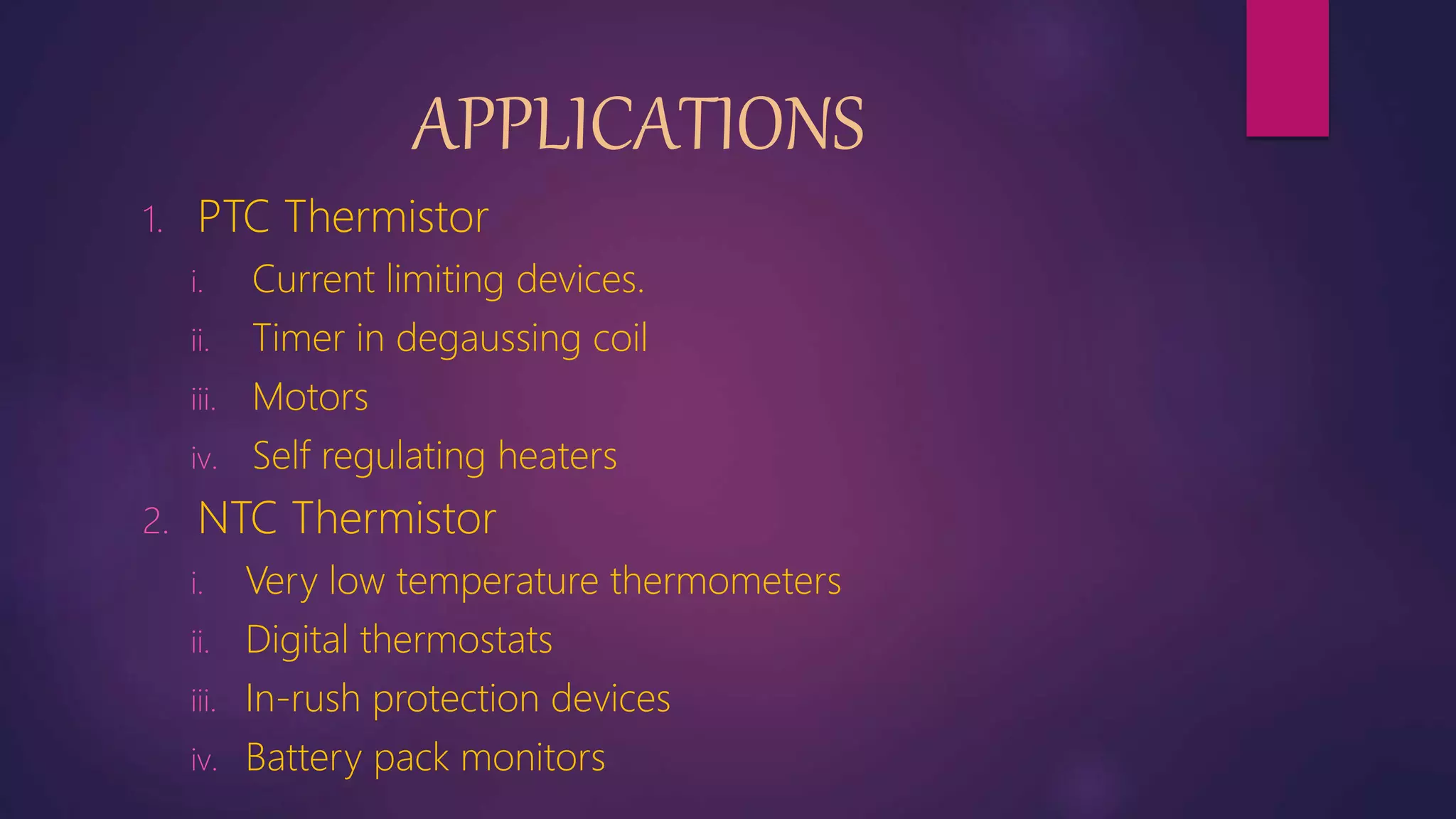
APPLICATIONS
1. PTC Thermistor
i. Current limiting devices.
ii. Timer in degaussing coil
iii. Motors
iv. Self regulating heaters
2. NTC Thermistor
i. Very low temperature thermometers
ii. Digital thermostats
iii. In-rush protection devices
iv. Battery pack monitors
REFERENCES
 https://www.teamwavelength.com/info/thermistors.php
 https://en.wikipedia.org/wiki/Thermistor
 http://www.resistorguide.com/thermistor/
 http://www.electronicshub.org/thermistors-types-and-
applications/
 https://www.elprocus.com/introduction-to-thermistor-
types-with-its-workings-and-applications/
Thermistor

Thermistor