Presentation Prepared by :
 Kunj Thummar (140050119517)
This type of instruments use primary sensing
element as some elastic material like
bourdon tube, diaphragm, bellows,
capsule,etc.
It senses pressure and converts it into
proportional mechanical signal.
What is a elastic pressure
measurement instrument ?
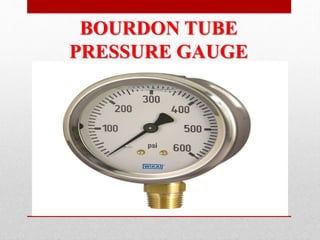
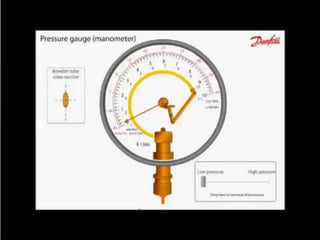
BOURDON TUBE
PRESSURE GAUGE
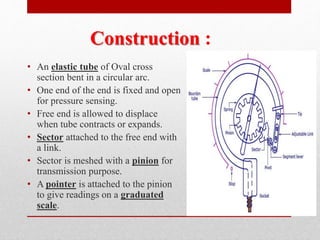
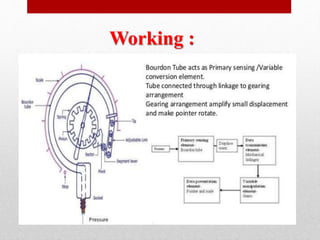
Construction :
• An elastic tube of Oval cross
section bent in a circular arc.
• One end of the end is fixed and open
for pressure sensing.
• Free end is allowed to displace
when tube contracts or expands.
• Sector attached to the free end with
a link.
• Sector is meshed with a pinion for
transmission purpose.
• A pointer is attached to the pinion
to give readings on a graduated
scale.
Working :
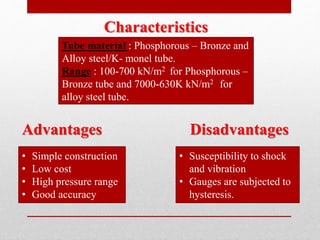
Characteristics
Tube material : Phosphorous – Bronze and
Alloy steel/K- monel tube.
Range : 100-700 kN/m2 for Phosphorous –
Bronze tube and 7000-630K kN/m2 for
alloy steel tube.
Advantages Disadvantages
• Simple construction
• Low cost
• High pressure range
• Good accuracy
• Susceptibility to shock
and vibration
• Gauges are subjected to
hysteresis.
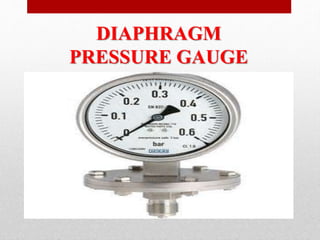
DIAPHRAGM
PRESSURE GAUGE
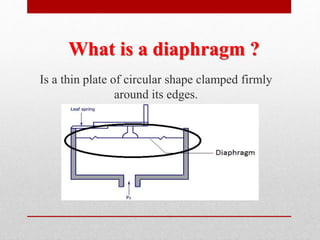
What is a diaphragm ?
Is a thin plate of circular shape clamped firmly
around its edges.
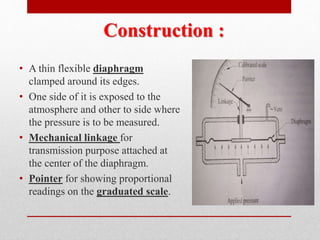
Construction :
• A thin flexible diaphragm
clamped around its edges.
• One side of it is exposed to the
atmosphere and other to side where
the pressure is to be measured.
• Mechanical linkage for
transmission purpose attached at
the center of the diaphragm.
• Pointer for showing proportional
readings on the graduated scale.
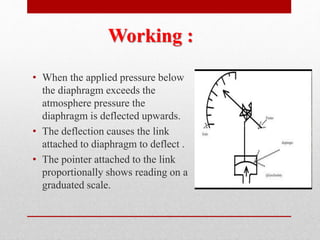
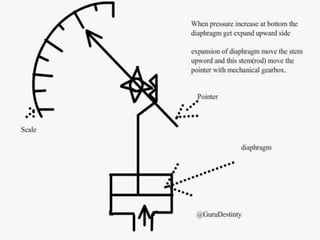
Working :
• When the applied pressure below
the diaphragm exceeds the
atmosphere pressure the
diaphragm is deflected upwards.
• The deflection causes the link
attached to diaphragm to deflect .
• The pointer attached to the link
proportionally shows reading on a
graduated scale.
• small size and
moderate cost.
• Corrosion
resistant
materials can be
used.
• Good linearity.
• Can withstand
high over
pressure.
Advantages Disadvantages
• It is limited to
relatively low
pressure.
• Repairing work is
difficult.
• Lack of vibration
and shock
resistance.
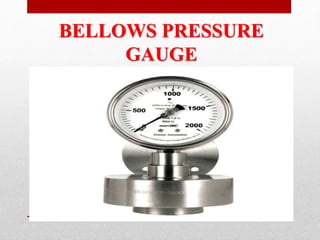
BELLOWS PRESSURE
GAUGE
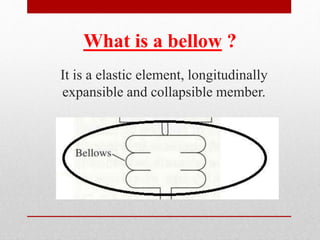
It is a elastic element, longitudinally
expansible and collapsible member.
What is a bellow ?
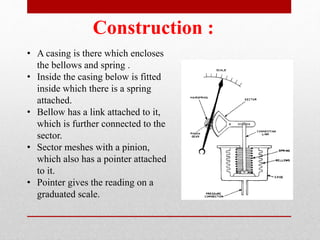
Construction :
• A casing is there which encloses
the bellows and spring .
• Inside the casing below is fitted
inside which there is a spring
attached.
• Bellow has a link attached to it,
which is further connected to the
sector.
• Sector meshes with a pinion,
which also has a pointer attached
to it.
• Pointer gives the reading on a
graduated scale.
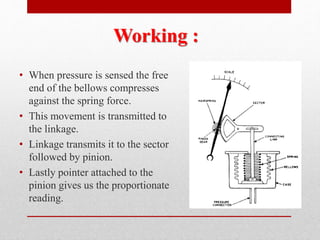
Working :
• When pressure is sensed the free
end of the bellows compresses
against the spring force.
• This movement is transmitted to
the linkage.
• Linkage transmits it to the sector
followed by pinion.
• Lastly pointer attached to the
pinion gives us the proportionate
reading.
Advantages
• Simple and
rugged
construction .
• It can measure
gauge, absolute
and vacuum
pressure.
• Moderate cost.
• Good in the low
to moderate
pressure range.
Disadvantages
• Not suitable for
high pressure.
• Requires
compensation
for ambient
high pressures.
• Not suitable for
dynamic
measurement .
BIBLIOGRAPHY
• Text material from Fluid Mechanics by J.P. Hadiya and
H.G. Katariya (Books India Publications)
• Images from Google and Bing.
• Videos from www.youtube.com.
ELASTIC PRESSURE MEASUREMENT DEVICES

ELASTIC PRESSURE MEASUREMENT DEVICES

  • 1.
    Presentation Prepared by:  Kunj Thummar (140050119517)
  • 2.
    This type ofinstruments use primary sensing element as some elastic material like bourdon tube, diaphragm, bellows, capsule,etc. It senses pressure and converts it into proportional mechanical signal. What is a elastic pressure measurement instrument ?
  • 3.
  • 4.
    Construction : • Anelastic tube of Oval cross section bent in a circular arc. • One end of the end is fixed and open for pressure sensing. • Free end is allowed to displace when tube contracts or expands. • Sector attached to the free end with a link. • Sector is meshed with a pinion for transmission purpose. • A pointer is attached to the pinion to give readings on a graduated scale.
  • 5.
  • 7.
    Characteristics Tube material :Phosphorous – Bronze and Alloy steel/K- monel tube. Range : 100-700 kN/m2 for Phosphorous – Bronze tube and 7000-630K kN/m2 for alloy steel tube. Advantages Disadvantages • Simple construction • Low cost • High pressure range • Good accuracy • Susceptibility to shock and vibration • Gauges are subjected to hysteresis.
  • 8.
  • 9.
    What is adiaphragm ? Is a thin plate of circular shape clamped firmly around its edges.
  • 10.
    Construction : • Athin flexible diaphragm clamped around its edges. • One side of it is exposed to the atmosphere and other to side where the pressure is to be measured. • Mechanical linkage for transmission purpose attached at the center of the diaphragm. • Pointer for showing proportional readings on the graduated scale.
  • 11.
    Working : • Whenthe applied pressure below the diaphragm exceeds the atmosphere pressure the diaphragm is deflected upwards. • The deflection causes the link attached to diaphragm to deflect . • The pointer attached to the link proportionally shows reading on a graduated scale.
  • 13.
    • small sizeand moderate cost. • Corrosion resistant materials can be used. • Good linearity. • Can withstand high over pressure. Advantages Disadvantages • It is limited to relatively low pressure. • Repairing work is difficult. • Lack of vibration and shock resistance.
  • 14.
  • 15.
    It is aelastic element, longitudinally expansible and collapsible member. What is a bellow ?
  • 16.
    Construction : • Acasing is there which encloses the bellows and spring . • Inside the casing below is fitted inside which there is a spring attached. • Bellow has a link attached to it, which is further connected to the sector. • Sector meshes with a pinion, which also has a pointer attached to it. • Pointer gives the reading on a graduated scale.
  • 17.
    Working : • Whenpressure is sensed the free end of the bellows compresses against the spring force. • This movement is transmitted to the linkage. • Linkage transmits it to the sector followed by pinion. • Lastly pointer attached to the pinion gives us the proportionate reading.
  • 19.
    Advantages • Simple and rugged construction. • It can measure gauge, absolute and vacuum pressure. • Moderate cost. • Good in the low to moderate pressure range. Disadvantages • Not suitable for high pressure. • Requires compensation for ambient high pressures. • Not suitable for dynamic measurement .
  • 20.
    BIBLIOGRAPHY • Text materialfrom Fluid Mechanics by J.P. Hadiya and H.G. Katariya (Books India Publications) • Images from Google and Bing. • Videos from www.youtube.com.