 Construction of PMMC Instruments
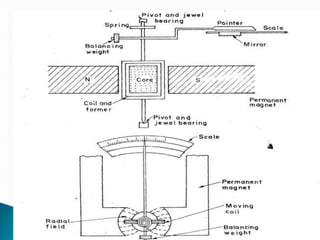
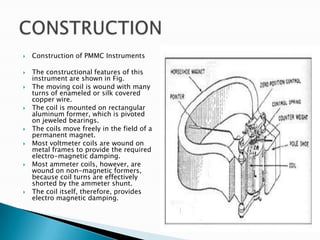
 The constructional features of this
instrument are shown in Fig.
 The moving coil is wound with many
turns of enameled or silk covered
copper wire.
 The coil is mounted on rectangular
aluminum former, which is pivoted
on jeweled bearings.
 The coils move freely in the field of a
permanent magnet.
 Most voltmeter coils are wound on
metal frames to provide the required
electro-magnetic damping.
 Most ammeter coils, however, are
wound on non-magnetic formers,
because coil turns are effectively
shorted by the ammeter shunt.
 The coil itself, therefore, provides
electro magnetic damping.
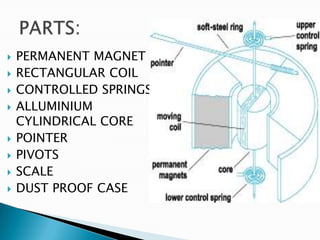
 PERMANENT MAGNET
 RECTANGULAR COIL
 CONTROLLED SPRINGS
 ALLUMINIUM
CYLINDRICAL CORE
 POINTER
 PIVOTS
 SCALE
 DUST PROOF CASE
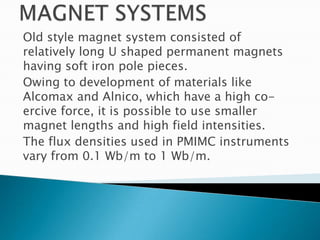
Old style magnet system consisted of
relatively long U shaped permanent magnets
having soft iron pole pieces.
Owing to development of materials like
Alcomax and Alnico, which have a high co-
ercive force, it is possible to use smaller
magnet lengths and high field intensities.
The flux densities used in PMIMC instruments
vary from 0.1 Wb/m to 1 Wb/m.
When the coil is supported between two jewel
bearings two phosphor bronze hairsprings
provide the control torque.
These springs also serve to lead current in
and out of the coil. The control torque is
provided by the ribbon suspension as shown.
This method is comparatively new and is
claimed to be advantageous as it eliminates
bearing friction.
 RECTANGULAR IN SHAPE
WOUND ON ALUMINIUM
FORMER WITH LARGE
NO.OF TURNS.
 WIDTH OF RECTANGLE
IS LESS THAN DISTANCE
b/w POLES OF PM WITH
AN AIR GAP.
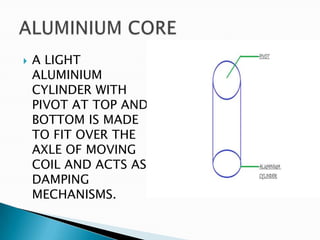
 A LIGHT
ALUMINIUM
CYLINDER WITH
PIVOT AT TOP AND
BOTTOM IS MADE
TO FIT OVER THE
AXLE OF MOVING
COIL AND ACTS AS
DAMPING
MECHANISMS.
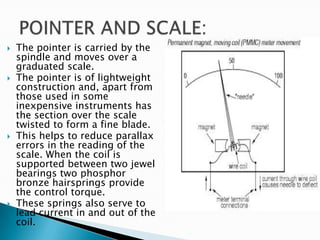
 The pointer is carried by the
spindle and moves over a
graduated scale.
 The pointer is of lightweight
construction and, apart from
those used in some
inexpensive instruments has
the section over the scale
twisted to form a fine blade.
 This helps to reduce parallax
errors in the reading of the
scale. When the coil is
supported between two jewel
bearings two phosphor
bronze hairsprings provide
the control torque.
 These springs also serve to
lead current in and out of the
coil.
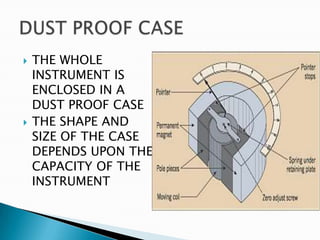
 THE WHOLE
INSTRUMENT IS
ENCLOSED IN A
DUST PROOF CASE
 THE SHAPE AND
SIZE OF THE CASE
DEPENDS UPON THE
CAPACITY OF THE
INSTRUMENT
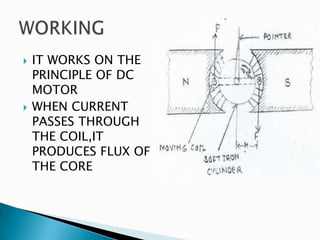
 IT WORKS ON THE
PRINCIPLE OF DC
MOTOR
 WHEN CURRENT
PASSES THROUGH
THE COIL,IT
PRODUCES FLUX OF
THE CORE
 THE FLUX DENSITY AT ONE SIDE INCREASES
WHILE OTHER SIDE DECREASES
 THIS IMBALANCE EXERTS A FORCE ON THE
CONDUCTOR IN THE DIRECTION OF LEAST
FLUX DENSITY
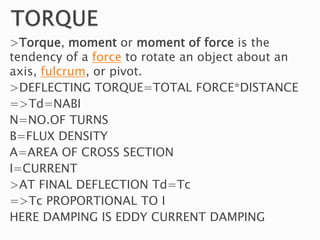
>Torque, moment or moment of force is the
tendency of a force to rotate an object about an
axis, fulcrum, or pivot.
>DEFLECTING TORQUE=TOTAL FORCE*DISTANCE
=>Td=NABI
N=NO.OF TURNS
B=FLUX DENSITY
A=AREA OF CROSS SECTION
I=CURRENT
>AT FINAL DEFLECTION Td=Tc
=>Tc PROPORTIONAL TO I
HERE DAMPING IS EDDY CURRENT DAMPING
 - The PMMC consumes less power and has
great accuracy.
 - It has uniformly divided scale and can
cover arc of 270 degree.
 - The PMMC has a high torque to weight
ratio.
 - It can be modified as ammeter or voltmeter
with suitable resistance.
 - It has efficient damping characteristics and
is not affected by stray magnetic field.
 - It produces no losses due to hysteresis.
 -The moving coil instrument can only be
used on D.C supply as the reversal of current
produces reversal of torque on the coil.
 - It’s very delicate and sometimes uses ac
circuit with a rectifier.
 - It’s costly as compared to moving coil iron
instruments.
 - It may show error due to loss of
magnetism of permanent magnet.
 You may also read Minimize the risk of
electrical shock on ship.

The basic sources of error in PMMC
instruments are friction, temperature and
aging of various parts. To reduce the
frictional errors ratio of torque to weight is
made very high.
The most serious errors are produced by the
heat generated or by changes in the
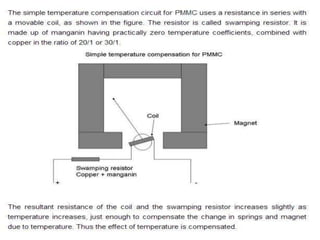
temperature. This changes the resistance of
the working coil, causing large errors. In case
of voltmeters, a large series resistance of
very low temperature coefficient is used. This
reduces the temperature errors.
 The aging of permanent magnet and control
springs also cause errors. Opposite errors in
PMMC is caused by weakening of magnet and
spring cause. The weakening of magnet
causes less deflection while weakening of
control springs cause large deflection, for a
particular value of current. The proper use of
material and pre-ageing during
manufacturing can reduce the errors due to
weakening of control springs.
Pmmc instrument
Pmmc instrument

Pmmc instrument

  • 3.
     Construction ofPMMC Instruments  The constructional features of this instrument are shown in Fig.  The moving coil is wound with many turns of enameled or silk covered copper wire.  The coil is mounted on rectangular aluminum former, which is pivoted on jeweled bearings.  The coils move freely in the field of a permanent magnet.  Most voltmeter coils are wound on metal frames to provide the required electro-magnetic damping.  Most ammeter coils, however, are wound on non-magnetic formers, because coil turns are effectively shorted by the ammeter shunt.  The coil itself, therefore, provides electro magnetic damping.
  • 4.
     PERMANENT MAGNET RECTANGULAR COIL  CONTROLLED SPRINGS  ALLUMINIUM CYLINDRICAL CORE  POINTER  PIVOTS  SCALE  DUST PROOF CASE
  • 5.
    Old style magnetsystem consisted of relatively long U shaped permanent magnets having soft iron pole pieces. Owing to development of materials like Alcomax and Alnico, which have a high co- ercive force, it is possible to use smaller magnet lengths and high field intensities. The flux densities used in PMIMC instruments vary from 0.1 Wb/m to 1 Wb/m.
  • 6.
    When the coilis supported between two jewel bearings two phosphor bronze hairsprings provide the control torque. These springs also serve to lead current in and out of the coil. The control torque is provided by the ribbon suspension as shown. This method is comparatively new and is claimed to be advantageous as it eliminates bearing friction.
  • 7.
     RECTANGULAR INSHAPE WOUND ON ALUMINIUM FORMER WITH LARGE NO.OF TURNS.  WIDTH OF RECTANGLE IS LESS THAN DISTANCE b/w POLES OF PM WITH AN AIR GAP.
  • 8.
     A LIGHT ALUMINIUM CYLINDERWITH PIVOT AT TOP AND BOTTOM IS MADE TO FIT OVER THE AXLE OF MOVING COIL AND ACTS AS DAMPING MECHANISMS.
  • 9.
     The pointeris carried by the spindle and moves over a graduated scale.  The pointer is of lightweight construction and, apart from those used in some inexpensive instruments has the section over the scale twisted to form a fine blade.  This helps to reduce parallax errors in the reading of the scale. When the coil is supported between two jewel bearings two phosphor bronze hairsprings provide the control torque.  These springs also serve to lead current in and out of the coil.
  • 10.
     THE WHOLE INSTRUMENTIS ENCLOSED IN A DUST PROOF CASE  THE SHAPE AND SIZE OF THE CASE DEPENDS UPON THE CAPACITY OF THE INSTRUMENT
  • 11.
     IT WORKSON THE PRINCIPLE OF DC MOTOR  WHEN CURRENT PASSES THROUGH THE COIL,IT PRODUCES FLUX OF THE CORE
  • 12.
     THE FLUXDENSITY AT ONE SIDE INCREASES WHILE OTHER SIDE DECREASES  THIS IMBALANCE EXERTS A FORCE ON THE CONDUCTOR IN THE DIRECTION OF LEAST FLUX DENSITY
  • 13.
    >Torque, moment ormoment of force is the tendency of a force to rotate an object about an axis, fulcrum, or pivot. >DEFLECTING TORQUE=TOTAL FORCE*DISTANCE =>Td=NABI N=NO.OF TURNS B=FLUX DENSITY A=AREA OF CROSS SECTION I=CURRENT >AT FINAL DEFLECTION Td=Tc =>Tc PROPORTIONAL TO I HERE DAMPING IS EDDY CURRENT DAMPING
  • 14.
     - ThePMMC consumes less power and has great accuracy.  - It has uniformly divided scale and can cover arc of 270 degree.  - The PMMC has a high torque to weight ratio.  - It can be modified as ammeter or voltmeter with suitable resistance.  - It has efficient damping characteristics and is not affected by stray magnetic field.  - It produces no losses due to hysteresis.
  • 15.
     -The movingcoil instrument can only be used on D.C supply as the reversal of current produces reversal of torque on the coil.  - It’s very delicate and sometimes uses ac circuit with a rectifier.  - It’s costly as compared to moving coil iron instruments.  - It may show error due to loss of magnetism of permanent magnet.  You may also read Minimize the risk of electrical shock on ship.
  • 16.
     The basic sourcesof error in PMMC instruments are friction, temperature and aging of various parts. To reduce the frictional errors ratio of torque to weight is made very high. The most serious errors are produced by the heat generated or by changes in the temperature. This changes the resistance of the working coil, causing large errors. In case of voltmeters, a large series resistance of very low temperature coefficient is used. This reduces the temperature errors.
  • 17.
     The agingof permanent magnet and control springs also cause errors. Opposite errors in PMMC is caused by weakening of magnet and spring cause. The weakening of magnet causes less deflection while weakening of control springs cause large deflection, for a particular value of current. The proper use of material and pre-ageing during manufacturing can reduce the errors due to weakening of control springs.