Presented By:
PRAVEEN KUMAR
APP. No : TEQIP016971
M.TECH (PEED)
IIT(ISM) DHANBAD
 Introduction of D.C. Machine
 Some important terms related to speed control
 EMF equation of D.C. Machine
 Methods of Speed control
 D.C. Machine :
1. It is a highly versatile energy conversion device.
2. It can meet the demands of high starting torques, high
accelerating & decelerating torques.
3. It is easily adaptable for drives requiring wide range speed
control & quick reversals.
 D.C. Motor :
It converts electrical energy into mechanical energy based on the
principle that when a current carrying conductor is placed in a Magnetic
field, it experiences a force whose direction is given by Fleming left
hand rule.
 Base Speed:
The speed at which a motor runs at rated armature voltage and rated field current. It is
rated speed or nameplate speed of the motor.
 Speed Regulation:
It is ratio of speed change from no load to full load to the rated speed.
 Speed range:
It is the ratio of maximum allowable speed to the minimum allowable speed of the
motor. It is always specified with type of load i.e. at full load, no load or a fraction of
full load.
 Constant Power Drives:
If the motor shaft power remains constant over a given speed range, the system is called
a constant power drive.
 Constant Torque Drives:
If the motor shaft torque remains constant over a given speed range, the system is called
a constant torque drive.
 The term ‘speed control’ stands for intentional speed variation of the drive to a value required
for performing the specific work ,which is carried out manually or automatically.
 D.C. Motors are most suitable for wide range speed control and are therefore, indispensable for
many adjustable speed drives.
 According to Faraday’s law of electromagnetic induction, the rotating action of the conductor
produces an EMF. This EMF, according to Lenz’ law, tends to oppose the cause, i.e., the
supplied voltage. This is known as back EMF or counter EMF whose equation is given as:
𝐸 =
ⱷ 𝑍𝑁𝑃
60𝐴
Where, ⱷ = flux per pole in weber
Z = Total number of armature conductor
N =Rotor speed in rpm
P =Numbers of poles
A =Number of parallel path
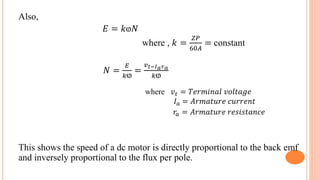
Also,
𝐸 = 𝑘ⱷ𝑁
where , 𝑘 =
𝑍𝑃
60𝐴
= constant
𝑁 =
𝐸
𝑘ⱷ
=
𝑣 𝑡−𝐼 𝑎 𝑟 𝑎
𝑘ⱷ
where 𝑣 𝑡 = 𝑇𝑒𝑟𝑚𝑖𝑛𝑎𝑙 𝑣𝑜𝑙𝑡𝑎𝑔𝑒
𝐼 𝑎 = 𝐴𝑟𝑚𝑎𝑡𝑢𝑟𝑒 𝑐𝑢𝑟𝑟𝑒𝑛𝑡
𝑟𝑎 = 𝐴𝑟𝑚𝑎𝑡𝑢𝑟𝑒 𝑟𝑒𝑠𝑖𝑠𝑡𝑎𝑛𝑐𝑒
This shows the speed of a dc motor is directly proportional to the back emf
and inversely proportional to the flux per pole.
Following from the above equation ,there are basically three
methods of speed control
1. Variation of resistance in the armature circuit (Armature Resistance
control)
2. Variation of field flux (Field flux control)
3. Variation of applied voltage (Armature Voltage control)
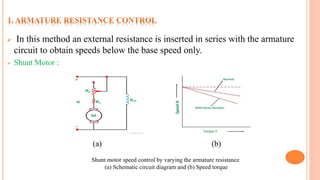
 In this method an external resistance is inserted in series with the armature
circuit to obtain speeds below the base speed only.
 Shunt Motor :
(a) (b)
Shunt motor speed control by varying the armature resistance
(a) Schematic circuit diagram and (b) Speed torque
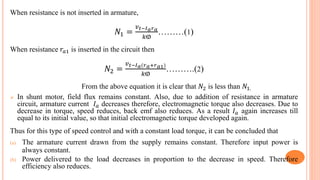
When resistance is not inserted in armature,
𝑁1 =
𝑣 𝑡−𝐼 𝑎 𝑟 𝑎
𝑘ⱷ
………(1)
When resistance 𝑟𝑎1 is inserted in the circuit then
𝑁2 =
𝑣 𝑡−𝐼 𝑎(𝑟 𝑎+𝑟 𝑎1)
𝑘ⱷ
……….(2)
From the above equation it is clear that 𝑁2 is less than 𝑁1.
 In shunt motor, field flux remains constant. Also, due to addition of resistance in armature
circuit, armature current 𝐼 𝑎 decreases therefore, electromagnetic torque also decreases. Due to
decrease in torque, speed reduces, back emf also reduces. As a result 𝐼 𝑎 again increases till
equal to its initial value, so that initial electromagnetic torque developed again.
Thus for this type of speed control and with a constant load torque, it can be concluded that
(a) The armature current drawn from the supply remains constant. Therefore input power is
always constant.
(b) Power delivered to the load decreases in proportion to the decrease in speed. Therefore
efficiency also reduces.
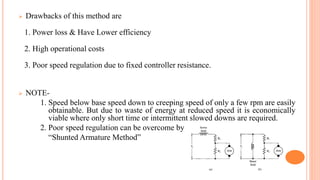
 Drawbacks of this method are
1. Power loss & Have Lower efficiency
2. High operational costs
3. Poor speed regulation due to fixed controller resistance.
 NOTE-
1. Speed below base speed down to creeping speed of only a few rpm are easily
obtainable. But due to waste of energy at reduced speed it is economically
viable where only short time or intermittent slowed downs are required.
2. Poor speed regulation can be overcome by
“Shunted Armature Method”
 Series Motor:
(a) (b)
 For the wide range of speed ,this method is usually carried out. Similar is the case as earlier
discussed in shunt motor, it has the speed below base speed.
Applications: Series motor driving Cranes, Hoists, Trains etc.
NOTE: In both the motors, field flux remains constant where armature current is maintained
equal to its rated value. So Armature circuit resistance method is usually referred to as a
Constant Torque[𝑘ⱷ𝐼 𝑎] drive method.
Series motor speed control by varying the armature resistance
(a) Schematic circuit diagram and (b) Speed torque
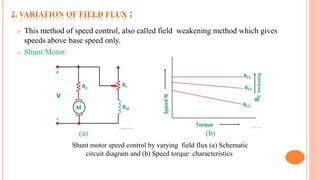
 This method of speed control, also called field weakening method which gives
speeds above base speed only.
 Shunt Motor:
(a) (b)
PV Array
Shunt motor speed control by varying field flux (a) Schematic
circuit diagram and (b) Speed torque characteristics
As we know that, 𝑁 =
𝑣 𝑡−𝐼 𝑎 𝑟 𝑎
𝑘ⱷ
where speed is inversely proportional to field
flux. So, if we are increasing the field resistance, field current reduces, field flux
reduces and finally speed increases.
 Series Motor:
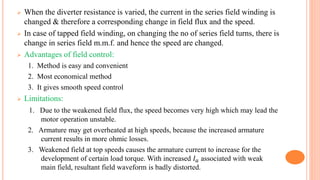
The field flux and therefore the speed of a series motor can be varied :
1. By Placing a resistor, called a diverter in parallel with the series winding
2. By Tapping the series field winding
3. By Changing the field coil connection from series to parallel
(a) (b)
Series motor speed control (a)by a diverter (b) by tapped field
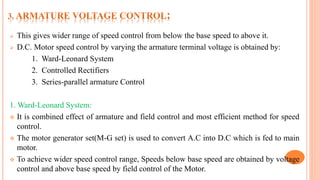
 When the diverter resistance is varied, the current in the series field winding is
changed & therefore a corresponding change in field flux and the speed.
 In case of tapped field winding, on changing the no of series field turns, there is
change in series field m.m.f. and hence the speed are changed.
 Advantages of field control:
1. Method is easy and convenient
2. Most economical method
3. It gives smooth speed control
 Limitations:
1. Due to the weakened field flux, the speed becomes very high which may lead the
motor operation unstable.
2. Armature may get overheated at high speeds, because the increased armature
current results in more ohmic losses.
3. Weakened field at top speeds causes the armature current to increase for the
development of certain load torque. With increased 𝐼 𝑎 associated with weak
main field, resultant field waveform is badly distorted.
 This gives wider range of speed control from below the base speed to above it.
 D.C. Motor speed control by varying the armature terminal voltage is obtained by:
1. Ward-Leonard System
2. Controlled Rectifiers
3. Series-parallel armature Control
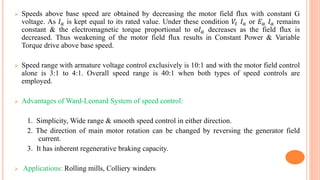
1. Ward-Leonard System:
 It is combined effect of armature and field control and most efficient method for speed
control.
 The motor generator set(M-G set) is used to convert A.C into D.C which is fed to main
motor.
 To achieve wider speed control range, Speeds below base speed are obtained by voltage
control and above base speed by field control of the Motor.
(a) Schematic diagram of Ward-Leonard
system of speed control
(b) Torque-speed and Power-speed
characteristics of Ward-Leonard system
 Speeds from the lowest possible speed up to base speed are obtained by G output
voltage, with constant motor field flux. Since the speed control is carried out with
rated current 𝐼 𝑎 & with constant motor field flux ⱷ, A constant torque[𝑘ⱷ𝐼 𝑎] and
variation of Power[𝑇𝑁] to the speed is obtained. Thus Constant Torque & Variable
Power drive is obtained up to base speed.
 Speeds above base speed are obtained by decreasing the motor field flux with constant G
voltage. As 𝐼 𝑎 is kept equal to its rated value. Under these condition 𝑉𝑡 𝐼 𝑎 or 𝐸 𝑎 𝐼 𝑎 remains
constant & the electromagnetic torque proportional to ⱷ𝐼 𝑎 decreases as the field flux is
decreased. Thus weakening of the motor field flux results in Constant Power & Variable
Torque drive above base speed.
 Speed range with armature voltage control exclusively is 10:1 and with the motor field control
alone is 3:1 to 4:1. Overall speed range is 40:1 when both types of speed controls are
employed.
 Advantages of Ward-Leonard System of speed control:
1. Simplicity, Wide range & smooth speed control in either direction.
2. The direction of main motor rotation can be changed by reversing the generator field
current.
3. It has inherent regenerative braking capacity.
 Applications: Rolling mills, Colliery winders
 Limitations:
1. High initial cost due to presence of induction motor and dc generator (M-G set).
2. Larger size and weight
3. Frequent maintenance
4. Lower efficiency & Noisy
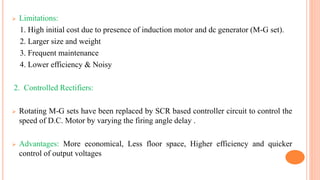
2. Controlled Rectifiers:
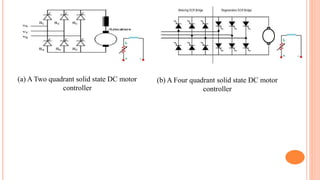
 Rotating M-G sets have been replaced by SCR based controller circuit to control the
speed of D.C. Motor by varying the firing angle delay .
 Advantages: More economical, Less floor space, Higher efficiency and quicker
control of output voltages
(a) A Two quadrant solid state DC motor
controller
(b) A Four quadrant solid state DC motor
controller
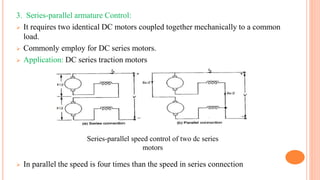
3. Series-parallel armature Control:
 It requires two identical DC motors coupled together mechanically to a common
load.
 Commonly employ for DC series motors.
 Application: DC series traction motors
 In parallel the speed is four times than the speed in series connection
Series-parallel speed control of two dc series
motors
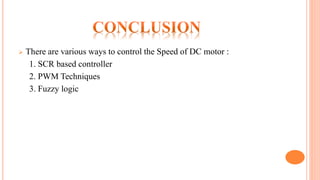
 There are various ways to control the Speed of DC motor :
1. SCR based controller
2. PWM Techniques
3. Fuzzy logic
 [1]. Electrical Machinery By Dr. P.S. Bimbhra
 [2]. Electrical Machines By Ashfaq Husain
 [3] Electric Machinery Fundamentals By Stephen J. Chapman
Speed Control Of DC Motor

Speed Control Of DC Motor

  • 1.
    Presented By: PRAVEEN KUMAR APP.No : TEQIP016971 M.TECH (PEED) IIT(ISM) DHANBAD
  • 2.
     Introduction ofD.C. Machine  Some important terms related to speed control  EMF equation of D.C. Machine  Methods of Speed control
  • 3.
     D.C. Machine: 1. It is a highly versatile energy conversion device. 2. It can meet the demands of high starting torques, high accelerating & decelerating torques. 3. It is easily adaptable for drives requiring wide range speed control & quick reversals.  D.C. Motor : It converts electrical energy into mechanical energy based on the principle that when a current carrying conductor is placed in a Magnetic field, it experiences a force whose direction is given by Fleming left hand rule.
  • 4.
     Base Speed: Thespeed at which a motor runs at rated armature voltage and rated field current. It is rated speed or nameplate speed of the motor.  Speed Regulation: It is ratio of speed change from no load to full load to the rated speed.  Speed range: It is the ratio of maximum allowable speed to the minimum allowable speed of the motor. It is always specified with type of load i.e. at full load, no load or a fraction of full load.  Constant Power Drives: If the motor shaft power remains constant over a given speed range, the system is called a constant power drive.  Constant Torque Drives: If the motor shaft torque remains constant over a given speed range, the system is called a constant torque drive.
  • 5.
     The term‘speed control’ stands for intentional speed variation of the drive to a value required for performing the specific work ,which is carried out manually or automatically.  D.C. Motors are most suitable for wide range speed control and are therefore, indispensable for many adjustable speed drives.  According to Faraday’s law of electromagnetic induction, the rotating action of the conductor produces an EMF. This EMF, according to Lenz’ law, tends to oppose the cause, i.e., the supplied voltage. This is known as back EMF or counter EMF whose equation is given as: 𝐸 = ⱷ 𝑍𝑁𝑃 60𝐴 Where, ⱷ = flux per pole in weber Z = Total number of armature conductor N =Rotor speed in rpm P =Numbers of poles A =Number of parallel path
  • 6.
    Also, 𝐸 = 𝑘ⱷ𝑁 where, 𝑘 = 𝑍𝑃 60𝐴 = constant 𝑁 = 𝐸 𝑘ⱷ = 𝑣 𝑡−𝐼 𝑎 𝑟 𝑎 𝑘ⱷ where 𝑣 𝑡 = 𝑇𝑒𝑟𝑚𝑖𝑛𝑎𝑙 𝑣𝑜𝑙𝑡𝑎𝑔𝑒 𝐼 𝑎 = 𝐴𝑟𝑚𝑎𝑡𝑢𝑟𝑒 𝑐𝑢𝑟𝑟𝑒𝑛𝑡 𝑟𝑎 = 𝐴𝑟𝑚𝑎𝑡𝑢𝑟𝑒 𝑟𝑒𝑠𝑖𝑠𝑡𝑎𝑛𝑐𝑒 This shows the speed of a dc motor is directly proportional to the back emf and inversely proportional to the flux per pole.
  • 7.
    Following from theabove equation ,there are basically three methods of speed control 1. Variation of resistance in the armature circuit (Armature Resistance control) 2. Variation of field flux (Field flux control) 3. Variation of applied voltage (Armature Voltage control)
  • 8.
     In thismethod an external resistance is inserted in series with the armature circuit to obtain speeds below the base speed only.  Shunt Motor : (a) (b) Shunt motor speed control by varying the armature resistance (a) Schematic circuit diagram and (b) Speed torque
  • 9.
    When resistance isnot inserted in armature, 𝑁1 = 𝑣 𝑡−𝐼 𝑎 𝑟 𝑎 𝑘ⱷ ………(1) When resistance 𝑟𝑎1 is inserted in the circuit then 𝑁2 = 𝑣 𝑡−𝐼 𝑎(𝑟 𝑎+𝑟 𝑎1) 𝑘ⱷ ……….(2) From the above equation it is clear that 𝑁2 is less than 𝑁1.  In shunt motor, field flux remains constant. Also, due to addition of resistance in armature circuit, armature current 𝐼 𝑎 decreases therefore, electromagnetic torque also decreases. Due to decrease in torque, speed reduces, back emf also reduces. As a result 𝐼 𝑎 again increases till equal to its initial value, so that initial electromagnetic torque developed again. Thus for this type of speed control and with a constant load torque, it can be concluded that (a) The armature current drawn from the supply remains constant. Therefore input power is always constant. (b) Power delivered to the load decreases in proportion to the decrease in speed. Therefore efficiency also reduces.
  • 10.
     Drawbacks ofthis method are 1. Power loss & Have Lower efficiency 2. High operational costs 3. Poor speed regulation due to fixed controller resistance.  NOTE- 1. Speed below base speed down to creeping speed of only a few rpm are easily obtainable. But due to waste of energy at reduced speed it is economically viable where only short time or intermittent slowed downs are required. 2. Poor speed regulation can be overcome by “Shunted Armature Method”
  • 11.
     Series Motor: (a)(b)  For the wide range of speed ,this method is usually carried out. Similar is the case as earlier discussed in shunt motor, it has the speed below base speed. Applications: Series motor driving Cranes, Hoists, Trains etc. NOTE: In both the motors, field flux remains constant where armature current is maintained equal to its rated value. So Armature circuit resistance method is usually referred to as a Constant Torque[𝑘ⱷ𝐼 𝑎] drive method. Series motor speed control by varying the armature resistance (a) Schematic circuit diagram and (b) Speed torque
  • 12.
     This methodof speed control, also called field weakening method which gives speeds above base speed only.  Shunt Motor: (a) (b) PV Array Shunt motor speed control by varying field flux (a) Schematic circuit diagram and (b) Speed torque characteristics
  • 13.
    As we knowthat, 𝑁 = 𝑣 𝑡−𝐼 𝑎 𝑟 𝑎 𝑘ⱷ where speed is inversely proportional to field flux. So, if we are increasing the field resistance, field current reduces, field flux reduces and finally speed increases.  Series Motor: The field flux and therefore the speed of a series motor can be varied : 1. By Placing a resistor, called a diverter in parallel with the series winding 2. By Tapping the series field winding 3. By Changing the field coil connection from series to parallel (a) (b) Series motor speed control (a)by a diverter (b) by tapped field
  • 14.
     When thediverter resistance is varied, the current in the series field winding is changed & therefore a corresponding change in field flux and the speed.  In case of tapped field winding, on changing the no of series field turns, there is change in series field m.m.f. and hence the speed are changed.  Advantages of field control: 1. Method is easy and convenient 2. Most economical method 3. It gives smooth speed control  Limitations: 1. Due to the weakened field flux, the speed becomes very high which may lead the motor operation unstable. 2. Armature may get overheated at high speeds, because the increased armature current results in more ohmic losses. 3. Weakened field at top speeds causes the armature current to increase for the development of certain load torque. With increased 𝐼 𝑎 associated with weak main field, resultant field waveform is badly distorted.
  • 15.
     This giveswider range of speed control from below the base speed to above it.  D.C. Motor speed control by varying the armature terminal voltage is obtained by: 1. Ward-Leonard System 2. Controlled Rectifiers 3. Series-parallel armature Control 1. Ward-Leonard System:  It is combined effect of armature and field control and most efficient method for speed control.  The motor generator set(M-G set) is used to convert A.C into D.C which is fed to main motor.  To achieve wider speed control range, Speeds below base speed are obtained by voltage control and above base speed by field control of the Motor.
  • 16.
    (a) Schematic diagramof Ward-Leonard system of speed control (b) Torque-speed and Power-speed characteristics of Ward-Leonard system  Speeds from the lowest possible speed up to base speed are obtained by G output voltage, with constant motor field flux. Since the speed control is carried out with rated current 𝐼 𝑎 & with constant motor field flux ⱷ, A constant torque[𝑘ⱷ𝐼 𝑎] and variation of Power[𝑇𝑁] to the speed is obtained. Thus Constant Torque & Variable Power drive is obtained up to base speed.
  • 17.
     Speeds abovebase speed are obtained by decreasing the motor field flux with constant G voltage. As 𝐼 𝑎 is kept equal to its rated value. Under these condition 𝑉𝑡 𝐼 𝑎 or 𝐸 𝑎 𝐼 𝑎 remains constant & the electromagnetic torque proportional to ⱷ𝐼 𝑎 decreases as the field flux is decreased. Thus weakening of the motor field flux results in Constant Power & Variable Torque drive above base speed.  Speed range with armature voltage control exclusively is 10:1 and with the motor field control alone is 3:1 to 4:1. Overall speed range is 40:1 when both types of speed controls are employed.  Advantages of Ward-Leonard System of speed control: 1. Simplicity, Wide range & smooth speed control in either direction. 2. The direction of main motor rotation can be changed by reversing the generator field current. 3. It has inherent regenerative braking capacity.  Applications: Rolling mills, Colliery winders
  • 18.
     Limitations: 1. Highinitial cost due to presence of induction motor and dc generator (M-G set). 2. Larger size and weight 3. Frequent maintenance 4. Lower efficiency & Noisy 2. Controlled Rectifiers:  Rotating M-G sets have been replaced by SCR based controller circuit to control the speed of D.C. Motor by varying the firing angle delay .  Advantages: More economical, Less floor space, Higher efficiency and quicker control of output voltages
  • 19.
    (a) A Twoquadrant solid state DC motor controller (b) A Four quadrant solid state DC motor controller
  • 20.
    3. Series-parallel armatureControl:  It requires two identical DC motors coupled together mechanically to a common load.  Commonly employ for DC series motors.  Application: DC series traction motors  In parallel the speed is four times than the speed in series connection Series-parallel speed control of two dc series motors
  • 21.
     There arevarious ways to control the Speed of DC motor : 1. SCR based controller 2. PWM Techniques 3. Fuzzy logic
  • 22.
     [1]. ElectricalMachinery By Dr. P.S. Bimbhra  [2]. Electrical Machines By Ashfaq Husain  [3] Electric Machinery Fundamentals By Stephen J. Chapman