Automation and Robotics
Advisor : 宜宸謝
Student : Truong Ha Anh
Student number: 10457120
Department: Automation Engineering
FINAL REPORT
content
 Automation and robotics in intelligent
environments
 Overview about robots
 Autonomous Robot Control
 Conclusion
Motivation
 Intelligent Environments are aimed at improving
the inhabitants’ experience and task
performance
 Automate functions in the home
 Provide services to the inhabitants
 Decisions coming from the decision maker in
the environment have to be executed.
 Decisions require actions to be performed on devices
 Decisions are frequently not elementary device
interactions but rather relatively complex commands
Automation and Robotics in
Intelligent Environments
 Control of the physical environment
 Automated blinds
 Thermostats and heating ducts
 Automatic doors
 Automatic room partitioning
 Personal service robots
 House cleaning
 Lawn mowing
 Assistance to the elderly and handicapped
 Office assistants
 Security services
Robots
 Robota (Czech) = A worker of forced labor
From Czech playwright Karel Capek's 1921 play
“R.U.R” (“Rossum's Universal Robots”)
 Japanese Industrial Robot Association (JIRA) :
“A device with degrees of freedom that can be
controlled.”
 Class 1 : Manual handling device
 Class 2 : Fixed sequence robot
 Class 3 : Variable sequence robot
 Class 4 : Playback robot
 Class 5 : Numerical control robot
 Class 6 : Intelligent robot
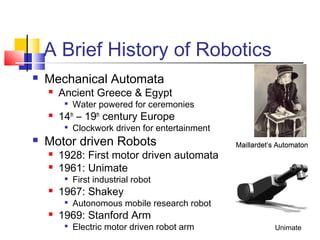
A Brief History of Robotics
 Mechanical Automata
 Ancient Greece & Egypt

Water powered for ceremonies
 14th
– 19th
century Europe

Clockwork driven for entertainment
 Motor driven Robots
 1928: First motor driven automata
 1961: Unimate

First industrial robot
 1967: Shakey

Autonomous mobile research robot
 1969: Stanford Arm

Electric motor driven robot arm
Maillardet’s Automaton
Unimate
Maillardet’s Automaton
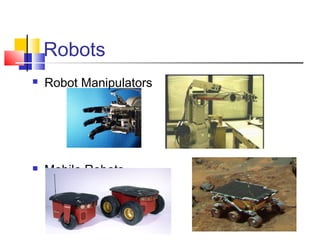
Robots
 Robot Manipulators
 Mobile Robots
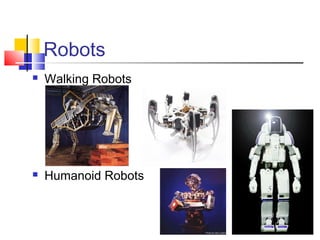
Robots
 Walking Robots
 Humanoid Robots
Autonomous Robots
 The control of autonomous robots involves a
number of subtasks
 Understanding and modeling of the mechanism

Kinematics, Dynamics, and Odometry
 Reliable control of the actuators

Closed-loop control
 Generation of task-specific motions

Path planning
 Integration of sensors

Selection and interfacing of various types of sensors
 Filtering with noise and uncertainty

Filtering of sensor noise and actuator uncertainty
 Creation of flexible control policies

Control has to deal with new situations
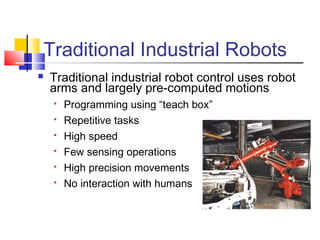
Traditional Industrial Robots
 Traditional industrial robot control uses robot
arms and largely pre-computed motions
 Programming using “teach box”
 Repetitive tasks
 High speed
 Few sensing operations
 High precision movements
 No interaction with humans
Problems
 Traditional programming techniques for
industrial robots lack key capabilities necessary
in intelligent environments
 Only limited on-line sensing
 No incorporation of uncertainty
 No interaction with humans
 Reliance on perfect task information
 Complete re-programming for new tasks
Requirements for Robots in
Intelligent Environments
 Autonomy
 Robots have to be capable of achieving task
objectives without human input
 Robots have to be able to make and execute their
own decisions based on sensor information
 Intuitive Human-Robot Interfaces
 Use of robots in smart homes can not require
extensive user training
 Commands to robots should be natural for
inhabitants
 Adaptation
 Robots have to be able to adjust to changes in the
environment
Robots for Intelligent
Environments
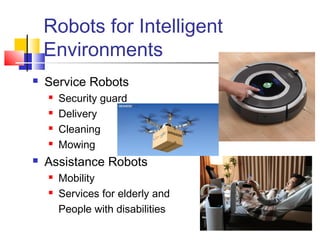
 Service Robots
 Security guard
 Delivery
 Cleaning
 Mowing
 Assistance Robots
 Mobility
 Services for elderly and
People with disabilities
Autonomous Robot Control
 To control robots to perform tasks
autonomously a number of tasks have to be
addressed:
 Modeling of robot mechanisms

Kinematics, Dynamics
 Robot sensor selection

Active and passive proximity sensors
 Low-level control of actuators

Closed-loop control
 Control architectures

Traditional planning architectures

Behavior-based control architectures

Hybrid architectures
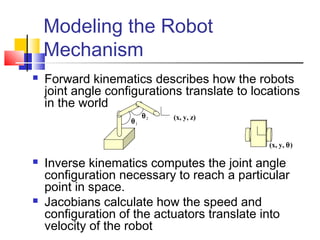
 Forward kinematics describes how the robots
joint angle configurations translate to locations
in the world
 Inverse kinematics computes the joint angle
configuration necessary to reach a particular
point in space.
 Jacobians calculate how the speed and
configuration of the actuators translate into
velocity of the robot
Modeling the Robot
Mechanism
(x, y, z)
θ1
θ2
(x, y, θ)
Sensor-Driven Robot Control
 To accurately achieve a task in an intelligent
environment, a robot has to be able to react
dynamically to changes ion its surrounding
 Robots need sensors to perceive the environment
 Most robots use a set of different sensors

Different sensors serve different purposes
 Information from sensors has to be integrated into
the control of the robot
Robot Sensors
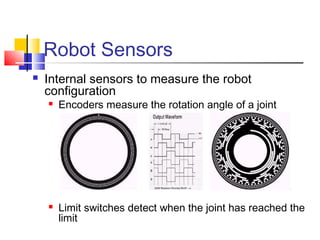
 Internal sensors to measure the robot
configuration
 Encoders measure the rotation angle of a joint
 Limit switches detect when the joint has reached the
limit
Robot Sensors
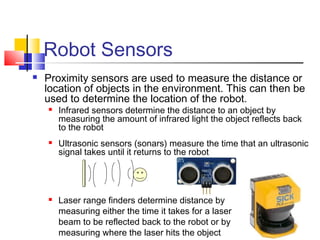
 Proximity sensors are used to measure the distance or
location of objects in the environment. This can then be
used to determine the location of the robot.
 Infrared sensors determine the distance to an object by
measuring the amount of infrared light the object reflects back
to the robot
 Ultrasonic sensors (sonars) measure the time that an ultrasonic
signal takes until it returns to the robot
 Laser range finders determine distance by
measuring either the time it takes for a laser
beam to be reflected back to the robot or by
measuring where the laser hits the object
Uncertainty in Robot Systems
 Robot systems in intelligent environments have to
deal with sensor noise and uncertainty
 Sensor uncertainty

Sensor readings are imprecise and unreliable
 Non-observability

Various aspects of the environment can not be observed

The environment is initially unknown
 Action uncertainty

Actions can fail

Actions have nondeterministic outcomes
Deliberative
Robot Control Architectures
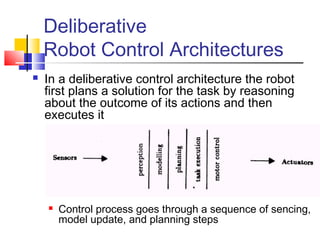
 In a deliberative control architecture the robot
first plans a solution for the task by reasoning
about the outcome of its actions and then
executes it
 Control process goes through a sequence of sencing,
model update, and planning steps
Deliberative
Control Architectures
 Advantages
 Reasons about contingencies
 Computes solutions to the given task
 Goal-directed strategies
 Problems
 Solutions tend to be fragile in the presence of
uncertainty
 Requires frequent replanning
 Reacts relatively slowly to changes and unexpected
occurrences
Behavior-Based
Robot Control Architectures
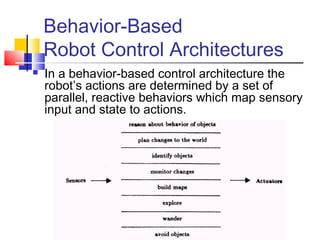
 In a behavior-based control architecture the
robot’s actions are determined by a set of
parallel, reactive behaviors which map sensory
input and state to actions.
Behavior-Based
Robot Control Architectures
 Reactive, behavior-based control combines
relatively simple behaviors, each of which
achieves a particular subtask, to achieve the
overall task.
 Robot can react fast to changes
 System does not depend on complete knowledge of
the environment
 Emergent behavior (resulting from combining initial
behaviors) can make it difficult to predict exact
behavior
 Difficult to assure that the overall task is achieved
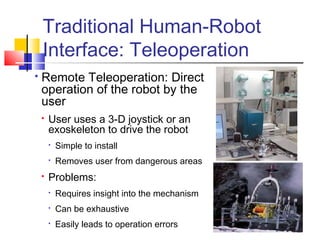
Traditional Human-Robot
Interface: Teleoperation
 Remote Teleoperation: Direct
operation of the robot by the
user
 User uses a 3-D joystick or an
exoskeleton to drive the robot

Simple to install

Removes user from dangerous areas
 Problems:

Requires insight into the mechanism

Can be exhaustive

Easily leads to operation errors
Human-Robot Interaction in
Intelligent Environments
 Personal service robot
 Controlled and used by untrained users

Intuitive, easy to use interface

Interface has to “filter” user input
 Eliminate dangerous instructions
 Find closest possible action
 Receive only intermittent commands

Robot requires autonomous capabilities

User commands can be at various levels of complexity

Control system merges instructions and autonomous
operation
 Interact with a variety of humans

Humans have to feel “comfortable” around robots

Robots have to communicate intentions in a natural way
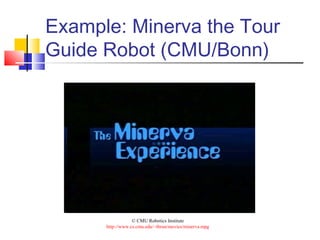
Example: Minerva the Tour
Guide Robot (CMU/Bonn)
© CMU Robotics Institute
http://www.cs.cmu.edu/~thrun/movies/minerva.mpg
Intuitive Robot Interfaces:
Command Input
 Graphical programming interfaces
 Users construct policies form elemental blocks
 Problems:

Requires substantial understanding of the robot
 Deictic (pointing) interfaces
 Humans point at desired targets in the world or
 Target specification on a computer screen
 Problems:

How to interpret human gestures ?
 Voice recognition
 Humans instruct the robot verbally
 Problems:

Speech recognition is very difficult

Robot actions corresponding to words has to be defined
Intuitive Robot Interfaces:
Robot-Human Interaction
 He robot has to be able to communicate its
intentions to the human
 Output has to be easy to understand by humans
 Robot has to be able to encode its intention
 Interface has to keep human’s attention without
annoying her
 Robot communication devices:
 Easy to understand computer screens
 Speech synthesis
 Robot “gestures”
Human-Robot Interfaces
 Existing technologies
 Simple voice recognition and speech synthesis
 Gesture recognition systems
 On-screen, text-based interaction
 Research challenges
 How to convey robot intentions ?
 How to infer user intent from visual observation (how
can a robot imitate a human) ?
 How to keep the attention of a human on the robot ?
 How to integrate human input with autonomous
operation ?
"Social" Robot Interactions
 To make robots acceptable to average users
they should appear and behave “natural”
 "Attentional" Robots
 Robot focuses on the user or the task
 Attention forms the first step to imitation
 "Emotional" Robots
 Robot exhibits “emotional” responses
 Robot follows human social norms for behavior
 Better acceptance by the user (users are more forgiving)
 Human-machine interaction appears more “natural”
 Robot can influence how the human reacts
"Social" Robot Interactions
 Advantages:
 Robots that look human and that show “emotions”
can make interactions more “natural”
 Humans tend to focus more attention on people than on
objects
 Humans tend to be more forgiving when a mistake is
made if it looks “human”
 Robots showing “emotions” can modify the way in
which humans interact with them
 Problems:
 How can robots determine the right emotion ?
 How can “emotions” be expressed by a robot ?
Human-Robot Interfaces for
Intelligent Environments
 Robot Interfaces have to be easy to use
 Robots have to be controllable by untrained users
 Robots have to be able to interact not only with their
owner but also with other people
 Robot interfaces have to be usable at the
human’s discretion
 Human-robot interaction occurs on an irregular basis

Frequently the robot has to operate autonomously

Whenever user input is provided the robot has to react to it
 Interfaces have to be designed human-centric
 The role of the robot is it to make the human’s life
easier and more comfortable (it is not just a tech toy)
Conclusions
 Robots are an important component in Intelligent
Environments
 Automate devices
 Provide physical services
 Robot Systems in these environments need particular
capabilities
 Autonomous control systems
 Simple and natural human-robot interface
 Adaptive and learning capabilities
 Robots have to maintain safety during operation
 While a number of techniques to address these
requirements exist, no functional, satisfactory solutions
have yet been developed
 Only very simple robots for single tasks in intelligent
environments exist

Robotics

  • 1.
    Automation and Robotics Advisor: 宜宸謝 Student : Truong Ha Anh Student number: 10457120 Department: Automation Engineering FINAL REPORT
  • 2.
    content  Automation androbotics in intelligent environments  Overview about robots  Autonomous Robot Control  Conclusion
  • 3.
    Motivation  Intelligent Environmentsare aimed at improving the inhabitants’ experience and task performance  Automate functions in the home  Provide services to the inhabitants  Decisions coming from the decision maker in the environment have to be executed.  Decisions require actions to be performed on devices  Decisions are frequently not elementary device interactions but rather relatively complex commands
  • 4.
    Automation and Roboticsin Intelligent Environments  Control of the physical environment  Automated blinds  Thermostats and heating ducts  Automatic doors  Automatic room partitioning  Personal service robots  House cleaning  Lawn mowing  Assistance to the elderly and handicapped  Office assistants  Security services
  • 5.
    Robots  Robota (Czech)= A worker of forced labor From Czech playwright Karel Capek's 1921 play “R.U.R” (“Rossum's Universal Robots”)  Japanese Industrial Robot Association (JIRA) : “A device with degrees of freedom that can be controlled.”  Class 1 : Manual handling device  Class 2 : Fixed sequence robot  Class 3 : Variable sequence robot  Class 4 : Playback robot  Class 5 : Numerical control robot  Class 6 : Intelligent robot
  • 6.
    A Brief Historyof Robotics  Mechanical Automata  Ancient Greece & Egypt  Water powered for ceremonies  14th – 19th century Europe  Clockwork driven for entertainment  Motor driven Robots  1928: First motor driven automata  1961: Unimate  First industrial robot  1967: Shakey  Autonomous mobile research robot  1969: Stanford Arm  Electric motor driven robot arm Maillardet’s Automaton Unimate Maillardet’s Automaton
  • 7.
  • 8.
  • 9.
    Autonomous Robots  Thecontrol of autonomous robots involves a number of subtasks  Understanding and modeling of the mechanism  Kinematics, Dynamics, and Odometry  Reliable control of the actuators  Closed-loop control  Generation of task-specific motions  Path planning  Integration of sensors  Selection and interfacing of various types of sensors  Filtering with noise and uncertainty  Filtering of sensor noise and actuator uncertainty  Creation of flexible control policies  Control has to deal with new situations
  • 10.
    Traditional Industrial Robots Traditional industrial robot control uses robot arms and largely pre-computed motions  Programming using “teach box”  Repetitive tasks  High speed  Few sensing operations  High precision movements  No interaction with humans
  • 11.
    Problems  Traditional programmingtechniques for industrial robots lack key capabilities necessary in intelligent environments  Only limited on-line sensing  No incorporation of uncertainty  No interaction with humans  Reliance on perfect task information  Complete re-programming for new tasks
  • 12.
    Requirements for Robotsin Intelligent Environments  Autonomy  Robots have to be capable of achieving task objectives without human input  Robots have to be able to make and execute their own decisions based on sensor information  Intuitive Human-Robot Interfaces  Use of robots in smart homes can not require extensive user training  Commands to robots should be natural for inhabitants  Adaptation  Robots have to be able to adjust to changes in the environment
  • 13.
    Robots for Intelligent Environments Service Robots  Security guard  Delivery  Cleaning  Mowing  Assistance Robots  Mobility  Services for elderly and People with disabilities
  • 14.
    Autonomous Robot Control To control robots to perform tasks autonomously a number of tasks have to be addressed:  Modeling of robot mechanisms  Kinematics, Dynamics  Robot sensor selection  Active and passive proximity sensors  Low-level control of actuators  Closed-loop control  Control architectures  Traditional planning architectures  Behavior-based control architectures  Hybrid architectures
  • 15.
     Forward kinematicsdescribes how the robots joint angle configurations translate to locations in the world  Inverse kinematics computes the joint angle configuration necessary to reach a particular point in space.  Jacobians calculate how the speed and configuration of the actuators translate into velocity of the robot Modeling the Robot Mechanism (x, y, z) θ1 θ2 (x, y, θ)
  • 16.
    Sensor-Driven Robot Control To accurately achieve a task in an intelligent environment, a robot has to be able to react dynamically to changes ion its surrounding  Robots need sensors to perceive the environment  Most robots use a set of different sensors  Different sensors serve different purposes  Information from sensors has to be integrated into the control of the robot
  • 17.
    Robot Sensors  Internalsensors to measure the robot configuration  Encoders measure the rotation angle of a joint  Limit switches detect when the joint has reached the limit
  • 18.
    Robot Sensors  Proximitysensors are used to measure the distance or location of objects in the environment. This can then be used to determine the location of the robot.  Infrared sensors determine the distance to an object by measuring the amount of infrared light the object reflects back to the robot  Ultrasonic sensors (sonars) measure the time that an ultrasonic signal takes until it returns to the robot  Laser range finders determine distance by measuring either the time it takes for a laser beam to be reflected back to the robot or by measuring where the laser hits the object
  • 19.
    Uncertainty in RobotSystems  Robot systems in intelligent environments have to deal with sensor noise and uncertainty  Sensor uncertainty  Sensor readings are imprecise and unreliable  Non-observability  Various aspects of the environment can not be observed  The environment is initially unknown  Action uncertainty  Actions can fail  Actions have nondeterministic outcomes
  • 20.
    Deliberative Robot Control Architectures In a deliberative control architecture the robot first plans a solution for the task by reasoning about the outcome of its actions and then executes it  Control process goes through a sequence of sencing, model update, and planning steps
  • 21.
    Deliberative Control Architectures  Advantages Reasons about contingencies  Computes solutions to the given task  Goal-directed strategies  Problems  Solutions tend to be fragile in the presence of uncertainty  Requires frequent replanning  Reacts relatively slowly to changes and unexpected occurrences
  • 22.
    Behavior-Based Robot Control Architectures In a behavior-based control architecture the robot’s actions are determined by a set of parallel, reactive behaviors which map sensory input and state to actions.
  • 23.
    Behavior-Based Robot Control Architectures Reactive, behavior-based control combines relatively simple behaviors, each of which achieves a particular subtask, to achieve the overall task.  Robot can react fast to changes  System does not depend on complete knowledge of the environment  Emergent behavior (resulting from combining initial behaviors) can make it difficult to predict exact behavior  Difficult to assure that the overall task is achieved
  • 24.
    Traditional Human-Robot Interface: Teleoperation Remote Teleoperation: Direct operation of the robot by the user  User uses a 3-D joystick or an exoskeleton to drive the robot  Simple to install  Removes user from dangerous areas  Problems:  Requires insight into the mechanism  Can be exhaustive  Easily leads to operation errors
  • 25.
    Human-Robot Interaction in IntelligentEnvironments  Personal service robot  Controlled and used by untrained users  Intuitive, easy to use interface  Interface has to “filter” user input  Eliminate dangerous instructions  Find closest possible action  Receive only intermittent commands  Robot requires autonomous capabilities  User commands can be at various levels of complexity  Control system merges instructions and autonomous operation  Interact with a variety of humans  Humans have to feel “comfortable” around robots  Robots have to communicate intentions in a natural way
  • 26.
    Example: Minerva theTour Guide Robot (CMU/Bonn) © CMU Robotics Institute http://www.cs.cmu.edu/~thrun/movies/minerva.mpg
  • 27.
    Intuitive Robot Interfaces: CommandInput  Graphical programming interfaces  Users construct policies form elemental blocks  Problems:  Requires substantial understanding of the robot  Deictic (pointing) interfaces  Humans point at desired targets in the world or  Target specification on a computer screen  Problems:  How to interpret human gestures ?  Voice recognition  Humans instruct the robot verbally  Problems:  Speech recognition is very difficult  Robot actions corresponding to words has to be defined
  • 28.
    Intuitive Robot Interfaces: Robot-HumanInteraction  He robot has to be able to communicate its intentions to the human  Output has to be easy to understand by humans  Robot has to be able to encode its intention  Interface has to keep human’s attention without annoying her  Robot communication devices:  Easy to understand computer screens  Speech synthesis  Robot “gestures”
  • 29.
    Human-Robot Interfaces  Existingtechnologies  Simple voice recognition and speech synthesis  Gesture recognition systems  On-screen, text-based interaction  Research challenges  How to convey robot intentions ?  How to infer user intent from visual observation (how can a robot imitate a human) ?  How to keep the attention of a human on the robot ?  How to integrate human input with autonomous operation ?
  • 30.
    "Social" Robot Interactions To make robots acceptable to average users they should appear and behave “natural”  "Attentional" Robots  Robot focuses on the user or the task  Attention forms the first step to imitation  "Emotional" Robots  Robot exhibits “emotional” responses  Robot follows human social norms for behavior  Better acceptance by the user (users are more forgiving)  Human-machine interaction appears more “natural”  Robot can influence how the human reacts
  • 31.
    "Social" Robot Interactions Advantages:  Robots that look human and that show “emotions” can make interactions more “natural”  Humans tend to focus more attention on people than on objects  Humans tend to be more forgiving when a mistake is made if it looks “human”  Robots showing “emotions” can modify the way in which humans interact with them  Problems:  How can robots determine the right emotion ?  How can “emotions” be expressed by a robot ?
  • 32.
    Human-Robot Interfaces for IntelligentEnvironments  Robot Interfaces have to be easy to use  Robots have to be controllable by untrained users  Robots have to be able to interact not only with their owner but also with other people  Robot interfaces have to be usable at the human’s discretion  Human-robot interaction occurs on an irregular basis  Frequently the robot has to operate autonomously  Whenever user input is provided the robot has to react to it  Interfaces have to be designed human-centric  The role of the robot is it to make the human’s life easier and more comfortable (it is not just a tech toy)
  • 33.
    Conclusions  Robots arean important component in Intelligent Environments  Automate devices  Provide physical services  Robot Systems in these environments need particular capabilities  Autonomous control systems  Simple and natural human-robot interface  Adaptive and learning capabilities  Robots have to maintain safety during operation  While a number of techniques to address these requirements exist, no functional, satisfactory solutions have yet been developed  Only very simple robots for single tasks in intelligent environments exist