Thinking  &  Language Chapter 10
Thinking
Thinking Cognition mental activity associated with processing, understanding, and communicating  information Cognitive Psychology the study of these mental activities concept formation problem solving decision making judgement formation study of both logical and illogical thinking
Thinking Concept  mental grouping of similar objects, events,  or people address country, city, street, house zip codes Prototype the best example of a category matching new items to the prototype provides a  quick and easy method for including items in a category (as when comparing feathered  creatures to a prototypical bird, such as a robin.)
Thinking Algorithm methodical, logical rule or procedure  that guarantees solving a particular problem contrasts with the usually speedier    but also more error-prone use of heuristics
Thinking Heuristic rule-of-thumb strategy that often  allows us to make judgements and  solve problems efficiently usually speedier than  algorithms   more error-prone than  algorithms sometimes we’re unaware of using heuristics
Thinking Unscramble S P L O Y O C H Y G Algorithm all 907,208 combinations Heuristic throw out all YY combinations other heuristics?
Thinking Insight sudden and often novel realization of the solution  to a problem contrasts with strategy-based solutions Confirmation Bias tendency to search for information that confirms  one’s preconceptions Fixation inability to see a problem from a new perspective impediment to problem solving
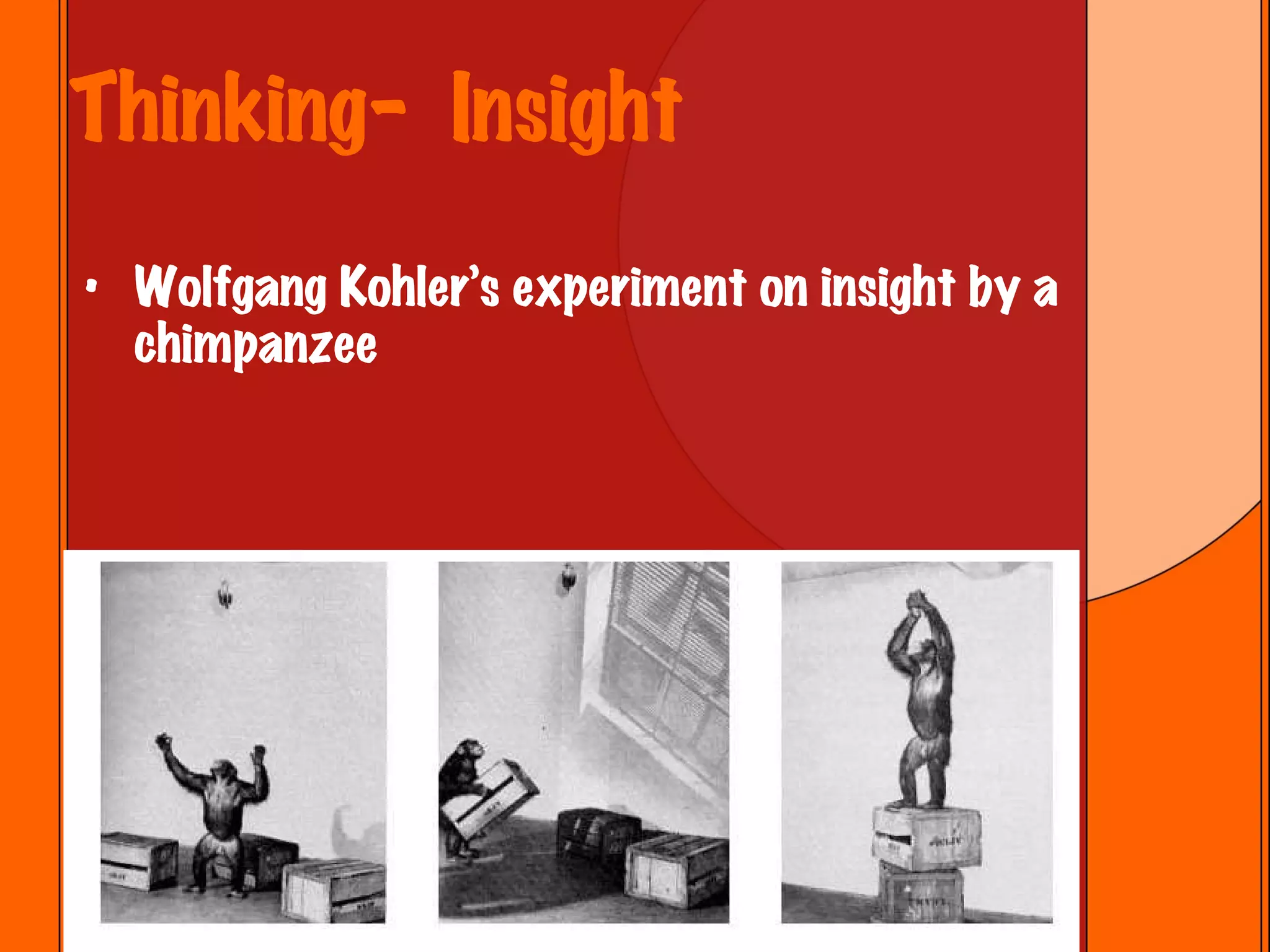
Thinking-  Insight Wolfgang Kohler’s experiment on insight by a chimpanzee
Thinking Mental Set tendency to approach a problem  in a particular way especially a way that has been successful in the past but may or may not be helpful in solving a  new problem
Thinking Functional Fixedness tendency to think of things  only in terms of their usual  functions impediment to problem  solving
Heuristics Representativeness Heuristic rule of thumb for judging the likelihood of things in terms of how well they seem to represent, or match, particular prototypes may lead one to ignore other relevant information
Heuristics Availability Heuristic estimating the likelihood of events  based on their availability in memory if instances come readily to mind (perhaps because of their vividness),  we presume such events are common Example:  airplane crash
Thinking Overconfidence tendency to be more confident than correct  tendency to overestimate the accuracy of one’s beliefs and judgements
Thinking Framing the way an issue is posed how an issue is framed can significantly affect decisions and judgements Example:  What is the best way to market ground beef-  As 25% fat or 75% lean?
Thinking Belief Bias the tendency for one’s preexisting beliefs to distort logical reasoning sometimes by making invalid conclusions  seem valid, or valid conclusions seem invalid Belief Perseverance clinging to one’s initial conceptions after the basis on which they were formed has been discredited
Artificial Intelligence Artificial Intelligence designing and programming computer systems to do intelligent things  to simulate human thought processes   intuitive reasoning learning understanding language
Artificial Intelligence Artificial Intelligence includes practical applications chess playing industrial robots expert systems efforts to model human thinking inspired by our current understanding  of how the brain works
Artificial Intelligence Computer Neural Networks computer circuits that mimic the  brain’s interconnected neural cells performing tasks learning to recognize visual patterns learning to recognize smells
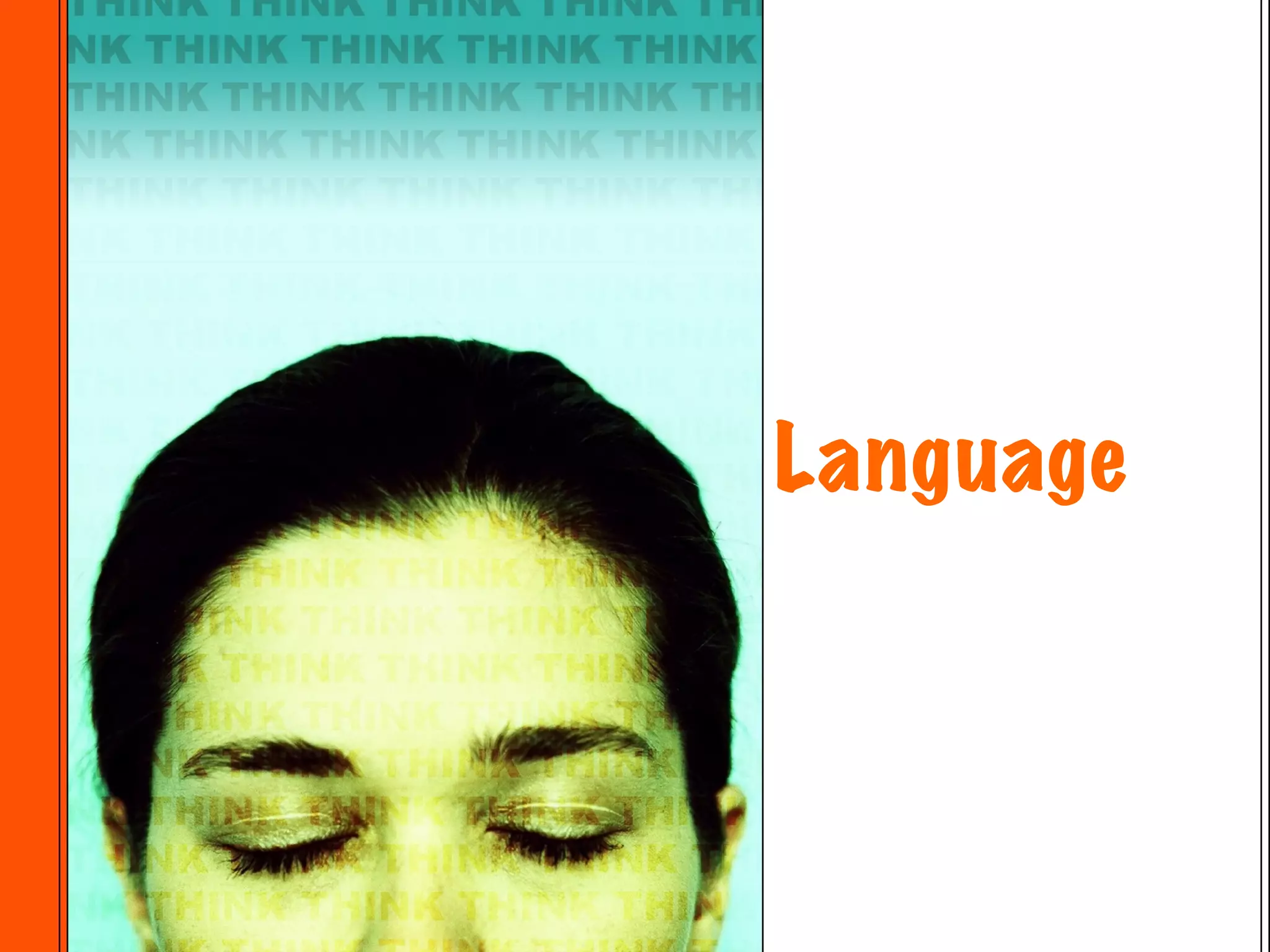
Language
Language Language our spoken, written, or gestured works and the way we combine them to communicate meaning Phoneme in a spoken language, the smallest distinctive sound unit
Language Morpheme in a language, the smallest unit that carries meaning may be a word or a part of a word (such as  a prefix) Grammar a system of rules in a language that enables  us to communicate with and understand others
Language Semantics the set of rules by which we derive meaning from morphemes, words, and sentences in a given language also, the study of meaning Syntax the rules for combining words into grammatically sensible sentences in a given language
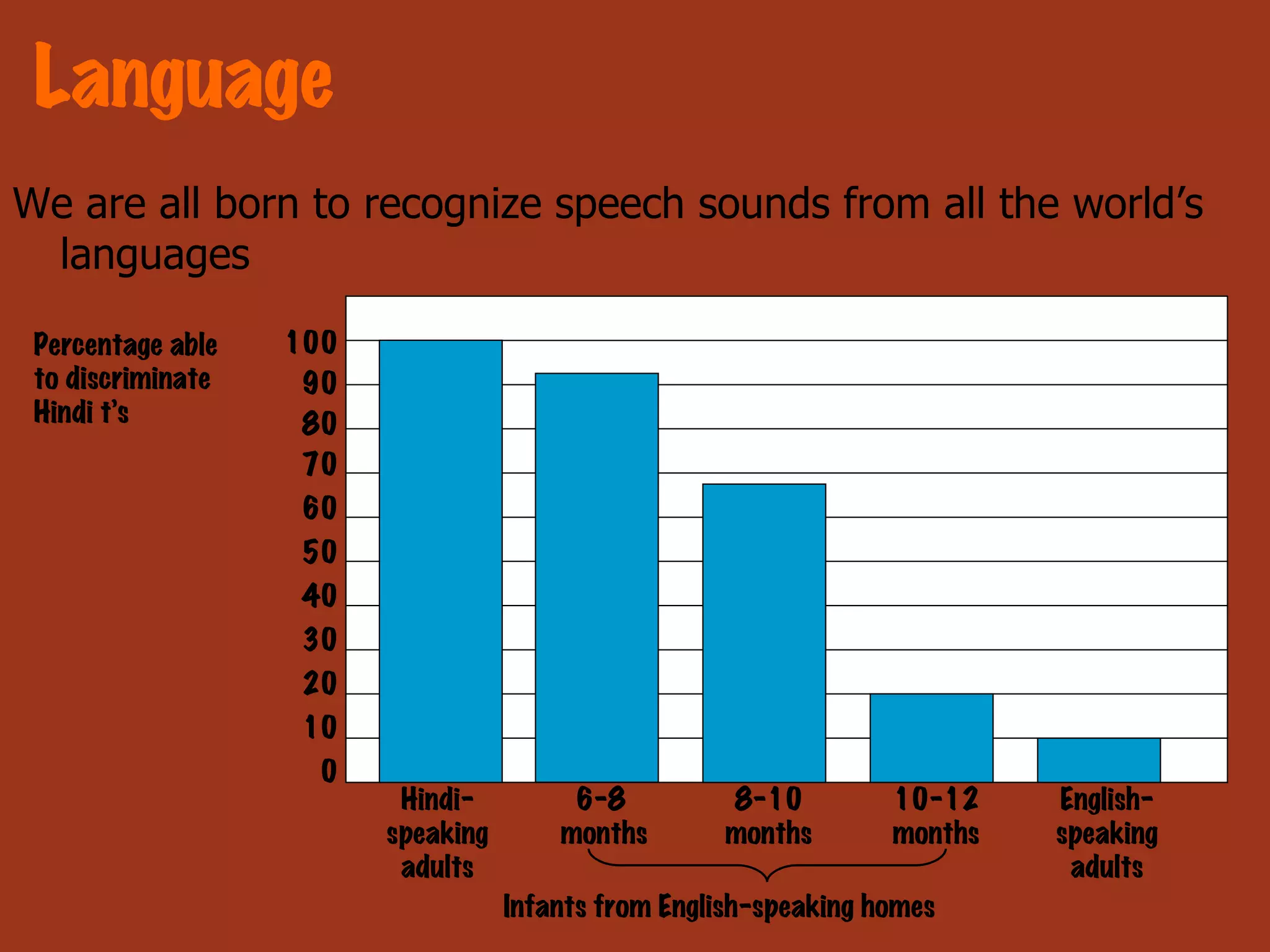
Language We are all born to recognize speech sounds from all the world’s languages 100 90 80 70 60 50 40 30 20 10 0 Percentage able to discriminate Hindi t’s Hindi- speaking adults 6-8  months 8-10 months 10-12 months English- speaking adults Infants from English-speaking homes
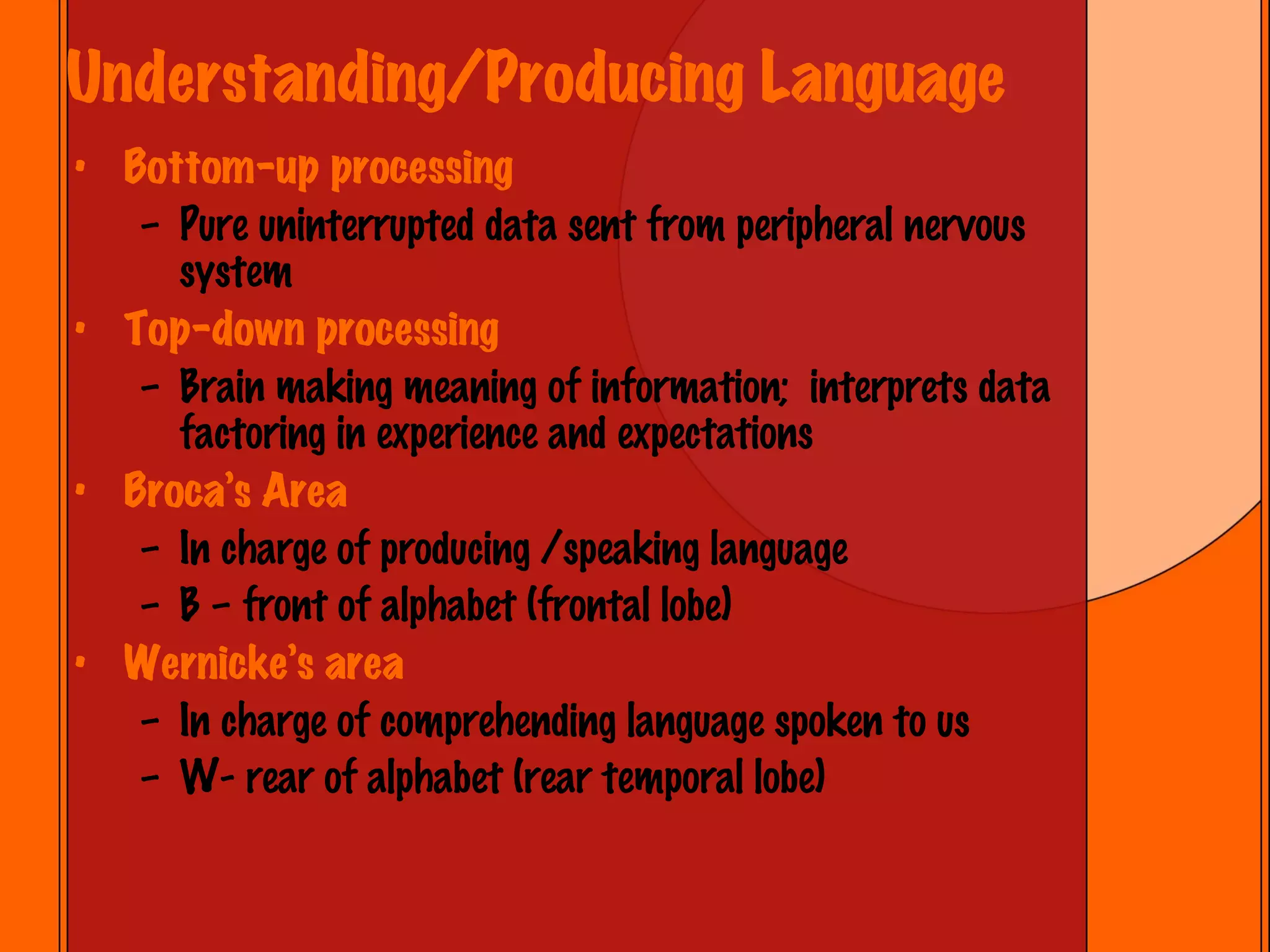
Understanding/Producing Language Bottom-up processing Pure uninterrupted data sent from peripheral nervous system Top-down processing Brain making meaning of information;  interprets data factoring in experience and expectations Broca’s Area In charge of producing /speaking language B – front of alphabet (frontal lobe) Wernicke’s area In charge of comprehending language spoken to us W- rear of alphabet (rear temporal lobe)
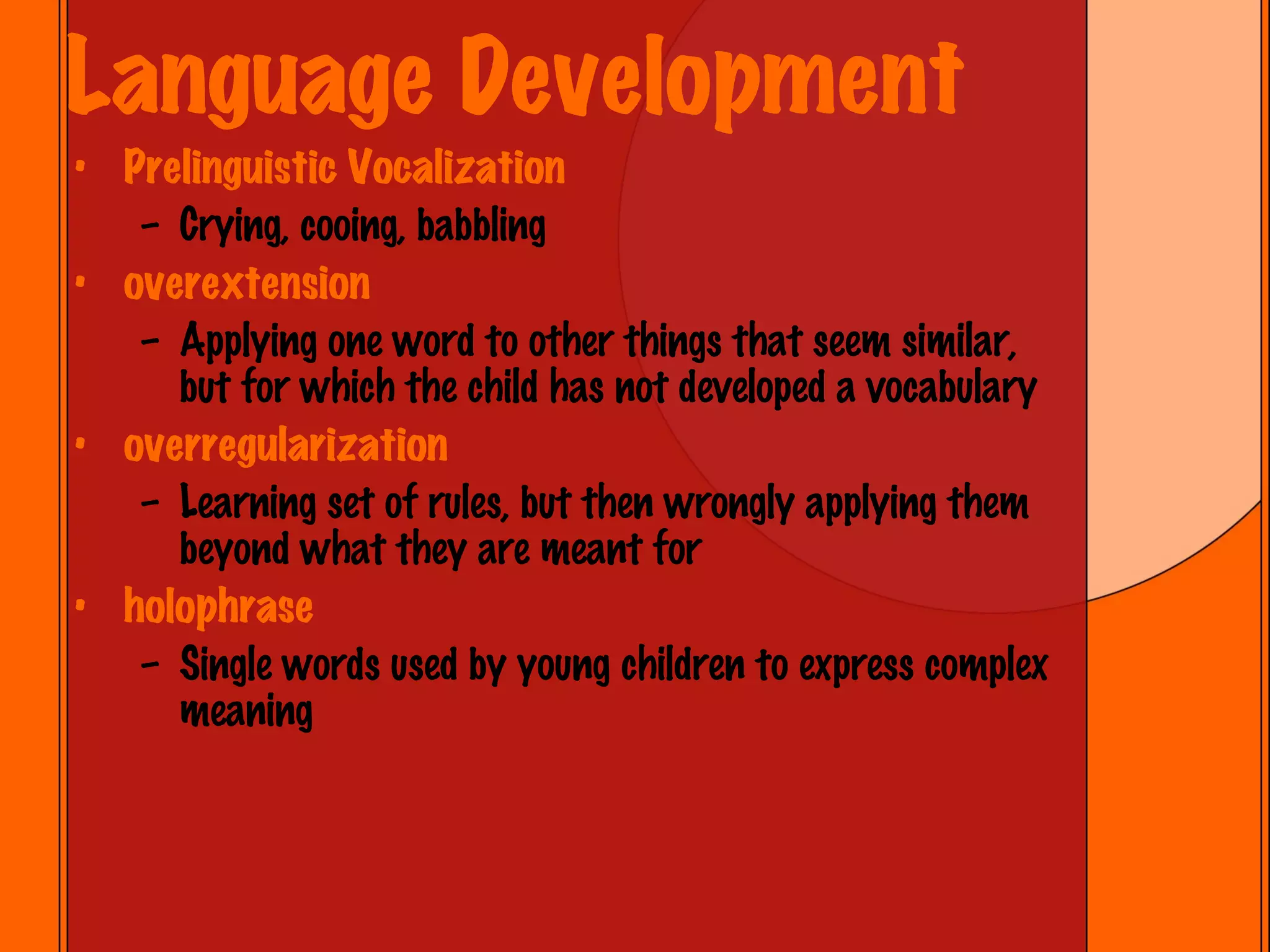
Language Development Prelinguistic Vocalization Crying, cooing, babbling overextension Applying one word to other things that seem similar, but for which the child has not developed a vocabulary overregularization Learning set of rules, but then wrongly applying them beyond what they are meant for holophrase Single words used by young children to express complex meaning
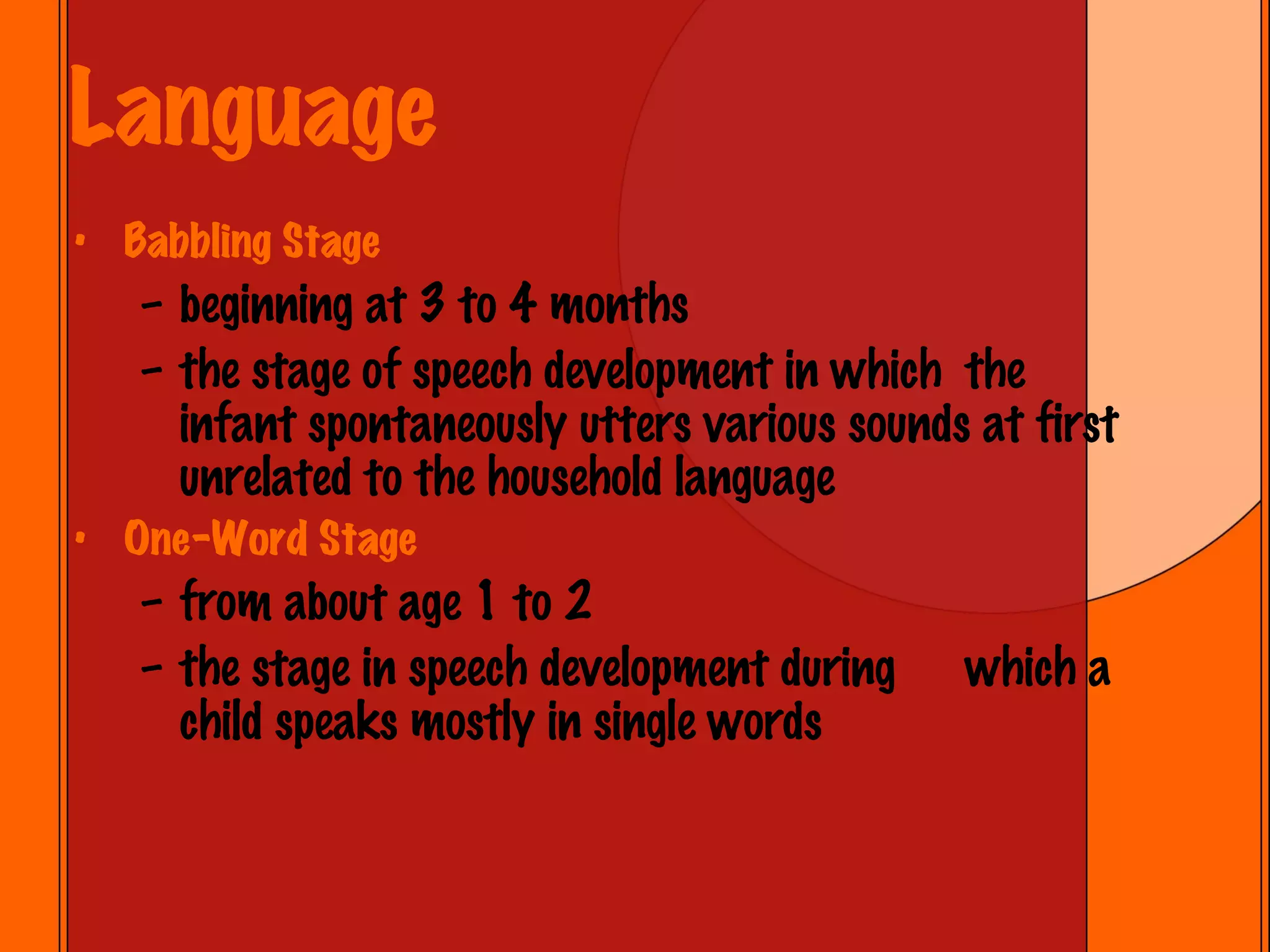
Language Babbling Stage beginning at 3 to 4 months the stage of speech development in which  the infant spontaneously utters various sounds at first unrelated to the household language One-Word Stage from about age 1 to 2 the stage in speech development during  which a child speaks mostly in single words
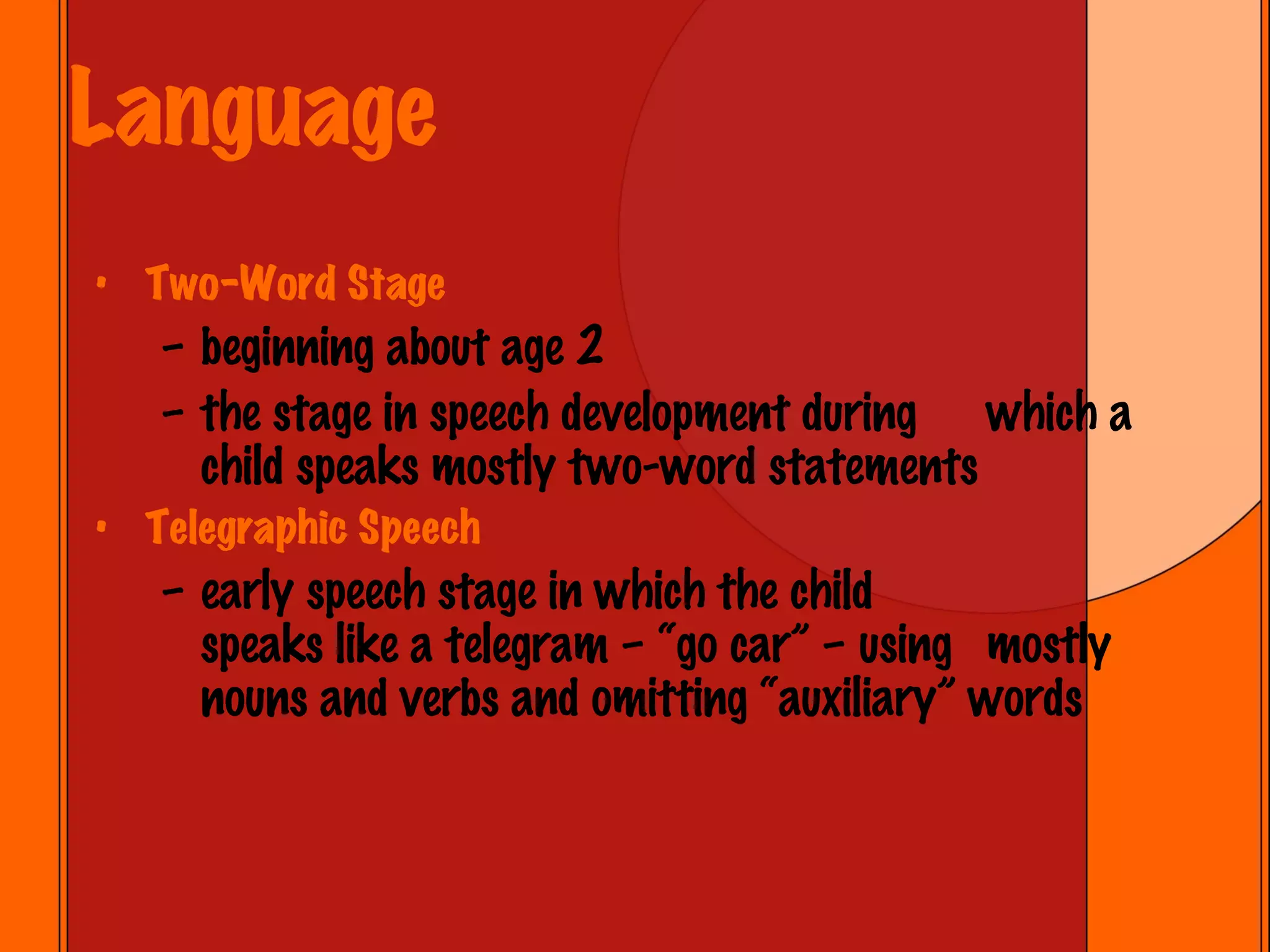
Language Two-Word Stage beginning about age 2 the stage in speech development during  which a child speaks mostly two-word statements Telegraphic Speech early speech stage in which the child  speaks like a telegram – “go car” – using  mostly nouns and verbs and omitting “auxiliary” words
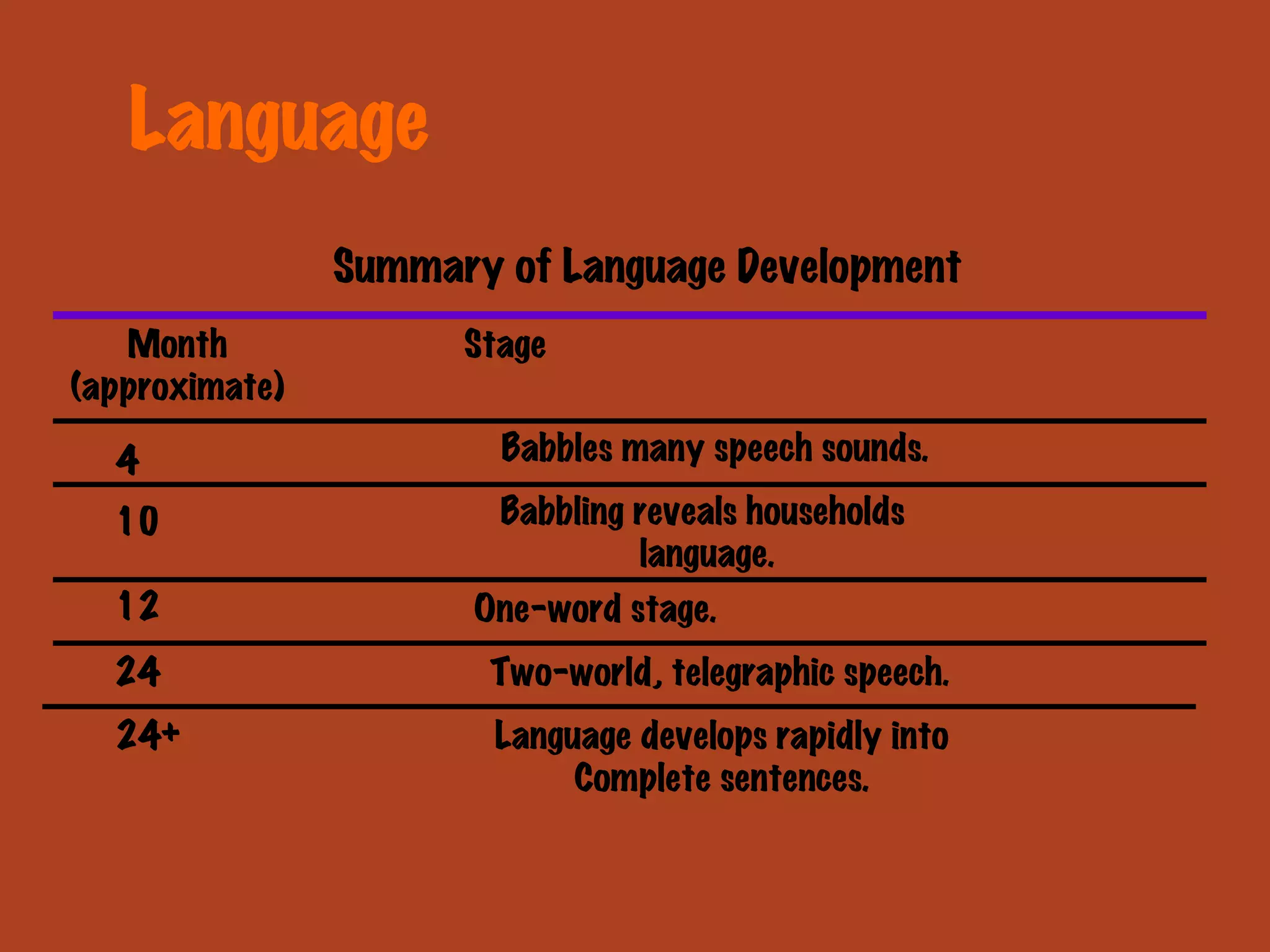
Language Summary of Language Development Month (approximate) Stage 4 10 12 24 24+ Babbles many speech sounds. Babbling reveals households  language. One-word stage. Two-world, telegraphic speech. Language develops rapidly into Complete sentences.
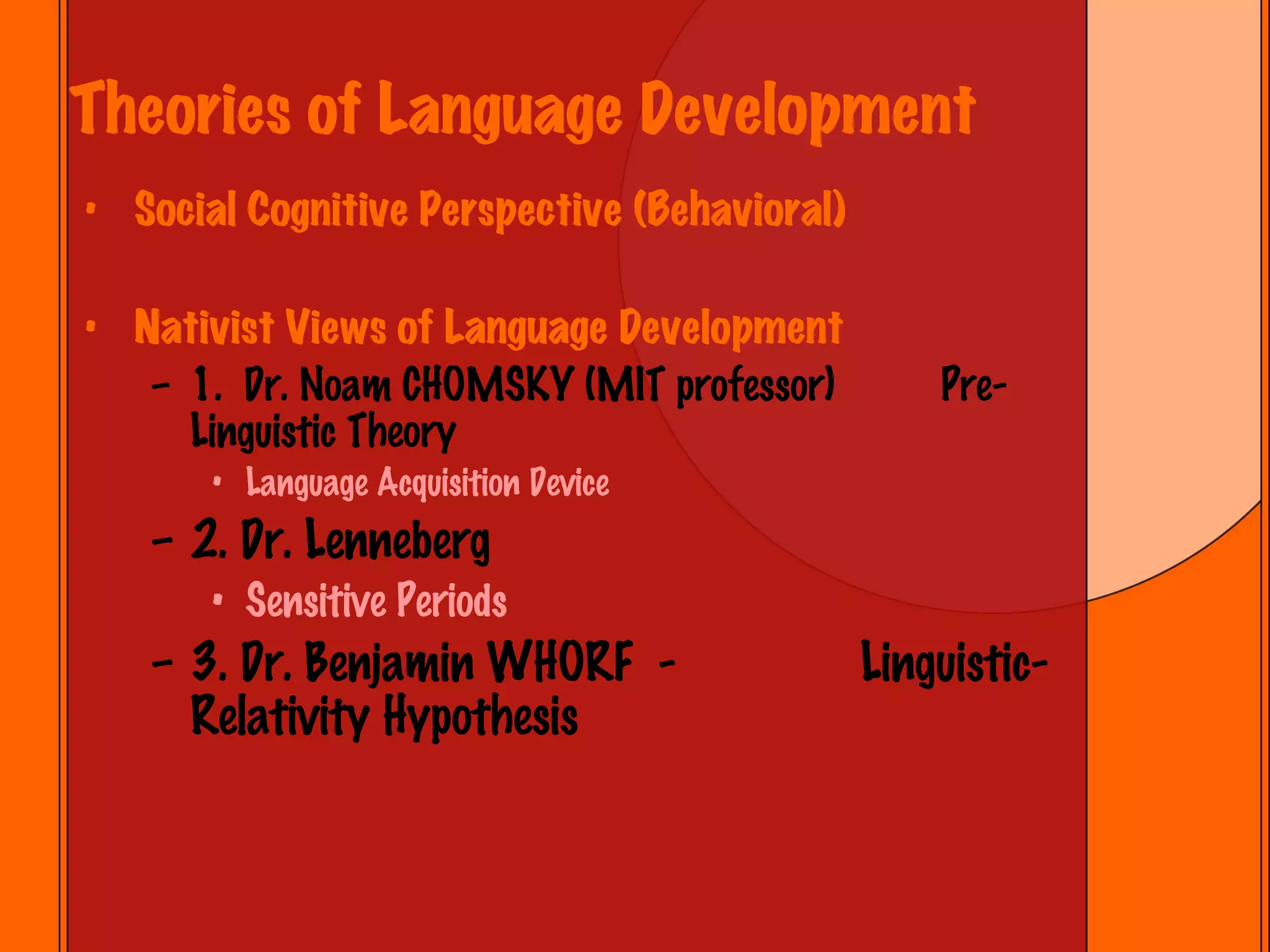
Theories of Language Development Social Cognitive Perspective (Behavioral) Nativist Views of Language Development 1.  Dr. Noam CHOMSKY (MIT professor)  Pre-Linguistic Theory Language Acquisition Device 2. Dr. Lenneberg Sensitive Periods 3. Dr. Benjamin WHORF  -  Linguistic-Relativity Hypothesis
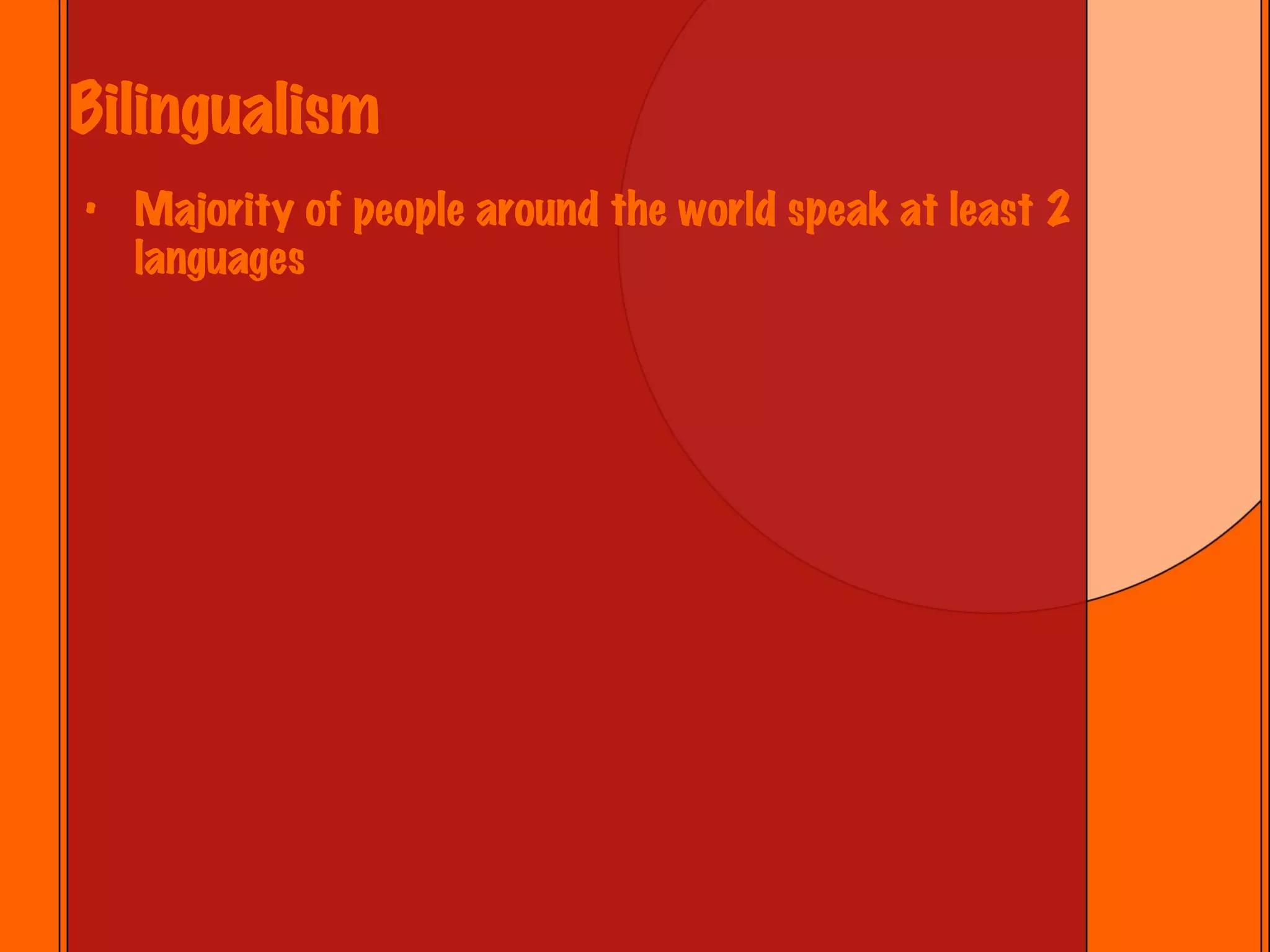
Bilingualism Majority of people around the world speak at least 2 languages
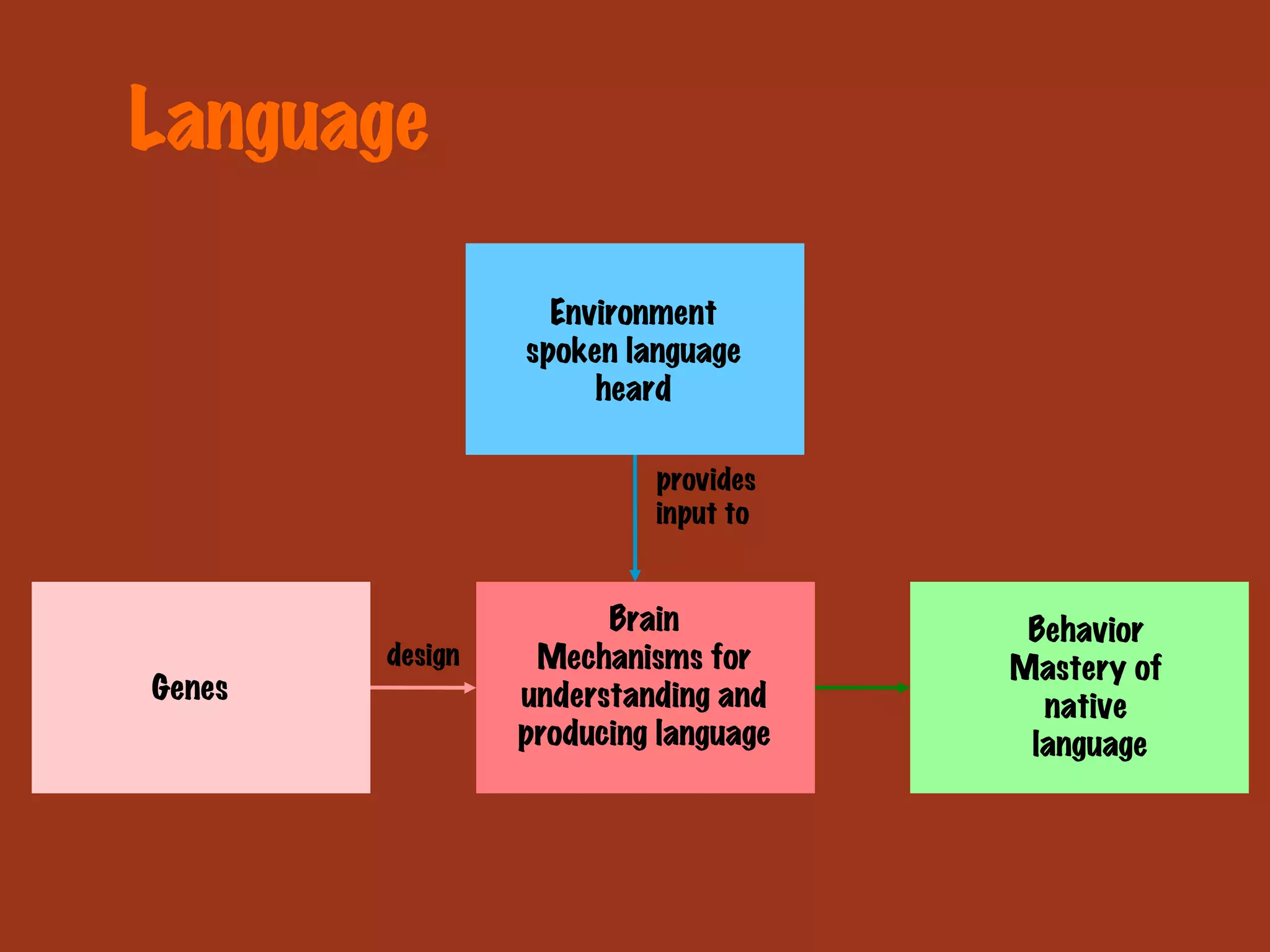
Language Genes Environment spoken language heard Brain Mechanisms for understanding and producing language Behavior Mastery of native language provides  input to design

Thinking and Language

  • 1.
    Thinking & Language Chapter 10
  • 2.
  • 3.
    Thinking Cognition mentalactivity associated with processing, understanding, and communicating information Cognitive Psychology the study of these mental activities concept formation problem solving decision making judgement formation study of both logical and illogical thinking
  • 4.
    Thinking Concept mental grouping of similar objects, events, or people address country, city, street, house zip codes Prototype the best example of a category matching new items to the prototype provides a quick and easy method for including items in a category (as when comparing feathered creatures to a prototypical bird, such as a robin.)
  • 5.
    Thinking Algorithm methodical,logical rule or procedure that guarantees solving a particular problem contrasts with the usually speedier but also more error-prone use of heuristics
  • 6.
    Thinking Heuristic rule-of-thumbstrategy that often allows us to make judgements and solve problems efficiently usually speedier than algorithms more error-prone than algorithms sometimes we’re unaware of using heuristics
  • 7.
    Thinking Unscramble SP L O Y O C H Y G Algorithm all 907,208 combinations Heuristic throw out all YY combinations other heuristics?
  • 8.
    Thinking Insight suddenand often novel realization of the solution to a problem contrasts with strategy-based solutions Confirmation Bias tendency to search for information that confirms one’s preconceptions Fixation inability to see a problem from a new perspective impediment to problem solving
  • 9.
    Thinking- InsightWolfgang Kohler’s experiment on insight by a chimpanzee
  • 10.
    Thinking Mental Settendency to approach a problem in a particular way especially a way that has been successful in the past but may or may not be helpful in solving a new problem
  • 11.
    Thinking Functional Fixednesstendency to think of things only in terms of their usual functions impediment to problem solving
  • 12.
    Heuristics Representativeness Heuristicrule of thumb for judging the likelihood of things in terms of how well they seem to represent, or match, particular prototypes may lead one to ignore other relevant information
  • 13.
    Heuristics Availability Heuristicestimating the likelihood of events based on their availability in memory if instances come readily to mind (perhaps because of their vividness), we presume such events are common Example: airplane crash
  • 14.
    Thinking Overconfidence tendencyto be more confident than correct tendency to overestimate the accuracy of one’s beliefs and judgements
  • 15.
    Thinking Framing theway an issue is posed how an issue is framed can significantly affect decisions and judgements Example: What is the best way to market ground beef- As 25% fat or 75% lean?
  • 16.
    Thinking Belief Biasthe tendency for one’s preexisting beliefs to distort logical reasoning sometimes by making invalid conclusions seem valid, or valid conclusions seem invalid Belief Perseverance clinging to one’s initial conceptions after the basis on which they were formed has been discredited
  • 17.
    Artificial Intelligence ArtificialIntelligence designing and programming computer systems to do intelligent things to simulate human thought processes intuitive reasoning learning understanding language
  • 18.
    Artificial Intelligence ArtificialIntelligence includes practical applications chess playing industrial robots expert systems efforts to model human thinking inspired by our current understanding of how the brain works
  • 19.
    Artificial Intelligence ComputerNeural Networks computer circuits that mimic the brain’s interconnected neural cells performing tasks learning to recognize visual patterns learning to recognize smells
  • 20.
  • 21.
    Language Language ourspoken, written, or gestured works and the way we combine them to communicate meaning Phoneme in a spoken language, the smallest distinctive sound unit
  • 22.
    Language Morpheme ina language, the smallest unit that carries meaning may be a word or a part of a word (such as a prefix) Grammar a system of rules in a language that enables us to communicate with and understand others
  • 23.
    Language Semantics theset of rules by which we derive meaning from morphemes, words, and sentences in a given language also, the study of meaning Syntax the rules for combining words into grammatically sensible sentences in a given language
  • 24.
    Language We areall born to recognize speech sounds from all the world’s languages 100 90 80 70 60 50 40 30 20 10 0 Percentage able to discriminate Hindi t’s Hindi- speaking adults 6-8 months 8-10 months 10-12 months English- speaking adults Infants from English-speaking homes
  • 25.
    Understanding/Producing Language Bottom-upprocessing Pure uninterrupted data sent from peripheral nervous system Top-down processing Brain making meaning of information; interprets data factoring in experience and expectations Broca’s Area In charge of producing /speaking language B – front of alphabet (frontal lobe) Wernicke’s area In charge of comprehending language spoken to us W- rear of alphabet (rear temporal lobe)
  • 26.
    Language Development PrelinguisticVocalization Crying, cooing, babbling overextension Applying one word to other things that seem similar, but for which the child has not developed a vocabulary overregularization Learning set of rules, but then wrongly applying them beyond what they are meant for holophrase Single words used by young children to express complex meaning
  • 27.
    Language Babbling Stagebeginning at 3 to 4 months the stage of speech development in which the infant spontaneously utters various sounds at first unrelated to the household language One-Word Stage from about age 1 to 2 the stage in speech development during which a child speaks mostly in single words
  • 28.
    Language Two-Word Stagebeginning about age 2 the stage in speech development during which a child speaks mostly two-word statements Telegraphic Speech early speech stage in which the child speaks like a telegram – “go car” – using mostly nouns and verbs and omitting “auxiliary” words
  • 29.
    Language Summary ofLanguage Development Month (approximate) Stage 4 10 12 24 24+ Babbles many speech sounds. Babbling reveals households language. One-word stage. Two-world, telegraphic speech. Language develops rapidly into Complete sentences.
  • 30.
    Theories of LanguageDevelopment Social Cognitive Perspective (Behavioral) Nativist Views of Language Development 1. Dr. Noam CHOMSKY (MIT professor) Pre-Linguistic Theory Language Acquisition Device 2. Dr. Lenneberg Sensitive Periods 3. Dr. Benjamin WHORF - Linguistic-Relativity Hypothesis
  • 31.
    Bilingualism Majority ofpeople around the world speak at least 2 languages
  • 32.
    Language Genes Environmentspoken language heard Brain Mechanisms for understanding and producing language Behavior Mastery of native language provides input to design