

Think over…

Thinking

        Dr. Hetal Shah
  Dr. Dharmesh Bhadja
Thinking process
•   Thinking over thinking
•   Language and thinking
•   Concepts
•   Problem solving
    – Algorithmic
    – Heuristic
• Decision making
    – Utility, subjective probability
    – bias
    – Weighing alternatives
…plz try…
• DON’T THINK…

• AS YOU READ THIS,
  you are thinking
  something…
• Even if you stop
  thinking about what you
  are reading, you are
  thinking something
  else…you are still
  thinking.
What is thinking???
• Cognitively rearrangement or manipulation
  of both information from environment and
  the symbols stored in long term memory.

• Symbols…language, images…used in
  thinking.
• Thinking is the way of information
  processing that goes on during the period
  between stimulus event and response to it.

• Before making the purchase…
Two types
• Autistic – very personal
  – Dreams


• Directed
Thinking process
• Human – animal

• Animal
  language limited & simple
• Human
  abundant availability of language and complex
   thinking
Now lets think
• Imagine you are sitting with a girl for candle light
  dinner, in five stared hotel. You ordered two ice
  creams of strawberry flavor. And the picture
  goes on…and at last you come to know, you
  have no money.

• Have you imagine about the shape of the cup of
  ice cream?
• Have you imagine about the dress of her?
• Have you imagine about chairs/table on which
  you both are sitting???
• We used to think with help of images…
  – Incomplete
  – Abstractions of certain features from past
    experiences
  – From long term memory
Thinking uses
           language and symbols..
• Thinking involves use of word, symbols…
• Language as a tool of thought

• Extremist view…
• Language can actually determine the
  thoughts we are capable of having.
     • The linguistic relativity hypothesis
…Thinking…


extensively involves the language, symbols,
                  pictures…


Thinking is actually a kind of inner speech
       “TALKING TO YOURSELF”
…Controlled study…
• What about the DEAF?
• Their cognitive and thinking capacity – N
• Their verbal language – minimal or no

• They use their own sign language

• So language is there, either verbal or
  gestural.
• Conclusion - Humans have an innate
  program for language
CONCEPTS

Important class of language
 symbols used in thinking
Classification with generalization
• Concept of sex
• Concept of girl to select a boy in modern
  times
• Concept of analogy
• Concept of drug proving
• Symbolic constructions that represents
  some common & general features of many
  objects or events
  – Basic - sex
  – Formation based on discrimination learning –
    rewarded, reinforced…
  – Definition - psychology
PROBLEM SOLVING

An important kind of thinking
Now what to do…?
• You are on bike. In middle of the journey, it got
  punctured.
• What we should do for passing in the exam…?
• There are five people in hostel. And three of them
  gone to palghar. How many remain…?

• Imagine you are sitting with a girl for candle light
  dinner, in five stared hotel. You ordered two ice
  creams of strawberry flavor. And the picture goes
  on…and at last you come to know, you have no
  money. Now what to do…?
• Algorithm – sure solution
• Heuristic – multiple possibilities

• Means-end-analysis
  – Each step leads closer to desire goal
Habit and set - pattern
Decision making…
• Kind of problem solving in which we are
  presented with several alternatives among
  which we much choose.

• Imagine you are sitting with a girl for
  candle light dinner, in five star hotel. You
  ordered two ice creams of strawberry
  flavor…and at last you come to know, you
  have no money.
• Now what to do…?
After completion of BHMS
•   ?
•   ?
•   ?
•   ?

• Reasons for MD
• utility
• Utility – perceived benefit or psychological value
  in making that decision

• Subjective probability
• 10$
• 100$

• SWOT analysis
• SMART

• An idea that has been formulated as a
  mathematical model of the decision process, is
  that people make decision that will maximize
  subjectively expected utility.
BIAS
• Problem experience
• Use of specific heuristic

• Another problem
• Same heuristic…

• i.e. favorite remedy
• Rhus tox, bryonia - fever
Thinking process…
• Weighing alternatives

• Imagine you are sitting with a girl for
  candle light dinner, in five stared hotel.
  You ordered two ice creams of strawberry
  flavor. And the picture goes on…and at
  last you come to know, you have no
  money. Now what to do…?
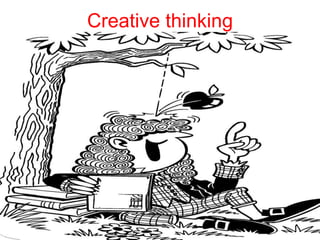
Creative thinking

    New under the sun
Unconscious rearrangement
Creative thinking
insight
• New idea seem to come suddenly after
  littele progress has been made over a long
  period of time.
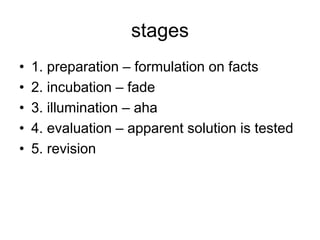
stages
•   1. preparation – formulation on facts
•   2. incubation – fade
•   3. illumination – aha
•   4. evaluation – apparent solution is tested
•   5. revision
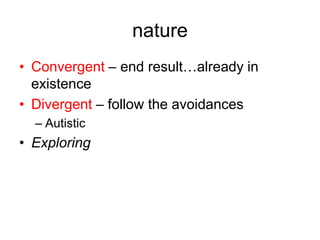
nature
• Convergent – end result…already in
  existence
• Divergent – follow the avoidances
  – Autistic
• Exploring
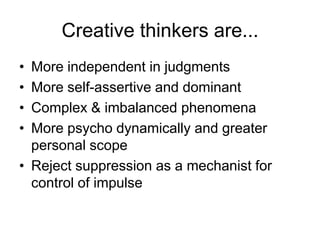
Creative thinkers are...
• More independent in judgments
• More self-assertive and dominant
• Complex & imbalanced phenomena
• More psycho dynamically and greater
  personal scope
• Reject suppression as a mechanist for
  control of impulse
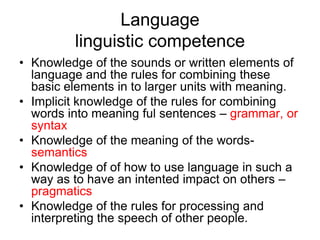
Language
         linguistic competence
• Knowledge of the sounds or written elements of
  language and the rules for combining these
  basic elements in to larger units with meaning.
• Implicit knowledge of the rules for combining
  words into meaning ful sentences – grammar, or
  syntax
• Knowledge of the meaning of the words-
  semantics
• Knowledge of of how to use language in such a
  way as to have an intented impact on others –
  pragmatics
• Knowledge of the rules for processing and
  interpreting the speech of other people.
Thinking and language

Thinking and language

  • 1.
    Think over… Thinking Dr. Hetal Shah Dr. Dharmesh Bhadja
  • 2.
    Thinking process • Thinking over thinking • Language and thinking • Concepts • Problem solving – Algorithmic – Heuristic • Decision making – Utility, subjective probability – bias – Weighing alternatives
  • 4.
    …plz try… • DON’TTHINK… • AS YOU READ THIS, you are thinking something… • Even if you stop thinking about what you are reading, you are thinking something else…you are still thinking.
  • 5.
    What is thinking??? •Cognitively rearrangement or manipulation of both information from environment and the symbols stored in long term memory. • Symbols…language, images…used in thinking.
  • 6.
    • Thinking isthe way of information processing that goes on during the period between stimulus event and response to it. • Before making the purchase…
  • 7.
    Two types • Autistic– very personal – Dreams • Directed
  • 8.
    Thinking process • Human– animal • Animal language limited & simple • Human abundant availability of language and complex thinking
  • 9.
    Now lets think •Imagine you are sitting with a girl for candle light dinner, in five stared hotel. You ordered two ice creams of strawberry flavor. And the picture goes on…and at last you come to know, you have no money. • Have you imagine about the shape of the cup of ice cream? • Have you imagine about the dress of her? • Have you imagine about chairs/table on which you both are sitting???
  • 10.
    • We usedto think with help of images… – Incomplete – Abstractions of certain features from past experiences – From long term memory
  • 11.
    Thinking uses language and symbols.. • Thinking involves use of word, symbols… • Language as a tool of thought • Extremist view… • Language can actually determine the thoughts we are capable of having. • The linguistic relativity hypothesis
  • 12.
    …Thinking… extensively involves thelanguage, symbols, pictures… Thinking is actually a kind of inner speech “TALKING TO YOURSELF”
  • 13.
    …Controlled study… • Whatabout the DEAF? • Their cognitive and thinking capacity – N • Their verbal language – minimal or no • They use their own sign language • So language is there, either verbal or gestural. • Conclusion - Humans have an innate program for language
  • 14.
    CONCEPTS Important class oflanguage symbols used in thinking
  • 15.
    Classification with generalization •Concept of sex • Concept of girl to select a boy in modern times • Concept of analogy • Concept of drug proving
  • 16.
    • Symbolic constructionsthat represents some common & general features of many objects or events – Basic - sex – Formation based on discrimination learning – rewarded, reinforced… – Definition - psychology
  • 17.
  • 18.
    Now what todo…? • You are on bike. In middle of the journey, it got punctured. • What we should do for passing in the exam…? • There are five people in hostel. And three of them gone to palghar. How many remain…? • Imagine you are sitting with a girl for candle light dinner, in five stared hotel. You ordered two ice creams of strawberry flavor. And the picture goes on…and at last you come to know, you have no money. Now what to do…?
  • 19.
    • Algorithm –sure solution • Heuristic – multiple possibilities • Means-end-analysis – Each step leads closer to desire goal
  • 20.
    Habit and set- pattern
  • 21.
    Decision making… • Kindof problem solving in which we are presented with several alternatives among which we much choose. • Imagine you are sitting with a girl for candle light dinner, in five star hotel. You ordered two ice creams of strawberry flavor…and at last you come to know, you have no money. • Now what to do…?
  • 22.
    After completion ofBHMS • ? • ? • ? • ? • Reasons for MD • utility
  • 23.
    • Utility –perceived benefit or psychological value in making that decision • Subjective probability • 10$ • 100$ • SWOT analysis • SMART • An idea that has been formulated as a mathematical model of the decision process, is that people make decision that will maximize subjectively expected utility.
  • 24.
    BIAS • Problem experience •Use of specific heuristic • Another problem • Same heuristic… • i.e. favorite remedy • Rhus tox, bryonia - fever
  • 25.
    Thinking process… • Weighingalternatives • Imagine you are sitting with a girl for candle light dinner, in five stared hotel. You ordered two ice creams of strawberry flavor. And the picture goes on…and at last you come to know, you have no money. Now what to do…?
  • 26.
    Creative thinking New under the sun Unconscious rearrangement
  • 27.
  • 28.
    insight • New ideaseem to come suddenly after littele progress has been made over a long period of time.
  • 29.
    stages • 1. preparation – formulation on facts • 2. incubation – fade • 3. illumination – aha • 4. evaluation – apparent solution is tested • 5. revision
  • 30.
    nature • Convergent –end result…already in existence • Divergent – follow the avoidances – Autistic • Exploring
  • 31.
    Creative thinkers are... •More independent in judgments • More self-assertive and dominant • Complex & imbalanced phenomena • More psycho dynamically and greater personal scope • Reject suppression as a mechanist for control of impulse
  • 32.
    Language linguistic competence • Knowledge of the sounds or written elements of language and the rules for combining these basic elements in to larger units with meaning. • Implicit knowledge of the rules for combining words into meaning ful sentences – grammar, or syntax • Knowledge of the meaning of the words- semantics • Knowledge of of how to use language in such a way as to have an intented impact on others – pragmatics • Knowledge of the rules for processing and interpreting the speech of other people.