Chapter 5  Sensation
Sensation Sensation a process by which our sensory receptors and nervous system receive and represent stimulus energy Perception a process of organizing and interpreting sensory information, enabling us to recognize meaningful objects and events
Sensation Bottom-Up Processing analysis that begins with the sense receptors and works up to the brain’s integration of sensory information Top-Down Processing information processing guided by higher-level mental processes as when we construct perceptions drawing on our experience and expectations
Sensation- Basic Principles Psychophysics study of the relationship between physical characteristics of stimuli and our psychological experience of them Light-   brightness Sound-   volume Pressure-   weight Taste-   sweetness
Sensation- Thresholds Absolute Threshold   minimum stimulation needed to detect a particular stimulus usually defined as the stimulus needed for detection 50% of the time Difference Threshold minimum difference between two stimuli that a subject can detect 50% of the time just noticeable difference (JND) increases with magnitude
Sensation- Thresholds Signal Detection Theory predicts how and when we detect the presence of a faint stimulus (signal) amid background stimulation (noise) assumes that there is no single absolute threshold detection depends partly on person’s experience expectations motivation level of fatigue
Sensation- Thresholds Weber’s Law-   to perceive a difference between two stimuli, they must differ by a constant proportion light intensity-  8% weight-  2% tone frequency-  0.3% Sensory adaptation-   diminished sensitivity with constant stimulation
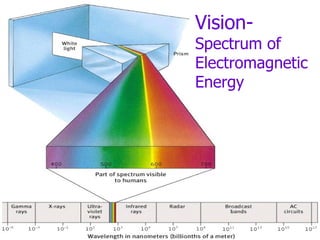
Vision Transduction-   conversion of one form of energy to another Wavelength-   the distance from the peak of one wave to the peak of the next Hue-   dimension of color determined by wavelength of light Intensity-   amount of energy in a wave determined by amplitude brightness loudness
Vision-   Spectrum of Electromagnetic Energy
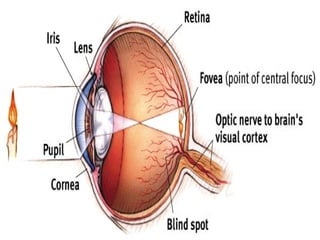
Vision Pupil-   adjustable opening in the center of the eye   Iris-  a ring of muscle the forms the colored portion of the eye around the pupil and controls the size of the pupil opening Lens-   transparent structure behind pupil that changes shape to focus images on the retina
Vision
Vision Accommodation change in shape of lens focus near objects Retina inner surface of eye light sensitive contains rods and cones layers of neurons beginning of visual information processing
Vision Acuity-   the sharpness of vision Nearsightedness nearby objects seen more clearly lens focuses image of distant objects in front of retina Farsightedness faraway objects seen more clearly lens focuses near objects behind retina
Retina’s Reaction to  Light- Receptors Cones near center of retina (fovea) fine detail and color vision daylight or well-lit conditions  Rods peripheral retina  detect black, white and gray twilight or low light
Retina’s Reaction to Light Optic nerve-  nerve that carries neural impulses from the eye to the brain Blind Spot-  point at which the optic nerve leaves the eye, creating a “blind spot” because there are no receptor cells located there Fovea-  central point in the retina, around which the eye’s cones cluster
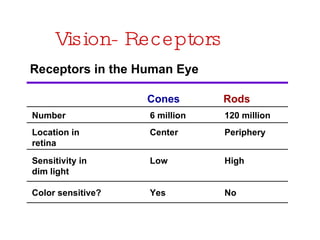
Vision- Receptors Receptors in the Human Eye Cones Rods Number Location in  retina Sensitivity in  dim light Color sensitive? Yes Low Center 6 million No High Periphery 120 million
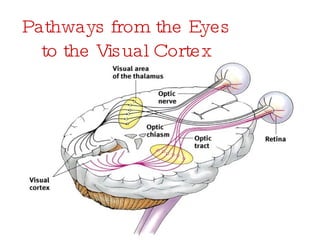
Pathways from the Eyes to the Visual Cortex
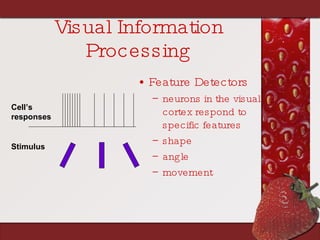
Visual Information Processing Feature Detectors neurons in the visual cortex respond to specific features shape angle movement Stimulus Cell’s  responses
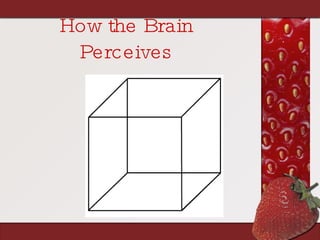
How the Brain Perceives
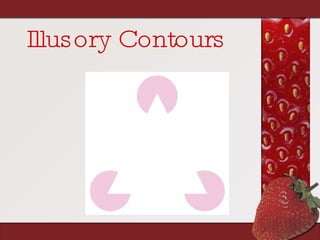
Illusory Contours
Visual Information Processing Parallel Processing simultaneous processing of several dimensions through multiple pathways color motion form depth
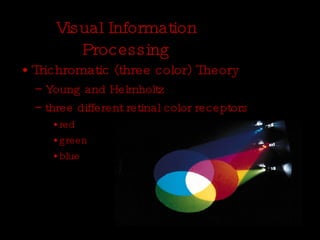
Visual Information Processing Trichromatic (three color) Theory Young and Helmholtz three different retinal color receptors red green blue
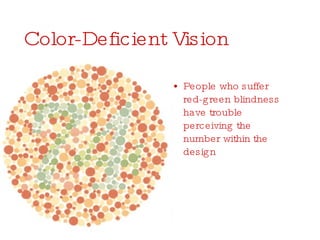
Color-Deficient Vision People who suffer red-green blindness have trouble perceiving the number within the design
Visual Information Processing Opponent-Process Theory-   opposing retinal processes enable color vision “ ON” “OFF” red  green green  red  blue  yellow  yellow  blue  black  white white  black
Audition Audition the sense of hearing Frequency the number of complete wavelengths that pass a point in a given time Pitch a tone’s highness or lowness depends on frequency
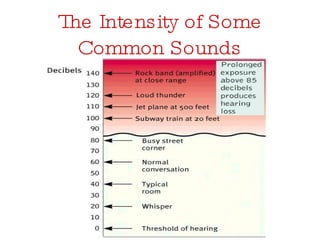
The Intensity of Some Common Sounds
 
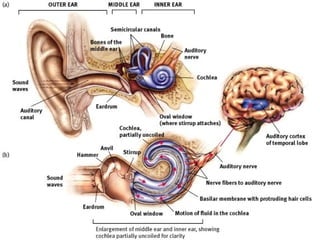
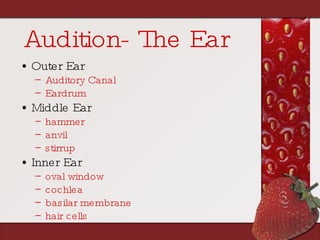
Audition- The Ear Outer Ear Auditory Canal Eardrum Middle Ear hammer anvil stirrup Inner Ear oval window cochlea basilar membrane hair cells
Audition Place Theory the theory that links the pitch we hear with the place where the cochlea’s membrane is stimulated Frequency Theory the theory that the rate of nerve impulses traveling up the auditory nerve matches the frequency of a tone, thus enabling us to sense its pitch
Audition Conduction Hearing Loss hearing loss caused by damage to the mechanical system that conducts sound waves to the cochlea Nerve Hearing Loss hearing loss caused by damage to the cochlea’s receptor cells or to the auditory nerve Older people tend to hear low frequencies well but suffer hearing loss for high frequencies
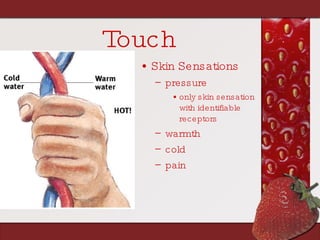
Touch Skin Sensations pressure only skin sensation with identifiable receptors warmth cold pain
Pain Gate-Control Theory theory that the spinal cord contains a neurological “gate” that blocks pain signals or allows them to pass on to the brain “ gate” opened by the activity of pain signals traveling up small nerve fibers  “ gate” closed by activity in larger fibers or by information coming from the brain
Taste Taste Sensations sweet sour salty bitter Sensory Interaction the principle that one sense may influence another as when the smell of food influences its taste
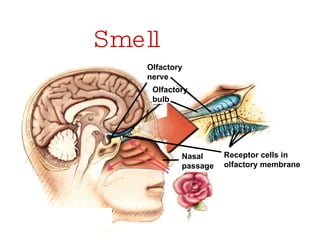
Smell Receptor cells in olfactory membrane Nasal  passage Olfactory bulb Olfactory nerve
Body Position and Movement Kinesthesis the system for sensing the position and movement of individual body parts Vestibular Sense the sense of body movement and position including the sense of balance

Sensation

  • 1.
    Chapter 5 Sensation
  • 2.
    Sensation Sensation aprocess by which our sensory receptors and nervous system receive and represent stimulus energy Perception a process of organizing and interpreting sensory information, enabling us to recognize meaningful objects and events
  • 3.
    Sensation Bottom-Up Processinganalysis that begins with the sense receptors and works up to the brain’s integration of sensory information Top-Down Processing information processing guided by higher-level mental processes as when we construct perceptions drawing on our experience and expectations
  • 4.
    Sensation- Basic PrinciplesPsychophysics study of the relationship between physical characteristics of stimuli and our psychological experience of them Light- brightness Sound- volume Pressure- weight Taste- sweetness
  • 5.
    Sensation- Thresholds AbsoluteThreshold minimum stimulation needed to detect a particular stimulus usually defined as the stimulus needed for detection 50% of the time Difference Threshold minimum difference between two stimuli that a subject can detect 50% of the time just noticeable difference (JND) increases with magnitude
  • 6.
    Sensation- Thresholds SignalDetection Theory predicts how and when we detect the presence of a faint stimulus (signal) amid background stimulation (noise) assumes that there is no single absolute threshold detection depends partly on person’s experience expectations motivation level of fatigue
  • 7.
    Sensation- Thresholds Weber’sLaw- to perceive a difference between two stimuli, they must differ by a constant proportion light intensity- 8% weight- 2% tone frequency- 0.3% Sensory adaptation- diminished sensitivity with constant stimulation
  • 8.
    Vision Transduction- conversion of one form of energy to another Wavelength- the distance from the peak of one wave to the peak of the next Hue- dimension of color determined by wavelength of light Intensity- amount of energy in a wave determined by amplitude brightness loudness
  • 9.
    Vision- Spectrum of Electromagnetic Energy
  • 10.
    Vision Pupil- adjustable opening in the center of the eye Iris- a ring of muscle the forms the colored portion of the eye around the pupil and controls the size of the pupil opening Lens- transparent structure behind pupil that changes shape to focus images on the retina
  • 11.
  • 12.
    Vision Accommodation changein shape of lens focus near objects Retina inner surface of eye light sensitive contains rods and cones layers of neurons beginning of visual information processing
  • 13.
    Vision Acuity- the sharpness of vision Nearsightedness nearby objects seen more clearly lens focuses image of distant objects in front of retina Farsightedness faraway objects seen more clearly lens focuses near objects behind retina
  • 14.
    Retina’s Reaction to Light- Receptors Cones near center of retina (fovea) fine detail and color vision daylight or well-lit conditions Rods peripheral retina detect black, white and gray twilight or low light
  • 15.
    Retina’s Reaction toLight Optic nerve- nerve that carries neural impulses from the eye to the brain Blind Spot- point at which the optic nerve leaves the eye, creating a “blind spot” because there are no receptor cells located there Fovea- central point in the retina, around which the eye’s cones cluster
  • 16.
    Vision- Receptors Receptorsin the Human Eye Cones Rods Number Location in retina Sensitivity in dim light Color sensitive? Yes Low Center 6 million No High Periphery 120 million
  • 17.
    Pathways from theEyes to the Visual Cortex
  • 18.
    Visual Information ProcessingFeature Detectors neurons in the visual cortex respond to specific features shape angle movement Stimulus Cell’s responses
  • 19.
    How the BrainPerceives
  • 20.
  • 21.
    Visual Information ProcessingParallel Processing simultaneous processing of several dimensions through multiple pathways color motion form depth
  • 22.
    Visual Information ProcessingTrichromatic (three color) Theory Young and Helmholtz three different retinal color receptors red green blue
  • 23.
    Color-Deficient Vision Peoplewho suffer red-green blindness have trouble perceiving the number within the design
  • 24.
    Visual Information ProcessingOpponent-Process Theory- opposing retinal processes enable color vision “ ON” “OFF” red green green red blue yellow yellow blue black white white black
  • 25.
    Audition Audition thesense of hearing Frequency the number of complete wavelengths that pass a point in a given time Pitch a tone’s highness or lowness depends on frequency
  • 26.
    The Intensity ofSome Common Sounds
  • 27.
  • 28.
    Audition- The EarOuter Ear Auditory Canal Eardrum Middle Ear hammer anvil stirrup Inner Ear oval window cochlea basilar membrane hair cells
  • 29.
    Audition Place Theorythe theory that links the pitch we hear with the place where the cochlea’s membrane is stimulated Frequency Theory the theory that the rate of nerve impulses traveling up the auditory nerve matches the frequency of a tone, thus enabling us to sense its pitch
  • 30.
    Audition Conduction HearingLoss hearing loss caused by damage to the mechanical system that conducts sound waves to the cochlea Nerve Hearing Loss hearing loss caused by damage to the cochlea’s receptor cells or to the auditory nerve Older people tend to hear low frequencies well but suffer hearing loss for high frequencies
  • 31.
    Touch Skin Sensationspressure only skin sensation with identifiable receptors warmth cold pain
  • 32.
    Pain Gate-Control Theorytheory that the spinal cord contains a neurological “gate” that blocks pain signals or allows them to pass on to the brain “ gate” opened by the activity of pain signals traveling up small nerve fibers “ gate” closed by activity in larger fibers or by information coming from the brain
  • 33.
    Taste Taste Sensationssweet sour salty bitter Sensory Interaction the principle that one sense may influence another as when the smell of food influences its taste
  • 34.
    Smell Receptor cellsin olfactory membrane Nasal passage Olfactory bulb Olfactory nerve
  • 35.
    Body Position andMovement Kinesthesis the system for sensing the position and movement of individual body parts Vestibular Sense the sense of body movement and position including the sense of balance