Chapter 8: Language and
Thought
The Cognitive Revolution
 19th Century focus on the mind
 Introspection
 Behaviorist focus on overt responses
 arguments regarding incomplete picture of
human functioning
 Empirical study of cognition – 1956
conference
 Simon and Newell – problem solving
 Chomsky – new model of language
 Miller – memory
Language: Turning Thoughts into Words
 Properties of Language
 Symbolic
 Semantic
 Generative
 Structured
The Hierarchical Structure of Language
 Phonemes = smallest speech units
 100 possible, English – about 40
 Morphemes = smallest unit of meaning
 50,000 in English, root words, prefixes, suffixes
 Semantics = meaning of words and word
combinations
 Objects and actions to which words refer
 Syntax = a system of rules for arranging
words into sentences
 Different rules for different languages
Language Development: Milestones
 Initial vocalizations similar across languages
 Crying, cooing, babbling
 6 months – babbling sounds begin to
resemble surrounding language
 Twin Talk
 1 year – first word
 similar cross-culturally – words for parents
 receptive vs. expressive language
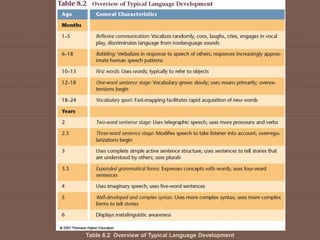
Table 8.2 Overview of Typical Language Development
Language Development:
Milestones Continued
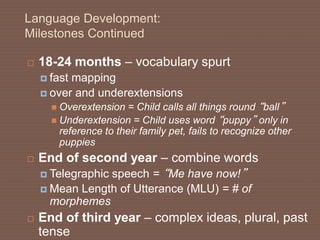
 18-24 months – vocabulary spurt
 fast mapping
 over and underextensions
 Overextension = Child calls all things round “ball”
 Underextension = Child uses word “puppy” only in
reference to their family pet, fails to recognize other
puppies
 End of second year – combine words
 Telegraphic speech = “Me have now!”
 Mean Length of Utterance (MLU) = # of
morphemes
 End of third year – complex ideas, plural, past
tense
Bilingualism:
Learning More Than One Language
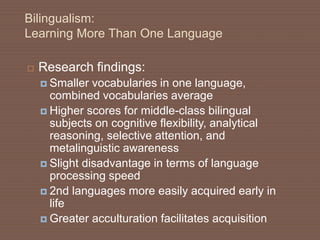
 Research findings:
 Smaller vocabularies in one language,
combined vocabularies average
 Higher scores for middle-class bilingual
subjects on cognitive flexibility, analytical
reasoning, selective attention, and
metalinguistic awareness
 Slight disadvantage in terms of language
processing speed
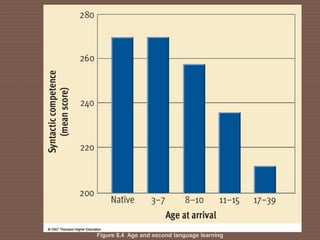
 2nd languages more easily acquired early in
life
 Greater acculturation facilitates acquisition
Figure 8.4 Age and second language learning
B.F. Skinner v. Noam Chomsky
Attempts to explain language development have sparked a spirited intellectual controversy. At the heart of this controversy is the nature-nurture debate.
Behaviorist B. F. Skinner believed that we can explain how babies acquire language entirely with principles of learning, such as the association of
objects with the sounds of words, the imitation of language modeled by others, and the reinforcement of correct use of words and syntax by parents and
teachers. Linguist Noam Chomsky, who favors the nature position, believes that much of our language capacity is inborn. According to this perspective,
just as "learning" to walk is programmed according to a timetable of biological maturation, so children are prewired to begin to babble and talk.
In this exercise, review each of the following examples of language use by children and decide whether it best supports
the position of B. F. Skinner or Noam Chomsky.
1.While Marie and her mother are looking at a book together, Marie's mother shows her a
picture of an animal and says "cow." Marie says "cow," and her mother praises her for her
correct utterance. Two pages later, Marie spontaneously points to a picture and correctly
identifies it as a cow.
2. When his day care teacher asks 2-year-old Jack what he did last Saturday, he responds
with "We goed to the zoo." His teacher smiles, marveling at the fact that all children Jack's
age make this type of grammatical error.
3. Nicole, who is deaf and was not exposed to sign language until age 3, lacks the manual
linguistic skills of deaf children born to deaf-signing parents.
4. Twelve-year-old Malcolm, who emigrated to the United States at age 4, understands
English grammar much better than 20-year-old Maya, who was first exposed to English at
age 12.
Can Animals Develop Language?
 Dolphins, sea lions, parrots, chimpanzees
 Vocal apparatus issue
 American Sign Language
 Allen and Beatrice Gardner (1969)
 Chimpanzee - Washoe
 160 word vocabulary
 Sue Savage-Rumbaugh
 Bonobo chimpanzee - Kanzi
 Symbols
 Receptive language – 72% of 660 requests
Theories of Language Acquisition
 Behaviorist
 Skinner (Verbal Behavior 1957)
 learning of specific verbal responses
 Nativist
 Chomsky
 learning the rules of language
 Language Acquisition Device (LAD)
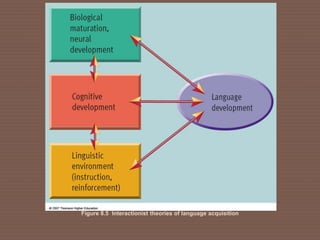
 Interactionist
 Cognitive, social communication, and
emergentist theories
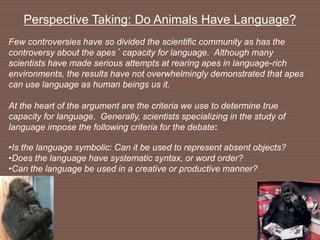
Perspective Taking: Do Animals Have Language?
Few controversies have so divided the scientific community as has the
controversy about the apes’ capacity for language. Although many
scientists have made serious attempts at rearing apes in language-rich
environments, the results have not overwhelmingly demonstrated that apes
can use language as human beings us it.
At the heart of the argument are the criteria we use to determine true
capacity for language. Generally, scientists specializing in the study of
language impose the following criteria for the debate:
•Is the language symbolic: Can it be used to represent absent objects?
•Does the language have systematic syntax, or word order?
•Can the language be used in a creative or productive manner?
Figure 8.5 Interactionist theories of language acquisition
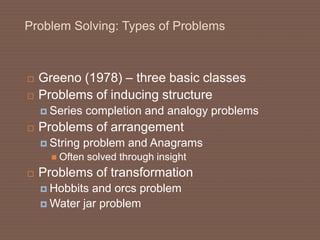
Problem Solving: Types of Problems
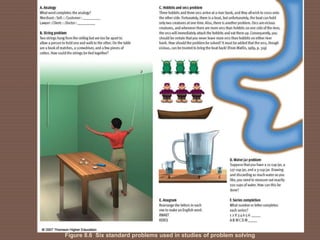
 Greeno (1978) – three basic classes
 Problems of inducing structure
 Series completion and analogy problems
 Problems of arrangement
 String problem and Anagrams
 Often solved through insight
 Problems of transformation
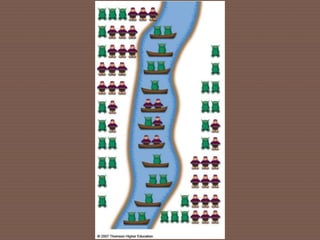
 Hobbits and orcs problem
 Water jar problem
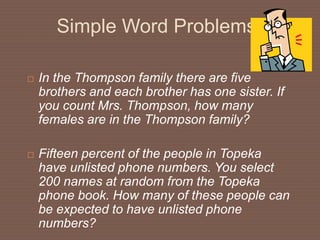
Simple Word Problems
 In the Thompson family there are five
brothers and each brother has one sister. If
you count Mrs. Thompson, how many
females are in the Thompson family?
 Fifteen percent of the people in Topeka
have unlisted phone numbers. You select
200 names at random from the Topeka
phone book. How many of these people can
be expected to have unlisted phone
numbers?
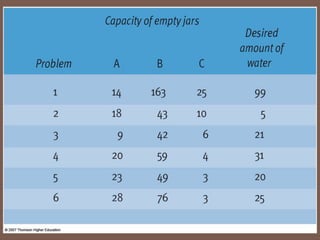
Figure 8.6 Six standard problems used in studies of problem solving
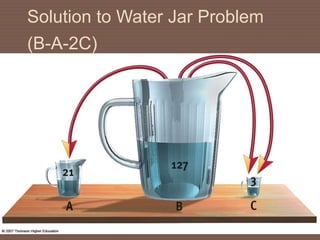
Solution to Water Jar Problem
(B-A-2C)
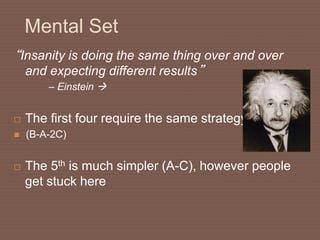
Mental Set
“Insanity is doing the same thing over and over
and expecting different results”
– Einstein 
 The first four require the same strategy
 (B-A-2C)
 The 5th is much simpler (A-C), however people
get stuck here
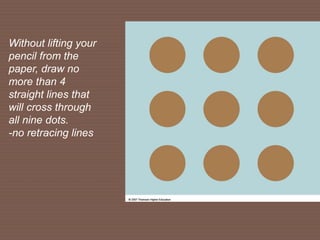
Without lifting your
pencil from the
paper, draw no
more than 4
straight lines that
will cross through
all nine dots.
-no retracing lines
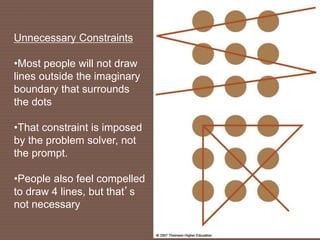
Unnecessary Constraints
•Most people will not draw
lines outside the imaginary
boundary that surrounds
the dots
•That constraint is imposed
by the problem solver, not
the prompt.
•People also feel compelled
to draw 4 lines, but that’s
not necessary
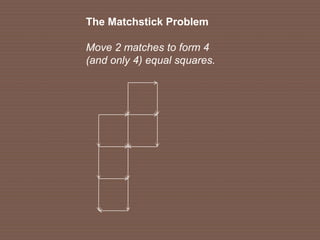
The Matchstick Problem
Move 2 matches to form 4
(and only 4) equal squares.
Matchstick Solution
Effective Problem Solving
 Barriers to effective problem solving:
 Irrelevant Information
 Functional Fixedness
 Mental Set
 Unnecessary Constraints
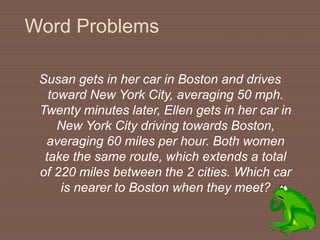
Word Problems
Susan gets in her car in Boston and drives
toward New York City, averaging 50 mph.
Twenty minutes later, Ellen gets in her car in
New York City driving towards Boston,
averaging 60 miles per hour. Both women
take the same route, which extends a total
of 220 miles between the 2 cities. Which car
is nearer to Boston when they meet?
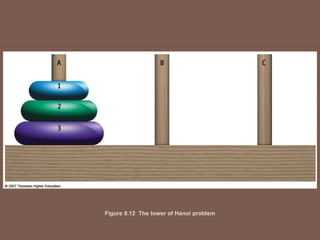
Figure 8.12 The tower of Hanoi problem
Approaches to Problem Solving
 Algorithms
 Systematic trial-and-error
 Guaranteed solution
 Heuristics
 Shortcuts
 No guaranteed solution
 Forming subgoals
 Working backward
 Searching for analogies
 Changing the representation of a problem
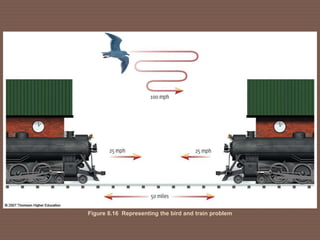
Figure 8.16 Representing the bird and train problem
Culture, Cognitive Style,
and Problem Solving
 Field dependence – relying on external frames
of reference
 Field independence – relying on internal
frames of reference
 Western cultures inspire field independence
 Cultural influence based in ecological demands
 Holistic vs. analytic cognitive styles
Decision Making:
Evaluating Alternatives and Making Choices
 Simon (1957) – theory of bounded
rationality
 Making Choices
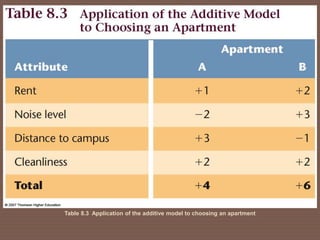
 Additive strategies
 Elimination by aspects
 Risky decision making
 Expected value
 Subjective utility
 Subjective probability
Table 8.3 Application of the additive model to choosing an apartment
Heuristics in Judging Probabilities
 The availability heuristic
 Explains why you are afraid of being attacked by a
shark, but you shouldn’t be.
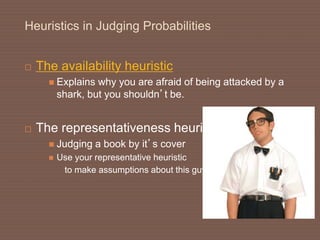
 The representativeness heuristic
 Judging a book by it’s cover
 Use your representative heuristic
to make assumptions about this guy 
Understanding Pitfalls in Reasoning About
Decisions
 The gambler’s fallacy
 Assuming something will happen soon because it’s
“due”
 Overestimating the improbable
 More likely to die in an airplane or car?
 Confirmation bias
 Seeking information to confirm what you already
believe
 The overconfidence effect
 98% confidence intervals only right 60% of the time
 Framing
 10 people are drowning, you can either save 5 of

LANGUAGE &THOUGHT -2.ppt

  • 1.
  • 2.
    The Cognitive Revolution 19th Century focus on the mind  Introspection  Behaviorist focus on overt responses  arguments regarding incomplete picture of human functioning  Empirical study of cognition – 1956 conference  Simon and Newell – problem solving  Chomsky – new model of language  Miller – memory
  • 3.
    Language: Turning Thoughtsinto Words  Properties of Language  Symbolic  Semantic  Generative  Structured
  • 4.
    The Hierarchical Structureof Language  Phonemes = smallest speech units  100 possible, English – about 40  Morphemes = smallest unit of meaning  50,000 in English, root words, prefixes, suffixes  Semantics = meaning of words and word combinations  Objects and actions to which words refer  Syntax = a system of rules for arranging words into sentences  Different rules for different languages
  • 5.
    Language Development: Milestones Initial vocalizations similar across languages  Crying, cooing, babbling  6 months – babbling sounds begin to resemble surrounding language  Twin Talk  1 year – first word  similar cross-culturally – words for parents  receptive vs. expressive language
  • 6.
    Table 8.2 Overviewof Typical Language Development
  • 7.
    Language Development: Milestones Continued 18-24 months – vocabulary spurt  fast mapping  over and underextensions  Overextension = Child calls all things round “ball”  Underextension = Child uses word “puppy” only in reference to their family pet, fails to recognize other puppies  End of second year – combine words  Telegraphic speech = “Me have now!”  Mean Length of Utterance (MLU) = # of morphemes  End of third year – complex ideas, plural, past tense
  • 8.
    Bilingualism: Learning More ThanOne Language  Research findings:  Smaller vocabularies in one language, combined vocabularies average  Higher scores for middle-class bilingual subjects on cognitive flexibility, analytical reasoning, selective attention, and metalinguistic awareness  Slight disadvantage in terms of language processing speed  2nd languages more easily acquired early in life  Greater acculturation facilitates acquisition
  • 9.
    Figure 8.4 Ageand second language learning
  • 10.
    B.F. Skinner v.Noam Chomsky Attempts to explain language development have sparked a spirited intellectual controversy. At the heart of this controversy is the nature-nurture debate. Behaviorist B. F. Skinner believed that we can explain how babies acquire language entirely with principles of learning, such as the association of objects with the sounds of words, the imitation of language modeled by others, and the reinforcement of correct use of words and syntax by parents and teachers. Linguist Noam Chomsky, who favors the nature position, believes that much of our language capacity is inborn. According to this perspective, just as "learning" to walk is programmed according to a timetable of biological maturation, so children are prewired to begin to babble and talk. In this exercise, review each of the following examples of language use by children and decide whether it best supports the position of B. F. Skinner or Noam Chomsky. 1.While Marie and her mother are looking at a book together, Marie's mother shows her a picture of an animal and says "cow." Marie says "cow," and her mother praises her for her correct utterance. Two pages later, Marie spontaneously points to a picture and correctly identifies it as a cow. 2. When his day care teacher asks 2-year-old Jack what he did last Saturday, he responds with "We goed to the zoo." His teacher smiles, marveling at the fact that all children Jack's age make this type of grammatical error. 3. Nicole, who is deaf and was not exposed to sign language until age 3, lacks the manual linguistic skills of deaf children born to deaf-signing parents. 4. Twelve-year-old Malcolm, who emigrated to the United States at age 4, understands English grammar much better than 20-year-old Maya, who was first exposed to English at age 12.
  • 11.
    Can Animals DevelopLanguage?  Dolphins, sea lions, parrots, chimpanzees  Vocal apparatus issue  American Sign Language  Allen and Beatrice Gardner (1969)  Chimpanzee - Washoe  160 word vocabulary  Sue Savage-Rumbaugh  Bonobo chimpanzee - Kanzi  Symbols  Receptive language – 72% of 660 requests
  • 12.
    Theories of LanguageAcquisition  Behaviorist  Skinner (Verbal Behavior 1957)  learning of specific verbal responses  Nativist  Chomsky  learning the rules of language  Language Acquisition Device (LAD)  Interactionist  Cognitive, social communication, and emergentist theories
  • 13.
    Perspective Taking: DoAnimals Have Language? Few controversies have so divided the scientific community as has the controversy about the apes’ capacity for language. Although many scientists have made serious attempts at rearing apes in language-rich environments, the results have not overwhelmingly demonstrated that apes can use language as human beings us it. At the heart of the argument are the criteria we use to determine true capacity for language. Generally, scientists specializing in the study of language impose the following criteria for the debate: •Is the language symbolic: Can it be used to represent absent objects? •Does the language have systematic syntax, or word order? •Can the language be used in a creative or productive manner?
  • 14.
    Figure 8.5 Interactionisttheories of language acquisition
  • 15.
    Problem Solving: Typesof Problems  Greeno (1978) – three basic classes  Problems of inducing structure  Series completion and analogy problems  Problems of arrangement  String problem and Anagrams  Often solved through insight  Problems of transformation  Hobbits and orcs problem  Water jar problem
  • 16.
    Simple Word Problems In the Thompson family there are five brothers and each brother has one sister. If you count Mrs. Thompson, how many females are in the Thompson family?  Fifteen percent of the people in Topeka have unlisted phone numbers. You select 200 names at random from the Topeka phone book. How many of these people can be expected to have unlisted phone numbers?
  • 17.
    Figure 8.6 Sixstandard problems used in studies of problem solving
  • 19.
    Solution to WaterJar Problem (B-A-2C)
  • 21.
    Mental Set “Insanity isdoing the same thing over and over and expecting different results” – Einstein   The first four require the same strategy  (B-A-2C)  The 5th is much simpler (A-C), however people get stuck here
  • 22.
    Without lifting your pencilfrom the paper, draw no more than 4 straight lines that will cross through all nine dots. -no retracing lines
  • 23.
    Unnecessary Constraints •Most peoplewill not draw lines outside the imaginary boundary that surrounds the dots •That constraint is imposed by the problem solver, not the prompt. •People also feel compelled to draw 4 lines, but that’s not necessary
  • 24.
    The Matchstick Problem Move2 matches to form 4 (and only 4) equal squares.
  • 25.
  • 26.
    Effective Problem Solving Barriers to effective problem solving:  Irrelevant Information  Functional Fixedness  Mental Set  Unnecessary Constraints
  • 27.
    Word Problems Susan getsin her car in Boston and drives toward New York City, averaging 50 mph. Twenty minutes later, Ellen gets in her car in New York City driving towards Boston, averaging 60 miles per hour. Both women take the same route, which extends a total of 220 miles between the 2 cities. Which car is nearer to Boston when they meet?
  • 28.
    Figure 8.12 Thetower of Hanoi problem
  • 29.
    Approaches to ProblemSolving  Algorithms  Systematic trial-and-error  Guaranteed solution  Heuristics  Shortcuts  No guaranteed solution  Forming subgoals  Working backward  Searching for analogies  Changing the representation of a problem
  • 30.
    Figure 8.16 Representingthe bird and train problem
  • 31.
    Culture, Cognitive Style, andProblem Solving  Field dependence – relying on external frames of reference  Field independence – relying on internal frames of reference  Western cultures inspire field independence  Cultural influence based in ecological demands  Holistic vs. analytic cognitive styles
  • 32.
    Decision Making: Evaluating Alternativesand Making Choices  Simon (1957) – theory of bounded rationality  Making Choices  Additive strategies  Elimination by aspects  Risky decision making  Expected value  Subjective utility  Subjective probability
  • 33.
    Table 8.3 Applicationof the additive model to choosing an apartment
  • 34.
    Heuristics in JudgingProbabilities  The availability heuristic  Explains why you are afraid of being attacked by a shark, but you shouldn’t be.  The representativeness heuristic  Judging a book by it’s cover  Use your representative heuristic to make assumptions about this guy 
  • 35.
    Understanding Pitfalls inReasoning About Decisions  The gambler’s fallacy  Assuming something will happen soon because it’s “due”  Overestimating the improbable  More likely to die in an airplane or car?  Confirmation bias  Seeking information to confirm what you already believe  The overconfidence effect  98% confidence intervals only right 60% of the time  Framing  10 people are drowning, you can either save 5 of