Chapter One: Intro/History Why Study Psychology? Overview of Goals of Psychology A Brief History of Psychology Psychology as a Profession
I.  Why Study Psychology? Insight Practical Information
Psychology The scientific study of  behavior  and  mental processes .  Such study can involve both  animal  and  human  behavior.  When applied to humans, psychology covers everything that people  think ,  feel , and  do .
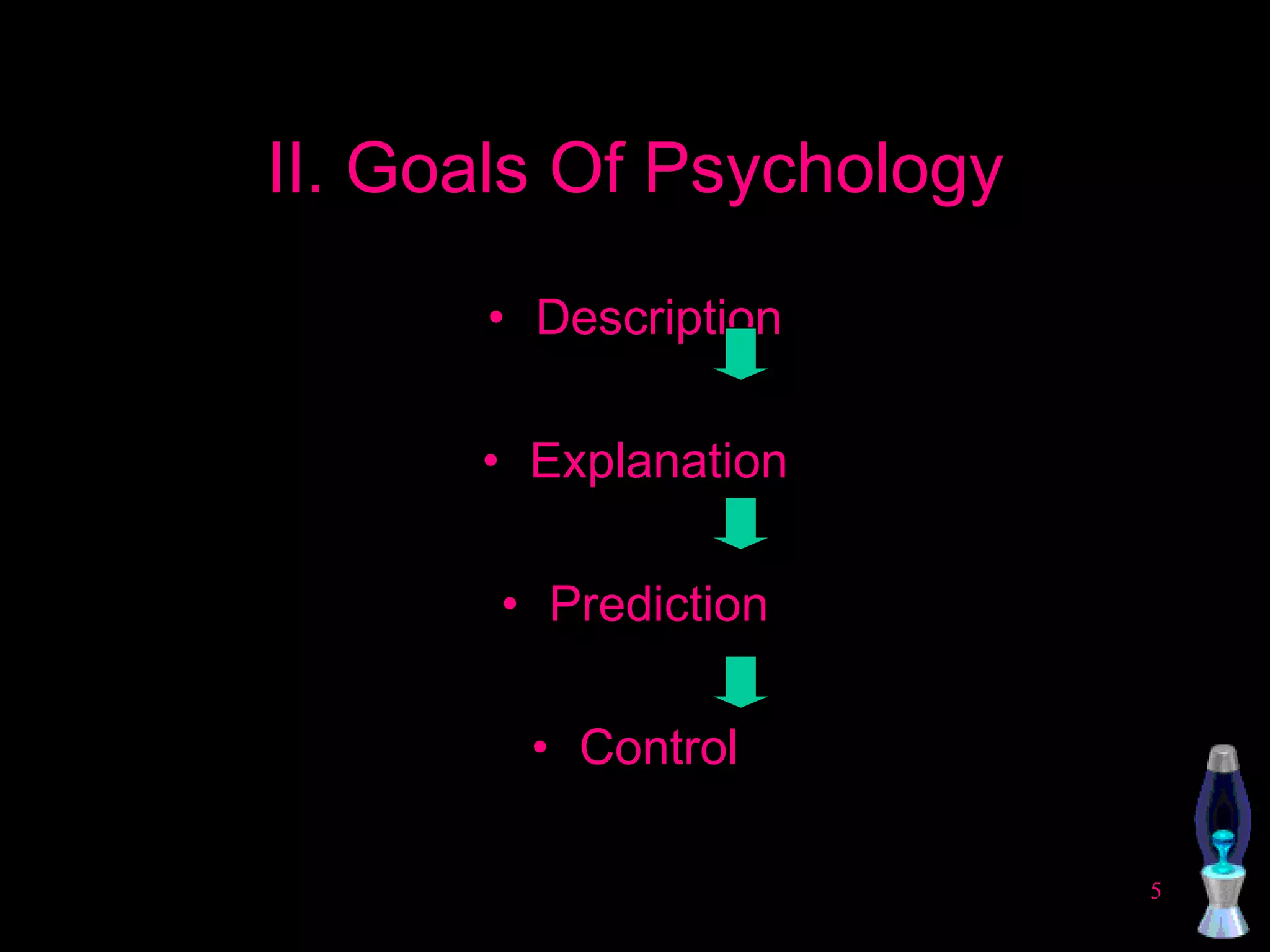
The Goals of Psychology Description Explanation Prediction Control Basic Science Applied Science
II. Goals Of Psychology Description Explanation Prediction Control
Description Gather information State the facts (What it is)
Explanation Formulate hypotheses Develop theories (Why it is)
Hypothesis An educated guess about the relationship between two variables
Theory An integrated set of principles that organizes, explains, and predicts observations. Exploring Psychology , Myers, 1990
Prediction Study theories and descriptive accounts of past behaviors Predict subsequent behaviors (What it will be)
Control Influence or manipulate behavior Basic science Applied science
Basic Science The pursuit of knowledge about natural phenomena for its own sake (to gain knowledge simply for the sake of knowledge) (acquire knowledge)
Applied Science Discovering ways to use scientific findings to accomplish practical goals (use knowledge)
Hypothesis-building Studies done on Orphanage Children Dennis, W.  “Causes of Retardation Among  Institutional Children: Iran.”  Journal of Genetic Psychology , 96 (1960):47-58  -  Applied or Basic? White, B.L.  “Child Development Research: An Edifice Without a Foundation.”  Merrill- Palmer Quarterly of Behavior and  Development , 15 (1969): 49-79 Applied or Basic? Shaffer (1993) Applied or Basic?
The Scientific Method State the problem Develop a hypothesis Conduct research Organize and interpret data Draw conclusions Communicate the results  Psychology: A Concise Introduction , Pettijohn, 1992
III.  A Brief History of Psychology Psychology as a Discipline
A.  Psychology as a Discipline -  Early History Stone Age BC: The Ancient Greeks The Middle Ages 16th century: Copernicus and Galileo 17th century: Descartes and the pseudo-sciences
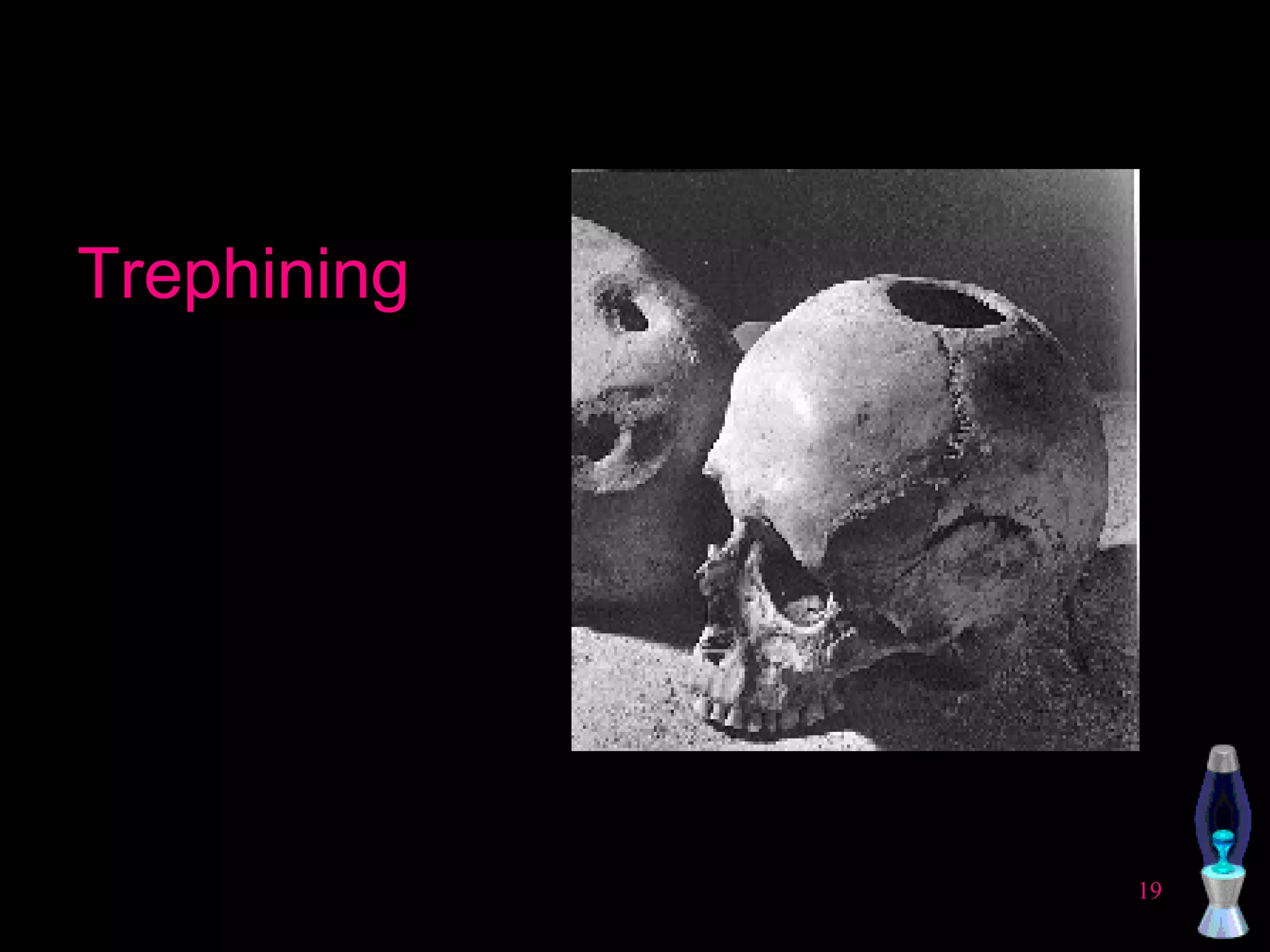
1.  The Stone Age Trephining Evil spirits Archeology
Trephining
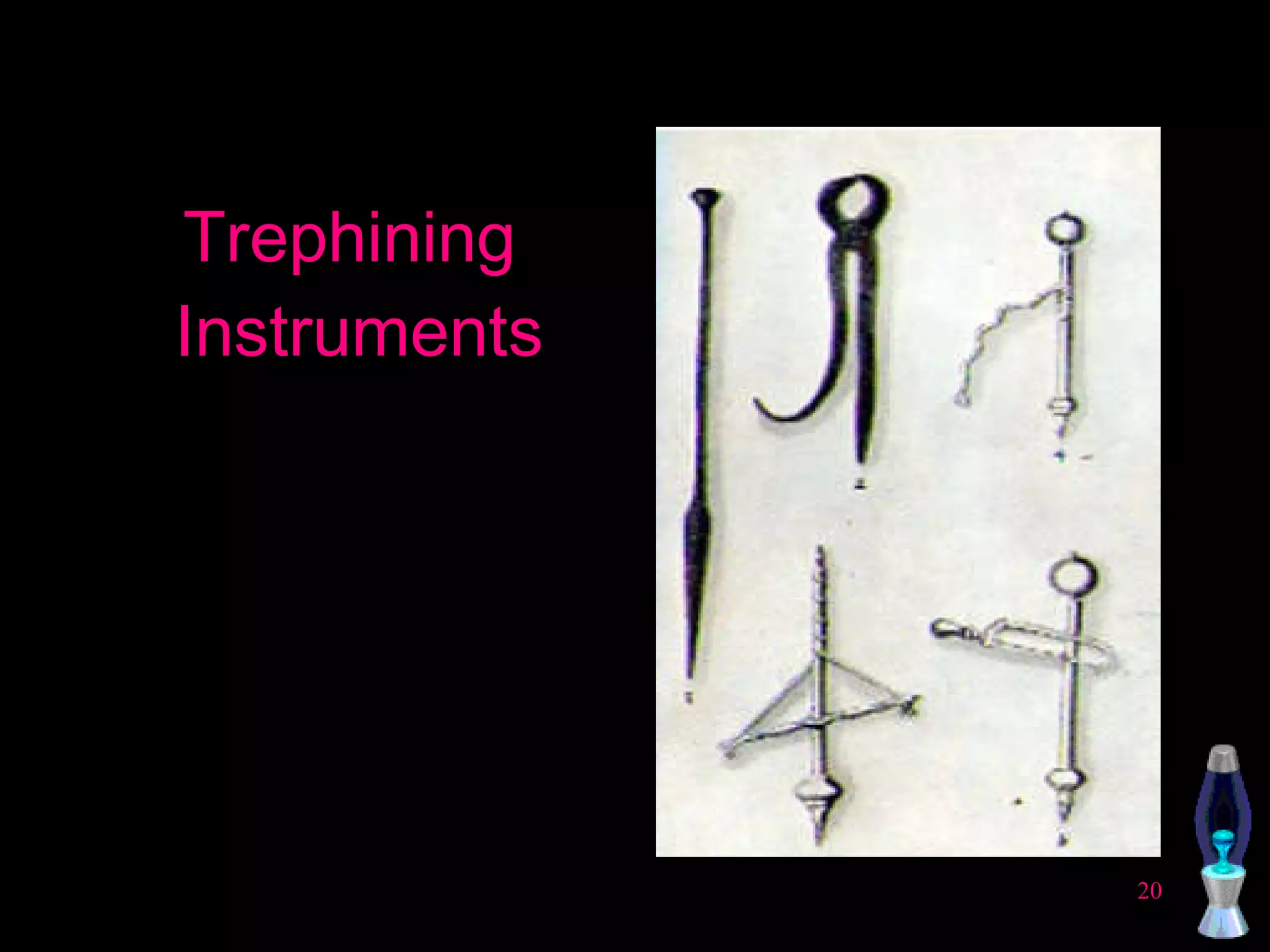
Trephining  Instruments
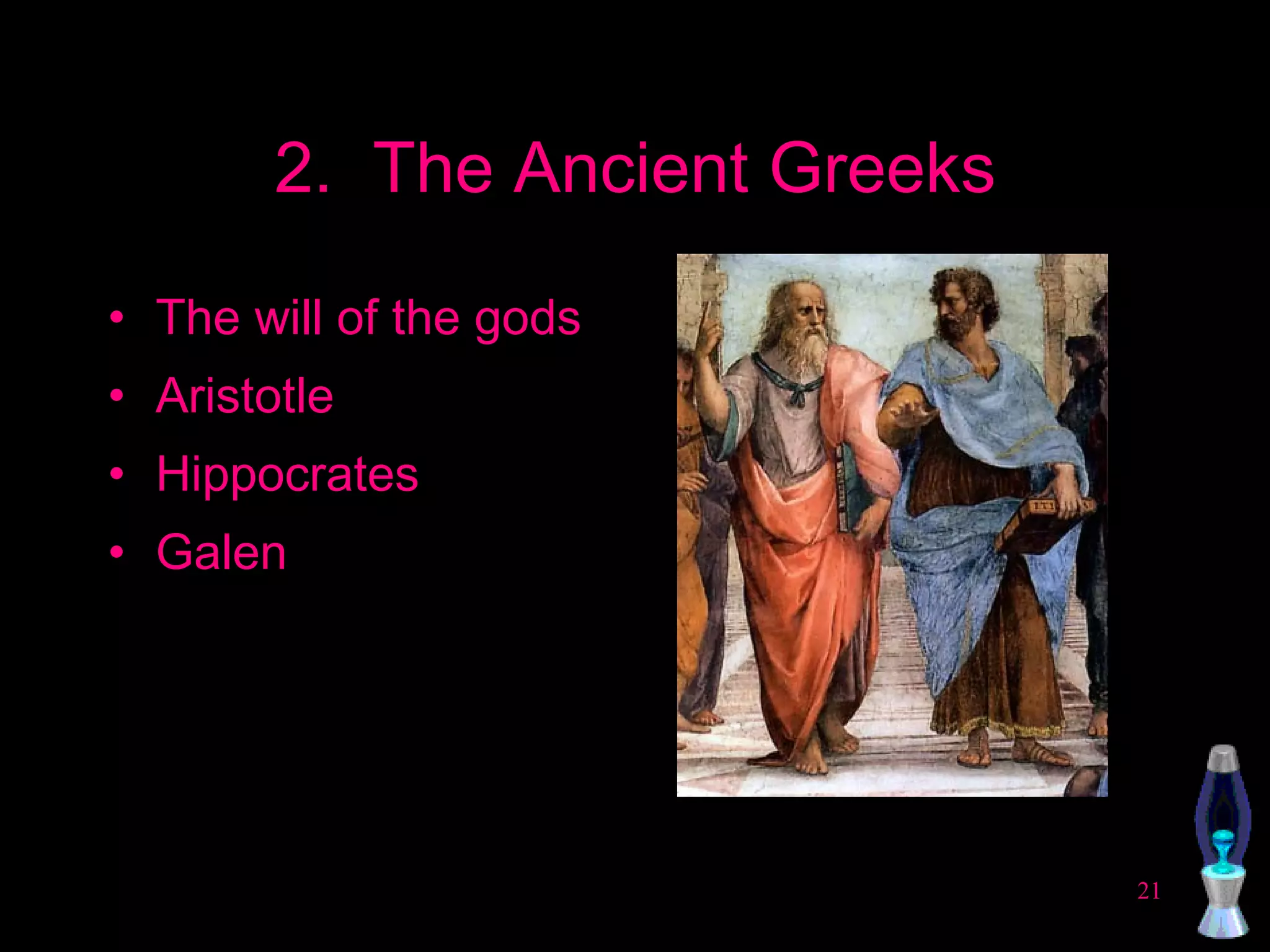
2.  The Ancient Greeks The will of the gods Aristotle Hippocrates Galen
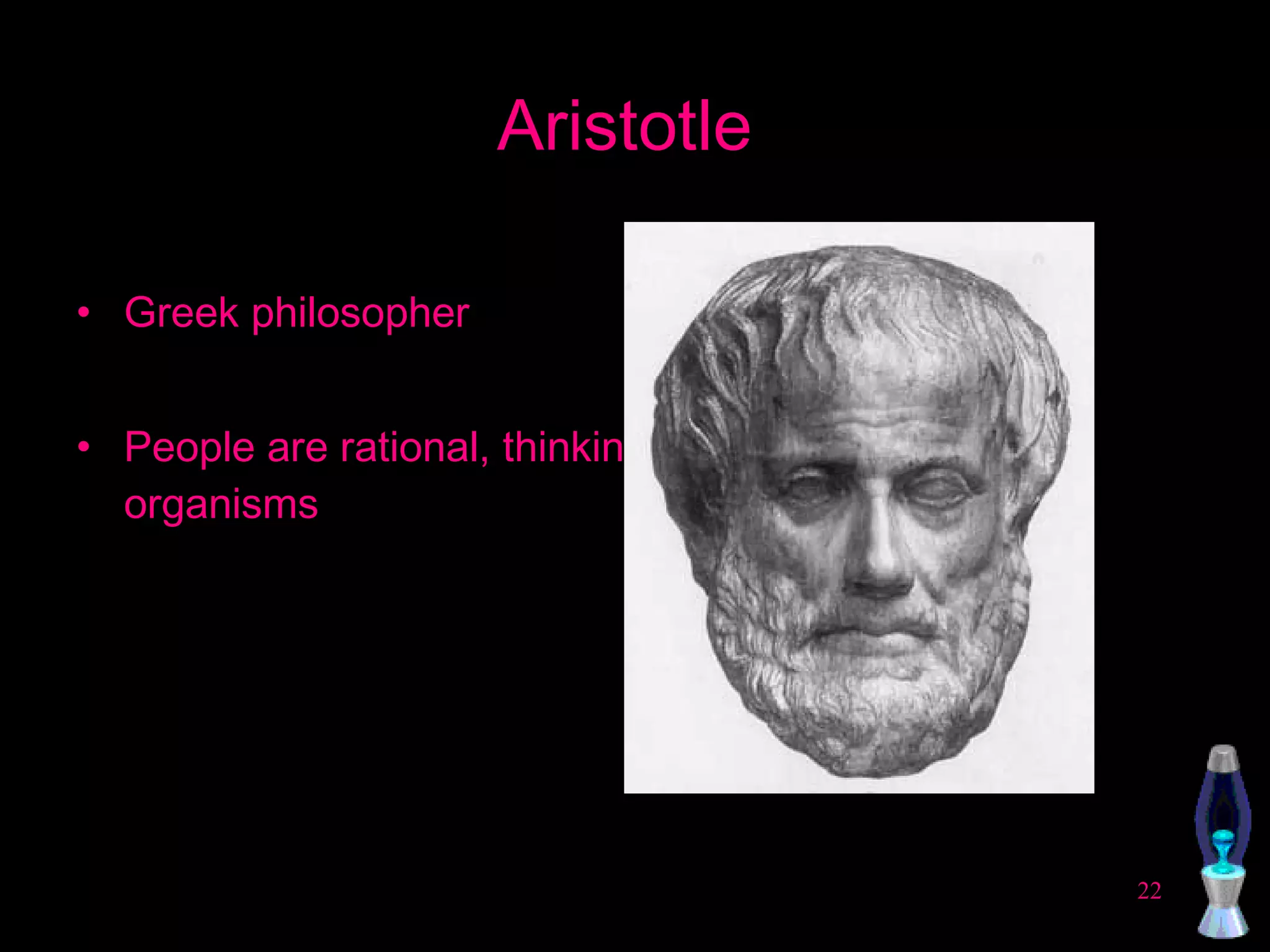
Aristotle Greek philosopher People are rational, thinking organisms
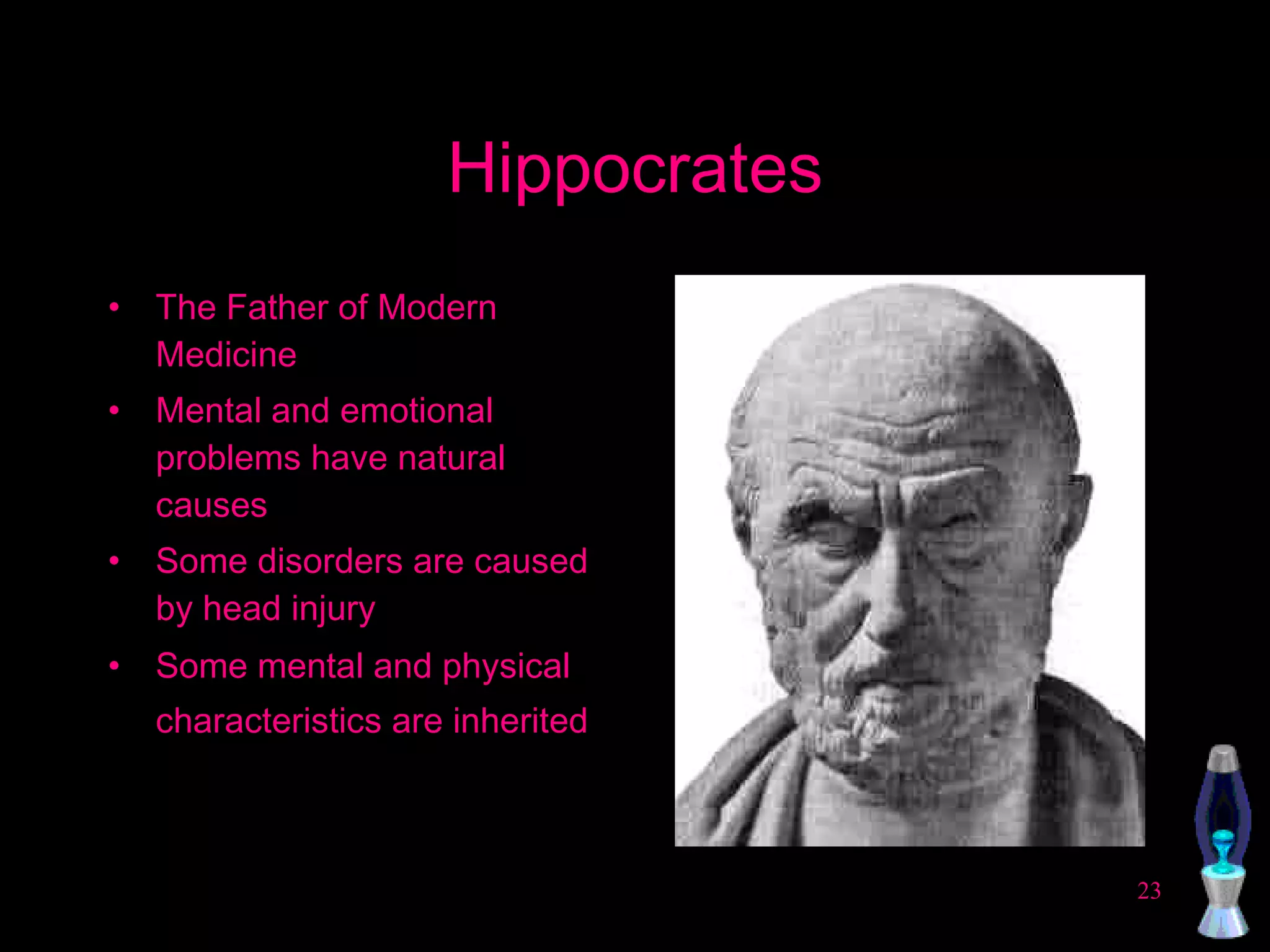
Hippocrates The Father of Modern Medicine Mental and emotional problems have natural causes Some disorders are caused by head injury Some mental and physical characteristics are inherited
Ancient Greeks Observation as a means of knowing the world
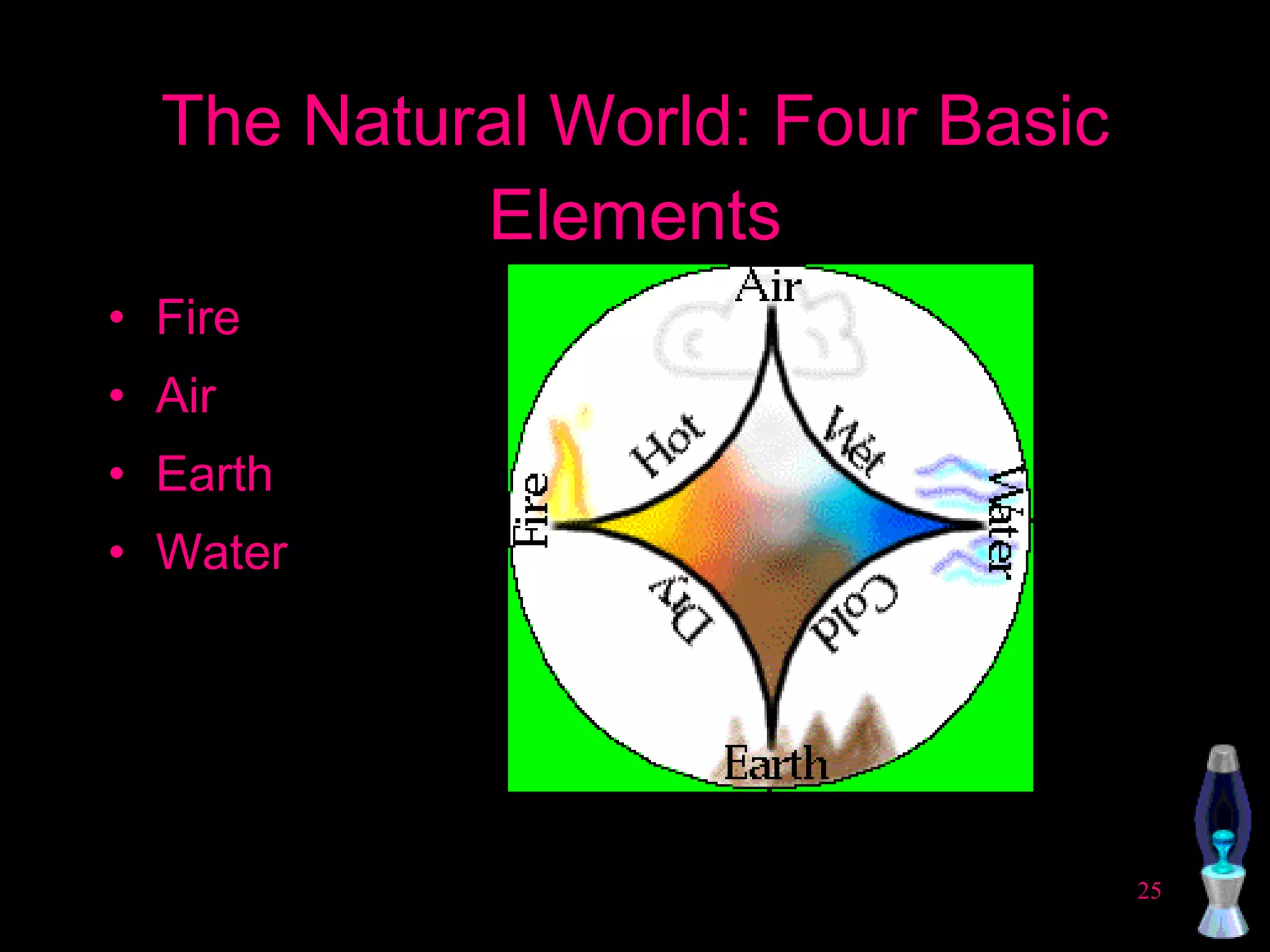
The Natural World: Four Basic Elements Fire Air Earth Water
The Natural World: Four Basic Elements Fire Warm Air Cool Earth Dry Water Moist
The Four Humors Blood (warm and moist) Black bile (cold and dry) Yellow bile (warm and dry) Phlegm (cold and moist)
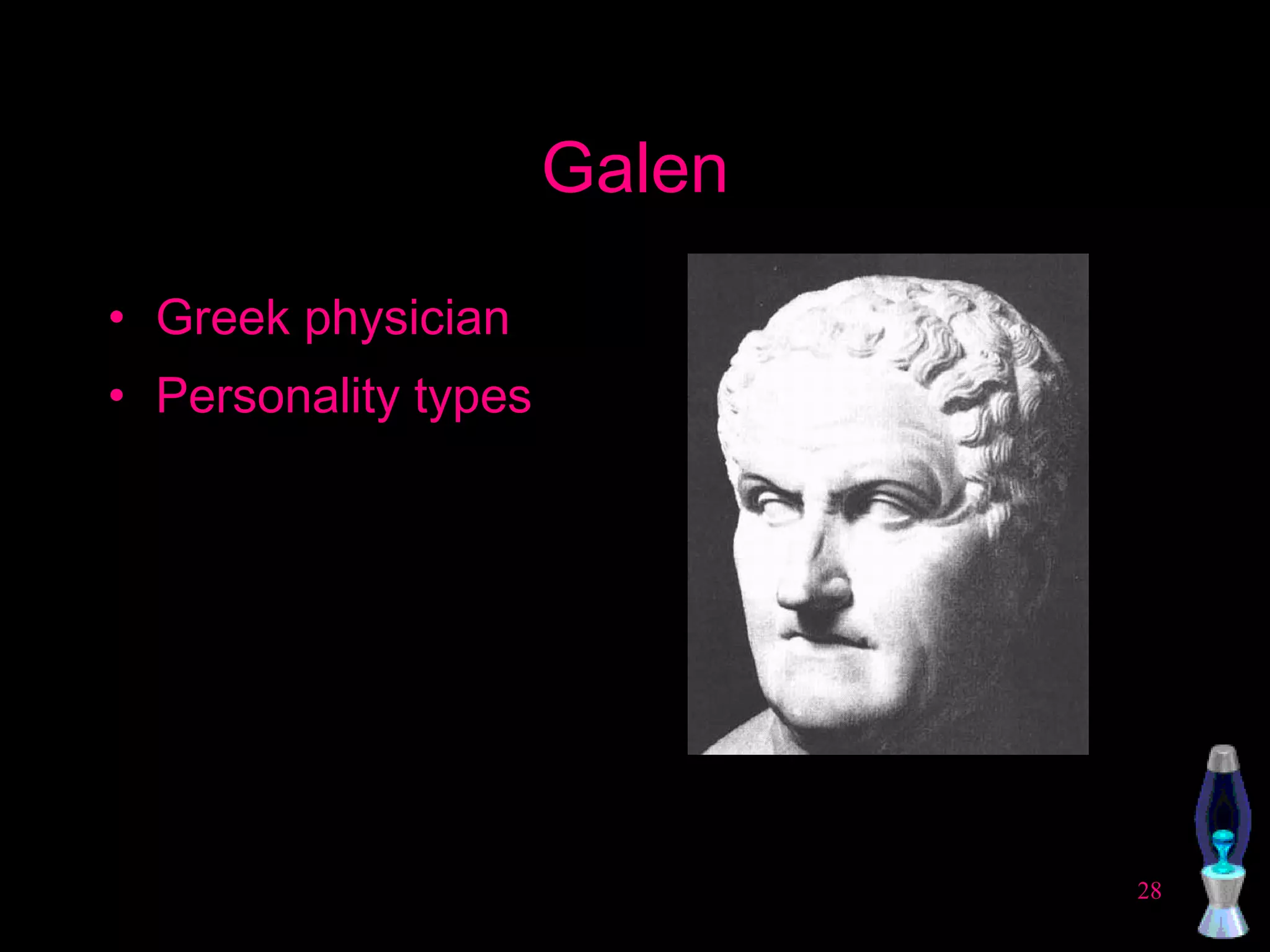
Galen Greek physician Personality types
Galen: Personality Types An excess of… blood  =  sanguine personality  (cheerful, warm-hearted) black bile  =  melancholic personality  (sad) yellow bile  =  choleric personality  (hot-tempered) phlegm  =  phlegmatic personality  (apathetic)
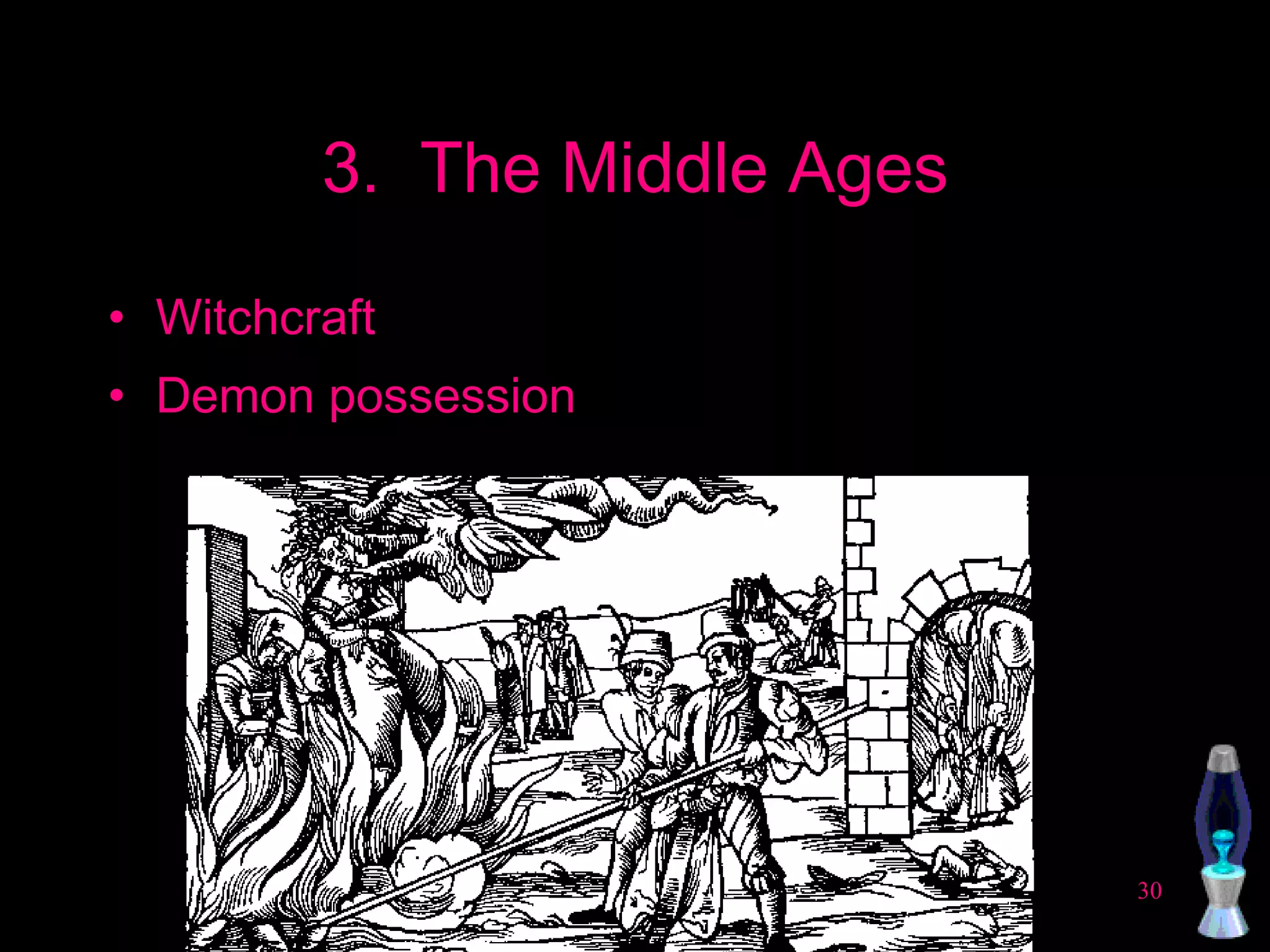
3.  The Middle Ages Witchcraft Demon possession
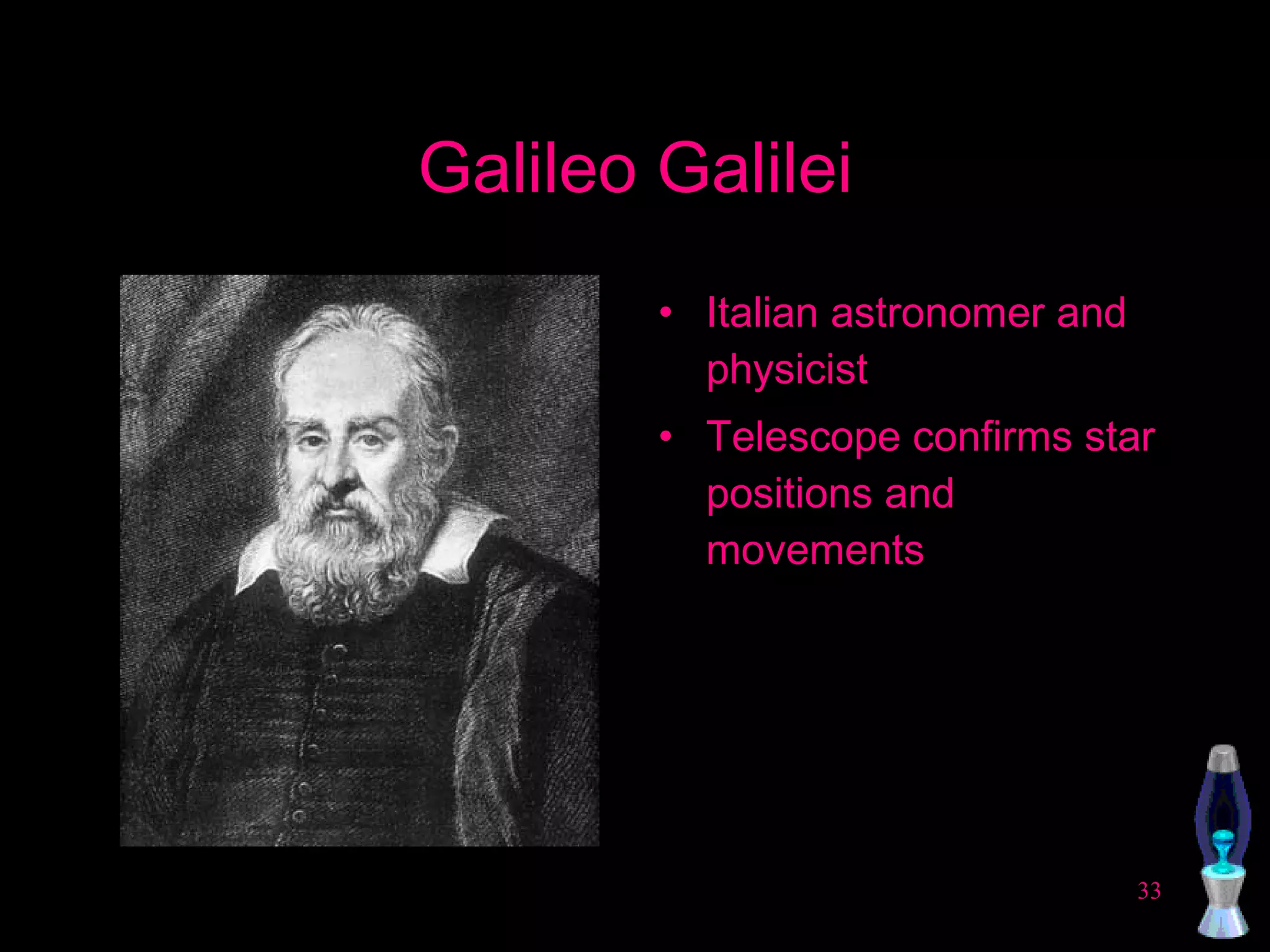
4.  The 16th Century Nicolaus Copernicus Galileo Galilei
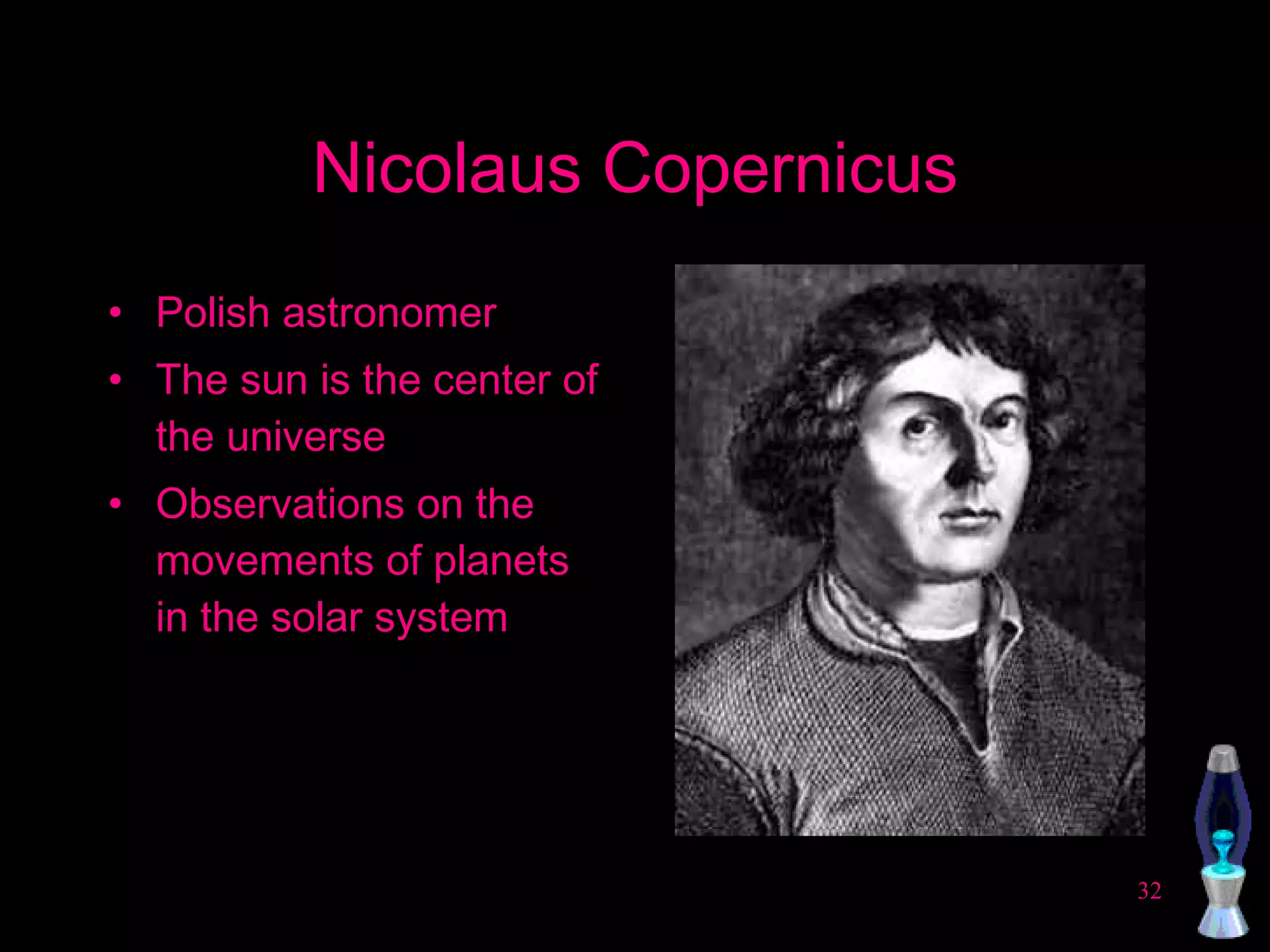
Nicolaus Copernicus Polish astronomer The sun is the center of the universe Observations on the movements of planets in the solar system
Galileo Galilei Italian astronomer and physicist Telescope confirms star positions and movements
The 16th Century Introduced the concept of observation as an element of scientific study (Copernicus) Introduced the concept of experimentation as an element of scientific study (Galileo)
5.  The 17th Century Dualism Rene Descartes Pseudo-sciences
Dualism Philosophy which teaches that the mind and body are separate and distinct from each other.
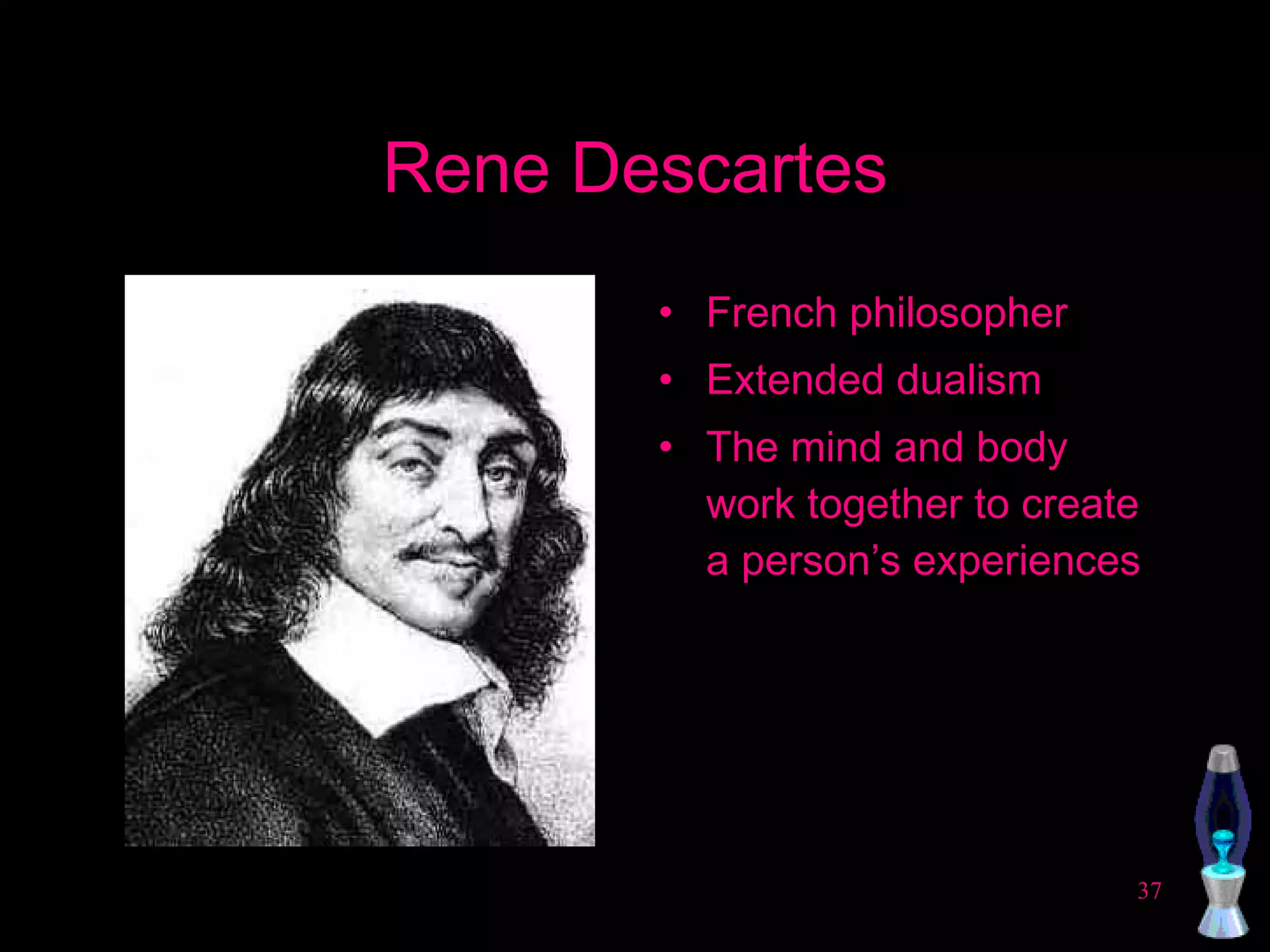
Rene Descartes French philosopher Extended dualism The mind and body work together to create a person’s experiences
The Pseudo-sciences Phrenology Physiognomy Typology
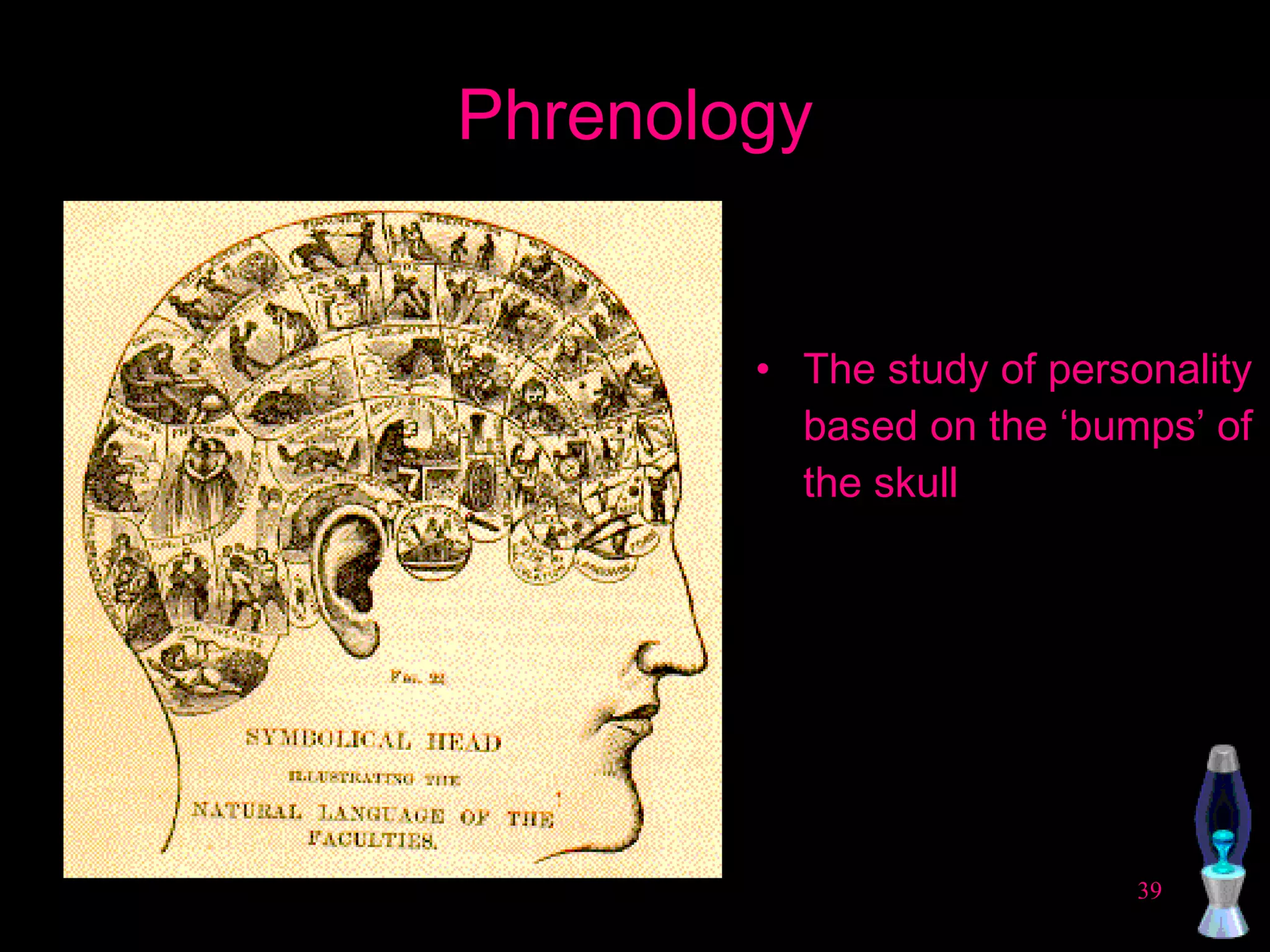
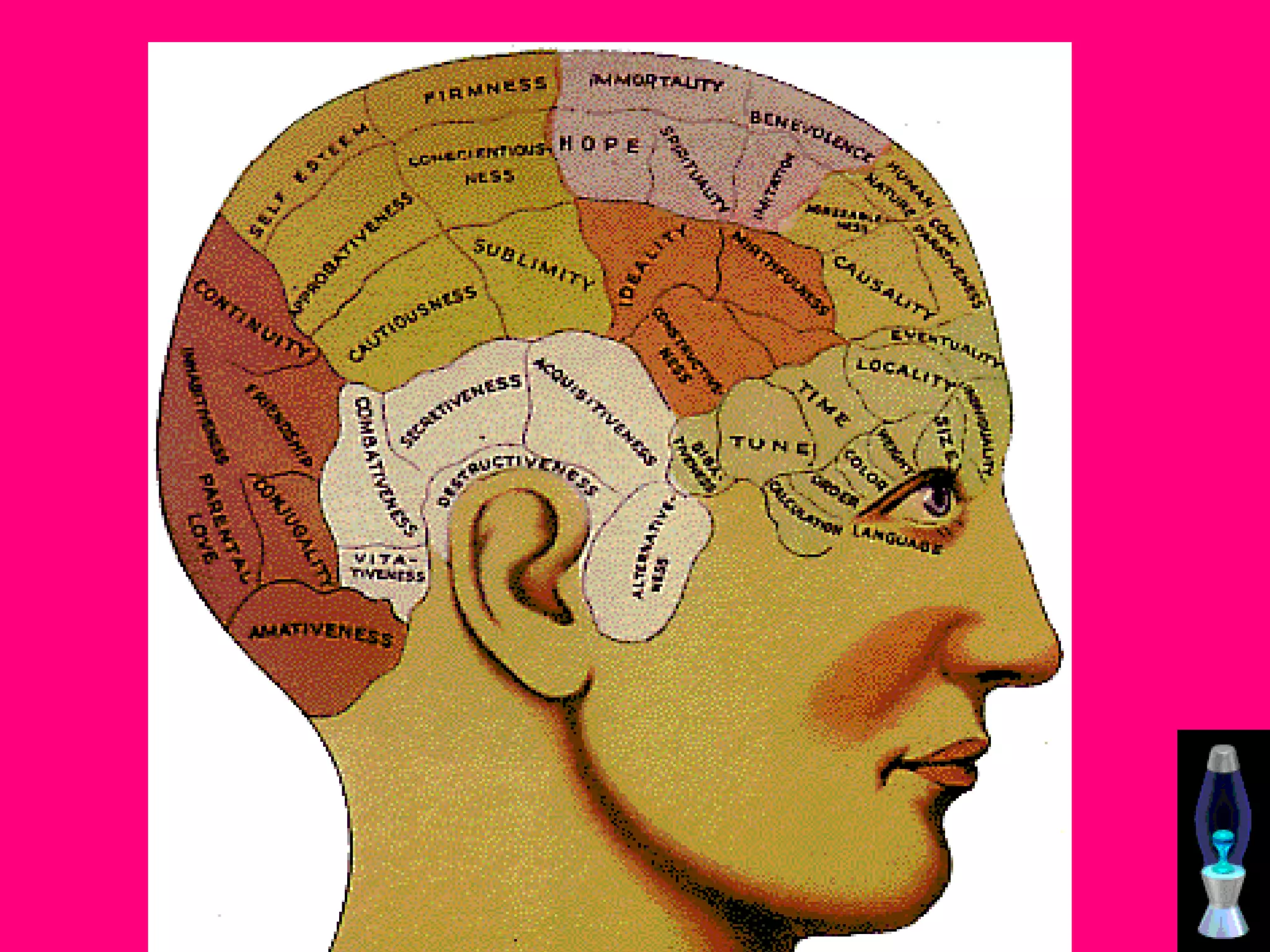
Phrenology The study of personality based on the ‘bumps’ of the skull
Modern Science A combination of… Philosophy Logic Math Observation
Psychology as a Discipline - Basic Theories Structuralism Functionalism
Structuralism Thoughts have structure, just as a molecule does
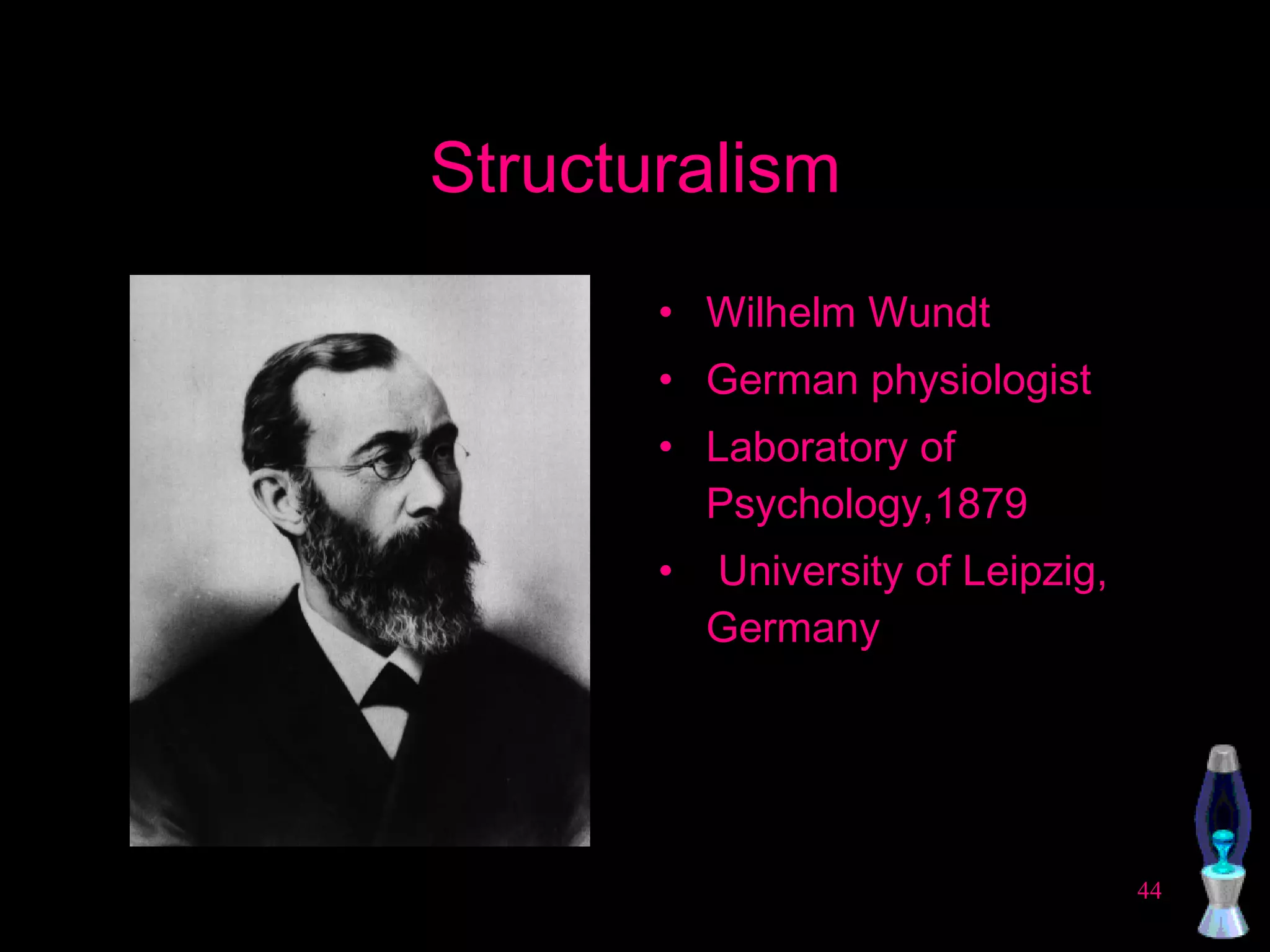
Structuralism Wilhelm Wundt German physiologist Laboratory of Psychology,1879 University of Leipzig, Germany
Structuralism The mind must be studied as scientifically as other ‘natural laws’ Wundt, Wilhelm,  Principles of Physiological Psychology , 1878
Introspection A detailed examination of one’s own thinking A controlled situation with trained subjects reporting their thoughts so that the basic structure of thought processes can be mapped
Functionalism The functions of the human mind -- thinking, feeling, learning, remembering -- exist to help man survive as a species
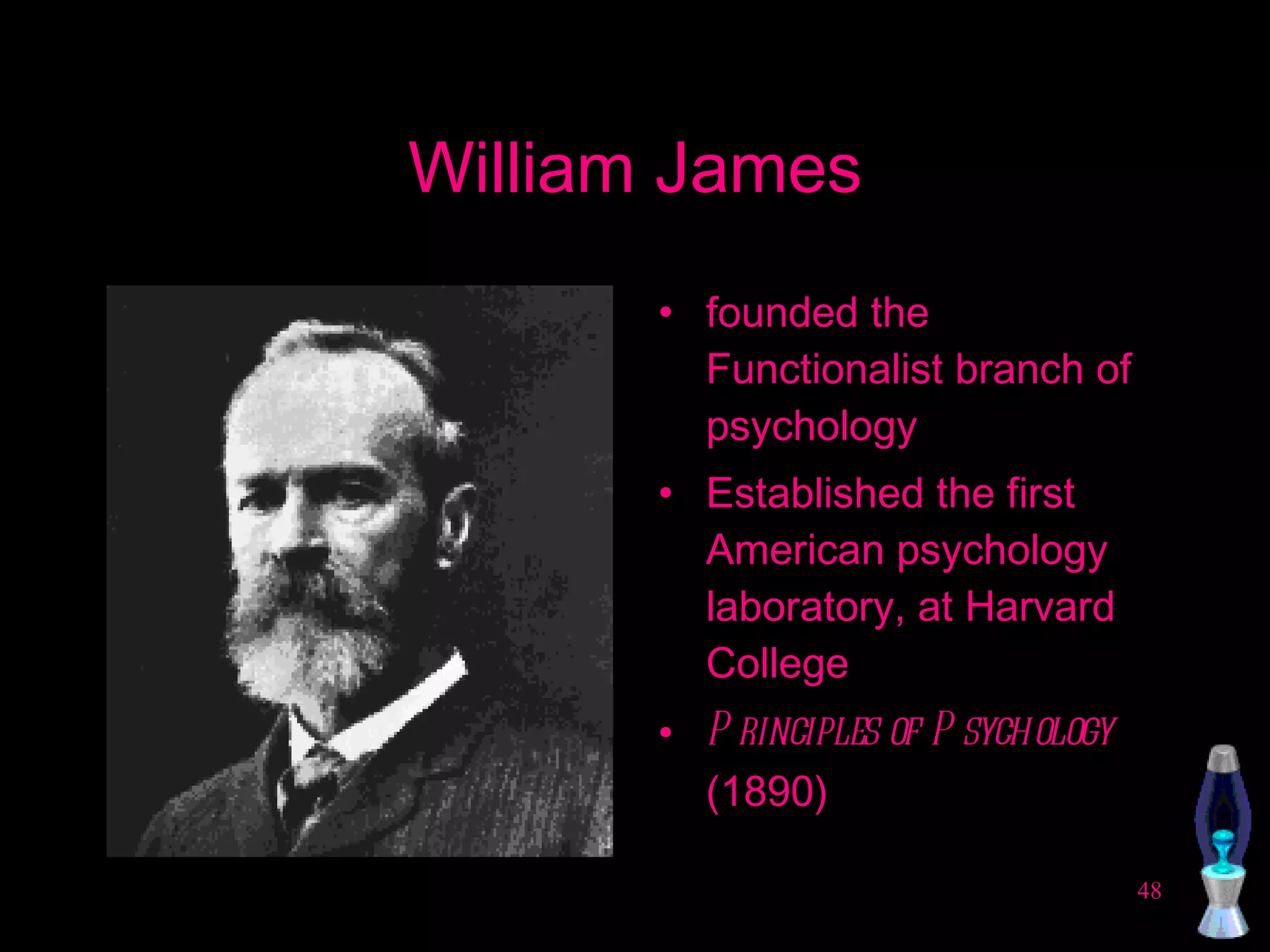
William James founded the Functionalist branch of psychology Established the first American psychology laboratory, at Harvard College Principles of Psychology  (1890)
A Brief History of Psychology B.  Psychology as the Study of... Unconscious Processes Individual Differences Observable Behavior Cognitive Processes
1.) Unconscious Processes Psychoanalysis Study of the unconscious mind Sigmund Freud
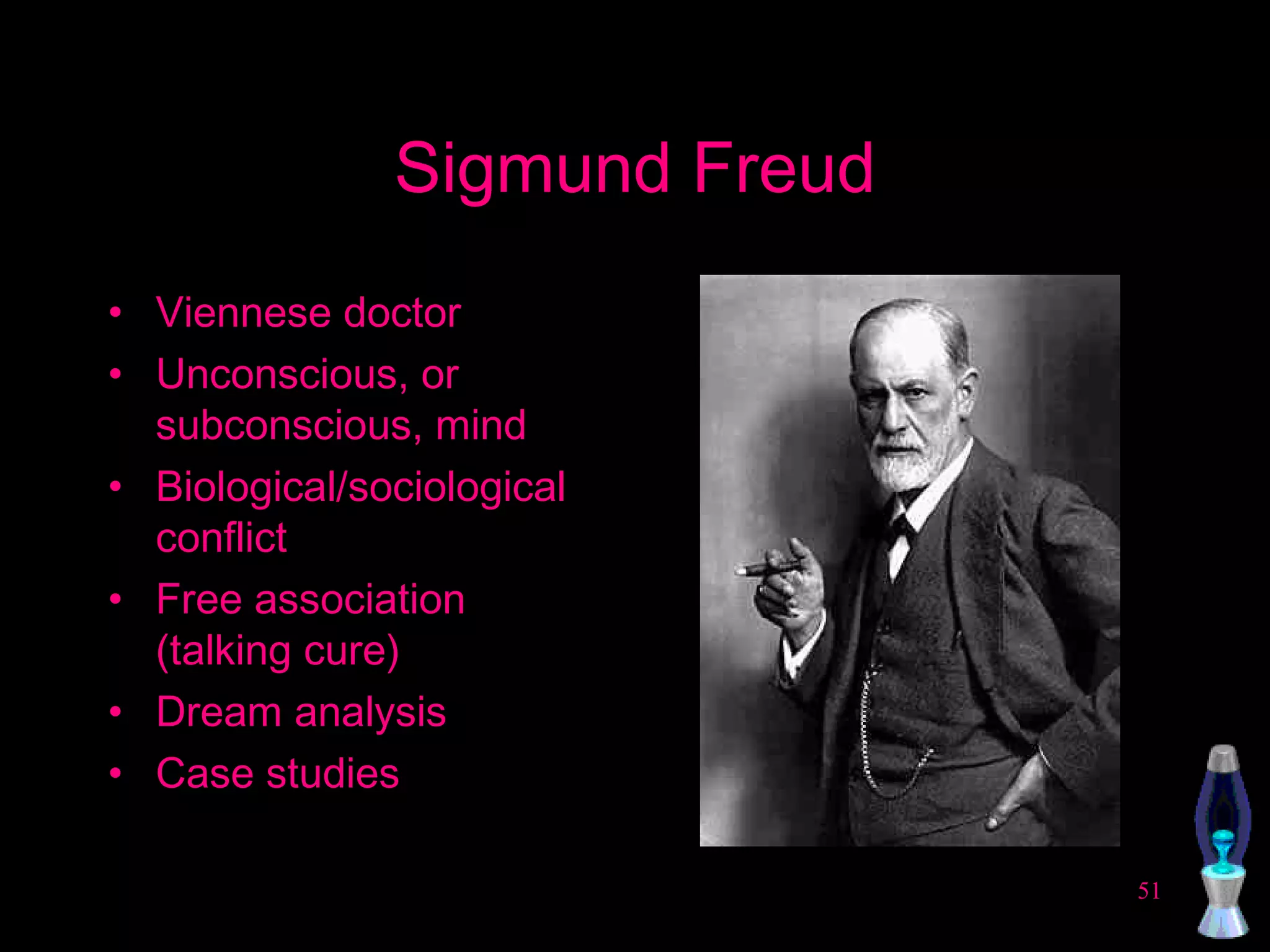
Sigmund Freud Viennese doctor Unconscious, or subconscious, mind Biological/sociological conflict Free association (talking cure) Dream analysis Case studies
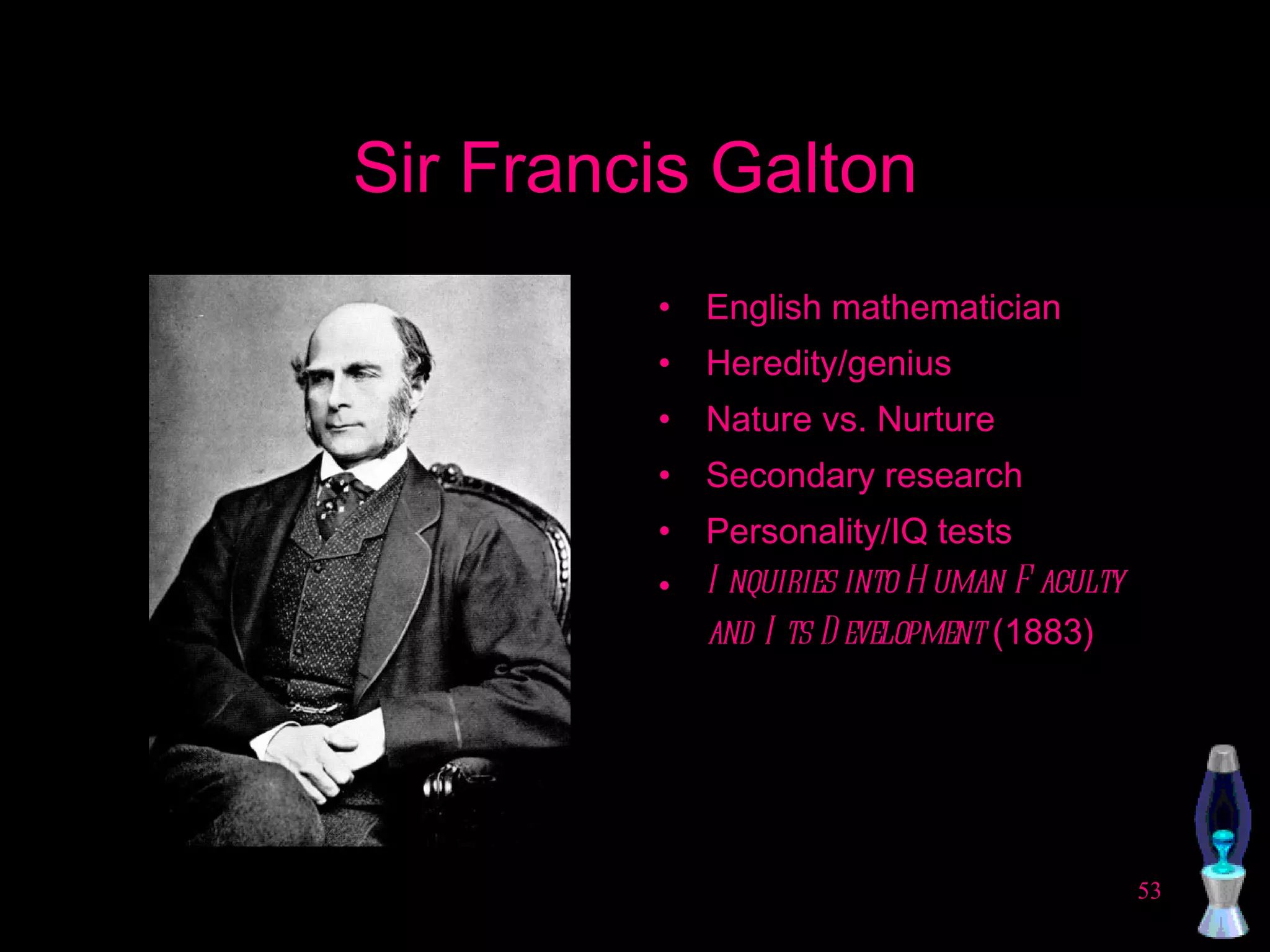
2.) Individual Differences Sir Francis Galton
Sir Francis Galton English mathematician Heredity/genius Nature vs. Nurture Secondary research Personality/IQ tests Inquiries into Human Faculty and Its Development  (1883)
3.) Observable Behavior Behaviorism Humanistic Psychology
Behaviorism Ivan Pavlov John B. Watson B. F. Skinner
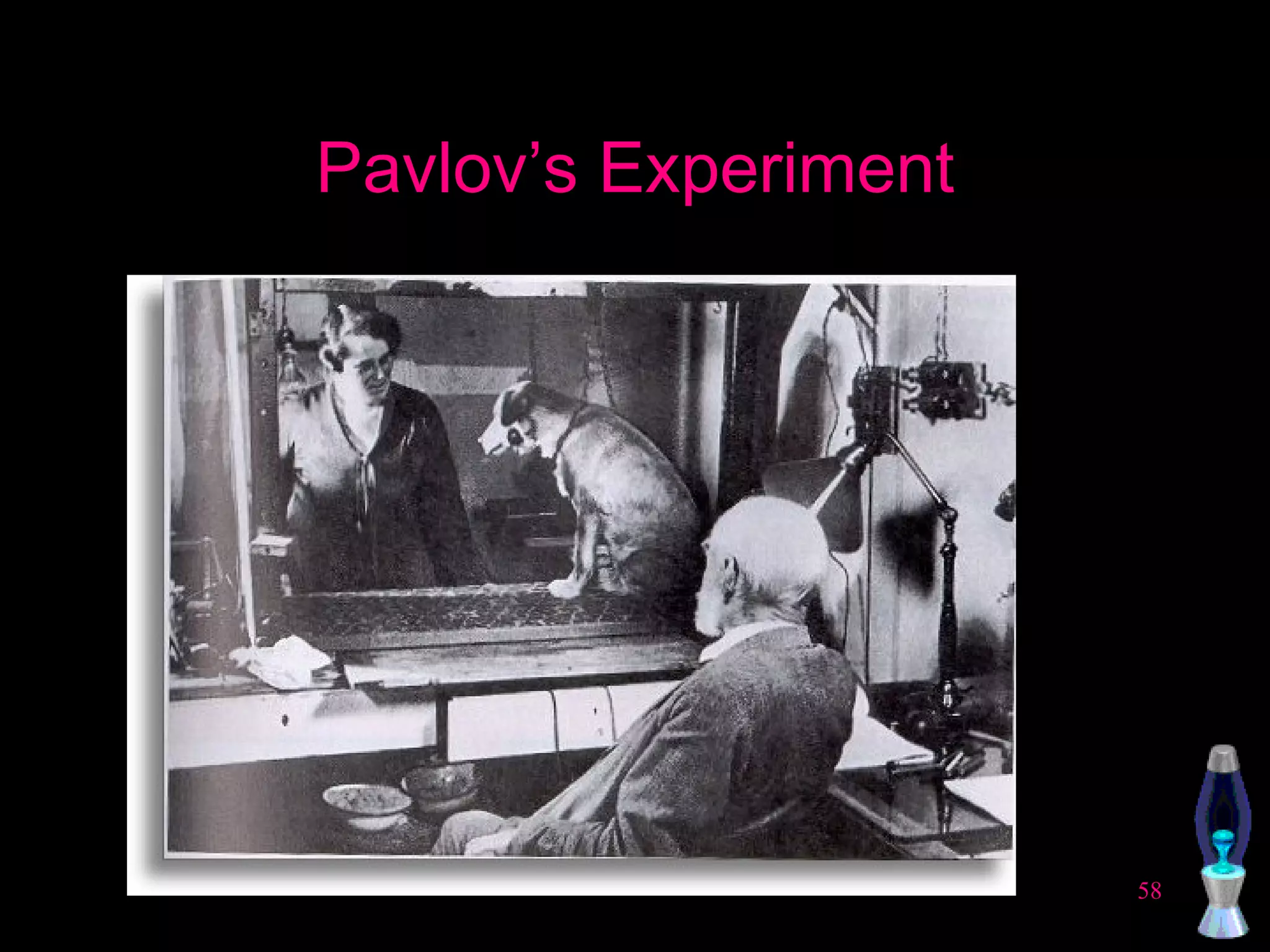
Ivan Pavlov Russian physiologist Nobel Prize (1904) The mechanics of digestion Classical conditioning
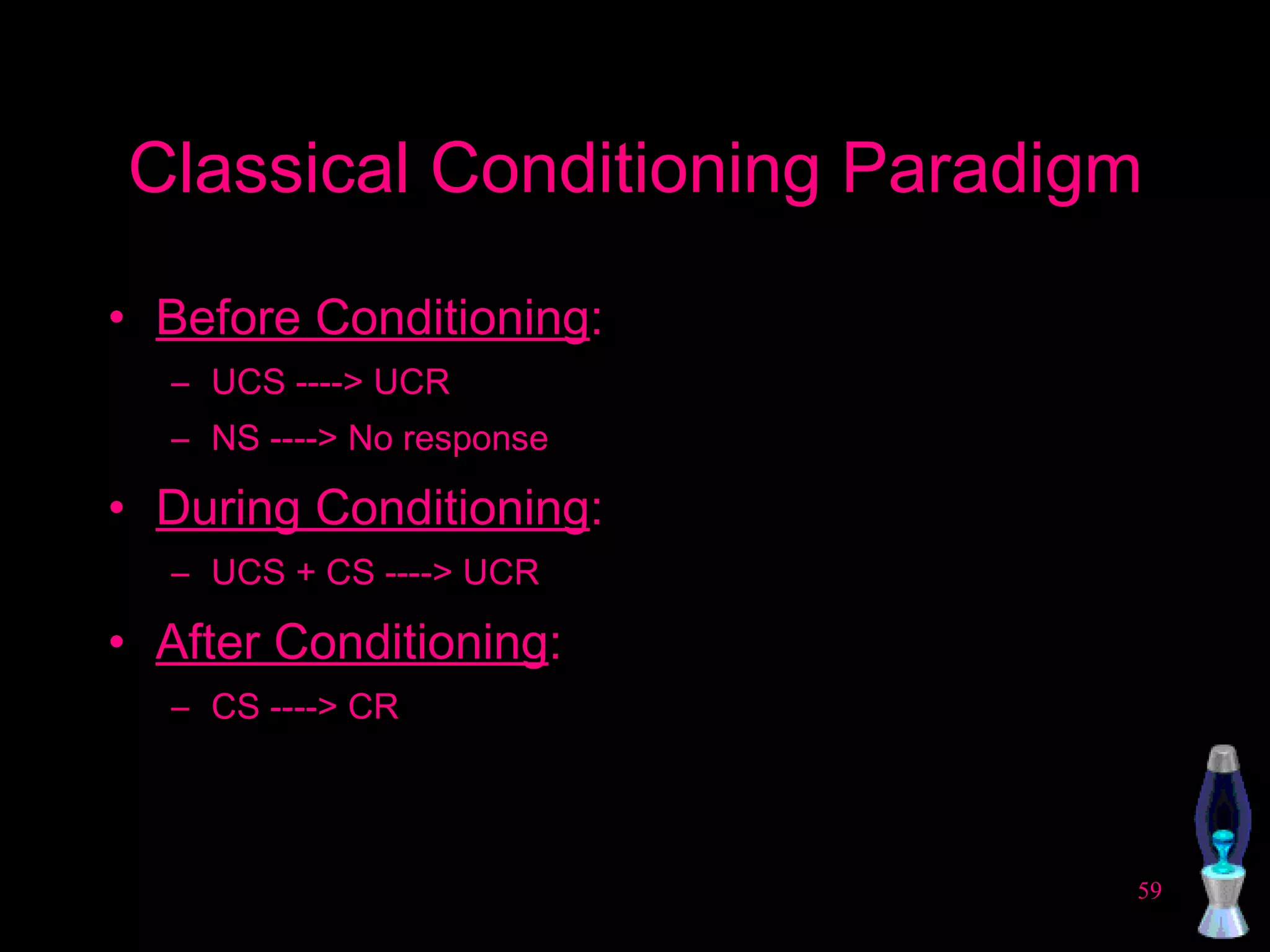
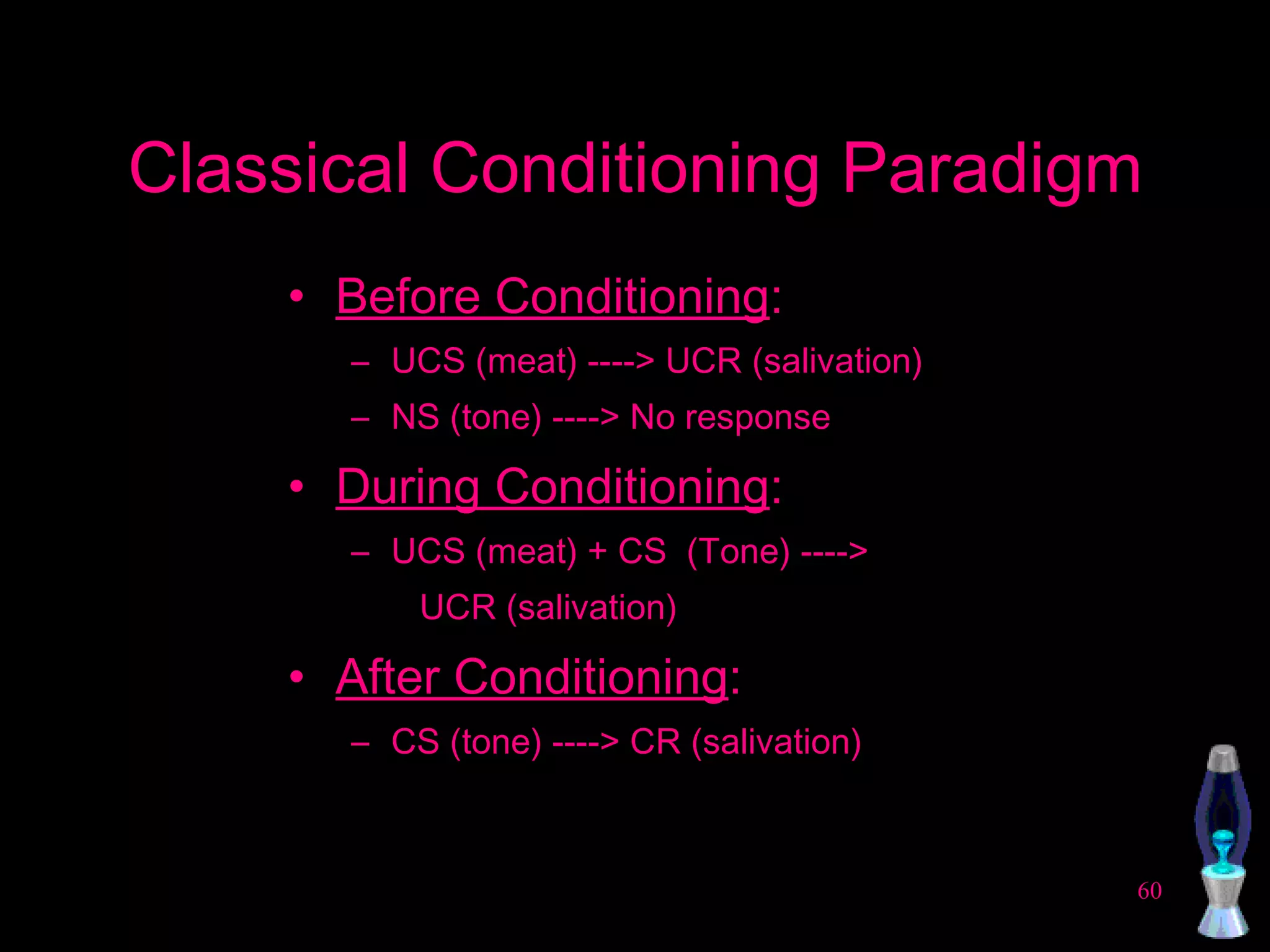
Classical Conditioning  UCS = unconditioned stimulus UCR = unconditioned response NS = neutral stimulus CS = conditioned stimulus CR = conditioned response
Pavlov’s Experiment
Classical Conditioning Paradigm Before Conditioning : UCS ----> UCR NS ----> No response During Conditioning : UCS + CS ----> UCR After Conditioning : CS ----> CR
Classical Conditioning Paradigm Before Conditioning : UCS (meat) ----> UCR (salivation) NS (tone) ----> No response During Conditioning : UCS (meat) + CS  (Tone) ---->  UCR (salivation) After Conditioning : CS (tone) ----> CR (salivation)
Behaviorism Behavior occurs as a result of learning
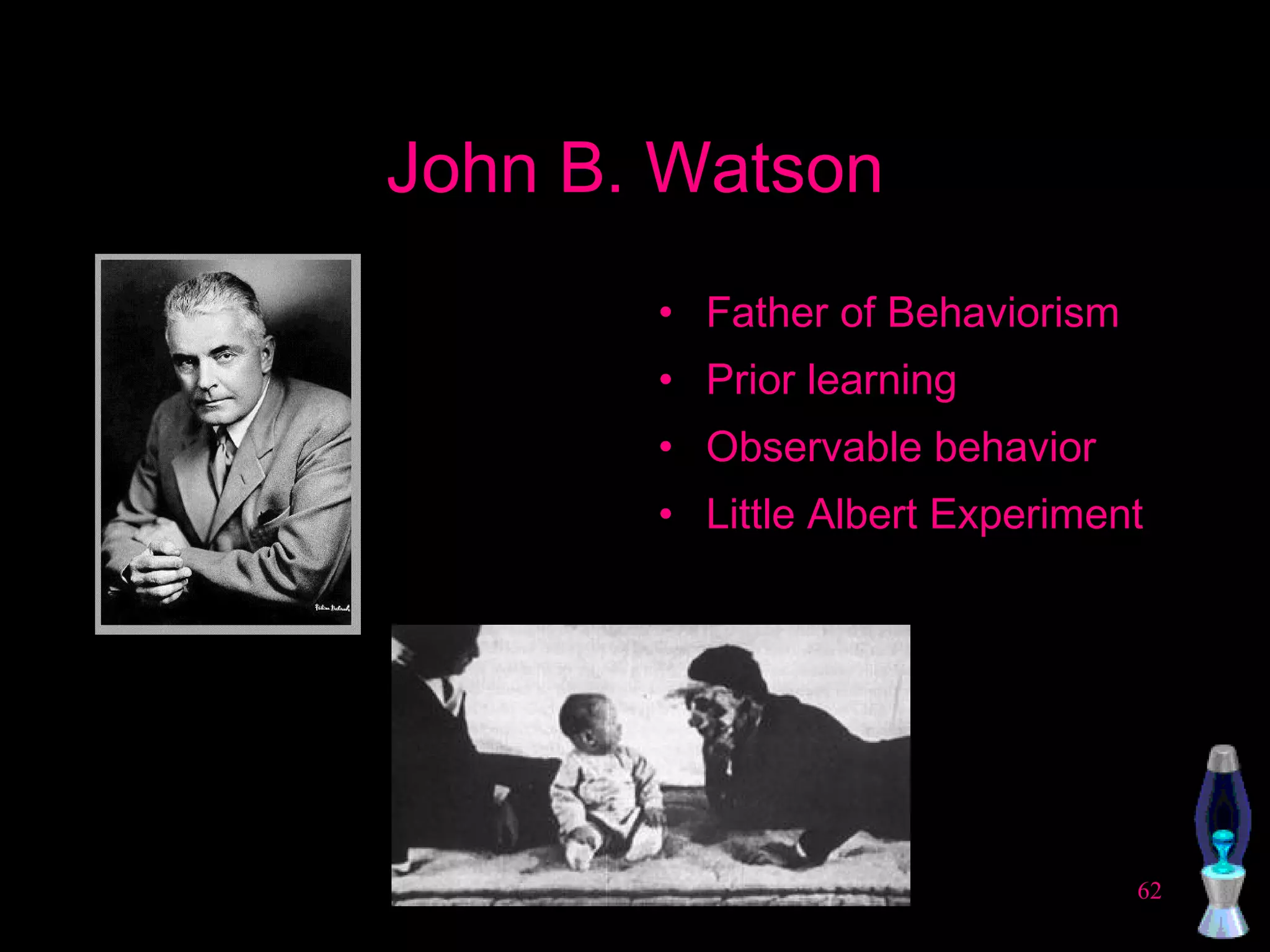
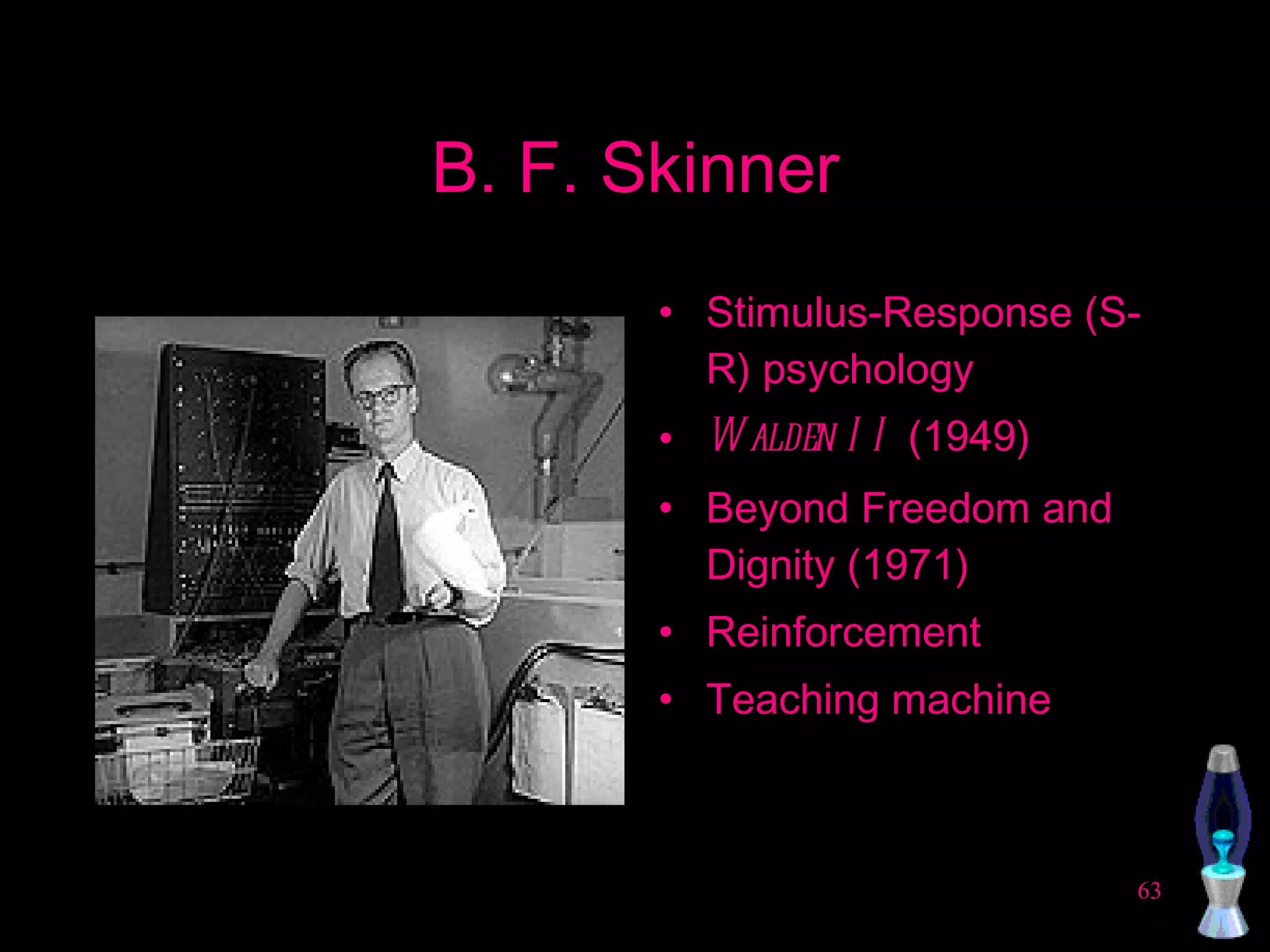
John B. Watson Father of Behaviorism Prior learning Observable behavior Little Albert Experiment
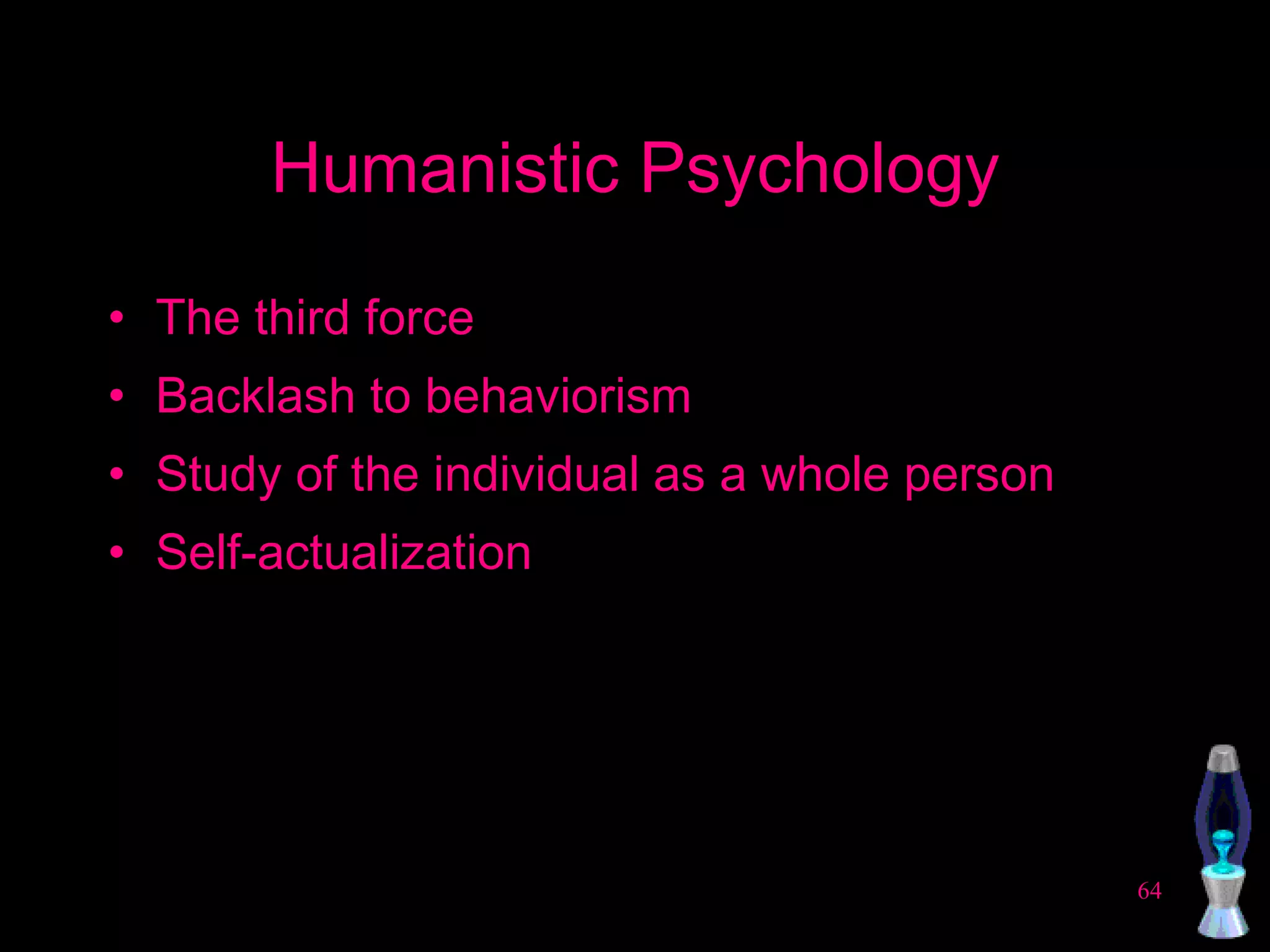
B. F. Skinner Stimulus-Response (S-R) psychology Walden II  (1949) Beyond Freedom and Dignity (1971) Reinforcement Teaching machine
Humanistic Psychology The third force Backlash to behaviorism Study of the individual as a whole person Self-actualization
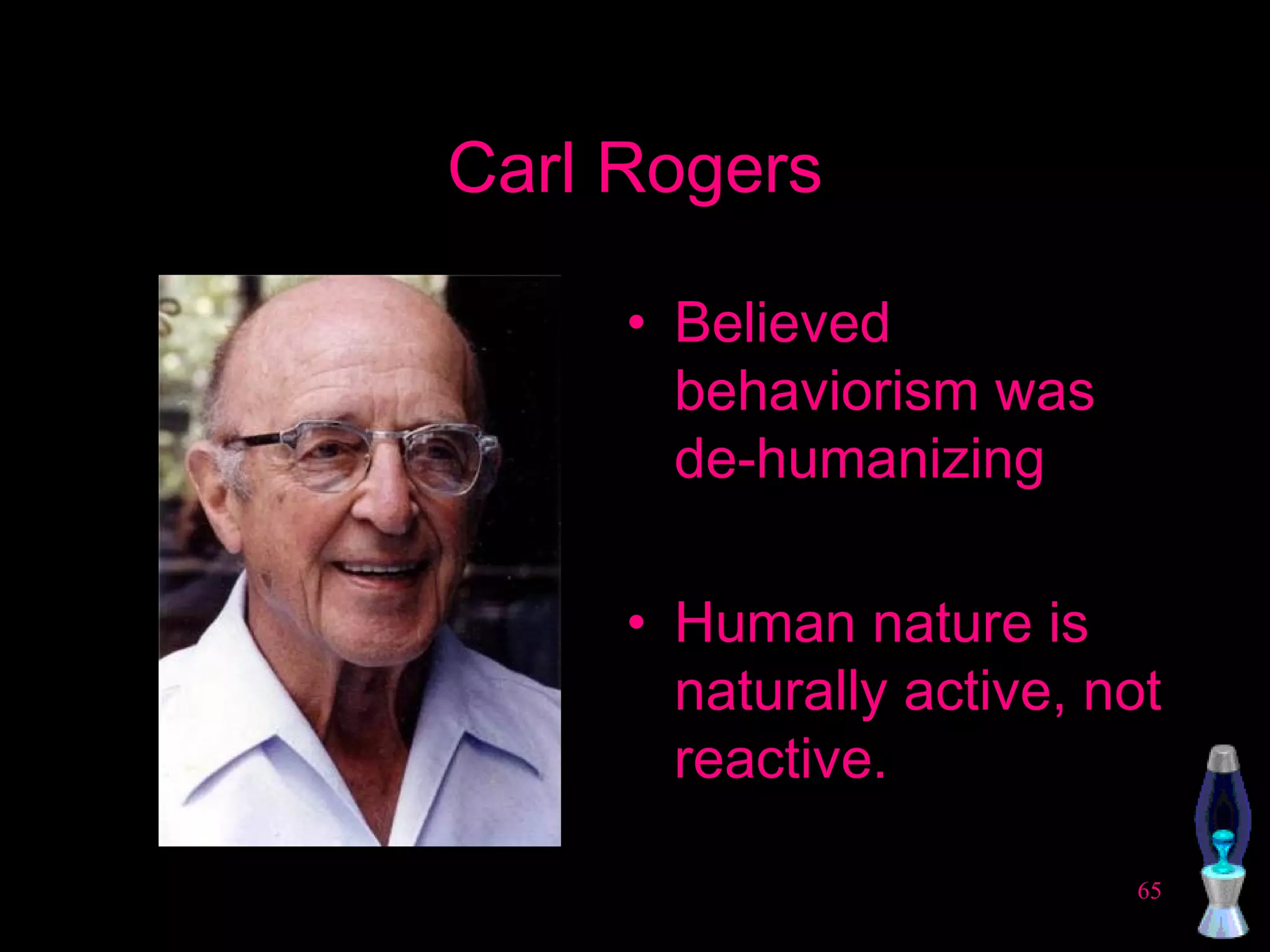
Carl Rogers Believed behaviorism was de-humanizing Human nature is  naturally active, not reactive.
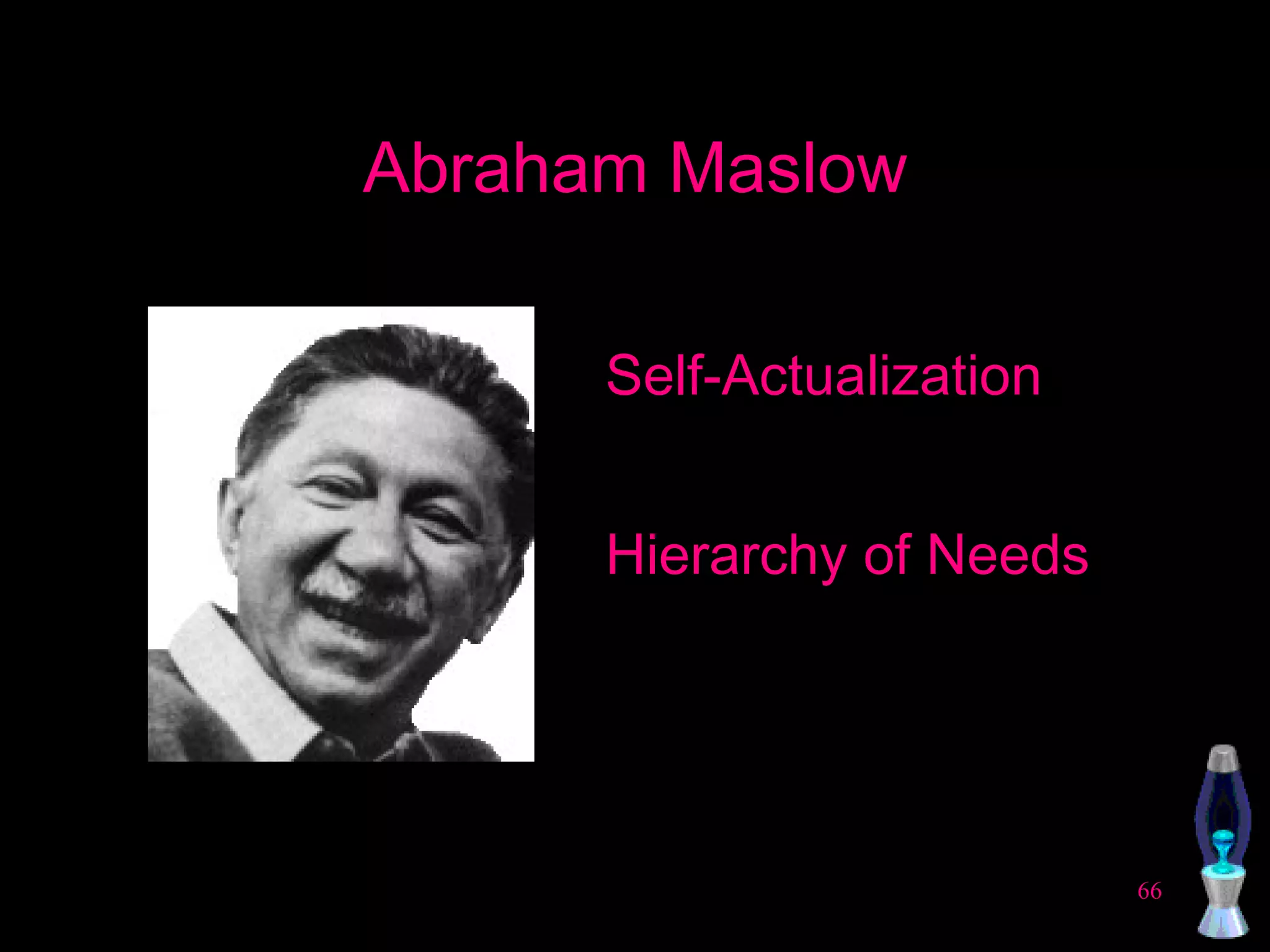
Abraham Maslow Self-Actualization Hierarchy of Needs
Humanism Behaviorism is de-humanizing Deprives man of free will Human nature is active, not reactive
4.) Cognitive Psychology Study of cognitive processes Internal knowledge
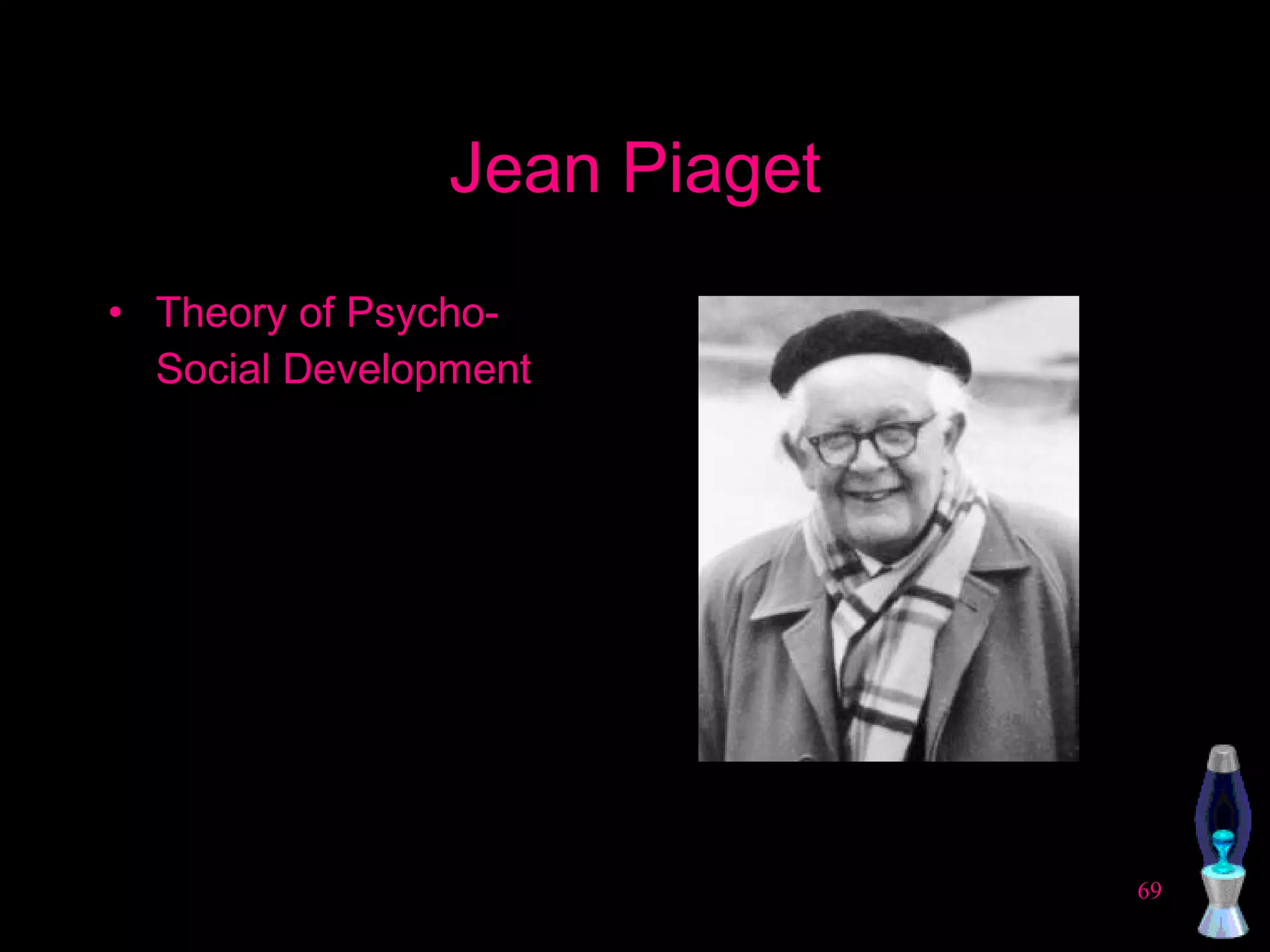
Jean Piaget Theory of Psycho-Social Development
Cognitive Psychology Behavior is affected by… Perception Interpretation Thinking Problem-solving Assessment of knowledge Use of language
IV.  Psychology as a Profession What is a Psychologist? Specialty Fields in Psychology
A.  Psychiatry vs.. Psychology  A psychiatrist’s training ...  medical doctor specialty in psychiatric medicine hospital or private practice freely prescribe medicines
Psychiatry vs.. Psychology A psychologist’s training … observe and analyze patterns of behavior develop theories of behavior apply knowledge to influence behavior
B.  Specialty Fields Clinical psychology Counseling psychology Personality psychology Social psychology Developmental psychology Educational psychology Community psychology Industrial/Organizational psychology Experimental psychology

Chapter 1 Reg. psych

  • 1.
    Chapter One: Intro/HistoryWhy Study Psychology? Overview of Goals of Psychology A Brief History of Psychology Psychology as a Profession
  • 2.
    I. WhyStudy Psychology? Insight Practical Information
  • 3.
    Psychology The scientificstudy of behavior and mental processes . Such study can involve both animal and human behavior. When applied to humans, psychology covers everything that people think , feel , and do .
  • 4.
    The Goals ofPsychology Description Explanation Prediction Control Basic Science Applied Science
  • 5.
    II. Goals OfPsychology Description Explanation Prediction Control
  • 6.
    Description Gather informationState the facts (What it is)
  • 7.
    Explanation Formulate hypothesesDevelop theories (Why it is)
  • 8.
    Hypothesis An educatedguess about the relationship between two variables
  • 9.
    Theory An integratedset of principles that organizes, explains, and predicts observations. Exploring Psychology , Myers, 1990
  • 10.
    Prediction Study theoriesand descriptive accounts of past behaviors Predict subsequent behaviors (What it will be)
  • 11.
    Control Influence ormanipulate behavior Basic science Applied science
  • 12.
    Basic Science Thepursuit of knowledge about natural phenomena for its own sake (to gain knowledge simply for the sake of knowledge) (acquire knowledge)
  • 13.
    Applied Science Discoveringways to use scientific findings to accomplish practical goals (use knowledge)
  • 14.
    Hypothesis-building Studies doneon Orphanage Children Dennis, W. “Causes of Retardation Among Institutional Children: Iran.” Journal of Genetic Psychology , 96 (1960):47-58 - Applied or Basic? White, B.L. “Child Development Research: An Edifice Without a Foundation.” Merrill- Palmer Quarterly of Behavior and Development , 15 (1969): 49-79 Applied or Basic? Shaffer (1993) Applied or Basic?
  • 15.
    The Scientific MethodState the problem Develop a hypothesis Conduct research Organize and interpret data Draw conclusions Communicate the results Psychology: A Concise Introduction , Pettijohn, 1992
  • 16.
    III. ABrief History of Psychology Psychology as a Discipline
  • 17.
    A. Psychologyas a Discipline - Early History Stone Age BC: The Ancient Greeks The Middle Ages 16th century: Copernicus and Galileo 17th century: Descartes and the pseudo-sciences
  • 18.
    1. TheStone Age Trephining Evil spirits Archeology
  • 19.
  • 20.
  • 21.
    2. TheAncient Greeks The will of the gods Aristotle Hippocrates Galen
  • 22.
    Aristotle Greek philosopherPeople are rational, thinking organisms
  • 23.
    Hippocrates The Fatherof Modern Medicine Mental and emotional problems have natural causes Some disorders are caused by head injury Some mental and physical characteristics are inherited
  • 24.
    Ancient Greeks Observationas a means of knowing the world
  • 25.
    The Natural World:Four Basic Elements Fire Air Earth Water
  • 26.
    The Natural World:Four Basic Elements Fire Warm Air Cool Earth Dry Water Moist
  • 27.
    The Four HumorsBlood (warm and moist) Black bile (cold and dry) Yellow bile (warm and dry) Phlegm (cold and moist)
  • 28.
    Galen Greek physicianPersonality types
  • 29.
    Galen: Personality TypesAn excess of… blood = sanguine personality (cheerful, warm-hearted) black bile = melancholic personality (sad) yellow bile = choleric personality (hot-tempered) phlegm = phlegmatic personality (apathetic)
  • 30.
    3. TheMiddle Ages Witchcraft Demon possession
  • 31.
    4. The16th Century Nicolaus Copernicus Galileo Galilei
  • 32.
    Nicolaus Copernicus Polishastronomer The sun is the center of the universe Observations on the movements of planets in the solar system
  • 33.
    Galileo Galilei Italianastronomer and physicist Telescope confirms star positions and movements
  • 34.
    The 16th CenturyIntroduced the concept of observation as an element of scientific study (Copernicus) Introduced the concept of experimentation as an element of scientific study (Galileo)
  • 35.
    5. The17th Century Dualism Rene Descartes Pseudo-sciences
  • 36.
    Dualism Philosophy whichteaches that the mind and body are separate and distinct from each other.
  • 37.
    Rene Descartes Frenchphilosopher Extended dualism The mind and body work together to create a person’s experiences
  • 38.
    The Pseudo-sciences PhrenologyPhysiognomy Typology
  • 39.
    Phrenology The studyof personality based on the ‘bumps’ of the skull
  • 41.
    Modern Science Acombination of… Philosophy Logic Math Observation
  • 42.
    Psychology as aDiscipline - Basic Theories Structuralism Functionalism
  • 43.
    Structuralism Thoughts havestructure, just as a molecule does
  • 44.
    Structuralism Wilhelm WundtGerman physiologist Laboratory of Psychology,1879 University of Leipzig, Germany
  • 45.
    Structuralism The mindmust be studied as scientifically as other ‘natural laws’ Wundt, Wilhelm, Principles of Physiological Psychology , 1878
  • 46.
    Introspection A detailedexamination of one’s own thinking A controlled situation with trained subjects reporting their thoughts so that the basic structure of thought processes can be mapped
  • 47.
    Functionalism The functionsof the human mind -- thinking, feeling, learning, remembering -- exist to help man survive as a species
  • 48.
    William James foundedthe Functionalist branch of psychology Established the first American psychology laboratory, at Harvard College Principles of Psychology (1890)
  • 49.
    A Brief Historyof Psychology B. Psychology as the Study of... Unconscious Processes Individual Differences Observable Behavior Cognitive Processes
  • 50.
    1.) Unconscious ProcessesPsychoanalysis Study of the unconscious mind Sigmund Freud
  • 51.
    Sigmund Freud Viennesedoctor Unconscious, or subconscious, mind Biological/sociological conflict Free association (talking cure) Dream analysis Case studies
  • 52.
    2.) Individual DifferencesSir Francis Galton
  • 53.
    Sir Francis GaltonEnglish mathematician Heredity/genius Nature vs. Nurture Secondary research Personality/IQ tests Inquiries into Human Faculty and Its Development (1883)
  • 54.
    3.) Observable BehaviorBehaviorism Humanistic Psychology
  • 55.
    Behaviorism Ivan PavlovJohn B. Watson B. F. Skinner
  • 56.
    Ivan Pavlov Russianphysiologist Nobel Prize (1904) The mechanics of digestion Classical conditioning
  • 57.
    Classical Conditioning UCS = unconditioned stimulus UCR = unconditioned response NS = neutral stimulus CS = conditioned stimulus CR = conditioned response
  • 58.
  • 59.
    Classical Conditioning ParadigmBefore Conditioning : UCS ----> UCR NS ----> No response During Conditioning : UCS + CS ----> UCR After Conditioning : CS ----> CR
  • 60.
    Classical Conditioning ParadigmBefore Conditioning : UCS (meat) ----> UCR (salivation) NS (tone) ----> No response During Conditioning : UCS (meat) + CS (Tone) ----> UCR (salivation) After Conditioning : CS (tone) ----> CR (salivation)
  • 61.
    Behaviorism Behavior occursas a result of learning
  • 62.
    John B. WatsonFather of Behaviorism Prior learning Observable behavior Little Albert Experiment
  • 63.
    B. F. SkinnerStimulus-Response (S-R) psychology Walden II (1949) Beyond Freedom and Dignity (1971) Reinforcement Teaching machine
  • 64.
    Humanistic Psychology Thethird force Backlash to behaviorism Study of the individual as a whole person Self-actualization
  • 65.
    Carl Rogers Believedbehaviorism was de-humanizing Human nature is naturally active, not reactive.
  • 66.
  • 67.
    Humanism Behaviorism isde-humanizing Deprives man of free will Human nature is active, not reactive
  • 68.
    4.) Cognitive PsychologyStudy of cognitive processes Internal knowledge
  • 69.
    Jean Piaget Theoryof Psycho-Social Development
  • 70.
    Cognitive Psychology Behavioris affected by… Perception Interpretation Thinking Problem-solving Assessment of knowledge Use of language
  • 71.
    IV. Psychologyas a Profession What is a Psychologist? Specialty Fields in Psychology
  • 72.
    A. Psychiatryvs.. Psychology A psychiatrist’s training ... medical doctor specialty in psychiatric medicine hospital or private practice freely prescribe medicines
  • 73.
    Psychiatry vs.. PsychologyA psychologist’s training … observe and analyze patterns of behavior develop theories of behavior apply knowledge to influence behavior
  • 74.
    B. SpecialtyFields Clinical psychology Counseling psychology Personality psychology Social psychology Developmental psychology Educational psychology Community psychology Industrial/Organizational psychology Experimental psychology