Page 1
Thinking and Language
Dr Ravi Soni
Page 2
Defining Thinking
• ‘Thinking consists of the cognitive rearrangement or manipulations
of both information from the environment and the symbols stored in
LTM’
• A symbol represents some event or item in the world: Images and
language are types of symbols
• AUTISTIC thinking: some thinking is highly private and may use
symbols with very personal meanings, e.g Dreams
• DIRECTED thinking: some thinking is aimed at solving problems or
creating something new.
• From another view point “thinking is the form of cognitive processes
that mediate , or go between, stimuli and response” e.g, you are
planning for buying new car, sales person suggests several cars to
you (stimuli), ultimately you purchase one of them (response).
Page 3
The Thinking Process
• Words, language and images are the symbols that we use in
thinking.
• Availability of language symbols, is what makes human thinking so
much more sophisticated than the thinking of other animals.
• IMAGES AND THINKING: some people use images in their thinking
• Example: imagine that you standing on a certain street corner, in a
section of a city, you know well. How would you walk or drive from
this point to some other part of the city- we usually make a visual
map.
• LANGUAGE AND THINKING: for many people, much of the time, a
good deal of thinking involves use of word symbols and the rules of
grammar to join the words into phrases and sentences.
• These symbols and rules are stored in our semantic LTMs.
Page 4
Concepts
• A concept is a ‘symbolic construction that represents some common
and general feature or features of many objects or events’.
• The human ability to form concepts enables us to classify things into
categories. With the concept of red we can sort objects into ‘red’ and
‘nonred’
• The feature we select define the concept and form the basis for
making classifications.
• Concepts are tools of thinking about the world & in solving the
problems.
How concepts are acquired?
I. Naturally
II. Discrimination learning
III. By Definition
Page 5
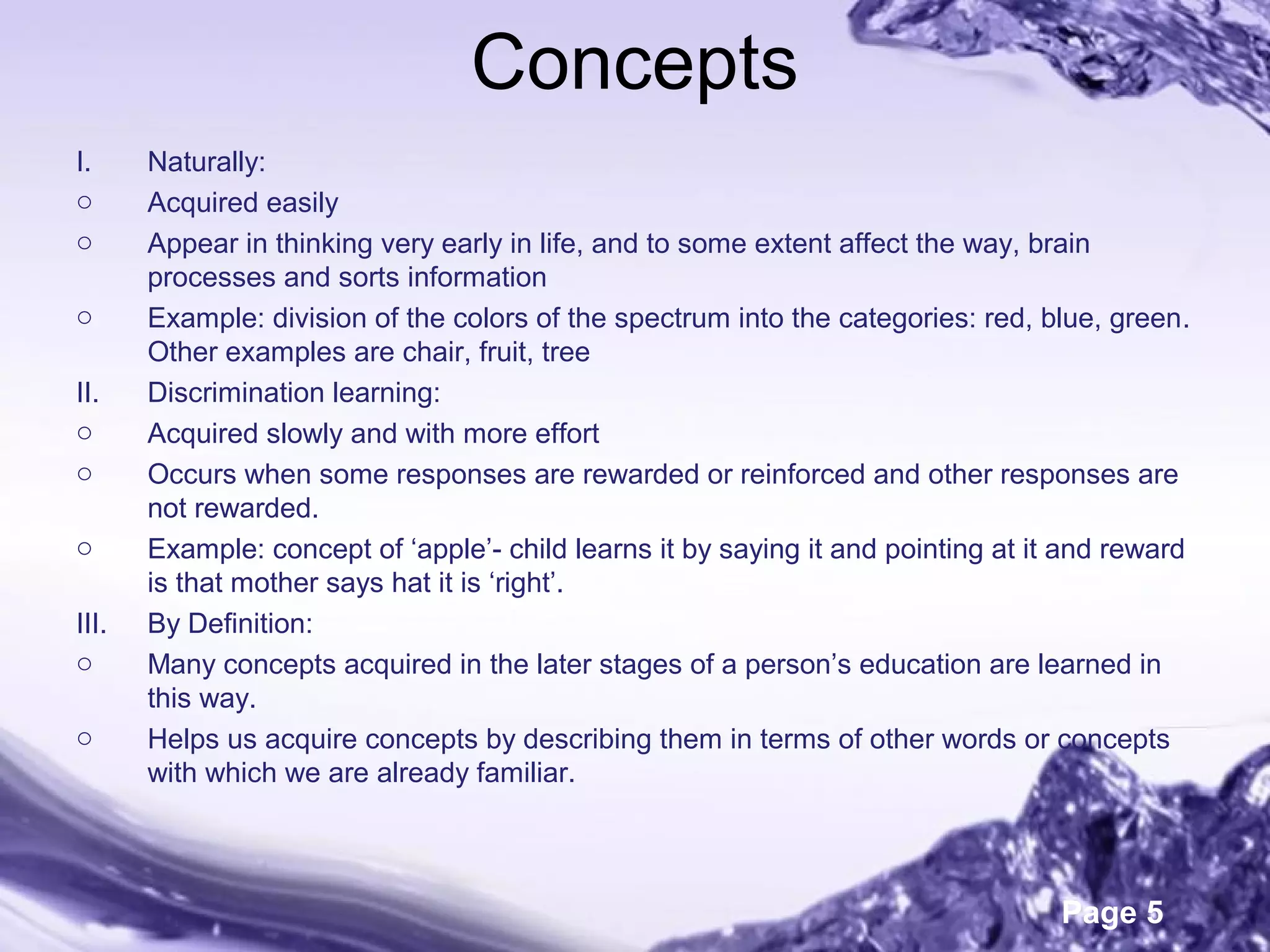
Concepts
I. Naturally:
o Acquired easily
o Appear in thinking very early in life, and to some extent affect the way, brain
processes and sorts information
o Example: division of the colors of the spectrum into the categories: red, blue, green.
Other examples are chair, fruit, tree
II. Discrimination learning:
o Acquired slowly and with more effort
o Occurs when some responses are rewarded or reinforced and other responses are
not rewarded.
o Example: concept of ‘apple’- child learns it by saying it and pointing at it and reward
is that mother says hat it is ‘right’.
III. By Definition:
o Many concepts acquired in the later stages of a person’s education are learned in
this way.
o Helps us acquire concepts by describing them in terms of other words or concepts
with which we are already familiar.
Page 6
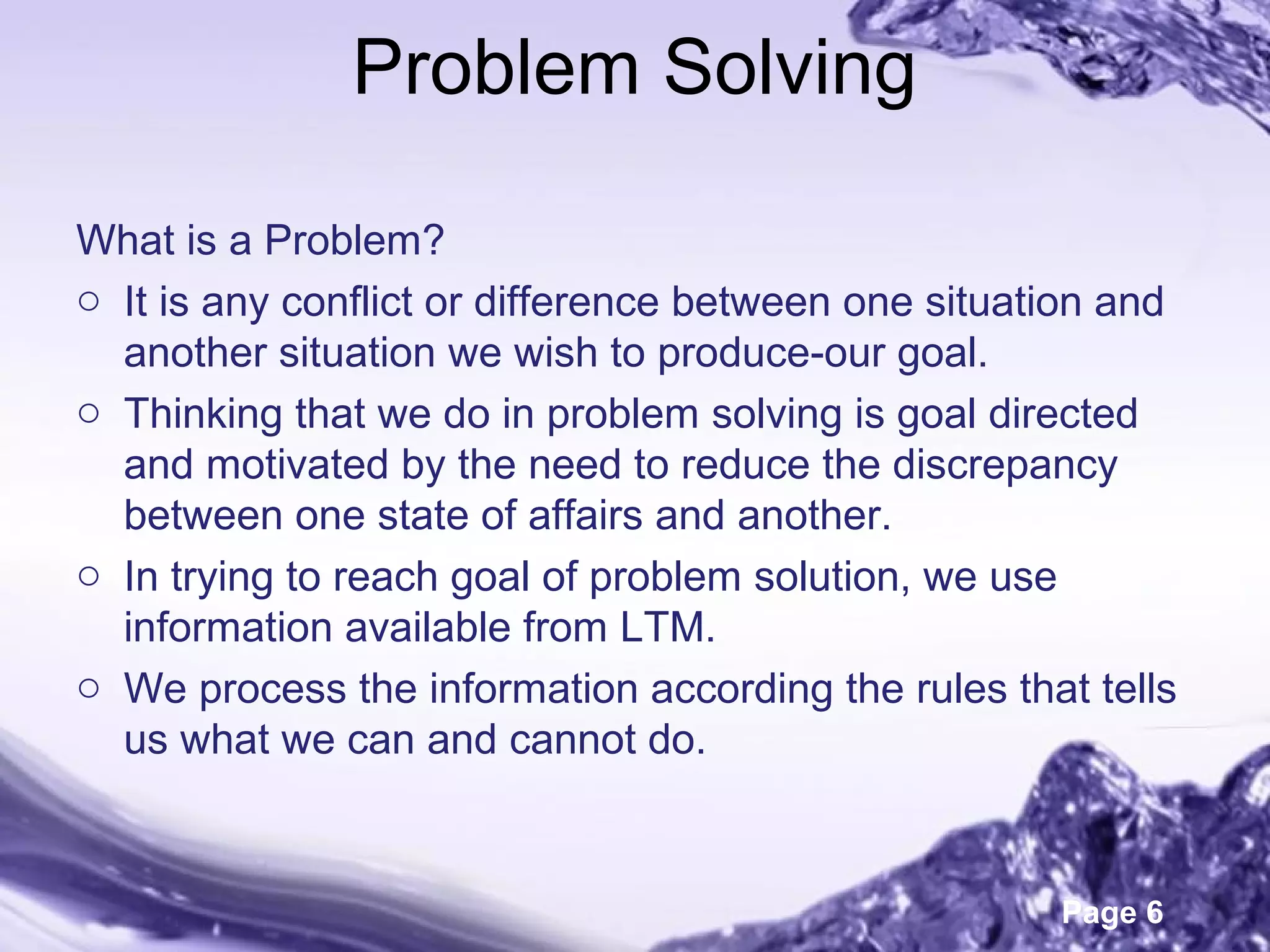
Problem Solving
What is a Problem?
o It is any conflict or difference between one situation and
another situation we wish to produce-our goal.
o Thinking that we do in problem solving is goal directed
and motivated by the need to reduce the discrepancy
between one state of affairs and another.
o In trying to reach goal of problem solution, we use
information available from LTM.
o We process the information according the rules that tells
us what we can and cannot do.
Page 7
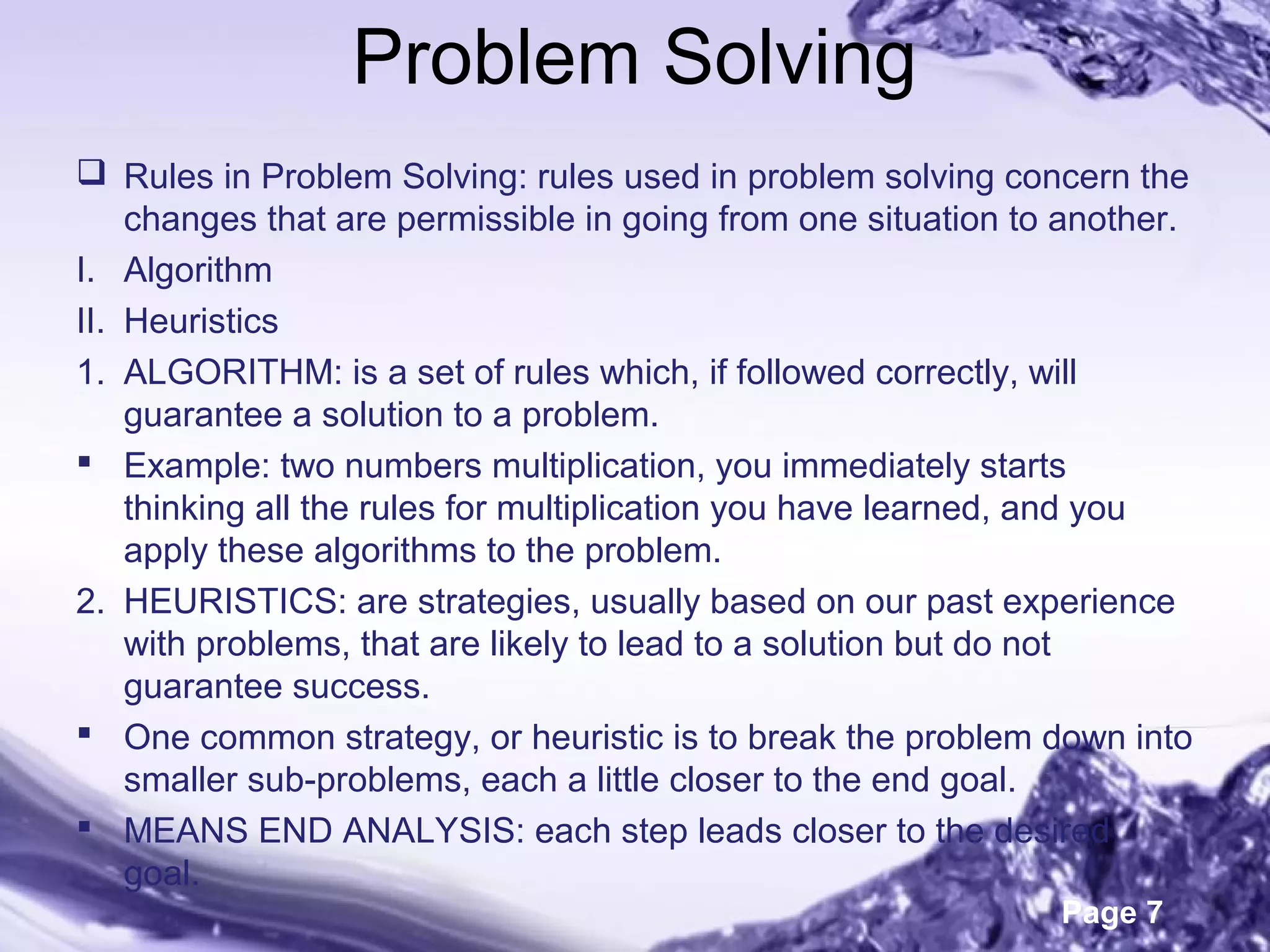
Problem Solving
 Rules in Problem Solving: rules used in problem solving concern the
changes that are permissible in going from one situation to another.
I. Algorithm
II. Heuristics
1. ALGORITHM: is a set of rules which, if followed correctly, will
guarantee a solution to a problem.
 Example: two numbers multiplication, you immediately starts
thinking all the rules for multiplication you have learned, and you
apply these algorithms to the problem.
2. HEURISTICS: are strategies, usually based on our past experience
with problems, that are likely to lead to a solution but do not
guarantee success.
 One common strategy, or heuristic is to break the problem down into
smaller sub-problems, each a little closer to the end goal.
 MEANS END ANALYSIS: each step leads closer to the desired
goal.
Page 8
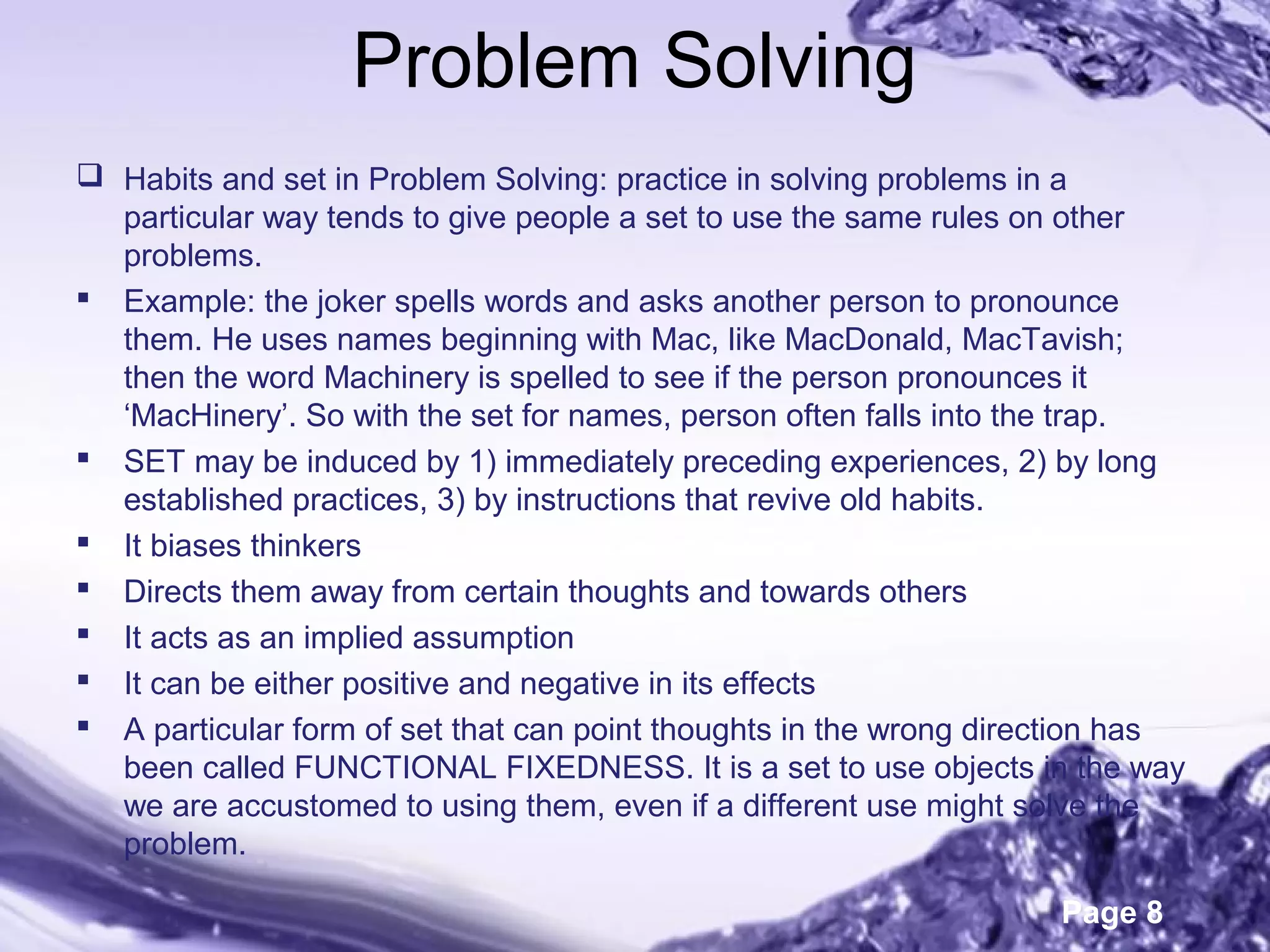
Problem Solving
 Habits and set in Problem Solving: practice in solving problems in a
particular way tends to give people a set to use the same rules on other
problems.
 Example: the joker spells words and asks another person to pronounce
them. He uses names beginning with Mac, like MacDonald, MacTavish;
then the word Machinery is spelled to see if the person pronounces it
‘MacHinery’. So with the set for names, person often falls into the trap.
 SET may be induced by 1) immediately preceding experiences, 2) by long
established practices, 3) by instructions that revive old habits.
 It biases thinkers
 Directs them away from certain thoughts and towards others
 It acts as an implied assumption
 It can be either positive and negative in its effects
 A particular form of set that can point thoughts in the wrong direction has
been called FUNCTIONAL FIXEDNESS. It is a set to use objects in the way
we are accustomed to using them, even if a different use might solve the
problem.
Page 9
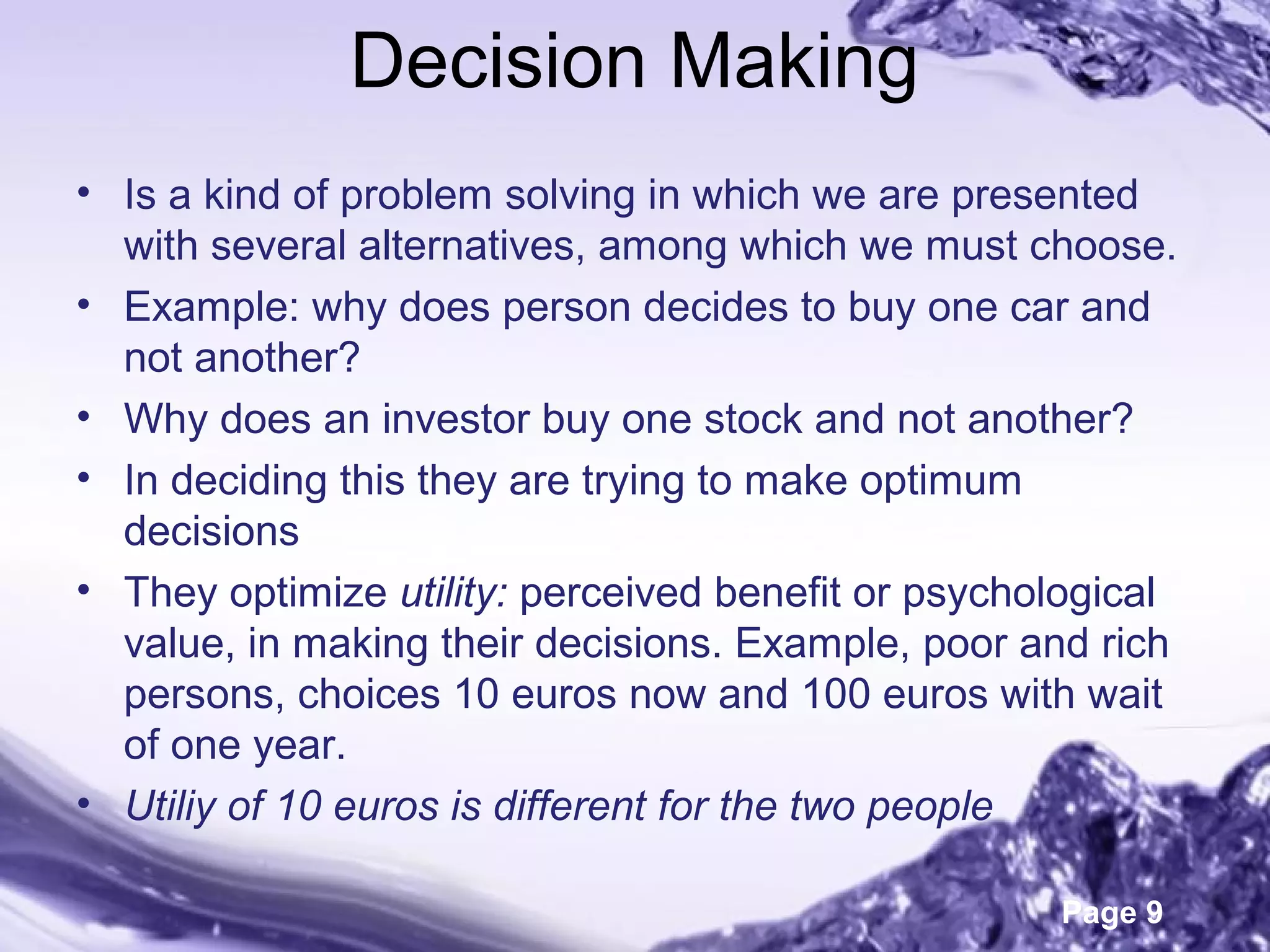
Decision Making
• Is a kind of problem solving in which we are presented
with several alternatives, among which we must choose.
• Example: why does person decides to buy one car and
not another?
• Why does an investor buy one stock and not another?
• In deciding this they are trying to make optimum
decisions
• They optimize utility: perceived benefit or psychological
value, in making their decisions. Example, poor and rich
persons, choices 10 euros now and 100 euros with wait
of one year.
• Utiliy of 10 euros is different for the two people
Page 10
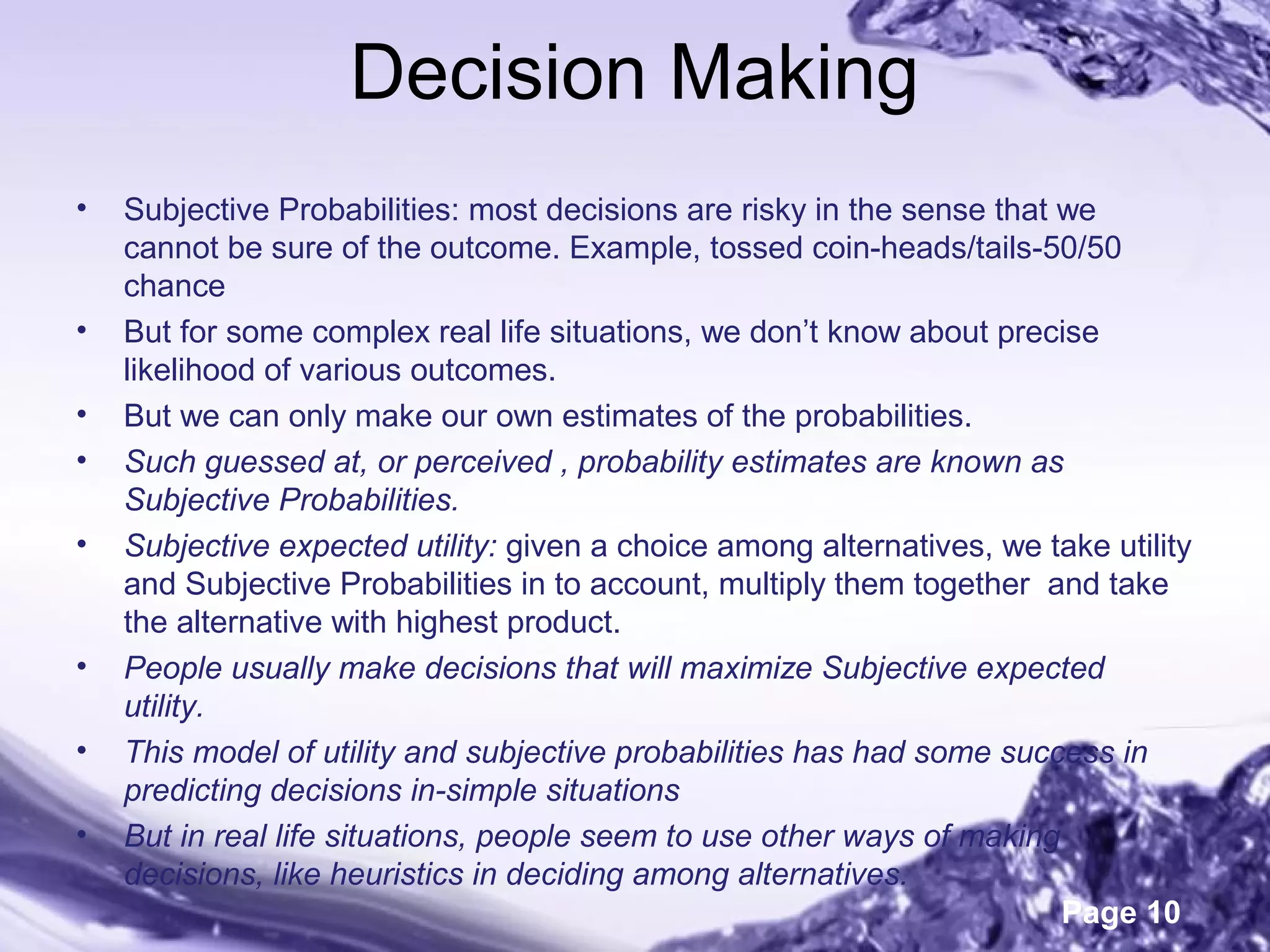
Decision Making
• Subjective Probabilities: most decisions are risky in the sense that we
cannot be sure of the outcome. Example, tossed coin-heads/tails-50/50
chance
• But for some complex real life situations, we don’t know about precise
likelihood of various outcomes.
• But we can only make our own estimates of the probabilities.
• Such guessed at, or perceived , probability estimates are known as
Subjective Probabilities.
• Subjective expected utility: given a choice among alternatives, we take utility
and Subjective Probabilities in to account, multiply them together and take
the alternative with highest product.
• People usually make decisions that will maximize Subjective expected
utility.
• This model of utility and subjective probabilities has had some success in
predicting decisions in-simple situations
• But in real life situations, people seem to use other ways of making
decisions, like heuristics in deciding among alternatives.
Page 11
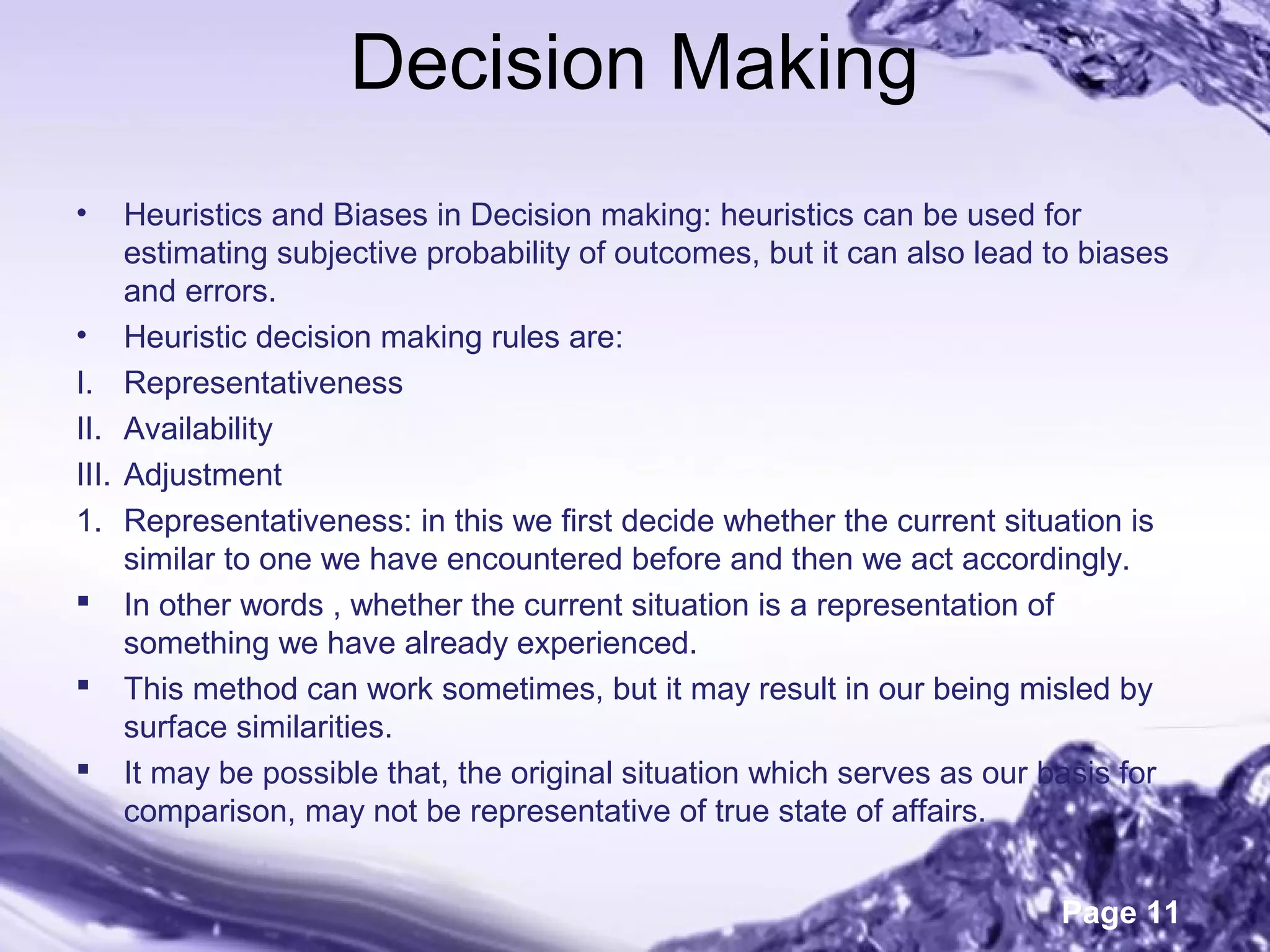
Decision Making
• Heuristics and Biases in Decision making: heuristics can be used for
estimating subjective probability of outcomes, but it can also lead to biases
and errors.
• Heuristic decision making rules are:
I. Representativeness
II. Availability
III. Adjustment
1. Representativeness: in this we first decide whether the current situation is
similar to one we have encountered before and then we act accordingly.
 In other words , whether the current situation is a representation of
something we have already experienced.
 This method can work sometimes, but it may result in our being misled by
surface similarities.
 It may be possible that, the original situation which serves as our basis for
comparison, may not be representative of true state of affairs.
Page 12
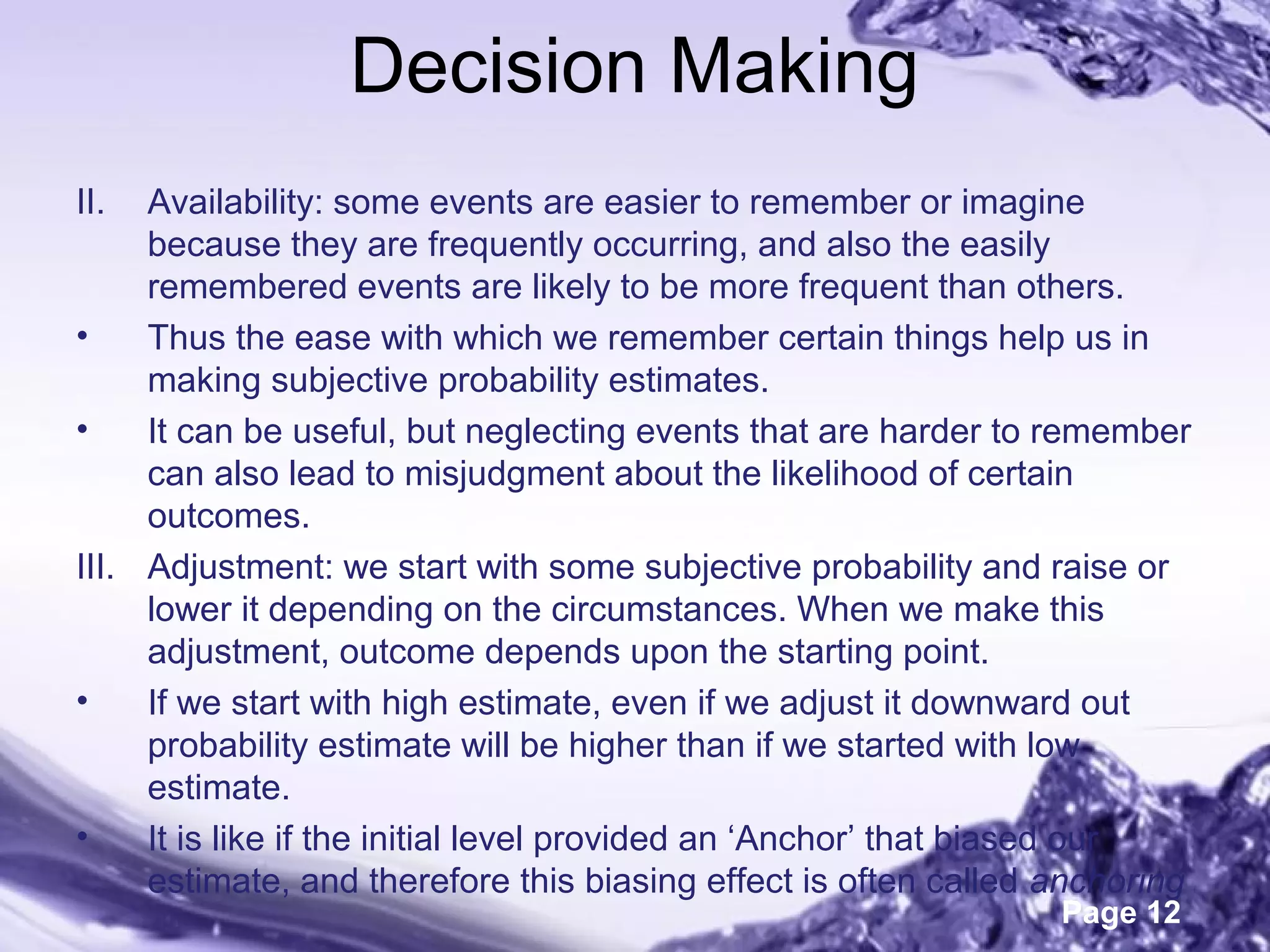
Decision Making
II. Availability: some events are easier to remember or imagine
because they are frequently occurring, and also the easily
remembered events are likely to be more frequent than others.
• Thus the ease with which we remember certain things help us in
making subjective probability estimates.
• It can be useful, but neglecting events that are harder to remember
can also lead to misjudgment about the likelihood of certain
outcomes.
III. Adjustment: we start with some subjective probability and raise or
lower it depending on the circumstances. When we make this
adjustment, outcome depends upon the starting point.
• If we start with high estimate, even if we adjust it downward out
probability estimate will be higher than if we started with low
estimate.
• It is like if the initial level provided an ‘Anchor’ that biased our
estimate, and therefore this biasing effect is often called anchoring
Page 13
Decision Making
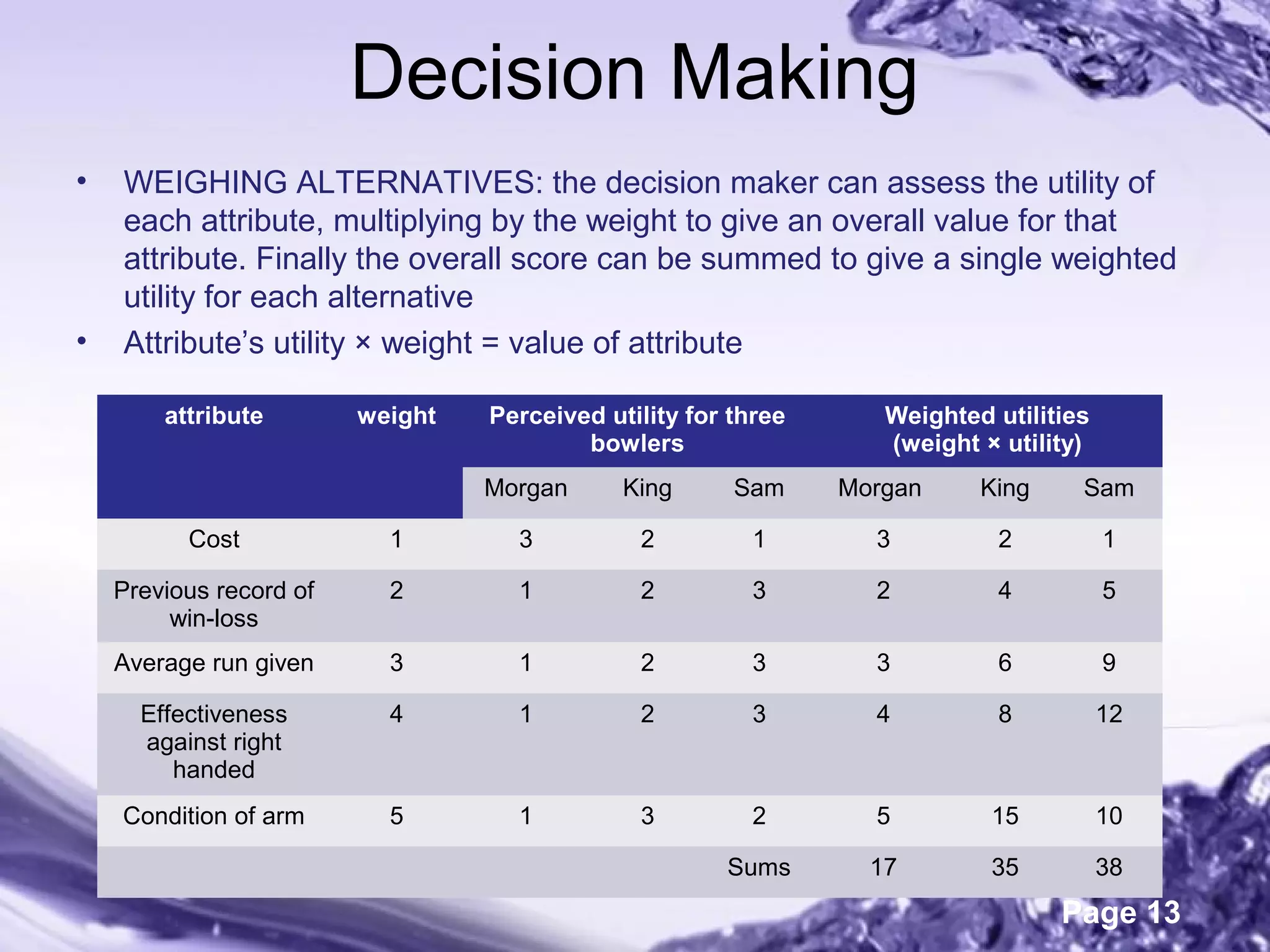
• WEIGHING ALTERNATIVES: the decision maker can assess the utility of
each attribute, multiplying by the weight to give an overall value for that
attribute. Finally the overall score can be summed to give a single weighted
utility for each alternative
• Attribute’s utility × weight = value of attribute
attribute weight Perceived utility for three
bowlers
Weighted utilities
(weight × utility)
Morgan King Sam Morgan King Sam
Cost 1 3 2 1 3 2 1
Previous record of
win-loss
2 1 2 3 2 4 5
Average run given 3 1 2 3 3 6 9
Effectiveness
against right
handed
4 1 2 3 4 8 12
Condition of arm 5 1 3 2 5 15 10
Sums 17 35 38
Page 14
Creative Thinking
• Thinking something ‘new’
• Trying to create ‘new’
• Product of creative thinking may be a new and unique
way of conceptualizing the world around us
• Emphasis in the creative thinking is on the word ‘NEW’
• Involves considerable amount of unconscious
rearrangement of symbols
• The sudden appearance of new idea is called ‘Insight’
Page 15
Insight in Creative thinking
• The thinker at first makes little progress, but
then, perhaps triggered by a fortuitous set of
circumstances, a new idea seems to ‘bubble up’
into awareness, in a seemingly spontaneous
manner.
• Example of the role of insight in creative
thinking: King Hiero and Archemedes.
• Golden crown in a temple as a thank offering to
gods.
Page 16
Stages in Creative thinking
• Graham Wallas- studied the steps involved in the
thinking of creative people
• One way of looking at creative thinking is five stages:
1. Preparation: thinker formulates the problem and collect
the facts and materials considered necessary for the
new solution
• Sometimes they cant find the solution
• Failing to solve the problem, the thinker either
deliberately or involuntarily turns away from it
Page 17
Stages in Creative thinking
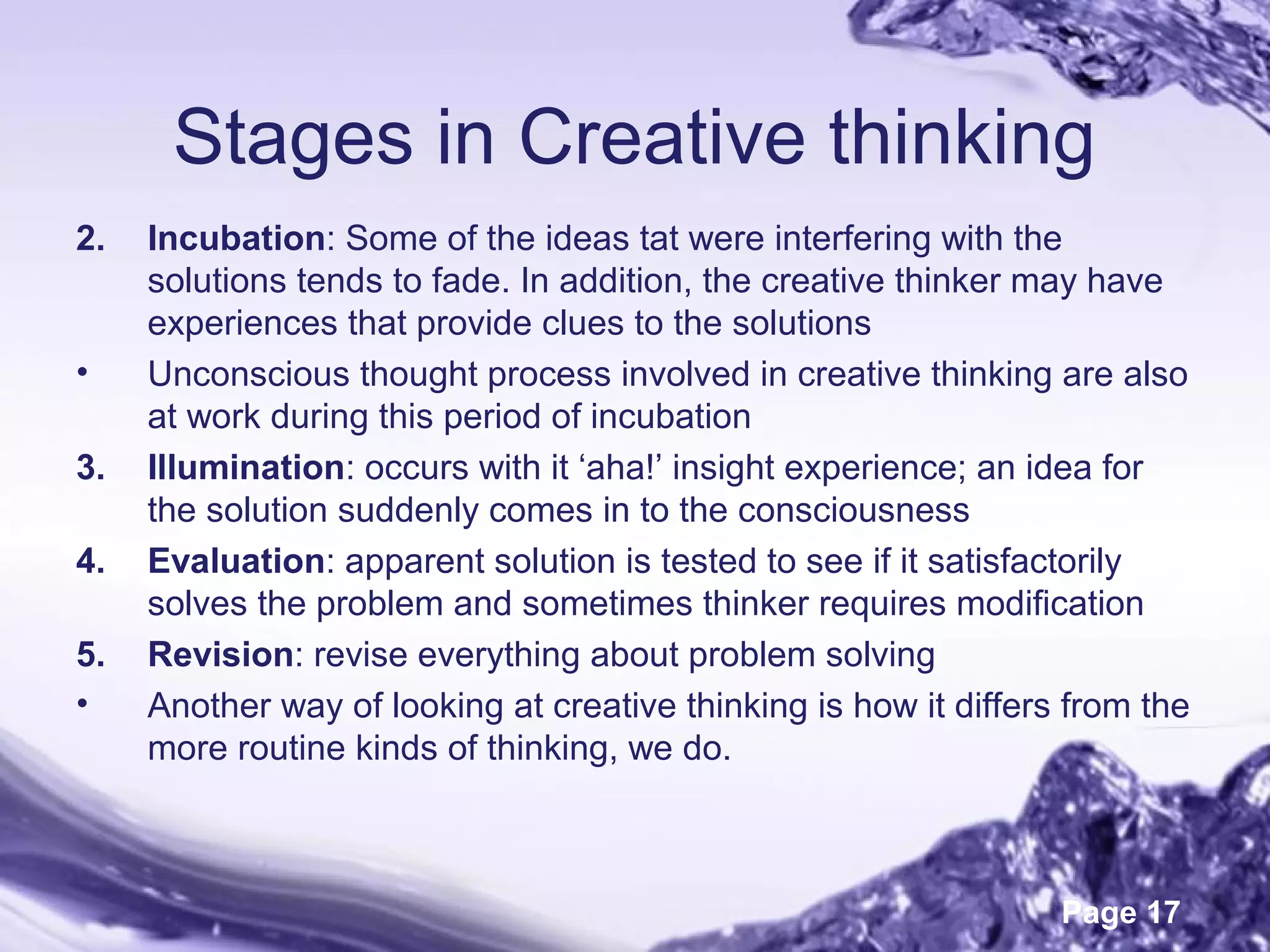
2. Incubation: Some of the ideas tat were interfering with the
solutions tends to fade. In addition, the creative thinker may have
experiences that provide clues to the solutions
• Unconscious thought process involved in creative thinking are also
at work during this period of incubation
3. Illumination: occurs with it ‘aha!’ insight experience; an idea for
the solution suddenly comes in to the consciousness
4. Evaluation: apparent solution is tested to see if it satisfactorily
solves the problem and sometimes thinker requires modification
5. Revision: revise everything about problem solving
• Another way of looking at creative thinking is how it differs from the
more routine kinds of thinking, we do.
Page 18
Nature of Creative Thinking
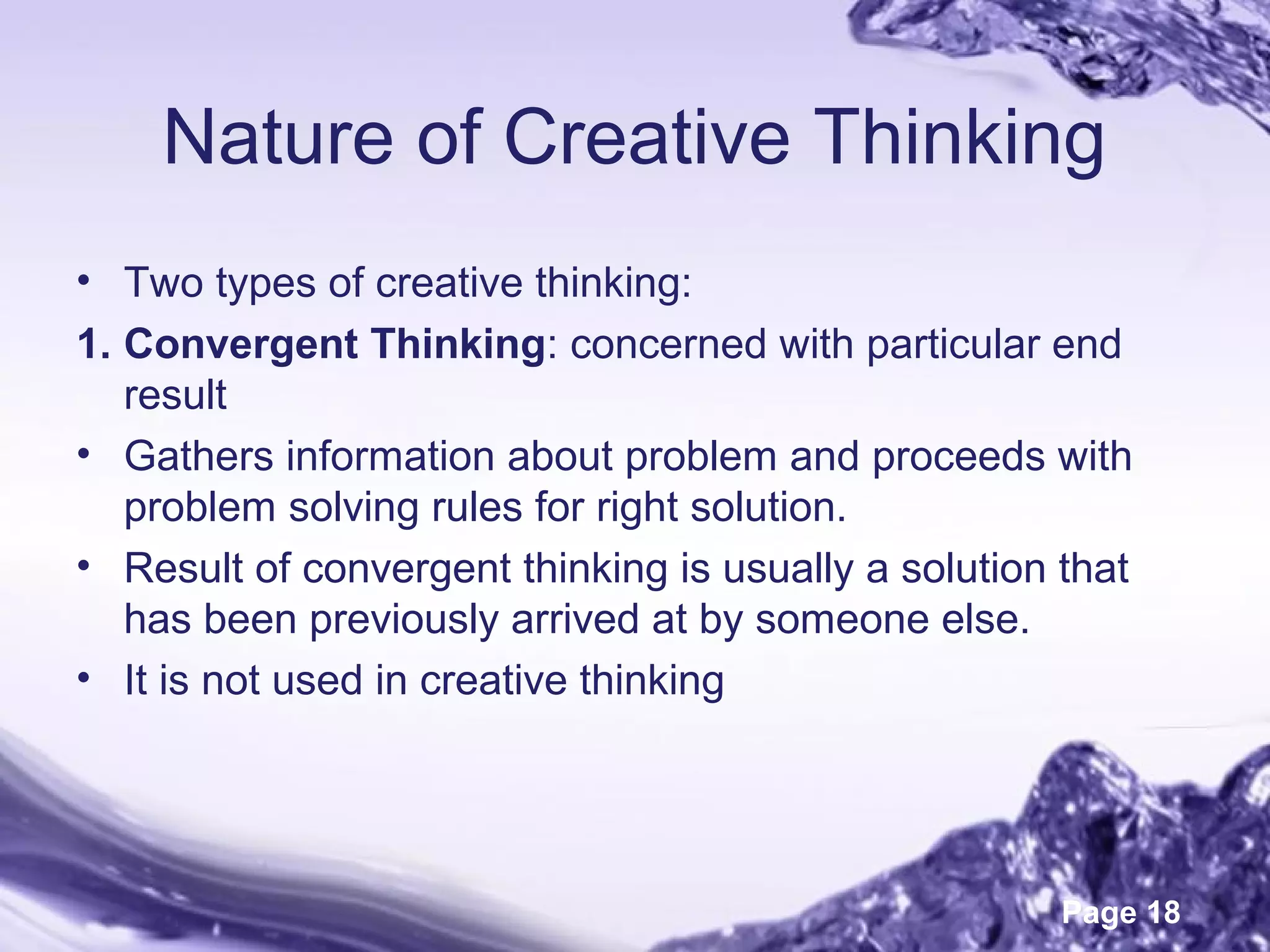
• Two types of creative thinking:
1. Convergent Thinking: concerned with particular end
result
• Gathers information about problem and proceeds with
problem solving rules for right solution.
• Result of convergent thinking is usually a solution that
has been previously arrived at by someone else.
• It is not used in creative thinking
Page 19
Nature of Creative Thinking
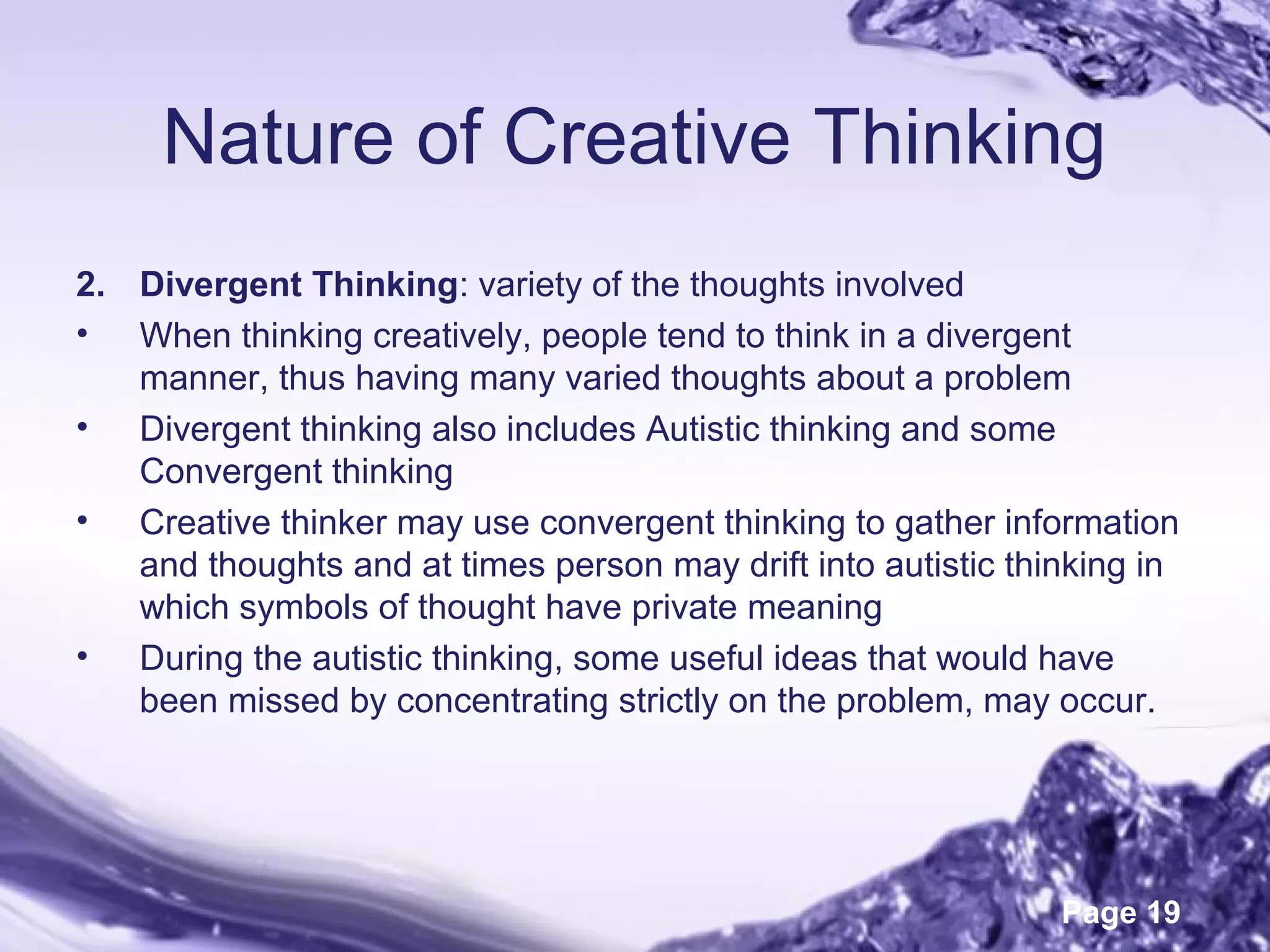
2. Divergent Thinking: variety of the thoughts involved
• When thinking creatively, people tend to think in a divergent
manner, thus having many varied thoughts about a problem
• Divergent thinking also includes Autistic thinking and some
Convergent thinking
• Creative thinker may use convergent thinking to gather information
and thoughts and at times person may drift into autistic thinking in
which symbols of thought have private meaning
• During the autistic thinking, some useful ideas that would have
been missed by concentrating strictly on the problem, may occur.
Page 20
Characteristics of Creative thinkers
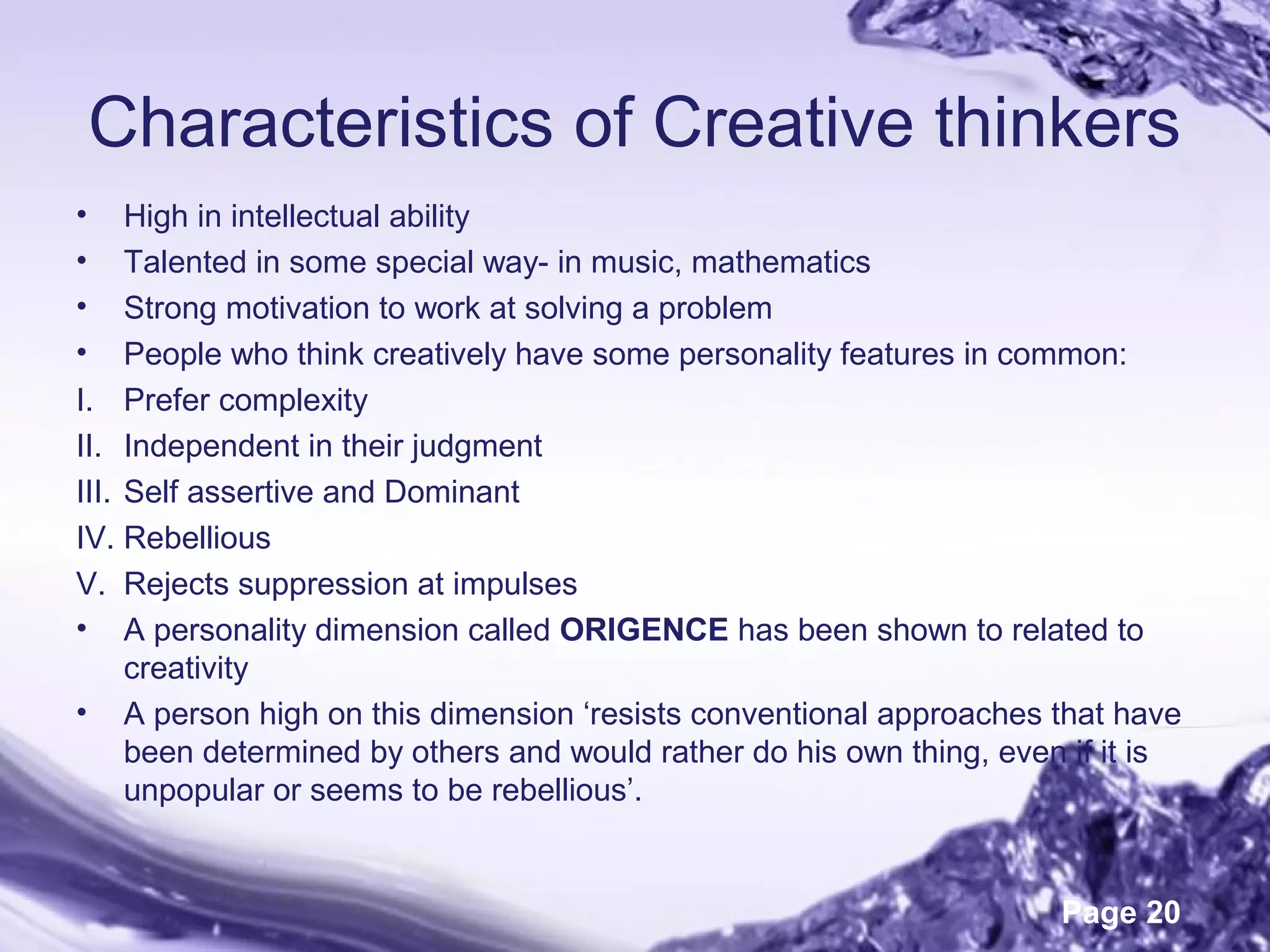
• High in intellectual ability
• Talented in some special way- in music, mathematics
• Strong motivation to work at solving a problem
• People who think creatively have some personality features in common:
I. Prefer complexity
II. Independent in their judgment
III. Self assertive and Dominant
IV. Rebellious
V. Rejects suppression at impulses
• A personality dimension called ORIGENCE has been shown to related to
creativity
• A person high on this dimension ‘resists conventional approaches that have
been determined by others and would rather do his own thing, even if it is
unpopular or seems to be rebellious’.
Page 21
Language communication
• Language is said to be communicated when others understand the meaning
of our sentences, and we, in turn, understand theirs.
• Linguistic Competence: our knowledge of the rules governing the use of
language
• This knowledge is used automatically and almost effortlessly to generate
and comprehend meaningful speech.
• Linguistic Competence comprises of
I. The sounds or written elements of language and the rules for combining
them into units, such as words, that have meaning
II. Rules of combining words into meaningful sentences, knowledge of
grammar/syntax
III. Semantic memory
Page 22
Language communication
IV. How to use speech in order to have an intended impact
on others.(PRAGMATICS)
V. Rules for processing and interpreting the speech of
other people
• LINGUISTICS: study of language as structured system
of rules
• PSYCHOLINGUISTICS: is concerned with the ways in
which people use linguistic competency to generate
and understand language
• How behavior is influenced by language
Page 23
Language Elements
• Phones: Speech sounds, are made by adjusting the vocal cords
and moving the tongue, lips, and mouth in wonderfully precise ways
to produce vibrations in the airflow from the lungs.
• Not all the speech sounds(Phones) are important
• Only a limited number of all the possible PHONES are important to
the understanding of the speech; these are known as Phonemes
• The sounds comprising phonemes are perceived as belonging
together as a category of sounds, a phenomenon called the
categorical perception of phonemes
• Example: sound ‘k’ in cool and key- same category
‘p’ in put and phone- different category
Page 24
Language Elements
• Syllable: is the smallest unit of the speech perception
• Evidence for syllable s perceptual units has been found in a number
of experiments
• Example: syllable beginning with the sound ‘b’ and syllable ‘boog’
• Demonstrates that people perceive the whole syllable before they
perceive its separate parts
• Morphemes: are the smallest unit of meaning in speech perception
• Consider the word ‘distasteful’- morphemes are dis, taste, ful
• ‘Dis’ means negation, ‘taste’ is a meaningful word, ‘ful’ means
quality
• Each morpheme is composed of syllable, but what makes them
morphemes is that they convey meaning.
Page 25
Language Elements
• Words are combined by rules of grammar into ‘clauses’, and
clauses are formed into sentences.
• A clause consist of a verb and its associated nouns, adjectives and
so on.
• Clauses are ‘the major units of perceived meaning in speech’.
• When we hear a sentence with more than one clause, we tend to
isolate the clauses, analyzing the meaning of each.
Page 26
Grammar and Meaning
• Grammar/syntax (meaning-joining together)
• Theory of transformational grammar:
• When a person intends to communicate a simple sentence (the
chicken crossed the road), the words are organized in what is called
the deep phrase structure (deep structure), mental representation of
what the person intends to say.
• By combining the elements according to phrase structure
grammatical rules, a sentence with meaning is generated.
• Continuing with the theory:
• It is a PROPOSITION (a combination of verbs and nouns)- that says
that a subject (chicken) does something (crosses) with respect to an
object (road).
• Expressed sentence is called ‘surface structure’.
Page 27
Grammar and Meaning
• Proposition can be expressed in a different way.
• Passive way: the road was crossed by the chicken.
• There are set of rules for changing the proposition into sentences
with different surface structure but the same underlying meaning.
These rules are called “TRANSFORMATION RULES’
• The surface meaning of underlying proposition can be changed by
same rules- like: the chicken did not cross the road.
• Meaning of the sentence is partly determined by grammatical
relationship and partly by transformational rules.
Page 28
Meanings of words and concepts
• Study of meaning of words and concepts is called semantics
• Without meaning communication would be impossible.
• 1st
approach: dictionary definition of words (not always helpful)
• Based on past learning- we have our own dictionaries of word and
concept meanings in our heads.
• 2nd
approach: meanings are represented in our mental dictionaries-
by in terms of ‘Family resemblance structure’ and ‘prototypes’
• Game-a prototypal game has many features
• Basketball and solitaire
• When another game name is given to us, we can say something
about that because it belongs to game family.
Page 29
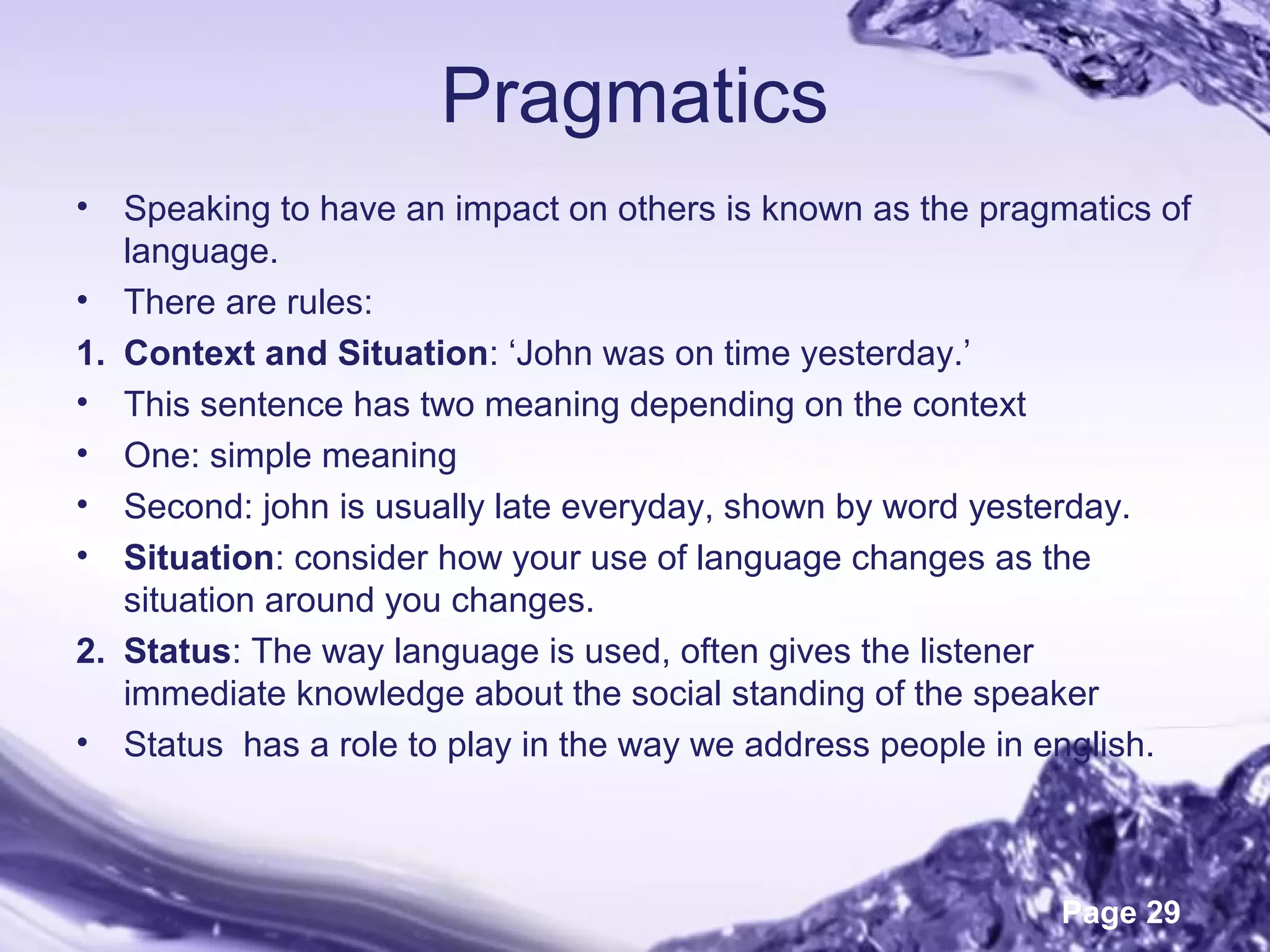
Pragmatics
• Speaking to have an impact on others is known as the pragmatics of
language.
• There are rules:
1. Context and Situation: ‘John was on time yesterday.’
• This sentence has two meaning depending on the context
• One: simple meaning
• Second: john is usually late everyday, shown by word yesterday.
• Situation: consider how your use of language changes as the
situation around you changes.
2. Status: The way language is used, often gives the listener
immediate knowledge about the social standing of the speaker
• Status has a role to play in the way we address people in english.
Page 30
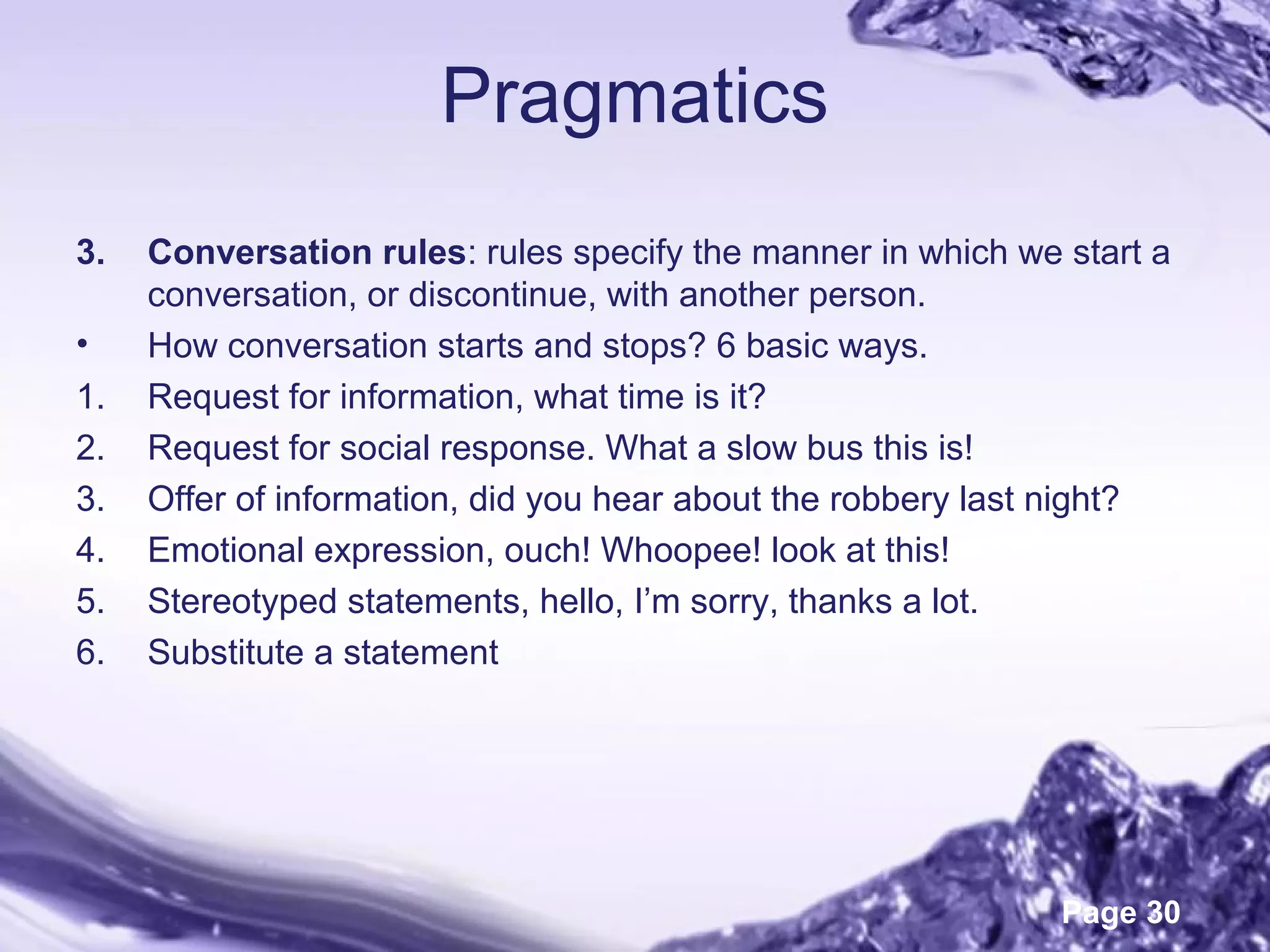
Pragmatics
3. Conversation rules: rules specify the manner in which we start a
conversation, or discontinue, with another person.
• How conversation starts and stops? 6 basic ways.
1. Request for information, what time is it?
2. Request for social response. What a slow bus this is!
3. Offer of information, did you hear about the robbery last night?
4. Emotional expression, ouch! Whoopee! look at this!
5. Stereotyped statements, hello, I’m sorry, thanks a lot.
6. Substitute a statement
Page 31
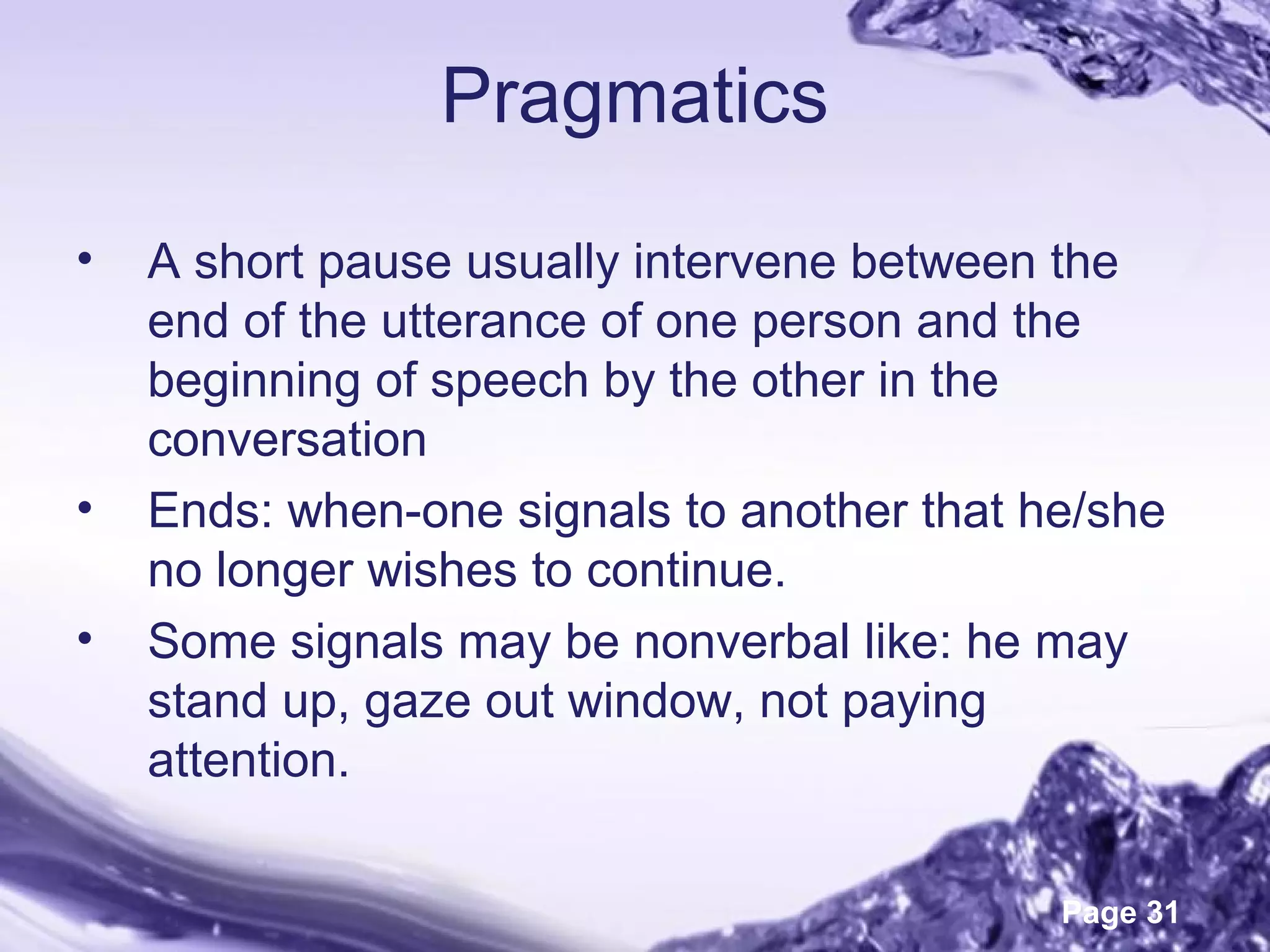
Pragmatics
• A short pause usually intervene between the
end of the utterance of one person and the
beginning of speech by the other in the
conversation
• Ends: when-one signals to another that he/she
no longer wishes to continue.
• Some signals may be nonverbal like: he may
stand up, gaze out window, not paying
attention.

Thinking and language

  • 1.
    Page 1 Thinking andLanguage Dr Ravi Soni
  • 2.
    Page 2 Defining Thinking •‘Thinking consists of the cognitive rearrangement or manipulations of both information from the environment and the symbols stored in LTM’ • A symbol represents some event or item in the world: Images and language are types of symbols • AUTISTIC thinking: some thinking is highly private and may use symbols with very personal meanings, e.g Dreams • DIRECTED thinking: some thinking is aimed at solving problems or creating something new. • From another view point “thinking is the form of cognitive processes that mediate , or go between, stimuli and response” e.g, you are planning for buying new car, sales person suggests several cars to you (stimuli), ultimately you purchase one of them (response).
  • 3.
    Page 3 The ThinkingProcess • Words, language and images are the symbols that we use in thinking. • Availability of language symbols, is what makes human thinking so much more sophisticated than the thinking of other animals. • IMAGES AND THINKING: some people use images in their thinking • Example: imagine that you standing on a certain street corner, in a section of a city, you know well. How would you walk or drive from this point to some other part of the city- we usually make a visual map. • LANGUAGE AND THINKING: for many people, much of the time, a good deal of thinking involves use of word symbols and the rules of grammar to join the words into phrases and sentences. • These symbols and rules are stored in our semantic LTMs.
  • 4.
    Page 4 Concepts • Aconcept is a ‘symbolic construction that represents some common and general feature or features of many objects or events’. • The human ability to form concepts enables us to classify things into categories. With the concept of red we can sort objects into ‘red’ and ‘nonred’ • The feature we select define the concept and form the basis for making classifications. • Concepts are tools of thinking about the world & in solving the problems. How concepts are acquired? I. Naturally II. Discrimination learning III. By Definition
  • 5.
    Page 5 Concepts I. Naturally: oAcquired easily o Appear in thinking very early in life, and to some extent affect the way, brain processes and sorts information o Example: division of the colors of the spectrum into the categories: red, blue, green. Other examples are chair, fruit, tree II. Discrimination learning: o Acquired slowly and with more effort o Occurs when some responses are rewarded or reinforced and other responses are not rewarded. o Example: concept of ‘apple’- child learns it by saying it and pointing at it and reward is that mother says hat it is ‘right’. III. By Definition: o Many concepts acquired in the later stages of a person’s education are learned in this way. o Helps us acquire concepts by describing them in terms of other words or concepts with which we are already familiar.
  • 6.
    Page 6 Problem Solving Whatis a Problem? o It is any conflict or difference between one situation and another situation we wish to produce-our goal. o Thinking that we do in problem solving is goal directed and motivated by the need to reduce the discrepancy between one state of affairs and another. o In trying to reach goal of problem solution, we use information available from LTM. o We process the information according the rules that tells us what we can and cannot do.
  • 7.
    Page 7 Problem Solving Rules in Problem Solving: rules used in problem solving concern the changes that are permissible in going from one situation to another. I. Algorithm II. Heuristics 1. ALGORITHM: is a set of rules which, if followed correctly, will guarantee a solution to a problem.  Example: two numbers multiplication, you immediately starts thinking all the rules for multiplication you have learned, and you apply these algorithms to the problem. 2. HEURISTICS: are strategies, usually based on our past experience with problems, that are likely to lead to a solution but do not guarantee success.  One common strategy, or heuristic is to break the problem down into smaller sub-problems, each a little closer to the end goal.  MEANS END ANALYSIS: each step leads closer to the desired goal.
  • 8.
    Page 8 Problem Solving Habits and set in Problem Solving: practice in solving problems in a particular way tends to give people a set to use the same rules on other problems.  Example: the joker spells words and asks another person to pronounce them. He uses names beginning with Mac, like MacDonald, MacTavish; then the word Machinery is spelled to see if the person pronounces it ‘MacHinery’. So with the set for names, person often falls into the trap.  SET may be induced by 1) immediately preceding experiences, 2) by long established practices, 3) by instructions that revive old habits.  It biases thinkers  Directs them away from certain thoughts and towards others  It acts as an implied assumption  It can be either positive and negative in its effects  A particular form of set that can point thoughts in the wrong direction has been called FUNCTIONAL FIXEDNESS. It is a set to use objects in the way we are accustomed to using them, even if a different use might solve the problem.
  • 9.
    Page 9 Decision Making •Is a kind of problem solving in which we are presented with several alternatives, among which we must choose. • Example: why does person decides to buy one car and not another? • Why does an investor buy one stock and not another? • In deciding this they are trying to make optimum decisions • They optimize utility: perceived benefit or psychological value, in making their decisions. Example, poor and rich persons, choices 10 euros now and 100 euros with wait of one year. • Utiliy of 10 euros is different for the two people
  • 10.
    Page 10 Decision Making •Subjective Probabilities: most decisions are risky in the sense that we cannot be sure of the outcome. Example, tossed coin-heads/tails-50/50 chance • But for some complex real life situations, we don’t know about precise likelihood of various outcomes. • But we can only make our own estimates of the probabilities. • Such guessed at, or perceived , probability estimates are known as Subjective Probabilities. • Subjective expected utility: given a choice among alternatives, we take utility and Subjective Probabilities in to account, multiply them together and take the alternative with highest product. • People usually make decisions that will maximize Subjective expected utility. • This model of utility and subjective probabilities has had some success in predicting decisions in-simple situations • But in real life situations, people seem to use other ways of making decisions, like heuristics in deciding among alternatives.
  • 11.
    Page 11 Decision Making •Heuristics and Biases in Decision making: heuristics can be used for estimating subjective probability of outcomes, but it can also lead to biases and errors. • Heuristic decision making rules are: I. Representativeness II. Availability III. Adjustment 1. Representativeness: in this we first decide whether the current situation is similar to one we have encountered before and then we act accordingly.  In other words , whether the current situation is a representation of something we have already experienced.  This method can work sometimes, but it may result in our being misled by surface similarities.  It may be possible that, the original situation which serves as our basis for comparison, may not be representative of true state of affairs.
  • 12.
    Page 12 Decision Making II.Availability: some events are easier to remember or imagine because they are frequently occurring, and also the easily remembered events are likely to be more frequent than others. • Thus the ease with which we remember certain things help us in making subjective probability estimates. • It can be useful, but neglecting events that are harder to remember can also lead to misjudgment about the likelihood of certain outcomes. III. Adjustment: we start with some subjective probability and raise or lower it depending on the circumstances. When we make this adjustment, outcome depends upon the starting point. • If we start with high estimate, even if we adjust it downward out probability estimate will be higher than if we started with low estimate. • It is like if the initial level provided an ‘Anchor’ that biased our estimate, and therefore this biasing effect is often called anchoring
  • 13.
    Page 13 Decision Making •WEIGHING ALTERNATIVES: the decision maker can assess the utility of each attribute, multiplying by the weight to give an overall value for that attribute. Finally the overall score can be summed to give a single weighted utility for each alternative • Attribute’s utility × weight = value of attribute attribute weight Perceived utility for three bowlers Weighted utilities (weight × utility) Morgan King Sam Morgan King Sam Cost 1 3 2 1 3 2 1 Previous record of win-loss 2 1 2 3 2 4 5 Average run given 3 1 2 3 3 6 9 Effectiveness against right handed 4 1 2 3 4 8 12 Condition of arm 5 1 3 2 5 15 10 Sums 17 35 38
  • 14.
    Page 14 Creative Thinking •Thinking something ‘new’ • Trying to create ‘new’ • Product of creative thinking may be a new and unique way of conceptualizing the world around us • Emphasis in the creative thinking is on the word ‘NEW’ • Involves considerable amount of unconscious rearrangement of symbols • The sudden appearance of new idea is called ‘Insight’
  • 15.
    Page 15 Insight inCreative thinking • The thinker at first makes little progress, but then, perhaps triggered by a fortuitous set of circumstances, a new idea seems to ‘bubble up’ into awareness, in a seemingly spontaneous manner. • Example of the role of insight in creative thinking: King Hiero and Archemedes. • Golden crown in a temple as a thank offering to gods.
  • 16.
    Page 16 Stages inCreative thinking • Graham Wallas- studied the steps involved in the thinking of creative people • One way of looking at creative thinking is five stages: 1. Preparation: thinker formulates the problem and collect the facts and materials considered necessary for the new solution • Sometimes they cant find the solution • Failing to solve the problem, the thinker either deliberately or involuntarily turns away from it
  • 17.
    Page 17 Stages inCreative thinking 2. Incubation: Some of the ideas tat were interfering with the solutions tends to fade. In addition, the creative thinker may have experiences that provide clues to the solutions • Unconscious thought process involved in creative thinking are also at work during this period of incubation 3. Illumination: occurs with it ‘aha!’ insight experience; an idea for the solution suddenly comes in to the consciousness 4. Evaluation: apparent solution is tested to see if it satisfactorily solves the problem and sometimes thinker requires modification 5. Revision: revise everything about problem solving • Another way of looking at creative thinking is how it differs from the more routine kinds of thinking, we do.
  • 18.
    Page 18 Nature ofCreative Thinking • Two types of creative thinking: 1. Convergent Thinking: concerned with particular end result • Gathers information about problem and proceeds with problem solving rules for right solution. • Result of convergent thinking is usually a solution that has been previously arrived at by someone else. • It is not used in creative thinking
  • 19.
    Page 19 Nature ofCreative Thinking 2. Divergent Thinking: variety of the thoughts involved • When thinking creatively, people tend to think in a divergent manner, thus having many varied thoughts about a problem • Divergent thinking also includes Autistic thinking and some Convergent thinking • Creative thinker may use convergent thinking to gather information and thoughts and at times person may drift into autistic thinking in which symbols of thought have private meaning • During the autistic thinking, some useful ideas that would have been missed by concentrating strictly on the problem, may occur.
  • 20.
    Page 20 Characteristics ofCreative thinkers • High in intellectual ability • Talented in some special way- in music, mathematics • Strong motivation to work at solving a problem • People who think creatively have some personality features in common: I. Prefer complexity II. Independent in their judgment III. Self assertive and Dominant IV. Rebellious V. Rejects suppression at impulses • A personality dimension called ORIGENCE has been shown to related to creativity • A person high on this dimension ‘resists conventional approaches that have been determined by others and would rather do his own thing, even if it is unpopular or seems to be rebellious’.
  • 21.
    Page 21 Language communication •Language is said to be communicated when others understand the meaning of our sentences, and we, in turn, understand theirs. • Linguistic Competence: our knowledge of the rules governing the use of language • This knowledge is used automatically and almost effortlessly to generate and comprehend meaningful speech. • Linguistic Competence comprises of I. The sounds or written elements of language and the rules for combining them into units, such as words, that have meaning II. Rules of combining words into meaningful sentences, knowledge of grammar/syntax III. Semantic memory
  • 22.
    Page 22 Language communication IV.How to use speech in order to have an intended impact on others.(PRAGMATICS) V. Rules for processing and interpreting the speech of other people • LINGUISTICS: study of language as structured system of rules • PSYCHOLINGUISTICS: is concerned with the ways in which people use linguistic competency to generate and understand language • How behavior is influenced by language
  • 23.
    Page 23 Language Elements •Phones: Speech sounds, are made by adjusting the vocal cords and moving the tongue, lips, and mouth in wonderfully precise ways to produce vibrations in the airflow from the lungs. • Not all the speech sounds(Phones) are important • Only a limited number of all the possible PHONES are important to the understanding of the speech; these are known as Phonemes • The sounds comprising phonemes are perceived as belonging together as a category of sounds, a phenomenon called the categorical perception of phonemes • Example: sound ‘k’ in cool and key- same category ‘p’ in put and phone- different category
  • 24.
    Page 24 Language Elements •Syllable: is the smallest unit of the speech perception • Evidence for syllable s perceptual units has been found in a number of experiments • Example: syllable beginning with the sound ‘b’ and syllable ‘boog’ • Demonstrates that people perceive the whole syllable before they perceive its separate parts • Morphemes: are the smallest unit of meaning in speech perception • Consider the word ‘distasteful’- morphemes are dis, taste, ful • ‘Dis’ means negation, ‘taste’ is a meaningful word, ‘ful’ means quality • Each morpheme is composed of syllable, but what makes them morphemes is that they convey meaning.
  • 25.
    Page 25 Language Elements •Words are combined by rules of grammar into ‘clauses’, and clauses are formed into sentences. • A clause consist of a verb and its associated nouns, adjectives and so on. • Clauses are ‘the major units of perceived meaning in speech’. • When we hear a sentence with more than one clause, we tend to isolate the clauses, analyzing the meaning of each.
  • 26.
    Page 26 Grammar andMeaning • Grammar/syntax (meaning-joining together) • Theory of transformational grammar: • When a person intends to communicate a simple sentence (the chicken crossed the road), the words are organized in what is called the deep phrase structure (deep structure), mental representation of what the person intends to say. • By combining the elements according to phrase structure grammatical rules, a sentence with meaning is generated. • Continuing with the theory: • It is a PROPOSITION (a combination of verbs and nouns)- that says that a subject (chicken) does something (crosses) with respect to an object (road). • Expressed sentence is called ‘surface structure’.
  • 27.
    Page 27 Grammar andMeaning • Proposition can be expressed in a different way. • Passive way: the road was crossed by the chicken. • There are set of rules for changing the proposition into sentences with different surface structure but the same underlying meaning. These rules are called “TRANSFORMATION RULES’ • The surface meaning of underlying proposition can be changed by same rules- like: the chicken did not cross the road. • Meaning of the sentence is partly determined by grammatical relationship and partly by transformational rules.
  • 28.
    Page 28 Meanings ofwords and concepts • Study of meaning of words and concepts is called semantics • Without meaning communication would be impossible. • 1st approach: dictionary definition of words (not always helpful) • Based on past learning- we have our own dictionaries of word and concept meanings in our heads. • 2nd approach: meanings are represented in our mental dictionaries- by in terms of ‘Family resemblance structure’ and ‘prototypes’ • Game-a prototypal game has many features • Basketball and solitaire • When another game name is given to us, we can say something about that because it belongs to game family.
  • 29.
    Page 29 Pragmatics • Speakingto have an impact on others is known as the pragmatics of language. • There are rules: 1. Context and Situation: ‘John was on time yesterday.’ • This sentence has two meaning depending on the context • One: simple meaning • Second: john is usually late everyday, shown by word yesterday. • Situation: consider how your use of language changes as the situation around you changes. 2. Status: The way language is used, often gives the listener immediate knowledge about the social standing of the speaker • Status has a role to play in the way we address people in english.
  • 30.
    Page 30 Pragmatics 3. Conversationrules: rules specify the manner in which we start a conversation, or discontinue, with another person. • How conversation starts and stops? 6 basic ways. 1. Request for information, what time is it? 2. Request for social response. What a slow bus this is! 3. Offer of information, did you hear about the robbery last night? 4. Emotional expression, ouch! Whoopee! look at this! 5. Stereotyped statements, hello, I’m sorry, thanks a lot. 6. Substitute a statement
  • 31.
    Page 31 Pragmatics • Ashort pause usually intervene between the end of the utterance of one person and the beginning of speech by the other in the conversation • Ends: when-one signals to another that he/she no longer wishes to continue. • Some signals may be nonverbal like: he may stand up, gaze out window, not paying attention.