Aggression Motivation &  Emotion
What is Aggression?
Aggression Presenting an aversive stimulus to an unwilling victim
Types of Aggression Hostile Aggression Striking out against someone or something because of anger or frustration (e.g., road rage)
Types of Aggression Instrumental Aggression Desired results obtained through hostile means due to reinforced hostile behavior  (e.g., a bully who gains respect of his/her peers)
Factors Increasing Aggressive Behavior
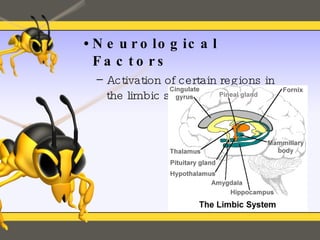
Neurological Factors Activation of certain regions in the limbic system
Environmental Factors Crowding and temperature
Theories of Aggression
Biological Perspective of Aggression Hypothalamus prompts instinctive aggressive actions   when electrically stimulated.  In higher animals, however, the brain(cerebral cortex) seems to moderate the aggression  (inhibit it).
Psychodynamic Perspective of Aggression Reactions to the frustrations of daily life .  Frustrations come from ungratified Id impulses, which, of course, can never be fully satisfied.
Cognitive Perspective of Aggression We act aggressively if we  choose  to ,  based on our values, how we process information in the world; therefore, if we feel it is  justified or not
Learning Perspective of Aggression Acquired through principles of reinforcement .  If aggression gets us what we want, it is reinforced and the behavior will increase.
Sociocultural Perspective on Aggression Cultures foster aggression  ( or not)   The United States fosters competitiveness, independence, and differentiation allowing children to be “under-controlled”. The problem  (side effect) arising from this is   Aggression .
other cultures foster politeness and deference & their children tend to be “over-controlled”  This fosters side effects like sleep disorders, irrational fears, and physical problems… but NOT  aggression .
You Get What You Foster
Definitions of  Aggression Proposed by psychologists
Freeman (1982) “Behavior intended to hurt another person”
McGee & Wilson (1984) “Any behavior whose intent is to inflict harm or injury on another living being.”
Lefreancois (1982) “Hostile or forceful action intended to dominate or violate.”
Atkinson, Atkinson & Hilgard (1983) “Behavior that is intended to injure another person (physically or verbally) or to destroy property.”
Buss (1961) “A response that delivers noxious stimuli to another organism.”
What does or does not constitute aggression? Even the experts can’t agree
MOTIVALTION CONFLICT Approach-approach conflict:  choosing between two positive or desirable alternatives. Avoidance-avoidance conflict:  choosing between two negative or mutually undesirable alternatives .
Approach-avoidance conflict : being attracted to and repelled bye the same goal. Double approach-avoidance conflict : being simultaneously attracted to and repelled by each of two alternatives.

Aggression

  • 1.
  • 2.
  • 3.
    Aggression Presenting anaversive stimulus to an unwilling victim
  • 4.
    Types of AggressionHostile Aggression Striking out against someone or something because of anger or frustration (e.g., road rage)
  • 5.
    Types of AggressionInstrumental Aggression Desired results obtained through hostile means due to reinforced hostile behavior (e.g., a bully who gains respect of his/her peers)
  • 6.
  • 7.
    Neurological Factors Activationof certain regions in the limbic system
  • 8.
  • 9.
  • 10.
    Biological Perspective ofAggression Hypothalamus prompts instinctive aggressive actions when electrically stimulated. In higher animals, however, the brain(cerebral cortex) seems to moderate the aggression (inhibit it).
  • 11.
    Psychodynamic Perspective ofAggression Reactions to the frustrations of daily life . Frustrations come from ungratified Id impulses, which, of course, can never be fully satisfied.
  • 12.
    Cognitive Perspective ofAggression We act aggressively if we choose to , based on our values, how we process information in the world; therefore, if we feel it is justified or not
  • 13.
    Learning Perspective ofAggression Acquired through principles of reinforcement . If aggression gets us what we want, it is reinforced and the behavior will increase.
  • 14.
    Sociocultural Perspective onAggression Cultures foster aggression ( or not) The United States fosters competitiveness, independence, and differentiation allowing children to be “under-controlled”. The problem (side effect) arising from this is Aggression .
  • 15.
    other cultures fosterpoliteness and deference & their children tend to be “over-controlled” This fosters side effects like sleep disorders, irrational fears, and physical problems… but NOT aggression .
  • 16.
    You Get WhatYou Foster
  • 17.
    Definitions of Aggression Proposed by psychologists
  • 18.
    Freeman (1982) “Behaviorintended to hurt another person”
  • 19.
    McGee & Wilson(1984) “Any behavior whose intent is to inflict harm or injury on another living being.”
  • 20.
    Lefreancois (1982) “Hostileor forceful action intended to dominate or violate.”
  • 21.
    Atkinson, Atkinson &Hilgard (1983) “Behavior that is intended to injure another person (physically or verbally) or to destroy property.”
  • 22.
    Buss (1961) “Aresponse that delivers noxious stimuli to another organism.”
  • 23.
    What does ordoes not constitute aggression? Even the experts can’t agree
  • 24.
    MOTIVALTION CONFLICT Approach-approachconflict: choosing between two positive or desirable alternatives. Avoidance-avoidance conflict: choosing between two negative or mutually undesirable alternatives .
  • 25.
    Approach-avoidance conflict :being attracted to and repelled bye the same goal. Double approach-avoidance conflict : being simultaneously attracted to and repelled by each of two alternatives.