LEARNING:  Principles  &  Applications Classical Conditioning Operant Conditioning Social Learning
LEARNING A relatively permanent change in behavior that results from experience
CHARACTERISTICS OF LEARNING Learning… is a change in mental state.  cannot be seen directly involves a change in behavior results from experience
CHARACTERISTICS OF LEARNING Cont. is relatively permanent can be applied from one situation to another (transfer) need not involve direct experience
Learning:  Principles and  Applications Classical Conditioning ** Operant Conditioning  Social Learning
CLASSICAL CONDITIONING Ivan Pavlov Russian biologist/physiologist Nobel Prize Serendipity
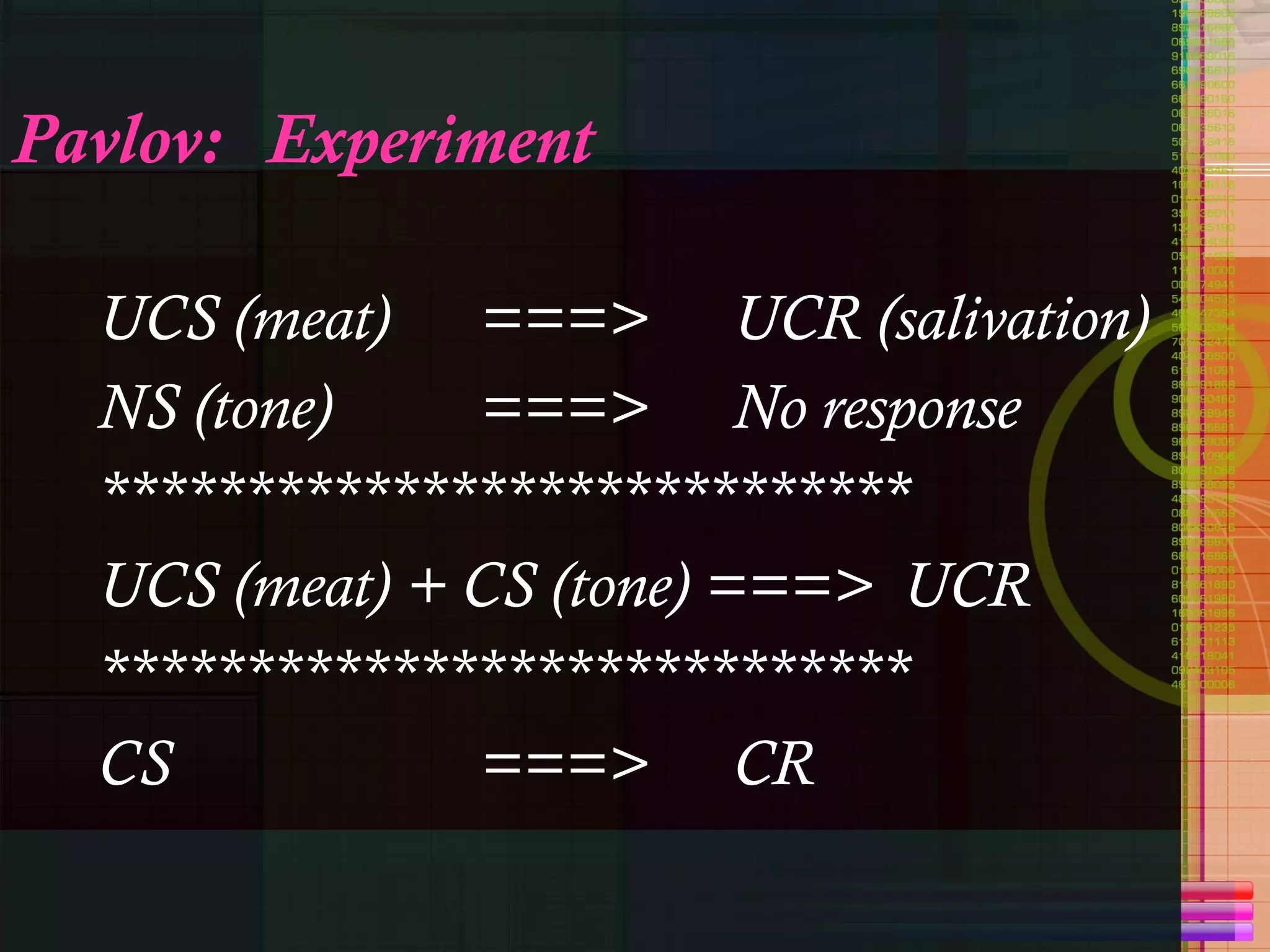
Pavlov:  Experiment UCS (meat) ===> UCR (salivation)  NS (tone)  ===> No response **************************** UCS (meat) + CS (tone) ===>  UCR  **************************** CS ===> CR
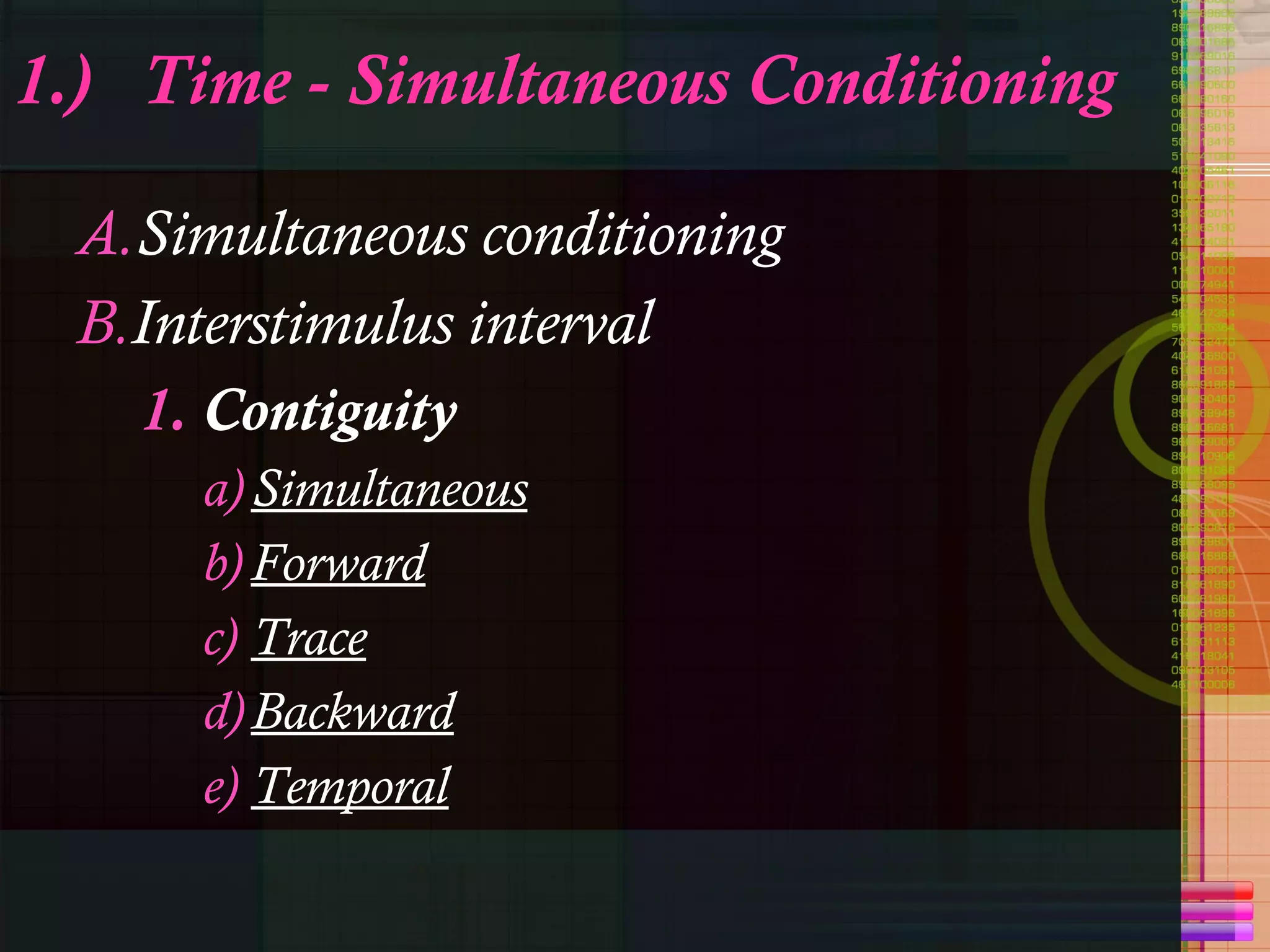
1.) Time - Simultaneous Conditioning Simultaneous conditioning  Interstimulus interval Contiguity Simultaneous   Forward   Trace   Backward Temporal
2)  Generalization Occurs when a subject responds to a second stimulus similar to the CS, without being trained with the second CS
3)  Discrimination Occurs when a subject is taught to tell the difference between 2 stimuli.  *Opposite of generalization **Has great value because…???
4)  Extinction Occurs over time when the experimenter stops pairing a CS together with a UCS. the response gradually fades away, although not entirely forgotten or unlearned used as a measurement… resistance to extinction * Partial reinforcement effect
5) Spontaneous Recovery Occurs when , after extinction, a CS is once again presented with a USC, the CR appears again. *Not as strong *Harmful experiences/ example
How the Body Remembers… When the Mind Forgets… Dog Chase example Schizokinesis Schizo means divided/split Kinesis means action WWII Vets example
6)  Spatial Learning Occurs in much the same way classical conditioning does, but involves the learning the location of objects in the subject’s environment.  *Cognitive Mapping
The Case of Little Albert - Watson (1920_ Subject - 9 month old Albert Desired Response - Fear USC = loud noise UCR = fear Criticism Ethics / Deconditioning
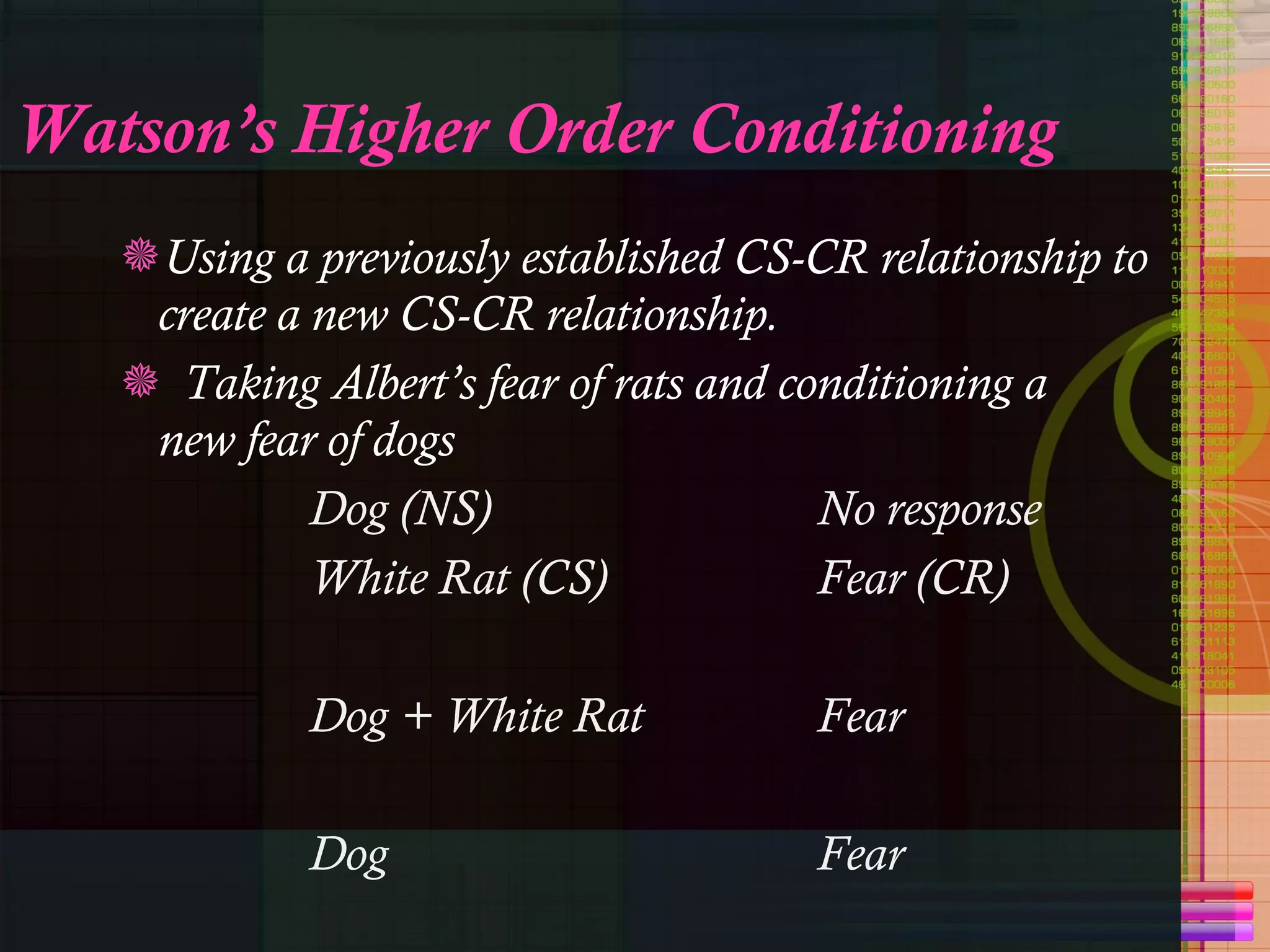
Watson’s Higher Order Conditioning Using a previously established CS-CR relationship to create a new CS-CR relationship. Taking Albert’s fear of rats and conditioning a  new fear of dogs Dog (NS) No response White Rat (CS) Fear (CR) Dog + White Rat Fear Dog Fear
Other Classical Conditioning Paradigms Jones (1924) Counter conditioning Used ice cream Mower (1938) Used applied science Bed wetting  Bell and pad conditioning apparatus Garcia & Koelling(1966) Taste aversion Electric shock Gustavson (1974) Taste aversion  Coyotes/sheep CTA (conditioning taste aversion)
Learning:  Principles and  Applications Classical Conditioning   Operant Conditioning   ** Social Learning
II. Operant Conditioning LEARNING FROM THE CONSEQUENCES OF BEHAVIOR OF OTHERS
Differences Between Classical and Operant Conditioning Way psychologists view learners Concept of reinforcement
Three Laws of Conditioning The law of association Repetition is a part of conditioning The law of effect
Reinforcement B.F. Skinner S-R psychology Positive reinforces Approval Money Privileges
Schedules of Reinforcement Dictate the frequency with which the behavior is rewarded Continuous schedule of reinforcement Partial schedule of reinforcement Ratio schedules Fixed ratio schedules Variable ratio schedules Interval schedules Fixed interval schedules Variable interval schedules
B.  Stimulus  Control Signals are stimuli that are associated with reward or punishment Skinner & the Pigeons Response(the pecking) -----> reinforcement (food)
Stimulus Control cont. Secondary reinforcers   (conditioned reinforcers) Wolfe (1936) chimp study Primary reinforcers Satisfy a basic need (hunger…) Examples:  food, sex, avoidance of pain, feeling of belonging… Jeans example
C. Aversive Control Negative reinforcement  - painful or unpleasant stimulus is either removed as a result of appropriate behavior or not applied at all Escape conditioning  (ex. Electric shock to Skinner rat) Avoidance conditioning  (ex. Flashing lights & electric shock, lever)
C. Aversive Control 2.  Punishment  - unpleasant stimulus applied as a result of undesirable behavior (after the fact) Often effective for stopping a specific behavior Less effective for stopping a general behavior
Negative Reinforcement vs Punishment Negative reinforcement is opposite of punishment Negative reinforcement increases a behavior Punishment decreases a behavior
6 effects of punishment: May slow down learning instead of speeding it up May suppress good behavior as well as bad Behavior may resurface when punisher is not around May create an expectation of failure; punishment becomes self-defeating May be negatively associated with power May have negative effects on the punisher
Summary of Aversion Control If punishment is used, it should be clear that certain behavior will be rewarded Punishment really suppresses, rather than eliminates undesirable behavior Example that fits all 3 categories (Running)
Learning:  Principles and  Applications Classical Conditioning   Operant Conditioning     Social Learning  **
3 Factors That Affect Learning Feedback Transfer Practice
1.  Feedback Finding out the results of an action or performance Increases the speed of learning
2. Transfer Using a skill that you have already learned to help you learn another skill a.  Positive Transfer b.  Negative Transfer
a.  Positive Transfer A previously learned response helps in learning a new response Ex. Moving from tricycle to bicycle
b.  Negative Transfer A previously learned response hinders in learning a new response Ex. Moving from 4 wheel Skating to inline skating
3.  Practice The repetition of a task How & when you practice is most important Psychologists have found that practice is most effective if it takes place regularly over time, rather than all at once Ex.  Mental Practice
Learning Strategies Learning to learn Learned helplessness Learned laziness
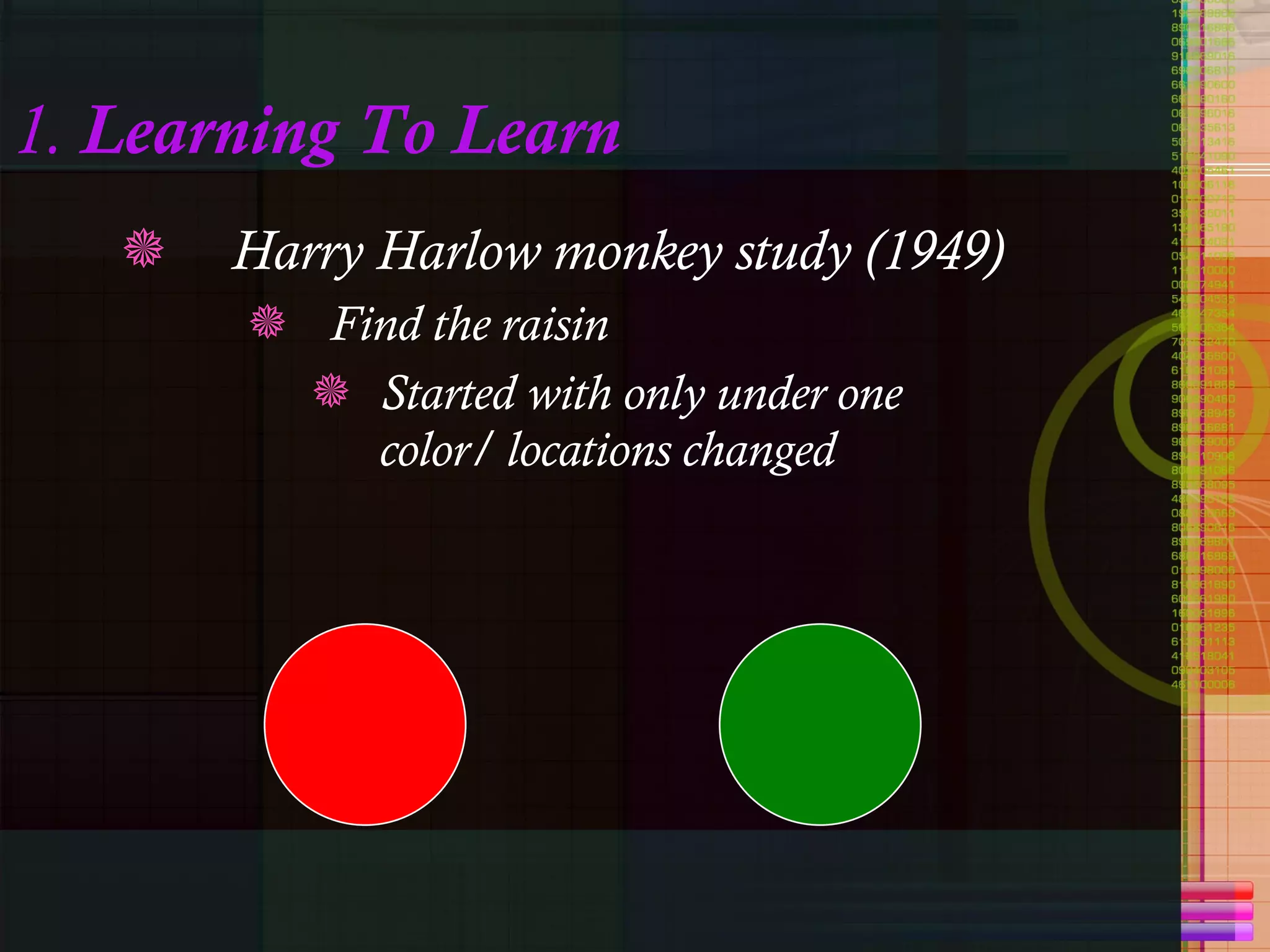
1.  Learning To Learn Harry Harlow monkey study (1949) Find the raisin Started with only under one color/ locations changed
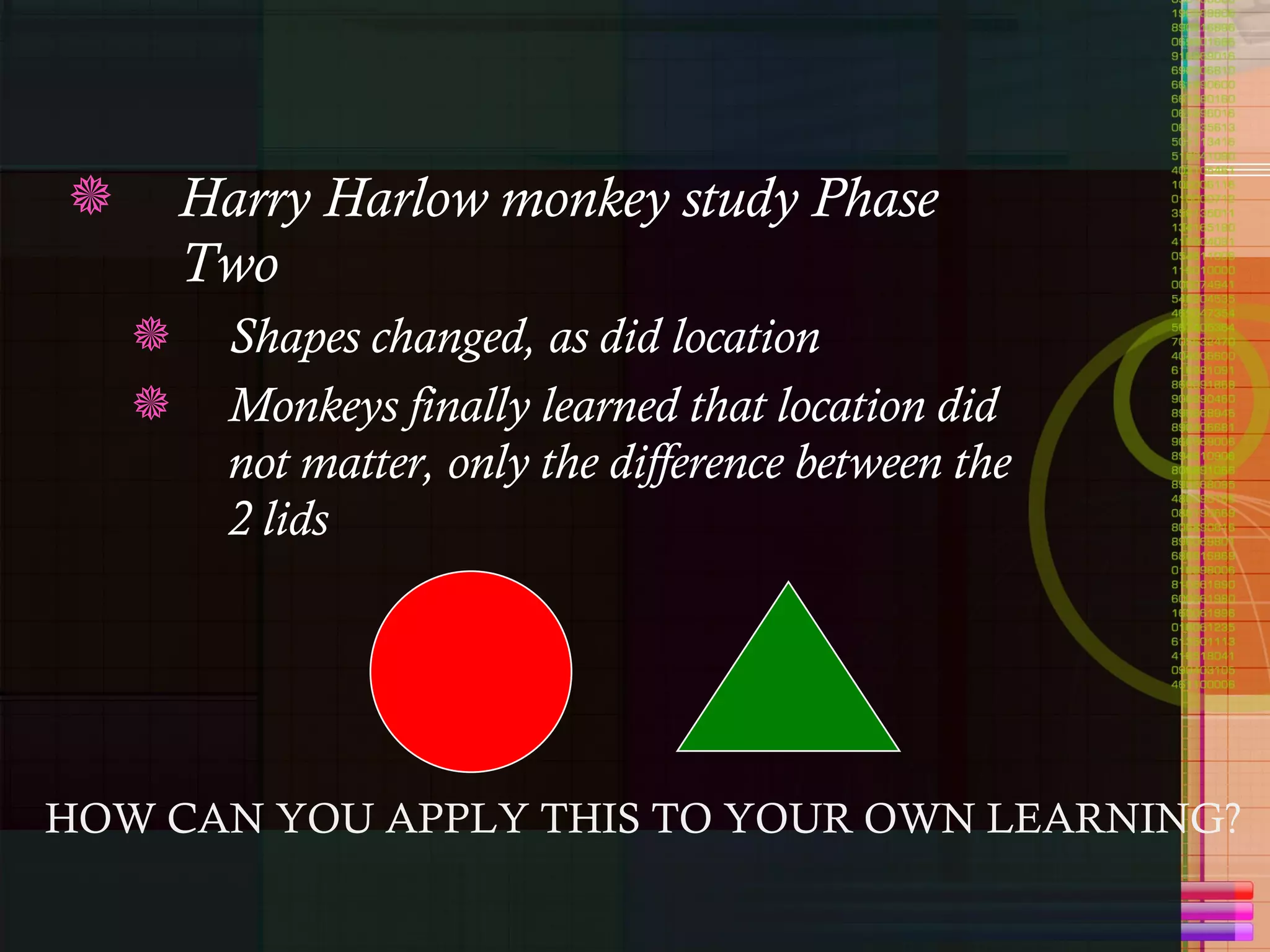
Harry Harlow monkey study Phase Two Shapes changed, as did location Monkeys finally learned that location did not matter, only the difference between the 2 lids HOW CAN YOU APPLY THIS TO YOUR OWN LEARNING?
2.  Learned Helplessness A general learning strategy in which subjects believe that they are powerless to affect the outcome of a situation, so it is useless to try to change it
Learned Helplessness cont.  Hiroto (1974) 2 groups of college students / loud noises Illustrates concept of learned helplessness Seligman (1982) Proposed that learned helplessness is one of the major causes of depression Initial study with dogs/applied to humans
Learned Helplessness and Depression less motivation poor self-concept may cause depression
Learned Helplessness & Depression cont. Stability (temporary vs stable)  Globality (specific vs global) Internality (internal vs external cause)
3. Learned Laziness Failure to overcome a problem because the subject knows that he won’t be punished as a result, or because he knows that someone will do it for him
… Learning Complicated Skills Shaping Chaining
1. Shaping Sculpting new responses out of old ones Rats raising a flag Skinner’s bowling pigeons Lovaas (1967)
2. Combining Responses: Chaining a.  Response chains b.  Response patterns
a.  Response Chains A group of responses that follow each other in a sequence Ex. Babies drinking bottles…
b.  Response Patterns A cluster of chained responses that operate together to produce a complex behavior Ex. Swimming (arm stroke chain, breathing chain, and leg kicking chain… all performed @ the same time)
Modeling Cuing Observational Learning Social Learning Theory
a. Cuing The behavior of others acts as a cue for the appropriate way to behave
b.  Observational Learning Coined by Albert Bandura Imitation The ability to reproduce a behavior that you have watched someone else perform
4 Processes of Observational Learning Attention  Retention Reproduction of Action Motivation
C.  Social Learning Theory Learning of social skills is done by observational learning Albert Bandura
Bandura: The Bobo Doll Experiment Bobo doll video Frustrating experience Playing experience   Variations…
The Bobo Doll Experiment - Conclusion BOTH classical and operant conditioning can take place through observational learning by observing another’s conditioning
Behavior Modification Applying principles of learning to change people’s actions and feelings
Computer assisted Instruction (CAI) Concept invented by SL Presser Teaching machine invented by BF Skinner (my boyfriend)
Token Economies Systematically paying people to behave appropriately Cohen and Filipczak - National training School experiment Miller and Schneider preschool experiment Head Start

Chp 9 learning Reg. Psych

  • 1.
    LEARNING: Principles & Applications Classical Conditioning Operant Conditioning Social Learning
  • 2.
    LEARNING A relativelypermanent change in behavior that results from experience
  • 3.
    CHARACTERISTICS OF LEARNINGLearning… is a change in mental state. cannot be seen directly involves a change in behavior results from experience
  • 4.
    CHARACTERISTICS OF LEARNINGCont. is relatively permanent can be applied from one situation to another (transfer) need not involve direct experience
  • 5.
    Learning: Principlesand Applications Classical Conditioning ** Operant Conditioning Social Learning
  • 6.
    CLASSICAL CONDITIONING IvanPavlov Russian biologist/physiologist Nobel Prize Serendipity
  • 7.
    Pavlov: ExperimentUCS (meat) ===> UCR (salivation) NS (tone) ===> No response **************************** UCS (meat) + CS (tone) ===> UCR **************************** CS ===> CR
  • 8.
    1.) Time -Simultaneous Conditioning Simultaneous conditioning Interstimulus interval Contiguity Simultaneous Forward Trace Backward Temporal
  • 9.
    2) GeneralizationOccurs when a subject responds to a second stimulus similar to the CS, without being trained with the second CS
  • 10.
    3) DiscriminationOccurs when a subject is taught to tell the difference between 2 stimuli. *Opposite of generalization **Has great value because…???
  • 11.
    4) ExtinctionOccurs over time when the experimenter stops pairing a CS together with a UCS. the response gradually fades away, although not entirely forgotten or unlearned used as a measurement… resistance to extinction * Partial reinforcement effect
  • 12.
    5) Spontaneous RecoveryOccurs when , after extinction, a CS is once again presented with a USC, the CR appears again. *Not as strong *Harmful experiences/ example
  • 13.
    How the BodyRemembers… When the Mind Forgets… Dog Chase example Schizokinesis Schizo means divided/split Kinesis means action WWII Vets example
  • 14.
    6) SpatialLearning Occurs in much the same way classical conditioning does, but involves the learning the location of objects in the subject’s environment. *Cognitive Mapping
  • 15.
    The Case ofLittle Albert - Watson (1920_ Subject - 9 month old Albert Desired Response - Fear USC = loud noise UCR = fear Criticism Ethics / Deconditioning
  • 16.
    Watson’s Higher OrderConditioning Using a previously established CS-CR relationship to create a new CS-CR relationship. Taking Albert’s fear of rats and conditioning a new fear of dogs Dog (NS) No response White Rat (CS) Fear (CR) Dog + White Rat Fear Dog Fear
  • 17.
    Other Classical ConditioningParadigms Jones (1924) Counter conditioning Used ice cream Mower (1938) Used applied science Bed wetting Bell and pad conditioning apparatus Garcia & Koelling(1966) Taste aversion Electric shock Gustavson (1974) Taste aversion Coyotes/sheep CTA (conditioning taste aversion)
  • 18.
    Learning: Principlesand Applications Classical Conditioning  Operant Conditioning ** Social Learning
  • 19.
    II. Operant ConditioningLEARNING FROM THE CONSEQUENCES OF BEHAVIOR OF OTHERS
  • 20.
    Differences Between Classicaland Operant Conditioning Way psychologists view learners Concept of reinforcement
  • 21.
    Three Laws ofConditioning The law of association Repetition is a part of conditioning The law of effect
  • 22.
    Reinforcement B.F. SkinnerS-R psychology Positive reinforces Approval Money Privileges
  • 23.
    Schedules of ReinforcementDictate the frequency with which the behavior is rewarded Continuous schedule of reinforcement Partial schedule of reinforcement Ratio schedules Fixed ratio schedules Variable ratio schedules Interval schedules Fixed interval schedules Variable interval schedules
  • 24.
    B. Stimulus Control Signals are stimuli that are associated with reward or punishment Skinner & the Pigeons Response(the pecking) -----> reinforcement (food)
  • 25.
    Stimulus Control cont.Secondary reinforcers (conditioned reinforcers) Wolfe (1936) chimp study Primary reinforcers Satisfy a basic need (hunger…) Examples: food, sex, avoidance of pain, feeling of belonging… Jeans example
  • 26.
    C. Aversive ControlNegative reinforcement - painful or unpleasant stimulus is either removed as a result of appropriate behavior or not applied at all Escape conditioning (ex. Electric shock to Skinner rat) Avoidance conditioning (ex. Flashing lights & electric shock, lever)
  • 27.
    C. Aversive Control2. Punishment - unpleasant stimulus applied as a result of undesirable behavior (after the fact) Often effective for stopping a specific behavior Less effective for stopping a general behavior
  • 28.
    Negative Reinforcement vsPunishment Negative reinforcement is opposite of punishment Negative reinforcement increases a behavior Punishment decreases a behavior
  • 29.
    6 effects ofpunishment: May slow down learning instead of speeding it up May suppress good behavior as well as bad Behavior may resurface when punisher is not around May create an expectation of failure; punishment becomes self-defeating May be negatively associated with power May have negative effects on the punisher
  • 30.
    Summary of AversionControl If punishment is used, it should be clear that certain behavior will be rewarded Punishment really suppresses, rather than eliminates undesirable behavior Example that fits all 3 categories (Running)
  • 31.
    Learning: Principlesand Applications Classical Conditioning  Operant Conditioning  Social Learning **
  • 32.
    3 Factors ThatAffect Learning Feedback Transfer Practice
  • 33.
    1. FeedbackFinding out the results of an action or performance Increases the speed of learning
  • 34.
    2. Transfer Usinga skill that you have already learned to help you learn another skill a. Positive Transfer b. Negative Transfer
  • 35.
    a. PositiveTransfer A previously learned response helps in learning a new response Ex. Moving from tricycle to bicycle
  • 36.
    b. NegativeTransfer A previously learned response hinders in learning a new response Ex. Moving from 4 wheel Skating to inline skating
  • 37.
    3. PracticeThe repetition of a task How & when you practice is most important Psychologists have found that practice is most effective if it takes place regularly over time, rather than all at once Ex. Mental Practice
  • 38.
    Learning Strategies Learningto learn Learned helplessness Learned laziness
  • 39.
    1. LearningTo Learn Harry Harlow monkey study (1949) Find the raisin Started with only under one color/ locations changed
  • 40.
    Harry Harlow monkeystudy Phase Two Shapes changed, as did location Monkeys finally learned that location did not matter, only the difference between the 2 lids HOW CAN YOU APPLY THIS TO YOUR OWN LEARNING?
  • 41.
    2. LearnedHelplessness A general learning strategy in which subjects believe that they are powerless to affect the outcome of a situation, so it is useless to try to change it
  • 42.
    Learned Helplessness cont. Hiroto (1974) 2 groups of college students / loud noises Illustrates concept of learned helplessness Seligman (1982) Proposed that learned helplessness is one of the major causes of depression Initial study with dogs/applied to humans
  • 43.
    Learned Helplessness andDepression less motivation poor self-concept may cause depression
  • 44.
    Learned Helplessness &Depression cont. Stability (temporary vs stable) Globality (specific vs global) Internality (internal vs external cause)
  • 45.
    3. Learned LazinessFailure to overcome a problem because the subject knows that he won’t be punished as a result, or because he knows that someone will do it for him
  • 46.
    … Learning ComplicatedSkills Shaping Chaining
  • 47.
    1. Shaping Sculptingnew responses out of old ones Rats raising a flag Skinner’s bowling pigeons Lovaas (1967)
  • 48.
    2. Combining Responses:Chaining a. Response chains b. Response patterns
  • 49.
    a. ResponseChains A group of responses that follow each other in a sequence Ex. Babies drinking bottles…
  • 50.
    b. ResponsePatterns A cluster of chained responses that operate together to produce a complex behavior Ex. Swimming (arm stroke chain, breathing chain, and leg kicking chain… all performed @ the same time)
  • 51.
    Modeling Cuing ObservationalLearning Social Learning Theory
  • 52.
    a. Cuing Thebehavior of others acts as a cue for the appropriate way to behave
  • 53.
    b. ObservationalLearning Coined by Albert Bandura Imitation The ability to reproduce a behavior that you have watched someone else perform
  • 54.
    4 Processes ofObservational Learning Attention Retention Reproduction of Action Motivation
  • 55.
    C. SocialLearning Theory Learning of social skills is done by observational learning Albert Bandura
  • 56.
    Bandura: The BoboDoll Experiment Bobo doll video Frustrating experience Playing experience Variations…
  • 57.
    The Bobo DollExperiment - Conclusion BOTH classical and operant conditioning can take place through observational learning by observing another’s conditioning
  • 58.
    Behavior Modification Applyingprinciples of learning to change people’s actions and feelings
  • 59.
    Computer assisted Instruction(CAI) Concept invented by SL Presser Teaching machine invented by BF Skinner (my boyfriend)
  • 60.
    Token Economies Systematicallypaying people to behave appropriately Cohen and Filipczak - National training School experiment Miller and Schneider preschool experiment Head Start