Chapter 15 Psychological Disorders
Historical Perspective Perceived Causes movements of sun or moon lunacy-  full moon evil spirits Ancient Treatments exorcism, caged like animals, beaten, burned, castrated, mutilated, blood replaced with animal’s blood
Psychological Disorders Psychological Disorder a “harmful dysfunction” in which behavior is judged to be: atypical-  not enough in itself disturbing- varies with time & culture maladaptive-  harmful unjustifiable- sometimes there’s a good reason
Insane Legal Definitions: Not “Crazy”
Normal vs. Abnormal The 3 D’s Distress  (to self or others) Disfunction  (for person or society) Deviance (violates social norms)
Psychological Disorders Medical Model concept that diseases have physical causes can be diagnosed, treated, and in most cases, cured assumes that these “mental” illnesses can be diagnosed on the basis of their symptoms and cured through therapy, which may include treatment in a psychiatric hospital
Psychological Disorders Bio-psycho-social Perspective assumes that biological, sociocultural, and psychological factors combine and interact to produce psychological disorders Need to also look at causes from each separate perspective as well!
Psychological Disorders- Etiology DSM-IV – TR  (most recent version 2000) American Psychiatric Association’s  Diagnostic and Statistical Manual of Mental Disorders  (Fourth Edition) a widely used system for classifying psychological disorders
DSM IV-TR Multi-axial Over 350 diagnostic categories classified along 5 dimensions or axes that take both the person and his/her life situation
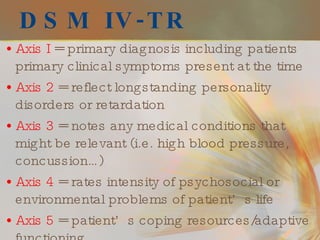
DSM IV-TR Axis I  = primary diagnosis including patients primary clinical symptoms present at the time Axis 2  = reflect longstanding personality disorders or retardation Axis 3  = notes any medical conditions that might be relevant (i.e. high blood pressure, concussion…) Axis 4  = rates intensity of psychosocial or environmental problems of patient’s life Axis 5  = patient’s coping resources/adaptive functioning
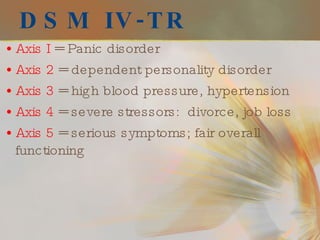
DSM IV-TR Axis I  = Panic disorder Axis 2  = dependent personality disorder Axis 3  = high blood pressure, hypertension Axis 4  = severe stressors:  divorce, job loss Axis 5  = serious symptoms; fair overall functioning
DSM IV Reliabilty  clinicians using the system should show high levels of agreement in their diagnostic decisions Validity  – diagnostic categories should accurately capture the essential features of various disorders
Vulnerability Stress Model Vulnerability in all people toward developing a psychological disorder, given sufficient stress. Diasthesis-Stress hypothesis  - proposes that genetic factors place a person at risk while environmental stress factors transform the potential into an actual disorder
Psychological Disorders- Etiology Neurotic disorder   (term seldom used now) usually distressing but that allows one to think rationally and function socially Freud saw the neurotic disorders as ways of dealing with anxiety Psychotic disorder person loses contact with reality experiences irrational ideas and distorted perceptions
Disorders  vs.  Psychosis Disorders - for the most part, are considered “transient situation disorders” (problems in everyday living) and have a generally positive prognosis. Psychosis -  typically no cure, treatment often helps, but often requires hospitalization.
Anxiety Disorders General Characteristics Not just symptom, but  depth and breadth  of a  collection of systems  (syndrome)
Anxiety Disorders Anxiety Disorders   distressing, persistent anxiety or maladaptive behaviors that reduce anxiety Generalized Anxiety Disorder person is tense, apprehensive, and in a state of autonomic nervous system arousal Phobia persistent, irrational fear of a specific object or situation
Anxiety Disorders Obsessive-Compulsive Disorder characterized by unwanted repetitive thoughts (obsessions) and/or actions (compulsions) Panic Disorder marked by a minutes-long episode of intense dread in which a person experiences terror and accompanying chest pain, choking, or other frightening sensation PTSD Severe anxiety disorder that can occur in people who have been exposed to traumatic life events
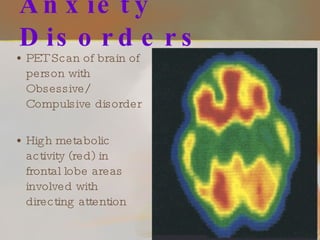
Anxiety Disorders PET Scan of brain of person with Obsessive/ Compulsive disorder High metabolic activity (red) in frontal lobe areas involved with directing attention
Somatoform & Dissociative Disorders Involve physical complaints or disabilities that suggest a medical problem but have no known biological cause and are not voluntarily produced by the person Soma = body Body manifestations Hypochondriasis Pain disorders Conversion disorders Malingering - faking it to escape responsibility
Dissociative Disorders Dissociative Disorders conscious awareness becomes separated (dissociated) from previous memories, thoughts, and feelings  psychogenic amnesia psychogenic fuge Dissociative Identity Disorder (DID) VERY  rare dissociative disorder in which a person exhibits two or more distinct and alternating personalities formerly called multiple personality disorder
Dissociative Disorder Causes Frank Putnam’s trauma-dissociation theory The development of new personalities occurs in response to severe stress
Mood Disorders (Affective Disorders) AFFECT  -  deals with mood or emotion “ Flat Affect” - negative mood state or  absence of emotions Dysthymia -  the  common cold  of  mental illness
Mood Disorders Mood Disorders   characterized by emotional extremes Major Depressive Disorder   a mood disorder in which a person, for no apparent reason, experiences two or more weeks of depressed moods, feelings of worthlessness, and diminished interest or pleasure in most activities
Mood Disorders Manic Episode a mood disorder marked by a hyperactive, wildly optimistic state Bipolar Disorder a mood disorder in which the person alternates between the hopelessness and lethargy of depression and the overexcited state of mania formerly called manic-depressive disorder
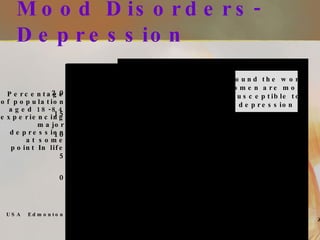
Mood Disorders-Depression Percentage of population aged 18-84 experiencing major depression at some point In life 20 15 10 5 0 USA  Edmonton  Puerto  Paris  West  Florence  Beirut  Taiwan  Korea  New  Rico  Germany  Zealand Around the world women are more susceptible to depression
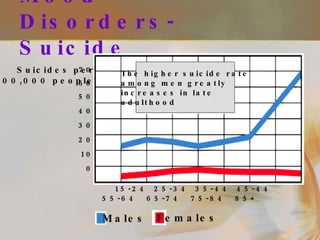
Mood Disorders- Suicide 15-24  25-34  35-44  45-44  55-64  65-74  75-84  85+ Suicides per 100,000 people 70 60 50 40 30 20 10 0 Males Females The higher suicide rate among men greatly  increases in late  adulthood
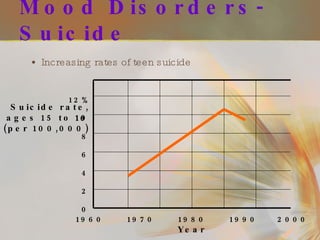
Mood Disorders-Suicide Increasing rates of teen suicide 1960  1970  1980  1990  2000 Year 12% 10 8 6 4 2 0 Suicide rate, ages 15 to 19 (per 100,000)
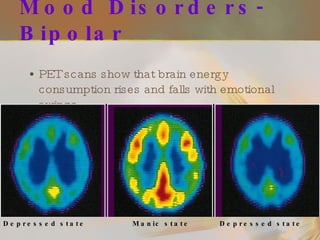
Mood Disorders-Bipolar PET scans show that brain energy consumption rises and falls with emotional swings Depressed state Manic state Depressed state
Schizophrenia Schizophrenia literal translation “split mind” Split from reality Characterized by “pieces of personality” and absence of “wholeness” Lay public’s idea of “split personality - actually DID ***Not to know this shows great ignorance!
Schizophrenia Schizophrenia a group of severe disorders characterized by: disorganized and delusional thinking disturbed perceptions inappropriate emotions and actions
Schizophrenia Delusions false beliefs, often of persecution or grandeur, that may accompany psychotic disorders Hallucinations false sensory experiences such as seeing something without any external visual stimulus
Schizophrenia Subtypes of Schizophrenia Paranoid:   Preoccupation with delusions or hallucinations Disorganized:   Disorganized speech or behavior, or flat or inappropriate    emotion Catatonic:   Immobility (or excessive, purposeless movement),    extreme negativism, and/or parrot-like repeating of another’s speech or movements Undifferentiated   Schizophrenia symptoms without fitting one of the  or residual:   above types
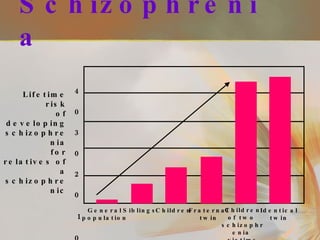
Schizophrenia Lifetime risk of developing schizophrenia for relatives of  a schizophrenic 40 30 20 10 0 General population Siblings Children Fraternal twin Children of two  schizophrenia  victims Identical twin
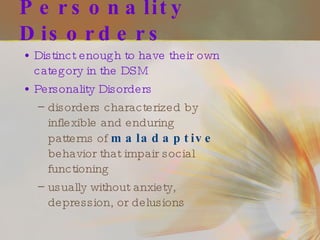
Personality Disorders Distinct enough to have their own category in the DSM Personality Disorders disorders characterized by inflexible and enduring patterns of  maladaptive  behavior that impair social functioning usually without anxiety, depression, or delusions
Personality Disorders Resistant to change “ Ingrained Patterns”
Personality Disorders Antisocial Personality Disorder disorder in which the person (usually a man) exhibits a lack of conscience for wrongdoing, even toward friends and family members may be aggressive and ruthless or a clever con artist Not against being social, but against social norms of a culture Commonly hear about Serial killers Tend to be charming, manipulative, and persistently violate the rights of others
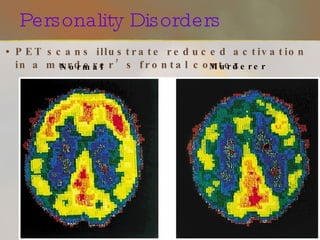
Personality Disorders PET scans illustrate reduced activation in a murderer’s frontal cortex Normal Murderer
Childhood Disorders Autism Biological foundations, but no cause determined ADD/ADHD Some genetic components possible  May not go away in adulthood
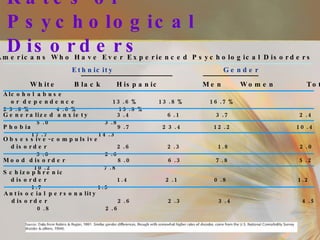
Rates of Psychological Disorders Percentage of Americans Who Have Ever Experienced Psychological Disorders Disorder  White  Black  Hispanic  Men  Women  Totals  Ethnicity   Gender Alcohol abuse  or dependence  13.6%  13.8%  16.7%  23.8%  4.6%  13.8% Generalized anxiety  3.4  6.1  3.7  2.4  5.0  3.8 Phobia  9.7  23.4  12.2  10.4  17.7  14.3 Obsessive-compulsive disorder  2.6  2.3  1.8  2.0  3.0  2.6 Mood disorder  8.0  6.3  7.8  5.2  10.2  7.8 Schizophrenic disorder  1.4  2.1  0.8  1.2  1.7  1.5 Antisocial personality disorder  2.6  2.3  3.4  4.5  0.8  2.6
 

Ch15 - Abnormal Behavior

  • 1.
  • 2.
    Historical Perspective PerceivedCauses movements of sun or moon lunacy- full moon evil spirits Ancient Treatments exorcism, caged like animals, beaten, burned, castrated, mutilated, blood replaced with animal’s blood
  • 3.
    Psychological Disorders PsychologicalDisorder a “harmful dysfunction” in which behavior is judged to be: atypical- not enough in itself disturbing- varies with time & culture maladaptive- harmful unjustifiable- sometimes there’s a good reason
  • 4.
  • 5.
    Normal vs. AbnormalThe 3 D’s Distress (to self or others) Disfunction (for person or society) Deviance (violates social norms)
  • 6.
    Psychological Disorders MedicalModel concept that diseases have physical causes can be diagnosed, treated, and in most cases, cured assumes that these “mental” illnesses can be diagnosed on the basis of their symptoms and cured through therapy, which may include treatment in a psychiatric hospital
  • 7.
    Psychological Disorders Bio-psycho-socialPerspective assumes that biological, sociocultural, and psychological factors combine and interact to produce psychological disorders Need to also look at causes from each separate perspective as well!
  • 8.
    Psychological Disorders- EtiologyDSM-IV – TR (most recent version 2000) American Psychiatric Association’s Diagnostic and Statistical Manual of Mental Disorders (Fourth Edition) a widely used system for classifying psychological disorders
  • 9.
    DSM IV-TR Multi-axialOver 350 diagnostic categories classified along 5 dimensions or axes that take both the person and his/her life situation
  • 10.
    DSM IV-TR AxisI = primary diagnosis including patients primary clinical symptoms present at the time Axis 2 = reflect longstanding personality disorders or retardation Axis 3 = notes any medical conditions that might be relevant (i.e. high blood pressure, concussion…) Axis 4 = rates intensity of psychosocial or environmental problems of patient’s life Axis 5 = patient’s coping resources/adaptive functioning
  • 11.
    DSM IV-TR AxisI = Panic disorder Axis 2 = dependent personality disorder Axis 3 = high blood pressure, hypertension Axis 4 = severe stressors: divorce, job loss Axis 5 = serious symptoms; fair overall functioning
  • 12.
    DSM IV Reliabilty clinicians using the system should show high levels of agreement in their diagnostic decisions Validity – diagnostic categories should accurately capture the essential features of various disorders
  • 13.
    Vulnerability Stress ModelVulnerability in all people toward developing a psychological disorder, given sufficient stress. Diasthesis-Stress hypothesis - proposes that genetic factors place a person at risk while environmental stress factors transform the potential into an actual disorder
  • 14.
    Psychological Disorders- EtiologyNeurotic disorder (term seldom used now) usually distressing but that allows one to think rationally and function socially Freud saw the neurotic disorders as ways of dealing with anxiety Psychotic disorder person loses contact with reality experiences irrational ideas and distorted perceptions
  • 15.
    Disorders vs. Psychosis Disorders - for the most part, are considered “transient situation disorders” (problems in everyday living) and have a generally positive prognosis. Psychosis - typically no cure, treatment often helps, but often requires hospitalization.
  • 16.
    Anxiety Disorders GeneralCharacteristics Not just symptom, but depth and breadth of a collection of systems (syndrome)
  • 17.
    Anxiety Disorders AnxietyDisorders distressing, persistent anxiety or maladaptive behaviors that reduce anxiety Generalized Anxiety Disorder person is tense, apprehensive, and in a state of autonomic nervous system arousal Phobia persistent, irrational fear of a specific object or situation
  • 18.
    Anxiety Disorders Obsessive-CompulsiveDisorder characterized by unwanted repetitive thoughts (obsessions) and/or actions (compulsions) Panic Disorder marked by a minutes-long episode of intense dread in which a person experiences terror and accompanying chest pain, choking, or other frightening sensation PTSD Severe anxiety disorder that can occur in people who have been exposed to traumatic life events
  • 19.
    Anxiety Disorders PETScan of brain of person with Obsessive/ Compulsive disorder High metabolic activity (red) in frontal lobe areas involved with directing attention
  • 20.
    Somatoform & DissociativeDisorders Involve physical complaints or disabilities that suggest a medical problem but have no known biological cause and are not voluntarily produced by the person Soma = body Body manifestations Hypochondriasis Pain disorders Conversion disorders Malingering - faking it to escape responsibility
  • 21.
    Dissociative Disorders DissociativeDisorders conscious awareness becomes separated (dissociated) from previous memories, thoughts, and feelings psychogenic amnesia psychogenic fuge Dissociative Identity Disorder (DID) VERY rare dissociative disorder in which a person exhibits two or more distinct and alternating personalities formerly called multiple personality disorder
  • 22.
    Dissociative Disorder CausesFrank Putnam’s trauma-dissociation theory The development of new personalities occurs in response to severe stress
  • 23.
    Mood Disorders (AffectiveDisorders) AFFECT - deals with mood or emotion “ Flat Affect” - negative mood state or absence of emotions Dysthymia - the common cold of mental illness
  • 24.
    Mood Disorders MoodDisorders characterized by emotional extremes Major Depressive Disorder a mood disorder in which a person, for no apparent reason, experiences two or more weeks of depressed moods, feelings of worthlessness, and diminished interest or pleasure in most activities
  • 25.
    Mood Disorders ManicEpisode a mood disorder marked by a hyperactive, wildly optimistic state Bipolar Disorder a mood disorder in which the person alternates between the hopelessness and lethargy of depression and the overexcited state of mania formerly called manic-depressive disorder
  • 26.
    Mood Disorders-Depression Percentageof population aged 18-84 experiencing major depression at some point In life 20 15 10 5 0 USA Edmonton Puerto Paris West Florence Beirut Taiwan Korea New Rico Germany Zealand Around the world women are more susceptible to depression
  • 27.
    Mood Disorders- Suicide15-24 25-34 35-44 45-44 55-64 65-74 75-84 85+ Suicides per 100,000 people 70 60 50 40 30 20 10 0 Males Females The higher suicide rate among men greatly increases in late adulthood
  • 28.
    Mood Disorders-Suicide Increasingrates of teen suicide 1960 1970 1980 1990 2000 Year 12% 10 8 6 4 2 0 Suicide rate, ages 15 to 19 (per 100,000)
  • 29.
    Mood Disorders-Bipolar PETscans show that brain energy consumption rises and falls with emotional swings Depressed state Manic state Depressed state
  • 30.
    Schizophrenia Schizophrenia literaltranslation “split mind” Split from reality Characterized by “pieces of personality” and absence of “wholeness” Lay public’s idea of “split personality - actually DID ***Not to know this shows great ignorance!
  • 31.
    Schizophrenia Schizophrenia agroup of severe disorders characterized by: disorganized and delusional thinking disturbed perceptions inappropriate emotions and actions
  • 32.
    Schizophrenia Delusions falsebeliefs, often of persecution or grandeur, that may accompany psychotic disorders Hallucinations false sensory experiences such as seeing something without any external visual stimulus
  • 33.
    Schizophrenia Subtypes ofSchizophrenia Paranoid: Preoccupation with delusions or hallucinations Disorganized: Disorganized speech or behavior, or flat or inappropriate emotion Catatonic: Immobility (or excessive, purposeless movement), extreme negativism, and/or parrot-like repeating of another’s speech or movements Undifferentiated Schizophrenia symptoms without fitting one of the or residual: above types
  • 34.
    Schizophrenia Lifetime riskof developing schizophrenia for relatives of a schizophrenic 40 30 20 10 0 General population Siblings Children Fraternal twin Children of two schizophrenia victims Identical twin
  • 35.
    Personality Disorders Distinctenough to have their own category in the DSM Personality Disorders disorders characterized by inflexible and enduring patterns of maladaptive behavior that impair social functioning usually without anxiety, depression, or delusions
  • 36.
    Personality Disorders Resistantto change “ Ingrained Patterns”
  • 37.
    Personality Disorders AntisocialPersonality Disorder disorder in which the person (usually a man) exhibits a lack of conscience for wrongdoing, even toward friends and family members may be aggressive and ruthless or a clever con artist Not against being social, but against social norms of a culture Commonly hear about Serial killers Tend to be charming, manipulative, and persistently violate the rights of others
  • 38.
    Personality Disorders PETscans illustrate reduced activation in a murderer’s frontal cortex Normal Murderer
  • 39.
    Childhood Disorders AutismBiological foundations, but no cause determined ADD/ADHD Some genetic components possible May not go away in adulthood
  • 40.
    Rates of PsychologicalDisorders Percentage of Americans Who Have Ever Experienced Psychological Disorders Disorder White Black Hispanic Men Women Totals Ethnicity Gender Alcohol abuse or dependence 13.6% 13.8% 16.7% 23.8% 4.6% 13.8% Generalized anxiety 3.4 6.1 3.7 2.4 5.0 3.8 Phobia 9.7 23.4 12.2 10.4 17.7 14.3 Obsessive-compulsive disorder 2.6 2.3 1.8 2.0 3.0 2.6 Mood disorder 8.0 6.3 7.8 5.2 10.2 7.8 Schizophrenic disorder 1.4 2.1 0.8 1.2 1.7 1.5 Antisocial personality disorder 2.6 2.3 3.4 4.5 0.8 2.6
  • 41.