Chapter Ten Memory and Thought
Information Processing Input  - The information you receive from your senses Central Processing  - The storing (in memory) and sorting (by thought) of input in the brain Output  - The ideas and actions that result from processing
Taking In  Information Selective Attention Picking and choosing from the sensory input available to you
Broadbent (1960) Theory of Selection Dichotic Listening Task
Treisman (1964) Attenuation Theory Filter doesn’t eliminate, merely suppresses… Like Picture in Picture
Criteria for Selective Attention Importance Novelty Interest
Taking In  Information Cont. Feature Extraction Analyzing the information that selective attention sends to us
Feature Extraction Identify Sort Categorize
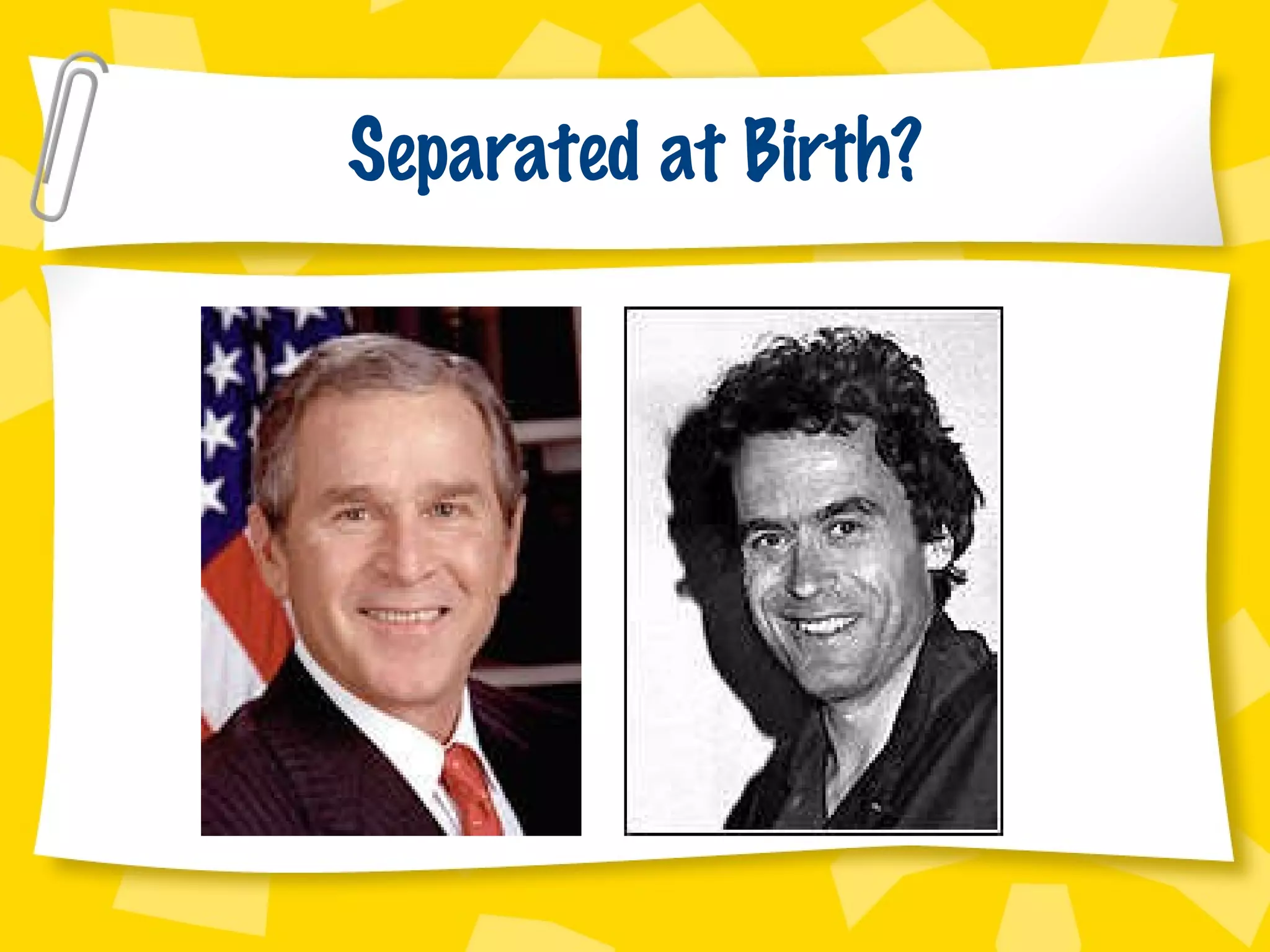
Separated at Birth?
Semantic Feature Theory Word meaning is a cluster of features that comprises our complete definition of a word
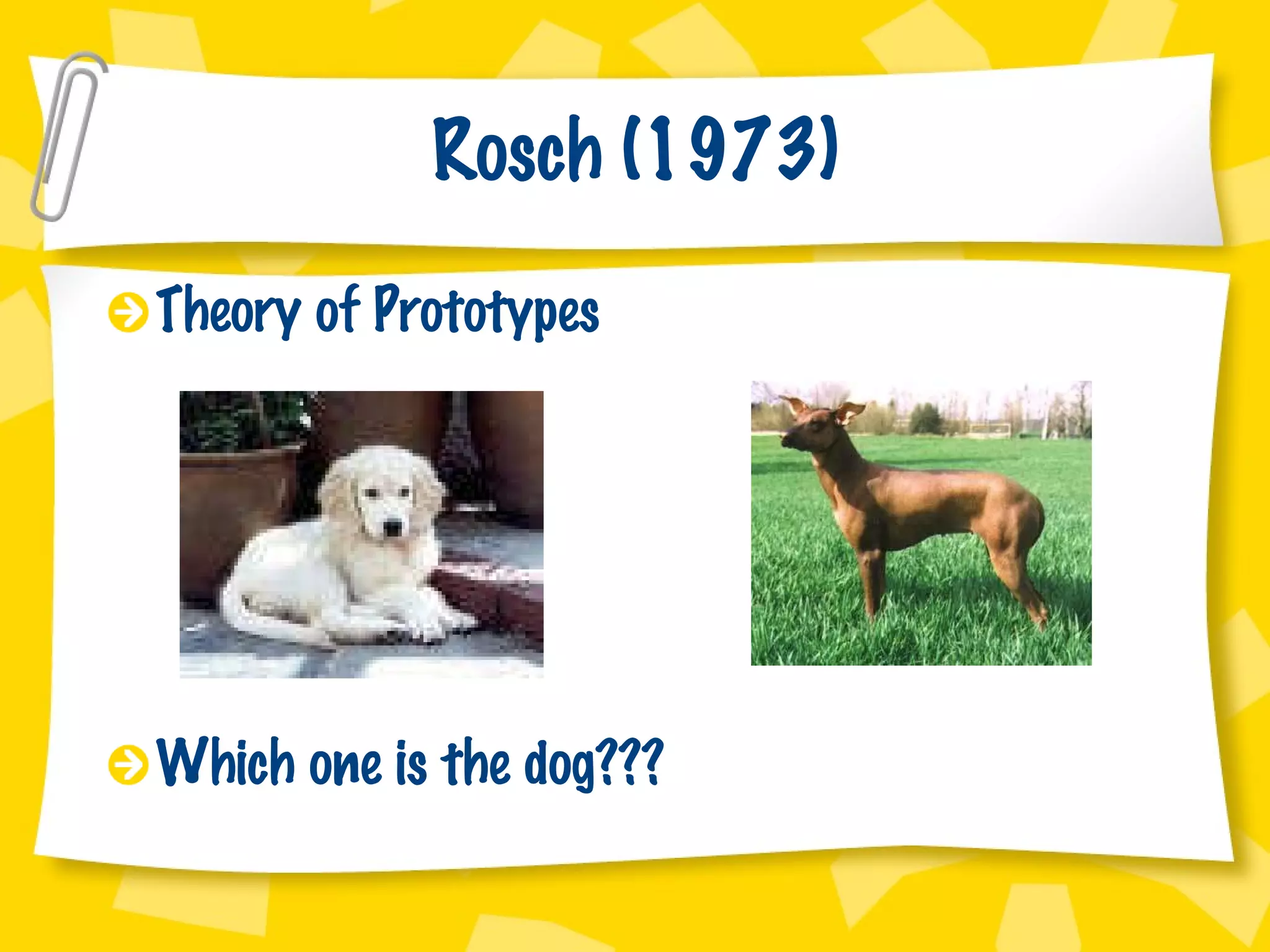
Rosch (1973) Theory of Prototypes Which one is the dog???
Storing Information Sensory Storage The memory system into which inputs from the senses are received
Sperling (1960) Demonstrated the phenomenon of sensory storage Duration: one second max Storage Limit: 7-9 items
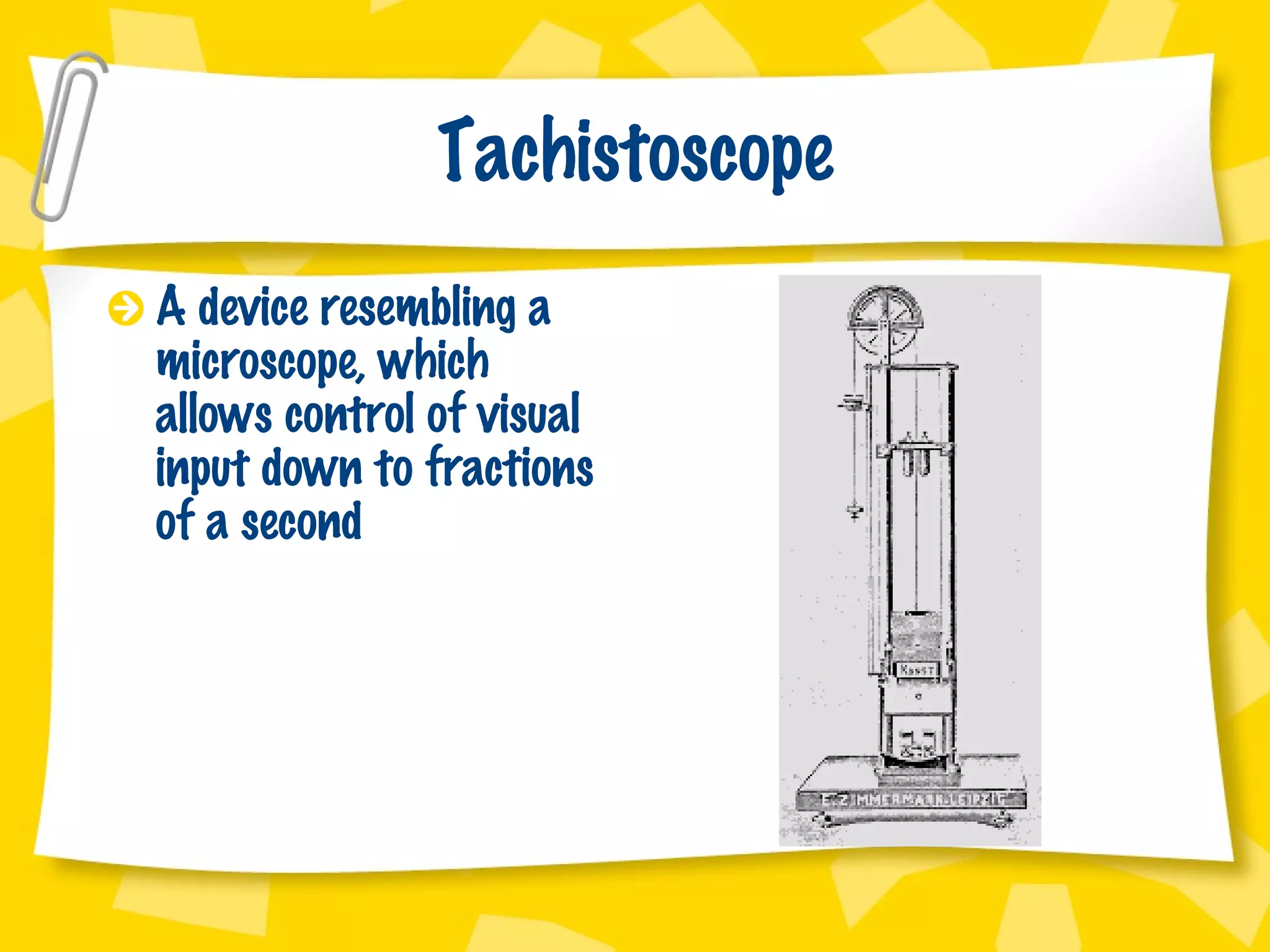
Tachistoscope A device resembling a microscope, which allows control of visual input down to fractions of a second
Storing Information cont. Short-Term Memory Receives inputs from sensory storage Input is analyzed and identified for later storage in long-term memory Duration: rarely longer than 20 seconds Rehearsal  - input must be repeated if you want it to stay in short-term memory
Miller (1956) Chunking  - grouping similar inputs together to compact space “ The Magical Number Seven, Plus or Minus Two”
Storing Information cont. Transition to Long-Term Memory Rehearsal Intent to learn
Storing Information  cont. Long-Term memory Input stored according to features Reconstructed or reassembled when needed
Other Models of Memory Tulving 1972 Semantic Memory  Knowledge of language and how it works Includes grammar, syntax, diction, denotation and connotation Episodic Memory Events and experiences which are completely unique to you Includes flashbulb memories
LR Squire (1972) Declarative memory AKA explicit memory Combination of semantic and episodic memory Descriptive Procedural memory AKA implicit memory Knowledge of how to perform the steps of a task Demonstration Priming  Conditioning - Takes place without conscious awareness of the subject
Memory and the Brain Learning - a relatively permanent change in behavior that results from experience
Theories of Change Theory #1  - physiological changes in the structure of neurons Theory #2  - physiological changes in either the molecular structure or the chemical structure of the brain
Where Memory Takes Place Declarative memories are stored in the amygdala and the hippocampus Procedural memories are stored in the striatum, in the frontal lobes
Thompson (1987) Simple memories are stored in one specific location in the brain Limits of plasticity
Selective Memory Problems Prospagnosia  - inability to recognize familiar faces  (Larry from the video) Visual agnosia  - inability to recognize faces, words, or other visual cues  (John from the video)
Neuronal Activity Research Neuropsychologists Memory and aging Neurological basis of ADHD
Retrieving Information Retrieval The process of finding a stored memory Recognition The ability to say whether something is familiar Function of declarative, or explicit, memory
Retrieving Information Cont. Indexing The process of identifying a stimulus in a variety of ways
Retrieving Information Cont. Eyewitness Testimony Uses recognition Unreliable
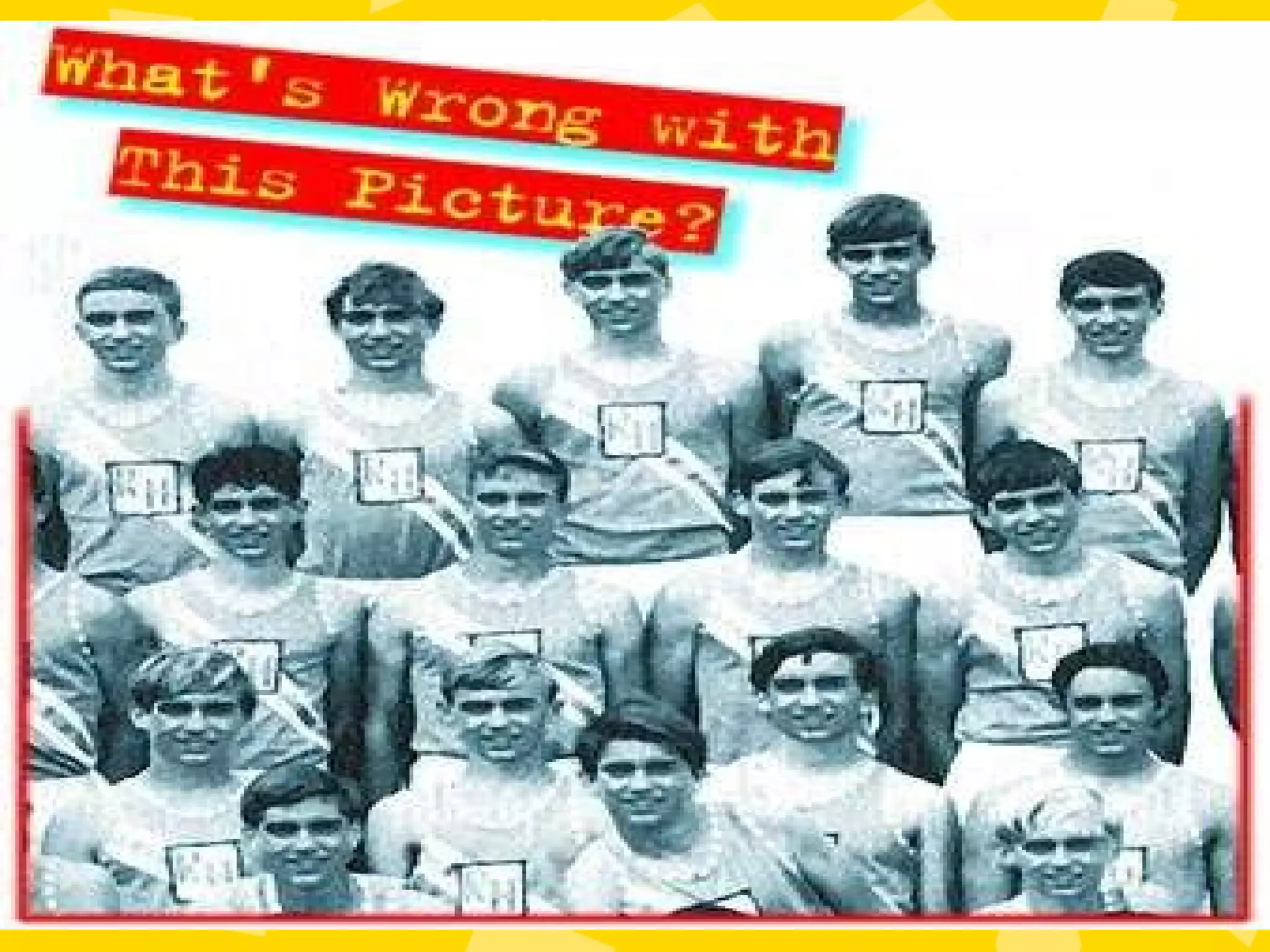
Retrieving Information Cont. Loftus  (1974) Mistaken identity in courtroom and lineup identification Distortion of eyewitness testimony (auto accident video)  Stress impacts the ability to create a strong, clear memory of an event (1979)
 
Retrieving Information Cont. Recall The active reconstruction of information stored in memory Influenced by: Knowledge Attitudes Experiences Passage of Time
Retrieving Information Cont. Inhelder (1969) Bottle drawing experiment
Retrieving Information Variations Simplified Enriched Distorted Confabulation
Eidetic Memory Memory storage as accurate as a picture Requires no reconstruction Possessed by less than 5% of the population
Relearning Learning something again Function of procedural (implicit) memory Quicker than original learning
Forgetting Information which is stored in long-term memory, but cannot be retrieved
Inhibiting Memory Retrieval Decay Fading away of sensory or short-term memory Interference Proactive Interference Old learning inhibits the acquisition of new learning Retroactive Interference New learning inhibits the recall of old learning Repression Freudian concept of the pushing down by consciousness of a traumatic memory into the subconscious
Improving Memory Mood Braid - hypnosis Sirhan Sirhan - state-dependent memory Bower - validates state-dependent memory
Improving Memory Cont. Meaningfulness More meaning means easier recall
Improving Memory Cont. Association Known items Strong emotion Fragrance experiment
Improving Memory Cont. Dissociation Opposite of association Roth (1990)
Improving Memory Lack of Interference Overlearning Divided studying Mnemonic Devices Aid to memorizing lists Word play HOMES
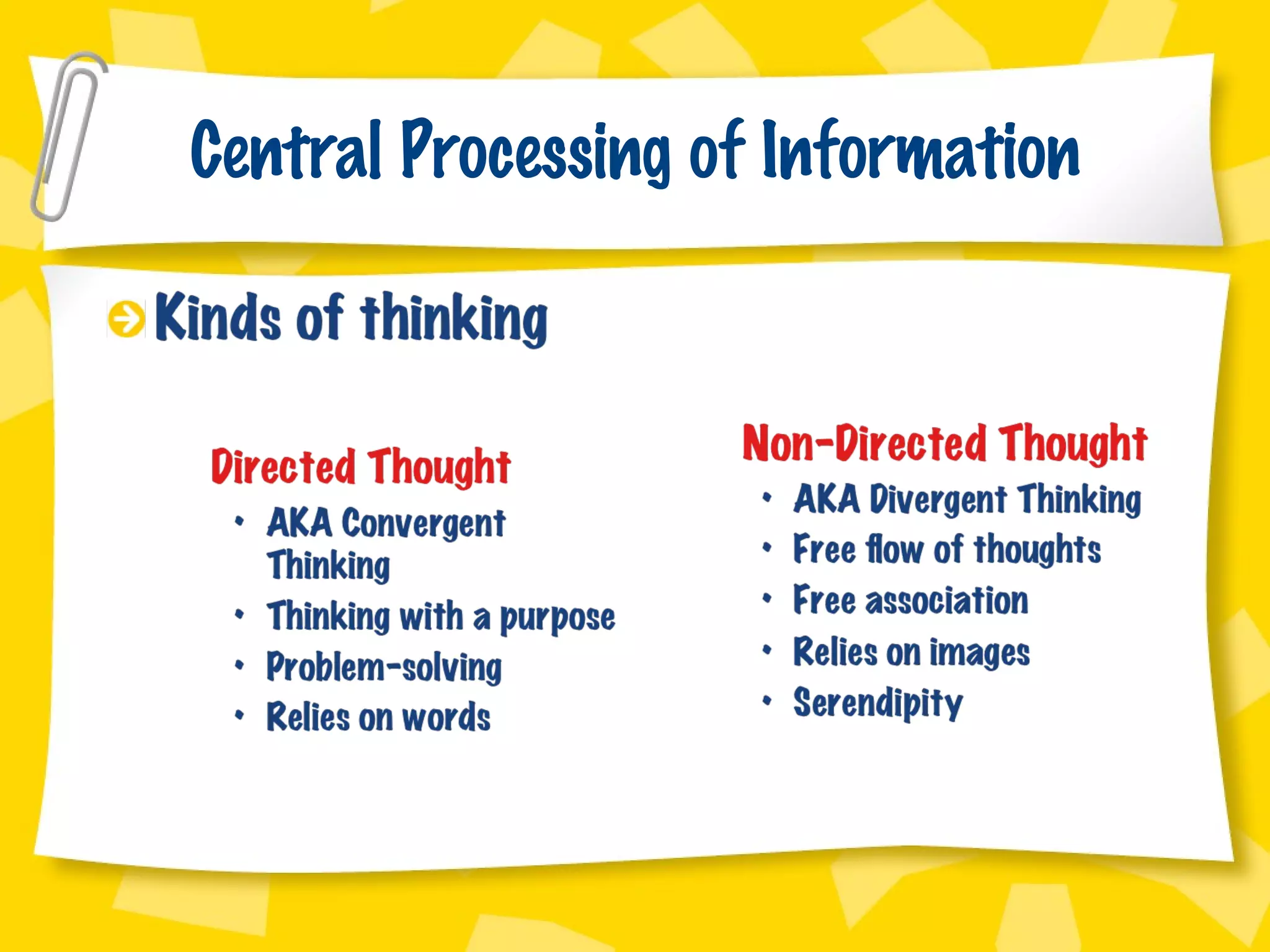
Central Processing of Information Thinking Units of Thought Image  -  A mental picture of a specific object or event Symbol  -  A sound, design or word that represents an object or a quality Concept  -  A symbol for a whole class or category of objects that we have decided to group together (Rosch/Prototypes) Rule  - A statement about how concepts are related to each other
Central Processing of Information
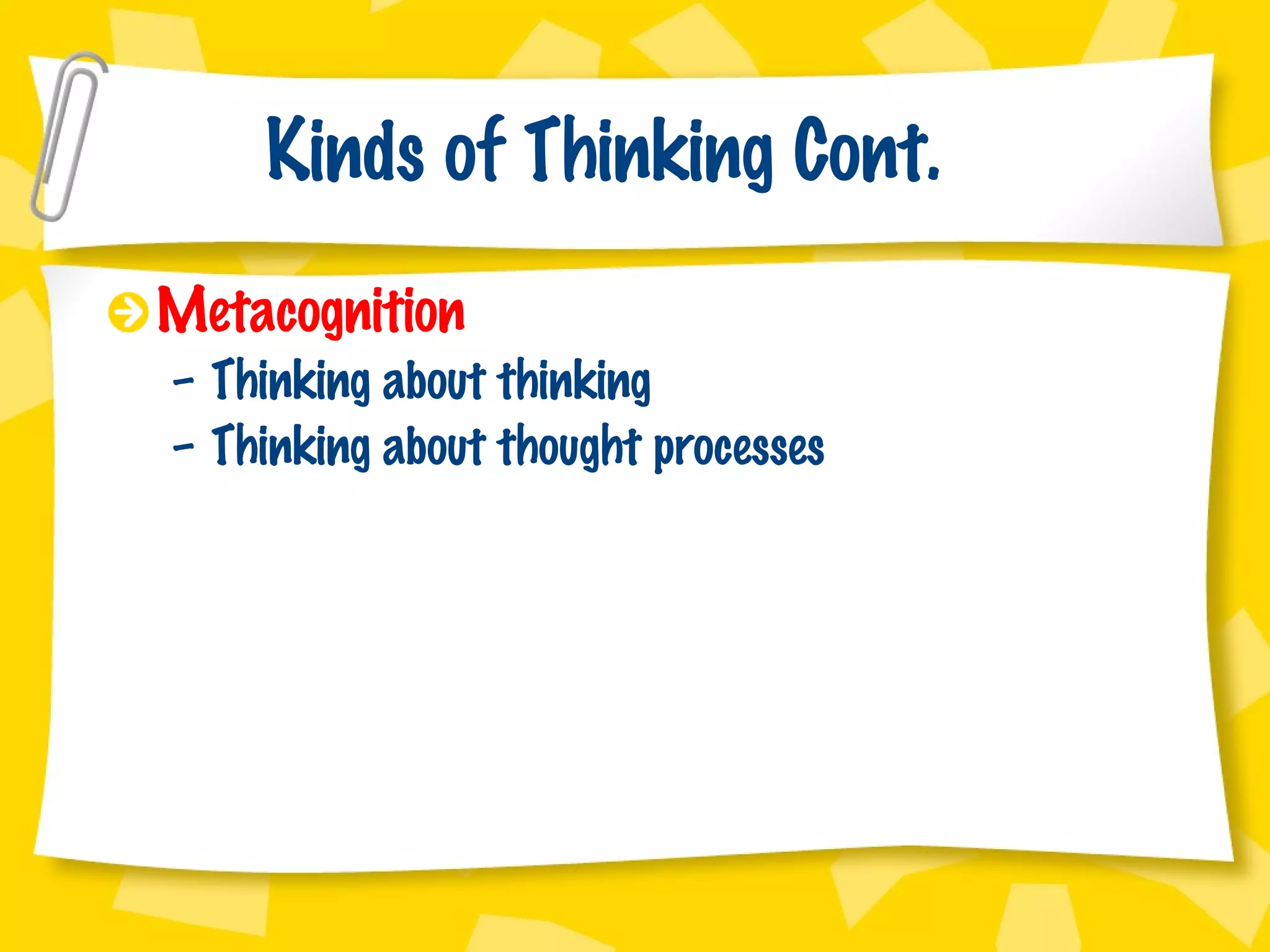
Kinds of Thinking Cont. Metacognition Thinking about thinking Thinking about thought processes
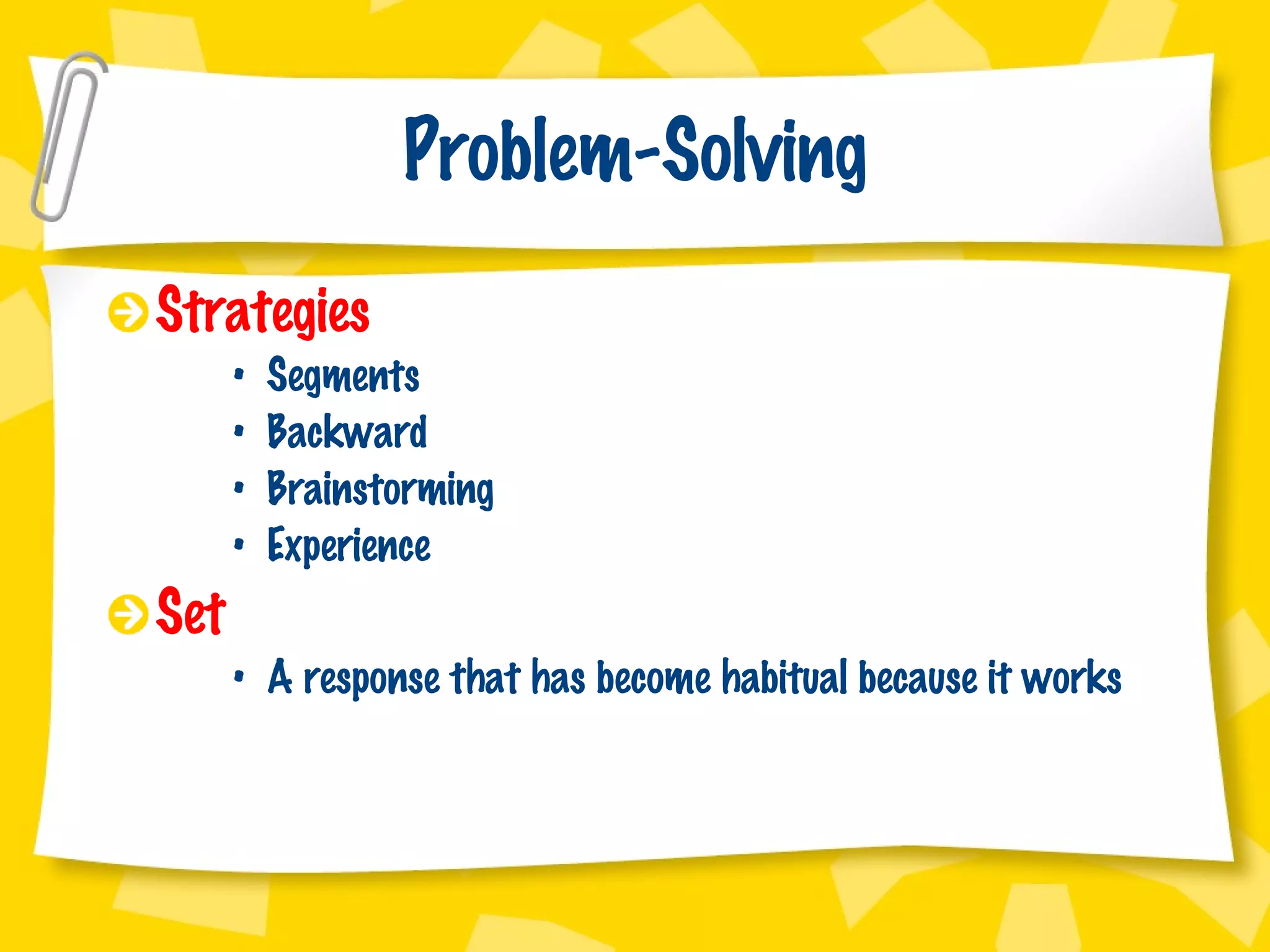
Problem-Solving Strategies Segments Backward Brainstorming Experience Set A response that has become habitual because it works
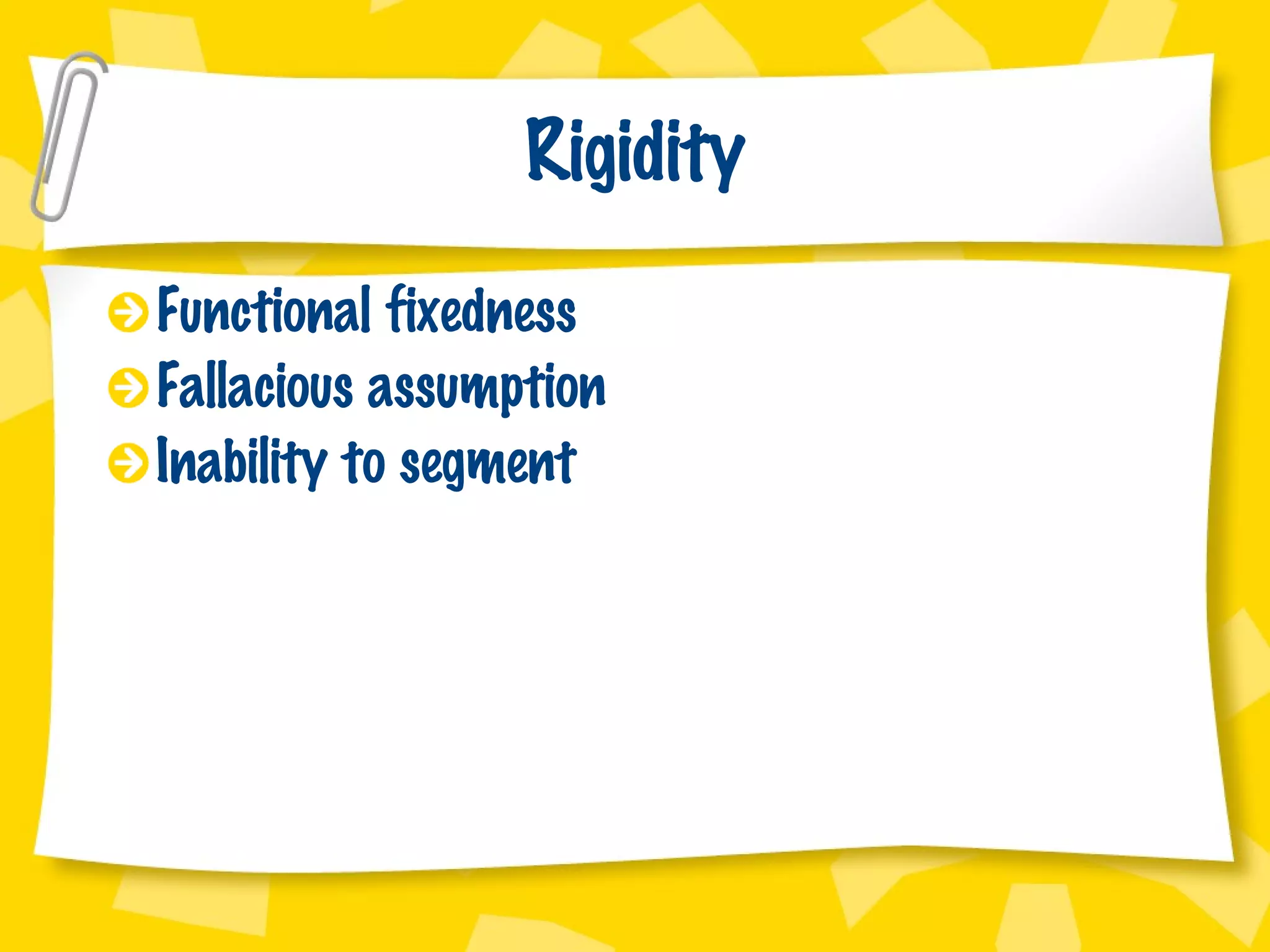
Rigidity Functional fixedness Fallacious assumption Inability to segment
Creativity The ability to take what you already know, and use it in a way that is new or original Characteristics Flexibility  The degree to which you are able to overcome rigidity in thinking Recombination  The ability to take information you already have, and rearrange it to make something new Insight The sudden emergence of a solution to a problem through recombining The “A-HA” experience
Wolfgang Kohler German psychologist Contemporary of Max Wertheimer and Kurt Koffka These three founded what became Gestalt psychology
Kohler (1925) Demonstrates the existence of insight in animals (chimps)
Alpert (1928) Demonstrates the existence of insight in young children (playpen)
The End

Chapter 10 memory new Reg. Psych 2011 no video

  • 1.
    Chapter Ten Memoryand Thought
  • 2.
    Information Processing Input - The information you receive from your senses Central Processing - The storing (in memory) and sorting (by thought) of input in the brain Output - The ideas and actions that result from processing
  • 3.
    Taking In Information Selective Attention Picking and choosing from the sensory input available to you
  • 4.
    Broadbent (1960) Theoryof Selection Dichotic Listening Task
  • 5.
    Treisman (1964) AttenuationTheory Filter doesn’t eliminate, merely suppresses… Like Picture in Picture
  • 6.
    Criteria for SelectiveAttention Importance Novelty Interest
  • 7.
    Taking In Information Cont. Feature Extraction Analyzing the information that selective attention sends to us
  • 8.
  • 9.
  • 10.
    Semantic Feature TheoryWord meaning is a cluster of features that comprises our complete definition of a word
  • 11.
    Rosch (1973) Theoryof Prototypes Which one is the dog???
  • 12.
    Storing Information SensoryStorage The memory system into which inputs from the senses are received
  • 13.
    Sperling (1960) Demonstratedthe phenomenon of sensory storage Duration: one second max Storage Limit: 7-9 items
  • 14.
    Tachistoscope A deviceresembling a microscope, which allows control of visual input down to fractions of a second
  • 15.
    Storing Information cont.Short-Term Memory Receives inputs from sensory storage Input is analyzed and identified for later storage in long-term memory Duration: rarely longer than 20 seconds Rehearsal - input must be repeated if you want it to stay in short-term memory
  • 16.
    Miller (1956) Chunking - grouping similar inputs together to compact space “ The Magical Number Seven, Plus or Minus Two”
  • 17.
    Storing Information cont.Transition to Long-Term Memory Rehearsal Intent to learn
  • 18.
    Storing Information cont. Long-Term memory Input stored according to features Reconstructed or reassembled when needed
  • 19.
    Other Models ofMemory Tulving 1972 Semantic Memory Knowledge of language and how it works Includes grammar, syntax, diction, denotation and connotation Episodic Memory Events and experiences which are completely unique to you Includes flashbulb memories
  • 20.
    LR Squire (1972)Declarative memory AKA explicit memory Combination of semantic and episodic memory Descriptive Procedural memory AKA implicit memory Knowledge of how to perform the steps of a task Demonstration Priming Conditioning - Takes place without conscious awareness of the subject
  • 21.
    Memory and theBrain Learning - a relatively permanent change in behavior that results from experience
  • 22.
    Theories of ChangeTheory #1 - physiological changes in the structure of neurons Theory #2 - physiological changes in either the molecular structure or the chemical structure of the brain
  • 23.
    Where Memory TakesPlace Declarative memories are stored in the amygdala and the hippocampus Procedural memories are stored in the striatum, in the frontal lobes
  • 24.
    Thompson (1987) Simplememories are stored in one specific location in the brain Limits of plasticity
  • 25.
    Selective Memory ProblemsProspagnosia - inability to recognize familiar faces (Larry from the video) Visual agnosia - inability to recognize faces, words, or other visual cues (John from the video)
  • 26.
    Neuronal Activity ResearchNeuropsychologists Memory and aging Neurological basis of ADHD
  • 27.
    Retrieving Information RetrievalThe process of finding a stored memory Recognition The ability to say whether something is familiar Function of declarative, or explicit, memory
  • 28.
    Retrieving Information Cont.Indexing The process of identifying a stimulus in a variety of ways
  • 29.
    Retrieving Information Cont.Eyewitness Testimony Uses recognition Unreliable
  • 30.
    Retrieving Information Cont.Loftus (1974) Mistaken identity in courtroom and lineup identification Distortion of eyewitness testimony (auto accident video) Stress impacts the ability to create a strong, clear memory of an event (1979)
  • 31.
  • 32.
    Retrieving Information Cont.Recall The active reconstruction of information stored in memory Influenced by: Knowledge Attitudes Experiences Passage of Time
  • 33.
    Retrieving Information Cont.Inhelder (1969) Bottle drawing experiment
  • 34.
    Retrieving Information VariationsSimplified Enriched Distorted Confabulation
  • 35.
    Eidetic Memory Memorystorage as accurate as a picture Requires no reconstruction Possessed by less than 5% of the population
  • 36.
    Relearning Learning somethingagain Function of procedural (implicit) memory Quicker than original learning
  • 37.
    Forgetting Information whichis stored in long-term memory, but cannot be retrieved
  • 38.
    Inhibiting Memory RetrievalDecay Fading away of sensory or short-term memory Interference Proactive Interference Old learning inhibits the acquisition of new learning Retroactive Interference New learning inhibits the recall of old learning Repression Freudian concept of the pushing down by consciousness of a traumatic memory into the subconscious
  • 39.
    Improving Memory MoodBraid - hypnosis Sirhan Sirhan - state-dependent memory Bower - validates state-dependent memory
  • 40.
    Improving Memory Cont.Meaningfulness More meaning means easier recall
  • 41.
    Improving Memory Cont.Association Known items Strong emotion Fragrance experiment
  • 42.
    Improving Memory Cont.Dissociation Opposite of association Roth (1990)
  • 43.
    Improving Memory Lackof Interference Overlearning Divided studying Mnemonic Devices Aid to memorizing lists Word play HOMES
  • 44.
    Central Processing ofInformation Thinking Units of Thought Image - A mental picture of a specific object or event Symbol - A sound, design or word that represents an object or a quality Concept - A symbol for a whole class or category of objects that we have decided to group together (Rosch/Prototypes) Rule - A statement about how concepts are related to each other
  • 45.
  • 46.
    Kinds of ThinkingCont. Metacognition Thinking about thinking Thinking about thought processes
  • 47.
    Problem-Solving Strategies SegmentsBackward Brainstorming Experience Set A response that has become habitual because it works
  • 48.
    Rigidity Functional fixednessFallacious assumption Inability to segment
  • 49.
    Creativity The abilityto take what you already know, and use it in a way that is new or original Characteristics Flexibility The degree to which you are able to overcome rigidity in thinking Recombination The ability to take information you already have, and rearrange it to make something new Insight The sudden emergence of a solution to a problem through recombining The “A-HA” experience
  • 50.
    Wolfgang Kohler Germanpsychologist Contemporary of Max Wertheimer and Kurt Koffka These three founded what became Gestalt psychology
  • 51.
    Kohler (1925) Demonstratesthe existence of insight in animals (chimps)
  • 52.
    Alpert (1928) Demonstratesthe existence of insight in young children (playpen)
  • 53.