Chapter 17 Stress and Health
Stress and Health Behavioral Medicine interdisciplinary field that integrates behavioral and medical knowledge and applies that knowledge to health and disease Health Psychology subfield of psychology that provides psychology’s contribution to behavioral medicine
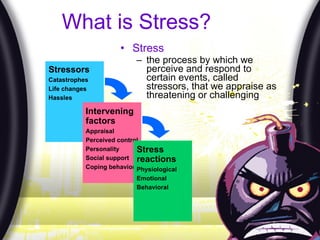
What is Stress? Stress the process by which we perceive and respond to certain events, called stressors, that we appraise as threatening or challenging Stressors Catastrophes Life changes Hassles Intervening factors Appraisal Perceived control Personality Social support Coping behaviors Stress reactions Physiological Emotional Behavioral
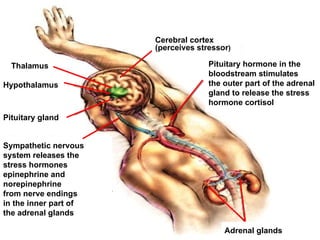
Pituitary hormone in the  bloodstream stimulates the outer part of the adrenal gland to release the stress  hormone cortisol Sympathetic nervous system releases the  stress hormones epinephrine and norepinephrine from nerve endings  in the inner part of the adrenal glands Thalamus Hypothalamus Pituitary gland Adrenal glands Cerebral cortex (perceives stressor )
What is Stress? General Adaptation Syndrome   Selye’s concept of the body’s adaptive response to stress as composed of three stages
Stressful Life Events Catastrophic Events earthquakes, combat stress, floods Life Changes death of a loved one, divorce, loss of job, promotion Daily Hassles rush hour traffic, long lines, job stress, burnout
What is Stress? Burnout physical, emotional and mental exhaustion brought on by persistent job-related stress Coronary Heart Disease clogging of the vessels that nourish the heart muscle leading cause of death in the United States
Stress & Coronary Heart Disease Type A   Friedman and Rosenman’s term for people who are competitive, hard-driving, impatient, verbally aggressive, anger-prone   Type B Friedman and Rosenman’s term for easygoing, relaxed people
Stress and Disease Psycho-physiological Illness “ mind-body” illness any stress-related physical illness some forms of hypertension some headaches distinct from hypochondriasis – misinterpreting normal physical sensations as symptoms of a disease
Stress and Disease Lymphocytes two types of white blood cells that are part of the body’s immune system B lymphocytes  form in the bone marrow and release antibodies that fight bacterial infections T lymphocytes  form in the thymus and, among other duties, attack cancer cells, viruses and foreign substances
Promoting Health Biofeedback system for electronically recording, amplifying, and feeding back information regarding a subtle physiological state blood pressure muscle tension
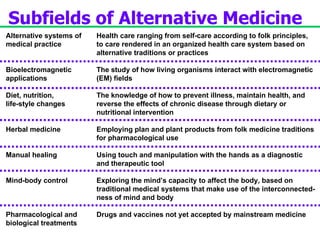
Alternative systems of medical practice Bioelectromagnetic applications Diet, nutrition, life-style changes Herbal medicine Manual healing Mind-body control Pharmacological and  biological treatments Subfields of Alternative Medicine Health care ranging from self-care according to folk principles, to care rendered in an organized health care system based on alternative traditions or practices The study of how living organisms interact with electromagnetic (EM) fields The knowledge of how to prevent illness, maintain health, and  reverse the effects of chronic disease through dietary or  nutritional intervention Employing plan and plant products from folk medicine traditions for pharmacological use Using touch and manipulation with the hands as a diagnostic and therapeutic tool Exploring the mind’s capacity to affect the body, based on  traditional medical systems that make use of the interconnected- ness of mind and body Drugs and vaccines not yet accepted by mainstream medicine
Promoting Health  Complementary and Alternative Medicine unproven health care treatments not taught widely in medical schools, not used in hospitals, and not usually reimbursed by insurance companies

Stress&health chp17

  • 1.
  • 2.
    Stress and HealthBehavioral Medicine interdisciplinary field that integrates behavioral and medical knowledge and applies that knowledge to health and disease Health Psychology subfield of psychology that provides psychology’s contribution to behavioral medicine
  • 3.
    What is Stress?Stress the process by which we perceive and respond to certain events, called stressors, that we appraise as threatening or challenging Stressors Catastrophes Life changes Hassles Intervening factors Appraisal Perceived control Personality Social support Coping behaviors Stress reactions Physiological Emotional Behavioral
  • 4.
    Pituitary hormone inthe bloodstream stimulates the outer part of the adrenal gland to release the stress hormone cortisol Sympathetic nervous system releases the stress hormones epinephrine and norepinephrine from nerve endings in the inner part of the adrenal glands Thalamus Hypothalamus Pituitary gland Adrenal glands Cerebral cortex (perceives stressor )
  • 5.
    What is Stress?General Adaptation Syndrome Selye’s concept of the body’s adaptive response to stress as composed of three stages
  • 6.
    Stressful Life EventsCatastrophic Events earthquakes, combat stress, floods Life Changes death of a loved one, divorce, loss of job, promotion Daily Hassles rush hour traffic, long lines, job stress, burnout
  • 7.
    What is Stress?Burnout physical, emotional and mental exhaustion brought on by persistent job-related stress Coronary Heart Disease clogging of the vessels that nourish the heart muscle leading cause of death in the United States
  • 8.
    Stress & CoronaryHeart Disease Type A Friedman and Rosenman’s term for people who are competitive, hard-driving, impatient, verbally aggressive, anger-prone Type B Friedman and Rosenman’s term for easygoing, relaxed people
  • 9.
    Stress and DiseasePsycho-physiological Illness “ mind-body” illness any stress-related physical illness some forms of hypertension some headaches distinct from hypochondriasis – misinterpreting normal physical sensations as symptoms of a disease
  • 10.
    Stress and DiseaseLymphocytes two types of white blood cells that are part of the body’s immune system B lymphocytes form in the bone marrow and release antibodies that fight bacterial infections T lymphocytes form in the thymus and, among other duties, attack cancer cells, viruses and foreign substances
  • 11.
    Promoting Health Biofeedbacksystem for electronically recording, amplifying, and feeding back information regarding a subtle physiological state blood pressure muscle tension
  • 12.
    Alternative systems ofmedical practice Bioelectromagnetic applications Diet, nutrition, life-style changes Herbal medicine Manual healing Mind-body control Pharmacological and biological treatments Subfields of Alternative Medicine Health care ranging from self-care according to folk principles, to care rendered in an organized health care system based on alternative traditions or practices The study of how living organisms interact with electromagnetic (EM) fields The knowledge of how to prevent illness, maintain health, and reverse the effects of chronic disease through dietary or nutritional intervention Employing plan and plant products from folk medicine traditions for pharmacological use Using touch and manipulation with the hands as a diagnostic and therapeutic tool Exploring the mind’s capacity to affect the body, based on traditional medical systems that make use of the interconnected- ness of mind and body Drugs and vaccines not yet accepted by mainstream medicine
  • 13.
    Promoting Health Complementary and Alternative Medicine unproven health care treatments not taught widely in medical schools, not used in hospitals, and not usually reimbursed by insurance companies