Thinking and Language Chapter 10
Thinking and Language Thinking Concepts Solving Problems Making Decisions and Forming Judgments Belief Bias
Thinking and Language Language Language Structure Language Development Thinking & Language Language Influences Thinking Thinking in Images
Thinking and Language Animal Thinking and Language Do Animals Think? Do Animals Exhibit Language? The Case of the Apes
Thinking Thinking, or  cognition,  refers to a process that involves knowing, understanding, remembering, and communicating.
Cognitive Psychologists Thinking involves a number of mental activities, which are listed below. Cognitive psychologists study these in great detail. Concepts Problem solving Decision making Judgment formation
Concept The mental grouping of similar objects, events, ideas, or people. There are a variety of chairs but their common features define the concept of a  chair .
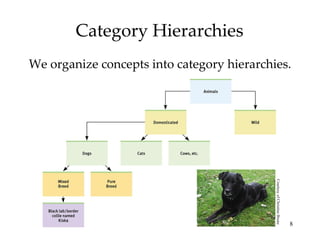
Category Hierarchies We organize concepts into category hierarchies. Courtesy of Christine Brune
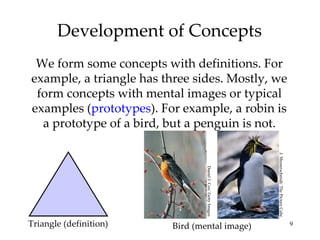
Development of Concepts We form some concepts with definitions. For example, a triangle has three sides. Mostly, we form concepts with mental images or typical examples ( prototypes ). For example, a robin is a prototype of a bird, but a penguin is not. Triangle (definition) Bird (mental image) Daniel J. Cox/ Getty Images J. Messerschmidt/ The Picture Cube
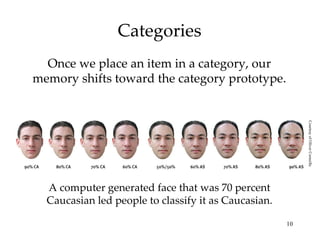
Categories Once we place an item in a category, our memory shifts toward the category prototype. A computer generated face that was 70 percent Caucasian led people to classify it as Caucasian. Courtesy of Oliver Corneille
Problem Solving There are two ways to solve problems: Algorithms:   Methodical, logical rules or procedures that guarantee solving a particular problem.
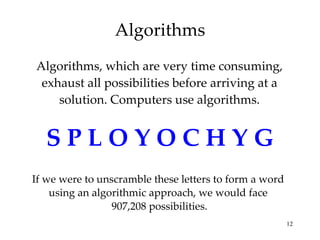
Algorithms Algorithms, which are very time consuming, exhaust all possibilities before arriving at a solution. Computers use algorithms. S P L O Y O C H Y G If we were to unscramble these letters to form a word  using an algorithmic approach, we would face  907,208 possibilities.
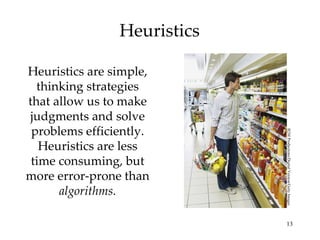
Heuristics Heuristics are simple, thinking strategies that allow us to make judgments and solve problems efficiently. Heuristics are less time consuming, but more error-prone than  algorithms. B2M Productions/Digital Version/Getty Images
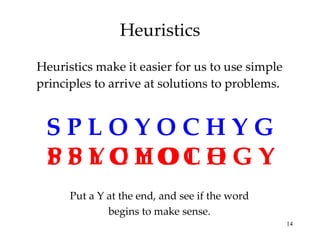
Heuristics Heuristics make it easier for us to use simple principles to arrive at solutions to problems.  S P L O Y O C H Y G S P L O Y O C H G Y P S L O Y O C H G Y P S Y C H O L O G Y Put a Y at the end, and see if the word begins to make sense.
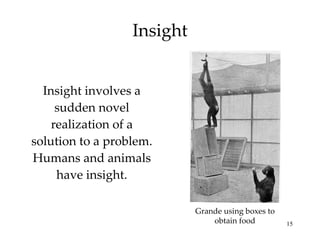
Insight Insight involves a sudden novel realization of a solution to a problem. Humans and animals have insight. Grande using boxes to obtain food
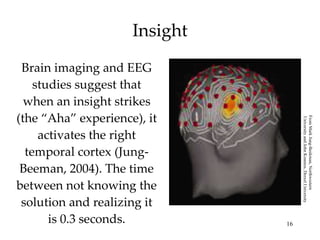
Insight Brain imaging and EEG studies suggest that when an insight strikes (the “Aha” experience), it activates the right temporal cortex (Jung-Beeman, 2004). The time between not knowing the solution and realizing it is 0.3 seconds. From Mark Jung-Beekman, Northwestern University and John Kounios, Drexel University
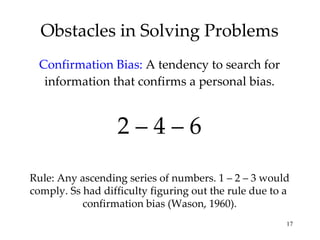
Obstacles in Solving Problems Confirmation Bias:  A tendency to search for information that confirms a personal bias. 2 – 4 – 6 Rule: Any ascending series of numbers. 1 – 2 – 3 would comply. Ss had difficulty figuring out the rule due to a  confirmation bias (Wason, 1960).
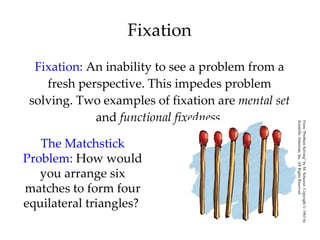
Fixation Fixation:  An inability to see a problem from a fresh perspective. This impedes problem solving. Two examples of fixation are  mental set  and  functional fixedness. The Matchstick Problem:  How would you arrange six matches to form four equilateral triangles?  From “Problem Solving” by M. Scheerer. Copyright © 1963 by  Scientific American, Inc. All Rights Reserved.
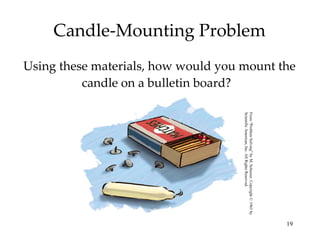
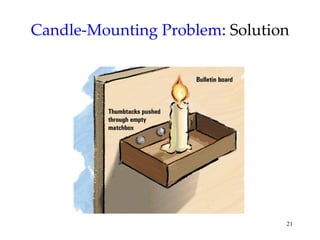
Using these materials, how would you mount the candle on a bulletin board?  Candle-Mounting Problem From “Problem Solving” by M. Scheerer. Copyright © 1963 by  Scientific American, Inc. All Rights Reserved.
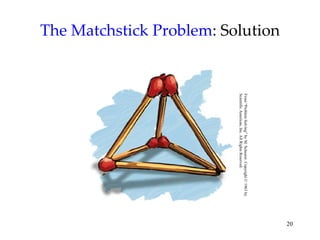
The Matchstick Problem : Solution From “Problem Solving” by M. Scheerer. Copyright © 1963 by  Scientific American, Inc. All Rights Reserved.
Candle-Mounting Problem : Solution
Mental Set A tendency to approach a problem in a particular way, especially if that way was successful in the past.
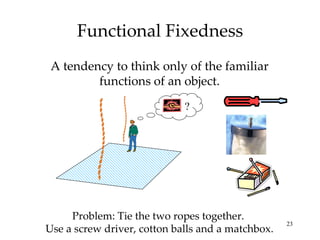
Functional Fixedness A tendency to think only of the familiar functions of an object. Problem: Tie the two ropes together.  Use a screw driver, cotton balls and a matchbox. ?
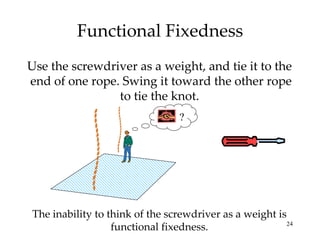
Functional Fixedness Use the screwdriver as a weight, and tie it to the  end of one rope. Swing it toward the other rope to tie the knot. The inability to think of the screwdriver as a weight is functional fixedness. ?
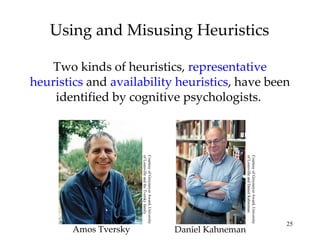
Using and Misusing Heuristics Two kinds of heuristics,  representative heuristics  and  availability heuristics , have been identified by cognitive psychologists.  Amos Tversky Daniel Kahneman Courtesy of Greymeyer Award, University  of Louisville and the Tversky family Courtesy of Greymeyer Award, University  of Louisville and Daniel Kahneman
Representativeness Heuristic Judging the likelihood of things or objects in terms of how well they seem to represent, or match, a particular prototype. Probability that that person is a truck driver is far greater than an ivy league professor just because there are more truck drivers than such professors. If you meet a slim, short, man who wears glasses and likes poetry, what do you think his profession would be? An Ivy league professor or a truck driver?
Availability Heuristic Why does our availability heuristic lead us astray? Whatever increases the ease of retrieving information increases its perceived availability. How is retrieval facilitated? How recently we have heard about the event. How distinct it is. How correct it is.
Making Decision & Forming Judgments Each day we make hundreds of judgments and decisions based on our intuition, seldom using systematic reasoning.
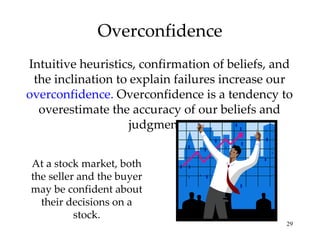
Overconfidence Intuitive heuristics, confirmation of beliefs, and the inclination to explain failures increase our  overconfidence.  Overconfidence is a tendency to overestimate the accuracy of our beliefs and judgments. At a stock market, both the seller and the buyer may be confident about their decisions on a stock.
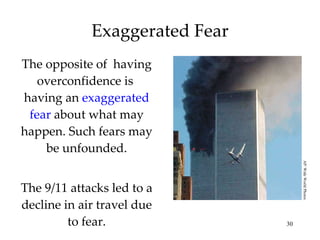
Exaggerated Fear The opposite of  having overconfidence   is  having an  exaggerated fear  about what may happen. Such fears may be unfounded. The 9/11 attacks led to a decline in air travel due to fear. AP/ Wide World Photos
Framing Decisions Decisions and judgments may be significantly affected depending upon how an issue is framed. Example:  What is the best way to market ground beef — as 25% fat or 75% lean?
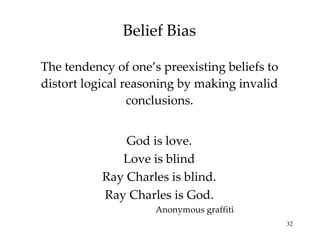
Belief Bias The tendency of one’s preexisting beliefs to distort logical reasoning by making invalid conclusions. God is love. Love is blind Ray Charles is blind. Ray Charles is God. Anonymous graffiti
Belief Perseverance Belief perseverance is the tendency to cling to our beliefs in the face of contrary evidence. If you see that a country is hostile, you are likely to interpret their ambiguous actions as a sign of hostility (Jervis, 1985).
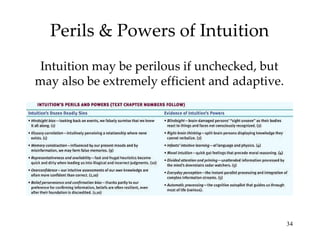
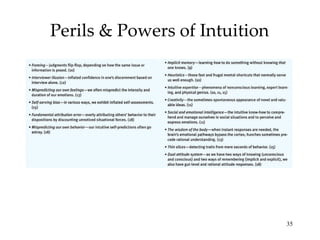
Perils & Powers of Intuition Intuition may be perilous if unchecked, but may also be extremely efficient and adaptive.
Perils & Powers of Intuition
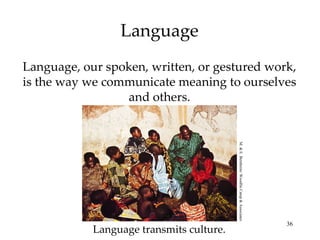
Language Language, our spoken, written, or gestured work, is the way we communicate meaning to ourselves and others. Language transmits culture. M. & E. Bernheim/ Woodfin Camp & Associates
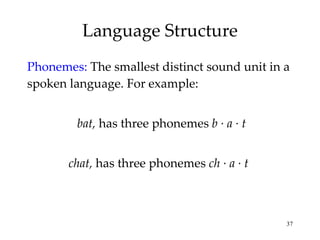
Language Structure Phonemes:  The smallest distinct sound unit in a spoken language. For example: bat,  has three phonemes  b · a · t chat,  has three phonemes  ch · a · t
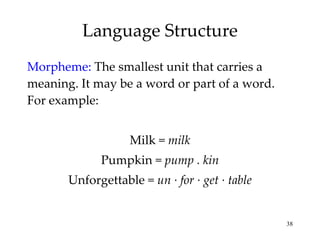
Language Structure Morpheme:  The smallest unit that carries a  meaning. It may be a word or part of a word. For example: Milk =  milk Pumpkin =  pump . kin Unforgettable =  un · for · get · table
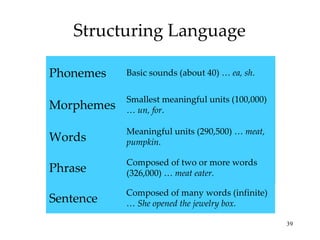
Structuring Language Phrase Sentence Meaningful units (290,500) …  meat, pumpkin. Words Smallest meaningful units (100,000) …  un, for . Morphemes Basic sounds (about 40) …  ea, sh . Phonemes Composed of two or more words (326,000) …  meat eater. Composed of many words (infinite) …  She opened the jewelry box.
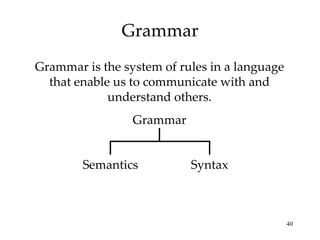
Grammar Grammar is the system of rules in a language that enable us to communicate with and understand others. Grammar Syntax Semantics
Semantics Semantics is the set of rules by which we derive meaning from morphemes, words, and sentences. For example: Semantic rule tells us that adding  –ed  to the word  laugh  means that it happened in the past.
Syntax Syntax consists of the rules for combining words into grammatically sensible sentences. For example:  In English, syntactical rule says that adjectives come before nouns;  white house . In Spanish, it is reversed;  casa blanca .
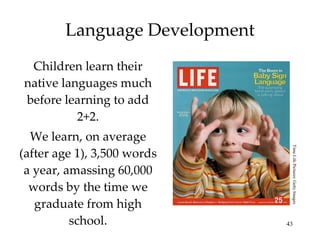
Language Development Children learn their native languages much before learning to add 2+2. We learn, on average (after age 1), 3,500 words a year, amassing 60,000 words by the time we graduate from high school. Time Life Pictures/ Getty Images
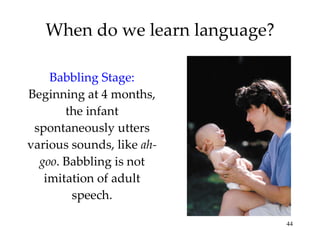
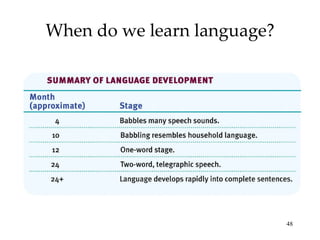
When do we learn language? Babbling Stage:   Beginning at 4 months, the infant spontaneously utters various sounds, like  ah-goo . Babbling is not imitation of adult speech.
When do we learn language? One-Word Stage:   Beginning at or around his first birthday, a child starts to speak one word at a time and is able to make family members understand him. The word  doggy  may mean  look at the dog out there .
When do we learn language? Two-Word Stage:   Before the 2nd year a child starts to speak in two-word sentences. This form of speech is called  telegraphic speech  because the child speaks like a telegram: “Go car,” means  I would like to go for a ride in the car.
When do we learn language? Longer phrases:  After telegraphic speech, children begin uttering longer phrases ( Mommy get ball ) with syntactical sense, and by early elementary school they are employing humor. You never starve in the desert because of all the sand-which-is there.
When do we learn language?
Explaining Language Development Operant Learning : Skinner (1957, 1985) believed that language development may be explained on the basis of learning principles such as association, imitation, and reinforcement.
Explaining Language Development 2. Inborn Universal Grammar:  Chomsky (1959, 1987) opposed Skinner’s ideas and suggested that the rate of language acquisition is so fast that it cannot be explained through learning principles, and thus most of it is inborn.
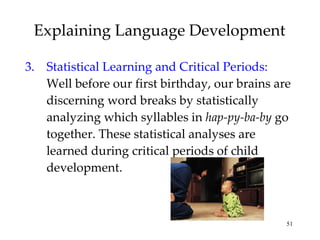
Explaining Language Development 3. Statistical Learning and Critical Periods:  Well before our first birthday, our brains are discerning word breaks by statistically analyzing which syllables in  hap-py-ba-by  go together. These statistical analyses are learned during critical periods of child development.
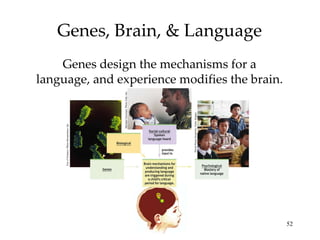
Genes, Brain, & Language Genes design the mechanisms for a language, and experience modifies the brain. Michael Newman/ Photo Edit, Inc. Eye of Science/ Photo Researchers, Inc. David Hume Kennerly/ Getty Images
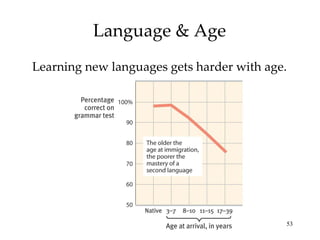
Language & Age Learning new languages gets harder with age.
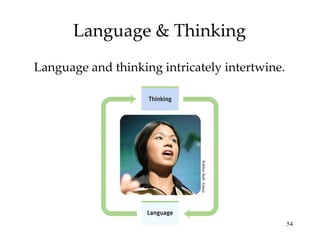
Language & Thinking Language and thinking intricately intertwine. Rubber Ball/ Almay
Language Influences Thinking Linguistic Determinism:   Whorf (1956) suggested that language determines the way we think. For example, he noted that the Hopi people do not have the past tense for verbs. Therefore, the Hopi cannot think readily about the past.
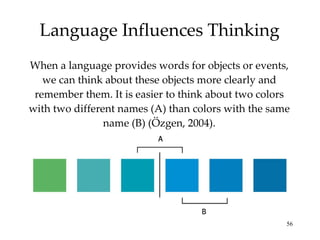
Language Influences Thinking When a language provides words for objects or events, we can think about these objects more clearly and remember them. It is easier to think about two colors with two different names (A) than colors with the same name (B) (Özgen, 2004).
Word Power Increasing word power pays its dividends. It pays for speakers and deaf individuals who learn sign language.
Linguistic Determinism Questioned Although people from Papua New Guinea do not use our words for colors and shapes, they still perceive them as we do (Rosch, 1974).
Thinking in Images To a large extent thinking is language-based. When alone, we may talk to ourselves. However, we also think in images. 2. When we are riding our bicycle. 1. When we open the hot water tap. We don’t think in words, when:
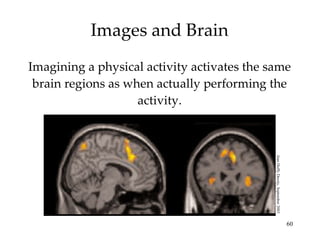
Images and Brain Imagining a physical activity activates the same brain regions as when actually performing the activity. Jean Duffy Decety, September 2003
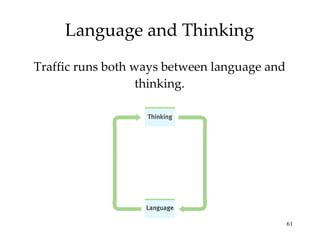
Language and Thinking Traffic runs both ways between language and thinking.
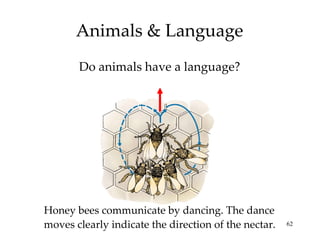
Do animals have a language? Animals & Language Honey bees communicate by dancing. The dance moves clearly indicate the direction of the nectar.
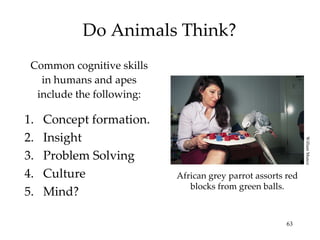
Do Animals Think? Common cognitive skills in humans and apes include the following: Concept formation. Insight Problem Solving Culture Mind? African grey parrot assorts red blocks from green balls. William Munoz
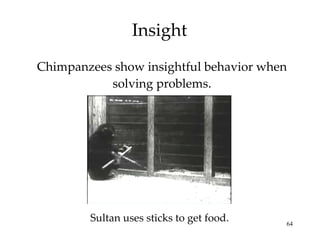
Insight Chimpanzees show insightful behavior when solving problems. Sultan uses sticks to get food.
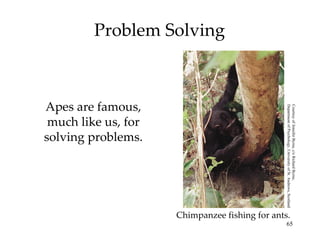
Problem Solving Apes are famous, much like us, for solving problems. Chimpanzee fishing for ants. Courtesy of Jennifer Byrne, c/o Richard Byrne,  Department of Psychology, University of St. Andrews, Scotland
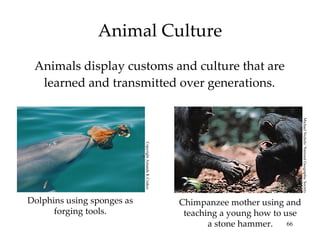
Animal Culture Animals display customs and culture that are learned and transmitted over generations. Dolphins using sponges as forging tools. Chimpanzee mother using and teaching a young how to use a stone hammer. Copyright Amanda K Coakes Michael Nichols/ National Geographic Society
Mental States Can animals infer mental states in themselves and others?  To some extent. Chimps and orangutans (and dolphins) used mirrors to inspect themselves when a researcher put paint spots on their faces or bodies.
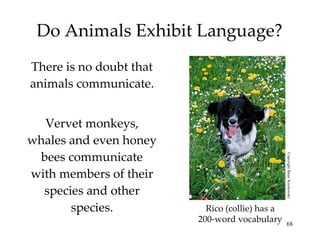
Do Animals Exhibit Language? There is no doubt that animals communicate. Vervet monkeys, whales and even honey bees communicate with members of their species and other species. Rico (collie) has a 200-word vocabulary Copyright Baus/ Kreslowski
The Case of Apes Chimps do not have a vocal apparatus for human-like speech (Hayes & Hayes,1951). Therefore, Gardner and Gardner (1969) used American Sign Language (ASL) to train Washoe, a chimp, who learned 182 signs by the age of 32.
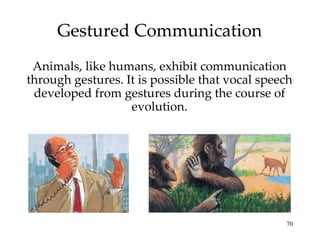
Gestured Communication Animals, like humans, exhibit communication through gestures. It is possible that vocal speech developed from gestures during the course of evolution.
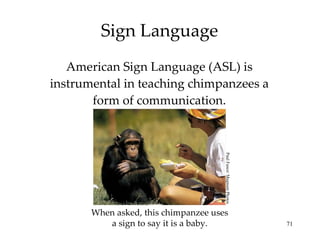
Sign Language American Sign Language (ASL) is instrumental in teaching chimpanzees a form of communication. When asked, this chimpanzee uses a sign to say it is a baby. Paul Fusco/ Magnum Photos
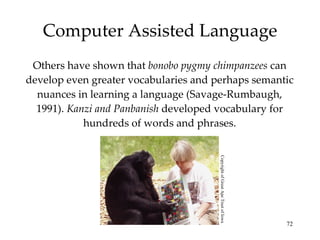
Computer Assisted Language Others have shown that  bonobo pygmy chimpanzees  can develop even greater vocabularies and perhaps semantic nuances in learning a language (Savage-Rumbaugh, 1991).  Kanzi and Panbanish  developed vocabulary for hundreds of words and phrases. Copyright of Great Ape Trust of Iowa
Criticism Apes acquire their limited vocabularies with a great deal of difficulty, unlike children who develop vocabularies at amazing rates. Chimpanzees can make signs to receive a  reward, just as a pigeon who pecks at the key receives a reward. However, pigeons have not learned a language. Chimpanzees use signs meaningfully but lack syntax. Presented with ambiguous information, people tend to see what they want to see.
Conclusions If we say that animals can use meaningful sequences of signs to communicate a capability for language, our understanding would be naive… Steven Pinker (1995) concludes, “chimps do not develop language.”

Chapter10

  • 1.
  • 2.
    Thinking and LanguageThinking Concepts Solving Problems Making Decisions and Forming Judgments Belief Bias
  • 3.
    Thinking and LanguageLanguage Language Structure Language Development Thinking & Language Language Influences Thinking Thinking in Images
  • 4.
    Thinking and LanguageAnimal Thinking and Language Do Animals Think? Do Animals Exhibit Language? The Case of the Apes
  • 5.
    Thinking Thinking, or cognition, refers to a process that involves knowing, understanding, remembering, and communicating.
  • 6.
    Cognitive Psychologists Thinkinginvolves a number of mental activities, which are listed below. Cognitive psychologists study these in great detail. Concepts Problem solving Decision making Judgment formation
  • 7.
    Concept The mentalgrouping of similar objects, events, ideas, or people. There are a variety of chairs but their common features define the concept of a chair .
  • 8.
    Category Hierarchies Weorganize concepts into category hierarchies. Courtesy of Christine Brune
  • 9.
    Development of ConceptsWe form some concepts with definitions. For example, a triangle has three sides. Mostly, we form concepts with mental images or typical examples ( prototypes ). For example, a robin is a prototype of a bird, but a penguin is not. Triangle (definition) Bird (mental image) Daniel J. Cox/ Getty Images J. Messerschmidt/ The Picture Cube
  • 10.
    Categories Once weplace an item in a category, our memory shifts toward the category prototype. A computer generated face that was 70 percent Caucasian led people to classify it as Caucasian. Courtesy of Oliver Corneille
  • 11.
    Problem Solving Thereare two ways to solve problems: Algorithms: Methodical, logical rules or procedures that guarantee solving a particular problem.
  • 12.
    Algorithms Algorithms, whichare very time consuming, exhaust all possibilities before arriving at a solution. Computers use algorithms. S P L O Y O C H Y G If we were to unscramble these letters to form a word using an algorithmic approach, we would face 907,208 possibilities.
  • 13.
    Heuristics Heuristics aresimple, thinking strategies that allow us to make judgments and solve problems efficiently. Heuristics are less time consuming, but more error-prone than algorithms. B2M Productions/Digital Version/Getty Images
  • 14.
    Heuristics Heuristics makeit easier for us to use simple principles to arrive at solutions to problems. S P L O Y O C H Y G S P L O Y O C H G Y P S L O Y O C H G Y P S Y C H O L O G Y Put a Y at the end, and see if the word begins to make sense.
  • 15.
    Insight Insight involvesa sudden novel realization of a solution to a problem. Humans and animals have insight. Grande using boxes to obtain food
  • 16.
    Insight Brain imagingand EEG studies suggest that when an insight strikes (the “Aha” experience), it activates the right temporal cortex (Jung-Beeman, 2004). The time between not knowing the solution and realizing it is 0.3 seconds. From Mark Jung-Beekman, Northwestern University and John Kounios, Drexel University
  • 17.
    Obstacles in SolvingProblems Confirmation Bias: A tendency to search for information that confirms a personal bias. 2 – 4 – 6 Rule: Any ascending series of numbers. 1 – 2 – 3 would comply. Ss had difficulty figuring out the rule due to a confirmation bias (Wason, 1960).
  • 18.
    Fixation Fixation: An inability to see a problem from a fresh perspective. This impedes problem solving. Two examples of fixation are mental set and functional fixedness. The Matchstick Problem: How would you arrange six matches to form four equilateral triangles? From “Problem Solving” by M. Scheerer. Copyright © 1963 by Scientific American, Inc. All Rights Reserved.
  • 19.
    Using these materials,how would you mount the candle on a bulletin board? Candle-Mounting Problem From “Problem Solving” by M. Scheerer. Copyright © 1963 by Scientific American, Inc. All Rights Reserved.
  • 20.
    The Matchstick Problem: Solution From “Problem Solving” by M. Scheerer. Copyright © 1963 by Scientific American, Inc. All Rights Reserved.
  • 21.
  • 22.
    Mental Set Atendency to approach a problem in a particular way, especially if that way was successful in the past.
  • 23.
    Functional Fixedness Atendency to think only of the familiar functions of an object. Problem: Tie the two ropes together. Use a screw driver, cotton balls and a matchbox. ?
  • 24.
    Functional Fixedness Usethe screwdriver as a weight, and tie it to the end of one rope. Swing it toward the other rope to tie the knot. The inability to think of the screwdriver as a weight is functional fixedness. ?
  • 25.
    Using and MisusingHeuristics Two kinds of heuristics, representative heuristics and availability heuristics , have been identified by cognitive psychologists. Amos Tversky Daniel Kahneman Courtesy of Greymeyer Award, University of Louisville and the Tversky family Courtesy of Greymeyer Award, University of Louisville and Daniel Kahneman
  • 26.
    Representativeness Heuristic Judgingthe likelihood of things or objects in terms of how well they seem to represent, or match, a particular prototype. Probability that that person is a truck driver is far greater than an ivy league professor just because there are more truck drivers than such professors. If you meet a slim, short, man who wears glasses and likes poetry, what do you think his profession would be? An Ivy league professor or a truck driver?
  • 27.
    Availability Heuristic Whydoes our availability heuristic lead us astray? Whatever increases the ease of retrieving information increases its perceived availability. How is retrieval facilitated? How recently we have heard about the event. How distinct it is. How correct it is.
  • 28.
    Making Decision &Forming Judgments Each day we make hundreds of judgments and decisions based on our intuition, seldom using systematic reasoning.
  • 29.
    Overconfidence Intuitive heuristics,confirmation of beliefs, and the inclination to explain failures increase our overconfidence. Overconfidence is a tendency to overestimate the accuracy of our beliefs and judgments. At a stock market, both the seller and the buyer may be confident about their decisions on a stock.
  • 30.
    Exaggerated Fear Theopposite of having overconfidence is having an exaggerated fear about what may happen. Such fears may be unfounded. The 9/11 attacks led to a decline in air travel due to fear. AP/ Wide World Photos
  • 31.
    Framing Decisions Decisionsand judgments may be significantly affected depending upon how an issue is framed. Example: What is the best way to market ground beef — as 25% fat or 75% lean?
  • 32.
    Belief Bias Thetendency of one’s preexisting beliefs to distort logical reasoning by making invalid conclusions. God is love. Love is blind Ray Charles is blind. Ray Charles is God. Anonymous graffiti
  • 33.
    Belief Perseverance Beliefperseverance is the tendency to cling to our beliefs in the face of contrary evidence. If you see that a country is hostile, you are likely to interpret their ambiguous actions as a sign of hostility (Jervis, 1985).
  • 34.
    Perils & Powersof Intuition Intuition may be perilous if unchecked, but may also be extremely efficient and adaptive.
  • 35.
    Perils & Powersof Intuition
  • 36.
    Language Language, ourspoken, written, or gestured work, is the way we communicate meaning to ourselves and others. Language transmits culture. M. & E. Bernheim/ Woodfin Camp & Associates
  • 37.
    Language Structure Phonemes: The smallest distinct sound unit in a spoken language. For example: bat, has three phonemes b · a · t chat, has three phonemes ch · a · t
  • 38.
    Language Structure Morpheme: The smallest unit that carries a meaning. It may be a word or part of a word. For example: Milk = milk Pumpkin = pump . kin Unforgettable = un · for · get · table
  • 39.
    Structuring Language PhraseSentence Meaningful units (290,500) … meat, pumpkin. Words Smallest meaningful units (100,000) … un, for . Morphemes Basic sounds (about 40) … ea, sh . Phonemes Composed of two or more words (326,000) … meat eater. Composed of many words (infinite) … She opened the jewelry box.
  • 40.
    Grammar Grammar isthe system of rules in a language that enable us to communicate with and understand others. Grammar Syntax Semantics
  • 41.
    Semantics Semantics isthe set of rules by which we derive meaning from morphemes, words, and sentences. For example: Semantic rule tells us that adding –ed to the word laugh means that it happened in the past.
  • 42.
    Syntax Syntax consistsof the rules for combining words into grammatically sensible sentences. For example: In English, syntactical rule says that adjectives come before nouns; white house . In Spanish, it is reversed; casa blanca .
  • 43.
    Language Development Childrenlearn their native languages much before learning to add 2+2. We learn, on average (after age 1), 3,500 words a year, amassing 60,000 words by the time we graduate from high school. Time Life Pictures/ Getty Images
  • 44.
    When do welearn language? Babbling Stage: Beginning at 4 months, the infant spontaneously utters various sounds, like ah-goo . Babbling is not imitation of adult speech.
  • 45.
    When do welearn language? One-Word Stage: Beginning at or around his first birthday, a child starts to speak one word at a time and is able to make family members understand him. The word doggy may mean look at the dog out there .
  • 46.
    When do welearn language? Two-Word Stage: Before the 2nd year a child starts to speak in two-word sentences. This form of speech is called telegraphic speech because the child speaks like a telegram: “Go car,” means I would like to go for a ride in the car.
  • 47.
    When do welearn language? Longer phrases: After telegraphic speech, children begin uttering longer phrases ( Mommy get ball ) with syntactical sense, and by early elementary school they are employing humor. You never starve in the desert because of all the sand-which-is there.
  • 48.
    When do welearn language?
  • 49.
    Explaining Language DevelopmentOperant Learning : Skinner (1957, 1985) believed that language development may be explained on the basis of learning principles such as association, imitation, and reinforcement.
  • 50.
    Explaining Language Development2. Inborn Universal Grammar: Chomsky (1959, 1987) opposed Skinner’s ideas and suggested that the rate of language acquisition is so fast that it cannot be explained through learning principles, and thus most of it is inborn.
  • 51.
    Explaining Language Development3. Statistical Learning and Critical Periods: Well before our first birthday, our brains are discerning word breaks by statistically analyzing which syllables in hap-py-ba-by go together. These statistical analyses are learned during critical periods of child development.
  • 52.
    Genes, Brain, &Language Genes design the mechanisms for a language, and experience modifies the brain. Michael Newman/ Photo Edit, Inc. Eye of Science/ Photo Researchers, Inc. David Hume Kennerly/ Getty Images
  • 53.
    Language & AgeLearning new languages gets harder with age.
  • 54.
    Language & ThinkingLanguage and thinking intricately intertwine. Rubber Ball/ Almay
  • 55.
    Language Influences ThinkingLinguistic Determinism: Whorf (1956) suggested that language determines the way we think. For example, he noted that the Hopi people do not have the past tense for verbs. Therefore, the Hopi cannot think readily about the past.
  • 56.
    Language Influences ThinkingWhen a language provides words for objects or events, we can think about these objects more clearly and remember them. It is easier to think about two colors with two different names (A) than colors with the same name (B) (Özgen, 2004).
  • 57.
    Word Power Increasingword power pays its dividends. It pays for speakers and deaf individuals who learn sign language.
  • 58.
    Linguistic Determinism QuestionedAlthough people from Papua New Guinea do not use our words for colors and shapes, they still perceive them as we do (Rosch, 1974).
  • 59.
    Thinking in ImagesTo a large extent thinking is language-based. When alone, we may talk to ourselves. However, we also think in images. 2. When we are riding our bicycle. 1. When we open the hot water tap. We don’t think in words, when:
  • 60.
    Images and BrainImagining a physical activity activates the same brain regions as when actually performing the activity. Jean Duffy Decety, September 2003
  • 61.
    Language and ThinkingTraffic runs both ways between language and thinking.
  • 62.
    Do animals havea language? Animals & Language Honey bees communicate by dancing. The dance moves clearly indicate the direction of the nectar.
  • 63.
    Do Animals Think?Common cognitive skills in humans and apes include the following: Concept formation. Insight Problem Solving Culture Mind? African grey parrot assorts red blocks from green balls. William Munoz
  • 64.
    Insight Chimpanzees showinsightful behavior when solving problems. Sultan uses sticks to get food.
  • 65.
    Problem Solving Apesare famous, much like us, for solving problems. Chimpanzee fishing for ants. Courtesy of Jennifer Byrne, c/o Richard Byrne, Department of Psychology, University of St. Andrews, Scotland
  • 66.
    Animal Culture Animalsdisplay customs and culture that are learned and transmitted over generations. Dolphins using sponges as forging tools. Chimpanzee mother using and teaching a young how to use a stone hammer. Copyright Amanda K Coakes Michael Nichols/ National Geographic Society
  • 67.
    Mental States Cananimals infer mental states in themselves and others? To some extent. Chimps and orangutans (and dolphins) used mirrors to inspect themselves when a researcher put paint spots on their faces or bodies.
  • 68.
    Do Animals ExhibitLanguage? There is no doubt that animals communicate. Vervet monkeys, whales and even honey bees communicate with members of their species and other species. Rico (collie) has a 200-word vocabulary Copyright Baus/ Kreslowski
  • 69.
    The Case ofApes Chimps do not have a vocal apparatus for human-like speech (Hayes & Hayes,1951). Therefore, Gardner and Gardner (1969) used American Sign Language (ASL) to train Washoe, a chimp, who learned 182 signs by the age of 32.
  • 70.
    Gestured Communication Animals,like humans, exhibit communication through gestures. It is possible that vocal speech developed from gestures during the course of evolution.
  • 71.
    Sign Language AmericanSign Language (ASL) is instrumental in teaching chimpanzees a form of communication. When asked, this chimpanzee uses a sign to say it is a baby. Paul Fusco/ Magnum Photos
  • 72.
    Computer Assisted LanguageOthers have shown that bonobo pygmy chimpanzees can develop even greater vocabularies and perhaps semantic nuances in learning a language (Savage-Rumbaugh, 1991). Kanzi and Panbanish developed vocabulary for hundreds of words and phrases. Copyright of Great Ape Trust of Iowa
  • 73.
    Criticism Apes acquiretheir limited vocabularies with a great deal of difficulty, unlike children who develop vocabularies at amazing rates. Chimpanzees can make signs to receive a reward, just as a pigeon who pecks at the key receives a reward. However, pigeons have not learned a language. Chimpanzees use signs meaningfully but lack syntax. Presented with ambiguous information, people tend to see what they want to see.
  • 74.
    Conclusions If wesay that animals can use meaningful sequences of signs to communicate a capability for language, our understanding would be naive… Steven Pinker (1995) concludes, “chimps do not develop language.”

Editor's Notes

  • #6 OBJECTIVE 1 | Define cognition.
  • #8 OBJECTIVE 2 | Describe the roles of categories, hierarchies, definitions, and prototypes in concept formation.
  • #12 OBJECTIVE 3 | Compare algorithms and heuristics as problem-solving strategies, and explain how insight differs from both of them.
  • #18 OBJECTIVE 4 | Contrast confirmation bias and fixation, and explain how they can interfere with effective problem solving.
  • #26 OBJECTIVE 5 | Contrast the representative and availability heuristics, and explain how they can cause us to underestimate or ignore important information.
  • #30 OBJECTIVE 6 | Describe the drawbacks and advantages of overconfidence in decision making.
  • #32 OBJECTIVE 7 | Describe how others can use framing to elicit from us the answers they want.
  • #33 OBJECTIVE 8 | Explain how our preexisting beliefs can distort our logic.
  • #34 OBJECTIVE 9 | Describe the remedy for belief perseverance phenomenon.
  • #35 OBJECTIVE 10 | Describe the smart thinker’s reaction to using intuition.
  • #38 OBJECTIVE 11 | Describe the basic structural units of language.
  • #45 OBJECTIVE 12 | Trace the course of language acquisition from the babbling stage through two-word stage.
  • #50 OBJECTIVE 13 | Discuss Skinner’s and Chomsky’s contributions to the nature-nurture debate over how children acquire language, and explain why statistical learning and critical periods are important concepts in children’s language learning.
  • #56 OBJECTIVE 14 | Summarize Whorf’s linguistic determinism hypothesis, and comment on its standing in contemporary psychology.
  • #60 OBJECTIVE 15 | Discuss the value of thinking in images.
  • #64 OBJECTIVE 16 | List five cognitive skills shared by the great apes and humans.
  • #69 OBJECTIVE 17 | Outline the arguments for and against the idea that animals and humans share the capacity for language.