Language in cognitive
psychology
Presented by
Ali Bahrani
Iran University of Science and Technology
Robert J Sternberg
Karin Sternberg
Adopted from Chapter 10 of Cognitive Psychology (6th edition)
80 is 4*20 in French (quatre-vingt)
The Chinese – The American
DO THE CHINESE THINK ABOUT NUMBERS DIFFERENTLY
THAN AMERICANS ?
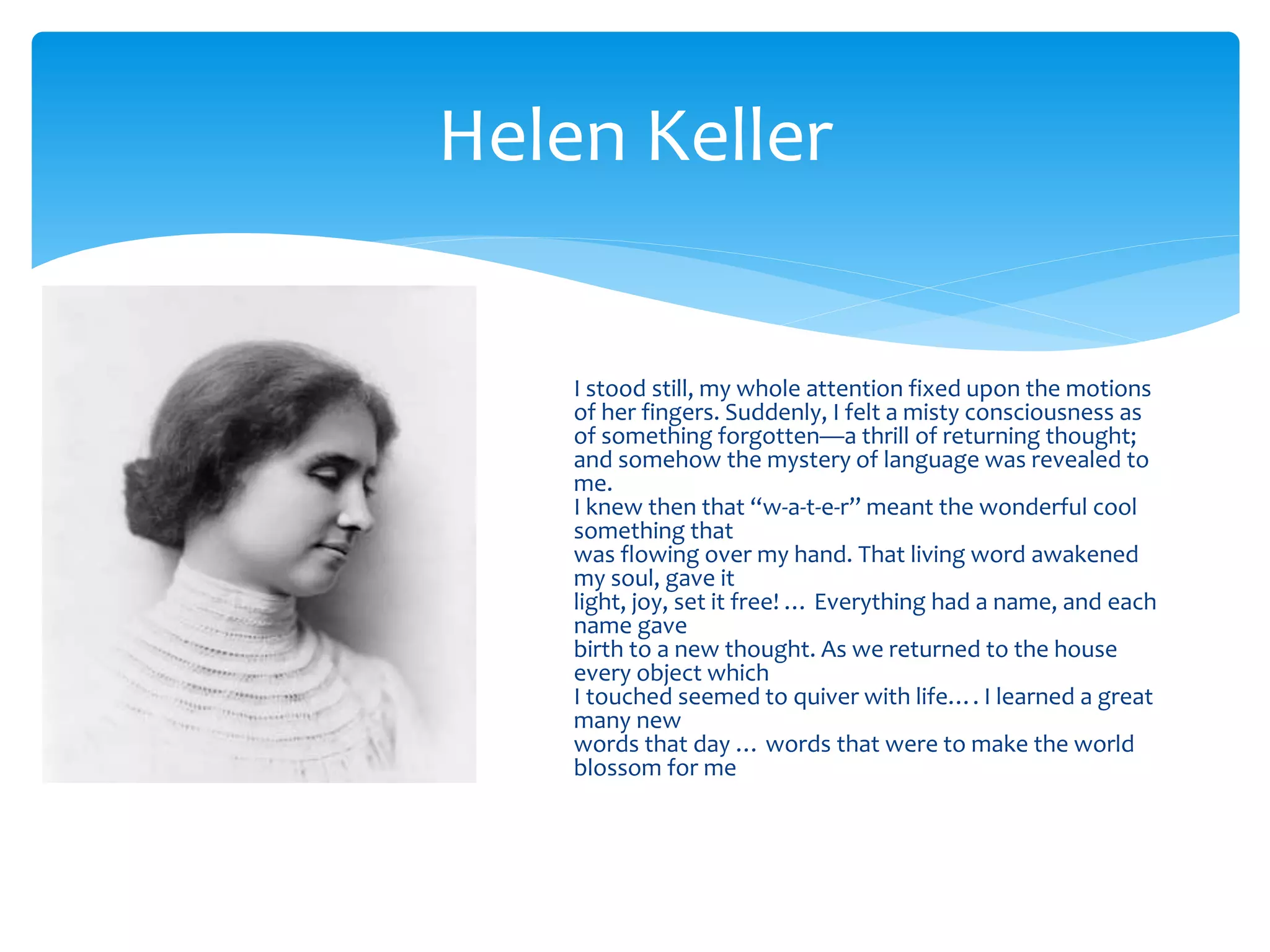
Helen Keller
I stood still, my whole attention fixed upon the motions
of her fingers. Suddenly, I felt a misty consciousness as
of something forgotten—a thrill of returning thought;
and somehow the mystery of language was revealed to
me.
I knew then that “w-a-t-e-r” meant the wonderful cool
something that
was flowing over my hand. That living word awakened
my soul, gave it
light, joy, set it free! … Everything had a name, and each
name gave
birth to a new thought. As we returned to the house
every object which
I touched seemed to quiver with life…. I learned a great
many new
words that day … words that were to make the world
blossom for me
 Properties of Language
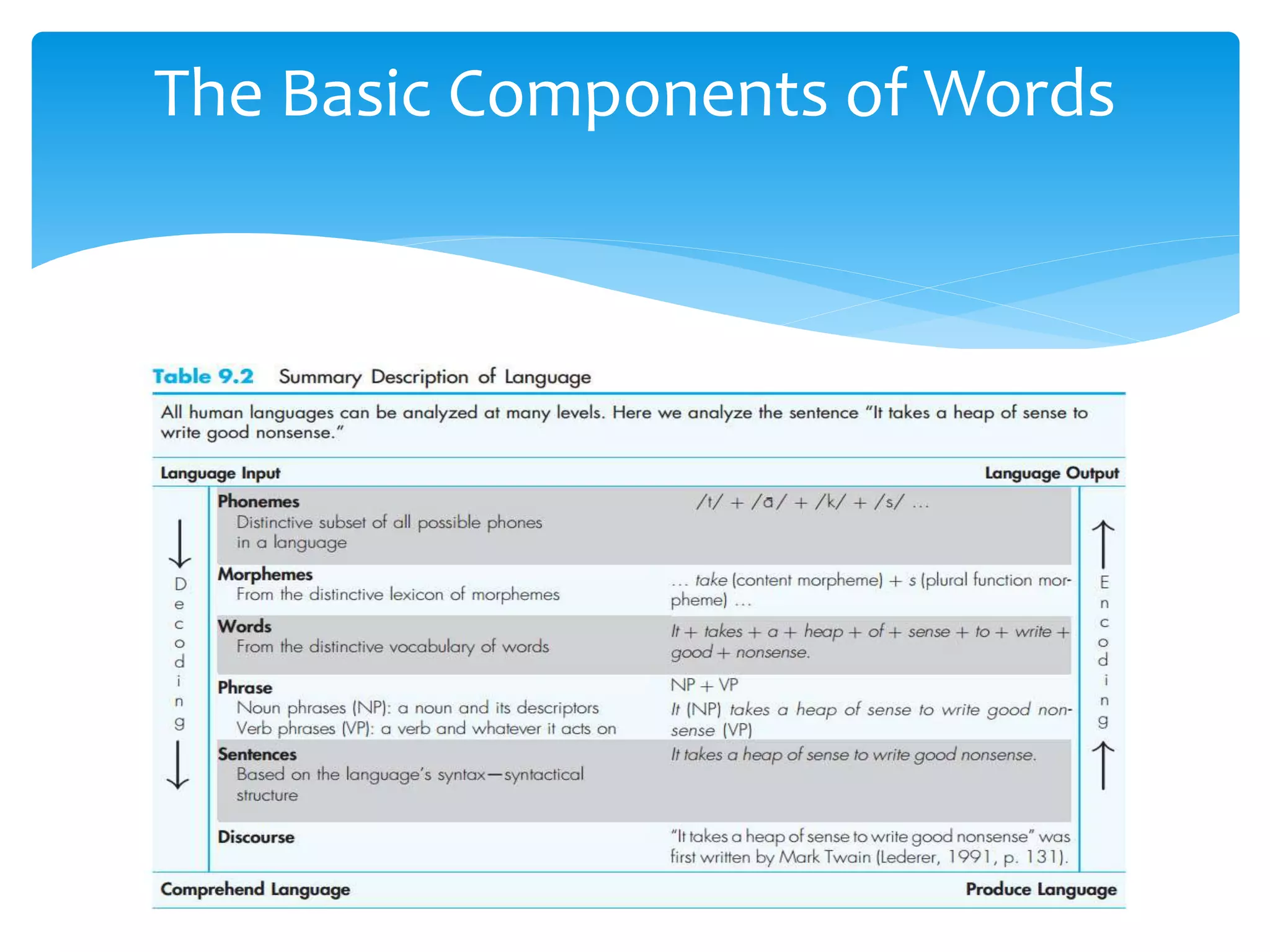
 The Basic Components of Words
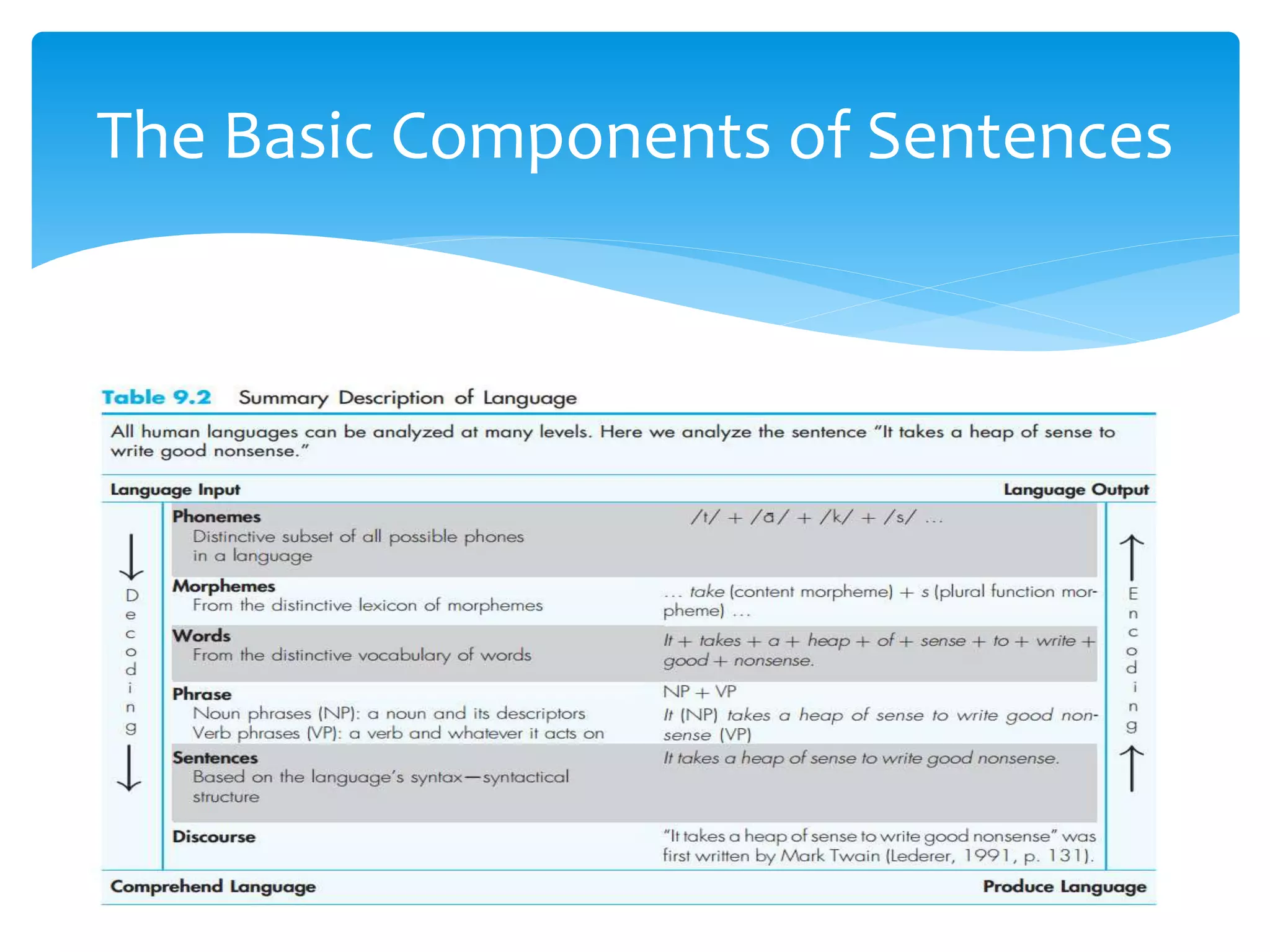
 The Basic Components of Sentences
What is Language?
1. Communicative
2. Arbitrarily symbolic
3. Regularly structured
4. Structured at multiple levels
5. Generative, Productive
6. Dynamic
Properties of Language
The Basic Components of Words
The Basic Components of Sentences
 Understanding Words
 Understanding Meaning: Semantics
 Understanding Sentences: Syntax
Understanding the Meaning of Words,
Sentences
 50 phonemes per second
 Get or Git
 Coarticulation
 Speech segmentation
 Also in non-verbal languages
Understanding Words
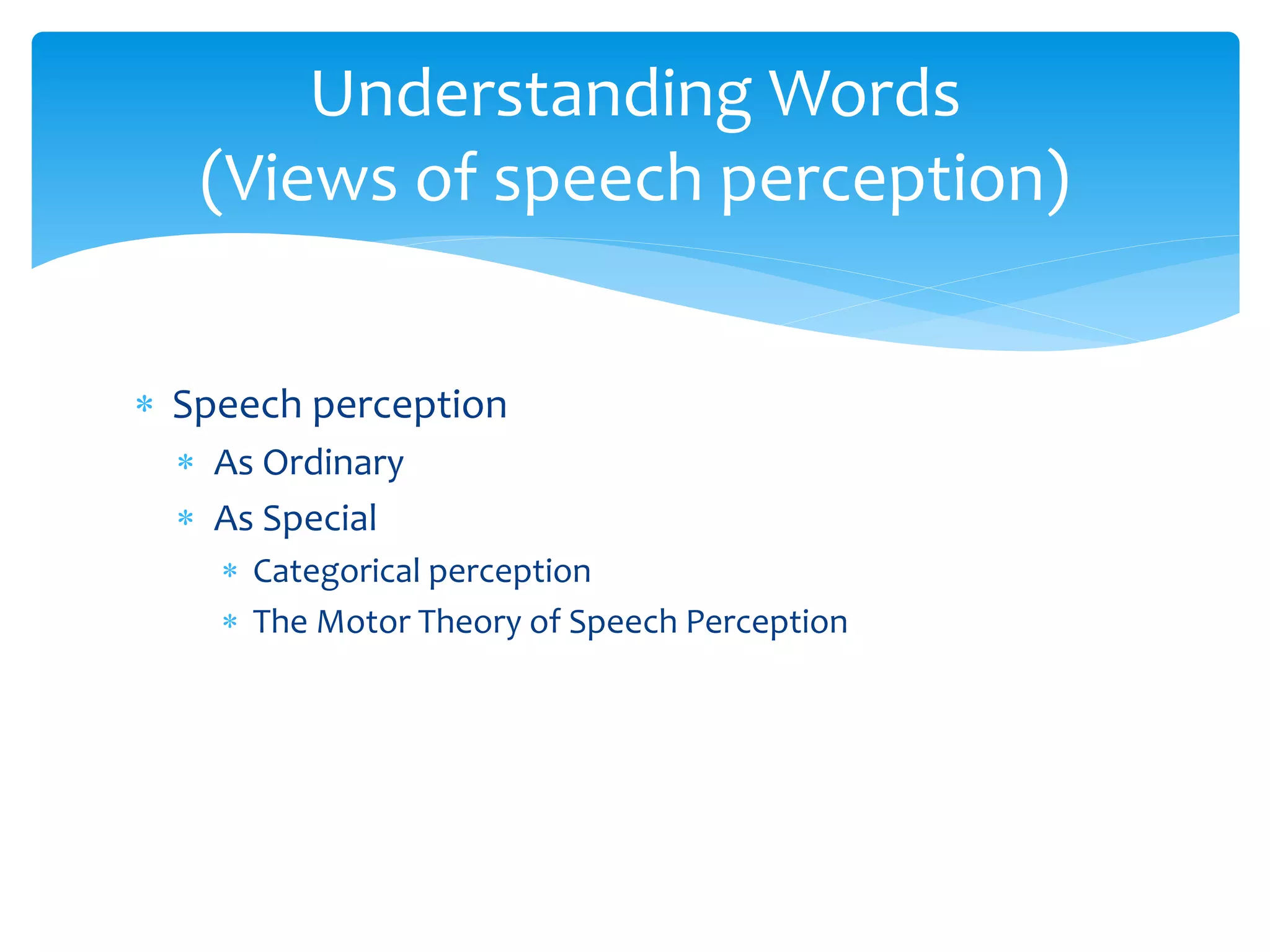
 Speech perception
 As Ordinary
 As Special
 Categorical perception
 The Motor Theory of Speech Perception
Understanding Words
(Views of speech perception)
Understanding Words
(Speech Perception as Ordinary)
 the same processes as when we
perceive other sounds
 different stages of neural processing
 phonetic refinement theory
 TRACE model : interactive
 3 phase : acoustic, phonemes, word
 phonemic-restoration effect
 The importance of context
Understanding Words
(The View of Speech Perception as Special)
Categorical Perception
• ba vs. da vs. ga
• The pitch vs. category
• It IS a specialized process
The Motor Theory
• use the movements of
the speaker’s vocal tract
• McGurk effect
Is a synthesis of these opposing views possible?
We assume YES!!!
linguistic and perceptual attributes
Understanding Words
 Denotation and Connection
 Connection varies among people
 Our mental lexicon = our dictionary
 Dominant meaning and subordinating meaning
 context
Understanding Meaning
(semantics)
Not only words convey meaning;
the structure of sentences does
as well.
Understanding Sentences
(syntax)
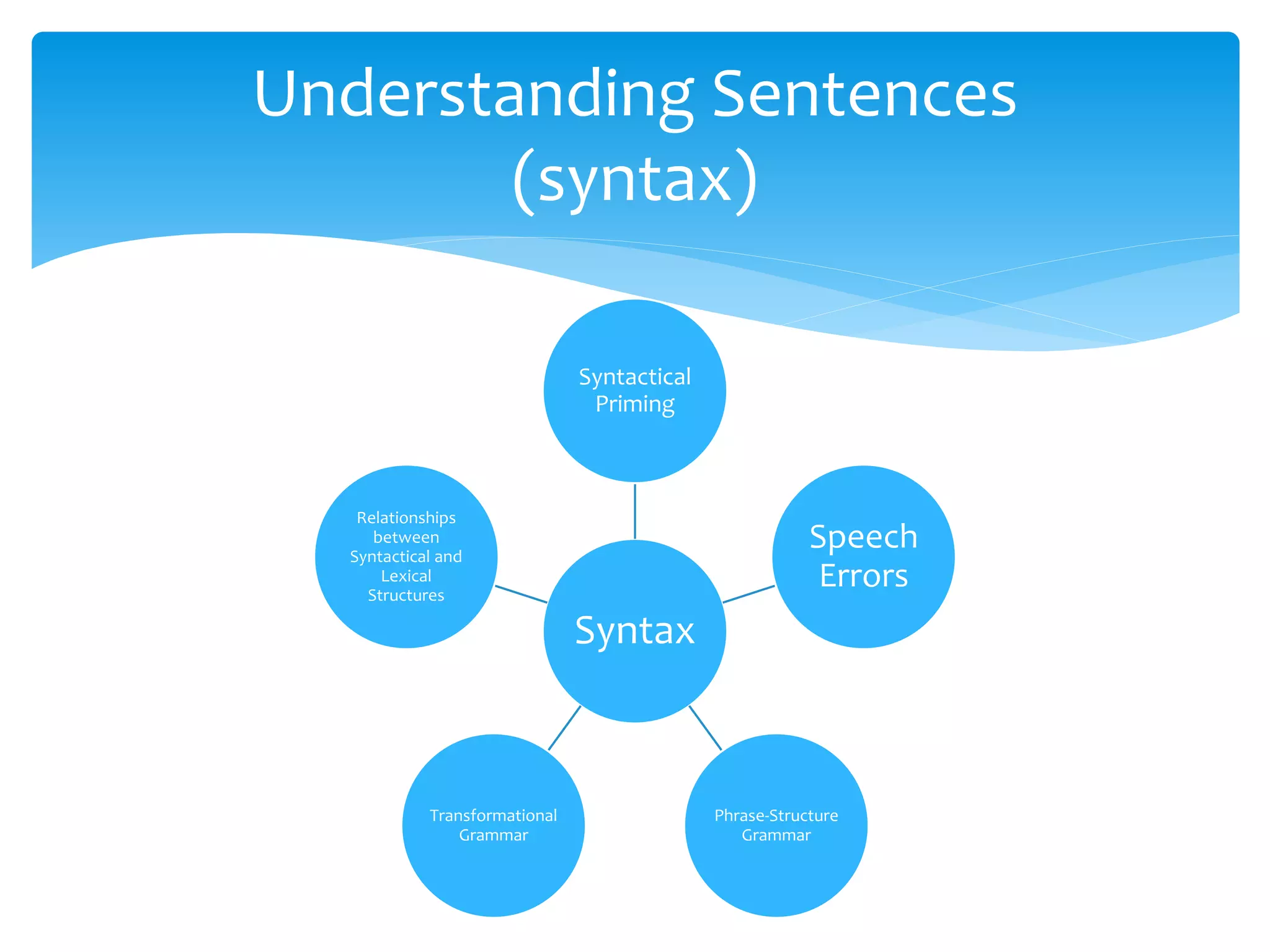
Syntax
Syntactical
Priming
Speech
Errors
Phrase-Structure
Grammar
Transformational
Grammar
Relationships
between
Syntactical and
Lexical
Structures
Understanding Sentences
(syntax)
 We tend to use the structures we heard
 The experiment of indirect objects
Syntactical Priming
 The error we make are syntactically true…
 Just like programming
Speech Error
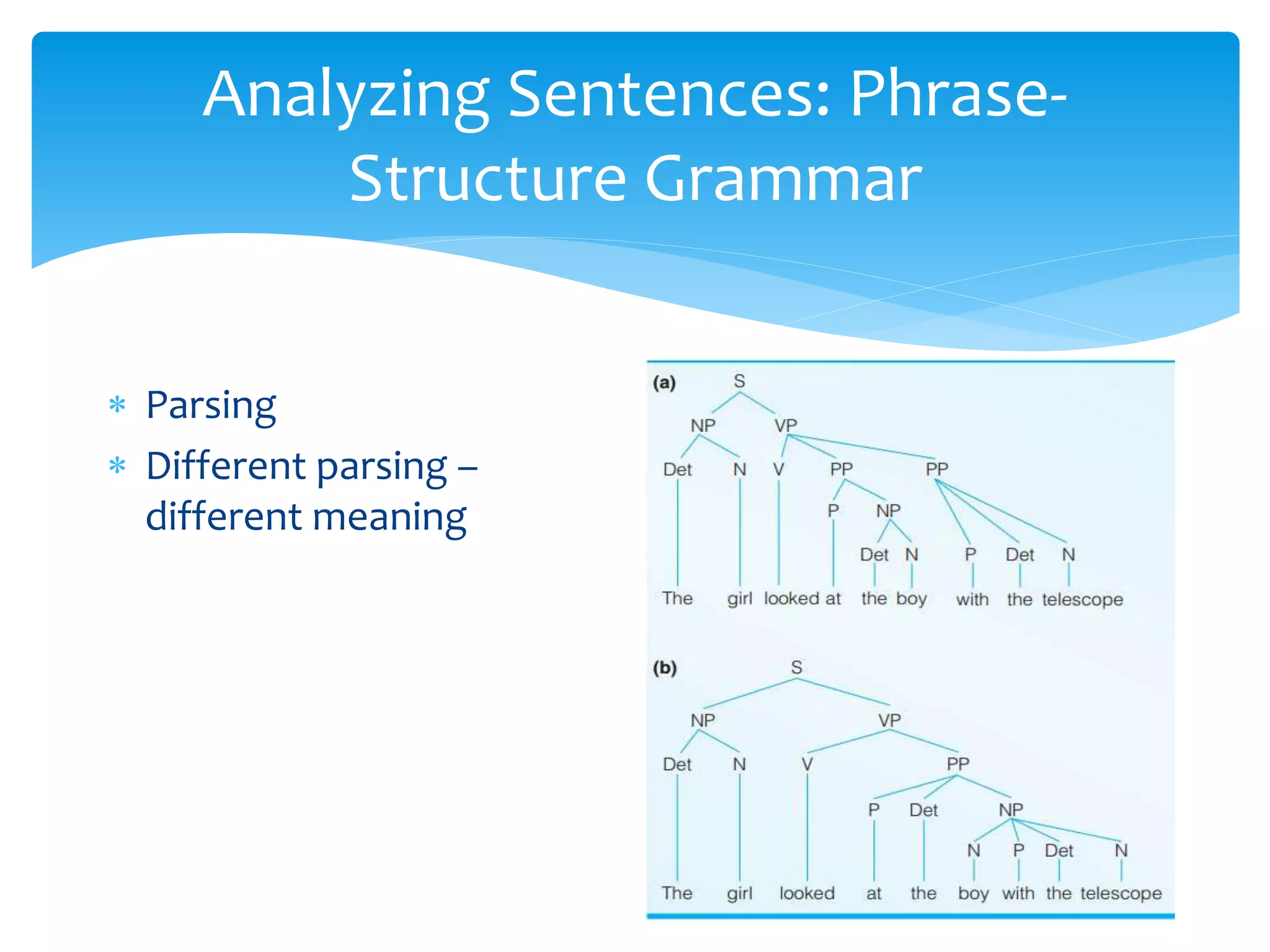
Analyzing Sentences: Phrase-
Structure Grammar
 Parsing
 Different parsing –
different meaning
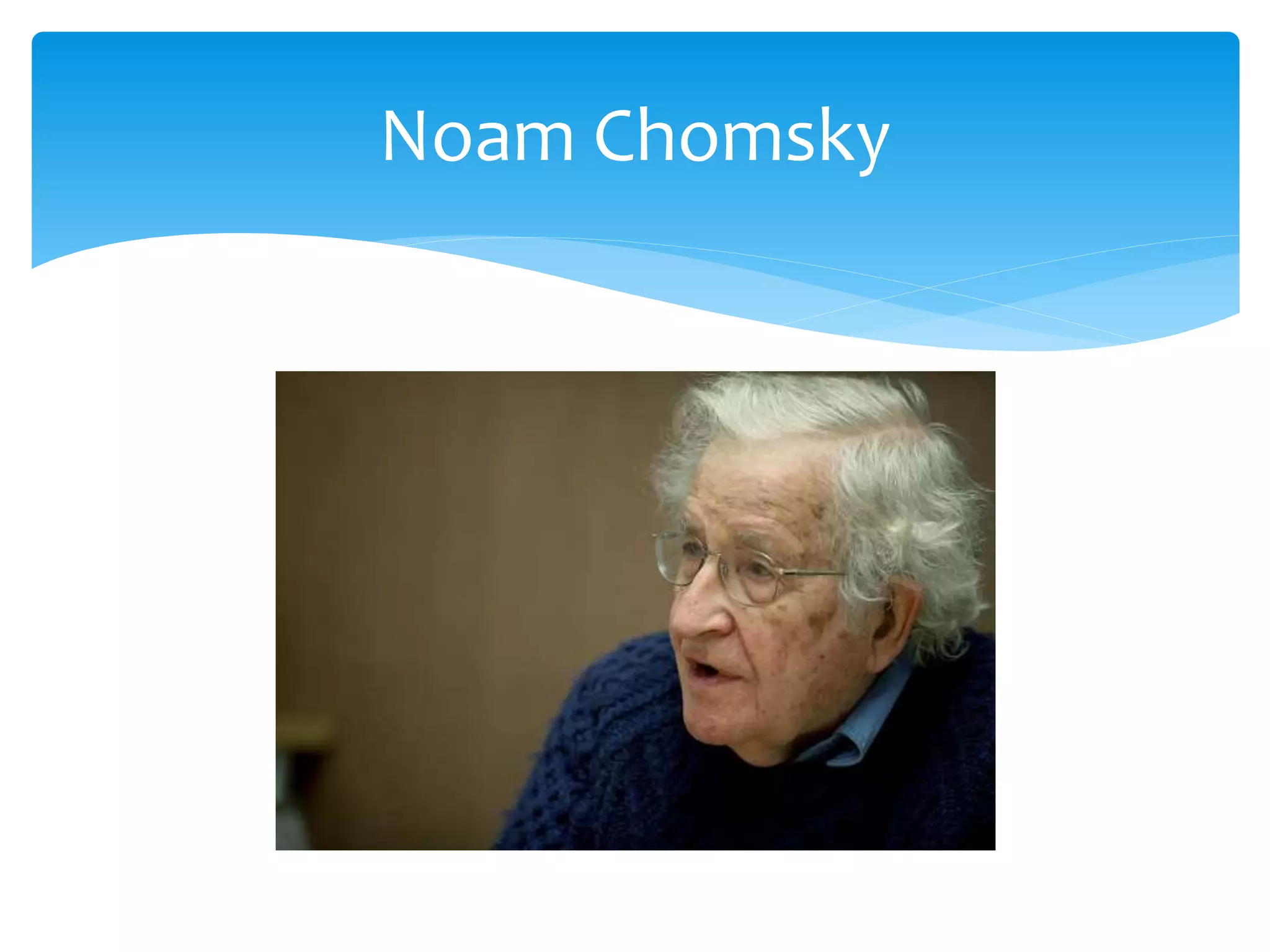
Noam Chomsky
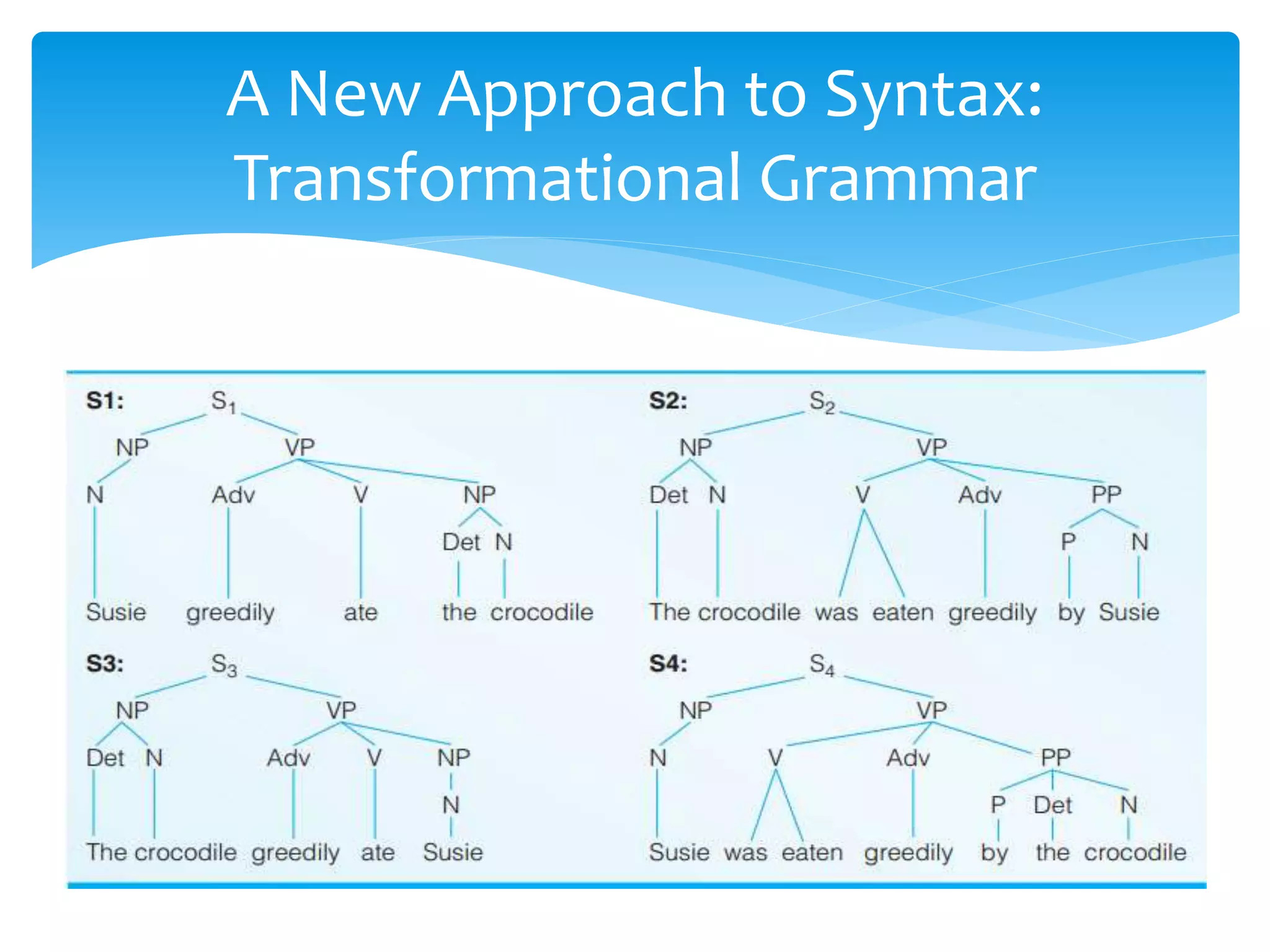
 consider the syntactical relationships between sentences.
S1: Susie greedily ate the crocodile.
S2: The crocodile was eaten greedily by Susie
S3: The crocodile greedily ate Susie.
S4: Susie was eaten greedily by the crocodile.
• Map a tree to another tree
• Deep structure and surface structure
A New Approach to Syntax:
Transformational Grammar
A New Approach to Syntax:
Transformational Grammar
 Our mental lexicon contains more than the semantic
meanings
 Lexical item also contains syntactical information.
 noun versus verb
 the appropriate syntactical contexts
 any idiosyncratic information about the syntactical uses
 Thematic roles
 A link between semantics and syntax
Relationships between Syntactical and Lexical
Structures
Thematic Roles
Reading
processes may be impaired in dyslexia :
 Phonological awareness:
 “Goat” without “-t”
 Phonological reading :
 Words in isolation
 Phonological coding:
 b,z,v,g vs. x,r,y,z
 Lexical access :
 one’s ability to retrieve phonemes from long-term memory.
When Reading Is a Problem—Dyslexia
 difficulty in learning the rules that relate letters to
sounds
 both biological and environmental
 abnormalities in certain chromosomes, most
notably, 3, 6, and 15
 Can be reduced by educational interventions
Developmental dyslexia
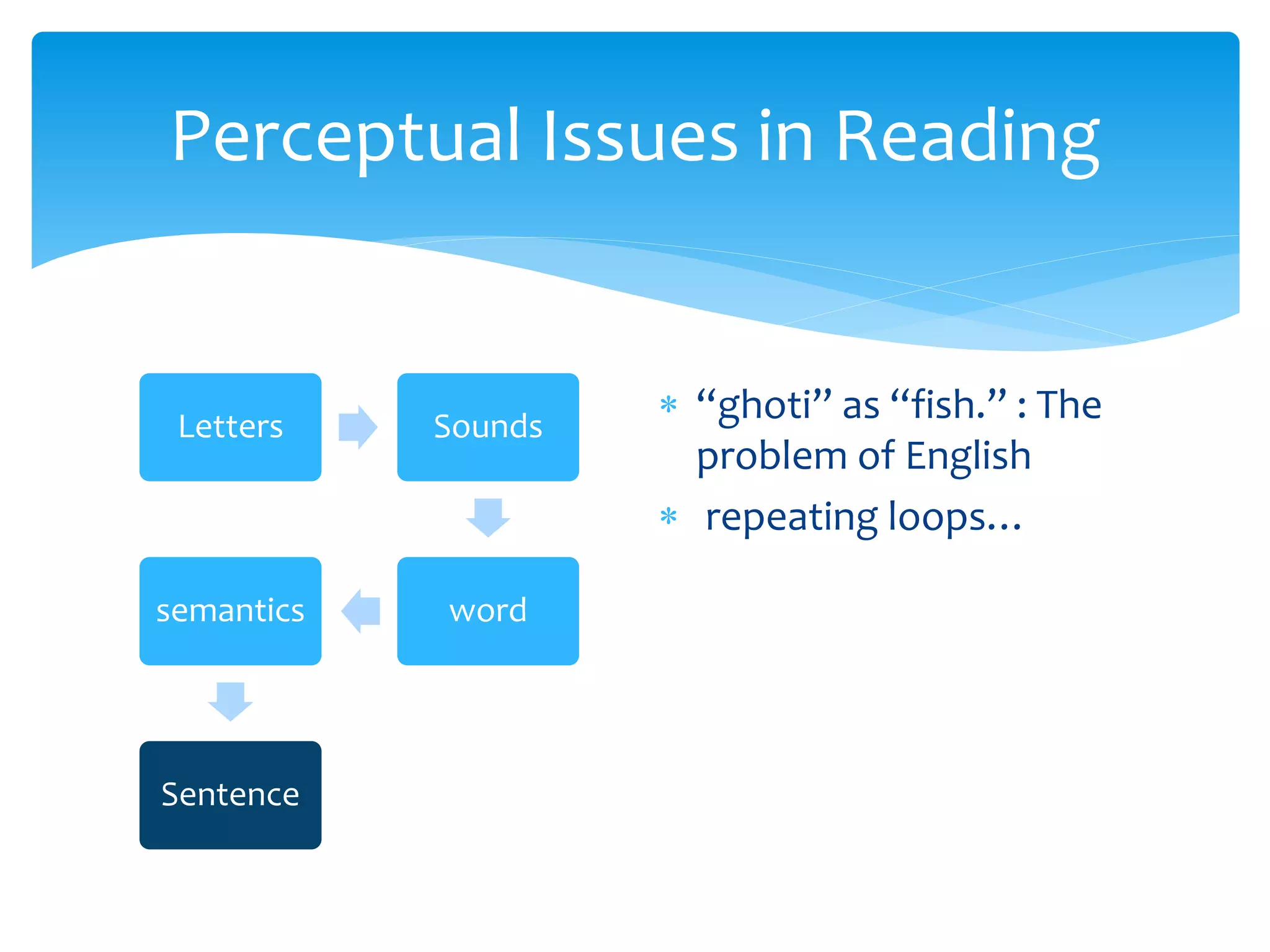
Perceptual Issues in Reading
Letters Sounds
wordsemantics
Sentence
 “ghoti” as “fish.” : The
problem of English
 repeating loops…
 Lexical Process
 Comprehension Process
Learn to read
 Fixations and Reading Speed
 Lexical Access
 Intelligence and Lexical-Access Speed
Lexical Processes in Reading
 Our eyes do not move smoothly
 successive clumps of text - a series of “snapshots”
 Fixate more on longer and less familiar words
 Sentence wrap-up time
 Only 80% of the word will be fixated up to
 visual span : 4 left 15 right
 Terminology: Saccadic
 speed-read -> Less understanding of the text
Fixations and Reading Speed
 lexical access: the identification of a word that
allows us to gain access to the meaning of the word
from memory
 lexical access is an interactive process.
 occurs at multiple levels

Lexical Access (cont'd)
Lexical Access (cont’d)
 The interactive-activation model
 Visual input
 The letter level
 The word level
 First bottom-up, Second Top-down
 The letter is identified for easily in word context
Lexical Access
(word-superiority effect)
 Physical matching (A A)
 Name matching (A a)
 Nm – Pm : Lexical Speed
 More verbal ability, more lexical speed
Intelligence and Lexical-Access Speed
 Disclosure
 Pronouns
 Knowledge and context
Understanding Conversations and
Essays: Discourse
 Semantic encoding
 The importance of vocabulary
 95 for ease – 98 for joy
Comprehending Known Words: Retrieving Word
Meaning from Memory
 Dictionary or formulating?
 Learning vocabulary indirectly
 High-verbal people derive easier…
Comprehending Unknown Words: Deriving
Word Meanings from Context
 Proposition
 Working memory holds them!!!
 Macropropositions
 1300 word experiment
Comprehending Ideas: Propositional
Representations
 Point of view of a thief vs. the one of a potential
buyer of a wealthy house
Comprehending Text Based on Context
and Point of View
 After the words were decoded…
 Inferences…
 Bridging
 The minimalist belief
Representing the Text in Mental
Models

Language in cognitive psychology

  • 1.
    Language in cognitive psychology Presentedby Ali Bahrani Iran University of Science and Technology
  • 2.
    Robert J Sternberg KarinSternberg Adopted from Chapter 10 of Cognitive Psychology (6th edition)
  • 3.
    80 is 4*20in French (quatre-vingt) The Chinese – The American DO THE CHINESE THINK ABOUT NUMBERS DIFFERENTLY THAN AMERICANS ?
  • 4.
    Helen Keller I stoodstill, my whole attention fixed upon the motions of her fingers. Suddenly, I felt a misty consciousness as of something forgotten—a thrill of returning thought; and somehow the mystery of language was revealed to me. I knew then that “w-a-t-e-r” meant the wonderful cool something that was flowing over my hand. That living word awakened my soul, gave it light, joy, set it free! … Everything had a name, and each name gave birth to a new thought. As we returned to the house every object which I touched seemed to quiver with life…. I learned a great many new words that day … words that were to make the world blossom for me
  • 5.
     Properties ofLanguage  The Basic Components of Words  The Basic Components of Sentences What is Language?
  • 6.
    1. Communicative 2. Arbitrarilysymbolic 3. Regularly structured 4. Structured at multiple levels 5. Generative, Productive 6. Dynamic Properties of Language
  • 7.
  • 8.
  • 9.
     Understanding Words Understanding Meaning: Semantics  Understanding Sentences: Syntax Understanding the Meaning of Words, Sentences
  • 10.
     50 phonemesper second  Get or Git  Coarticulation  Speech segmentation  Also in non-verbal languages Understanding Words
  • 11.
     Speech perception As Ordinary  As Special  Categorical perception  The Motor Theory of Speech Perception Understanding Words (Views of speech perception)
  • 12.
    Understanding Words (Speech Perceptionas Ordinary)  the same processes as when we perceive other sounds  different stages of neural processing  phonetic refinement theory  TRACE model : interactive  3 phase : acoustic, phonemes, word  phonemic-restoration effect  The importance of context
  • 13.
    Understanding Words (The Viewof Speech Perception as Special) Categorical Perception • ba vs. da vs. ga • The pitch vs. category • It IS a specialized process The Motor Theory • use the movements of the speaker’s vocal tract • McGurk effect
  • 14.
    Is a synthesisof these opposing views possible? We assume YES!!! linguistic and perceptual attributes Understanding Words
  • 15.
     Denotation andConnection  Connection varies among people  Our mental lexicon = our dictionary  Dominant meaning and subordinating meaning  context Understanding Meaning (semantics)
  • 16.
    Not only wordsconvey meaning; the structure of sentences does as well. Understanding Sentences (syntax)
  • 17.
  • 18.
     We tendto use the structures we heard  The experiment of indirect objects Syntactical Priming
  • 19.
     The errorwe make are syntactically true…  Just like programming Speech Error
  • 20.
    Analyzing Sentences: Phrase- StructureGrammar  Parsing  Different parsing – different meaning
  • 21.
  • 22.
     consider thesyntactical relationships between sentences. S1: Susie greedily ate the crocodile. S2: The crocodile was eaten greedily by Susie S3: The crocodile greedily ate Susie. S4: Susie was eaten greedily by the crocodile. • Map a tree to another tree • Deep structure and surface structure A New Approach to Syntax: Transformational Grammar
  • 23.
    A New Approachto Syntax: Transformational Grammar
  • 24.
     Our mentallexicon contains more than the semantic meanings  Lexical item also contains syntactical information.  noun versus verb  the appropriate syntactical contexts  any idiosyncratic information about the syntactical uses  Thematic roles  A link between semantics and syntax Relationships between Syntactical and Lexical Structures
  • 25.
  • 26.
  • 27.
    processes may beimpaired in dyslexia :  Phonological awareness:  “Goat” without “-t”  Phonological reading :  Words in isolation  Phonological coding:  b,z,v,g vs. x,r,y,z  Lexical access :  one’s ability to retrieve phonemes from long-term memory. When Reading Is a Problem—Dyslexia
  • 28.
     difficulty inlearning the rules that relate letters to sounds  both biological and environmental  abnormalities in certain chromosomes, most notably, 3, 6, and 15  Can be reduced by educational interventions Developmental dyslexia
  • 29.
    Perceptual Issues inReading Letters Sounds wordsemantics Sentence  “ghoti” as “fish.” : The problem of English  repeating loops…
  • 30.
     Lexical Process Comprehension Process Learn to read
  • 31.
     Fixations andReading Speed  Lexical Access  Intelligence and Lexical-Access Speed Lexical Processes in Reading
  • 32.
     Our eyesdo not move smoothly  successive clumps of text - a series of “snapshots”  Fixate more on longer and less familiar words  Sentence wrap-up time  Only 80% of the word will be fixated up to  visual span : 4 left 15 right  Terminology: Saccadic  speed-read -> Less understanding of the text Fixations and Reading Speed
  • 33.
     lexical access:the identification of a word that allows us to gain access to the meaning of the word from memory  lexical access is an interactive process.  occurs at multiple levels  Lexical Access (cont'd)
  • 34.
    Lexical Access (cont’d) The interactive-activation model  Visual input  The letter level  The word level  First bottom-up, Second Top-down
  • 35.
     The letteris identified for easily in word context Lexical Access (word-superiority effect)
  • 36.
     Physical matching(A A)  Name matching (A a)  Nm – Pm : Lexical Speed  More verbal ability, more lexical speed Intelligence and Lexical-Access Speed
  • 37.
     Disclosure  Pronouns Knowledge and context Understanding Conversations and Essays: Discourse
  • 38.
     Semantic encoding The importance of vocabulary  95 for ease – 98 for joy Comprehending Known Words: Retrieving Word Meaning from Memory
  • 39.
     Dictionary orformulating?  Learning vocabulary indirectly  High-verbal people derive easier… Comprehending Unknown Words: Deriving Word Meanings from Context
  • 40.
     Proposition  Workingmemory holds them!!!  Macropropositions  1300 word experiment Comprehending Ideas: Propositional Representations
  • 41.
     Point ofview of a thief vs. the one of a potential buyer of a wealthy house Comprehending Text Based on Context and Point of View
  • 42.
     After thewords were decoded…  Inferences…  Bridging  The minimalist belief Representing the Text in Mental Models

Editor's Notes

  • #4 برای شروع بحث و گرم کردن ذهن دانشجویان از آزمایش اعداد استفاده کرده ام تلفظ فرانسوی عدد هشتاد کتخون هست.
  • #5 هلن کلر یکی از شگفتی های حوزه ی زبان است یکی دیگر از دلایل ساخت این اسلاید، تاکید بر این است که زبان لزوما verbal نیست.
  • #6 آشنایی با زبان و ویژگی های آن
  • #13 ReRead the part
  • #16 ترمینولوژی جدید و مهم mental lexicon باید جا بیفتند در این اسلاید
  • #22 پایه گذار دو مبحث بعدی آقای چامسکی است.
  • #23 Deep and surface
  • #26 نقش های موضوعی دقیقا از کتاب برداشته شده است.
  • #28 ایجاد مسئله با ایرادات خواندن