THE PHASE RULE
PROF. (DR.) SUNIL VERMA
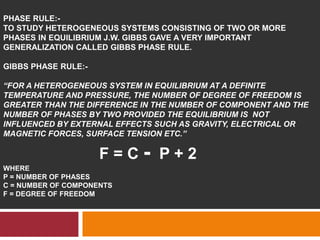
PHASE RULE:-
TO STUDY HETEROGENEOUS SYSTEMS CONSISTING OF TWO OR MORE
PHASES IN EQUILIBRIUM J.W. GIBBS GAVE A VERY IMPORTANT
GENERALIZATION CALLED GIBBS PHASE RULE.
GIBBS PHASE RULE:-
“FOR A HETEROGENEOUS SYSTEM IN EQUILIBRIUM AT A DEFINITE
TEMPERATURE AND PRESSURE, THE NUMBER OF DEGREE OF FREEDOM IS
GREATER THAN THE DIFFERENCE IN THE NUMBER OF COMPONENT AND THE
NUMBER OF PHASES BY TWO PROVIDED THE EQUILIBRIUM IS NOT
INFLUENCED BY EXTERNAL EFFECTS SUCH AS GRAVITY, ELECTRICAL OR
MAGNETIC FORCES, SURFACE TENSION ETC.”
F = C - P + 2
WHERE
P = NUMBER OF PHASES
C = NUMBER OF COMPONENTS
F = DEGREE OF FREEDOM
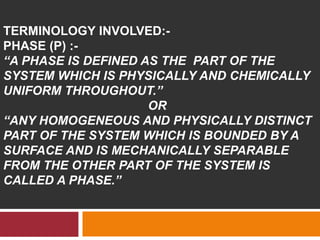
TERMINOLOGY INVOLVED:-
PHASE (P) :-
“A PHASE IS DEFINED AS THE PART OF THE
SYSTEM WHICH IS PHYSICALLY AND CHEMICALLY
UNIFORM THROUGHOUT.”
OR
“ANY HOMOGENEOUS AND PHYSICALLY DISTINCT
PART OF THE SYSTEM WHICH IS BOUNDED BY A
SURFACE AND IS MECHANICALLY SEPARABLE
FROM THE OTHER PART OF THE SYSTEM IS
CALLED A PHASE.”
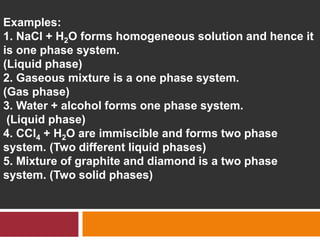
Examples:
1. NaCl + H2O forms homogeneous solution and hence it
is one phase system.
(Liquid phase)
2. Gaseous mixture is a one phase system.
(Gas phase)
3. Water + alcohol forms one phase system.
(Liquid phase)
4. CCl4 + H2O are immiscible and forms two phase
system. (Two different liquid phases)
5. Mixture of graphite and diamond is a two phase
system. (Two solid phases)
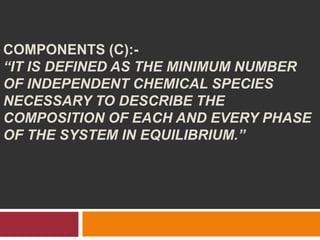
COMPONENTS (C):-
“IT IS DEFINED AS THE MINIMUM NUMBER
OF INDEPENDENT CHEMICAL SPECIES
NECESSARY TO DESCRIBE THE
COMPOSITION OF EACH AND EVERY PHASE
OF THE SYSTEM IN EQUILIBRIUM.”
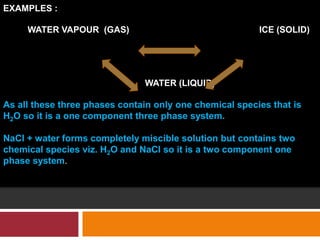
EXAMPLES :
WATER VAPOUR (GAS) ICE (SOLID)
WATER (LIQUID)
As all these three phases contain only one chemical species that is
H2O so it is a one component three phase system.
NaCl + water forms completely miscible solution but contains two
chemical species viz. H2O and NaCl so it is a two component one
phase system.
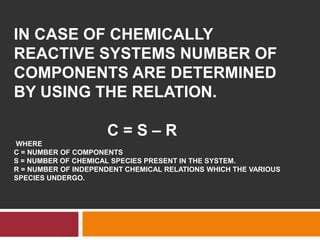
IN CASE OF CHEMICALLY
REACTIVE SYSTEMS NUMBER OF
COMPONENTS ARE DETERMINED
BY USING THE RELATION.
C = S – R
WHERE
C = NUMBER OF COMPONENTS
S = NUMBER OF CHEMICAL SPECIES PRESENT IN THE SYSTEM.
R = NUMBER OF INDEPENDENT CHEMICAL RELATIONS WHICH THE VARIOUS
SPECIES UNDERGO.
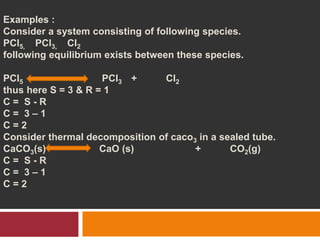
Examples :
Consider a system consisting of following species.
PCl5, PCl3, Cl2
following equilibrium exists between these species.
PCl5 PCl3 + Cl2
thus here S = 3 & R = 1
C = S - R
C = 3 – 1
C = 2
Consider thermal decomposition of caco3 in a sealed tube.
CaCO3(s) CaO (s) + CO2(g)
C = S - R
C = 3 – 1
C = 2
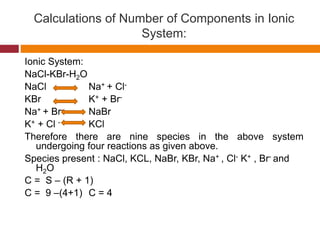
Calculations of Number of Components in Ionic
System:
Ionic System:
NaCl-KBr-H2O
NaCl Na+ + Cl-
KBr K+ + Br-
Na+ + Br- NaBr
K+ + Cl - KCl
Therefore there are nine species in the above system
undergoing four reactions as given above.
Species present : NaCl, KCL, NaBr, KBr, Na+ , Cl- K+ , Br- and
H2O
C = S – (R + 1)
C = 9 –(4+1) C = 4
NUMBER OF DEGREE OF FREEDOM (F) OR VARIANCE:-
“THE DEGREE OF FREEDOM OF A SYSTEM IS DEFINED AS THE
MINIMUM NUMBER OF INDEPENDENT VARIABLE SUCH AS
TEMPERATURE, PRESSURE AND CONCENTRATION WHICH
MUST BE SPECIFIED IN ORDER TO DEFINE THE SYSTEM
COMPLETELY”
OR
“IT IS THE MINIMUM NUMBER OF INTENSIVE VARIABLE THAT
MUST BE SPECIFIED TO KNOW THE VALUES OF ALL THE
REMAINING INTENSIVE VARIABLES”
EXAMPLE:
CONSIDER A ONE COMPONENT ONE PHASE SYSTEM LIKE
LIQUID WATER, IT WILL HAVE A NUMBER OF INTENSIVE
PROPERTIES LIKE DENSITY, REFRACTIVE INDEX, SURFACE
TENSION, VISCOSITY ETC. BUT IF TEMPERATURE AND
PRESSURE ARE KNOWN THEN ALL OTHER PROPERTIES WILL
HAVE FIX VALUES.
SAME FOLLOWS FROM THE GIBBS PHASE RULE EQUATION
F = C - P + 2
F = 1 – 1 + 2
F = 2
TYPES OF SYSTEMS
1. NON-VARIANT OR INVARIANT
IF THE DEGREE OF FREEDOM FOR A SYSTEM IS ZERO THAN THE
SYSTEM IS TERMED NON-VARIANT OR INVARIANT.
2. UNIVARIANT OR MONOVARIANT
A SYSTEM IS SAID TO BE UNIVARIANT OR MONOVARIANT IF ITS
DEGREE OF FREEDOM IS ONE.
3. BIVARIANT
A SYSTEM IS SAID TO BE BIVARIANT IF ITS DEGREE OF FREEDOM IS
TWO.
Phase Rule Derivation
Consider a heterogeneous system containing C
components (C1, C2, C3…………….CC)
distributed among P phases (P1, P2,
P3…………….PP).
Number of degree of freedom (F) =
Total number of Variables – Number of variable Defined by
the System because of its being in equilibrium.
Calculations of total number of
variables:-
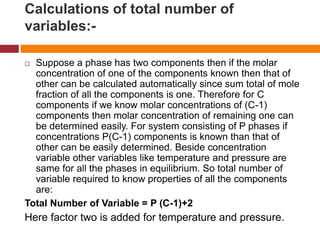
 Suppose a phase has two components then if the molar
concentration of one of the components known then that of
other can be calculated automatically since sum total of mole
fraction of all the components is one. Therefore for C
components if we know molar concentrations of (C-1)
components then molar concentration of remaining one can
be determined easily. For system consisting of P phases if
concentrations P(C-1) components is known than that of
other can be easily determined. Beside concentration
variable other variables like temperature and pressure are
same for all the phases in equilibrium. So total number of
variable required to know properties of all the components
are:
Total Number of Variable = P (C-1)+2
Here factor two is added for temperature and pressure.
Calculations of number of variables defined by the
system because of its being in equilibrium:-
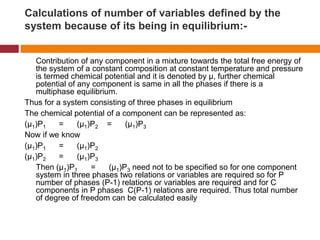
Contribution of any component in a mixture towards the total free energy of
the system of a constant composition at constant temperature and pressure
is termed chemical potential and it is denoted by µ, further chemical
potential of any component is same in all the phases if there is a
multiphase equilibrium.
Thus for a system consisting of three phases in equilibrium
The chemical potential of a component can be represented as:
(µ1)P1 = (µ1)P2 = (µ1)P3
Now if we know
(µ1)P1 = (µ1)P2
(µ1)P2 = (µ1)P3
Then (µ1)P1 = (µ1)P3 need not to be specified so for one component
system in three phases two relations or variables are required so for P
number of phases (P-1) relations or variables are required and for C
components in P phases C(P-1) relations are required. Thus total number
of degree of freedom can be calculated easily
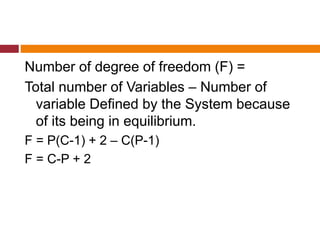
Number of degree of freedom (F) =
Total number of Variables – Number of
variable Defined by the System because
of its being in equilibrium.
F = P(C-1) + 2 – C(P-1)
F = C-P + 2
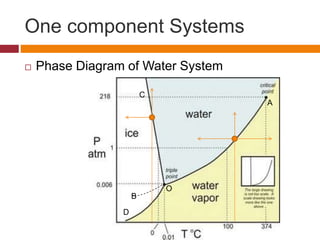
One component Systems
 Phase Diagram of Water System
O
A
C
B
D
Super cooled Water
Ice skating & Flow of Glacier
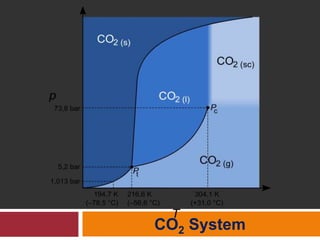
CO2 System
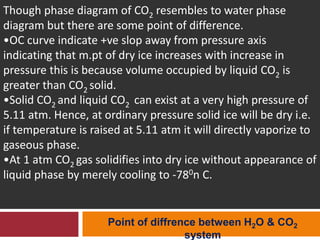
Though phase diagram of CO2 resembles to water phase
diagram but there are some point of difference.
•OC curve indicate +ve slop away from pressure axis
indicating that m.pt of dry ice increases with increase in
pressure this is because volume occupied by liquid CO2 is
greater than CO2 solid.
•Solid CO2 and liquid CO2 can exist at a very high pressure of
5.11 atm. Hence, at ordinary pressure solid ice will be dry i.e.
if temperature is raised at 5.11 atm it will directly vaporize to
gaseous phase.
•At 1 atm CO2 gas solidifies into dry ice without appearance of
liquid phase by merely cooling to -780n C.
Point of diffrence between H2O & CO2
system
Dry Ice
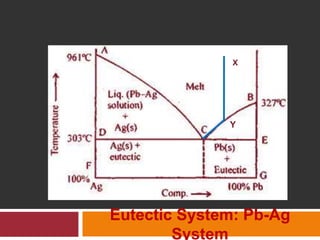
Eutectic System: Pb-Ag
System
X
Y
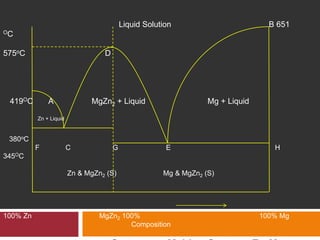
Liquid Solution B 651
OC
575oC D
419OC A MgZn2 + Liquid Mg + Liquid
Zn + Liquid
380oC
F C G E H
345OC
Zn & MgZn2 (S) Mg & MgZn2 (S)
100% Zn MgZn2 100% 100% Mg
Composition
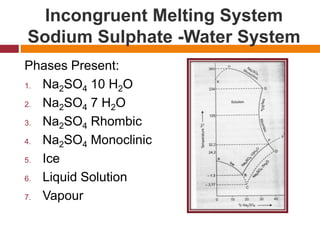
Incongruent Melting System
Sodium Sulphate -Water System
Phases Present:
1. Na2SO4 10 H2O
2. Na2SO4 7 H2O
3. Na2SO4 Rhombic
4. Na2SO4 Monoclinic
5. Ice
6. Liquid Solution
7. Vapour
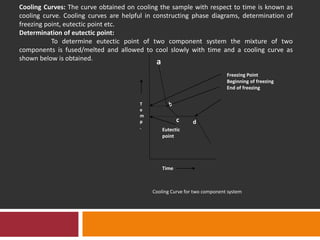
Cooling Curves: The curve obtained on cooling the sample with respect to time is known as
cooling curve. Cooling curves are helpful in constructing phase diagrams, determination of
freezing point, eutectic point etc.
Determination of eutectic point:
To determine eutectic point of two component system the mixture of two
components is fused/melted and allowed to cool slowly with time and a cooling curve as
shown below is obtained.
dc
bT
e
m
p
.
Time
Freezing Point
Beginning of freezing
End of freezing
Eutectic
point
a
Cooling Curve for two component system
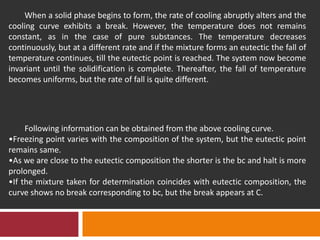
When a solid phase begins to form, the rate of cooling abruptly alters and the
cooling curve exhibits a break. However, the temperature does not remains
constant, as in the case of pure substances. The temperature decreases
continuously, but at a different rate and if the mixture forms an eutectic the fall of
temperature continues, till the eutectic point is reached. The system now become
invariant until the solidification is complete. Thereafter, the fall of temperature
becomes uniforms, but the rate of fall is quite different.
Following information can be obtained from the above cooling curve.
•Freezing point varies with the composition of the system, but the eutectic point
remains same.
•As we are close to the eutectic composition the shorter is the bc and halt is more
prolonged.
•If the mixture taken for determination coincides with eutectic composition, the
curve shows no break corresponding to bc, but the break appears at C.
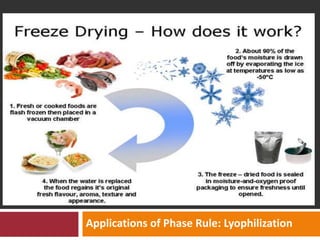
Applications of Phase Rule: Lyophilization
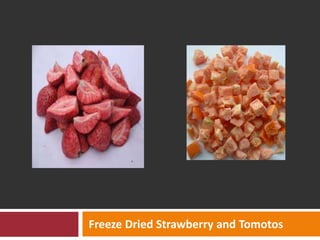
Freeze Dried Strawberry and Tomotos
Solders
THANKS

The phase rule_presentation

  • 1.
    THE PHASE RULE PROF.(DR.) SUNIL VERMA
  • 2.
    PHASE RULE:- TO STUDYHETEROGENEOUS SYSTEMS CONSISTING OF TWO OR MORE PHASES IN EQUILIBRIUM J.W. GIBBS GAVE A VERY IMPORTANT GENERALIZATION CALLED GIBBS PHASE RULE. GIBBS PHASE RULE:- “FOR A HETEROGENEOUS SYSTEM IN EQUILIBRIUM AT A DEFINITE TEMPERATURE AND PRESSURE, THE NUMBER OF DEGREE OF FREEDOM IS GREATER THAN THE DIFFERENCE IN THE NUMBER OF COMPONENT AND THE NUMBER OF PHASES BY TWO PROVIDED THE EQUILIBRIUM IS NOT INFLUENCED BY EXTERNAL EFFECTS SUCH AS GRAVITY, ELECTRICAL OR MAGNETIC FORCES, SURFACE TENSION ETC.” F = C - P + 2 WHERE P = NUMBER OF PHASES C = NUMBER OF COMPONENTS F = DEGREE OF FREEDOM
  • 3.
    TERMINOLOGY INVOLVED:- PHASE (P):- “A PHASE IS DEFINED AS THE PART OF THE SYSTEM WHICH IS PHYSICALLY AND CHEMICALLY UNIFORM THROUGHOUT.” OR “ANY HOMOGENEOUS AND PHYSICALLY DISTINCT PART OF THE SYSTEM WHICH IS BOUNDED BY A SURFACE AND IS MECHANICALLY SEPARABLE FROM THE OTHER PART OF THE SYSTEM IS CALLED A PHASE.”
  • 4.
    Examples: 1. NaCl +H2O forms homogeneous solution and hence it is one phase system. (Liquid phase) 2. Gaseous mixture is a one phase system. (Gas phase) 3. Water + alcohol forms one phase system. (Liquid phase) 4. CCl4 + H2O are immiscible and forms two phase system. (Two different liquid phases) 5. Mixture of graphite and diamond is a two phase system. (Two solid phases)
  • 5.
    COMPONENTS (C):- “IT ISDEFINED AS THE MINIMUM NUMBER OF INDEPENDENT CHEMICAL SPECIES NECESSARY TO DESCRIBE THE COMPOSITION OF EACH AND EVERY PHASE OF THE SYSTEM IN EQUILIBRIUM.”
  • 6.
    EXAMPLES : WATER VAPOUR(GAS) ICE (SOLID) WATER (LIQUID) As all these three phases contain only one chemical species that is H2O so it is a one component three phase system. NaCl + water forms completely miscible solution but contains two chemical species viz. H2O and NaCl so it is a two component one phase system.
  • 7.
    IN CASE OFCHEMICALLY REACTIVE SYSTEMS NUMBER OF COMPONENTS ARE DETERMINED BY USING THE RELATION. C = S – R WHERE C = NUMBER OF COMPONENTS S = NUMBER OF CHEMICAL SPECIES PRESENT IN THE SYSTEM. R = NUMBER OF INDEPENDENT CHEMICAL RELATIONS WHICH THE VARIOUS SPECIES UNDERGO.
  • 8.
    Examples : Consider asystem consisting of following species. PCl5, PCl3, Cl2 following equilibrium exists between these species. PCl5 PCl3 + Cl2 thus here S = 3 & R = 1 C = S - R C = 3 – 1 C = 2 Consider thermal decomposition of caco3 in a sealed tube. CaCO3(s) CaO (s) + CO2(g) C = S - R C = 3 – 1 C = 2
  • 9.
    Calculations of Numberof Components in Ionic System: Ionic System: NaCl-KBr-H2O NaCl Na+ + Cl- KBr K+ + Br- Na+ + Br- NaBr K+ + Cl - KCl Therefore there are nine species in the above system undergoing four reactions as given above. Species present : NaCl, KCL, NaBr, KBr, Na+ , Cl- K+ , Br- and H2O C = S – (R + 1) C = 9 –(4+1) C = 4
  • 10.
    NUMBER OF DEGREEOF FREEDOM (F) OR VARIANCE:- “THE DEGREE OF FREEDOM OF A SYSTEM IS DEFINED AS THE MINIMUM NUMBER OF INDEPENDENT VARIABLE SUCH AS TEMPERATURE, PRESSURE AND CONCENTRATION WHICH MUST BE SPECIFIED IN ORDER TO DEFINE THE SYSTEM COMPLETELY” OR “IT IS THE MINIMUM NUMBER OF INTENSIVE VARIABLE THAT MUST BE SPECIFIED TO KNOW THE VALUES OF ALL THE REMAINING INTENSIVE VARIABLES”
  • 11.
    EXAMPLE: CONSIDER A ONECOMPONENT ONE PHASE SYSTEM LIKE LIQUID WATER, IT WILL HAVE A NUMBER OF INTENSIVE PROPERTIES LIKE DENSITY, REFRACTIVE INDEX, SURFACE TENSION, VISCOSITY ETC. BUT IF TEMPERATURE AND PRESSURE ARE KNOWN THEN ALL OTHER PROPERTIES WILL HAVE FIX VALUES. SAME FOLLOWS FROM THE GIBBS PHASE RULE EQUATION F = C - P + 2 F = 1 – 1 + 2 F = 2
  • 12.
    TYPES OF SYSTEMS 1.NON-VARIANT OR INVARIANT IF THE DEGREE OF FREEDOM FOR A SYSTEM IS ZERO THAN THE SYSTEM IS TERMED NON-VARIANT OR INVARIANT. 2. UNIVARIANT OR MONOVARIANT A SYSTEM IS SAID TO BE UNIVARIANT OR MONOVARIANT IF ITS DEGREE OF FREEDOM IS ONE. 3. BIVARIANT A SYSTEM IS SAID TO BE BIVARIANT IF ITS DEGREE OF FREEDOM IS TWO.
  • 13.
    Phase Rule Derivation Considera heterogeneous system containing C components (C1, C2, C3…………….CC) distributed among P phases (P1, P2, P3…………….PP). Number of degree of freedom (F) = Total number of Variables – Number of variable Defined by the System because of its being in equilibrium.
  • 14.
    Calculations of totalnumber of variables:-  Suppose a phase has two components then if the molar concentration of one of the components known then that of other can be calculated automatically since sum total of mole fraction of all the components is one. Therefore for C components if we know molar concentrations of (C-1) components then molar concentration of remaining one can be determined easily. For system consisting of P phases if concentrations P(C-1) components is known than that of other can be easily determined. Beside concentration variable other variables like temperature and pressure are same for all the phases in equilibrium. So total number of variable required to know properties of all the components are: Total Number of Variable = P (C-1)+2 Here factor two is added for temperature and pressure.
  • 15.
    Calculations of numberof variables defined by the system because of its being in equilibrium:- Contribution of any component in a mixture towards the total free energy of the system of a constant composition at constant temperature and pressure is termed chemical potential and it is denoted by µ, further chemical potential of any component is same in all the phases if there is a multiphase equilibrium. Thus for a system consisting of three phases in equilibrium The chemical potential of a component can be represented as: (µ1)P1 = (µ1)P2 = (µ1)P3 Now if we know (µ1)P1 = (µ1)P2 (µ1)P2 = (µ1)P3 Then (µ1)P1 = (µ1)P3 need not to be specified so for one component system in three phases two relations or variables are required so for P number of phases (P-1) relations or variables are required and for C components in P phases C(P-1) relations are required. Thus total number of degree of freedom can be calculated easily
  • 16.
    Number of degreeof freedom (F) = Total number of Variables – Number of variable Defined by the System because of its being in equilibrium. F = P(C-1) + 2 – C(P-1) F = C-P + 2
  • 17.
    One component Systems Phase Diagram of Water System O A C B D
  • 18.
  • 19.
    Ice skating &Flow of Glacier
  • 20.
  • 21.
    Though phase diagramof CO2 resembles to water phase diagram but there are some point of difference. •OC curve indicate +ve slop away from pressure axis indicating that m.pt of dry ice increases with increase in pressure this is because volume occupied by liquid CO2 is greater than CO2 solid. •Solid CO2 and liquid CO2 can exist at a very high pressure of 5.11 atm. Hence, at ordinary pressure solid ice will be dry i.e. if temperature is raised at 5.11 atm it will directly vaporize to gaseous phase. •At 1 atm CO2 gas solidifies into dry ice without appearance of liquid phase by merely cooling to -780n C. Point of diffrence between H2O & CO2 system
  • 22.
  • 23.
  • 24.
    Liquid Solution B651 OC 575oC D 419OC A MgZn2 + Liquid Mg + Liquid Zn + Liquid 380oC F C G E H 345OC Zn & MgZn2 (S) Mg & MgZn2 (S) 100% Zn MgZn2 100% 100% Mg Composition
  • 25.
    Incongruent Melting System SodiumSulphate -Water System Phases Present: 1. Na2SO4 10 H2O 2. Na2SO4 7 H2O 3. Na2SO4 Rhombic 4. Na2SO4 Monoclinic 5. Ice 6. Liquid Solution 7. Vapour
  • 26.
    Cooling Curves: Thecurve obtained on cooling the sample with respect to time is known as cooling curve. Cooling curves are helpful in constructing phase diagrams, determination of freezing point, eutectic point etc. Determination of eutectic point: To determine eutectic point of two component system the mixture of two components is fused/melted and allowed to cool slowly with time and a cooling curve as shown below is obtained. dc bT e m p . Time Freezing Point Beginning of freezing End of freezing Eutectic point a Cooling Curve for two component system
  • 27.
    When a solidphase begins to form, the rate of cooling abruptly alters and the cooling curve exhibits a break. However, the temperature does not remains constant, as in the case of pure substances. The temperature decreases continuously, but at a different rate and if the mixture forms an eutectic the fall of temperature continues, till the eutectic point is reached. The system now become invariant until the solidification is complete. Thereafter, the fall of temperature becomes uniforms, but the rate of fall is quite different. Following information can be obtained from the above cooling curve. •Freezing point varies with the composition of the system, but the eutectic point remains same. •As we are close to the eutectic composition the shorter is the bc and halt is more prolonged. •If the mixture taken for determination coincides with eutectic composition, the curve shows no break corresponding to bc, but the break appears at C.
  • 28.
    Applications of PhaseRule: Lyophilization
  • 29.
  • 30.
  • 31.