Topic:
PHASE RULE
By:
Mehak Shabbir
BCH172003
2
Contents:
• Phase rule
• Explanation of terms
Ø Phase
Ø Components
Ø Degree of freedom
• Merits & Limitations
• Application of phase rule to
Ø One component system
3
Phase Rule:
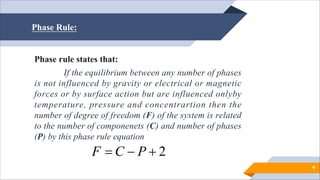
Phase rule states that:
If the equilibrium between any number of phases
is not influenced by gravity or electrical or magnetic
forces or by surface action but are influenced onlyby
temperature, pressure and concentrartion then the
number of degree of freedom (F) of the system is related
to the number of componenets (C) and number of phases
(P) by this phase rule equation
4
2 PCF
Explanation of Terms:
1) Phase (P):
An homogeneous, physically distinct and
mechanically separable portion of system, which is
separated from other such parts of the syatem by definite
boundary surfaces.
Examples:
• Liquid phase
• Solid phase
• Gaseous phase
5
a. Liquid phase:
The number of liquid phase depends on the
number of liquids present and their miscibilty.
i. If two liquids are misicible form one liquid
phase only.
• example: alcohol and water
ii. If two liquids are immmiscible form two
separate liquid phase.
• example: benzene and water
6
b. Solid phase:
The number of solid phase depends on the
number of solides present in it.
• example: all forms of sulphur are separate phases
c. Gaseous phase:
A gaseous mixture is thoroughly miscible in all
proportions. It will form one phase only.
• exapmle: mixture of N2 and H2
7
q Moreover combinations of phases also exists.
• Solution of substance in a solvent is one phase only
Ø glucose solution
• Heterogeneous mixture of three phases i.e., two solids
and one gaseous
Ø CaCO3(s) CaO(s) + CO2 (g)
8

• At freezing point, water exists in three phases
Ø Ice(s) Water (l) Water vapors (g)
• Homogenous solid solution of salt forms a single
phase
Ø Mohr's salt
9
  OHSONHFeSO 24244 6..
 
2) Component (C):
The smallest number of independently variable
constituents, by means of which the composition of each
phase can be expressed in the form of a chemical
equation.
Exapmles:
Ø One component system:
• All three phases of water
• All the four phases of sulphur
10
Ø Two component system:
Saturated solution of NaCl consists of NaCl and
H2O
Ø Three component system:
In the equilibrium,
Fe(s) + H2O(g) FeO(s) + H2(g)
The minimum components required to express
the composition of each phase is three.
11

3) Degree of freedom:
Degree of freedom is defined as the minimum
number of independent variable factors such as
temperature, pressure and concentration of the phases,
which must be fixed in order to define the condition of a
system completely.
• A system may have 0,1,2,3 degrees of freedom.
12
Ø Mono variant or Univariant system:
• Degree of freedom is one (F=1)
• E.g. A system of water in contact with its vapours
• This system has two variables, Pressure(P) and
Temperature(T)
• To define this system, we must state either T or P
• If one variable is specified, other is fixed
automatically
13
Ø Bivariant system:
• Degree of freedom is two (F=2)
• E.g. A system consisting of water vapour phase only
• To define this system completely, we must state both
temperature and pressure
• If P and T values are specified there can be only one
definite value of V
14
Ø Trivariant System:
• Degree of freedom is three (F=3)
• E.g. A mixture of two or more gases
• To define this system completely, we must
state P, T and composition
Ø Nonvariant system:
• This system has no degree of freedom (F=0)
15
• E.g. A system of ice, water and water vapours
• Three phases are in equilibrium at particular T and P
• When all the three phases are in equilibrium, no
condition need to be specified
• This system is therefore zero
variant/invariant/nonvariant
16
Merits of Phase Rule:
• Applicable to both physical and chemical equilibria
• Requires no information regarding molecular/micro-
structure, since it is applicable to macroscopic
systems.
• A convenient method of classifying equilibrium
states in terms of phases, components and degrees
of freedom
• Helps us to predict behaviour of a system under
different set of variables
17
Contd…
• Indicates that different systems with same degree of
freedom behave similarly
• Helps in deciding wheter under a given set of
conditions:
a) Existence of equilibrium among various substances
b) Interconvergence of substances
c) Disappearance of some of substances
18
Limitations of Phase rule:
• Applied only for system in equilibrium
• Not mostly used for systems which attain
equilibrium state very slowly
• Applies only to a single equilibrium system
• Requires at most care in deciding the number of
phases existing in an equilibrium state, since it
considers only the number of phases rather than their
amounts
19
• All the phases of the system must be present
simultaneously under the identical conditions of
Temperature and pressure
• Solid and liquid phases must not be in finely divided
state
• Only three degrees of freedom viz. temperature,
pressure and components are allowed to influence the
equilibrium systems
20
Applications of Phase Rule:
1) One component system(water system):
• Since water exists in three possible phases such as
solid, liquid and vapour
• There are three forms of equilibria :
a) Liquid -vapour
b) solid -vapour
c) solid-liquid
• Each equilibrium involves two phases
21
• In one component system number of degrees of freedom is
related with number of phases.
22

Phase rule

  • 1.
  • 2.
  • 3.
    Contents: • Phase rule •Explanation of terms Ø Phase Ø Components Ø Degree of freedom • Merits & Limitations • Application of phase rule to Ø One component system 3
  • 4.
    Phase Rule: Phase rulestates that: If the equilibrium between any number of phases is not influenced by gravity or electrical or magnetic forces or by surface action but are influenced onlyby temperature, pressure and concentrartion then the number of degree of freedom (F) of the system is related to the number of componenets (C) and number of phases (P) by this phase rule equation 4 2 PCF
  • 5.
    Explanation of Terms: 1)Phase (P): An homogeneous, physically distinct and mechanically separable portion of system, which is separated from other such parts of the syatem by definite boundary surfaces. Examples: • Liquid phase • Solid phase • Gaseous phase 5
  • 6.
    a. Liquid phase: Thenumber of liquid phase depends on the number of liquids present and their miscibilty. i. If two liquids are misicible form one liquid phase only. • example: alcohol and water ii. If two liquids are immmiscible form two separate liquid phase. • example: benzene and water 6
  • 7.
    b. Solid phase: Thenumber of solid phase depends on the number of solides present in it. • example: all forms of sulphur are separate phases c. Gaseous phase: A gaseous mixture is thoroughly miscible in all proportions. It will form one phase only. • exapmle: mixture of N2 and H2 7
  • 8.
    q Moreover combinationsof phases also exists. • Solution of substance in a solvent is one phase only Ø glucose solution • Heterogeneous mixture of three phases i.e., two solids and one gaseous Ø CaCO3(s) CaO(s) + CO2 (g) 8 
  • 9.
    • At freezingpoint, water exists in three phases Ø Ice(s) Water (l) Water vapors (g) • Homogenous solid solution of salt forms a single phase Ø Mohr's salt 9   OHSONHFeSO 24244 6..  
  • 10.
    2) Component (C): Thesmallest number of independently variable constituents, by means of which the composition of each phase can be expressed in the form of a chemical equation. Exapmles: Ø One component system: • All three phases of water • All the four phases of sulphur 10
  • 11.
    Ø Two componentsystem: Saturated solution of NaCl consists of NaCl and H2O Ø Three component system: In the equilibrium, Fe(s) + H2O(g) FeO(s) + H2(g) The minimum components required to express the composition of each phase is three. 11 
  • 12.
    3) Degree offreedom: Degree of freedom is defined as the minimum number of independent variable factors such as temperature, pressure and concentration of the phases, which must be fixed in order to define the condition of a system completely. • A system may have 0,1,2,3 degrees of freedom. 12
  • 13.
    Ø Mono variantor Univariant system: • Degree of freedom is one (F=1) • E.g. A system of water in contact with its vapours • This system has two variables, Pressure(P) and Temperature(T) • To define this system, we must state either T or P • If one variable is specified, other is fixed automatically 13
  • 14.
    Ø Bivariant system: •Degree of freedom is two (F=2) • E.g. A system consisting of water vapour phase only • To define this system completely, we must state both temperature and pressure • If P and T values are specified there can be only one definite value of V 14
  • 15.
    Ø Trivariant System: •Degree of freedom is three (F=3) • E.g. A mixture of two or more gases • To define this system completely, we must state P, T and composition Ø Nonvariant system: • This system has no degree of freedom (F=0) 15
  • 16.
    • E.g. Asystem of ice, water and water vapours • Three phases are in equilibrium at particular T and P • When all the three phases are in equilibrium, no condition need to be specified • This system is therefore zero variant/invariant/nonvariant 16
  • 17.
    Merits of PhaseRule: • Applicable to both physical and chemical equilibria • Requires no information regarding molecular/micro- structure, since it is applicable to macroscopic systems. • A convenient method of classifying equilibrium states in terms of phases, components and degrees of freedom • Helps us to predict behaviour of a system under different set of variables 17
  • 18.
    Contd… • Indicates thatdifferent systems with same degree of freedom behave similarly • Helps in deciding wheter under a given set of conditions: a) Existence of equilibrium among various substances b) Interconvergence of substances c) Disappearance of some of substances 18
  • 19.
    Limitations of Phaserule: • Applied only for system in equilibrium • Not mostly used for systems which attain equilibrium state very slowly • Applies only to a single equilibrium system • Requires at most care in deciding the number of phases existing in an equilibrium state, since it considers only the number of phases rather than their amounts 19
  • 20.
    • All thephases of the system must be present simultaneously under the identical conditions of Temperature and pressure • Solid and liquid phases must not be in finely divided state • Only three degrees of freedom viz. temperature, pressure and components are allowed to influence the equilibrium systems 20
  • 21.
    Applications of PhaseRule: 1) One component system(water system): • Since water exists in three possible phases such as solid, liquid and vapour • There are three forms of equilibria : a) Liquid -vapour b) solid -vapour c) solid-liquid • Each equilibrium involves two phases 21
  • 22.
    • In onecomponent system number of degrees of freedom is related with number of phases. 22