SEMINAR ON
GROUP MULTIPLICATION TABLES
&
ABELIAN , NON-ABELIAN POINT GROUPS
BY
MISS. NEHA MILIND DHANSEKAR
MSc I ANALYTICAL CHEMISTRY
THE INSTITUTE OF SCIENCE
15, MADAM CAMA RAOD.
CONTENTS
Concept of groups
Sub – group
Classes of Symmetry Operations
Group Multiplication table
Abelian & Non Abelian Point Group
Point group
QUESTIONS
 Explain abelian and non-abelian point group using
suitable example for each. [4 marks ] { nov’ 17 ; june
18 }
 Define subgroup . Give its characteristic [ 3 marks ]
{ June 18 }
GROUPS
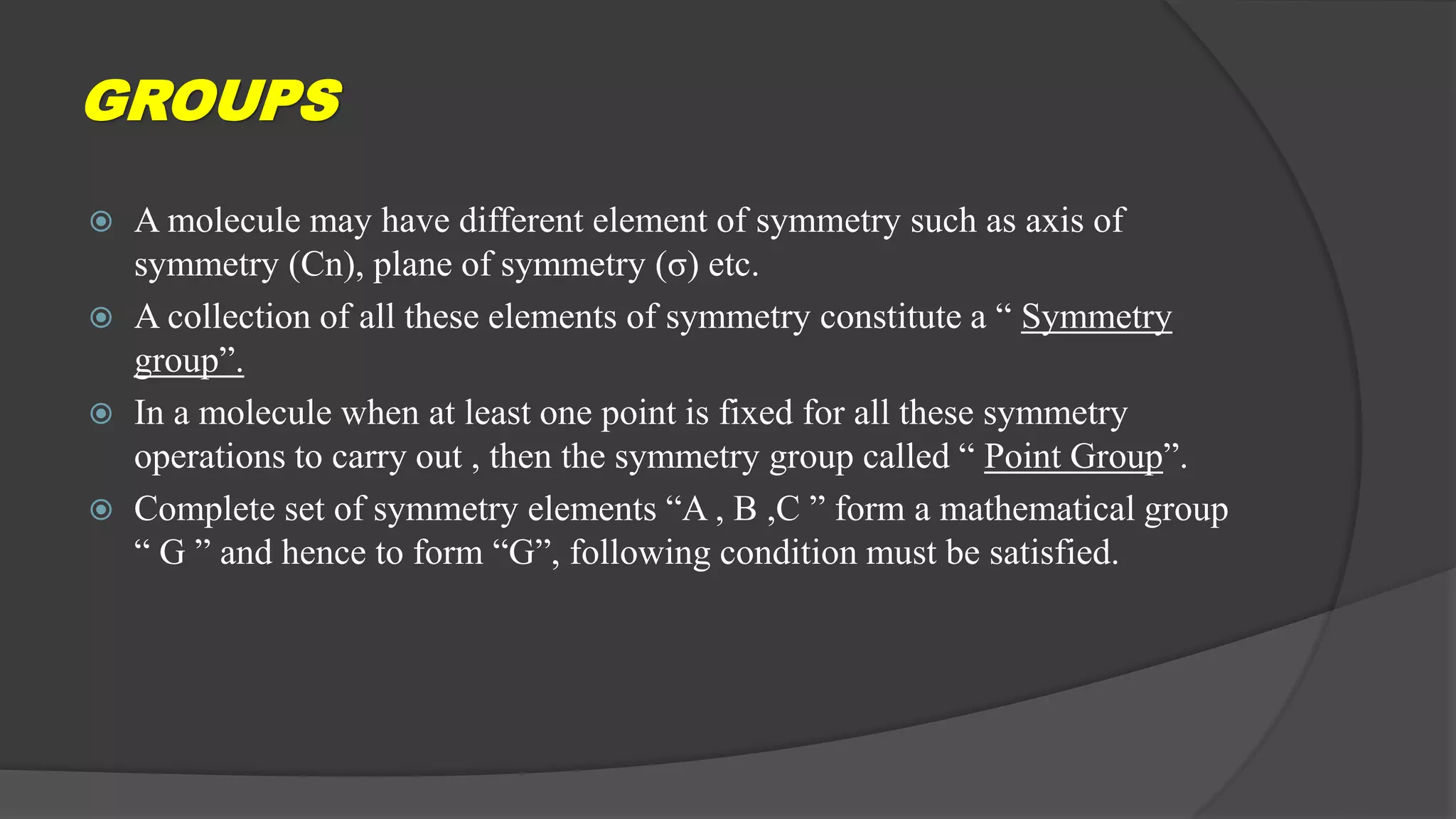
 A molecule may have different element of symmetry such as axis of
symmetry (Cn), plane of symmetry (σ) etc.
 A collection of all these elements of symmetry constitute a “ Symmetry
group”.
 In a molecule when at least one point is fixed for all these symmetry
operations to carry out , then the symmetry group called “ Point Group”.
 Complete set of symmetry elements “A , B ,C ” form a mathematical group
“ G ” and hence to form “G”, following condition must be satisfied.
1.Two elements in a group (A&B) combines to form a third element called C and this
C belongs to the element of group .
A.B=C
2 An element combine itself to form the another element of group.
i.e A.A =E (exception)
A.A = B ( another element of group )
3. Group must contain identity element [E] which commute with other element
keeping them unchanged.
i.e. A.E =E.A = A
Similarly, B.E = E.B = B etc.
e.g . In H2O ; ( C2V)⇒ E.C2 = C2 =C2.E
4. Every element of group “Associative law of combinations”.
A(BC) =( AB)C
e.g . In H2O ; ( C2V)⇒ E (C2.σv) = (E.C2)σv = σ’v
5.For every A in group ,there is A⁻¹ exist and when both are carried
out in succession , the resultant effect is identify transformation.
AA⁻¹=A⁻¹A=E
 Order of Group( h ) :
 It is a total no. of element in group .
SUB – GROUPS
 Among the operations that constitute a point group , there
generally exist smaller sets that also obey 4- requirements of a
group .
 The smaller sets which are groups in their own right , can be
considered as sub – groups of larger group. From which the
elements were carried .
 Group ⇒ h ( order) & sub – group ⇒ g(order )
then ‘g’ must be deviser of ‘h’
i.e h/g = k = Some integral
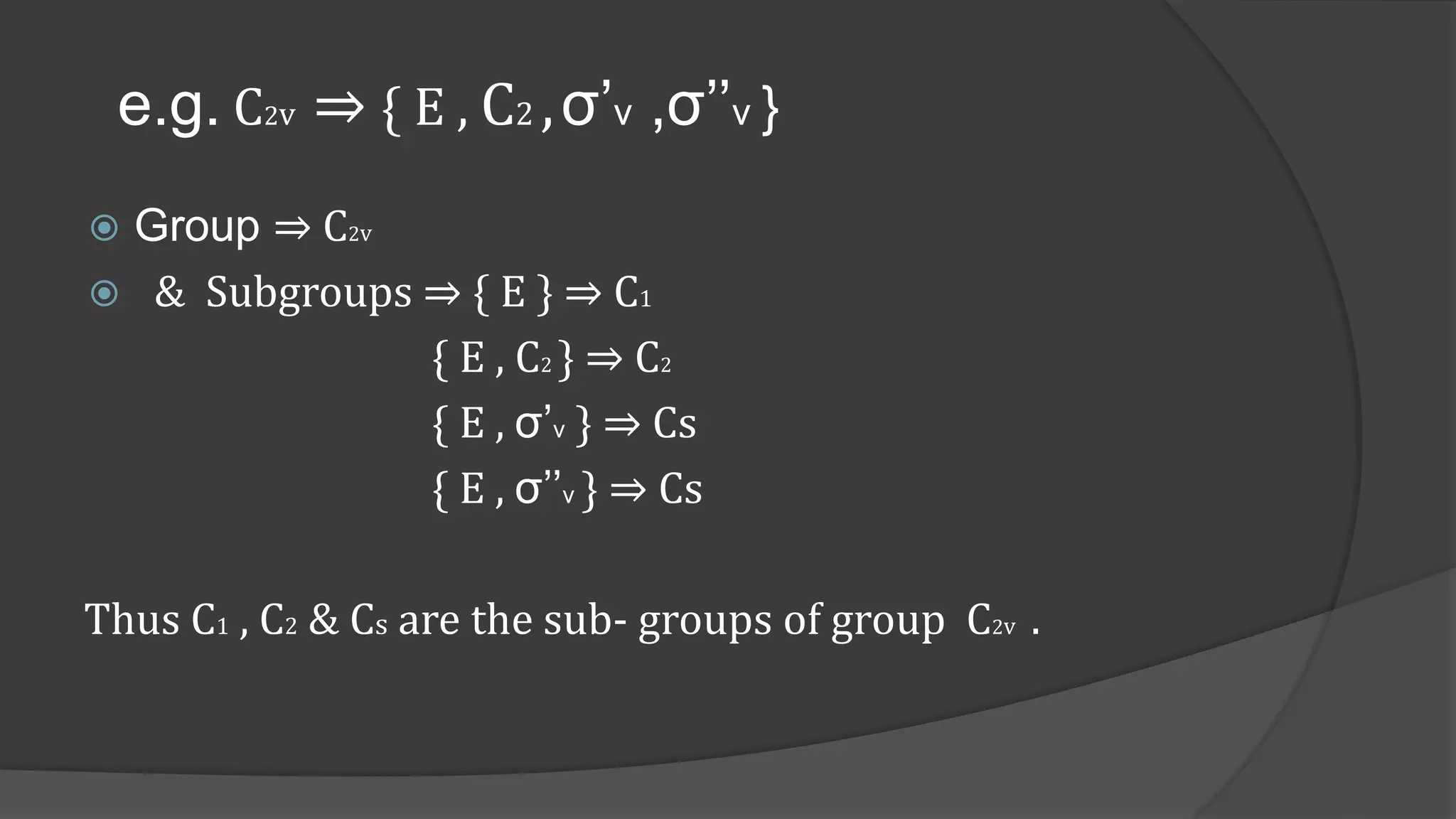
e.g. C2v ⇒ { E , C2 ,σ’v ,σ’’v }
 Group ⇒ C2v
 & Subgroups ⇒ { E } ⇒ C1
{ E , C2 } ⇒ C2
{ E , σ’v } ⇒ Cs
{ E , σ’’v } ⇒ Cs
Thus C1 , C2 & Cs are the sub- groups of group C2v .
CLASSES OF SYMMETRY OPERATIONS
 “ A set of elements in a group which are conjugate to one
another is said to form a class”.
 Two elements say A & B in a group forms a class if they are
conjugate and they are related as follows ;
 X⁻¹AX = B
 Where ; x = another element of group .
 E.g. Similarity transformation of C2 operation of H2O molecule
with all other operations .
C2V – { E , C2, σv , σ’v}
Table : E ⁻¹C2E= C2 ;
(C2) ⁻¹C2 (C2)=C2
(σv ) ⁻¹ C2 (σv )=C2
(σ’v) ⁻¹C2 σ’v = C2
Since E ⁻¹.E = (C2) ⁻¹.C2= (σv ) ⁻¹(σv )= (σ’v) ⁻¹ σ’v =E
&E.C2=C2
From this we can say that ,
• C2 belongs to seperate class since similarity
transformation of C2 with all separation generates C2
 Asymmetry operation which commute with all
symmetry operation belong to separate class. Hence in
Abelian group every symmetry operation belongs to
separate class .
GROUP MULTIPLICATION TABLE
 A multiplication table is an array showing the result of applying a
binary operation to the element of the given set .
Thus the table that reveals the relation between the elements of a
group and hence called “ Group Multiplication Table” .
 E.g 1. H2O belongs to (C2v) point group with E , C2 , σv
& σ’v as the symmetry elements .
C2v
C2v E C2 σv σ’v
E E C2 σv σ’v
C2 C2 E σ’v σv
σv σv σ’v E C2
σ’v σ’v σv C2 E
σv(xz) σv(yz)
C3v
C3V E C3¹ C3² σv σ’v σ’’v
E E C3¹ C3² σv σ’v σ’’v
C3¹ C3¹ C3² E σ’v σ’’v σv
C3² C3² E C3¹ σ’’v σv σ’v
σv σv σv σ’v E C3² C3¹
σ’v σ’v σ’v σ’’v C3¹ E C3²
σ’’v σ’’v σ’’v σv C3² C3¹ E
Abelian & Non –Abelian Point Group
 Definition : In mathematics of group , any group in which
all combinations of elements commute. This group is said
to be “ Abelian Group”.
 By associavity : The associative law of combination is valid
for combinations of elements of the group .
Thus , for example in C2v(H2O) ⇒ { E , C2 ,σ’v ,σ’’v }
 Account to commutation an associative law :
C2v ⇒ C2 (σ’v.σ’’v )=(C2 .σ’v) σ’’v
If the product two elements or operations of point groups is not commutative
then point group is called Non – Abelian Point group .
i.e. AB ≠ BA
E.g. NH3 ⇒ C3V = { E , C3 , C3², σv , σ’v , σ’’v }
 σv.C3²≠C3².σv
Point group
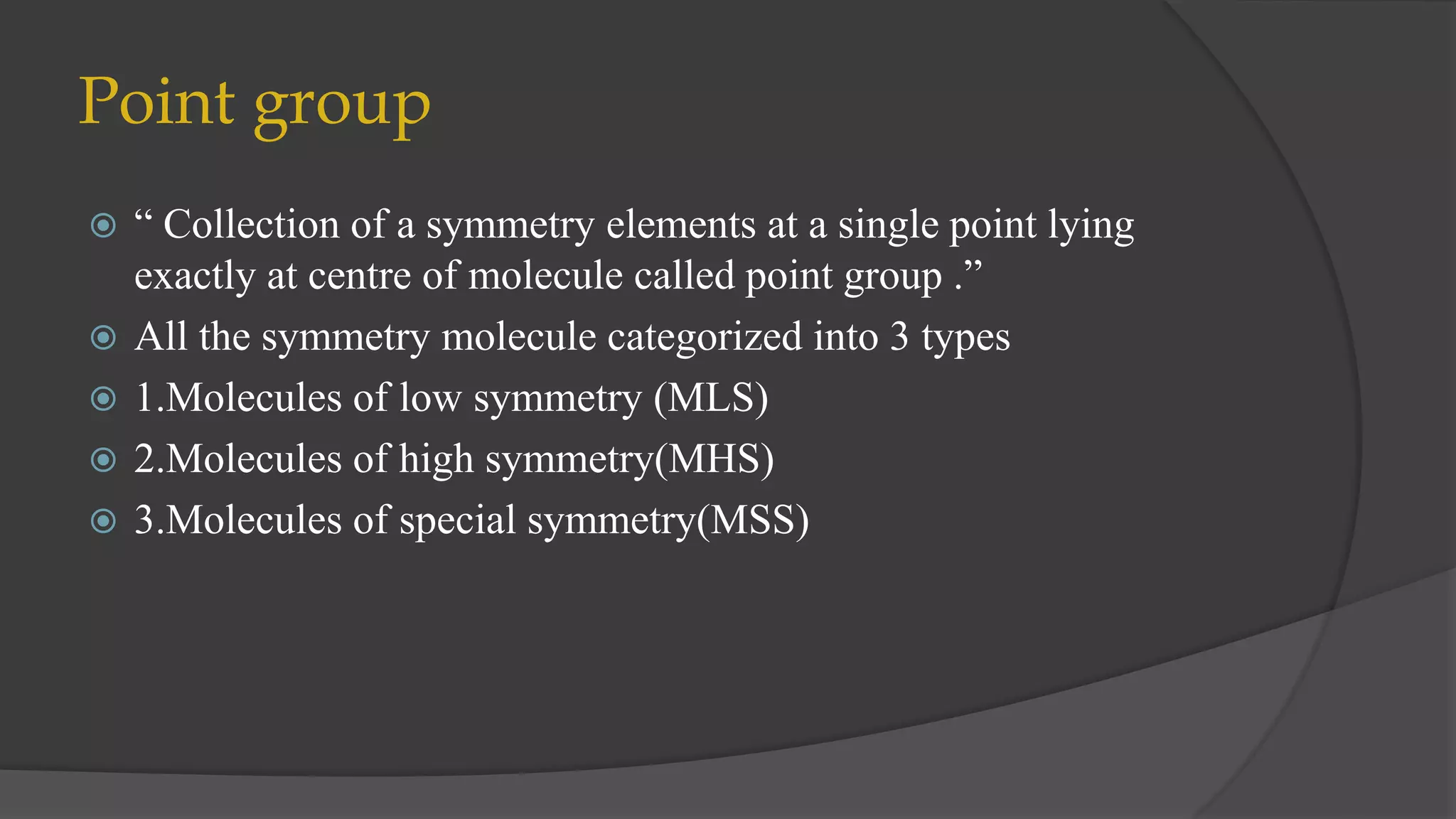
 “ Collection of a symmetry elements at a single point lying
exactly at centre of molecule called point group .”
 All the symmetry molecule categorized into 3 types
 1.Molecules of low symmetry (MLS)
 2.Molecules of high symmetry(MHS)
 3.Molecules of special symmetry(MSS)
1.Molecules of low symmetry (MLS)
I. C1 ⇒ e.g. CHFClBr
II. Cs ⇒ e.g. SOCl2 , Phenol
III. Ci ⇒ e.g. Trans-CHFCl - CHFCl
REFERENCES
 Principle of Physical Chemistry, Puri, Sharma,
Pathania.
 Inorganic Chemistry: Principle and Structure, Huheey
and Keiter.
THANK YOU
 I express my sincere thanks to all
my professors, seniors and my
parents.

group thoery and character table

  • 1.
    SEMINAR ON GROUP MULTIPLICATIONTABLES & ABELIAN , NON-ABELIAN POINT GROUPS BY MISS. NEHA MILIND DHANSEKAR MSc I ANALYTICAL CHEMISTRY THE INSTITUTE OF SCIENCE 15, MADAM CAMA RAOD.
  • 2.
    CONTENTS Concept of groups Sub– group Classes of Symmetry Operations Group Multiplication table Abelian & Non Abelian Point Group Point group
  • 3.
    QUESTIONS  Explain abelianand non-abelian point group using suitable example for each. [4 marks ] { nov’ 17 ; june 18 }  Define subgroup . Give its characteristic [ 3 marks ] { June 18 }
  • 4.
    GROUPS  A moleculemay have different element of symmetry such as axis of symmetry (Cn), plane of symmetry (σ) etc.  A collection of all these elements of symmetry constitute a “ Symmetry group”.  In a molecule when at least one point is fixed for all these symmetry operations to carry out , then the symmetry group called “ Point Group”.  Complete set of symmetry elements “A , B ,C ” form a mathematical group “ G ” and hence to form “G”, following condition must be satisfied.
  • 5.
    1.Two elements ina group (A&B) combines to form a third element called C and this C belongs to the element of group . A.B=C 2 An element combine itself to form the another element of group. i.e A.A =E (exception) A.A = B ( another element of group ) 3. Group must contain identity element [E] which commute with other element keeping them unchanged. i.e. A.E =E.A = A Similarly, B.E = E.B = B etc. e.g . In H2O ; ( C2V)⇒ E.C2 = C2 =C2.E 4. Every element of group “Associative law of combinations”. A(BC) =( AB)C e.g . In H2O ; ( C2V)⇒ E (C2.σv) = (E.C2)σv = σ’v
  • 6.
    5.For every Ain group ,there is A⁻¹ exist and when both are carried out in succession , the resultant effect is identify transformation. AA⁻¹=A⁻¹A=E  Order of Group( h ) :  It is a total no. of element in group .
  • 7.
    SUB – GROUPS Among the operations that constitute a point group , there generally exist smaller sets that also obey 4- requirements of a group .  The smaller sets which are groups in their own right , can be considered as sub – groups of larger group. From which the elements were carried .  Group ⇒ h ( order) & sub – group ⇒ g(order ) then ‘g’ must be deviser of ‘h’ i.e h/g = k = Some integral
  • 8.
    e.g. C2v ⇒{ E , C2 ,σ’v ,σ’’v }  Group ⇒ C2v  & Subgroups ⇒ { E } ⇒ C1 { E , C2 } ⇒ C2 { E , σ’v } ⇒ Cs { E , σ’’v } ⇒ Cs Thus C1 , C2 & Cs are the sub- groups of group C2v .
  • 9.
    CLASSES OF SYMMETRYOPERATIONS  “ A set of elements in a group which are conjugate to one another is said to form a class”.  Two elements say A & B in a group forms a class if they are conjugate and they are related as follows ;  X⁻¹AX = B  Where ; x = another element of group .  E.g. Similarity transformation of C2 operation of H2O molecule with all other operations .
  • 10.
    C2V – {E , C2, σv , σ’v} Table : E ⁻¹C2E= C2 ; (C2) ⁻¹C2 (C2)=C2 (σv ) ⁻¹ C2 (σv )=C2 (σ’v) ⁻¹C2 σ’v = C2 Since E ⁻¹.E = (C2) ⁻¹.C2= (σv ) ⁻¹(σv )= (σ’v) ⁻¹ σ’v =E &E.C2=C2 From this we can say that ,
  • 11.
    • C2 belongsto seperate class since similarity transformation of C2 with all separation generates C2  Asymmetry operation which commute with all symmetry operation belong to separate class. Hence in Abelian group every symmetry operation belongs to separate class .
  • 12.
    GROUP MULTIPLICATION TABLE A multiplication table is an array showing the result of applying a binary operation to the element of the given set . Thus the table that reveals the relation between the elements of a group and hence called “ Group Multiplication Table” .  E.g 1. H2O belongs to (C2v) point group with E , C2 , σv & σ’v as the symmetry elements .
  • 13.
    C2v C2v E C2σv σ’v E E C2 σv σ’v C2 C2 E σ’v σv σv σv σ’v E C2 σ’v σ’v σv C2 E σv(xz) σv(yz)
  • 15.
    C3v C3V E C3¹C3² σv σ’v σ’’v E E C3¹ C3² σv σ’v σ’’v C3¹ C3¹ C3² E σ’v σ’’v σv C3² C3² E C3¹ σ’’v σv σ’v σv σv σv σ’v E C3² C3¹ σ’v σ’v σ’v σ’’v C3¹ E C3² σ’’v σ’’v σ’’v σv C3² C3¹ E
  • 16.
    Abelian & Non–Abelian Point Group  Definition : In mathematics of group , any group in which all combinations of elements commute. This group is said to be “ Abelian Group”.  By associavity : The associative law of combination is valid for combinations of elements of the group . Thus , for example in C2v(H2O) ⇒ { E , C2 ,σ’v ,σ’’v }  Account to commutation an associative law : C2v ⇒ C2 (σ’v.σ’’v )=(C2 .σ’v) σ’’v
  • 17.
    If the producttwo elements or operations of point groups is not commutative then point group is called Non – Abelian Point group . i.e. AB ≠ BA E.g. NH3 ⇒ C3V = { E , C3 , C3², σv , σ’v , σ’’v }  σv.C3²≠C3².σv
  • 18.
    Point group  “Collection of a symmetry elements at a single point lying exactly at centre of molecule called point group .”  All the symmetry molecule categorized into 3 types  1.Molecules of low symmetry (MLS)  2.Molecules of high symmetry(MHS)  3.Molecules of special symmetry(MSS)
  • 20.
    1.Molecules of lowsymmetry (MLS) I. C1 ⇒ e.g. CHFClBr II. Cs ⇒ e.g. SOCl2 , Phenol III. Ci ⇒ e.g. Trans-CHFCl - CHFCl
  • 21.
    REFERENCES  Principle ofPhysical Chemistry, Puri, Sharma, Pathania.  Inorganic Chemistry: Principle and Structure, Huheey and Keiter.
  • 22.
    THANK YOU  Iexpress my sincere thanks to all my professors, seniors and my parents.