ZIEGLER-NATTA
CATALYST
PRESENTED BY:
LISAMONI KALITA
M.SC 2ND SEM
ID: BS14MC0229
DEPT. OF CHEMISTRY
ASSAM KAZIRANGA UNIVERSITY
1
Table of Contents
 Introduction
 Brief History of Ziegler Natta Catalyst
 Mechanism of Ziegler Natta Polymerization
 Importance of Ziegler Natta Catalyst
 Applications of Ziegler Natta Catalyst
 Conclusion
 Reference
2
Introduction
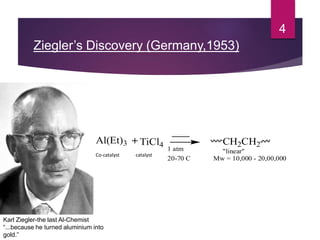
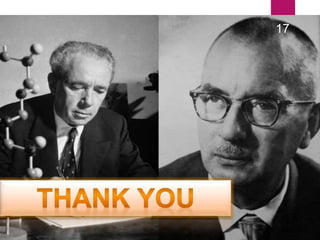
 Karl Ziegler in 1953 polymerized ethylene catalytically to polyethylene.
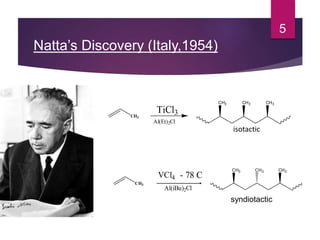
 Giulio Natta utilized Ziegler's catalyst to produce polypropylene in 1954.
 In 1963, both Karl Ziegler and Giulio Natta were awarded the Nobel Prize for their
discoveries.
 In 1973 the 2nd generation Ziegler-Natta catalysts were introduced with β-TiCl3 at lower
temperatures.
 In 1980 3rd generation catalysts supported on MgCl2 were commercialized by many
companies.
 In 1991 4th generation Ziegler-Natta catalysts based on aluminoxane activated metallocene
complexes were used.
 Two broad classes:
 Heterogeneous Catalyst: Based on Ti compounds
 Homogeneous Catalyst: Based on complexes of Ti, Zr and Hf
3
Ziegler’s Discovery (Germany,1953)
4
Co-catalyst catalyst
Karl Ziegler-the last Al-Chemist
“...because he turned aluminium into
gold.”
TiCl4
1 atm
20-70 C
Al(Et)3 + CH2CH2
"linear"
Mw = 10,000 - 20,00,000
Natta’s Discovery (Italy,1954)
5
isotactic
syndiotactic
CH3
VCl4
Al(iBu)2Cl
- 78 C
CH3CH3 CH3
CH3CH3 CH3
CH3
TiCl3
Al(Et)2Cl
Mechanism of Ziegler-Natta
Polymerization: The Cossee Mechanism
6
Ti
CH2
Polymer
Catalyst accepts
ethylene as a
ligand
1,2- Migratory
insertion [Ethyl
migration]
Ti CH2CH3
H2C CH2
ligand
association
Ti CH2CH2
CH2H2C
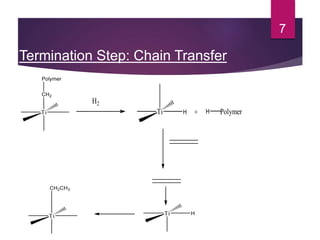
Termination Step: Chain Transfer
7
Ti H
H2
PolymerH+
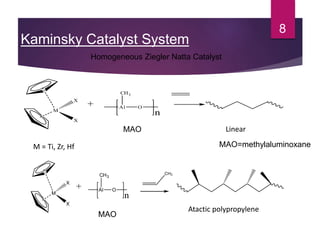
Kaminsky Catalyst System
8
M = Ti, Zr, Hf
Linear
Atactic polypropylene
M
X
X
+ Al O
CH3
n
M
X
X
+ Al O
CH3
n
CH3
MAO
MAO
MAO=methylaluminoxane
Homogeneous Ziegler Natta Catalyst
Brintzinger System
9
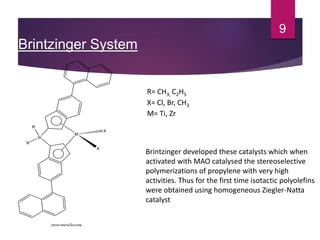
Brintzinger developed these catalysts which when
activated with MAO catalysed the stereoselective
polymerizations of propylene with very high
activities. Thus for the first time isotactic polyolefins
were obtained using homogeneous Ziegler-Natta
catalyst
Si
R
R
M
X
X
ansa-metallocene
R= CH3, C2H5
X= Cl, Br, CH3
M= Ti, Zr
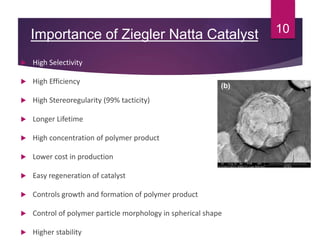
Importance of Ziegler Natta Catalyst
 High Selectivity
 High Efficiency
 High Stereoregularity (99% tacticity)
 Longer Lifetime
 High concentration of polymer product
 Lower cost in production
 Easy regeneration of catalyst
 Controls growth and formation of polymer product
 Control of polymer particle morphology in spherical shape
 Higher stability
10
Example:
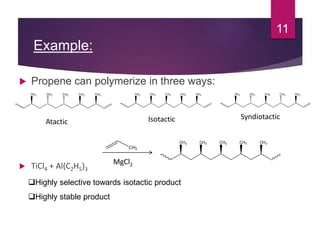
 Propene can polymerize in three ways:
 TiCl4 + Al(C2H5)3
11
CH3
Highly selective towards isotactic product
Highly stable product
CH3CH3 CH3 CH3 CH3 CH3CH3 CH3 CH3 CH3
CH3CH3 CH3 CH3 CH3
CH3CH3 CH3 CH3 CH3
Atactic Isotactic Syndiotactic
MgCl2
Applications of Ziegler-Natta Catalyst
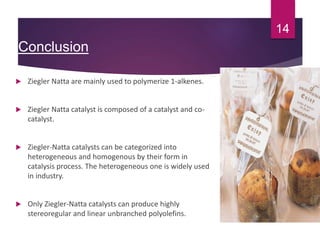
Production of:
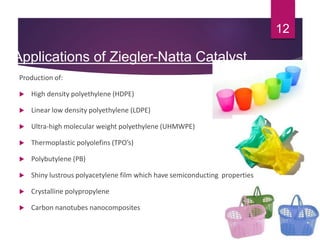
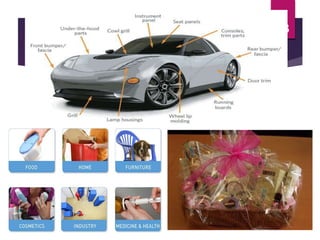
 High density polyethylene (HDPE)
 Linear low density polyethylene (LDPE)
 Ultra-high molecular weight polyethylene (UHMWPE)
 Thermoplastic polyolefins (TPO’s)
 Polybutylene (PB)
 Shiny lustrous polyacetylene film which have semiconducting properties
 Crystalline polypropylene
 Carbon nanotubes nanocomposites
12
13
Conclusion
 Ziegler Natta are mainly used to polymerize 1-alkenes.
 Ziegler Natta catalyst is composed of a catalyst and co-
catalyst.
 Ziegler-Natta catalysts can be categorized into
heterogeneous and homogenous by their form in
catalysis process. The heterogeneous one is widely used
in industry.
 Only Ziegler-Natta catalysts can produce highly
stereoregular and linear unbranched polyolefins.
14
References
 Pokasermsong P. and Praserthdam P.; Comparison of Activity Of Ziegler-Natta
Catalysts; Engineering Journal; Vol. 13; 2009; 57
 Ahmad A.; Propylene Polymerization Using 4th Generation Ziegler-Natta Catalysts:
Polymerization Kinetics and Polymer Microstructural Investigation; A thesis
presented to the University of Waterloo; 2011
 Cerruti L.; Historical and Philosophical Remarks on Ziegler-Natta Catalysts; HYLE –
An International Journal for the Philosophy of Chemistry; Vol. 5; 1999; 3.
 Bajgur C. S. and Sivaram S.; The evolution of new generation ‘single-site’ Ziegler–
Natta polymerization catalysts; Current Science; Vol. 78; 2000; 1325
 Busico V., Cipullo R., Pellecchia R., Ronca S., Roviello G., and Talarico G.; Design of
stereoselective Ziegler–Natta propene polymerization catalysts; PNAS; vol. 103;
2006; 15321
15
References Contd.
 Lewin M.; Handbook of Fiber Chemistry; CRC Press; Third Edition; ISBN 1420015273
 Gross E., Liu J. H, Toste F. D. and Somorjai G. A.; Control of selectivity in heterogeneous
catalysis by tuning nanoparticle properties and reactor residence time; Nature
Chemistry ; Vol. 4; 2012; 947
 Clayden J., Greeves N. and Warren S.; Organic Chemistry; Oxford; Second Edition; ISBN
978-0-19-927029-3
 Gupta B. D., Elias A. J.; Basic Organometallic Chemistry Concepts, Syntheses and
Applications; University Press; Second Edition; ISBN 978-81-7371-874-8
 Ramakrishnan S; Conducting Polymers; RESONANCE ; Vol.2; 2011; 48
 http://en.wikipedia.org/wiki/Ziegler%E2%93Natta_catalyst
 http://www.chemheritage.org/discover/online-resources/chemistry-in-
history/themes/petrochemistry-and-synthetic-polymers/ziegler-and-natta.aspx
16
17

Ziegler natta catalyst

  • 1.
    ZIEGLER-NATTA CATALYST PRESENTED BY: LISAMONI KALITA M.SC2ND SEM ID: BS14MC0229 DEPT. OF CHEMISTRY ASSAM KAZIRANGA UNIVERSITY 1
  • 2.
    Table of Contents Introduction  Brief History of Ziegler Natta Catalyst  Mechanism of Ziegler Natta Polymerization  Importance of Ziegler Natta Catalyst  Applications of Ziegler Natta Catalyst  Conclusion  Reference 2
  • 3.
    Introduction  Karl Zieglerin 1953 polymerized ethylene catalytically to polyethylene.  Giulio Natta utilized Ziegler's catalyst to produce polypropylene in 1954.  In 1963, both Karl Ziegler and Giulio Natta were awarded the Nobel Prize for their discoveries.  In 1973 the 2nd generation Ziegler-Natta catalysts were introduced with β-TiCl3 at lower temperatures.  In 1980 3rd generation catalysts supported on MgCl2 were commercialized by many companies.  In 1991 4th generation Ziegler-Natta catalysts based on aluminoxane activated metallocene complexes were used.  Two broad classes:  Heterogeneous Catalyst: Based on Ti compounds  Homogeneous Catalyst: Based on complexes of Ti, Zr and Hf 3
  • 4.
    Ziegler’s Discovery (Germany,1953) 4 Co-catalystcatalyst Karl Ziegler-the last Al-Chemist “...because he turned aluminium into gold.” TiCl4 1 atm 20-70 C Al(Et)3 + CH2CH2 "linear" Mw = 10,000 - 20,00,000
  • 5.
  • 6.
    Mechanism of Ziegler-Natta Polymerization:The Cossee Mechanism 6 Ti CH2 Polymer Catalyst accepts ethylene as a ligand 1,2- Migratory insertion [Ethyl migration] Ti CH2CH3 H2C CH2 ligand association Ti CH2CH2 CH2H2C
  • 7.
    Termination Step: ChainTransfer 7 Ti H H2 PolymerH+
  • 8.
    Kaminsky Catalyst System 8 M= Ti, Zr, Hf Linear Atactic polypropylene M X X + Al O CH3 n M X X + Al O CH3 n CH3 MAO MAO MAO=methylaluminoxane Homogeneous Ziegler Natta Catalyst
  • 9.
    Brintzinger System 9 Brintzinger developedthese catalysts which when activated with MAO catalysed the stereoselective polymerizations of propylene with very high activities. Thus for the first time isotactic polyolefins were obtained using homogeneous Ziegler-Natta catalyst Si R R M X X ansa-metallocene R= CH3, C2H5 X= Cl, Br, CH3 M= Ti, Zr
  • 10.
    Importance of ZieglerNatta Catalyst  High Selectivity  High Efficiency  High Stereoregularity (99% tacticity)  Longer Lifetime  High concentration of polymer product  Lower cost in production  Easy regeneration of catalyst  Controls growth and formation of polymer product  Control of polymer particle morphology in spherical shape  Higher stability 10
  • 11.
    Example:  Propene canpolymerize in three ways:  TiCl4 + Al(C2H5)3 11 CH3 Highly selective towards isotactic product Highly stable product CH3CH3 CH3 CH3 CH3 CH3CH3 CH3 CH3 CH3 CH3CH3 CH3 CH3 CH3 CH3CH3 CH3 CH3 CH3 Atactic Isotactic Syndiotactic MgCl2
  • 12.
    Applications of Ziegler-NattaCatalyst Production of:  High density polyethylene (HDPE)  Linear low density polyethylene (LDPE)  Ultra-high molecular weight polyethylene (UHMWPE)  Thermoplastic polyolefins (TPO’s)  Polybutylene (PB)  Shiny lustrous polyacetylene film which have semiconducting properties  Crystalline polypropylene  Carbon nanotubes nanocomposites 12
  • 13.
  • 14.
    Conclusion  Ziegler Nattaare mainly used to polymerize 1-alkenes.  Ziegler Natta catalyst is composed of a catalyst and co- catalyst.  Ziegler-Natta catalysts can be categorized into heterogeneous and homogenous by their form in catalysis process. The heterogeneous one is widely used in industry.  Only Ziegler-Natta catalysts can produce highly stereoregular and linear unbranched polyolefins. 14
  • 15.
    References  Pokasermsong P.and Praserthdam P.; Comparison of Activity Of Ziegler-Natta Catalysts; Engineering Journal; Vol. 13; 2009; 57  Ahmad A.; Propylene Polymerization Using 4th Generation Ziegler-Natta Catalysts: Polymerization Kinetics and Polymer Microstructural Investigation; A thesis presented to the University of Waterloo; 2011  Cerruti L.; Historical and Philosophical Remarks on Ziegler-Natta Catalysts; HYLE – An International Journal for the Philosophy of Chemistry; Vol. 5; 1999; 3.  Bajgur C. S. and Sivaram S.; The evolution of new generation ‘single-site’ Ziegler– Natta polymerization catalysts; Current Science; Vol. 78; 2000; 1325  Busico V., Cipullo R., Pellecchia R., Ronca S., Roviello G., and Talarico G.; Design of stereoselective Ziegler–Natta propene polymerization catalysts; PNAS; vol. 103; 2006; 15321 15
  • 16.
    References Contd.  LewinM.; Handbook of Fiber Chemistry; CRC Press; Third Edition; ISBN 1420015273  Gross E., Liu J. H, Toste F. D. and Somorjai G. A.; Control of selectivity in heterogeneous catalysis by tuning nanoparticle properties and reactor residence time; Nature Chemistry ; Vol. 4; 2012; 947  Clayden J., Greeves N. and Warren S.; Organic Chemistry; Oxford; Second Edition; ISBN 978-0-19-927029-3  Gupta B. D., Elias A. J.; Basic Organometallic Chemistry Concepts, Syntheses and Applications; University Press; Second Edition; ISBN 978-81-7371-874-8  Ramakrishnan S; Conducting Polymers; RESONANCE ; Vol.2; 2011; 48  http://en.wikipedia.org/wiki/Ziegler%E2%93Natta_catalyst  http://www.chemheritage.org/discover/online-resources/chemistry-in- history/themes/petrochemistry-and-synthetic-polymers/ziegler-and-natta.aspx 16
  • 17.