PHASE RULE
Prof. H. K. Khaira
Professor in MSME Deptt.
MANIT, Bhopal
The Phase Diagram
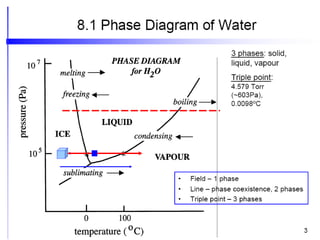
• Phase diagram: shows the regions of
pressure and temperature at which its
various phases are thermodynamically
stable.
• Phase boundary: a boundary between
regions, shows the values of P and T at
which two phases coexist in equilibrium.
The Gibbs Phase Rule
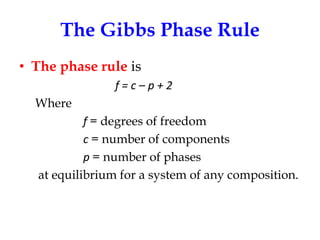
• The phase rule is
f=c–p+2
Where
f = degrees of freedom
c = number of components
p = number of phases
at equilibrium for a system of any composition.
The Gibbs Phase Rule
• Degree of freedom (f): It is the number of external
variables that can be changed independently
without disturbing the number of phases in
equilibrium. These are pressure, temperature and
composition.
• Component: a chemically independent constituent
of a system
• number of components (c): the minimum number
of independent species necessary to define the
composition of all the phase present in the system
• Phase: a state of matter that is uniform throughout
in chemical composition and physical state.
The Phase Rule
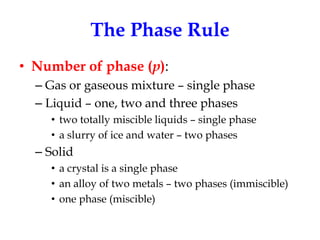
• Number of phase (p):
– Gas or gaseous mixture – single phase
– Liquid – one, two and three phases
• two totally miscible liquids – single phase
• a slurry of ice and water – two phases

– Solid
• a crystal is a single phase
• an alloy of two metals – two phases (immiscible)
• one phase (miscible)
Chapter 7

The Phase Rule
(a)

(b)

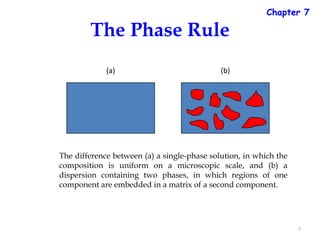
The difference between (a) a single-phase solution, in which the
composition is uniform on a microscopic scale, and (b) a
dispersion containing two phases, in which regions of one
component are embedded in a matrix of a second component.

7
Examples of Two Phases
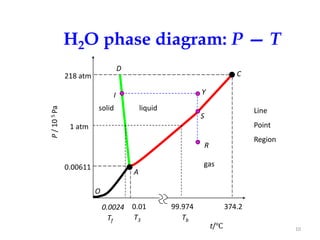
H2O phase diagram: P — T
D

218 atm

C
Y

P / 10 5 Pa

I
solid

liquid

Line

S

Point

1 atm

Region

R
0.00611

gas
A
O
0.0024 0.01
T3
Tf

99.974
Tb

374.2
t/℃

10
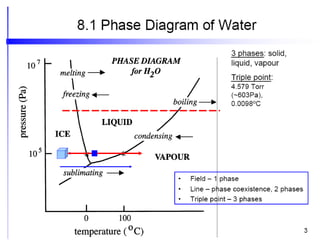
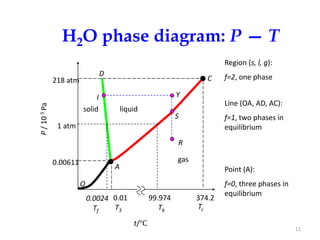
H2O phase diagram: P — T
Region (s, l, g):
D

P / 10 5 Pa

218 atm

C

f=2, one phase

Y

I
solid

Line (OA, AD, AC):

liquid

S

f=1, two phases in
equilibrium

1 atm
R
0.00611

gas

A

Point (A):

O
0.0024 0.01
T3
Tf

99.974
Tb
t/℃

374.2
Tc

f=0, three phases in
equilibrium

11
Simple Example
Chapter 7

Physical Chemistry

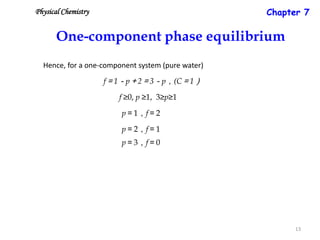
One-component phase equilibrium
Hence, for a one-component system (pure water)

f=1-p+2=3-p,(C=1)
f ≥0, p ≥1, 3≥p≥1
p=1,f=2
p=2,f=1
p=3,f=0

13
Phase Rule in Metallurgical Systems
• But in case of metallurgical systems, the
pressure is kept constant.
• Hence the Phase Rule gets modified to
F=C–P+1

Phase rule

  • 1.
    PHASE RULE Prof. H.K. Khaira Professor in MSME Deptt. MANIT, Bhopal
  • 2.
    The Phase Diagram •Phase diagram: shows the regions of pressure and temperature at which its various phases are thermodynamically stable. • Phase boundary: a boundary between regions, shows the values of P and T at which two phases coexist in equilibrium.
  • 4.
    The Gibbs PhaseRule • The phase rule is f=c–p+2 Where f = degrees of freedom c = number of components p = number of phases at equilibrium for a system of any composition.
  • 5.
    The Gibbs PhaseRule • Degree of freedom (f): It is the number of external variables that can be changed independently without disturbing the number of phases in equilibrium. These are pressure, temperature and composition. • Component: a chemically independent constituent of a system • number of components (c): the minimum number of independent species necessary to define the composition of all the phase present in the system • Phase: a state of matter that is uniform throughout in chemical composition and physical state.
  • 6.
    The Phase Rule •Number of phase (p): – Gas or gaseous mixture – single phase – Liquid – one, two and three phases • two totally miscible liquids – single phase • a slurry of ice and water – two phases – Solid • a crystal is a single phase • an alloy of two metals – two phases (immiscible) • one phase (miscible)
  • 7.
    Chapter 7 The PhaseRule (a) (b) The difference between (a) a single-phase solution, in which the composition is uniform on a microscopic scale, and (b) a dispersion containing two phases, in which regions of one component are embedded in a matrix of a second component. 7
  • 8.
  • 10.
    H2O phase diagram:P — T D 218 atm C Y P / 10 5 Pa I solid liquid Line S Point 1 atm Region R 0.00611 gas A O 0.0024 0.01 T3 Tf 99.974 Tb 374.2 t/℃ 10
  • 11.
    H2O phase diagram:P — T Region (s, l, g): D P / 10 5 Pa 218 atm C f=2, one phase Y I solid Line (OA, AD, AC): liquid S f=1, two phases in equilibrium 1 atm R 0.00611 gas A Point (A): O 0.0024 0.01 T3 Tf 99.974 Tb t/℃ 374.2 Tc f=0, three phases in equilibrium 11
  • 12.
  • 13.
    Chapter 7 Physical Chemistry One-componentphase equilibrium Hence, for a one-component system (pure water) f=1-p+2=3-p,(C=1) f ≥0, p ≥1, 3≥p≥1 p=1,f=2 p=2,f=1 p=3,f=0 13
  • 14.
    Phase Rule inMetallurgical Systems • But in case of metallurgical systems, the pressure is kept constant. • Hence the Phase Rule gets modified to F=C–P+1