Phase Rule And It’s
Applications.
SUBMITTED BY: PRAJAKTA PANDA
REGD. NO. 190704180001
B.SC. BIOCHEMISTRY 3RD SEMESTER
CUTM 1475 (PHASE EQUILIBRIUM AND CHEMICAL KINETICS)
BBSR CAMPUS
CONTENTS:
 PHASE OF A SYSTEM
 COMPONENTS OF A SYSTEM
 DEGREES OF FREEDOM
 GIBBS PHASE RULE
 APPLICATIONS OF PHASE RULE
 IT‘S ADVANTAGES
 IT‘S LIMITATIONS
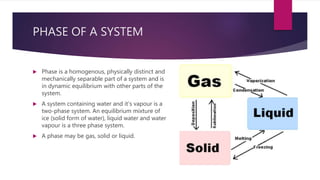
PHASE OF A SYSTEM
 Phase is a homogenous, physically distinct and
mechanically separable part of a system and is
in dynamic equilibrium with other parts of the
system.
 A system containing water and it’s vapour is a
two-phase system. An equilibrium mixture of
ice (solid form of water), liquid water and water
vapour is a three phase system.
 A phase may be gas, solid or liquid.
COMPONENTS OF A SYSTEM
 Component is “the smallest number of independent variable constituents,
taking part in state of equilibrium, by mean of which the composition of each
phase can be expressed in the form of chemical equation”.
 C= N – E, where, C= No. of components
N= No. Of constituents present in a system
E= relation between them
 In the water system, the chemical composition of all the three phases is H2O.
Hence, it is one component system.
 The sulphur system consists of four phases, rhombic, monoclinic, liquid and
vapour, the chemical composition of all phases is S. Hence, it is one
component system.
DEGREE OF FREEDOM
 The minimum number of independently variable factors, such as temperature, pressure and
composition of the phases, which must be arbitrarily specified in order to represent perfectly the
condition of a system is known as the degree of freedom of a system.
 In case of water system, three phases are present in equilibrium, then no condition need to be
specified, as the three phases can be in equilibrium only at particular temperature and pressure.
If condition (e.g. Temperature or pressure) is altered, three phases will not remain in equilibrium
and one of the phase disappears.
 For a system consisting of water in contact with its vapour, we must state either the temperature
or pressure to define it completely. Hence, degree of freedom is one or system is univariant.
 For a system consisting of water vapour phase only, we must the values of both the temperature
and pressure in order to describe the system completely. Hence, the system is bivariant or has
two degrees of freedom.
GIBBS PHASE RULE
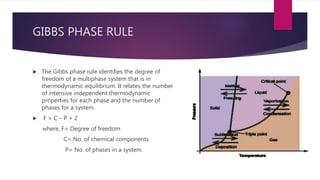
 The Gibbs phase rule identifies the degree of
freedom of a multiphase system that is in
thermodynamic equilibrium. It relates the number
of intensive independent thermodynamic
properties for each phase and the number of
phases for a system.
 F = C – P + 2
where, F= Degree of freedom
C= No. of chemical components
P= No. of phases in a system
APPLICATIONS OF PHASE RULE.
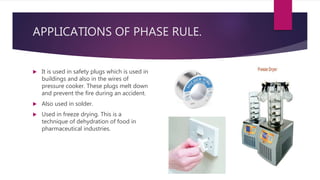
 It is used in safety plugs which is used in
buildings and also in the wires of
pressure cooker. These plugs melt down
and prevent the fire during an accident.
 Also used in solder.
 Used in freeze drying. This is a
technique of dehydration of food in
pharmaceutical industries.
ADVANTAGES OF PHASE RULE
 It is applicable to both physical and chemical equilibria.
 It require no information regarding molecular/ micro-structure, since it is applicable to macroscopic
system.
 It is a convenient method of classifying equilibrium states in terms of phases, components and
degrees of freedom.
 It helps us to predict the behaviour of a system, under different sets of variables.
 It indicates that different systems with same degree of freedom behave similarly.
 It helps in deciding whether under a given set of condition:
a. Various substances would exist together in equilibrium
b. Some of the substances present would be interconverted
c. Some of the substances present would be eliminated
LIMITATIONS OF PHASE RULE
 It can be applied only for system in equilibrium. Consequently, it is of little value in
case of very slow equilibrium state attaining system.
 It applies only to a single equilibrium system and provided no information regarding
any other possible equilibria in the system.
 It requires utmost care in deciding the number of phases existing in an equilibrium
sate, since it considers only the number of phases, rather than their amounts. Thus,
even if a trace of the phase is present, it accounts towards the total number of phases.
 It conditions that all phases of the system must be present simultaneously, under the
identical conditions of temperature and pressure.
 It conditions that solid and liquid phases must not be in finely –divided state; otherwise
deviations occurs.
THANK
YOU!

Phase rule and it's applications

  • 1.
    Phase Rule AndIt’s Applications. SUBMITTED BY: PRAJAKTA PANDA REGD. NO. 190704180001 B.SC. BIOCHEMISTRY 3RD SEMESTER CUTM 1475 (PHASE EQUILIBRIUM AND CHEMICAL KINETICS) BBSR CAMPUS
  • 2.
    CONTENTS:  PHASE OFA SYSTEM  COMPONENTS OF A SYSTEM  DEGREES OF FREEDOM  GIBBS PHASE RULE  APPLICATIONS OF PHASE RULE  IT‘S ADVANTAGES  IT‘S LIMITATIONS
  • 3.
    PHASE OF ASYSTEM  Phase is a homogenous, physically distinct and mechanically separable part of a system and is in dynamic equilibrium with other parts of the system.  A system containing water and it’s vapour is a two-phase system. An equilibrium mixture of ice (solid form of water), liquid water and water vapour is a three phase system.  A phase may be gas, solid or liquid.
  • 4.
    COMPONENTS OF ASYSTEM  Component is “the smallest number of independent variable constituents, taking part in state of equilibrium, by mean of which the composition of each phase can be expressed in the form of chemical equation”.  C= N – E, where, C= No. of components N= No. Of constituents present in a system E= relation between them  In the water system, the chemical composition of all the three phases is H2O. Hence, it is one component system.  The sulphur system consists of four phases, rhombic, monoclinic, liquid and vapour, the chemical composition of all phases is S. Hence, it is one component system.
  • 5.
    DEGREE OF FREEDOM The minimum number of independently variable factors, such as temperature, pressure and composition of the phases, which must be arbitrarily specified in order to represent perfectly the condition of a system is known as the degree of freedom of a system.  In case of water system, three phases are present in equilibrium, then no condition need to be specified, as the three phases can be in equilibrium only at particular temperature and pressure. If condition (e.g. Temperature or pressure) is altered, three phases will not remain in equilibrium and one of the phase disappears.  For a system consisting of water in contact with its vapour, we must state either the temperature or pressure to define it completely. Hence, degree of freedom is one or system is univariant.  For a system consisting of water vapour phase only, we must the values of both the temperature and pressure in order to describe the system completely. Hence, the system is bivariant or has two degrees of freedom.
  • 6.
    GIBBS PHASE RULE The Gibbs phase rule identifies the degree of freedom of a multiphase system that is in thermodynamic equilibrium. It relates the number of intensive independent thermodynamic properties for each phase and the number of phases for a system.  F = C – P + 2 where, F= Degree of freedom C= No. of chemical components P= No. of phases in a system
  • 7.
    APPLICATIONS OF PHASERULE.  It is used in safety plugs which is used in buildings and also in the wires of pressure cooker. These plugs melt down and prevent the fire during an accident.  Also used in solder.  Used in freeze drying. This is a technique of dehydration of food in pharmaceutical industries.
  • 8.
    ADVANTAGES OF PHASERULE  It is applicable to both physical and chemical equilibria.  It require no information regarding molecular/ micro-structure, since it is applicable to macroscopic system.  It is a convenient method of classifying equilibrium states in terms of phases, components and degrees of freedom.  It helps us to predict the behaviour of a system, under different sets of variables.  It indicates that different systems with same degree of freedom behave similarly.  It helps in deciding whether under a given set of condition: a. Various substances would exist together in equilibrium b. Some of the substances present would be interconverted c. Some of the substances present would be eliminated
  • 9.
    LIMITATIONS OF PHASERULE  It can be applied only for system in equilibrium. Consequently, it is of little value in case of very slow equilibrium state attaining system.  It applies only to a single equilibrium system and provided no information regarding any other possible equilibria in the system.  It requires utmost care in deciding the number of phases existing in an equilibrium sate, since it considers only the number of phases, rather than their amounts. Thus, even if a trace of the phase is present, it accounts towards the total number of phases.  It conditions that all phases of the system must be present simultaneously, under the identical conditions of temperature and pressure.  It conditions that solid and liquid phases must not be in finely –divided state; otherwise deviations occurs.
  • 10.