A PRESENTATION ON
FUGACITY
PRESENTED BY
ABRAR ABDULLAH
REG.NO. 2016332020
CONTENTS
• Introduction
• Concepts of Fugacity
• Fugacity Coefficient
• Significance of Fugacity Coefficient
• Standard State of Fugacity
• Effect of Temperature on Fugacity
• Effect of Pressure on Fugacity
INTRODUCTION
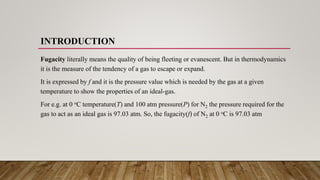
Fugacity literally means the quality of being fleeting or evanescent. But in thermodynamics
it is the measure of the tendency of a gas to escape or expand.
It is expressed by f and it is the pressure value which is needed by the gas at a given
temperature to show the properties of an ideal-gas.
For e.g. at 0 oC temperature(T) and 100 atm pressure(P) for N2 the pressure required for the
gas to act as an ideal gas is 97.03 atm. So, the fugacity(f) of N2 at 0 oC is 97.03 atm
CONCEPTS OF
FUGACITY
• The concept of Fugacity was introduced by Gilbert Newton Lewis.
• Fugacity is widely used in solution thermodynamics to represent the behavior of real
gases.
• Fugacity has been used extensively in the study of phase and chemical reaction equilibria
involving gases at high pressures.
CONCEPTS OF
FUGACITY
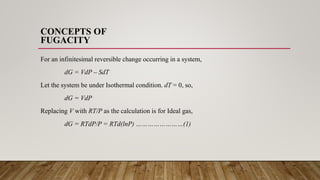
For an infinitesimal reversible change occurring in a system,
dG = VdP – SdT
Let the system be under Isothermal condition. dT = 0, so,
dG = VdP
Replacing V with RT/P as the calculation is for Ideal gas,
dG = RTdP/P = RTd(lnP) ……………………(1)
CONCEPTS OF
FUGACITY
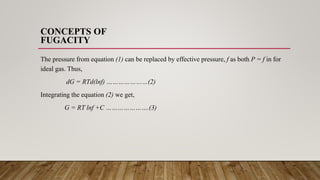
The pressure from equation (1) can be replaced by effective pressure, f as both P = f in for
ideal gas. Thus,
dG = RTd(lnf) …………………(2)
Integrating the equation (2) we get,
G = RT lnf +C ………………….(3)
FUGACITY COEFFICIENT
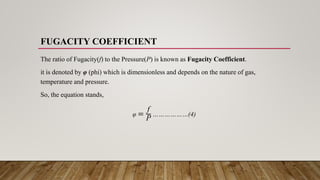
The ratio of Fugacity(f) to the Pressure(P) is known as Fugacity Coefficient.
it is denoted by φ (phi) which is dimensionless and depends on the nature of gas,
temperature and pressure.
So, the equation stands,
φ =
f
P
………………(4)
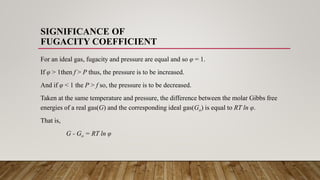
SIGNIFICANCE OF
FUGACITY COEFFICIENT
For an ideal gas, fugacity and pressure are equal and so φ = 1.
If φ > 1then f > P thus, the pressure is to be increased.
And if φ < 1 the P > f so, the pressure is to be decreased.
Taken at the same temperature and pressure, the difference between the molar Gibbs free
energies of a real gas(G) and the corresponding ideal gas(Go) is equal to RT ln φ.
That is,
G - Go = RT ln φ
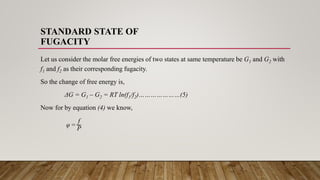
STANDARD STATE OF
FUGACITY
Let us consider the molar free energies of two states at same temperature be G1 and G2 with
f1 and f2 as their corresponding fugacity.
So the change of free energy is,
ΔG = G1 – G2 = RT ln(f1/f2)…………………(5)
Now for by equation (4) we know,
φ =
f
P
STANDARD STATE OF
FUGACITY
Thus, for ideal gas fo = Po and for real gas f = φP
So, we can replace f2 and f1 by P2 and P1. So, we get,
Δ G = G1 – G2 = RT ln(P1/P2)
Now for ideal gas we get,
G1 = Go + RT ln(P1/Po) ………………….(6)
STANDARD STATE OF
FUGACITY
Now for real gas(G) and ideal gas(Go),
G – Go = RT ln(f/fo)……………………(7)
G – Go = RT ln(φP/Po)
G = Go + RT ln(P/Po) + RT ln(φ)………………(8)
By equations (6) and (8) we get,
G = G1 + RT ln(φ)
EFFECT OF TEMPERATURE
ON FUGACITY
From equation (7) we get,
G/T – Go/T = R ln(f ) - R ln(fo)
Differentiating with respect to temperature at constant pressure we get,
(
𝜕(G/T)
𝜕T
)P – (
𝜕(Go/T)
𝜕T
)P= R[(
𝜕ln(f )
𝜕T
)P – (
𝜕ln(fo)
𝜕T
)P]………(9)
We know,
dG = VdP – SdT
EFFECT OF TEMPERATURE
ON FUGACITY
So, at constant pressure, dP = 0, thus,
(
𝜕G
𝜕T
)P = - S
Gibbs free energy,
G = H – TS
H = G + TS
EFFECT OF TEMPERATURE
ON FUGACITY
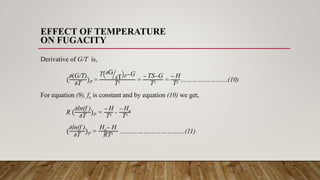
Derivative of G/T is,
(
𝜕(G/T)
𝜕T
)P =
T 𝜕G
𝜕T P−G
T2 =
− TS−G
T2 =
− H
T2 ……………………(10)
For equation (9), fo is constant and by equation (10) we get,
R (
𝜕ln(f )
𝜕T
)P =
− H
T2 -
− Ho
T2
(
𝜕ln(f )
𝜕T
)P =
Ho− H
RT2 ……………………………(11)
EFFECT OF PRESSURE
ON FUGACITY
We know for Gibbs free energy,
dG = VdP – SdT
Now at constant temperature, dT = 0 so,
dG = VdP
But by equation (2),
dG = RTd(lnf)
EFFECT OF PRESSURE
ON FUGACITY
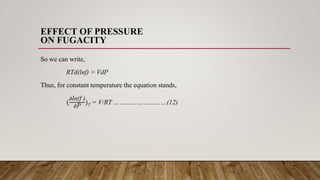
So we can write,
RTd(lnf) = VdP
Thus, for constant temperature the equation stands,
(
𝜕ln(f )
𝜕P
)T = V/RT ………………………(12)
Thank You for
Your
Cooperation

Fugacity

  • 1.
    A PRESENTATION ON FUGACITY PRESENTEDBY ABRAR ABDULLAH REG.NO. 2016332020
  • 2.
    CONTENTS • Introduction • Conceptsof Fugacity • Fugacity Coefficient • Significance of Fugacity Coefficient • Standard State of Fugacity • Effect of Temperature on Fugacity • Effect of Pressure on Fugacity
  • 3.
    INTRODUCTION Fugacity literally meansthe quality of being fleeting or evanescent. But in thermodynamics it is the measure of the tendency of a gas to escape or expand. It is expressed by f and it is the pressure value which is needed by the gas at a given temperature to show the properties of an ideal-gas. For e.g. at 0 oC temperature(T) and 100 atm pressure(P) for N2 the pressure required for the gas to act as an ideal gas is 97.03 atm. So, the fugacity(f) of N2 at 0 oC is 97.03 atm
  • 4.
    CONCEPTS OF FUGACITY • Theconcept of Fugacity was introduced by Gilbert Newton Lewis. • Fugacity is widely used in solution thermodynamics to represent the behavior of real gases. • Fugacity has been used extensively in the study of phase and chemical reaction equilibria involving gases at high pressures.
  • 5.
    CONCEPTS OF FUGACITY For aninfinitesimal reversible change occurring in a system, dG = VdP – SdT Let the system be under Isothermal condition. dT = 0, so, dG = VdP Replacing V with RT/P as the calculation is for Ideal gas, dG = RTdP/P = RTd(lnP) ……………………(1)
  • 6.
    CONCEPTS OF FUGACITY The pressurefrom equation (1) can be replaced by effective pressure, f as both P = f in for ideal gas. Thus, dG = RTd(lnf) …………………(2) Integrating the equation (2) we get, G = RT lnf +C ………………….(3)
  • 7.
    FUGACITY COEFFICIENT The ratioof Fugacity(f) to the Pressure(P) is known as Fugacity Coefficient. it is denoted by φ (phi) which is dimensionless and depends on the nature of gas, temperature and pressure. So, the equation stands, φ = f P ………………(4)
  • 8.
    SIGNIFICANCE OF FUGACITY COEFFICIENT Foran ideal gas, fugacity and pressure are equal and so φ = 1. If φ > 1then f > P thus, the pressure is to be increased. And if φ < 1 the P > f so, the pressure is to be decreased. Taken at the same temperature and pressure, the difference between the molar Gibbs free energies of a real gas(G) and the corresponding ideal gas(Go) is equal to RT ln φ. That is, G - Go = RT ln φ
  • 9.
    STANDARD STATE OF FUGACITY Letus consider the molar free energies of two states at same temperature be G1 and G2 with f1 and f2 as their corresponding fugacity. So the change of free energy is, ΔG = G1 – G2 = RT ln(f1/f2)…………………(5) Now for by equation (4) we know, φ = f P
  • 10.
    STANDARD STATE OF FUGACITY Thus,for ideal gas fo = Po and for real gas f = φP So, we can replace f2 and f1 by P2 and P1. So, we get, Δ G = G1 – G2 = RT ln(P1/P2) Now for ideal gas we get, G1 = Go + RT ln(P1/Po) ………………….(6)
  • 11.
    STANDARD STATE OF FUGACITY Nowfor real gas(G) and ideal gas(Go), G – Go = RT ln(f/fo)……………………(7) G – Go = RT ln(φP/Po) G = Go + RT ln(P/Po) + RT ln(φ)………………(8) By equations (6) and (8) we get, G = G1 + RT ln(φ)
  • 12.
    EFFECT OF TEMPERATURE ONFUGACITY From equation (7) we get, G/T – Go/T = R ln(f ) - R ln(fo) Differentiating with respect to temperature at constant pressure we get, ( 𝜕(G/T) 𝜕T )P – ( 𝜕(Go/T) 𝜕T )P= R[( 𝜕ln(f ) 𝜕T )P – ( 𝜕ln(fo) 𝜕T )P]………(9) We know, dG = VdP – SdT
  • 13.
    EFFECT OF TEMPERATURE ONFUGACITY So, at constant pressure, dP = 0, thus, ( 𝜕G 𝜕T )P = - S Gibbs free energy, G = H – TS H = G + TS
  • 14.
    EFFECT OF TEMPERATURE ONFUGACITY Derivative of G/T is, ( 𝜕(G/T) 𝜕T )P = T 𝜕G 𝜕T P−G T2 = − TS−G T2 = − H T2 ……………………(10) For equation (9), fo is constant and by equation (10) we get, R ( 𝜕ln(f ) 𝜕T )P = − H T2 - − Ho T2 ( 𝜕ln(f ) 𝜕T )P = Ho− H RT2 ……………………………(11)
  • 15.
    EFFECT OF PRESSURE ONFUGACITY We know for Gibbs free energy, dG = VdP – SdT Now at constant temperature, dT = 0 so, dG = VdP But by equation (2), dG = RTd(lnf)
  • 16.
    EFFECT OF PRESSURE ONFUGACITY So we can write, RTd(lnf) = VdP Thus, for constant temperature the equation stands, ( 𝜕ln(f ) 𝜕P )T = V/RT ………………………(12)
  • 17.