by
Rukhsar Latif
Selection Rules For
SoectroscopicTransitions
Selection rules
 Chemical reactions accompanied with light.
 1. Action of light → chemical change (light induced reactions)
 2. Chemical reaction → light emission (chemiluminescence)
 Photochemistry: is the study of the interaction of electromagnetic radiation with
matter resulting into a physical change or into a chemical reactions.
 Grotthuss-Draper law: Only the light absorbed in a molecule can produce
photochemical Change in the molecule
 Stark – Einstein law: If a species absorbs radiation, then one particle is excited for
each quantum of radiation absorbed.
Orbital Selection Rule
 Types of Selection Rule
 There are three levels of intensity of bands in spectra of complex metal ions. Two
are governed by Laporte selection Rule and Spin Selection Rule.
 Spin Selection Rule
 Transition may occur between two energy states of same multiplicity.
 Forbidden: ΔS≠O
 Allowed: ΔM = 0, S = 0 means if one spin is +1/2 and other is also clock wise +1/2
 Δs= S2-S1 = 0
 Transitions can only occur between states of the same spin (and therefore the same spin
multiplicity) eg. 2 T2g → 2 Eg is allowed but 2 T2g → 1 Eg is not
 Allowed: singlet -> singlet, triplet -> triplet, others are
 Forbidden: singlet -> triplet, doublet -> singlet, etc.
 Spin multiplicity MS = 2S+1 S = Ss = n/2 (total spin quantum number)
 Spin Forbidden Transition in which there is change in spin state of molecule.
Orbital Selection Rule
2. d-d-transitions are forbidden Transitions that are allowed must involve an overall change in L
= +1 or -1.
orbital angular momentum of one unit, i.e. Transitions within the same sub-level are
forbidden d p, p allowed: s p d, p forbidden: d
Mixing d, p and s functions can lead to partial lifting of the rule (this explains, why d-d-
transitions are observed at all, as all MO‘s have also some s and p character) .
Laporte Selection Rule(Parity Rule)
•The Laporte Selection Rule reflects that for the light to interact with a molecule and be
absorbed there should be a change in Dipole Moment. For a Forbidden Transition in which
there is no change in parity,there is no chamge in Dipole Moment. In a molecule having
center of symmetry, transitions between states of the same parity (symmetry with respect
to a center of inversion) are forbidden.
• For example, transitions between states that arise from d orbitals are forbidden (g→g
transitions; d orbitals are symmetric to inversion), but transitions between states arising
from d and p orbitals are allowed (g→u transitions; p orbitals are anti-symmetric to
inversion). Therefore, all d-d transitions in octahedral complexes .All d,d transitions are
forbidden. this means g→g or u→u transitions are not allowed in a field since an
octahedron has a centre of symmetry which effectively means no d→d (or f→f) transitions
are allowed since all d derived orbitals have g parity.
Continue….
•g stands for gerade, compounds having centre of symmetry e.g. s and d orbitals
•u stands for ungerade, compounds which don't have centre of symmetry e.g. p an f orbitals.
are Laporte-forbidden involves d-d transitions and laporte allowed involves charge transfer..
• Laporte-allowed transitions involve Δl = ±1.
•Laporte rule: parity must change
allowed: g u, u : g , d-f
Forbidden: g g, u u, s-d
parity: g(even), u(uneven); index refers to symmetry behaviour of the wave function (orbital, state)
with respect to an inversion operation about origin This rule is a specific variant of the symmetry
selection rule. g, even: s and d orbitals s-, n- and p* bonds
u, uneven: p and f orbitals s-, n- and p* bonds
LaPorte rule: parity/symmetry must change (holds for systems with inversion symmetry) g u, u g
allowed: g -g, u u, u forbidden: g parity: g(even), u(uneven); index refers to symmetry behaviour
of the wave function (orbital, state) with respect to an inversion operation about origin for octahedral
complexes, all d-d transitions are forbidden (d-orbitals are „g“) intensities of bands in non-
centrosymmetric molecules generally higher.
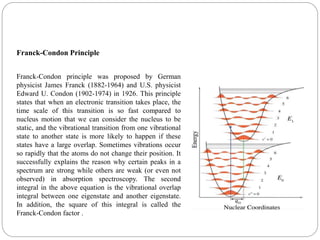
Franck-Condon Principle
Franck-Condon principle was proposed by German
physicist James Franck (1882-1964) and U.S. physicist
Edward U. Condon (1902-1974) in 1926. This principle
states that when an electronic transition takes place, the
time scale of this transition is so fast compared to
nucleus motion that we can consider the nucleus to be
static, and the vibrational transition from one vibrational
state to another state is more likely to happen if these
states have a large overlap. Sometimes vibrations occur
so rapidly that the atoms do not change their position. It
successfully explains the reason why certain peaks in a
spectrum are strong while others are weak (or even not
observed) in absorption spectroscopy. The second
integral in the above equation is the vibrational overlap
integral between one eigenstate and another eigenstate.
In addition, the square of this integral is called the
Franck-Condon factor .
Abstract
• This paper is a tutorial review in the field of atmospheric chemistry. It describes
some recent developments in tropospheric photochemistry.
• The relevant reactions can take place both on the surface of dispersed
particles and within liquid droplets (e.g. cloud, fog, mist, dew). Direct and sensitised
photolysis and the photogeneration of radical species are the main processes
involved. Direct photolysis can be very important in the transformation of particle-
adsorbed compounds.
• The significance of direct photolysis depends on the substrate under consideration
and on the colour of the particle:dark carbonaceous material shields light, therefore
protecting the adsorbed molecules fromphotodegradation, while a much lower
protection is afforded for the light-shaded mineral fraction of particulate.
• Particulate matter is also rich in photosensitisers (e.g. quinones and aromatic
carbonyls), partially derived from PAH photodegradation. The substrates such as
ethoxyphenols, major constituents of wood-smoke aerosol, can also enhance the
degradation of some sensitisers. (HULIS) that are major components of liquid
droplets. .
The main photochemical sources of reactive radical species in aqueous solution and on
particulate matter are hydrogen peroxide, itrate, nitrite, and Fe(III) compounds and oxides.
Introduction
Our envirment is affected by VOCS, hydrocarbons, benzene, toluene and xylenes) and
tropospheric ozone in urban air is strongly influenced by the emission.
Gas-phase atmo-spheric reactions include direct photolysis of photoactive compounds, and
processes initiated by reactive species (N,OH, N
NO3, ozone and atmospheric reactions taking place in the
aerosol phase (on particles or in aqueous solution) has been
acknowledged more recently.
Antarctic strato-pheric ozone hole is caused by reactions occurring on the
surface of the crystals composing the Polar Stratospheric
Clouds.
Many chemical processes taking place in the tropospheric
aerosol phase are called ‘heterogeneous’’ reactions, occurring on the surfacee of tropospheric
particles, or ‘‘multiphase’’ reactions,occur on the surface or inside water droplets.3
Tropospheric reactions include the conversion of Nto NO2 into HNO2 on the surface of
soot particles4 (HNO2 photolysis is then one of the processes that initiate the
tropospheric ozone cycle), the oxidation of S(IV) to H2SO4 by H2O2 in water droplets
(H2SO4 is involved in the phenomenon of acid rain), and the formation of active
chlorine species upon reaction between nitrogen oxides and sea-salt particles.
The main focus will be on the photochemical transformation of organic compounds in
the tropospheric aerosol phase.
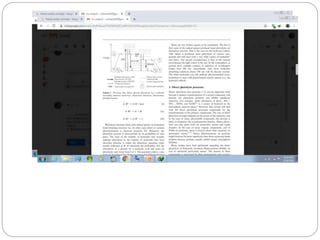
3. Direct photolysis processes
Direct photolysis induces transformation of a certain compound, and because the
photolysis products can exhibit significant reactivity. For instance, direct photolysis of
H2O2, NO3 2,NO2 2, HNO2 and FeOH2+ is a source of hydroxyl in the
atmospheric aqueous phase. Direct photo-lysis can take place both on particulate matter
and inside droplets. In the case of many organic compounds reactions on particulate
matter.
Many studies have been performed regarding the direct photolysis of Polycyclic because
of their mutagenicity and carcino-genicity.
The wide electron delocalisation in PAH molecules allows them to absorb sunlight.
Irradiation in the absence of oxygen mainly results in photodimerisation, while
irradiation under atmospheric conditions leads to photooxidation. Fairly
complete photo-oxidation pathways have been proposed for phenanthrene9 and pyrene10
adsorbed on silica, and for anthracene11 in aqueous solution.
The photolysis rate is higher for those
molecules with lower abstraction energies for their p
electrons.
Selection rules for soectroscopic transitions

Selection rules for soectroscopic transitions

  • 1.
    by Rukhsar Latif Selection RulesFor SoectroscopicTransitions
  • 2.
    Selection rules  Chemicalreactions accompanied with light.  1. Action of light → chemical change (light induced reactions)  2. Chemical reaction → light emission (chemiluminescence)  Photochemistry: is the study of the interaction of electromagnetic radiation with matter resulting into a physical change or into a chemical reactions.  Grotthuss-Draper law: Only the light absorbed in a molecule can produce photochemical Change in the molecule  Stark – Einstein law: If a species absorbs radiation, then one particle is excited for each quantum of radiation absorbed.
  • 3.
    Orbital Selection Rule Types of Selection Rule  There are three levels of intensity of bands in spectra of complex metal ions. Two are governed by Laporte selection Rule and Spin Selection Rule.  Spin Selection Rule  Transition may occur between two energy states of same multiplicity.  Forbidden: ΔS≠O  Allowed: ΔM = 0, S = 0 means if one spin is +1/2 and other is also clock wise +1/2  Δs= S2-S1 = 0  Transitions can only occur between states of the same spin (and therefore the same spin multiplicity) eg. 2 T2g → 2 Eg is allowed but 2 T2g → 1 Eg is not  Allowed: singlet -> singlet, triplet -> triplet, others are  Forbidden: singlet -> triplet, doublet -> singlet, etc.  Spin multiplicity MS = 2S+1 S = Ss = n/2 (total spin quantum number)  Spin Forbidden Transition in which there is change in spin state of molecule.
  • 4.
    Orbital Selection Rule 2.d-d-transitions are forbidden Transitions that are allowed must involve an overall change in L = +1 or -1. orbital angular momentum of one unit, i.e. Transitions within the same sub-level are forbidden d p, p allowed: s p d, p forbidden: d Mixing d, p and s functions can lead to partial lifting of the rule (this explains, why d-d- transitions are observed at all, as all MO‘s have also some s and p character) .
  • 5.
    Laporte Selection Rule(ParityRule) •The Laporte Selection Rule reflects that for the light to interact with a molecule and be absorbed there should be a change in Dipole Moment. For a Forbidden Transition in which there is no change in parity,there is no chamge in Dipole Moment. In a molecule having center of symmetry, transitions between states of the same parity (symmetry with respect to a center of inversion) are forbidden. • For example, transitions between states that arise from d orbitals are forbidden (g→g transitions; d orbitals are symmetric to inversion), but transitions between states arising from d and p orbitals are allowed (g→u transitions; p orbitals are anti-symmetric to inversion). Therefore, all d-d transitions in octahedral complexes .All d,d transitions are forbidden. this means g→g or u→u transitions are not allowed in a field since an octahedron has a centre of symmetry which effectively means no d→d (or f→f) transitions are allowed since all d derived orbitals have g parity.
  • 6.
    Continue…. •g stands forgerade, compounds having centre of symmetry e.g. s and d orbitals •u stands for ungerade, compounds which don't have centre of symmetry e.g. p an f orbitals. are Laporte-forbidden involves d-d transitions and laporte allowed involves charge transfer.. • Laporte-allowed transitions involve Δl = ±1. •Laporte rule: parity must change allowed: g u, u : g , d-f Forbidden: g g, u u, s-d parity: g(even), u(uneven); index refers to symmetry behaviour of the wave function (orbital, state) with respect to an inversion operation about origin This rule is a specific variant of the symmetry selection rule. g, even: s and d orbitals s-, n- and p* bonds u, uneven: p and f orbitals s-, n- and p* bonds LaPorte rule: parity/symmetry must change (holds for systems with inversion symmetry) g u, u g allowed: g -g, u u, u forbidden: g parity: g(even), u(uneven); index refers to symmetry behaviour of the wave function (orbital, state) with respect to an inversion operation about origin for octahedral complexes, all d-d transitions are forbidden (d-orbitals are „g“) intensities of bands in non- centrosymmetric molecules generally higher.
  • 7.
    Franck-Condon Principle Franck-Condon principlewas proposed by German physicist James Franck (1882-1964) and U.S. physicist Edward U. Condon (1902-1974) in 1926. This principle states that when an electronic transition takes place, the time scale of this transition is so fast compared to nucleus motion that we can consider the nucleus to be static, and the vibrational transition from one vibrational state to another state is more likely to happen if these states have a large overlap. Sometimes vibrations occur so rapidly that the atoms do not change their position. It successfully explains the reason why certain peaks in a spectrum are strong while others are weak (or even not observed) in absorption spectroscopy. The second integral in the above equation is the vibrational overlap integral between one eigenstate and another eigenstate. In addition, the square of this integral is called the Franck-Condon factor .
  • 8.
    Abstract • This paperis a tutorial review in the field of atmospheric chemistry. It describes some recent developments in tropospheric photochemistry. • The relevant reactions can take place both on the surface of dispersed particles and within liquid droplets (e.g. cloud, fog, mist, dew). Direct and sensitised photolysis and the photogeneration of radical species are the main processes involved. Direct photolysis can be very important in the transformation of particle- adsorbed compounds. • The significance of direct photolysis depends on the substrate under consideration and on the colour of the particle:dark carbonaceous material shields light, therefore protecting the adsorbed molecules fromphotodegradation, while a much lower protection is afforded for the light-shaded mineral fraction of particulate. • Particulate matter is also rich in photosensitisers (e.g. quinones and aromatic carbonyls), partially derived from PAH photodegradation. The substrates such as ethoxyphenols, major constituents of wood-smoke aerosol, can also enhance the degradation of some sensitisers. (HULIS) that are major components of liquid droplets. .
  • 9.
    The main photochemicalsources of reactive radical species in aqueous solution and on particulate matter are hydrogen peroxide, itrate, nitrite, and Fe(III) compounds and oxides. Introduction Our envirment is affected by VOCS, hydrocarbons, benzene, toluene and xylenes) and tropospheric ozone in urban air is strongly influenced by the emission. Gas-phase atmo-spheric reactions include direct photolysis of photoactive compounds, and processes initiated by reactive species (N,OH, N NO3, ozone and atmospheric reactions taking place in the aerosol phase (on particles or in aqueous solution) has been acknowledged more recently. Antarctic strato-pheric ozone hole is caused by reactions occurring on the surface of the crystals composing the Polar Stratospheric Clouds. Many chemical processes taking place in the tropospheric aerosol phase are called ‘heterogeneous’’ reactions, occurring on the surfacee of tropospheric particles, or ‘‘multiphase’’ reactions,occur on the surface or inside water droplets.3
  • 10.
    Tropospheric reactions includethe conversion of Nto NO2 into HNO2 on the surface of soot particles4 (HNO2 photolysis is then one of the processes that initiate the tropospheric ozone cycle), the oxidation of S(IV) to H2SO4 by H2O2 in water droplets (H2SO4 is involved in the phenomenon of acid rain), and the formation of active chlorine species upon reaction between nitrogen oxides and sea-salt particles. The main focus will be on the photochemical transformation of organic compounds in the tropospheric aerosol phase.
  • 11.
    3. Direct photolysisprocesses Direct photolysis induces transformation of a certain compound, and because the photolysis products can exhibit significant reactivity. For instance, direct photolysis of H2O2, NO3 2,NO2 2, HNO2 and FeOH2+ is a source of hydroxyl in the atmospheric aqueous phase. Direct photo-lysis can take place both on particulate matter and inside droplets. In the case of many organic compounds reactions on particulate matter. Many studies have been performed regarding the direct photolysis of Polycyclic because of their mutagenicity and carcino-genicity. The wide electron delocalisation in PAH molecules allows them to absorb sunlight. Irradiation in the absence of oxygen mainly results in photodimerisation, while irradiation under atmospheric conditions leads to photooxidation. Fairly complete photo-oxidation pathways have been proposed for phenanthrene9 and pyrene10 adsorbed on silica, and for anthracene11 in aqueous solution.
  • 12.
    The photolysis rateis higher for those molecules with lower abstraction energies for their p electrons.