ALLOYS IN
PROSTHODONTICS
PRESENTED BY-
DR.KELLY NORTON
POST GRADUATE STUDENT
DEPT. OF PROSTHODONTICS
INTRODUCTION
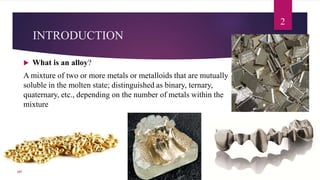
 What is an alloy?
A mixture of two or more metals or metalloids that are mutually
soluble in the molten state; distinguished as binary, ternary,
quaternary, etc., depending on the number of metals within the
mixture
2
107
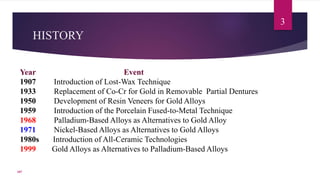
Year Event
1907 Introduction of Lost-Wax Technique
1933 Replacement of Co-Cr for Gold in Removable Partial Dentures
1950 Development of Resin Veneers for Gold Alloys
1959 Introduction of the Porcelain Fused-to-Metal Technique
1968 Palladium-Based Alloys as Alternatives to Gold Alloy
1971 Nickel-Based Alloys as Alternatives to Gold Alloys
1980s Introduction of All-Ceramic Technologies
1999 Gold Alloys as Alternatives to Palladium-Based Alloys
HISTORY
107
3
METALS
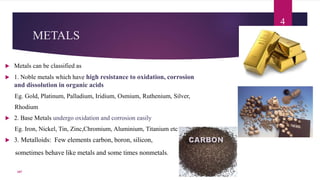
 Metals can be classified as
 1. Noble metals which have high resistance to oxidation, corrosion
and dissolution in organic acids
Eg. Gold, Platinum, Palladium, Iridium, Osmium, Ruthenium, Silver,
Rhodium
 2. Base Metals undergo oxidation and corrosion easily
Eg. Iron, Nickel, Tin, Zinc,Chromium, Aluminium, Titanium etc
 3. Metalloids: Few elements carbon, boron, silicon,
sometimes behave like metals and some times nonmetals.
4
107
SOLIDIFICATION
AND
CRYSTALLIZATION OF
METALS
5
107
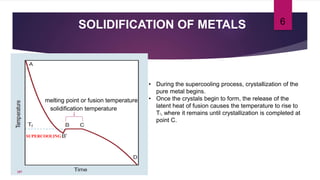
SOLIDIFICATION OF METALS 6
solidification temperature
melting point or fusion temperature
SUPERCOOLING
• During the supercooling process, crystallization of the
pure metal begins.
• Once the crystals begin to form, the release of the
latent heat of fusion causes the temperature to rise to
Tf, where it remains until crystallization is completed at
point C.
107
 Nucleation can occur by two processes. The first, called homogeneous
nucleation, is enhanced by rapid cooling so the nuclei are supercooled.
 The more nuclei that are formed by rapid cooling, the smaller the grain size
 Another means of decreasing the grain size (grain refining) is by adding to
the melt a foreign solid particle or surface to which the atoms are attracted,
such as a very fine high-melting metal or oxide powder. This process of
seeding the nuclei is called heterogeneous nucleation.
 All modern noble metal alloys are fine grained. Smaller the grain size of
the metal, the higher yield stress, better ductility, and improved ultimate
strength
 A large grain size reduces the strength and increases the brittleness of the
metal.
7
107
CRYSTALLISATION OF METALS
8
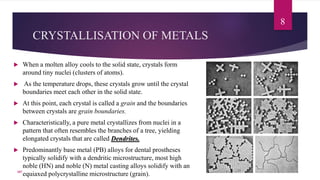
 When a molten alloy cools to the solid state, crystals form
around tiny nuclei (clusters of atoms).
 As the temperature drops, these crystals grow until the crystal
boundaries meet each other in the solid state.
 At this point, each crystal is called a grain and the boundaries
between crystals are grain boundaries.
 Characteristically, a pure metal crystallizes from nuclei in a
pattern that often resembles the branches of a tree, yielding
elongated crystals that are called Dendrites.
 Predominantly base metal (PB) alloys for dental prostheses
typically solidify with a dendritic microstructure, most high
noble (HN) and noble (N) metal casting alloys solidify with an
equiaxed polycrystalline microstructure (grain).107
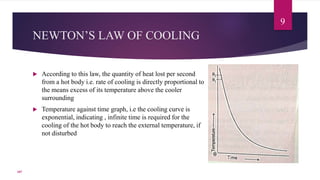
NEWTON’S LAW OF COOLING
 According to this law, the quantity of heat lost per second
from a hot body i.e. rate of cooling is directly proportional to
the means excess of its temperature above the cooler
surrounding
 Temperature against time graph, i.e the cooling curve is
exponential, indicating , infinite time is required for the
cooling of the hot body to reach the external temperature, if
not disturbed
9
107
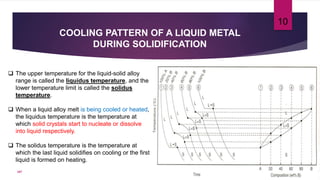
COOLING PATTERN OF A LIQUID METAL
DURING SOLIDIFICATION
10
 The upper temperature for the liquid-solid alloy
range is called the liquidus temperature, and the
lower temperature limit is called the solidus
temperature.
 When a liquid alloy melt is being cooled or heated,
the liquidus temperature is the temperature at
which solid crystals start to nucleate or dissolve
into liquid respectively.
 The solidus temperature is the temperature at
which the last liquid solidifies on cooling or the first
liquid is formed on heating.
107
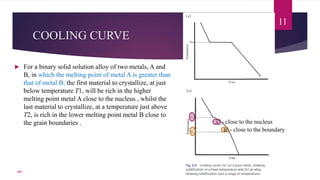
COOLING CURVE
 For a binary solid solution alloy of two metals, A and
B, in which the melting point of metal A is greater than
that of metal B, the first material to crystallize, at just
below temperature T1, will be rich in the higher
melting point metal A close to the nucleus , whilst the
last material to crystallize, at a temperature just above
T2, is rich in the lower melting point metal B close to
the grain boundaries .
11
107
A - close to the nucleus
B - close to the boundary
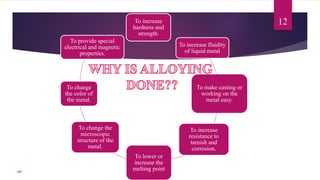
12To increase
hardness and
strength.
To increase fluidity
of liquid metal
To make casting or
working on the
metal easy.
To increase
resistance to
tarnish and
corrosion.
To lower or
increase the
melting point
To change the
microscopic
structure of the
metal.
To change
the color of
the metal.
To provide special
electrical and magnetic
properties.
107
SOLID SOLUTION
 In the molten state metals usually show mutual solubility, one within another.
When the molten mixture is cooled to below the melting point the component
metals may remain soluble in each other forming a solid solution.
13
CONDITIONS FAVORING SOLID-SOLUBILITY
 Atom size - if the atom sizes of the mixing metal are same, it will produce solid
solution type alloy.
 Valency - metals of the same valency will produce solid-solution alloy.
 Space-lattice type - if same, preferably if face centered will favour solid
solubility.
 Chemical affinity - must be less to produce solid-solution alloy.
107
TYPES OF SOLID SOLUTION
 There are two principal atomic arrangements for binary solid
solutions.
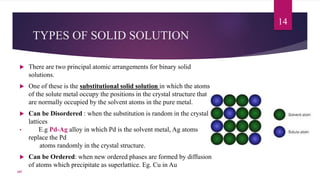
 One of these is the substitutional solid solution in which the atoms
of the solute metal occupy the positions in the crystal structure that
are normally occupied by the solvent atoms in the pure metal.
 Can be Disordered : when the substitution is random in the crystal
lattices
• E.g Pd-Ag alloy in which Pd is the solvent metal, Ag atoms
replace the Pd
atoms randomly in the crystal structure.
 Can be Ordered: when new ordered phases are formed by diffusion
of atoms which precipitate as superlattice. Eg. Cu in Au
14
107
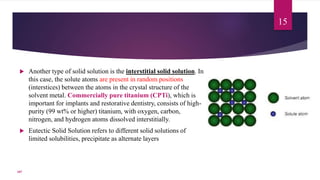
 Another type of solid solution is the interstitial solid solution. In
this case, the solute atoms are present in random positions
(interstices) between the atoms in the crystal structure of the
solvent metal. Commercially pure titanium (CPTi), which is
important for implants and restorative dentistry, consists of high-
purity (99 wt% or higher) titanium, with oxygen, carbon,
nitrogen, and hydrogen atoms dissolved interstitially.
 Eutectic Solid Solution refers to different solid solutions of
limited solubilities, precipitate as alternate layers
15
107
PHASE DIAGRAM FOR ALLOYS
 A phase is a state of matter that is distinct in some way from the matter around it.
 Phase diagrams are maps of the phases that occur when metals are mixed together .
 The x axis -------- composition of element
 The y axis -------- temperature of the alloy system.
 shows the composition and types of phases at a given temperature and at equilibrium.
 Every phase diagrams divides an alloy system into at least three areas :the liquid phase, the liquid
–solid phase and solid phase.
 If a series of cooling curves for alloys of different composition within a given alloy system are available
a phase diagram can be constructed from which many important predictions regarding coring and other
structural variations can be made.
16
107
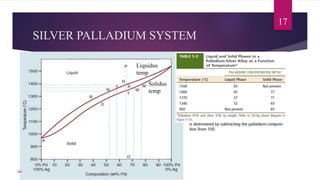
SILVER PALLADIUM SYSTEM
17
107
Liquidus
temp
Solidus
temp
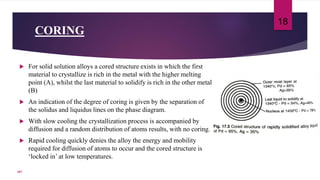
CORING
 For solid solution alloys a cored structure exists in which the first
material to crystallize is rich in the metal with the higher melting
point (A), whilst the last material to solidify is rich in the other metal
(B)
 An indication of the degree of coring is given by the separation of
the solidus and liquidus lines on the phase diagram.
 With slow cooling the crystallization process is accompanied by
diffusion and a random distribution of atoms results, with no coring.
 Rapid cooling quickly denies the alloy the energy and mobility
required for diffusion of atoms to occur and the cored structure is
‘locked in’ at low temperatures.
18
107
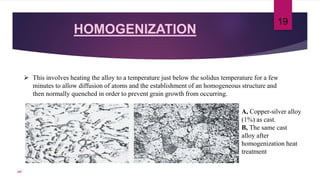
 This involves heating the alloy to a temperature just below the solidus temperature for a few
minutes to allow diffusion of atoms and the establishment of an homogeneous structure and
then normally quenched in order to prevent grain growth from occurring.
HOMOGENIZATION
19
A, Copper-silver alloy
(1%) as cast.
B, The same cast
alloy after
homogenization heat
treatment
107
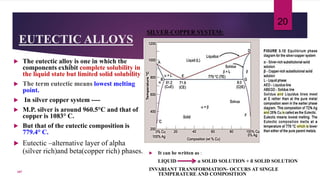
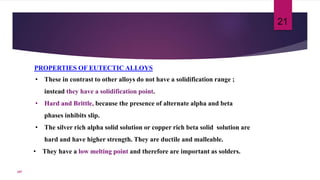
EUTECTIC ALLOYS
 The eutectic alloy is one in which the
components exhibit complete solubility in
the liquid state but limited solid solubility
 The term eutectic means lowest melting
point.
 In silver copper system ----
 M.P. silver is around 960.5°C and that of
copper is 1083° C.
 But that of the eutectic composition is
779.4° C.
 Eutectic –alternative layer of alpha
(silver rich)and beta(copper rich) phases.
20
 It can be written as :
LIQUID α SOLID SOLUTION + ß SOLID SOLUTION
INVARIANT TRANSFORMATION- OCCURS AT SINGLE
TEMPERATURE AND COMPOSITION
SILVER-COPPER SYSTEM:
107
PROPERTIES OF EUTECTIC ALLOYS
• These in contrast to other alloys do not have a solidification range ;
instead they have a solidification point.
• Hard and Brittle, because the presence of alternate alpha and beta
phases inhibits slip.
• The silver rich alpha solid solution or copper rich beta solid solution are
hard and have higher strength. They are ductile and malleable.
• They have a low melting point and therefore are important as solders.
21
107
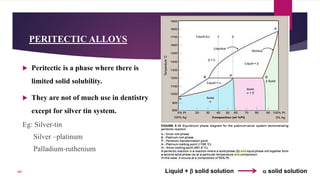
 Peritectic is a phase where there is
limited solid solubility.
 They are not of much use in dentistry
except for silver tin system.
Eg: Silver-tin
Silver –platinum
Palladium-ruthenium
22
PERITECTIC ALLOYS
Liquid +  solid solution  solid solution107
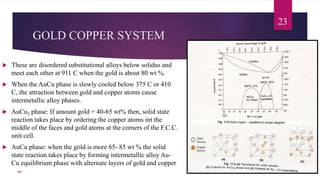
GOLD COPPER SYSTEM
 These are disordered substitutional alloys below solidus and
meet each other at 911 C when the gold is about 80 wt %.
 When the AuCu phase is slowly cooled below 375 C or 410
C, the attraction between gold and copper atoms cause
intermetallic alloy phases.
 AuCu3 phase: If amount gold = 40-65 wt% then, solid state
reaction takes place by ordering the copper atoms int the
middle of the faces and gold atoms at the corners of the F.C.C.
unit cell.
 AuCu phase: when the gold is more 65- 85 wt % the solid
state reaction takes place by forming intermetallic alloy Au-
Cu equilibrium phase with alternate layers of gold and copper
23
107
INTERMETALLIC COMPOUNDS
Inter metallic compounds are those when the metals are soluble in the liquid
state but unite and form a chemical compound on solidifying.
Eg ; Ag3 – Sn,
Sn7 – Hg8
They are called inter metallic compounds because the alloy is formed by a
chemical reaction between a metal and metal.
24
107
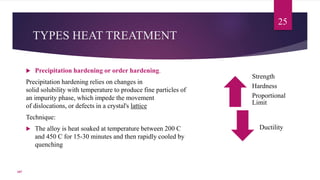
TYPES HEAT TREATMENT
 Precipitation hardening or order hardening.
Precipitation hardening relies on changes in
solid solubility with temperature to produce fine particles of
an impurity phase, which impede the movement
of dislocations, or defects in a crystal's lattice
Technique:
 The alloy is heat soaked at temperature between 200 C
and 450 C for 15-30 minutes and then rapidly cooled by
quenching
25
Strength
Hardness
Proportional
Limit
Ductility
107
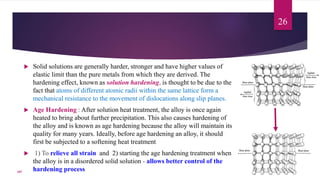
 Solid solutions are generally harder, stronger and have higher values of
elastic limit than the pure metals from which they are derived. The
hardening effect, known as solution hardening, is thought to be due to the
fact that atoms of different atomic radii within the same lattice form a
mechanical resistance to the movement of dislocations along slip planes.
 Age Hardening : After solution heat treatment, the alloy is once again
heated to bring about further precipitation. This also causes hardening of
the alloy and is known as age hardening because the alloy will maintain its
quality for many years. Ideally, before age hardening an alloy, it should
first be subjected to a softening heat treatment
 1) To relieve all strain and 2) starting the age hardening treatment when
the alloy is in a disordered solid solution - allows better control of the
hardening process
26
107
 In a summary, Solid solution strengthening involves formation of a single-phase
solid solution via quenching. Precipitation heat treating involves the addition of
impurity particles to increase a material's strength
 A heat treatment is sometimes used to eliminate the cored structure. Such a heat
treatment is termed a homogenization heat treatment. Homogenization heat
treatment INCREASES DUCTILITY AND CORROSION RESISTANCE
107
27
 Clinical significance of heat treatment
 Type I and II gold alloys usually do not harden or they harden to a
lesser degree than do the types III and IV gold alloys.
 The type III and IV gold alloys that can be hardened or strengthened
from quenching, can also be softened by heat treatments.
28
107
107
29
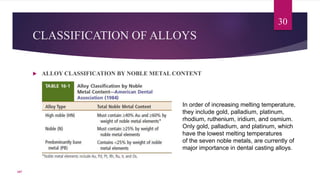
CLASSIFICATION OF ALLOYS
 ALLOY CLASSIFICATION BY NOBLE METAL CONTENT
30
In order of increasing melting temperature,
they include gold, palladium, platinum,
rhodium, ruthenium, iridium, and osmium.
Only gold, palladium, and platinum, which
have the lowest melting temperatures
of the seven noble metals, are currently of
major importance in dental casting alloys.
107
ALLOY CLASSIFICATION BY
MECHANICAL PROPERTIES
31
107
ALLOY TYPE BY MAJOR ELEMENTS:
Gold-based, palladium-based, silver-based, nickel-based, cobalt-based and
titanium-based .
ALLOY TYPE BY PRINCIPAL THREE ELEMENTS:
Such as Au-Pd-Ag, Pd-Ag-Sn, Ni-Cr-Be, Co-Cr-Mo, Ti-Al-V and Fe-Ni-Cr.
(If two metals are present, a binary alloy is formed; if three or four metals
are present, ternary and quaternary alloys, respectively, are produced and
so on.)
ALLOY TYPE BY DOMINANT PHASE SYSTEM:
Single phase [isomorphous], eutectic, peritectic and intermetallic.107
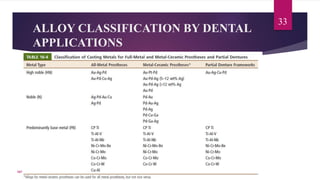
32
ALLOY CLASSIFICATION BY DENTAL
APPLICATIONS
33
107
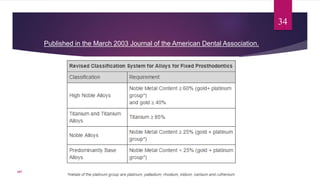
34
Published in the March 2003 Journal of the American Dental Association.
107
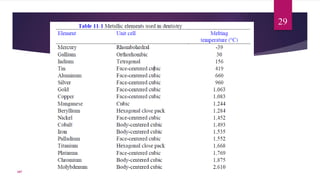
Metallic Elements Used in Dental Alloys
NOBLE METALS
• Noble Metal are corrosion and oxidation resistant because of
inertness and chemical resistance.
• Basis of inlays, crowns and bridges because of their resistance to
corrosion in the oral cavity.
• Gold, platinum, palladium, rhodium, ruthenium, iridium, osmium, and
silver
35
107
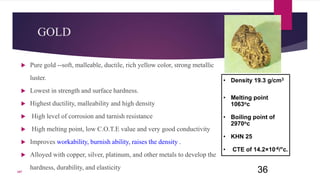
GOLD
 Pure gold --soft, malleable, ductile, rich yellow color, strong metallic
luster.
 Lowest in strength and surface hardness.
 Highest ductility, malleability and high density
 High level of corrosion and tarnish resistance
 High melting point, low C.O.T.E value and very good conductivity
 Improves workability, burnish ability, raises the density .
 Alloyed with copper, silver, platinum, and other metals to develop the
hardness, durability, and elasticity 36
• Density 19.3 g/cm3
• Melting point
1063oc
• Boiling point of
2970oc
• KHN 25
• CTE of 14.2×10⁻⁶/°c.
107
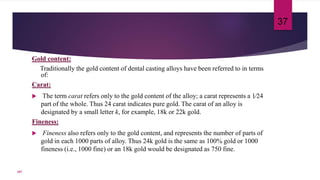
Gold content:
Traditionally the gold content of dental casting alloys have been referred to in terms
of:
Carat:
 The term carat refers only to the gold content of the alloy; a carat represents a 1⁄24
part of the whole. Thus 24 carat indicates pure gold. The carat of an alloy is
designated by a small letter k, for example, 18k or 22k gold.
Fineness:
 Fineness also refers only to the gold content, and represents the number of parts of
gold in each 1000 parts of alloy. Thus 24k gold is the same as 100% gold or 1000
fineness (i.e., 1000 fine) or an 18k gold would be designated as 750 fine.
37
107
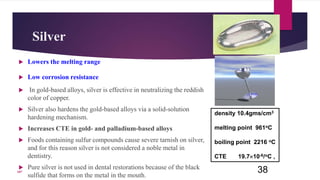
Silver
 Lowers the melting range
 Low corrosion resistance
 In gold-based alloys, silver is effective in neutralizing the reddish
color of copper.
 Silver also hardens the gold-based alloys via a solid-solution
hardening mechanism.
 Increases CTE in gold- and palladium-based alloys
 Foods containing sulfur compounds cause severe tarnish on silver,
and for this reason silver is not considered a noble metal in
dentistry.
 Pure silver is not used in dental restorations because of the black
sulfide that forms on the metal in the mouth.
density 10.4gms/cm3
melting point 961oC
boiling point 2216 oC
CTE 19.710-6/oC ,
38107
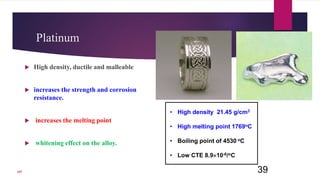
Platinum
 High density, ductile and malleable
 increases the strength and corrosion
resistance.
 increases the melting point
 whitening effect on the alloy.
39
• High density 21.45 g/cm3
• High melting point 1769oC
• Boiling point of 4530 oC
• Low CTE 8.910-6/oC
107
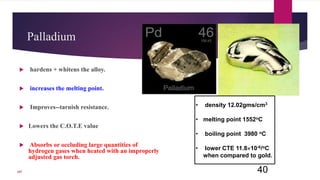
Palladium
 hardens + whitens the alloy.
 increases the melting point.
 Improves--tarnish resistance.
 Lowers the C.O.T.E value
 Absorbs or occluding large quantities of
hydrogen gases when heated with an improperly
adjusted gas torch.
40
• density 12.02gms/cm3
• melting point 1552oC
• boiling point 3980 oC
• lower CTE 11.810-6/oC
when compared to gold.
107
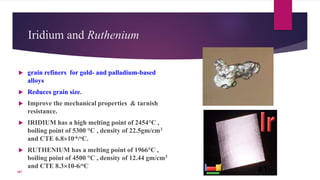
Iridium and Ruthenium
 grain refiners for gold- and palladium-based
alloys
 Reduces grain size.
 Improve the mechanical properties & tarnish
resistance.
 IRIDIUM has a high melting point of 2454°C ,
boiling point of 5300 °C , density of 22.5gm/cm3
and CTE 6.810-6/oC.
 RUTHENIUM has a melting point of 1966°C ,
boiling point of 4500 °C , density of 12.44 gm/cm3
and CTE 8.310-6/oC
41107
BASE METALS
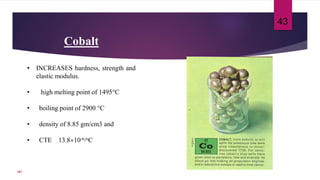
Cobalt
• INCREASES hardness, strength and
elastic modulus.
• high melting point of 1495°C
• boiling point of 2900 °C
• density of 8.85 gm/cm3 and
• CTE 13.810-6/oC
43
107
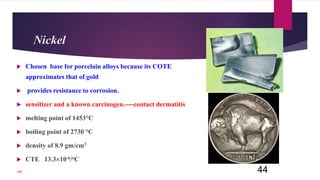
Nickel
 Chosen base for porcelain alloys because its COTE
approximates that of gold
 provides resistance to corrosion.
 sensitizer and a known carcinogen.----contact dermatitis
 melting point of 1453°C
 boiling point of 2730 °C
 density of 8.9 gm/cm3
 CTE 13.310-6/oC
44107
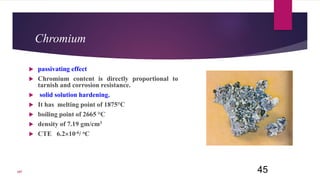
Chromium
 passivating effect
 Chromium content is directly proportional to
tarnish and corrosion resistance.
 solid solution hardening.
 It has melting point of 1875°C
 boiling point of 2665 °C
 density of 7.19 gm/cm3
 CTE 6.210-6/ oC
45107
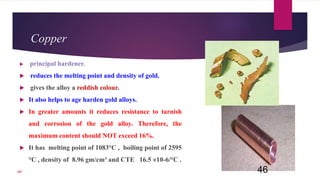
Copper
 principal hardener.
 reduces the melting point and density of gold.
 gives the alloy a reddish colour.
 It also helps to age harden gold alloys.
 In greater amounts it reduces resistance to tarnish
and corrosion of the gold alloy. Therefore, the
maximum content should NOT exceed 16%.
 It has melting point of 1083°C , boiling point of 2595
°C , density of 8.96 gm/cm³ and CTE 16.5 10-6/°C .
46107
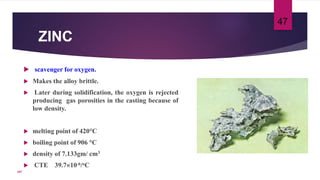
 scavenger for oxygen.
 Makes the alloy brittle.
 Later during solidification, the oxygen is rejected
producing gas porosities in the casting because of
low density.
 melting point of 420°C
 boiling point of 906 °C
 density of 7.133gm/ cm3
 CTE 39.710-6/oC
ZINC
47
107
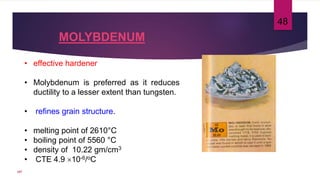
MOLYBDENUM
• effective hardener
• Molybdenum is preferred as it reduces
ductility to a lesser extent than tungsten.
• refines grain structure.
• melting point of 2610°C
• boiling point of 5560 °C
• density of 10.22 gm/cm3
• CTE 4.9 10-6/oC
48
107
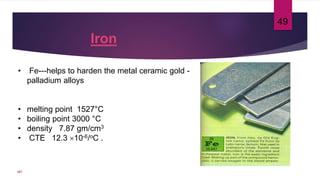
Iron
• Fe---helps to harden the metal ceramic gold -
palladium alloys
• melting point 1527°C
• boiling point 3000 °C
• density 7.87 gm/cm3
• CTE 12.3 10-6/oC .
49
107
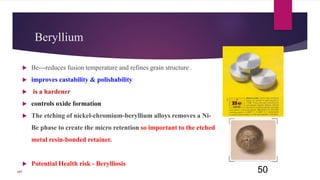
Beryllium
 Be---reduces fusion temperature and refines grain structure .
 improves castability & polishability
 is a hardener
 controls oxide formation
 The etching of nickel-chromium-beryllium alloys removes a Ni-
Be phase to create the micro retention so important to the etched
metal resin-bonded retainer.
 Potential Health risk - Berylliosis
50107
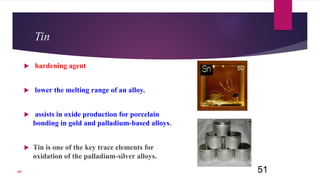
Tin
 hardening agent
 lower the melting range of an alloy.
 assists in oxide production for porcelain
bonding in gold and palladium-based alloys.
 Tin is one of the key trace elements for
oxidation of the palladium-silver alloys.
51107
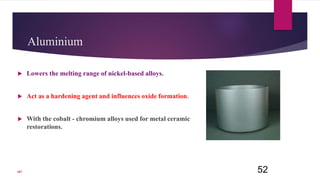
Aluminium
 Lowers the melting range of nickel-based alloys.
 Act as a hardening agent and influences oxide formation.
 With the cobalt - chromium alloys used for metal ceramic
restorations.
52107
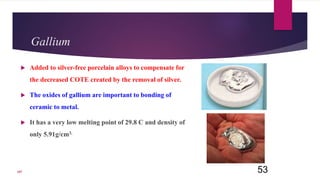
Gallium
 Added to silver-free porcelain alloys to compensate for
the decreased COTE created by the removal of silver.
 The oxides of gallium are important to bonding of
ceramic to metal.
 It has a very low melting point of 29.8 C and density of
only 5.91g/cm3.
53107
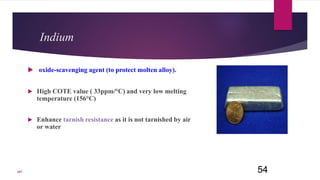
Indium
 oxide-scavenging agent (to protect molten alloy).
 High COTE value ( 33ppm/°C) and very low melting
temperature (156°C)
 Enhance tarnish resistance as it is not tarnished by air
or water
54107
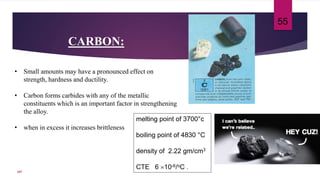
CARBON:
• Small amounts may have a pronounced effect on
strength, hardness and ductility.
• Carbon forms carbides with any of the metallic
constituents which is an important factor in strengthening
the alloy.
• when in excess it increases brittleness
55
melting point of 3700°c
boiling point of 4830 °C
density of 2.22 gm/cm3
CTE 6 10-6/oC .
107
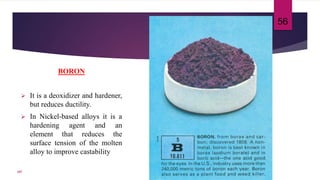
BORON
 It is a deoxidizer and hardener,
but reduces ductility.
 In Nickel-based alloys it is a
hardening agent and an
element that reduces the
surface tension of the molten
alloy to improve castability
56
107
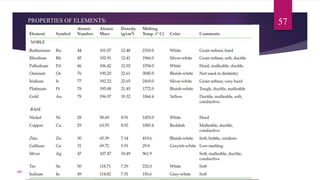
57PROPERTIES OF ELEMENTS:
107
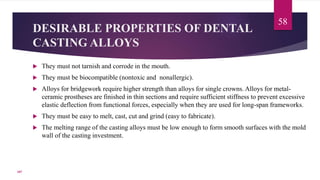
DESIRABLE PROPERTIES OF DENTAL
CASTING ALLOYS
 They must not tarnish and corrode in the mouth.
 They must be biocompatible (nontoxic and nonallergic).
 Alloys for bridgework require higher strength than alloys for single crowns. Alloys for metal-
ceramic prostheses are finished in thin sections and require sufficient stiffness to prevent excessive
elastic deflection from functional forces, especially when they are used for long-span frameworks.
 They must be easy to melt, cast, cut and grind (easy to fabricate).
 The melting range of the casting alloys must be low enough to form smooth surfaces with the mold
wall of the casting investment.
58
107
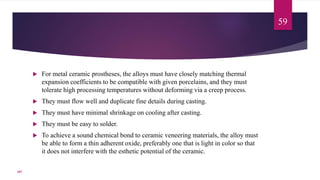
 For metal ceramic prostheses, the alloys must have closely matching thermal
expansion coefficients to be compatible with given porcelains, and they must
tolerate high processing temperatures without deforming via a creep process.
 They must flow well and duplicate fine details during casting.
 They must have minimal shrinkage on cooling after casting.
 They must be easy to solder.
 To achieve a sound chemical bond to ceramic veneering materials, the alloy must
be able to form a thin adherent oxide, preferably one that is light in color so that
it does not interfere with the esthetic potential of the ceramic.
59
107
ALLOYS FOR ALL-METAL PROSTHESES
- HIGH NOBLE AND NOBLE ALLOYS
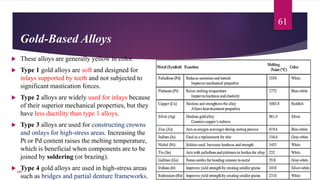
Gold-Based Alloys
 These alloys are generally yellow in color.
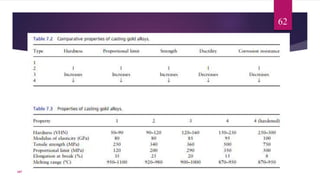
 Type 1 gold alloys are soft and designed for
inlays supported by teeth and not subjected to
significant mastication forces.
 Type 2 alloys are widely used for inlays because
of their superior mechanical properties, but they
have less ductility than type 1 alloys.
 Type 3 alloys are used for constructing crowns
and onlays for high-stress areas. Increasing the
Pt or Pd content raises the melting temperature,
which is beneficial when components are to be
joined by soldering (or brazing).
 Type 4 gold alloys are used in high-stress areas
such as bridges and partial denture frameworks.
61
107
62
107
HEAT TREATMENT OF GOLD ALLOYS:
Heat treatment of alloys is done in order to alter its mechanical
properties.
Type III and type IV gold alloys can be heat-treated.
There are two types of heat treatment.
1. Softening Heat Treatment (Solution heat treatment)
2. Hardening Heat Treatment (Age hardening)
63
107
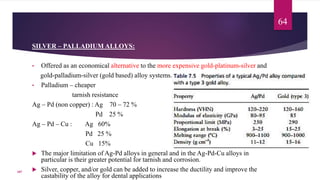
SILVER – PALLADIUM ALLOYS:
• Offered as an economical alternative to the more expensive gold-platinum-silver and
gold-palladium-silver (gold based) alloy systems.
• Palladium – cheaper
tarnish resistance
Ag – Pd (non copper) : Ag 70 – 72 %
Pd 25 %
Ag – Pd – Cu : Ag 60%
Pd 25 %
Cu 15%
 The major limitation of Ag-Pd alloys in general and in the Ag-Pd-Cu alloys in
particular is their greater potential for tarnish and corrosion.
 Silver, copper, and/or gold can be added to increase the ductility and improve the
castability of the alloy for dental applications
64
107
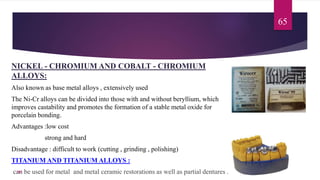
NICKEL - CHROMIUM AND COBALT - CHROMIUM
ALLOYS:
Also known as base metal alloys , extensively used
The Ni-Cr alloys can be divided into those with and without beryllium, which
improves castability and promotes the formation of a stable metal oxide for
porcelain bonding.
Advantages :low cost
strong and hard
Disadvantage : difficult to work (cutting , grinding , polishing)
TITANIUM AND TITANIUM ALLOYS :
can be used for metal and metal ceramic restorations as well as partial dentures .
65
107
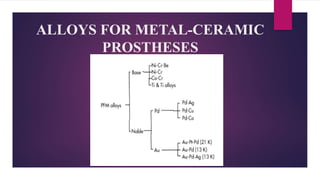
ALLOYS FOR METAL-CERAMIC
PROSTHESES
COMMON FEATURES OF PFM ALLOYS
 (1) they have the potential to bond to dental porcelain:
 The addition of a small quantity of base metal to noble and high noble alloys promotes oxide
formation on the surface, which promotes chemical bonding between the alloy and the porcelain
 (2) they exhibit coefficients of thermal contraction compatible with those of dental porcelain:
 The thermal contraction differential between metal alloys and dental porcelains may, under certain
conditions, contribute to high levels of stress in porcelain, which can induce cracking of porcelain
or delayed fracture.
 (3) their solidus temperature is sufficiently high to resist softening during the sintering of
porcelain:
 When an alloy is heated close to its solidus temperature, it may become susceptible to flow under
its own mass (creep). All metal-ceramic alloys should have a solidus temperature that is
significantly higher than the sintering temperature of the porcelain so as to minimize creep
deformation.
67
107
CHEMICAL BONDING
 The addition of 1% passivating base metals to gold palladium and platinum
alloys was sufficient to produce a slight oxide film on surface of sub structure to
achieve porcelain metal bond strength that surpassed the cohesive strength of
porcelain.
 By electro-depostion of Gold on an article followed by Tin which forms a tin
oxide layer that helps to chemically bond to cermaics
68
107
MECHANICAL INTERLOCKING
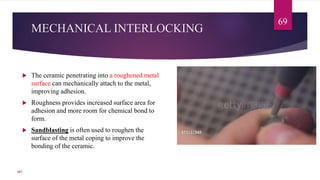
 The ceramic penetrating into a roughened metal
surface can mechanically attach to the metal,
improving adhesion.
 Roughness provides increased surface area for
adhesion and more room for chemical bond to
form.
 Sandblasting is often used to roughen the
surface of the metal coping to improve the
bonding of the ceramic.
69
107
THERMAL COMPATIBILITY
 When the co efficient of thermal expansion of metal and porcelain are incompatible the
tensile stress that develop during cooling are sufficient to cause immediate cracking of
porcelain or delayed cracking after cooling at room temperature.
 Porcelains have coefficient of thermal expansion between 13.0 and 14.0 X 10⁻⁶ and
metal between 13.5 and 14.5 X 10⁻⁶.
 The difference of 0.5 X10⁻⁶ in thermal expansion between metal and porcelain causes
the metal to contract slightly more than does the ceramic during cooling after firing the
porcelain
 The C.O.T.E of alloys is decreased by adding platinum or palladium.
70
107
HIGH NOBLE AND
NOBLE ALLOYS
Most alloys contain palladium, whose high
melting point improves sag resistance
during firing, and whose thermal contraction
coefficient is lower than that of silver, gold,
and platinum, which is helpful in developing
lightweight metal-ceramic alloys that are
compatible with currently used dental
ceramics.
The Gold-Platinum-Palladium
(Au-Pt-Pd) System:
This is one of the oldest metal ceramic
alloy system. But these alloys are not
used widely today because they are
very expensive.
 These alloys have adequate elastic
modulus, strength, hardness, and
elongation but are low in sag
resistance.
 Therefore, they should be limited to
crowns and three-unit FDPs.
 Their use has decreased over time,
since more economical alloys have
been developed with significantly
better mechanical properties and sag
resistance.107
72
Gold-Palladium-Silver Alloys
 These alloys are economical alternatives to the Au-Pt-Pd
or Au-Pd-Pt alloys.
 Excellent tarnish and corrosion resistance
 Increased melting ranges.
 Improved resistance to creep deformation (sag) at elevated
temperatures.
 A study revealed that Ag–Pd–Au alloy has a lower
potential to abrade opposing enamel than do indirect resin
composite, disilicate glass ceramic, and tooth enamel.
73
Journal of Prosthodontic Research. 2015;59(3):210-212.
Japanese Dental Science Review. 2011;47(1):82-87.
107
Gold - Palladium Alloys
 Lower thermal contraction coefficient than that
of either the Au-Pd-Ag or Pd-Ag alloys.
 The esthetic quality of metal-ceramic prostheses
made with Au-Pd alloys is comparable to that
obtained with Au-Pt-Pd alloys.
 The sag resistance of these alloys is better than
that of Au-Pt-Pd alloys.
74
107
PALLADIUM-SILVER ALLOYS
Alternative to gold and base metal alloys
 Disadvantage-
high silver content causes greening (green yellow
discoloration of metal ceramic alloy)
75
107
PALLADIUM BASED ALLOYS
76
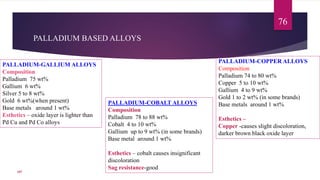
PALLADIUM-COBALT ALLOYS
Composition
Palladium 78 to 88 wt%
Cobalt 4 to 10 wt%
Gallium up to 9 wt% (in some brands)
Base metal around 1 wt%
Esthetics – cobalt causes insignificant
discoloration
Sag resistance-good
PALLADIUM-COPPER ALLOYS
Composition
Palladium 74 to 80 wt%
Copper 5 to 10 wt%
Gallium 4 to 9 wt%
Gold 1 to 2 wt% (in some brands)
Base metals around 1 wt%
Esthetics –
Copper -causes slight discoloration,
darker brown black oxide layer
PALLADIUM-GALLIUM ALLOYS
Composition
Palladium 75 wt%
Gallium 6 wt%
Silver 5 to 8 wt%
Gold 6 wt%(when present)
Base metals around 1 wt%
Esthetics – oxide layer is lighter than
Pd Cu and Pd Co alloys
107
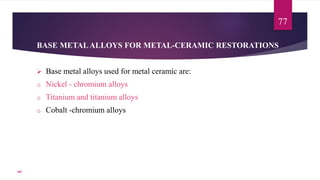
BASE METALALLOYS FOR METAL-CERAMIC RESTORATIONS
 Base metal alloys used for metal ceramic are:
o Nickel - chromium alloys
o Titanium and titanium alloys
o Cobalt -chromium alloys
77
107
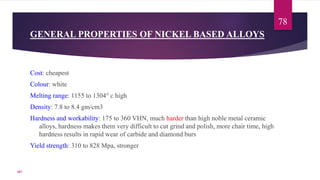
GENERAL PROPERTIES OF NICKEL BASED ALLOYS
Cost: cheapest
Colour: white
Melting range: 1155 to 1304° c high
Density: 7.8 to 8.4 gm/cm3
Hardness and workability: 175 to 360 VHN, much harder than high noble metal ceramic
alloys, hardness makes them very difficult to cut grind and polish, more chair time, high
hardness results in rapid wear of carbide and diamond burs
Yield strength: 310 to 828 Mpa, stronger
78
107
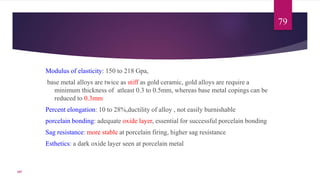
Modulus of elasticity: 150 to 218 Gpa,
base metal alloys are twice as stiff as gold ceramic, gold alloys are require a
minimum thickness of atleast 0.3 to 0.5mm, whereas base metal copings can be
reduced to 0.3mm
Percent elongation: 10 to 28%,ductility of alloy , not easily burnishable
porcelain bonding: adequate oxide layer, essential for successful porcelain bonding
Sag resistance: more stable at porcelain firing, higher sag resistance
Esthetics: a dark oxide layer seen at porcelain metal
79
107
Tarnish and corrosion resistance: highly resistant, this is due to the property known as
passivation.
passivation is the resistant oxide layer on surface of chrome containing alloys
Soldering: base metal alloys much more difficult to solder than gold alloys
Casting shrinkage: higher casting shrinkage than gold alloys, greater mould expansion is
to compensate for inadequate compensation for casting shrinkage
Etching: the alloy's surface can etched electrochemically to create micromechanical
retention for resin-bonded FPD’s (Maryland Bridges).
80
107
Biological considerations: nickel may produce allergic, potential carcinogen,
beryllium potentially toxic, inhalation of beryllium containing dust or fumes
known as berylliosis, flu-like symptoms and granulomas of the lungs.
Precautions: wear mask, well-ventilated, good exhaust
81
107
NICKEL-CHROMIUM (NI-CR) ALLOYS
 used for complete crown and all metal fixed partial denture prosthesis
 major constituents - nickel -61 to 71 %
chromium – 11 to 27 %
 The system contains two major groups:
-Beryllium free (class 1)
-Beryllium (class 2)
82
107
NICKEL CHROMIUM ALLOYS
Composition
Basic elements
Nickel : 61 To 81 Wt%
Chromium : 11 To 27 Wt%
Molybdenum : 2 To 9 Wt%
83
The minor additions include
Beryllium : 0.5 To 2.0 Wt%
Aluminum : 0.2 To 4.2 Wt%
Iron : 0.1 To 0.5 Wt%
Silicon : 0.2 To 2.8 Wt%
Copper : 0.1 To 1.6 Wt%
Manganese : 0.1 To 3.0 Wt%
Cobalt : 0.4 To 0.5 Wt%
Tin : 1.25 wt%
ADVANTAGES
• Low cost
• Low Density permits more castings
• High sag resistance
• Poor thermal conductor
• Can be etched
DISADVANTAGES
• Cannot be used with nickel-sensitive
patients
• Beryllium exposure may be
potentially harmful
• Bond failure more common in oxide
layer
• High hardness, may wear opposing
tooth
107
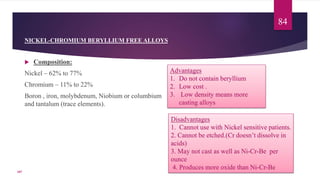
NICKEL-CHROMIUM BERYLLIUM FREE ALLOYS
 Composition:
Nickel – 62% to 77%
Chromium – 11% to 22%
Boron , iron, molybdenum, Niobium or columbium
and tantalum (trace elements).
Advantages
1. Do not contain beryllium
2. Low cost .
3. Low density means more
casting alloys
Disadvantages
1. Cannot use with Nickel sensitive patients.
2. Cannot be etched.(Cr doesn’t dissolve in
acids)
3. May not cast as well as Ni-Cr-Be per
ounce
4. Produces more oxide than Ni-Cr-Be
84
107
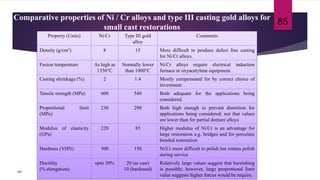
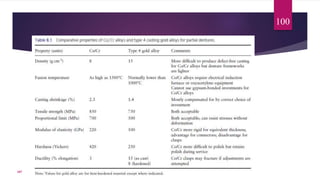
Comparative properties of Ni / Cr alloys and type III casting gold alloys for
small cast restorations
85
Property (Units) Ni/Cr Type III gold
alloy
Comments
Density (g/cm3) 8 15 More difficult to produce defect free casting
for Ni/Cr alloys.
Fusion temperature As high as
1350°C
Normally lower
than 1000°C
Ni/Cr alloys require electrical induction
furnace or oxyacetylene equipment.
Casting shrinkage (%) 2 1.4 Mostly compensated for by correct choice of
investment
Tensile strength (MPa) 600 540 Both adequate for the applications being
considered.
Proportional limit
(MPa)
230 290 Both high enough to prevent distortion for
applications being considered; not that values
are lower than for partial denture alloys
Modulus of elasticity
(GPa)
220 85 Higher modulus of Ni/Cr is an advantage for
large restoration e.g. bridges and for porcelain
bonded restoration.
Hardness (VHN) 300 150 Ni/Cr more difficult to polish but retains polish
during service
Ductility
(% elongation)
upto 30% 20 (as cast)
10 (hardened)
Relatively large values suggest that burnishing
is possible; however, large proportional limit
value suggests higher forces would be require.
107
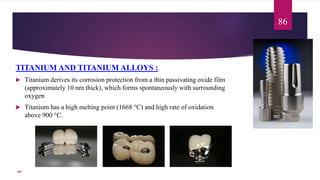
TITANIUM AND TITANIUM ALLOYS :
 Titanium derives its corrosion protection from a thin passivating oxide film
(approximately 10 nm thick), which forms spontaneously with surrounding
oxygen
 Titanium has a high melting point (1668 °C) and high rate of oxidation
above 900 °C.
86
107
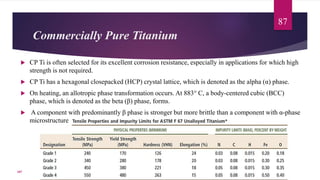
Commercially Pure Titanium
 CP Ti is often selected for its excellent corrosion resistance, especially in applications for which high
strength is not required.
 CP Ti has a hexagonal closepacked (HCP) crystal lattice, which is denoted as the alpha (α) phase.
 On heating, an allotropic phase transformation occurs. At 883° C, a body-centered cubic (BCC)
phase, which is denoted as the beta (β) phase, forms.
 A component with predominantly β phase is stronger but more brittle than a component with α-phase
microstructure
87
107
PROPERTIES OF COMMERCIALLY PURE TITANIUM
Phases: in metallic form at ambient temperature- has a hexagonal, close-
packed crystal lattice, transforms into a body-centered cubic format 883 °c-
phase is susceptible to oxidation.
Color: white
Density: light weight metal 4.5 gm/cm3 compared nickel chrome 8gm/cm3 and
gold alloys 15 gm/cm3
Modulus of elasticity: half as rigid as base metal alloys
Melting point: quite high 1668° c
Yield strength: 460 to 600 MPa
Tensile strength: 560 to 680 Mpa
88
107
Coefficient of thermal expansion: CTE(8.4-10)too low to be compatible with
porcelain. for this reason special low fusing porcelains have been developed
to get around this problems
Biocompatibility: nontoxic excellent biocompatibility
Tarnish and corrosion:
• Ability to self-passivate, oxidizes in air to form a tenacious and stable oxide
layer, oxide layer protects the metal from further oxidation.
• Oxide layer allows for bonding of fused porcelains, adhesive polymers,
• In case of endosseous implants, plasma-sprayed or surface-nucleated apatite
coatings.
89
107
Titanium Alloys
 By incorporating α and/or β microstructural stabilizers, four possible types of
titanium alloys can be produced: α, near-α, α-β, and β.
 Alpha-phase stabilizers, such as aluminum, carbon, nitrogen, and gallium, cause
the transformation from α to β phase to occur at a higher temperature on heating.
 Beta-phase stabilizers, such as molybdenum, cobalt, nickel, niobium, copper,
palladium, tantalum, and vanadium, cause the transformation from β to α phase
to occur at lower temperatures on cooling.
 In general, alpha-titanium is weldable, but difficult to form or work with at room
temperature.
 Beta titanium, however, is malleable at room temperature and is thus used in
orthodontics.
 The (α + β) alloys are strong and formable but difficult to weld
90
107
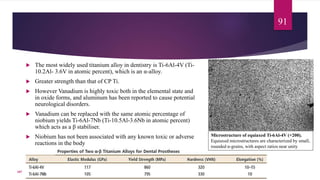
 The most widely used titanium alloy in dentistry is Ti-6Al-4V (Ti-
10.2Al- 3.6V in atomic percent), which is an α-alloy.
 Greater strength than that of CP Ti.
 However Vanadium is highly toxic both in the elemental state and
in oxide forms, and aluminum has been reported to cause potential
neurological disorders.
 Vanadium can be replaced with the same atomic percentage of
niobium yields Ti-6Al-7Nb (Ti-10.5Al-3.6Nb in atomic percent)
which acts as a β stabiliser.
 Niobium has not been associated with any known toxic or adverse
reactions in the body
91
Microstructure of equiaxed Ti-6Al-4V (×200).
Equiaxed microstructures are characterized by small,
rounded α-grains, with aspect ratios near unity
107
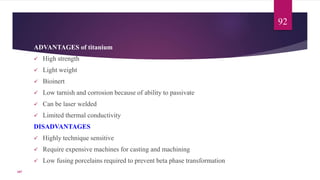
ADVANTAGES of titanium
 High strength
 Light weight
 Bioinert
 Low tarnish and corrosion because of ability to passivate
 Can be laser welded
 Limited thermal conductivity
DISADVANTAGES
 Highly technique sensitive
 Require expensive machines for casting and machining
 Low fusing porcelains required to prevent beta phase transformation
92
107
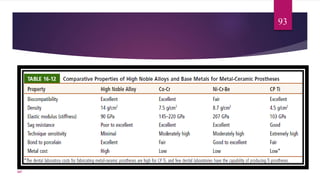
93
107
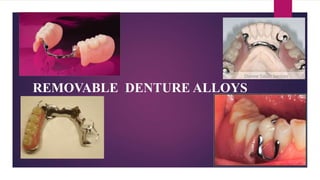
REMOVABLE DENTURE ALLOYS
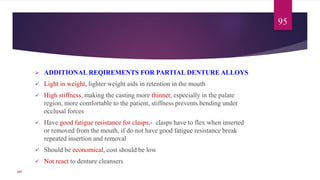
 ADDITIONAL REQIREMENTS FOR PARTIAL DENTURE ALLOYS
 Light in weight, lighter weight aids in retention in the mouth
 High stiffness, making the casting more thinner, especially in the palate
region, more comfortable to the patient, stiffness prevents bending under
occlusal forces
 Have good fatigue resistance for clasps,- clasps have to flex when inserted
or removed from the mouth, if do not have good fatigue resistance break
repeated insertion and removal
 Should be economical, cost should be low
 Not react to denture cleansers
95
107
TYPES alloys used for removable dentures
 Cobalt chromium alloys
 Nickel chromium alloys
 Aluminum and its alloys
 Type 4 noble alloys
 Titanium
96
107
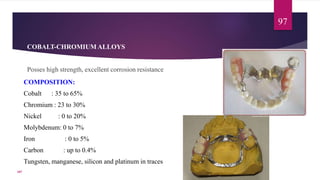
COBALT-CHROMIUM ALLOYS
Posses high strength, excellent corrosion resistance
97
107
COMPOSITION:
Cobalt : 35 to 65%
Chromium : 23 to 30%
Nickel : 0 to 20%
Molybdenum: 0 to 7%
Iron : 0 to 5%
Carbon : up to 0.4%
Tungsten, manganese, silicon and platinum in traces
PROPERTIES OF COBALT CHROMIUM
Cost Lower and good mechanical properties
Density: half that of gold alloys, lighter in weight (8 to 9 gm/cm3)
Fusion temperature:
Type-1(high fusing)-liquidus temperature greater than 1300° c
Type-2(low fusing)-liquidus temperature not greater than 1300 °c
Yield strength : higher than the gold alloys
Elongation: ductility is lower
Modulus of elasticity: twice as stiff as gold alloys, casting made thinner, the
weight of the RPD
Hardness: harder than gold alloys,cutting,grinding,finishing are difficult.
98
107
Tarnish and corrosion resistance:
Chromium oxide prevents tarnish and corrosion - passivating effect
Caution: hypochlorite denture cleaning cause corrosion ,should not be used to
clean chromium based alloys
Casting shrinkage: shrinkage is much greater due to high fusion temperature
Porosity: is due to shrinkage of alloy and release of dissolved gases
99
107
100
107
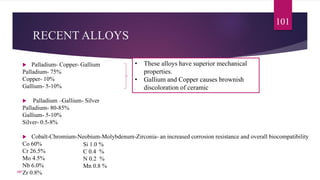
RECENT ALLOYS
 Palladium- Copper- Gallium
Palladium- 75%
Copper- 10%
Gallium- 5-10%
 Palladium –Gallium- Silver
Palladium- 80-85%
Gallium- 5-10%
Silver- 0.5-8%
 Cobalt-Chromium-Neobium-Molybdenum-Zirconia- an increased corrosion resistance and overall biocompatibility
Co 60%
Cr 26.5%
Mo 4.5%
Nb 6.0%
Zr 0.8%
101
• These alloys have superior mechanical
properties.
• Gallium and Copper causes brownish
discoloration of ceramic
Si 1.0 %
C 0.4 %
N 0.2 %
Mn 0.8 %
107
Comparison of titanium and cobalt-chromium
removable partial denture clasps.
 This study assessed the characteristics of cast clasps made of titanium and titanium alloys
to determine whether these materials are suitable alternatives for removable partial denture
applications.
 Removable partial denture clasps at two undercut depths were fabricated from
commercially pure titanium, titanium alloy (Ti-6A1-4V), and cobalt-chromium.
 Results showed that for the 0.75 mm undercut specimens, there was less loss of retention
for clasps made from pure titanium and titanium alloy than for cobalt-chromium clasps.
 Porosity was more apparent in the pure titanium and titanium alloy clasps than in those
made from cobalt-chromium.
102
The Journal of Prosthetic Dentistry. 1997;78(2):187-193.
107
Microstructure, elemental composition, hardness and crystal
structure study of the interface between a noble implant
component and cast noble alloys.
The Journal of Prosthetic Dentistry. 2011;106(3):170-178.
 Casting a high-gold alloy to a wrought prefabricated noble implant-component increases the cost
of an implant. Selecting a less expensive noble alloy would decrease implant treatment costs.
 The purpose of this study was to investigate the interfacial regions of a representative noble
implant component and cast noble dental alloys and to evaluate the effects of porcelain firing
cycles on the interface.
 Six representative alloys gold-platinum-palladium (Aquarius XH), gold-platinum (Brite Gold
XH), gold-palladium (IPS d.SIGN 91), palladium-silver (IPS d.SIGN 59), and palladium-silver-
gold (Capricorn 15) systems and ANSI/ADA Type IV (non-ceramic) gold alloy were cast to gold
implant abutments (ComOcta).
 Less expensive reduced-gold and palladium alloy alternatives provided comparable results to
high-gold alloys for joint quality. Consequently, such noble metal alternatives to high gold alloys
for conventional partial fixed dental prostheses might provide clinically acceptable implant
superstructures.
103
107
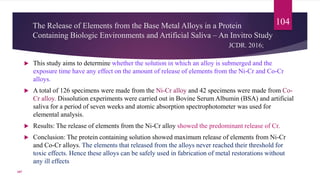
The Release of Elements from the Base Metal Alloys in a Protein
Containing Biologic Environments and Artificial Saliva – An Invitro Study
JCDR. 2016;
 This study aims to determine whether the solution in which an alloy is submerged and the
exposure time have any effect on the amount of release of elements from the Ni-Cr and Co-Cr
alloys.
 A total of 126 specimens were made from the Ni-Cr alloy and 42 specimens were made from Co-
Cr alloy. Dissolution experiments were carried out in Bovine Serum Albumin (BSA) and artificial
saliva for a period of seven weeks and atomic absorption spectrophotometer was used for
elemental analysis.
 Results: The release of elements from the Ni-Cr alloy showed the predominant release of Cr.
 Conclusion: The protein containing solution showed maximum release of elements from Ni-Cr
and Co-Cr alloys. The elements that released from the alloys never reached their threshold for
toxic effects. Hence these alloys can be safely used in fabrication of metal restorations without
any ill effects
104
107
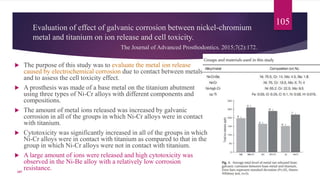
Evaluation of effect of galvanic corrosion between nickel-chromium
metal and titanium on ion release and cell toxicity.
The Journal of Advanced Prosthodontics. 2015;7(2):172.
.
 The purpose of this study was to evaluate the metal ion release
caused by electrochemical corrosion due to contact between metals
and to assess the cell toxicity effect.
 A prosthesis was made of a base metal on the titanium abutment
using three types of Ni-Cr alloys with different components and
compositions.
 The amount of metal ions released was increased by galvanic
corrosion in all of the groups in which Ni-Cr alloys were in contact
with titanium.
 Cytotoxicity was significantly increased in all of the groups in which
Ni-Cr alloys were in contact with titanium as compared to that in the
group in which Ni-Cr alloys were not in contact with titanium.
 A large amount of ions were released and high cytotoxicity was
observed in the Ni-Be alloy with a relatively low corrosion
resistance.
105
107
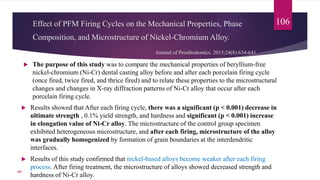
Effect of PFM Firing Cycles on the Mechanical Properties, Phase
Composition, and Microstructure of Nickel-Chromium Alloy.
Journal of Prosthodontics. 2015;24(8):634-641.
 The purpose of this study was to compare the mechanical properties of beryllium-free
nickel-chromium (Ni-Cr) dental casting alloy before and after each porcelain firing cycle
(once fired, twice fired, and thrice fired) and to relate these properties to the microstructural
changes and changes in X-ray diffraction patterns of Ni-Cr alloy that occur after each
porcelain firing cycle.
106
107
 Results showed that After each firing cycle, there was a significant (p < 0.001) decrease in
ultimate strength , 0.1% yield strength, and hardness and significant (p < 0.001) increase
in elongation value of Ni-Cr alloy. The microstructure of the control group specimen
exhibited heterogeneous microstructure, and after each firing, microstructure of the alloy
was gradually homogenized by formation of grain boundaries at the interdendritic
interfaces.
 Results of this study confirmed that nickel-based alloys become weaker after each firing
process. After firing treatment, the microstructure of alloys showed decreased strength and
hardness of Ni-Cr alloy.
 EACH ALLOY SYSTEM HAS ITS OWN PROS AND CONS AND IS DEVELOPED
FOR A SPECIFIC APPLICATION IN DENTISTRY OVERCOMING THE
DRAWBACKS OF ITS PREDECESSORS
 A SOUND KNOWLEDGE OF THE PROPERTIES AND HANDLIING OF THE
CASTING METALS AND ALLOYS IS ESSENTIAL TO ENSURE PROPER
APPLICATION IN CLINICAL PRACTICE AND DIAGNOSIS OF FAILURES IN
CASE THEY OCCUR.
107
107
REFERENCES
1. Phillips' Science Of Dental Materials, 12th Edition Anusavice & Shen & Rawls
2. Craig’s Restorative Dental Materials / Edited By Ronald L. Sakaguchi, John M. Powers. -- 13th Ed.
3. Dental Materials And Their Selection - 3rd Ed. (2002) By William J. O'brien
4. Applied Dental Materials –Mccabbes And Walls- 9th Ed.
5. Science of Dental Materials- Clinical Application – V Shama Bhat & B.T Nandish
108
107
CROSS REFERENCES
 1. Taira Y, Nakashima J, Sawase T, Sakihara M. Wear of tooth enamel against silver–palladium–gold
alloy and two other restorative materials in vitro. Journal of Prosthodontic Research. 2015;59(3):210-
212.
 2. Bridgemana J, Marker V, Hummel S, Benson B, Pace L. Comparison of titanium and cobalt-
chromium removable partial denture clasps. The Journal of Prosthetic Dentistry. 1997;78(2):187-193.
 3. Jorge J, Barão V, Delben J, Faverani L, Queiroz T, Assunção W. Titanium in Dentistry: Historical
Development, State of the Art and Future Perspectives. The Journal of Indian Prosthodontic Society.
2012;13(2):71-77.
 4. Ucar Y, Brantley W, Johnston W, Iijima M, Han D, Dasgupta T. Microstructure, elemental
composition, hardness and crystal structure study of the interface between a noble implant
component and cast noble alloys. The Journal of Prosthetic Dentistry. 2011;106(3):170-178.
109
107
 5. McGinley E, Moran G, Fleming G. Biocompatibility effects of indirect exposure of base-
metal dental casting alloys to a human-derived three-dimensional oral mucosal model. Journal of
Dentistry. 2013;41(11):1091-1100.
 6. Pangi A. The Release of Elements from the Base Metal Alloys in a Protein Containing
Biologic Environments and Artificial Saliva – An Invitro Study. JCDR. 2016;.
 7. Andrei M, Galateanu B, Hudita A, Costache M, Osiceanu P, Calderon Moreno J et al.
Electrochemical comparison and biological performance of a new CoCrNbMoZr alloy with
commercial CoCrMo alloy. Materials Science and Engineering: C. 2016;59:346-355
 8. Lee J, Song K, Ahn S, Choi J, Seo J, Park J. Evaluation of effect of galvanic corrosion
between nickel-chromium metal and titanium on ion release and cell toxicity. The Journal of
Advanced Prosthodontics. 2015;7(2):172. .
 9. Anwar M, Tripathi A, Kar S, Sekhar K. Effect of PFM Firing Cycles on the Mechanical
Properties, Phase Composition, and Microstructure of Nickel-Chromium Alloy. Journal of
Prosthodontics. 2015;24(8):634-641.
110
107
107
111

Alloys in prosthodontics

  • 1.
    ALLOYS IN PROSTHODONTICS PRESENTED BY- DR.KELLYNORTON POST GRADUATE STUDENT DEPT. OF PROSTHODONTICS
  • 2.
    INTRODUCTION  What isan alloy? A mixture of two or more metals or metalloids that are mutually soluble in the molten state; distinguished as binary, ternary, quaternary, etc., depending on the number of metals within the mixture 2 107
  • 3.
    Year Event 1907 Introductionof Lost-Wax Technique 1933 Replacement of Co-Cr for Gold in Removable Partial Dentures 1950 Development of Resin Veneers for Gold Alloys 1959 Introduction of the Porcelain Fused-to-Metal Technique 1968 Palladium-Based Alloys as Alternatives to Gold Alloy 1971 Nickel-Based Alloys as Alternatives to Gold Alloys 1980s Introduction of All-Ceramic Technologies 1999 Gold Alloys as Alternatives to Palladium-Based Alloys HISTORY 107 3
  • 4.
    METALS  Metals canbe classified as  1. Noble metals which have high resistance to oxidation, corrosion and dissolution in organic acids Eg. Gold, Platinum, Palladium, Iridium, Osmium, Ruthenium, Silver, Rhodium  2. Base Metals undergo oxidation and corrosion easily Eg. Iron, Nickel, Tin, Zinc,Chromium, Aluminium, Titanium etc  3. Metalloids: Few elements carbon, boron, silicon, sometimes behave like metals and some times nonmetals. 4 107
  • 5.
  • 6.
    SOLIDIFICATION OF METALS6 solidification temperature melting point or fusion temperature SUPERCOOLING • During the supercooling process, crystallization of the pure metal begins. • Once the crystals begin to form, the release of the latent heat of fusion causes the temperature to rise to Tf, where it remains until crystallization is completed at point C. 107
  • 7.
     Nucleation canoccur by two processes. The first, called homogeneous nucleation, is enhanced by rapid cooling so the nuclei are supercooled.  The more nuclei that are formed by rapid cooling, the smaller the grain size  Another means of decreasing the grain size (grain refining) is by adding to the melt a foreign solid particle or surface to which the atoms are attracted, such as a very fine high-melting metal or oxide powder. This process of seeding the nuclei is called heterogeneous nucleation.  All modern noble metal alloys are fine grained. Smaller the grain size of the metal, the higher yield stress, better ductility, and improved ultimate strength  A large grain size reduces the strength and increases the brittleness of the metal. 7 107
  • 8.
    CRYSTALLISATION OF METALS 8 When a molten alloy cools to the solid state, crystals form around tiny nuclei (clusters of atoms).  As the temperature drops, these crystals grow until the crystal boundaries meet each other in the solid state.  At this point, each crystal is called a grain and the boundaries between crystals are grain boundaries.  Characteristically, a pure metal crystallizes from nuclei in a pattern that often resembles the branches of a tree, yielding elongated crystals that are called Dendrites.  Predominantly base metal (PB) alloys for dental prostheses typically solidify with a dendritic microstructure, most high noble (HN) and noble (N) metal casting alloys solidify with an equiaxed polycrystalline microstructure (grain).107
  • 9.
    NEWTON’S LAW OFCOOLING  According to this law, the quantity of heat lost per second from a hot body i.e. rate of cooling is directly proportional to the means excess of its temperature above the cooler surrounding  Temperature against time graph, i.e the cooling curve is exponential, indicating , infinite time is required for the cooling of the hot body to reach the external temperature, if not disturbed 9 107
  • 10.
    COOLING PATTERN OFA LIQUID METAL DURING SOLIDIFICATION 10  The upper temperature for the liquid-solid alloy range is called the liquidus temperature, and the lower temperature limit is called the solidus temperature.  When a liquid alloy melt is being cooled or heated, the liquidus temperature is the temperature at which solid crystals start to nucleate or dissolve into liquid respectively.  The solidus temperature is the temperature at which the last liquid solidifies on cooling or the first liquid is formed on heating. 107
  • 11.
    COOLING CURVE  Fora binary solid solution alloy of two metals, A and B, in which the melting point of metal A is greater than that of metal B, the first material to crystallize, at just below temperature T1, will be rich in the higher melting point metal A close to the nucleus , whilst the last material to crystallize, at a temperature just above T2, is rich in the lower melting point metal B close to the grain boundaries . 11 107 A - close to the nucleus B - close to the boundary
  • 12.
    12To increase hardness and strength. Toincrease fluidity of liquid metal To make casting or working on the metal easy. To increase resistance to tarnish and corrosion. To lower or increase the melting point To change the microscopic structure of the metal. To change the color of the metal. To provide special electrical and magnetic properties. 107
  • 13.
    SOLID SOLUTION  Inthe molten state metals usually show mutual solubility, one within another. When the molten mixture is cooled to below the melting point the component metals may remain soluble in each other forming a solid solution. 13 CONDITIONS FAVORING SOLID-SOLUBILITY  Atom size - if the atom sizes of the mixing metal are same, it will produce solid solution type alloy.  Valency - metals of the same valency will produce solid-solution alloy.  Space-lattice type - if same, preferably if face centered will favour solid solubility.  Chemical affinity - must be less to produce solid-solution alloy. 107
  • 14.
    TYPES OF SOLIDSOLUTION  There are two principal atomic arrangements for binary solid solutions.  One of these is the substitutional solid solution in which the atoms of the solute metal occupy the positions in the crystal structure that are normally occupied by the solvent atoms in the pure metal.  Can be Disordered : when the substitution is random in the crystal lattices • E.g Pd-Ag alloy in which Pd is the solvent metal, Ag atoms replace the Pd atoms randomly in the crystal structure.  Can be Ordered: when new ordered phases are formed by diffusion of atoms which precipitate as superlattice. Eg. Cu in Au 14 107
  • 15.
     Another typeof solid solution is the interstitial solid solution. In this case, the solute atoms are present in random positions (interstices) between the atoms in the crystal structure of the solvent metal. Commercially pure titanium (CPTi), which is important for implants and restorative dentistry, consists of high- purity (99 wt% or higher) titanium, with oxygen, carbon, nitrogen, and hydrogen atoms dissolved interstitially.  Eutectic Solid Solution refers to different solid solutions of limited solubilities, precipitate as alternate layers 15 107
  • 16.
    PHASE DIAGRAM FORALLOYS  A phase is a state of matter that is distinct in some way from the matter around it.  Phase diagrams are maps of the phases that occur when metals are mixed together .  The x axis -------- composition of element  The y axis -------- temperature of the alloy system.  shows the composition and types of phases at a given temperature and at equilibrium.  Every phase diagrams divides an alloy system into at least three areas :the liquid phase, the liquid –solid phase and solid phase.  If a series of cooling curves for alloys of different composition within a given alloy system are available a phase diagram can be constructed from which many important predictions regarding coring and other structural variations can be made. 16 107
  • 17.
  • 18.
    CORING  For solidsolution alloys a cored structure exists in which the first material to crystallize is rich in the metal with the higher melting point (A), whilst the last material to solidify is rich in the other metal (B)  An indication of the degree of coring is given by the separation of the solidus and liquidus lines on the phase diagram.  With slow cooling the crystallization process is accompanied by diffusion and a random distribution of atoms results, with no coring.  Rapid cooling quickly denies the alloy the energy and mobility required for diffusion of atoms to occur and the cored structure is ‘locked in’ at low temperatures. 18 107
  • 19.
     This involvesheating the alloy to a temperature just below the solidus temperature for a few minutes to allow diffusion of atoms and the establishment of an homogeneous structure and then normally quenched in order to prevent grain growth from occurring. HOMOGENIZATION 19 A, Copper-silver alloy (1%) as cast. B, The same cast alloy after homogenization heat treatment 107
  • 20.
    EUTECTIC ALLOYS  Theeutectic alloy is one in which the components exhibit complete solubility in the liquid state but limited solid solubility  The term eutectic means lowest melting point.  In silver copper system ----  M.P. silver is around 960.5°C and that of copper is 1083° C.  But that of the eutectic composition is 779.4° C.  Eutectic –alternative layer of alpha (silver rich)and beta(copper rich) phases. 20  It can be written as : LIQUID α SOLID SOLUTION + ß SOLID SOLUTION INVARIANT TRANSFORMATION- OCCURS AT SINGLE TEMPERATURE AND COMPOSITION SILVER-COPPER SYSTEM: 107
  • 21.
    PROPERTIES OF EUTECTICALLOYS • These in contrast to other alloys do not have a solidification range ; instead they have a solidification point. • Hard and Brittle, because the presence of alternate alpha and beta phases inhibits slip. • The silver rich alpha solid solution or copper rich beta solid solution are hard and have higher strength. They are ductile and malleable. • They have a low melting point and therefore are important as solders. 21 107
  • 22.
     Peritectic isa phase where there is limited solid solubility.  They are not of much use in dentistry except for silver tin system. Eg: Silver-tin Silver –platinum Palladium-ruthenium 22 PERITECTIC ALLOYS Liquid +  solid solution  solid solution107
  • 23.
    GOLD COPPER SYSTEM These are disordered substitutional alloys below solidus and meet each other at 911 C when the gold is about 80 wt %.  When the AuCu phase is slowly cooled below 375 C or 410 C, the attraction between gold and copper atoms cause intermetallic alloy phases.  AuCu3 phase: If amount gold = 40-65 wt% then, solid state reaction takes place by ordering the copper atoms int the middle of the faces and gold atoms at the corners of the F.C.C. unit cell.  AuCu phase: when the gold is more 65- 85 wt % the solid state reaction takes place by forming intermetallic alloy Au- Cu equilibrium phase with alternate layers of gold and copper 23 107
  • 24.
    INTERMETALLIC COMPOUNDS Inter metalliccompounds are those when the metals are soluble in the liquid state but unite and form a chemical compound on solidifying. Eg ; Ag3 – Sn, Sn7 – Hg8 They are called inter metallic compounds because the alloy is formed by a chemical reaction between a metal and metal. 24 107
  • 25.
    TYPES HEAT TREATMENT Precipitation hardening or order hardening. Precipitation hardening relies on changes in solid solubility with temperature to produce fine particles of an impurity phase, which impede the movement of dislocations, or defects in a crystal's lattice Technique:  The alloy is heat soaked at temperature between 200 C and 450 C for 15-30 minutes and then rapidly cooled by quenching 25 Strength Hardness Proportional Limit Ductility 107
  • 26.
     Solid solutionsare generally harder, stronger and have higher values of elastic limit than the pure metals from which they are derived. The hardening effect, known as solution hardening, is thought to be due to the fact that atoms of different atomic radii within the same lattice form a mechanical resistance to the movement of dislocations along slip planes.  Age Hardening : After solution heat treatment, the alloy is once again heated to bring about further precipitation. This also causes hardening of the alloy and is known as age hardening because the alloy will maintain its quality for many years. Ideally, before age hardening an alloy, it should first be subjected to a softening heat treatment  1) To relieve all strain and 2) starting the age hardening treatment when the alloy is in a disordered solid solution - allows better control of the hardening process 26 107
  • 27.
     In asummary, Solid solution strengthening involves formation of a single-phase solid solution via quenching. Precipitation heat treating involves the addition of impurity particles to increase a material's strength  A heat treatment is sometimes used to eliminate the cored structure. Such a heat treatment is termed a homogenization heat treatment. Homogenization heat treatment INCREASES DUCTILITY AND CORROSION RESISTANCE 107 27
  • 28.
     Clinical significanceof heat treatment  Type I and II gold alloys usually do not harden or they harden to a lesser degree than do the types III and IV gold alloys.  The type III and IV gold alloys that can be hardened or strengthened from quenching, can also be softened by heat treatments. 28 107
  • 29.
  • 30.
    CLASSIFICATION OF ALLOYS ALLOY CLASSIFICATION BY NOBLE METAL CONTENT 30 In order of increasing melting temperature, they include gold, palladium, platinum, rhodium, ruthenium, iridium, and osmium. Only gold, palladium, and platinum, which have the lowest melting temperatures of the seven noble metals, are currently of major importance in dental casting alloys. 107
  • 31.
  • 32.
    ALLOY TYPE BYMAJOR ELEMENTS: Gold-based, palladium-based, silver-based, nickel-based, cobalt-based and titanium-based . ALLOY TYPE BY PRINCIPAL THREE ELEMENTS: Such as Au-Pd-Ag, Pd-Ag-Sn, Ni-Cr-Be, Co-Cr-Mo, Ti-Al-V and Fe-Ni-Cr. (If two metals are present, a binary alloy is formed; if three or four metals are present, ternary and quaternary alloys, respectively, are produced and so on.) ALLOY TYPE BY DOMINANT PHASE SYSTEM: Single phase [isomorphous], eutectic, peritectic and intermetallic.107 32
  • 33.
    ALLOY CLASSIFICATION BYDENTAL APPLICATIONS 33 107
  • 34.
    34 Published in theMarch 2003 Journal of the American Dental Association. 107
  • 35.
    Metallic Elements Usedin Dental Alloys NOBLE METALS • Noble Metal are corrosion and oxidation resistant because of inertness and chemical resistance. • Basis of inlays, crowns and bridges because of their resistance to corrosion in the oral cavity. • Gold, platinum, palladium, rhodium, ruthenium, iridium, osmium, and silver 35 107
  • 36.
    GOLD  Pure gold--soft, malleable, ductile, rich yellow color, strong metallic luster.  Lowest in strength and surface hardness.  Highest ductility, malleability and high density  High level of corrosion and tarnish resistance  High melting point, low C.O.T.E value and very good conductivity  Improves workability, burnish ability, raises the density .  Alloyed with copper, silver, platinum, and other metals to develop the hardness, durability, and elasticity 36 • Density 19.3 g/cm3 • Melting point 1063oc • Boiling point of 2970oc • KHN 25 • CTE of 14.2×10⁻⁶/°c. 107
  • 37.
    Gold content: Traditionally thegold content of dental casting alloys have been referred to in terms of: Carat:  The term carat refers only to the gold content of the alloy; a carat represents a 1⁄24 part of the whole. Thus 24 carat indicates pure gold. The carat of an alloy is designated by a small letter k, for example, 18k or 22k gold. Fineness:  Fineness also refers only to the gold content, and represents the number of parts of gold in each 1000 parts of alloy. Thus 24k gold is the same as 100% gold or 1000 fineness (i.e., 1000 fine) or an 18k gold would be designated as 750 fine. 37 107
  • 38.
    Silver  Lowers themelting range  Low corrosion resistance  In gold-based alloys, silver is effective in neutralizing the reddish color of copper.  Silver also hardens the gold-based alloys via a solid-solution hardening mechanism.  Increases CTE in gold- and palladium-based alloys  Foods containing sulfur compounds cause severe tarnish on silver, and for this reason silver is not considered a noble metal in dentistry.  Pure silver is not used in dental restorations because of the black sulfide that forms on the metal in the mouth. density 10.4gms/cm3 melting point 961oC boiling point 2216 oC CTE 19.710-6/oC , 38107
  • 39.
    Platinum  High density,ductile and malleable  increases the strength and corrosion resistance.  increases the melting point  whitening effect on the alloy. 39 • High density 21.45 g/cm3 • High melting point 1769oC • Boiling point of 4530 oC • Low CTE 8.910-6/oC 107
  • 40.
    Palladium  hardens +whitens the alloy.  increases the melting point.  Improves--tarnish resistance.  Lowers the C.O.T.E value  Absorbs or occluding large quantities of hydrogen gases when heated with an improperly adjusted gas torch. 40 • density 12.02gms/cm3 • melting point 1552oC • boiling point 3980 oC • lower CTE 11.810-6/oC when compared to gold. 107
  • 41.
    Iridium and Ruthenium grain refiners for gold- and palladium-based alloys  Reduces grain size.  Improve the mechanical properties & tarnish resistance.  IRIDIUM has a high melting point of 2454°C , boiling point of 5300 °C , density of 22.5gm/cm3 and CTE 6.810-6/oC.  RUTHENIUM has a melting point of 1966°C , boiling point of 4500 °C , density of 12.44 gm/cm3 and CTE 8.310-6/oC 41107
  • 42.
  • 43.
    Cobalt • INCREASES hardness,strength and elastic modulus. • high melting point of 1495°C • boiling point of 2900 °C • density of 8.85 gm/cm3 and • CTE 13.810-6/oC 43 107
  • 44.
    Nickel  Chosen basefor porcelain alloys because its COTE approximates that of gold  provides resistance to corrosion.  sensitizer and a known carcinogen.----contact dermatitis  melting point of 1453°C  boiling point of 2730 °C  density of 8.9 gm/cm3  CTE 13.310-6/oC 44107
  • 45.
    Chromium  passivating effect Chromium content is directly proportional to tarnish and corrosion resistance.  solid solution hardening.  It has melting point of 1875°C  boiling point of 2665 °C  density of 7.19 gm/cm3  CTE 6.210-6/ oC 45107
  • 46.
    Copper  principal hardener. reduces the melting point and density of gold.  gives the alloy a reddish colour.  It also helps to age harden gold alloys.  In greater amounts it reduces resistance to tarnish and corrosion of the gold alloy. Therefore, the maximum content should NOT exceed 16%.  It has melting point of 1083°C , boiling point of 2595 °C , density of 8.96 gm/cm³ and CTE 16.5 10-6/°C . 46107
  • 47.
     scavenger foroxygen.  Makes the alloy brittle.  Later during solidification, the oxygen is rejected producing gas porosities in the casting because of low density.  melting point of 420°C  boiling point of 906 °C  density of 7.133gm/ cm3  CTE 39.710-6/oC ZINC 47 107
  • 48.
    MOLYBDENUM • effective hardener •Molybdenum is preferred as it reduces ductility to a lesser extent than tungsten. • refines grain structure. • melting point of 2610°C • boiling point of 5560 °C • density of 10.22 gm/cm3 • CTE 4.9 10-6/oC 48 107
  • 49.
    Iron • Fe---helps toharden the metal ceramic gold - palladium alloys • melting point 1527°C • boiling point 3000 °C • density 7.87 gm/cm3 • CTE 12.3 10-6/oC . 49 107
  • 50.
    Beryllium  Be---reduces fusiontemperature and refines grain structure .  improves castability & polishability  is a hardener  controls oxide formation  The etching of nickel-chromium-beryllium alloys removes a Ni- Be phase to create the micro retention so important to the etched metal resin-bonded retainer.  Potential Health risk - Berylliosis 50107
  • 51.
    Tin  hardening agent lower the melting range of an alloy.  assists in oxide production for porcelain bonding in gold and palladium-based alloys.  Tin is one of the key trace elements for oxidation of the palladium-silver alloys. 51107
  • 52.
    Aluminium  Lowers themelting range of nickel-based alloys.  Act as a hardening agent and influences oxide formation.  With the cobalt - chromium alloys used for metal ceramic restorations. 52107
  • 53.
    Gallium  Added tosilver-free porcelain alloys to compensate for the decreased COTE created by the removal of silver.  The oxides of gallium are important to bonding of ceramic to metal.  It has a very low melting point of 29.8 C and density of only 5.91g/cm3. 53107
  • 54.
    Indium  oxide-scavenging agent(to protect molten alloy).  High COTE value ( 33ppm/°C) and very low melting temperature (156°C)  Enhance tarnish resistance as it is not tarnished by air or water 54107
  • 55.
    CARBON: • Small amountsmay have a pronounced effect on strength, hardness and ductility. • Carbon forms carbides with any of the metallic constituents which is an important factor in strengthening the alloy. • when in excess it increases brittleness 55 melting point of 3700°c boiling point of 4830 °C density of 2.22 gm/cm3 CTE 6 10-6/oC . 107
  • 56.
    BORON  It isa deoxidizer and hardener, but reduces ductility.  In Nickel-based alloys it is a hardening agent and an element that reduces the surface tension of the molten alloy to improve castability 56 107
  • 57.
  • 58.
    DESIRABLE PROPERTIES OFDENTAL CASTING ALLOYS  They must not tarnish and corrode in the mouth.  They must be biocompatible (nontoxic and nonallergic).  Alloys for bridgework require higher strength than alloys for single crowns. Alloys for metal- ceramic prostheses are finished in thin sections and require sufficient stiffness to prevent excessive elastic deflection from functional forces, especially when they are used for long-span frameworks.  They must be easy to melt, cast, cut and grind (easy to fabricate).  The melting range of the casting alloys must be low enough to form smooth surfaces with the mold wall of the casting investment. 58 107
  • 59.
     For metalceramic prostheses, the alloys must have closely matching thermal expansion coefficients to be compatible with given porcelains, and they must tolerate high processing temperatures without deforming via a creep process.  They must flow well and duplicate fine details during casting.  They must have minimal shrinkage on cooling after casting.  They must be easy to solder.  To achieve a sound chemical bond to ceramic veneering materials, the alloy must be able to form a thin adherent oxide, preferably one that is light in color so that it does not interfere with the esthetic potential of the ceramic. 59 107
  • 60.
    ALLOYS FOR ALL-METALPROSTHESES - HIGH NOBLE AND NOBLE ALLOYS
  • 61.
    Gold-Based Alloys  Thesealloys are generally yellow in color.  Type 1 gold alloys are soft and designed for inlays supported by teeth and not subjected to significant mastication forces.  Type 2 alloys are widely used for inlays because of their superior mechanical properties, but they have less ductility than type 1 alloys.  Type 3 alloys are used for constructing crowns and onlays for high-stress areas. Increasing the Pt or Pd content raises the melting temperature, which is beneficial when components are to be joined by soldering (or brazing).  Type 4 gold alloys are used in high-stress areas such as bridges and partial denture frameworks. 61 107
  • 62.
  • 63.
    HEAT TREATMENT OFGOLD ALLOYS: Heat treatment of alloys is done in order to alter its mechanical properties. Type III and type IV gold alloys can be heat-treated. There are two types of heat treatment. 1. Softening Heat Treatment (Solution heat treatment) 2. Hardening Heat Treatment (Age hardening) 63 107
  • 64.
    SILVER – PALLADIUMALLOYS: • Offered as an economical alternative to the more expensive gold-platinum-silver and gold-palladium-silver (gold based) alloy systems. • Palladium – cheaper tarnish resistance Ag – Pd (non copper) : Ag 70 – 72 % Pd 25 % Ag – Pd – Cu : Ag 60% Pd 25 % Cu 15%  The major limitation of Ag-Pd alloys in general and in the Ag-Pd-Cu alloys in particular is their greater potential for tarnish and corrosion.  Silver, copper, and/or gold can be added to increase the ductility and improve the castability of the alloy for dental applications 64 107
  • 65.
    NICKEL - CHROMIUMAND COBALT - CHROMIUM ALLOYS: Also known as base metal alloys , extensively used The Ni-Cr alloys can be divided into those with and without beryllium, which improves castability and promotes the formation of a stable metal oxide for porcelain bonding. Advantages :low cost strong and hard Disadvantage : difficult to work (cutting , grinding , polishing) TITANIUM AND TITANIUM ALLOYS : can be used for metal and metal ceramic restorations as well as partial dentures . 65 107
  • 66.
  • 67.
    COMMON FEATURES OFPFM ALLOYS  (1) they have the potential to bond to dental porcelain:  The addition of a small quantity of base metal to noble and high noble alloys promotes oxide formation on the surface, which promotes chemical bonding between the alloy and the porcelain  (2) they exhibit coefficients of thermal contraction compatible with those of dental porcelain:  The thermal contraction differential between metal alloys and dental porcelains may, under certain conditions, contribute to high levels of stress in porcelain, which can induce cracking of porcelain or delayed fracture.  (3) their solidus temperature is sufficiently high to resist softening during the sintering of porcelain:  When an alloy is heated close to its solidus temperature, it may become susceptible to flow under its own mass (creep). All metal-ceramic alloys should have a solidus temperature that is significantly higher than the sintering temperature of the porcelain so as to minimize creep deformation. 67 107
  • 68.
    CHEMICAL BONDING  Theaddition of 1% passivating base metals to gold palladium and platinum alloys was sufficient to produce a slight oxide film on surface of sub structure to achieve porcelain metal bond strength that surpassed the cohesive strength of porcelain.  By electro-depostion of Gold on an article followed by Tin which forms a tin oxide layer that helps to chemically bond to cermaics 68 107
  • 69.
    MECHANICAL INTERLOCKING  Theceramic penetrating into a roughened metal surface can mechanically attach to the metal, improving adhesion.  Roughness provides increased surface area for adhesion and more room for chemical bond to form.  Sandblasting is often used to roughen the surface of the metal coping to improve the bonding of the ceramic. 69 107
  • 70.
    THERMAL COMPATIBILITY  Whenthe co efficient of thermal expansion of metal and porcelain are incompatible the tensile stress that develop during cooling are sufficient to cause immediate cracking of porcelain or delayed cracking after cooling at room temperature.  Porcelains have coefficient of thermal expansion between 13.0 and 14.0 X 10⁻⁶ and metal between 13.5 and 14.5 X 10⁻⁶.  The difference of 0.5 X10⁻⁶ in thermal expansion between metal and porcelain causes the metal to contract slightly more than does the ceramic during cooling after firing the porcelain  The C.O.T.E of alloys is decreased by adding platinum or palladium. 70 107
  • 71.
    HIGH NOBLE AND NOBLEALLOYS Most alloys contain palladium, whose high melting point improves sag resistance during firing, and whose thermal contraction coefficient is lower than that of silver, gold, and platinum, which is helpful in developing lightweight metal-ceramic alloys that are compatible with currently used dental ceramics.
  • 72.
    The Gold-Platinum-Palladium (Au-Pt-Pd) System: Thisis one of the oldest metal ceramic alloy system. But these alloys are not used widely today because they are very expensive.  These alloys have adequate elastic modulus, strength, hardness, and elongation but are low in sag resistance.  Therefore, they should be limited to crowns and three-unit FDPs.  Their use has decreased over time, since more economical alloys have been developed with significantly better mechanical properties and sag resistance.107 72
  • 73.
    Gold-Palladium-Silver Alloys  Thesealloys are economical alternatives to the Au-Pt-Pd or Au-Pd-Pt alloys.  Excellent tarnish and corrosion resistance  Increased melting ranges.  Improved resistance to creep deformation (sag) at elevated temperatures.  A study revealed that Ag–Pd–Au alloy has a lower potential to abrade opposing enamel than do indirect resin composite, disilicate glass ceramic, and tooth enamel. 73 Journal of Prosthodontic Research. 2015;59(3):210-212. Japanese Dental Science Review. 2011;47(1):82-87. 107
  • 74.
    Gold - PalladiumAlloys  Lower thermal contraction coefficient than that of either the Au-Pd-Ag or Pd-Ag alloys.  The esthetic quality of metal-ceramic prostheses made with Au-Pd alloys is comparable to that obtained with Au-Pt-Pd alloys.  The sag resistance of these alloys is better than that of Au-Pt-Pd alloys. 74 107
  • 75.
    PALLADIUM-SILVER ALLOYS Alternative togold and base metal alloys  Disadvantage- high silver content causes greening (green yellow discoloration of metal ceramic alloy) 75 107
  • 76.
    PALLADIUM BASED ALLOYS 76 PALLADIUM-COBALTALLOYS Composition Palladium 78 to 88 wt% Cobalt 4 to 10 wt% Gallium up to 9 wt% (in some brands) Base metal around 1 wt% Esthetics – cobalt causes insignificant discoloration Sag resistance-good PALLADIUM-COPPER ALLOYS Composition Palladium 74 to 80 wt% Copper 5 to 10 wt% Gallium 4 to 9 wt% Gold 1 to 2 wt% (in some brands) Base metals around 1 wt% Esthetics – Copper -causes slight discoloration, darker brown black oxide layer PALLADIUM-GALLIUM ALLOYS Composition Palladium 75 wt% Gallium 6 wt% Silver 5 to 8 wt% Gold 6 wt%(when present) Base metals around 1 wt% Esthetics – oxide layer is lighter than Pd Cu and Pd Co alloys 107
  • 77.
    BASE METALALLOYS FORMETAL-CERAMIC RESTORATIONS  Base metal alloys used for metal ceramic are: o Nickel - chromium alloys o Titanium and titanium alloys o Cobalt -chromium alloys 77 107
  • 78.
    GENERAL PROPERTIES OFNICKEL BASED ALLOYS Cost: cheapest Colour: white Melting range: 1155 to 1304° c high Density: 7.8 to 8.4 gm/cm3 Hardness and workability: 175 to 360 VHN, much harder than high noble metal ceramic alloys, hardness makes them very difficult to cut grind and polish, more chair time, high hardness results in rapid wear of carbide and diamond burs Yield strength: 310 to 828 Mpa, stronger 78 107
  • 79.
    Modulus of elasticity:150 to 218 Gpa, base metal alloys are twice as stiff as gold ceramic, gold alloys are require a minimum thickness of atleast 0.3 to 0.5mm, whereas base metal copings can be reduced to 0.3mm Percent elongation: 10 to 28%,ductility of alloy , not easily burnishable porcelain bonding: adequate oxide layer, essential for successful porcelain bonding Sag resistance: more stable at porcelain firing, higher sag resistance Esthetics: a dark oxide layer seen at porcelain metal 79 107
  • 80.
    Tarnish and corrosionresistance: highly resistant, this is due to the property known as passivation. passivation is the resistant oxide layer on surface of chrome containing alloys Soldering: base metal alloys much more difficult to solder than gold alloys Casting shrinkage: higher casting shrinkage than gold alloys, greater mould expansion is to compensate for inadequate compensation for casting shrinkage Etching: the alloy's surface can etched electrochemically to create micromechanical retention for resin-bonded FPD’s (Maryland Bridges). 80 107
  • 81.
    Biological considerations: nickelmay produce allergic, potential carcinogen, beryllium potentially toxic, inhalation of beryllium containing dust or fumes known as berylliosis, flu-like symptoms and granulomas of the lungs. Precautions: wear mask, well-ventilated, good exhaust 81 107
  • 82.
    NICKEL-CHROMIUM (NI-CR) ALLOYS used for complete crown and all metal fixed partial denture prosthesis  major constituents - nickel -61 to 71 % chromium – 11 to 27 %  The system contains two major groups: -Beryllium free (class 1) -Beryllium (class 2) 82 107
  • 83.
    NICKEL CHROMIUM ALLOYS Composition Basicelements Nickel : 61 To 81 Wt% Chromium : 11 To 27 Wt% Molybdenum : 2 To 9 Wt% 83 The minor additions include Beryllium : 0.5 To 2.0 Wt% Aluminum : 0.2 To 4.2 Wt% Iron : 0.1 To 0.5 Wt% Silicon : 0.2 To 2.8 Wt% Copper : 0.1 To 1.6 Wt% Manganese : 0.1 To 3.0 Wt% Cobalt : 0.4 To 0.5 Wt% Tin : 1.25 wt% ADVANTAGES • Low cost • Low Density permits more castings • High sag resistance • Poor thermal conductor • Can be etched DISADVANTAGES • Cannot be used with nickel-sensitive patients • Beryllium exposure may be potentially harmful • Bond failure more common in oxide layer • High hardness, may wear opposing tooth 107
  • 84.
    NICKEL-CHROMIUM BERYLLIUM FREEALLOYS  Composition: Nickel – 62% to 77% Chromium – 11% to 22% Boron , iron, molybdenum, Niobium or columbium and tantalum (trace elements). Advantages 1. Do not contain beryllium 2. Low cost . 3. Low density means more casting alloys Disadvantages 1. Cannot use with Nickel sensitive patients. 2. Cannot be etched.(Cr doesn’t dissolve in acids) 3. May not cast as well as Ni-Cr-Be per ounce 4. Produces more oxide than Ni-Cr-Be 84 107
  • 85.
    Comparative properties ofNi / Cr alloys and type III casting gold alloys for small cast restorations 85 Property (Units) Ni/Cr Type III gold alloy Comments Density (g/cm3) 8 15 More difficult to produce defect free casting for Ni/Cr alloys. Fusion temperature As high as 1350°C Normally lower than 1000°C Ni/Cr alloys require electrical induction furnace or oxyacetylene equipment. Casting shrinkage (%) 2 1.4 Mostly compensated for by correct choice of investment Tensile strength (MPa) 600 540 Both adequate for the applications being considered. Proportional limit (MPa) 230 290 Both high enough to prevent distortion for applications being considered; not that values are lower than for partial denture alloys Modulus of elasticity (GPa) 220 85 Higher modulus of Ni/Cr is an advantage for large restoration e.g. bridges and for porcelain bonded restoration. Hardness (VHN) 300 150 Ni/Cr more difficult to polish but retains polish during service Ductility (% elongation) upto 30% 20 (as cast) 10 (hardened) Relatively large values suggest that burnishing is possible; however, large proportional limit value suggests higher forces would be require. 107
  • 86.
    TITANIUM AND TITANIUMALLOYS :  Titanium derives its corrosion protection from a thin passivating oxide film (approximately 10 nm thick), which forms spontaneously with surrounding oxygen  Titanium has a high melting point (1668 °C) and high rate of oxidation above 900 °C. 86 107
  • 87.
    Commercially Pure Titanium CP Ti is often selected for its excellent corrosion resistance, especially in applications for which high strength is not required.  CP Ti has a hexagonal closepacked (HCP) crystal lattice, which is denoted as the alpha (α) phase.  On heating, an allotropic phase transformation occurs. At 883° C, a body-centered cubic (BCC) phase, which is denoted as the beta (β) phase, forms.  A component with predominantly β phase is stronger but more brittle than a component with α-phase microstructure 87 107
  • 88.
    PROPERTIES OF COMMERCIALLYPURE TITANIUM Phases: in metallic form at ambient temperature- has a hexagonal, close- packed crystal lattice, transforms into a body-centered cubic format 883 °c- phase is susceptible to oxidation. Color: white Density: light weight metal 4.5 gm/cm3 compared nickel chrome 8gm/cm3 and gold alloys 15 gm/cm3 Modulus of elasticity: half as rigid as base metal alloys Melting point: quite high 1668° c Yield strength: 460 to 600 MPa Tensile strength: 560 to 680 Mpa 88 107
  • 89.
    Coefficient of thermalexpansion: CTE(8.4-10)too low to be compatible with porcelain. for this reason special low fusing porcelains have been developed to get around this problems Biocompatibility: nontoxic excellent biocompatibility Tarnish and corrosion: • Ability to self-passivate, oxidizes in air to form a tenacious and stable oxide layer, oxide layer protects the metal from further oxidation. • Oxide layer allows for bonding of fused porcelains, adhesive polymers, • In case of endosseous implants, plasma-sprayed or surface-nucleated apatite coatings. 89 107
  • 90.
    Titanium Alloys  Byincorporating α and/or β microstructural stabilizers, four possible types of titanium alloys can be produced: α, near-α, α-β, and β.  Alpha-phase stabilizers, such as aluminum, carbon, nitrogen, and gallium, cause the transformation from α to β phase to occur at a higher temperature on heating.  Beta-phase stabilizers, such as molybdenum, cobalt, nickel, niobium, copper, palladium, tantalum, and vanadium, cause the transformation from β to α phase to occur at lower temperatures on cooling.  In general, alpha-titanium is weldable, but difficult to form or work with at room temperature.  Beta titanium, however, is malleable at room temperature and is thus used in orthodontics.  The (α + β) alloys are strong and formable but difficult to weld 90 107
  • 91.
     The mostwidely used titanium alloy in dentistry is Ti-6Al-4V (Ti- 10.2Al- 3.6V in atomic percent), which is an α-alloy.  Greater strength than that of CP Ti.  However Vanadium is highly toxic both in the elemental state and in oxide forms, and aluminum has been reported to cause potential neurological disorders.  Vanadium can be replaced with the same atomic percentage of niobium yields Ti-6Al-7Nb (Ti-10.5Al-3.6Nb in atomic percent) which acts as a β stabiliser.  Niobium has not been associated with any known toxic or adverse reactions in the body 91 Microstructure of equiaxed Ti-6Al-4V (×200). Equiaxed microstructures are characterized by small, rounded α-grains, with aspect ratios near unity 107
  • 92.
    ADVANTAGES of titanium High strength  Light weight  Bioinert  Low tarnish and corrosion because of ability to passivate  Can be laser welded  Limited thermal conductivity DISADVANTAGES  Highly technique sensitive  Require expensive machines for casting and machining  Low fusing porcelains required to prevent beta phase transformation 92 107
  • 93.
  • 94.
  • 95.
     ADDITIONAL REQIREMENTSFOR PARTIAL DENTURE ALLOYS  Light in weight, lighter weight aids in retention in the mouth  High stiffness, making the casting more thinner, especially in the palate region, more comfortable to the patient, stiffness prevents bending under occlusal forces  Have good fatigue resistance for clasps,- clasps have to flex when inserted or removed from the mouth, if do not have good fatigue resistance break repeated insertion and removal  Should be economical, cost should be low  Not react to denture cleansers 95 107
  • 96.
    TYPES alloys usedfor removable dentures  Cobalt chromium alloys  Nickel chromium alloys  Aluminum and its alloys  Type 4 noble alloys  Titanium 96 107
  • 97.
    COBALT-CHROMIUM ALLOYS Posses highstrength, excellent corrosion resistance 97 107 COMPOSITION: Cobalt : 35 to 65% Chromium : 23 to 30% Nickel : 0 to 20% Molybdenum: 0 to 7% Iron : 0 to 5% Carbon : up to 0.4% Tungsten, manganese, silicon and platinum in traces
  • 98.
    PROPERTIES OF COBALTCHROMIUM Cost Lower and good mechanical properties Density: half that of gold alloys, lighter in weight (8 to 9 gm/cm3) Fusion temperature: Type-1(high fusing)-liquidus temperature greater than 1300° c Type-2(low fusing)-liquidus temperature not greater than 1300 °c Yield strength : higher than the gold alloys Elongation: ductility is lower Modulus of elasticity: twice as stiff as gold alloys, casting made thinner, the weight of the RPD Hardness: harder than gold alloys,cutting,grinding,finishing are difficult. 98 107
  • 99.
    Tarnish and corrosionresistance: Chromium oxide prevents tarnish and corrosion - passivating effect Caution: hypochlorite denture cleaning cause corrosion ,should not be used to clean chromium based alloys Casting shrinkage: shrinkage is much greater due to high fusion temperature Porosity: is due to shrinkage of alloy and release of dissolved gases 99 107
  • 100.
  • 101.
    RECENT ALLOYS  Palladium-Copper- Gallium Palladium- 75% Copper- 10% Gallium- 5-10%  Palladium –Gallium- Silver Palladium- 80-85% Gallium- 5-10% Silver- 0.5-8%  Cobalt-Chromium-Neobium-Molybdenum-Zirconia- an increased corrosion resistance and overall biocompatibility Co 60% Cr 26.5% Mo 4.5% Nb 6.0% Zr 0.8% 101 • These alloys have superior mechanical properties. • Gallium and Copper causes brownish discoloration of ceramic Si 1.0 % C 0.4 % N 0.2 % Mn 0.8 % 107
  • 102.
    Comparison of titaniumand cobalt-chromium removable partial denture clasps.  This study assessed the characteristics of cast clasps made of titanium and titanium alloys to determine whether these materials are suitable alternatives for removable partial denture applications.  Removable partial denture clasps at two undercut depths were fabricated from commercially pure titanium, titanium alloy (Ti-6A1-4V), and cobalt-chromium.  Results showed that for the 0.75 mm undercut specimens, there was less loss of retention for clasps made from pure titanium and titanium alloy than for cobalt-chromium clasps.  Porosity was more apparent in the pure titanium and titanium alloy clasps than in those made from cobalt-chromium. 102 The Journal of Prosthetic Dentistry. 1997;78(2):187-193. 107
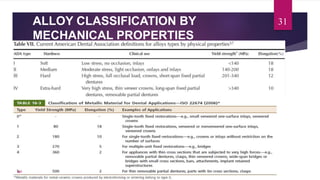
  • 103.
    Microstructure, elemental composition,hardness and crystal structure study of the interface between a noble implant component and cast noble alloys. The Journal of Prosthetic Dentistry. 2011;106(3):170-178.  Casting a high-gold alloy to a wrought prefabricated noble implant-component increases the cost of an implant. Selecting a less expensive noble alloy would decrease implant treatment costs.  The purpose of this study was to investigate the interfacial regions of a representative noble implant component and cast noble dental alloys and to evaluate the effects of porcelain firing cycles on the interface.  Six representative alloys gold-platinum-palladium (Aquarius XH), gold-platinum (Brite Gold XH), gold-palladium (IPS d.SIGN 91), palladium-silver (IPS d.SIGN 59), and palladium-silver- gold (Capricorn 15) systems and ANSI/ADA Type IV (non-ceramic) gold alloy were cast to gold implant abutments (ComOcta).  Less expensive reduced-gold and palladium alloy alternatives provided comparable results to high-gold alloys for joint quality. Consequently, such noble metal alternatives to high gold alloys for conventional partial fixed dental prostheses might provide clinically acceptable implant superstructures. 103 107
  • 104.
    The Release ofElements from the Base Metal Alloys in a Protein Containing Biologic Environments and Artificial Saliva – An Invitro Study JCDR. 2016;  This study aims to determine whether the solution in which an alloy is submerged and the exposure time have any effect on the amount of release of elements from the Ni-Cr and Co-Cr alloys.  A total of 126 specimens were made from the Ni-Cr alloy and 42 specimens were made from Co- Cr alloy. Dissolution experiments were carried out in Bovine Serum Albumin (BSA) and artificial saliva for a period of seven weeks and atomic absorption spectrophotometer was used for elemental analysis.  Results: The release of elements from the Ni-Cr alloy showed the predominant release of Cr.  Conclusion: The protein containing solution showed maximum release of elements from Ni-Cr and Co-Cr alloys. The elements that released from the alloys never reached their threshold for toxic effects. Hence these alloys can be safely used in fabrication of metal restorations without any ill effects 104 107
  • 105.
    Evaluation of effectof galvanic corrosion between nickel-chromium metal and titanium on ion release and cell toxicity. The Journal of Advanced Prosthodontics. 2015;7(2):172. .  The purpose of this study was to evaluate the metal ion release caused by electrochemical corrosion due to contact between metals and to assess the cell toxicity effect.  A prosthesis was made of a base metal on the titanium abutment using three types of Ni-Cr alloys with different components and compositions.  The amount of metal ions released was increased by galvanic corrosion in all of the groups in which Ni-Cr alloys were in contact with titanium.  Cytotoxicity was significantly increased in all of the groups in which Ni-Cr alloys were in contact with titanium as compared to that in the group in which Ni-Cr alloys were not in contact with titanium.  A large amount of ions were released and high cytotoxicity was observed in the Ni-Be alloy with a relatively low corrosion resistance. 105 107
  • 106.
    Effect of PFMFiring Cycles on the Mechanical Properties, Phase Composition, and Microstructure of Nickel-Chromium Alloy. Journal of Prosthodontics. 2015;24(8):634-641.  The purpose of this study was to compare the mechanical properties of beryllium-free nickel-chromium (Ni-Cr) dental casting alloy before and after each porcelain firing cycle (once fired, twice fired, and thrice fired) and to relate these properties to the microstructural changes and changes in X-ray diffraction patterns of Ni-Cr alloy that occur after each porcelain firing cycle. 106 107  Results showed that After each firing cycle, there was a significant (p < 0.001) decrease in ultimate strength , 0.1% yield strength, and hardness and significant (p < 0.001) increase in elongation value of Ni-Cr alloy. The microstructure of the control group specimen exhibited heterogeneous microstructure, and after each firing, microstructure of the alloy was gradually homogenized by formation of grain boundaries at the interdendritic interfaces.  Results of this study confirmed that nickel-based alloys become weaker after each firing process. After firing treatment, the microstructure of alloys showed decreased strength and hardness of Ni-Cr alloy.
  • 107.
     EACH ALLOYSYSTEM HAS ITS OWN PROS AND CONS AND IS DEVELOPED FOR A SPECIFIC APPLICATION IN DENTISTRY OVERCOMING THE DRAWBACKS OF ITS PREDECESSORS  A SOUND KNOWLEDGE OF THE PROPERTIES AND HANDLIING OF THE CASTING METALS AND ALLOYS IS ESSENTIAL TO ENSURE PROPER APPLICATION IN CLINICAL PRACTICE AND DIAGNOSIS OF FAILURES IN CASE THEY OCCUR. 107 107
  • 108.
    REFERENCES 1. Phillips' ScienceOf Dental Materials, 12th Edition Anusavice & Shen & Rawls 2. Craig’s Restorative Dental Materials / Edited By Ronald L. Sakaguchi, John M. Powers. -- 13th Ed. 3. Dental Materials And Their Selection - 3rd Ed. (2002) By William J. O'brien 4. Applied Dental Materials –Mccabbes And Walls- 9th Ed. 5. Science of Dental Materials- Clinical Application – V Shama Bhat & B.T Nandish 108 107
  • 109.
    CROSS REFERENCES  1.Taira Y, Nakashima J, Sawase T, Sakihara M. Wear of tooth enamel against silver–palladium–gold alloy and two other restorative materials in vitro. Journal of Prosthodontic Research. 2015;59(3):210- 212.  2. Bridgemana J, Marker V, Hummel S, Benson B, Pace L. Comparison of titanium and cobalt- chromium removable partial denture clasps. The Journal of Prosthetic Dentistry. 1997;78(2):187-193.  3. Jorge J, Barão V, Delben J, Faverani L, Queiroz T, Assunção W. Titanium in Dentistry: Historical Development, State of the Art and Future Perspectives. The Journal of Indian Prosthodontic Society. 2012;13(2):71-77.  4. Ucar Y, Brantley W, Johnston W, Iijima M, Han D, Dasgupta T. Microstructure, elemental composition, hardness and crystal structure study of the interface between a noble implant component and cast noble alloys. The Journal of Prosthetic Dentistry. 2011;106(3):170-178. 109 107
  • 110.
     5. McGinleyE, Moran G, Fleming G. Biocompatibility effects of indirect exposure of base- metal dental casting alloys to a human-derived three-dimensional oral mucosal model. Journal of Dentistry. 2013;41(11):1091-1100.  6. Pangi A. The Release of Elements from the Base Metal Alloys in a Protein Containing Biologic Environments and Artificial Saliva – An Invitro Study. JCDR. 2016;.  7. Andrei M, Galateanu B, Hudita A, Costache M, Osiceanu P, Calderon Moreno J et al. Electrochemical comparison and biological performance of a new CoCrNbMoZr alloy with commercial CoCrMo alloy. Materials Science and Engineering: C. 2016;59:346-355  8. Lee J, Song K, Ahn S, Choi J, Seo J, Park J. Evaluation of effect of galvanic corrosion between nickel-chromium metal and titanium on ion release and cell toxicity. The Journal of Advanced Prosthodontics. 2015;7(2):172. .  9. Anwar M, Tripathi A, Kar S, Sekhar K. Effect of PFM Firing Cycles on the Mechanical Properties, Phase Composition, and Microstructure of Nickel-Chromium Alloy. Journal of Prosthodontics. 2015;24(8):634-641. 110 107
  • 111.

Editor's Notes

  • #19 Coring forms a brittle structure
  • #20 Cast alloy is held at a temperature near its solidus to achieve the maximum amount of diffusion without melting Little or no grain growth occurs when a casting receives this type of heat treatment eg. Annealing done mainly for wrought alloys . Gold alloys are heat treated by softening (solution heat treat) or hardening (age hardening heat treat)
  • #21 The primary crystals of the hypoeutectic alloys in the Ag-Cu system of Figure 5-12 consist of the α solid solution, whereas those of the hypereutectic alloys consist of the β solid solution.
  • #23 and the two-phase (α-plus-β) region results from the limited solid solubility of less than approximately 12% Ag in Pt at 700 °C (point F) of silver in platinum. Figure 5-14 shows that the equilibrium solid solubility of Pt in Ag is approximately 56% at 700 °C. The eritectic transformation occurs at point P, where the liquid composition at B and the platinum-rich β phase (composition at point D) transform into the silver-rich α phase (composition at point P).
  • #24 Heat treatment can also be used to harden gold-copper alloys by a slightly different process. In this case, because the gold-copper system forms a complete solid solution at all compositions, the atoms can be interchanged on the lattice sites. However, as the atoms are cooled, the copper and gold atoms tend to separate on alternating planes of the lattice in ordered arrangement. This ordering makes dislocation motion more difficult, raising the yield stress. These alloys are soft if quenched but hard if cooled slowly on the bench top or held in the furnace at the ordering temperature range (350C for 30 minutes).
  • #42 A small grain size is desirable because it improves the mechanical properties and uniformity of properties within an alloy.
  • #64 CASTING SHRINKAGE – Less for gold alloys(1.25 – 1.65 %) than compared to base metal.
  • #70 50 microns alumina oxide and hydr
  • #71 The coefficient of thermal expansion by definition is the change in length per unit of original length of a material when its temperature is raised by 1o K Cote of ceramics by forming more leucite or by adding alkali like sodium and potassium
  • #74 Thione monomers has been proved effective for bonding noble metal alloys.
  • #98 ADA Sp.no.14
  • #105 in the form of 5mm diameter discs, 2mm in thickness.
  • #107 MATERIAL AND METHODS: Forty tensile bar specimens and 20 disc-shaped specimens of Ni-Cr alloy were prepared. These specimens were divided into four groups. The first group was not heat treated and tested in the as-cast condition, thus serving as control group. The second, third, and fourth groups were fired once, twice, and thrice, respectively. RESULTS: Before porcelain firing, the alloy exhibited higher ultimate tensile strength (548 MPa), 0.1% yield strength (327 MPa), hardness (192 HV), and lower elongation values (18%). decreased dendritic structure (i.e., homogenization, which was responsible for decrease in strength and an increase in ductility of the alloy); however,